COMPLEXOMETRIC
TITRATION
Mrs.Poonam Sunil Aher (M.Pharm, PhD)
Assistant Professor
Sanjivani College of Pharmaceutical Education and
Research (Autonomous),
Kopargaon, Ahmednagar-423603 (M.S.), INDIA
Mobile: +91-9689942854
Introduction
• Complexometric titration (sometimes chelatometry) is a form of volumetric analysis in
which the formation of a colored complex is used to indicate the end point of a titration.
• Complexometric titrations are particularly useful for the determination of a mixture of
different metal ions in solution. An indicator capable of producing an unambiguous color
change is usually used to detect the end-point of the titration. Complexometric titration
are those reactions where a simple ion is transformed into a complex ion and the
equivalence point is determined by using metal indicators or electrometrically.
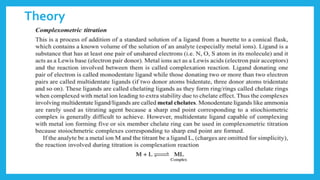
Theory
Theory
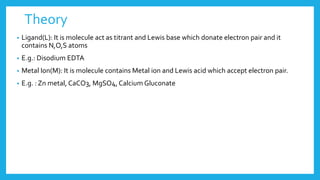
• Ligand(L): It is molecule act as titrant and Lewis base which donate electron pair and it
contains N,O,S atoms
• E.g.: Disodium EDTA
• Metal Ion(M): It is molecule contains Metal ion and Lewis acid which accept electron pair.
• E.g. : Zn metal, CaCO3, MgSO4, Calcium Gluconate
Types of Ligand
• A ligand is an ion or molecule, which donates a pair of electrons to the central metal atom or ion to form a
coordination complex. The word ligand is from Latin, which means “tie or bind”.
• Ligands can be anions, cations, and neutral molecules.

• Ligands act as Lewis bases (donate electron pairs) and central metal atoms viewed as Lewis acid (electron
pair acceptor).
• The nature of bonding between metal to ligand varies from covalent bond to ionic bond.
• Occasionally ligands can be cations (NO+, N2H5+) and electron-pair acceptors.
• Examples for anionic ligands are F–, Cl–, Br–, I–, S2
–, CN–, NCS–, OH–, NH2
– and neutral ligands are NH3,
H2O, NO, CO.
• A ligand is an ion or molecule, which binds to the central metal atom to form a coordination entity or complex
compounds.
• Classification of ligands is on the basis of the number of binding sites with the central metal atom, charge and
size.
Types of ligand
•1. Monodentate Ligand
•2.Bidentate Ligand
•3. Tridentate Ligands
•4.Tetradentate Ligand
•5.Polydentate Ligand
1. Monodentate Ligand
• Mono dentate Ligands
• Monodentate ligands are also called “one-toothed“ because they bite the metal atom only in one
place.
• Example: Cl-,Br-,F-,I-,H2O,NH3,CN-,OH-,Cyanide ion CN-,Thicyanate Ion SCN-
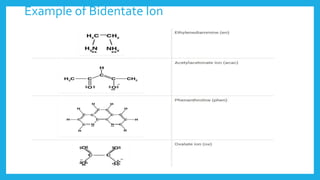
2. Bidentate Ion
• Bidentate Ligands
• Lewis base which donates two lone pairs of electrons to the central metal atom is known as
bidentate ligands. They are often referred to as a “chelating ligands”. The complex which
contains chelating ligands is called “Chelates”
Example of Bidentate Ion
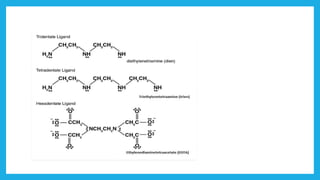
3.Tridentate ion and polydentate Ligands
• Tridentate Ligands and Polydentate Ligands
• Tridentate ligands have three lone pairs of electrons to the central metal atom or ion.
Molecules with four donor atoms are called tetradentate, five donor atoms are called
pentadentate and six donor atoms are called hexadentate. They are generally mentioned as
polydentate ligands.
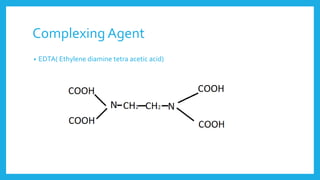
Complexing Agent
• EDTA( Ethylene diamine tetra acetic acid)
Complexometric Indicators
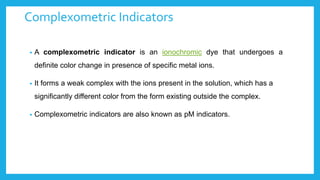
• A complexometric indicator is an ionochromic dye that undergoes a
definite color change in presence of specific metal ions.
• It forms a weak complex with the ions present in the solution, which has a
significantly different color from the form existing outside the complex.
• Complexometric indicators are also known as pM indicators.
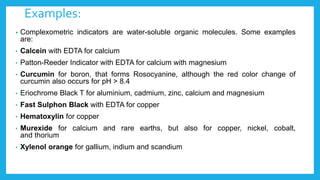
Examples:
• Complexometric indicators are water-soluble organic molecules. Some examples
are:
• Calcein with EDTA for calcium
• Patton-Reeder Indicator with EDTA for calcium with magnesium
• Curcumin for boron, that forms Rosocyanine, although the red color change of
curcumin also occurs for pH > 8.4
• Eriochrome Black T for aluminium, cadmium, zinc, calcium and magnesium
• Fast Sulphon Black with EDTA for copper
• Hematoxylin for copper
• Murexide for calcium and rare earths, but also for copper, nickel, cobalt,
and thorium
• Xylenol orange for gallium, indium and scandium
Preparation and Standardization of 0.05
M Disodium EDTA
• Preparation:
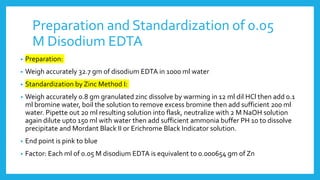
• Weigh accurately 32.7 gm of disodium EDTA in 1000 ml water
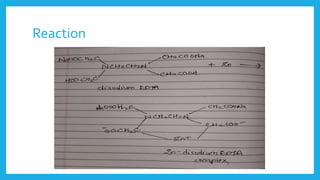
• Standardization by Zinc Method I:
• Weigh accurately 0.8 gm granulated zinc dissolve by warming in 12 ml dil HCl then add 0.1
ml bromine water, boil the solution to remove excess bromine then add sufficient 200 ml
water. Pipette out 20 ml resulting solution into flask, neutralize with 2 M NaOH solution
again dilute upto 150 ml with water then add sufficient ammonia buffer PH 10 to dissolve
precipitate and Mordant Black II or Erichrome Black Indicator solution.
• End point is pink to blue
• Factor: Each ml of 0.05 M disodium EDTA is equivalent to 0.000654 gm of Zn
Reaction
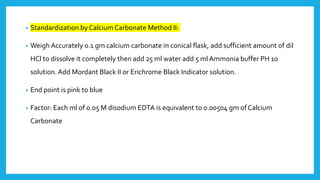
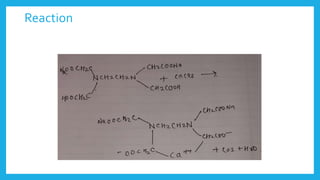
• Standardization by Calcium Carbonate Method II:
• Weigh Accurately 0.1 gm calcium carbonate in conical flask, add sufficient amount of dil
HCl to dissolve it completely then add 25 ml water add 5 ml Ammonia buffer PH 10
solution. Add Mordant Black II or Erichrome Black Indicator solution.
• End point is pink to blue
• Factor: Each ml of 0.05 M disodium EDTA is equivalent to 0.00504 gm of Calcium
Carbonate
Reaction
Application
• 1. Assay of Magnesium Sulphate
• 2. Assay of Calcium Gluconate
• 3. Assay of Aluminium Hydroxide Gel
1. Assay of Magnesium Sulphate
• Weigh Accurately 0.1 gm magnesium sulphate in conical flask, add sufficient amount of dil
HCl to dissolve it completely then add 25 ml water add 5 ml Ammonia buffer PH 10
solution. Add Mordant Black II or Erichrome Black Indicator solution.
• End point is pink to blue
• Factor: Each ml of 0.05 M disodium EDTA is equivalent to 0.00602 gm of Magnesium
Sulphate
2. Assay of Calcium Gluconate
• Weigh Accurately 0.1 gm sample in conical flask, add sufficient amount of dil HCl to dissolve
it completely then add 25 ml water add 5 ml Ammonia buffer PH 10 solution. Add Mordant
Black II or Erichrome Black Indicator solution.
• End point is pink to blue
• Factor: Each ml of 0.05 M disodium EDTA is equivalent to 0.44840 gm of Calcium Gluconate
Thank you

COMPLEXOMETRIC TITRATION OR CHEALATOMETRIC TITRATION

  • 1.
    COMPLEXOMETRIC TITRATION Mrs.Poonam Sunil Aher(M.Pharm, PhD) Assistant Professor Sanjivani College of Pharmaceutical Education and Research (Autonomous), Kopargaon, Ahmednagar-423603 (M.S.), INDIA Mobile: +91-9689942854
  • 2.
    Introduction • Complexometric titration(sometimes chelatometry) is a form of volumetric analysis in which the formation of a colored complex is used to indicate the end point of a titration. • Complexometric titrations are particularly useful for the determination of a mixture of different metal ions in solution. An indicator capable of producing an unambiguous color change is usually used to detect the end-point of the titration. Complexometric titration are those reactions where a simple ion is transformed into a complex ion and the equivalence point is determined by using metal indicators or electrometrically.
  • 3.
  • 4.
    Theory • Ligand(L): Itis molecule act as titrant and Lewis base which donate electron pair and it contains N,O,S atoms • E.g.: Disodium EDTA • Metal Ion(M): It is molecule contains Metal ion and Lewis acid which accept electron pair. • E.g. : Zn metal, CaCO3, MgSO4, Calcium Gluconate
  • 5.
    Types of Ligand •A ligand is an ion or molecule, which donates a pair of electrons to the central metal atom or ion to form a coordination complex. The word ligand is from Latin, which means “tie or bind”. • Ligands can be anions, cations, and neutral molecules. • Ligands act as Lewis bases (donate electron pairs) and central metal atoms viewed as Lewis acid (electron pair acceptor). • The nature of bonding between metal to ligand varies from covalent bond to ionic bond. • Occasionally ligands can be cations (NO+, N2H5+) and electron-pair acceptors. • Examples for anionic ligands are F–, Cl–, Br–, I–, S2 –, CN–, NCS–, OH–, NH2 – and neutral ligands are NH3, H2O, NO, CO. • A ligand is an ion or molecule, which binds to the central metal atom to form a coordination entity or complex compounds. • Classification of ligands is on the basis of the number of binding sites with the central metal atom, charge and size.
  • 6.
    Types of ligand •1.Monodentate Ligand •2.Bidentate Ligand •3. Tridentate Ligands •4.Tetradentate Ligand •5.Polydentate Ligand
  • 7.
    1. Monodentate Ligand •Mono dentate Ligands • Monodentate ligands are also called “one-toothed“ because they bite the metal atom only in one place. • Example: Cl-,Br-,F-,I-,H2O,NH3,CN-,OH-,Cyanide ion CN-,Thicyanate Ion SCN-
  • 8.
    2. Bidentate Ion •Bidentate Ligands • Lewis base which donates two lone pairs of electrons to the central metal atom is known as bidentate ligands. They are often referred to as a “chelating ligands”. The complex which contains chelating ligands is called “Chelates”
  • 9.
  • 10.
    3.Tridentate ion andpolydentate Ligands • Tridentate Ligands and Polydentate Ligands • Tridentate ligands have three lone pairs of electrons to the central metal atom or ion. Molecules with four donor atoms are called tetradentate, five donor atoms are called pentadentate and six donor atoms are called hexadentate. They are generally mentioned as polydentate ligands.
  • 12.
    Complexing Agent • EDTA(Ethylene diamine tetra acetic acid)
  • 23.
    Complexometric Indicators • Acomplexometric indicator is an ionochromic dye that undergoes a definite color change in presence of specific metal ions. • It forms a weak complex with the ions present in the solution, which has a significantly different color from the form existing outside the complex. • Complexometric indicators are also known as pM indicators.
  • 26.
    Examples: • Complexometric indicatorsare water-soluble organic molecules. Some examples are: • Calcein with EDTA for calcium • Patton-Reeder Indicator with EDTA for calcium with magnesium • Curcumin for boron, that forms Rosocyanine, although the red color change of curcumin also occurs for pH > 8.4 • Eriochrome Black T for aluminium, cadmium, zinc, calcium and magnesium • Fast Sulphon Black with EDTA for copper • Hematoxylin for copper • Murexide for calcium and rare earths, but also for copper, nickel, cobalt, and thorium • Xylenol orange for gallium, indium and scandium
  • 29.
    Preparation and Standardizationof 0.05 M Disodium EDTA • Preparation: • Weigh accurately 32.7 gm of disodium EDTA in 1000 ml water • Standardization by Zinc Method I: • Weigh accurately 0.8 gm granulated zinc dissolve by warming in 12 ml dil HCl then add 0.1 ml bromine water, boil the solution to remove excess bromine then add sufficient 200 ml water. Pipette out 20 ml resulting solution into flask, neutralize with 2 M NaOH solution again dilute upto 150 ml with water then add sufficient ammonia buffer PH 10 to dissolve precipitate and Mordant Black II or Erichrome Black Indicator solution. • End point is pink to blue • Factor: Each ml of 0.05 M disodium EDTA is equivalent to 0.000654 gm of Zn
  • 30.
  • 31.
    • Standardization byCalcium Carbonate Method II: • Weigh Accurately 0.1 gm calcium carbonate in conical flask, add sufficient amount of dil HCl to dissolve it completely then add 25 ml water add 5 ml Ammonia buffer PH 10 solution. Add Mordant Black II or Erichrome Black Indicator solution. • End point is pink to blue • Factor: Each ml of 0.05 M disodium EDTA is equivalent to 0.00504 gm of Calcium Carbonate
  • 32.
  • 33.
    Application • 1. Assayof Magnesium Sulphate • 2. Assay of Calcium Gluconate • 3. Assay of Aluminium Hydroxide Gel
  • 34.
    1. Assay ofMagnesium Sulphate • Weigh Accurately 0.1 gm magnesium sulphate in conical flask, add sufficient amount of dil HCl to dissolve it completely then add 25 ml water add 5 ml Ammonia buffer PH 10 solution. Add Mordant Black II or Erichrome Black Indicator solution. • End point is pink to blue • Factor: Each ml of 0.05 M disodium EDTA is equivalent to 0.00602 gm of Magnesium Sulphate
  • 35.
    2. Assay ofCalcium Gluconate • Weigh Accurately 0.1 gm sample in conical flask, add sufficient amount of dil HCl to dissolve it completely then add 25 ml water add 5 ml Ammonia buffer PH 10 solution. Add Mordant Black II or Erichrome Black Indicator solution. • End point is pink to blue • Factor: Each ml of 0.05 M disodium EDTA is equivalent to 0.44840 gm of Calcium Gluconate
  • 36.