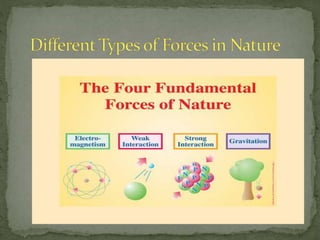
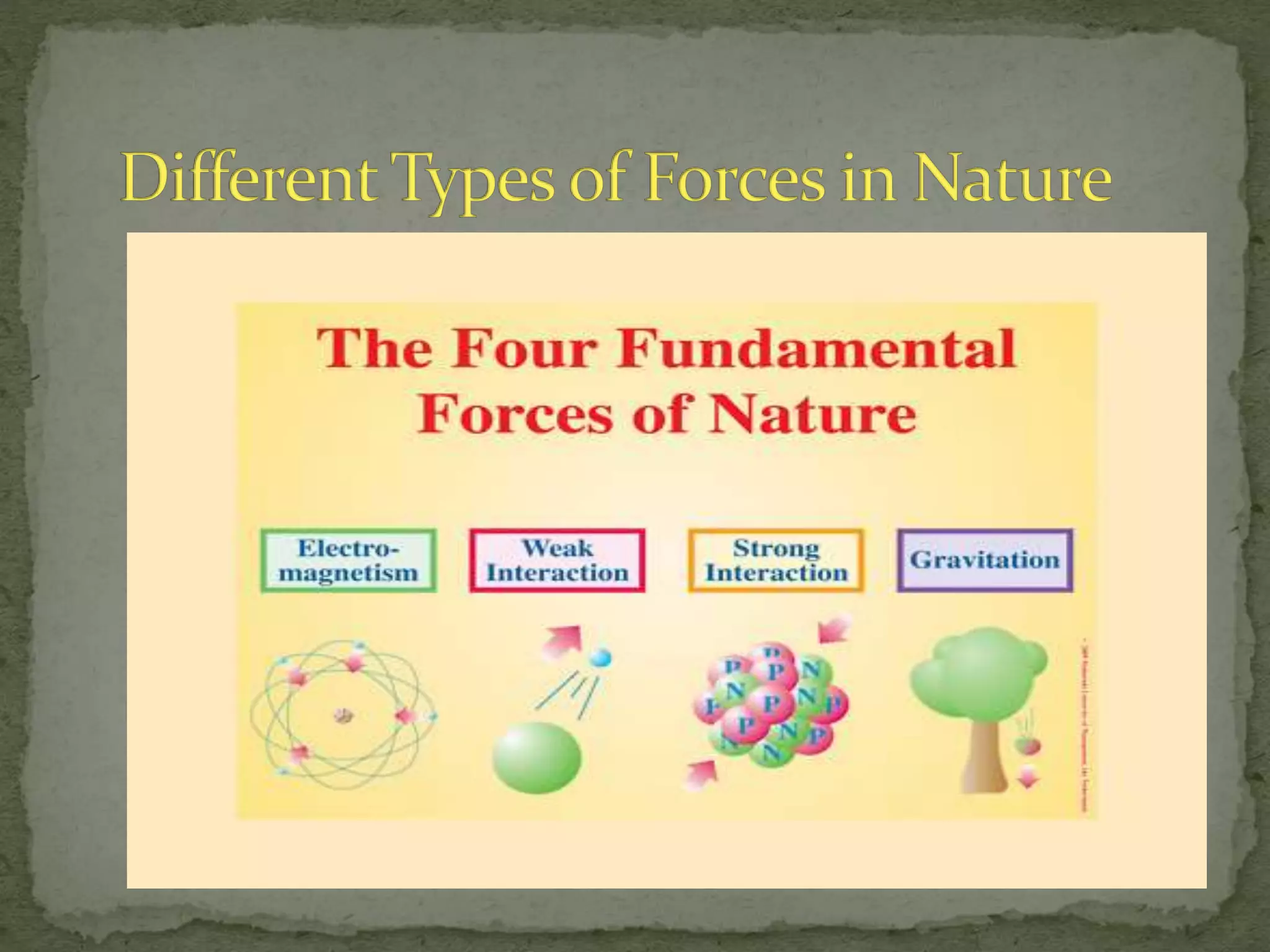
 GRAVITATIONAL FORCE : This is the force which is always
ATTRACTIVE. It acts between two masses. Each and every object
in this universe applies this force on all other objects, This is the
weakest force.
 . ELECTROMAGNETIC FORCE : When an electric charge is
moving, it produces magnetic force besides the electric force.
The combined effect of these two forces, is called the
electromagnetic force. It is stronger than gravitational force.
 WEAK NUCLEAR FORCE : This is the force which is responsible
for emission of beta particles from the nucleus. This force is
more powerful than the gravitational force but it is weaker than
the electromagnetic force.
 . STRONG FORCE : This is the strongest force in the nature. It
acts on any two nucleons (i.e. proton and neutron) in the
nucleus.
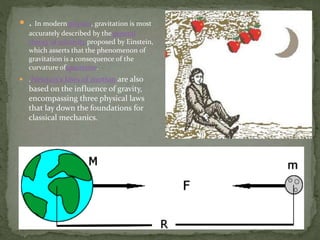
 Gravitation, or gravity, is a natural phenomenon by
which all physical bodiesattract each other. It is most
commonly recognized and experienced as the agent that
gives weight to physical objects and causes physical objects
to fall toward the ground when dropped from a height.
 It is hypothesized that the gravitational force is mediated
by a massless spin-2particle called the graviton.
 Gravity is one of the four fundamental forces of nature,
along with electromagnetism, and the nuclear strong
force and weak force.
 Colloquially, gravitation is a force of attraction that acts
between and on all physical objects with matter (mass) or
energy.
 . In modern physics, gravitation is most
accurately described by the general
theory of relativity proposed by Einstein,
which asserts that the phenomenon of
gravitation is a consequence of the
curvature ofspacetime.
 .Newton's laws of motion are also
based on the influence of gravity,
encompassing three physical laws
that lay down the foundations for
classical mechanics.
 Electromagnetism, or the electromagnetic force is one of the
four fundamental interactions in nature, the other three being
the strong interaction, the weak interaction, and gravitation.
 This force is described by electromagnetic fields, and has
innumerable physical instances including the interaction
of electrically chargedparticles and the interaction of uncharged
magnetic force fields with electrical conductors.
 The science of electromagnetic phenomena is defined in terms
of the electromagnetic force, sometimes called theLorentz force,
which includes both electricity and magnetism as elements of
one phenomenon.
 During the quark epoch, the electroweak force split into the
electromagnetic and weak force. The electromagnetic force plays
a major role in determining the internal properties of most
objects encountered in daily life.
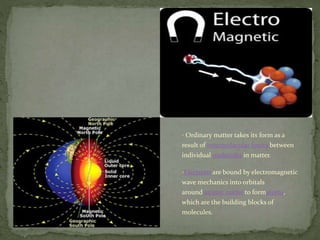
• Ordinary matter takes its form as a
result of intermolecular forces between
individual molecules in matter.
•Electrons are bound by electromagnetic
wave mechanics into orbitals
around atomic nuclei to formatoms,
which are the building blocks of
molecules.
 In particle physics, the weak interaction is the
mechanism responsible for theweak force or weak
nuclear force, one of the four fundamental interactionsof
nature, alongside the strong
interaction, electromagnetism, and gravitation.
 The weak interaction is responsible for both the radioactive
decay and nuclear fusion of subatomic particles.
 In the Standard Model of particle physics, the weak
interaction is caused by the emission or absorption of W
and Z bosons. All known fermions interact through the
weak interaction.
 The force is termed weak because its field strength over a
given distance is typically several orders of magnitude less
than that of the strong nuclear forceand electromagnetism.
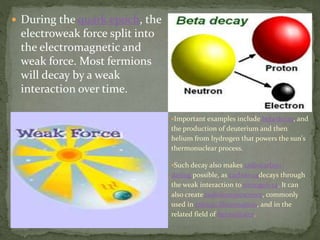
 During the quark epoch, the
electroweak force split into
the electromagnetic and
weak force. Most fermions
will decay by a weak
interaction over time.
Important examples include beta decay, and
the production of deuterium and then
helium from hydrogen that powers the sun's
thermonuclear process.
Such decay also makes radiocarbon
dating possible, as carbon-14decays through
the weak interaction to nitrogen-14. It can
also create radioluminescence, commonly
used in tritium illumination, and in the
related field of betavoltaics.
 In particle physics, the strong interaction is the mechanism
responsible for the the strong nuclear force, one of the
four fundamental interactions of nature, the others
being electromagnetism, the weak interaction and gravitation.
 Effective only at a distance of a femtometre, it is 137 times
stronger than electromagnetism, a million times stronger than
the weak force interaction and many orders of
magnitude stronger than gravitation.
 It ensures the stability of ordinary matter, in confining the
elementary particles quarks into hadrons such as
the proton and neutron, the largest components of the mass of
ordinary matter.
 In the context of binding protons and neutrons together to form
atoms, the strong interaction is called the nuclear force.
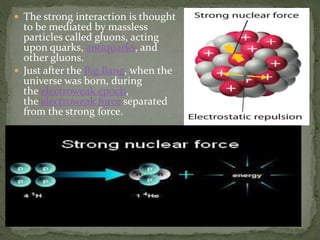
 The strong interaction is thought
to be mediated by massless
particles called gluons, acting
upon quarks, antiquarks, and
other gluons.
 Just after the Big Bang, when the
universe was born, during
the electroweak epoch,
the electroweak force separated
from the strong force.
Different forces of nature

Different forces of nature

  • 2.
     GRAVITATIONAL FORCE: This is the force which is always ATTRACTIVE. It acts between two masses. Each and every object in this universe applies this force on all other objects, This is the weakest force.  . ELECTROMAGNETIC FORCE : When an electric charge is moving, it produces magnetic force besides the electric force. The combined effect of these two forces, is called the electromagnetic force. It is stronger than gravitational force.  WEAK NUCLEAR FORCE : This is the force which is responsible for emission of beta particles from the nucleus. This force is more powerful than the gravitational force but it is weaker than the electromagnetic force.  . STRONG FORCE : This is the strongest force in the nature. It acts on any two nucleons (i.e. proton and neutron) in the nucleus.
  • 3.
     Gravitation, orgravity, is a natural phenomenon by which all physical bodiesattract each other. It is most commonly recognized and experienced as the agent that gives weight to physical objects and causes physical objects to fall toward the ground when dropped from a height.  It is hypothesized that the gravitational force is mediated by a massless spin-2particle called the graviton.  Gravity is one of the four fundamental forces of nature, along with electromagnetism, and the nuclear strong force and weak force.  Colloquially, gravitation is a force of attraction that acts between and on all physical objects with matter (mass) or energy.
  • 4.
     . Inmodern physics, gravitation is most accurately described by the general theory of relativity proposed by Einstein, which asserts that the phenomenon of gravitation is a consequence of the curvature ofspacetime.  .Newton's laws of motion are also based on the influence of gravity, encompassing three physical laws that lay down the foundations for classical mechanics.
  • 5.
     Electromagnetism, orthe electromagnetic force is one of the four fundamental interactions in nature, the other three being the strong interaction, the weak interaction, and gravitation.  This force is described by electromagnetic fields, and has innumerable physical instances including the interaction of electrically chargedparticles and the interaction of uncharged magnetic force fields with electrical conductors.  The science of electromagnetic phenomena is defined in terms of the electromagnetic force, sometimes called theLorentz force, which includes both electricity and magnetism as elements of one phenomenon.  During the quark epoch, the electroweak force split into the electromagnetic and weak force. The electromagnetic force plays a major role in determining the internal properties of most objects encountered in daily life.
  • 6.
    • Ordinary mattertakes its form as a result of intermolecular forces between individual molecules in matter. •Electrons are bound by electromagnetic wave mechanics into orbitals around atomic nuclei to formatoms, which are the building blocks of molecules.
  • 7.
     In particlephysics, the weak interaction is the mechanism responsible for theweak force or weak nuclear force, one of the four fundamental interactionsof nature, alongside the strong interaction, electromagnetism, and gravitation.  The weak interaction is responsible for both the radioactive decay and nuclear fusion of subatomic particles.  In the Standard Model of particle physics, the weak interaction is caused by the emission or absorption of W and Z bosons. All known fermions interact through the weak interaction.  The force is termed weak because its field strength over a given distance is typically several orders of magnitude less than that of the strong nuclear forceand electromagnetism.
  • 8.
     During thequark epoch, the electroweak force split into the electromagnetic and weak force. Most fermions will decay by a weak interaction over time. Important examples include beta decay, and the production of deuterium and then helium from hydrogen that powers the sun's thermonuclear process. Such decay also makes radiocarbon dating possible, as carbon-14decays through the weak interaction to nitrogen-14. It can also create radioluminescence, commonly used in tritium illumination, and in the related field of betavoltaics.
  • 9.
     In particlephysics, the strong interaction is the mechanism responsible for the the strong nuclear force, one of the four fundamental interactions of nature, the others being electromagnetism, the weak interaction and gravitation.  Effective only at a distance of a femtometre, it is 137 times stronger than electromagnetism, a million times stronger than the weak force interaction and many orders of magnitude stronger than gravitation.  It ensures the stability of ordinary matter, in confining the elementary particles quarks into hadrons such as the proton and neutron, the largest components of the mass of ordinary matter.  In the context of binding protons and neutrons together to form atoms, the strong interaction is called the nuclear force.
  • 10.
     The stronginteraction is thought to be mediated by massless particles called gluons, acting upon quarks, antiquarks, and other gluons.  Just after the Big Bang, when the universe was born, during the electroweak epoch, the electroweak force separated from the strong force.