By
Syed Mudassir Zaidi
Gravity.
Electromagnetism.
The strong force
The weak force.
 This was the first interaction known to
humans. First law of gravitation was
formulated in 1666 by Newton. The
gravitational force is mainly responsible for
keeping heavenly bodies like moon,
planets, stars, etc. In their orbits. This
force depends upon the masses of the two
objects and the distance between them. It
is always attractive and its range is infinite.
 GN is gravitational constant=6.66×10⁻¹¹ Nm2/kg2
 This interaction is universal,
every particle, is subject to the
gravitational force. The carrier of
gravitational interactions is
supposed to be a graviton. The
mass of graviton is zero and
thus it travels with velocity
which is equal to that of
the light.This interaction is
extremely small for elementary
particles, and hence is usually
neglected.
 The theory of electromagnetism
was formulated on the great
experimental works, started with
appearance of Coulomb law of
electrostatics in 1776. Later
due to the works of Faraday
and Maxwell, a proper field
theory of electromagnetic
forces was finalized around 1860.
Electromagnetic Theory covers the
basic principles of electromagnetism:
electrostatics, magnetic fields of
steady currents, motional e.m.f. and
electromagnetic induction, Maxwell's
equations, propagation and radiation
of electromagnetic waves, electric
and magnetic properties of matter,
and conservation laws.
The electromagnetic interaction provides a
force between two charges, which is repulsive,
If thetwo charges are similar, and attractive, if
the charges are opposite. All the chemical and
biological reactions are basically controlled by
the electromagnetic interactions. This
interaction is also responsible for formation of
electron–positron pair from g-rays, and vice
versa.
This interaction also plays a role in nuclear
structure through the mutual repulsion
between protons.
It causes several electromagnetic decays like
decay of neutral pion into two photons.
 The characteristic interaction
time of electromagnetic
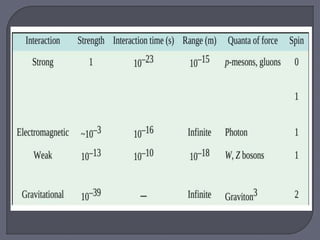
interactions is 10–16s. The
carrier of this interaction is
photon with rest mass zero
 Strong interactions hold several nucleons
together in a nucleus against the
electromagnetic repulsion of the protons.
Strong force is charge independent,
i.e. it is the same between p–p, n–n and
p–n. The range of the strong interactions
is about 10–15m and the interaction time is
about 10–23s. This is roughly the time
taken by light to travel across a proton. In
1935, Yukawa explained this force at nuclear
level through the exchange of particles
called pions.
The strength of electromagnetic
interactions is about a one thousandth
part (10–3) of the strong interactions.
Strong interactions are responsible for α-
decay, nuclear reactions, production of
hadrons
Strong interactions occur at the quark
level through exchange of gluons carrying
spin 1 and massless.
Weak interactions are unique in that they
do not form any bound system, and only
show through decay of the elementary
particles. For instance, weak interaction is
always responsible for all radioactive
decays in which β-particle (e– or e+) are
involved. The range of weak interactions is
very small 10–18 m, which is about 0.1% of
the diameter of a proton.
Basic Forces of Nature or Interactions

Basic Forces of Nature or Interactions

  • 1.
  • 2.
  • 3.
     This wasthe first interaction known to humans. First law of gravitation was formulated in 1666 by Newton. The gravitational force is mainly responsible for keeping heavenly bodies like moon, planets, stars, etc. In their orbits. This force depends upon the masses of the two objects and the distance between them. It is always attractive and its range is infinite.  GN is gravitational constant=6.66×10⁻¹¹ Nm2/kg2
  • 4.
     This interactionis universal, every particle, is subject to the gravitational force. The carrier of gravitational interactions is supposed to be a graviton. The mass of graviton is zero and thus it travels with velocity which is equal to that of the light.This interaction is extremely small for elementary particles, and hence is usually neglected.
  • 5.
     The theoryof electromagnetism was formulated on the great experimental works, started with appearance of Coulomb law of electrostatics in 1776. Later due to the works of Faraday and Maxwell, a proper field theory of electromagnetic forces was finalized around 1860.
  • 6.
    Electromagnetic Theory coversthe basic principles of electromagnetism: electrostatics, magnetic fields of steady currents, motional e.m.f. and electromagnetic induction, Maxwell's equations, propagation and radiation of electromagnetic waves, electric and magnetic properties of matter, and conservation laws.
  • 7.
    The electromagnetic interactionprovides a force between two charges, which is repulsive, If thetwo charges are similar, and attractive, if the charges are opposite. All the chemical and biological reactions are basically controlled by the electromagnetic interactions. This interaction is also responsible for formation of electron–positron pair from g-rays, and vice versa. This interaction also plays a role in nuclear structure through the mutual repulsion between protons. It causes several electromagnetic decays like decay of neutral pion into two photons.
  • 8.
     The characteristicinteraction time of electromagnetic interactions is 10–16s. The carrier of this interaction is photon with rest mass zero
  • 9.
     Strong interactionshold several nucleons together in a nucleus against the electromagnetic repulsion of the protons. Strong force is charge independent, i.e. it is the same between p–p, n–n and p–n. The range of the strong interactions is about 10–15m and the interaction time is about 10–23s. This is roughly the time taken by light to travel across a proton. In 1935, Yukawa explained this force at nuclear level through the exchange of particles called pions.
  • 10.
    The strength ofelectromagnetic interactions is about a one thousandth part (10–3) of the strong interactions. Strong interactions are responsible for α- decay, nuclear reactions, production of hadrons Strong interactions occur at the quark level through exchange of gluons carrying spin 1 and massless.
  • 11.
    Weak interactions areunique in that they do not form any bound system, and only show through decay of the elementary particles. For instance, weak interaction is always responsible for all radioactive decays in which β-particle (e– or e+) are involved. The range of weak interactions is very small 10–18 m, which is about 0.1% of the diameter of a proton.