UNIT I
CHAPTER 1
INTRODUCTION TO DATA MINING
Learning Objectives
1. Explain what data mining is and where it may be useful
2. List the steps that a data mining process often involves
3. Discuss why data mining has become important
4. Introduce briefly some of the data mining techniques
5. Develop a good understanding of the data mining software available on the market
6. Identify data mining web resources and a bibliography of data mining
1.1 WHAT IS DATA MINING?
Data mining or knowledge discovery in databases (KDD) is a collection of
exploration techniques based on advanced analytical methods and tools for handling a
large amount of information. The techniques can find novel patterns that may assist
an enterprise in understanding the business better and in forecasting.
Data mining is a collection of techniques for efficient automated discovery of previously
unknown, valid, novel, useful and understandable patterns in large databases. The
patterns must be actionable so that they may be used in a decision of an enterprise
making process.
Data mining is a complex process and may require a variety of steps before some useful
results are obtained. Often data pre-processing including data cleaning may be needed. In
some cases, sampling of data and testing of various hypotheses may be required before
data mining can start.
1.2 WHY DATA MINING NOW?
Data mining has found many applications in the last few years for a number of reasons.
1. Growth of OLAP data: The first database systems were implemented in the
1960’s and 1970’s. Many enterprises therefore have more than 30 years of
experience in using database systems and they have accumulated large amounts of
data during that time.
2. Growth of data due to cards: The growing use of credit cards and loyalty cards
is an important area of data growth. In the USA, there has been a tremendous
growth in the use of loyalty cards. Even in Australia, the use of cards like
FlyBuys has grown considerably.
Table 1.1 shows the total number of VISA and Mastercard credit cards in the top
ten card holding countries.
Table 1.1 Top ten card holding countries
Rank Country Cards (millions) Population (millions) Cards per
capita
1 USA 755 293 2.6
2 China 177 1294 0.14
3 Brazil 148 184 0.80
4 UK 126 60 2.1
5 Japan 121 127 0.95
6 Germany 109 83 1.31
7 South Korea 95 47 2.02
8 Taiwan 60 22 2.72
9 Spain 56 39 1.44
10 Canada 51 31 1.65
Total Top Ten 1700 2180 0.78
Total Global 2362 6443 0.43
3. Growth in data due to the web: E-commerce developments have resulted in
information about visitors to Web sites being captures, once again resulting in
mountains of data for some companies.
4. Growth in data due to other sources: There are many other sources of data.
Some of them are:
Telephone Transactions
Frequent flyer transactions
Medical transactions
Immigration and customs transactions
Banking transactions
Motor vehicle transactions
Utilities (e.g electricity and gas) transactions
Shopping transactions
5. Growth in data storage capacity:
Another way of illustrating data growth is to consider annual disk storage sales over
the last few years.
6. Decline in the cost of processing
The cost of computing hardware has declined rapidly the last 30 years coupled with
the increase in hardware performance. Not only do the prices for processors continue
to decline, but also the prices for computer peripherals have also been declining.
7. Competitive environment
Owning to increased globalization of trade, the business environment in most
countries has become very competitive. For example, in many countries the
telecommunications industry used to be a state monopoly but it has mostly been
privatized now, leading to intense competition in this industry. Businesses have to
work harder to find new customers and to retain old ones.
8. Availability of software
A number of companies have developed useful data mining software in the last few
years. Companies that were already operating in the statistics software market and were
familiar with statistical algorithms, some of which are now used in data mining, have
developed some of the software.
1.3 THE DATA MINING PROCESS
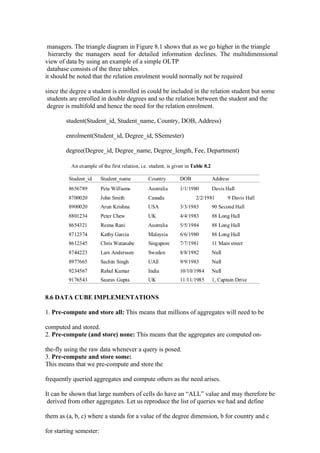
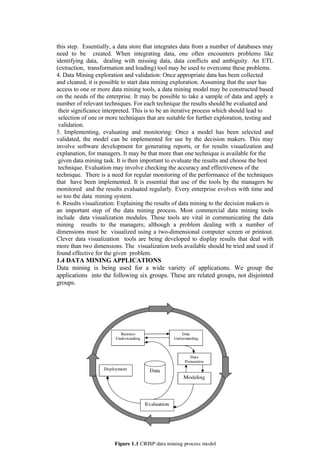
The data mining process involves much hard work, including building a data
warehouse. The data mining process includes the following steps:
1. Requirement analysis: the enterprise decision makers need to formulate goals that the
data mining process is expected to achieve. The business problem must be clearly
defined. One cannot use data mining without a good idea of what kind of outcomes the
enterprise is looking for, since the technique is to be used and the data is required.
2. Data Selection and collection: this step includes finding the best source the databases
for the data that is required. If the enterprise has implemented a data warehouse, then
most of the data could be available there. If the data is not available in the warehouse or
the enterprise does not have a warehouse, the source OnLine Transaction processing
(OLTP) systems need to be identified and the required information extracted and stored
in some temporary system.
3. Cleaning and preparing data: This may not be an onerous task if a data warehouse
containing the required data exists, since most of this must have already been done
when data was loaded in the warehouse. Otherwise this task can be very resource
intensive and sometimes more than 50% of effort in a data mining project is spent on
this step. Essentially, a data store that integrates data from a number of databases may
need to be created. When integrating data, one often encounters problems like
identifying data, dealing with missing data, data conflicts and ambiguity. An ETL
(extraction, transformation and loading) tool may be used to overcome these problems.
4. Data Mining exploration and validation: Once appropriate data has been collected
and cleaned, it is possible to start data mining exploration. Assuming that the user has
access to one or more data mining tools, a data mining model may be constructed based
on the needs of the enterprise. It may be possible to take a sample of data and apply a
number of relevant techniques. For each technique the results should be evaluated and
their significance interpreted. This is to be an iterative process which should lead to
selection of one or more techniques that are suitable for further exploration, testing and
validation.
5. Implementing, evaluating and monitoring: Once a model has been selected and
validated, the model can be implemented for use by the decision makers. This may
involve software development for generating reports, or for results visualization and
explanation, for managers. It may be that more than one technique is available for the
given data mining task. It is then important to evaluate the results and choose the best
technique. Evaluation may involve checking the accuracy and effectiveness of the
technique. There is a need for regular monitoring of the performance of the techniques
that have been implemented. It is essential that use of the tools by the managers be
monitored and the results evaluated regularly. Every enterprise evolves with time and
so too the data mining system.
6. Results visualization: Explaining the results of data mining to the decision makers is
an important step of the data mining process. Most commercial data mining tools
include data visualization modules. These tools are vital in communicating the data
mining results to the managers; although a problem dealing with a number of
dimensions must be visualized using a two-dimensional computer screen or printout.
Clever data visualization tools are being developed to display results that deal with
more than two dimensions. The visualization tools available should be tried and used if
found effective for the given problem.
1.4 DATA MINING APPLICATIONS
Data mining is being used for a wide variety of applications. We group the
applications into the following six groups. These are related groups, not disjointed
groups.
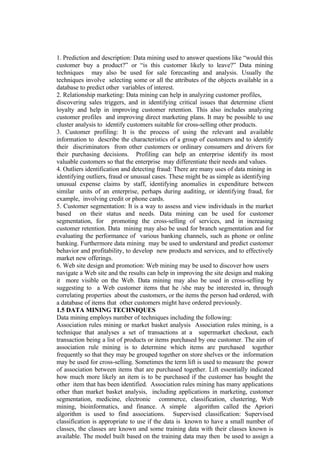
1. Prediction and description: Data mining used to answer questions like “would this
customer buy a product?” or “is this customer likely to leave?” Data mining
techniques may also be used for sale forecasting and analysis. Usually the
techniques involve selecting some or all the attributes of the objects available in a
database to predict other variables of interest.
2. Relationship marketing: Data mining can help in analyzing customer profiles,
discovering sales triggers, and in identifying critical issues that determine client
loyalty and help in improving customer retention. This also includes analyzing
customer profiles and improving direct marketing plans. It may be possible to use
cluster analysis to identify customers suitable for cross-selling other products.
3. Customer profiling: It is the process of using the relevant and available
information to describe the characteristics of a group of customers and to identify
their discriminators from other customers or ordinary consumers and drivers for
their purchasing decisions. Profiling can help an enterprise identify its most
valuable customers so that the enterprise may differentiate their needs and values.
4. Outliers identification and detecting fraud: There are many uses of data mining in
identifying outliers, fraud or unusual cases. These might be as simple as identifying
unusual expense claims by staff, identifying anomalies in expenditure between
similar units of an enterprise, perhaps during auditing, or identifying fraud, for
example, involving credit or phone cards.
5. Customer segmentation: It is a way to assess and view individuals in the market
based on their status and needs. Data mining can be used for customer
segmentation, for promoting the cross-selling of services, and in increasing
customer retention. Data mining may also be used for branch segmentation and for
evaluating the performance of various banking channels, such as phone or online
banking. Furthermore data mining may be used to understand and predict customer
behavior and profitability, to develop new products and services, and to effectively
market new offerings.
6. Web site design and promotion: Web mining may be used to discover how users
navigate a Web site and the results can help in improving the site design and making
it more visible on the Web. Data mining may also be used in cross-selling by
suggesting to a Web customer items that he /she may be interested in, through
correlating properties about the customers, or the items the person had ordered, with
a database of items that other customers might have ordered previously.
1.5 DATA MINING TECHNIQUES
Data mining employs number of techniques including the following:
Association rules mining or market basket analysis Association rules mining, is a
technique that analyses a set of transactions at a supermarket checkout, each
transaction being a list of products or items purchased by one customer. The aim of
association rule mining is to determine which items are purchased together
frequently so that they may be grouped together on store shelves or the information
may be used for cross-selling. Sometimes the term lift is used to measure the power
of association between items that are purchased together. Lift essentially indicated
how much more likely an item is to be purchased if the customer has bought the
other item that has been identified. Association rules mining has many applications
other than market basket analysis, including applications in marketing, customer
segmentation, medicine, electronic commerce, classification, clustering, Web
mining, bioinformatics, and finance. A simple algorithm called the Apriori
algorithm is used to find associations. Supervised classification: Supervised
classification is appropriate to use if the data is known to have a small number of
classes, the classes are known and some training data with their classes known is
available. The model built based on the training data may then be used to assign a
new object to a predefined class. Supervised classification can be used in predicting
the class to which an object or individual is likely to belong. This is useful, for
example, in predicting whether an individual is likely to respond to a direct mail
solicitation, in identifying a good candidate for a surgical procedure, or in
identifying a good risk for granting a loan or insurance. One of the most widely
used supervised classification techniques is decision tree. The decision tree
technique is widely used because it generates easily understandable rules for
classifying data.Cluster analysis Cluster analysis or clustering is similar to
classification but, in contrast to supervised classification, cluster analysis is useful
when the classes in the data are not already known and the training data is not
available. The aim of cluster analysis is to find groups that are very different from
each other in a collection of data. Cluster analysis breaks up a single collection of
diverse data into a number of groups. Often these techniques require that the user
specifies how many groups are expected. One of the most widely used cluster
analysis methods is called the K-means algorithm, which requires that the user
specified not only the number of clusters but also their starting seeds. The algorithm
assigns each object in the given data to the closet seed which provides the initial
clusters.
Web data mining
The last decade has witnessed the Web revolution which has ushered a new
information retrieval age. The revolution has had a profound impact on the way we
search and find information at home and at work. Searching the web has become an
everyday experience for millions of people from all over the world (some estimates
suggest over 500 million users). From its beginning in the early 1990s, the web had
grown to more than four billion pages in 2004, and perhaps would grow to more
than eight billion pages by the end of 2006. Search engines The search engine
databases of Web pages are built and updated automatically by Web crawlers.
When one searches the Web using one of the search engines, one is not searching
the entire Web. Instead one is only searching the database that has been compiled
by search engine.
Data warehousing and OLAP
Data warehousing is a process by which an enterprise collects data from the
whole enterprise to build a single version of the truth. This information is useful for
decision makers and may also be used for data mining. A data warehouse can be of
real help indata mining since data cleaning and other problems of collecting data
would have already been overcome. OLAP tools are decision support tools that are
often built on the top of a data warehouse or another database (called a
multidimensional database).
1.6 DATA MINING CASE STUDIES
There are number of case studies from a variety of data mining applications.
Aviation – Wipro’s Frequent Flyer Program Wipro has reported a study of frequent
flyer data from an Indian airline. Before carrying out data mining, the data was
selected and prepared. It was decided to use only the three most common sectors
flown by each customer and the three most common sectors when points are
reduced by each customer. It was discovered that much of the data supplied by the
airline was incomplete or inaccurate. Also it was found that the customer data
captured by the company could have been more complete. For example, the airline
did not know customer’s martial status or their income or their reasons for taking a
journey.
Astronomy
Astronomers produce huge amounts of data every night on the fluctuating intensity
of around 20 millions stars which are classified by their spectra and their surface
temperature.
dwarf, and white dwarf.
Banking and Finance
Banking and finance is a rapidly changing competitive industry. The industry is
using data mining for a variety of tasks including building customer profiles to
better understand the customers, to identify fraud, to evaluate risks in personal and
home loans, and to better forecast stock prices, interest rates, exchange rates and
commodity prices.
Climate
A study has been reported on atmospheric and oceanic parameters that cause
drought in the state of Nebraska in USA. Many variables were considered including
the following.
1. Standardized precipitation index (SPI)
2. Palmer drought severity index (PDSI)
3. Southern oscillation index (SOI)
4. Multivariate ENSO (El Nino Southern Oscillation) index (MEI)
5. Pacific / North American index (PNA)
6. North Atlantic oscillation index (NAO)
7. Pacific decadal oscillation index (PDO)
As a result of the study, it was concluded that SOI, MEI and PDO rather than SPI
and PDSI have relatively stronger relationships with drought episodes over selected
stations in Nebraska.
Crime Prevention
A number of case studies have been published about the use of data mining
techniques in analyzing crime data. In one particular study, the data mining
techniques were used to link serious sexual crimes to other crimes that might have
been committed by the same offenders.
Direct Mail Service
In this case study, a direct mail company held a list of a large number of potential
customers. The response rate of the company had been only 1%, which the company
wanted to improve
Healthcare
Healthcare. It has been found, for example, that in drug testing, data mining may
assist in isolating those patients where the drug is most effective or where the drug
is having unintended side effects. Data mining has been used in determining
1.7 FUTURE OF DATA MINING
The use of data mining in business is growing as data mining techniques move from
research algorithms to business applications and as storage prices continue to
decline and enterprise data continues to grow, data mining is still not being used
widely. Thus, there is considerable potential for data mining to continue to grow.
Other techniques that are to receive more attention in the future are text and
web-content mining, bioinformatics, and multimedia data mining. The issues related
to information privacy and data mining will continue to attract serious concern in the
community in the future. In particular, privacy concerns related to use of data
mining tec hniques by governments, in particular the US Government, in fighting
terrorism are likely to grow.1.8 GUIDELINES FOR SUCCESSFUL DATA
MINING Every data mining project is different but the projects do have some
common features. Following are some basic requirements for successful data
mining project.
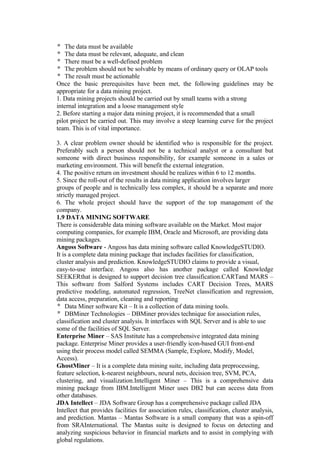
The data must be available
The data must be relevant, adequate, and clean
There must be a well-defined problem
The problem should not be solvable by means of ordinary query or OLAP tools
The result must be actionable
Once the basic prerequisites have been met, the following guidelines may be
appropriate for a data mining project.
1. Data mining projects should be carried out by small teams with a strong
internal integration and a loose management style
2. Before starting a major data mining project, it is recommended that a small
pilot project be carried out. This may involve a steep learning curve for the project
team. This is of vital importance.
3. A clear problem owner should be identified who is responsible for the project.
Preferably such a person should not be a technical analyst or a consultant but
someone with direct business responsibility, for example someone in a sales or
marketing environment. This will benefit the external integration.
4. The positive return on investment should be realizes within 6 to 12 months.
5. Since the roll-out of the results in data mining application involves larger
groups of people and is technically less complex, it should be a separate and more
strictly managed project.
6. The whole project should have the support of the top management of the
company.
1.9 DATA MINING SOFTWARE
There is considerable data mining software available on the Market. Most major
computing companies, for example IBM, Oracle and Microsoft, are providing data
mining packages.
Angoss Software - Angoss has data mining software called KnowledgeSTUDIO.
It is a complete data mining package that includes facilities for classification,
cluster analysis and prediction. KnowledgeSTUDIO claims to provide a visual,
easy-to-use interface. Angoss also has another package called Knowledge
SEEKERthat is designed to support decision tree classification.CARTand MARS –
This software from Salford Systems includes CART Decision Trees, MARS
predictive modeling, automated regression, TreeNet classification and regression,
data access, preparation, cleaning and reporting
Data Miner software Kit – It is a collection of data mining tools.
DBMiner Technologies – DBMiner provides technique for association rules,
classification and cluster analysis. It interfaces with SQL Server and is able to use
some of the facilities of SQL Server.
Enterprise Miner – SAS Institute has a comprehensive integrated data mining
package. Enterprise Miner provides a user-friendly icon-based GUI front-end
using their process model called SEMMA (Sample, Explore, Modify, Model,
Access).
GhostMiner – It is a complete data mining suite, including data preprocessing,
feature selection, k-nearest neighbours, neural nets, decision tree, SVM, PCA,
clustering, and visualization.Intelligent Miner – This is a comprehensive data
mining package from IBM.Intelligent Miner uses DB2 but can access data from
other databases.
JDA Intellect – JDA Software Group has a comprehensive package called JDA
Intellect that provides facilities for association rules, classification, cluster analysis,
and prediction. Mantas – Mantas Software is a small company that was a spin-off
from SRAInternational. The Mantas suite is designed to focus on detecting and
analyzing suspicious behavior in financial markets and to assist in complying with
global regulations.
CHAPTER 2
ASSOCIATION RULES MINING
2.1 INTRODUCTION
A huge amount data is stored electronically in most enterprises. In particular, in all
retail outlets the amount of data stored has grown enormously due to bar coding of
all goods sold. As an extreme example presented earlier, Wall-Mart, with more than
4000 stores, collects about 20 million point-of-sale transaction data each day.
Analyzing a large database of supermarket transactions with the aim of finding
association rule is called association rules mining or market basket analysis. It
involves searching for interesting customer habits by looking at associations.
Association rules mining has many applications other than market basket analysis,
including applications in marketing, customer segmentation, medicine, electronic
commerce, classification, clustering, web mining, bioinformatics and finance.
2.2 BASICS
Let us first describe the association rule task, and also define some of the terminology
by using an example of a small shop. We assume that the shop sells:
Bread,Juice,,Biscuits,Cheese,Milk,Newspaper,Coffee,Tea,Sugar
We assume that the shopkeeper keeps records of what each customer purchases. Such
records of ten customers are given in Table 2.1. Each row in the table gives the set of
items that one customer bought.The shopkeeper wants to find which products (call
them items) are sold together frequently. If for example, sugar and tea are the two items
that are sold together frequently then the shopkeeper might consider having a sale on
one of them in the hope that it will not only increase the sale that item but also increase
the sale of the other. Association rule are written as X Y meaning that whenever X
appears Y also tends to appear. X and Y may be single items or sets of items (in which
the same item does not appear in both sets). X is referred to as the antecedent of the
rule and Y as the
consequent.X Y is a probabilistic relationship found empirically. It indicates only
that X and Y have been found together frequently in the given data and does not show a
causal relationship implying that buying of X by a customer causes him/her to buy Y.
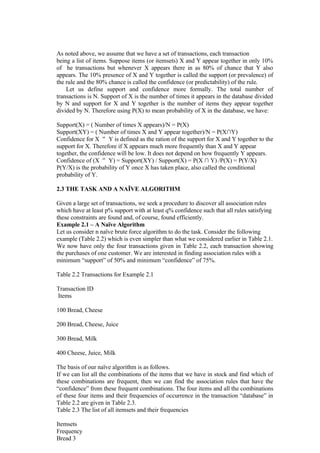
As noted above, we assume that we have a set of transactions, each transaction
being a list of items. Suppose items (or itemsets) X and Y appear together in only 10%
of he transactions but whenever X appears there in as 80% of chance that Y also
appears. The 10% presence of X and Y together is called the support (or prevalence) of
the rule and the 80% chance is called the confidence (or predictability) of the rule.
Let us define support and confidence more formally. The total number of
transactions is N. Support of X is the number of times it appears in the database divided
by N and support for X and Y together is the number of items they appear together
divided by N. Therefore using P(X) to mean probability of X in the database, we have:
Support(X) = ( Number of times X appears)/N = P(X)
Support(XY) = ( Number of times X and Y appear together)/N = P(X∩Y)
Confidence for X Y is defined as the ration of the support for X and Y together to the
support for X. Therefore if X appears much more frequently than X and Y appear
together, the confidence will be low. It does not depend on how frequently Y appears.
Confidence of (X Y) = Support(XY) / Support(X) = P(X ∩ Y) /P(X) = P(Y/X)
P(Y/X) is the probability of Y once X has taken place, also called the conditional
probability of Y.
2.3 THE TASK AND A NAÏVE ALGORITHM
Given a large set of transactions, we seek a procedure to discover all association rules
which have at least p% support with at least q% confidence such that all rules satisfying
these constraints are found and, of course, found efficiently.
Example 2.1 – A Naïve Algorithm
Let us consider n naïve brute force algorithm to do the task. Consider the following
example (Table 2.2) which is even simpler than what we considered earlier in Table 2.1.
We now have only the four transactions given in Table 2.2, each transaction showing
the purchases of one customer. We are interested in finding association rules with a
minimum “support” of 50% and minimum “confidence” of 75%.
Table 2.2 Transactions for Example 2.1
Transaction ID
Items
100 Bread, Cheese
200 Bread, Cheese, Juice
300 Bread, Milk
400 Cheese, Juice, Milk
The basis of our naïve algorithm is as follows.
If we can list all the combinations of the items that we have in stock and find which of
these combinations are frequent, then we can find the association rules that have the
“confidence” from these frequent combinations. The four items and all the combinations
of these four items and their frequencies of occurrence in the transaction “database” in
Table 2.2 are given in Table 2.3.
Table 2.3 The list of all itemsets and their frequencies
Itemsets
Frequency
Bread 3
Cheese 3
Juice 2
Milk 2
(Bread, Cheese) 2
(Bread, Juice) 1
(Bread, Milk) 1
(Cheese, Juice) 2
(Cheese, Milk) 1
(Juice, Milk) 1
(Bread, Cheese, Juice) 1
(Bread, Cheese, Milk) 0
(Bread, Juice, Milk) 0
(Cheese, Juice, Milk) 1
(Bread, Cheese, Juice, Milk) 0
Given the required minimum support of 50%, we find the itemsets that occur in at least
two transactions. Such itemsets are called frequent. The list of frequencies shows that all
four items Bread, Cheese, Juice and Milk are frequent. The frequency goes down as we
look at 2-itemsets, 3-itemsets and 4-itemsets.
The frequent itemsets are given in Table 2.4
Table 2.4 The set of all frequent itemsets
Itemsets
Frequency
Bread 3
Cheese 3
Juice 2
Milk 2
Bread, Cheese 2
Cheese, Juice 2
We can now proceed to determine if the two 2-itemsets (Bread, Cheese) and (Cheese,
Juice lead to association rules with required confidence of 75%. Every 2-itemset (A, B)
can lead to two rules A B and B A if both satisfy the required confidence. As 
defined earlier, confidence of A B is given by the support for A and B together
divided by the support for A. We therefore have four possible rules and their confidence
as follows:
Bread Cheese with confidence of 2/3 = 67%
Cheese Bread with confidence of 2/3 = 67%
Cheese Juice with confidence of 2/3 = 67%
Juice Cheese with confidence of 100%
Therefore only the last rule Juice Cheese has confidence above the minimum 75%
required and qualifies. Rules that have more than the user-specified minimum
confidence are called confident.
2.4 THE APRIORI ALGORITHM
The basic algorithm for finding the association rules was first proposed in 1993. In
1994, an improved algorithm was proposed. Our discussion is based on the 1994
algorithm called the Apriori algorithm. This algorithm may be considered to consist of
two parts. In the first part, those itemsets that exceed the minimum support requirement
are found. Asnoted earlier, such itemsets are called frequent itemsets. In the second part,
the association rules that meet the minimum confidence requirement are found from the
frequent itemsets. The second part is relatively straightforward, so much of the focus of
the research in this field has been to improve the first part. First Part – Frequent
Itemsets The first part of the algorithm itself may be divided into two steps (Steps 2 and
3 below). The first step essentially finds itemsets that are likely to be frequent or
candidates for frequent itemsets. The second step finds a subset of these candidate
itemsets that are actually frequent. The algorithm works given below are a given set of
transactions (it is assumed that we require minimum support of p%):
Step 1: Scan all transactions and find all frequent items that have support above p%. Let
these frequent items be L1.
Step 2: Build potential sets of k items from Lk-1 by using pairs of itemsets in Lk-1 such
that each pair has the first k-2 items in common. Now the k-2 common items and the
one remaining item from each of the two itemsets are combined to form a k-itemset.
The set of such potentially frequent k itemsets is the candidate set Ck. (For k=2, build
the potential frequent pairs by using the frequent item set L1 so that every item in L1
appears with every other item in L1. The set so generated is the candidate set C2). This
step is called Apriori-gen.
Step 3: Scan all transactions and find all k-itemsets in Ck that are frequent. The frequent
set so obtained is Lk. (For k=2, C2 is the set of candidate pairs. The frequent pairs are
L2.) Terminate when no further frequent itemsets are found, otherwise continue with
Step 2. Terminate when no further frequent itemsets are found, otherwise continue with
Step 2.The main notation for association rule mining that is used in the Apriori
algorithm is the following:
A k-itemset is a set of k items.
The set Ck is a set of candidate k-itemsets that are potentially frequent.
The set Lk is a subset of Ck and is the set of k-itemsets that are frequent.
It is now worthwhile to discuss the algorithmic aspects of the Apriori algorithm. Some
of the issues that need to be considered are:
1. Computing L1: We scan the disk-resident database only once to obtain L1. An item
vector of length n with count for each item stored in the main memory may be used.
Once the scan of the database is finished and the count for each item found, the items
that meet the support criterion can be identified and L1 determined.
2. Apriori-gen function: This is step 2 of the Apriori algorithm. It takes an argument
Lk-1 and returns a set of all candidate k-itemsets. In computing C3 from L2, we
organize L2 so that the itemsets are stored in their lexicographic order. Observe that if
an itemset in C3 is (a, b, c) then L2 must have items (a, b) and (a,c) since all subsets of
C3 must be frequent. Therefore to find C3 we only need to look at pairs in L2 that have
the same first item. Once we find two such matching pairs in L2, they are combined to
form a candidate itemset in C3. Similarly when forming Ci from Li-1, we sort the
itemsets in Li-1 and look for a pair of itemsets in Li-1 that have the same first i-2 items.
If we find such a pair, we can combine them to produce a candidate itemset for Ci.
3. Pruning: Once a candidate set Ci has been produced, we can prune some of the
candidate itemsets by checking that all subsets of every itemset in the set are frequent.
For example, if we have derived a, b, c from a, b and a, c, then we check that b, c is
also in L2. If it is not a, b,c may be removed from C3. The task of such pruning
becomes harder as the number of items in the itemsets grows, but the number of large
itemsets tends to be small.
4. Apriori subset function: To improve the efficiency of searching, the candidate
itemsets Ck are stored in a hash tree. The leaves of the hash tree store itemsets while
the internal nodes provide a roadmap to reach the leaves. Each leaf node is reached by
traversing the tree whose root is at depth 1. Each internal node of depth d points to all
the related nodes atdepth d+1 and the branch to be taken is determined by applying a
hash function on the dth item. All nodes are initially created as leaf nodes and when
the number of itemsets in leaf nodes exceeds a specified threshold, he leaf node is
converted to an internal node. . Transactions storage: We assume the data is too large to
be stored in the main memory. Should it be stored as a set of transactions, each
transaction being a sequence of item numbers? Alternatively, should each transaction
be stored as a Boolean vector of length n (n being the number of items in the store) with
1s showing for the items purchased?
6. Computing L2 (and more generally Lk): Assuming that C2 is available in the main
memory, each candidate pair needs to be tested to find if the pair is frequent. Given that
C2 is likely to be large, this testing must be done efficiently. In one scan, each
transaction can be checked for the candidate pairs.
Second Part – Finding the Rules
To find the association rules from the frequent itemsets, we take a large frequent
itemset, say p, and find each nonempty subset a. The rule a (p-a) is possible if it
satisfies the confidence. Confidence of this rule is given by support (p) / support(a).
It should be noted that when considering rules like a (p-a), it is possible to make the
rule generation process more efficient as follows. We only want rules that have the
minimum confidence required. Since confidence is given by support(p)/support(a), it is
cleat that if for some a, the rule a (p-a) does not have minimum confidence then all
rules like b (p-b), where b is a subset of a, will also not have the confidence since
support(b) cannot be smaller than support(a).
Another way to improve rule generation is to consider rules like (p-a) a. If this rule
has the minimum confidence then all rules (p-b) b will also have minimum
confidence if b is a subset of a since (p-b) has more items than (p-a, given that b is
smaller than a and so cannot have support higher than that of (p-a). As an example, if
A BCD has the minimum confidence then all rules like AB CD, AC BD and  
ABC D will also have the minimum confidence. Once again this can be used in
improving the efficiency of rule generation. Implementation Issue – Transaction
Storage Representation of the transactions.
To illustrate the different options, let the number of items be six. Let there be {A, B, C,
D, E, F}. Let there be only eight transactions with transactions IDs (10, 20, 30, 40, 50,
60, 70, 80}. This set of eight transactions with six items can be represented in at least
three different ways as follows. The first representation (Table 2.7) is the most obvious
horizontal one. Each row in the table provides the transaction ID and the items that
were purchased.
2.5 IMPROVING THE EFFICIENCY OF THE APRIORI ALGORITHM
The Apriori algorithm is resource intensive for large sets of transactions that have a
large set of frequent items. The major reasons for this may be summarized as follows:
1. the number of candidate items sets grows quickly and can result in huge candidate
sets. For example, the size of the candidate sets, in particular C2, is crucial to the
performance of the Apriori algorithm. The larger the candidate set, the higher the
processing cost for scanning the transaction database to find the frequent item sets.
Given that the early sets of candidate itemsets are very large, the initial iteration
dominates the cost.
2. the Apriori algorithm requires many scans of the database. If n is the length of the
longest itemset, then (n+1) scans are required
3. many trivial rules (eg. Buying milk with Tic Tacs) are derived and it can often be
difficult to extract the most interesting rules from all the rules derived. For example, one
may wish to remove all the rules involving very frequent sold items.
4. some rules can be in explicable and very fine grained, for example, toothbrush was
the most frequently sold item on Thursday mornings
5. redundant rules are generated. For example, if A → B is a rule then any rule AC →
B is redundant. A number of approaches have been suggested to avoid generating
redundant rules.
6. the Apriori algorithm assumes sparseness since the number of items in each
transaction is small compared with the total number of items. The algorithm works
better with sparsity. Some applications produce dense data which may also have many
frequently occurring items. A number of techniques for improving the performance of
the Apriori algorithm have been suggested. They can be classified into 4 categories.
Reduce the number of candidate itemsets. For example, use pruning to reduce the
number of candidate 3- itemsets and, if necessary, larger itemsets.
Reduce the number of transactions. This may involve scanning the transaction data
after L1 has been computer and deleting all the transactions that do not have atleast two
frequent items. More transaction reduction may be done if the frequent 2-itemset L2 is
small.
Reduce the number of comparisons. There may be no need to compare every
candidate against every transaction if we use an appropriate data structure.
Generate candidate sets efficiently. For example, it may be possible to compute Ck
and from it compute Ck+1 rather than wait for Lk to be available. One could search for
both k- itemsets and (k+1)- itemsets in one pass.We now discuss a number of
algorithms that use one or more of the above approaches to improve the Apriori
Algorithm. The last method, the Frequent Pattern Growth, does not generate candidate
itemsets and is not based on the Apriori algorithm.
1. Apriori-TID
2. Direct Hashing and Pruning (DHP)
3. Dynamic Itemset Counting (DIC)
4. Frequent Pattern Growth
2.6 APRIORI-TID
The Apriori-TID algorithm is outline below:
1. The entire transaction database is scanned to obtain T1 in terms of itemsets (i.e. each
entry of T1 contains all items in the transaction along with the corresponding TID)
2. Frequent 1-itemset L1 is calculated with the help of T1
3. C2 is obtained by applying the Apriori-gen function
4. The support for the candidates in C2 is then calculated by using T1
5. Entries in T2 are then calculated.
6. L2 is then generated from C2 the usual means and then C3 can be generated from L2.
7. T3 is then generated with the help of T2 and C3. This process is repeated until the set
of candidate k-itemsets is an empty set.
Example 2.3 – Apriori-TID
We consider the transactions in Example 2.2 again. As a first step, T1 is generated by
scanning the database. It is assumed throughout the algorithm that the itemsets in each
transaction are stored in lexicographical order. T1 is essentially the same as the whole
database, the only difference being that each of the itemsets in a transaction is
represented as a set of one item.
Step 1
First scan the entire database and obtain T1 by treating each item as a 1-itemset. This is
given in Table 2.12. Table 2.12 The transaction database T1
Transaction ID
Items
100 Bread cheese Eggs Juice
200 Bread cheese Juice
300 Bread Milk Yogurt
400 Bread Juice Milk
500 Cheese Juice Milk
Steps 2 and 3
The next step is to generate L1. This is generated with the help of T1. C2 calculated as
previously in the Apriori algorithm. See Table 2.13.
Table 2.13 The sets L1 and C2
L1
Itemset
C2
Support
{Bread} 4
{Cheese} 3
{Juice} 4
{Milk} 3
Itemset
{B, C}
{B, J}
{B, M}
{C, J}
{C, M}
{J, M}In Table 2.13, we have used single letters B(Bread), C(Cheese), J(Juice) and
M(Milk) for C2.
Step 4
The support for itemsets in C2 is now calculated with the help of T1, instead of
scanning the actual database as in the Apriori algorithm and the result is shown in
Table 2.14. Table 2.14 Frequency of itemsets in C2
Itemset Frequency
{B, C} 2
{B, J} 3
{B, M} 2
{C, J} 3
{C, M} 1
{J, M} 2
Step 5
We now find T2 by using C2 and T1 as shown in Table 2.15. Table 2.15 Transaction
database T2
TID Set-of-Itemsets
100 {{B, C}, {B, J}, {C, J}}
200 {{B, C}, {B, J}, {C, J}}
300 {{B, M}}
400 {{B, J}, {B, M}, {J, M}}
500 {{C, J}, {C, M}, {J, M}}
{B, J}and {C, J} are the frequent pairs and they make up L2. C3 may now be generated
but we find that C3 is empty. If it was not empty we would have used it to find T3 with
the help of the transaction set T2. That would result in a smaller T2. This is the end of
this simple example. The generation of association rules from the derived frequent set
can be done in the usual way. The main advantage of the Apriori-TID algorithm is that
the size of Tk is usually smaller than smaller, than the entry in the corresponding
transaction for larger k
values. Since the support for each candidate k-itemset is counted with the help of the
corresponding Tk, the algorithm is often faster than the basic Apriori algorithm.
It should be noted that both Apriori and Apriori-TID use the same candidate
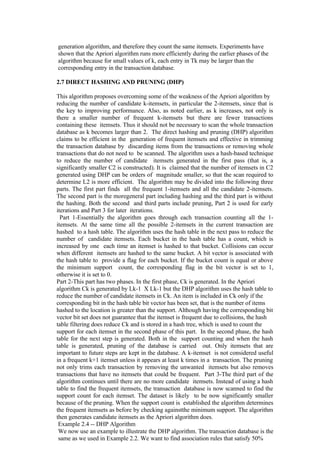
generation algorithm, and therefore they count the same itemsets. Experiments have
shown that the Apriori algorithm runs more efficiently during the earlier phases of the
algorithm because for small values of k, each entry in Tk may be larger than the
corresponding entry in the transaction database.
2.7 DIRECT HASHING AND PRUNING (DHP)
This algorithm proposes overcoming some of the weakness of the Apriori algorithm by
reducing the number of candidate k-itemsets, in particular the 2-itemsets, since that is
the key to improving performance. Also, as noted earlier, as k increases, not only is
there a smaller number of frequent k-itemsets but there are fewer transactions
containing these itemsets. Thus it should not be necessary to scan the whole transaction
database as k becomes larger than 2. The direct hashing and pruning (DHP) algorithm
claims to be efficient in the generation of frequent itemsets and effective in trimming
the transaction database by discarding items from the transactions or removing whole
transactions that do not need to be scanned. The algorithm uses a hash-based technique
to reduce the number of candidate itemsets generated in the first pass (that is, a
significantly smaller C2 is constructed). It is claimed that the number of itemsets in C2
generated using DHP can be orders of magnitude smaller, so that the scan required to
determine L2 is more efficient. The algorithm may be divided into the following three
parts. The first part finds all the frequent 1-itemsets and all the candidate 2-itemsets.
The second part is the moregeneral part including hashing and the third part is without
the hashing. Both the second and third parts include pruning, Part 2 is used for early
iterations and Part 3 for later iterations.
Part 1-Essentially the algorithm goes through each transaction counting all the 1-
itemsets. At the same time all the possible 2-itemsets in the current transaction are
hashed to a hash table. The algorithm uses the hash table in the next pass to reduce the
number of candidate itemsets. Each bucket in the hash table has a count, which is
increased by one each time an itemset is hashed to that bucket. Collisions can occur
when different itemsets are hashed to the same bucket. A bit vector is associated with
the hash table to provide a flag for each bucket. If the bucket count is equal or above
the minimum support count, the corresponding flag in the bit vector is set to 1,
otherwise it is set to 0.
Part 2-This part has two phases. In the first phase, Ck is generated. In the Apriori
algorithm Ck is generated by Lk-1 X Lk-1 but the DHP algorithm uses the hash table to
reduce the number of candidate itemsets in Ck. An item is included in Ck only if the
corresponding bit in the hash table bit vector has been set, that is the number of items
hashed to the location is greater than the support. Although having the corresponding bit
vector bit set does not guarantee that the itemset is frequent due to collisions, the hash
table filtering does reduce Ck and is stored in a hash tree, which is used to count the
support for each itemset in the second phase of this part. In the second phase, the hash
table for the next step is generated. Both in the support counting and when the hash
table is generated, pruning of the database is carried out. Only itemsets that are
important to future steps are kept in the database. A k-itemset is not considered useful
in a frequent k+1 itemset unless it appears at least k times in a transaction. The pruning
not only trims each transaction by removing the unwanted itemsets but also removes
transactions that have no itemsets that could be frequent. Part 3-The third part of the
algorithm continues until there are no more candidate itemsets. Instead of using a hash
table to find the frequent itemsets, the transaction database is now scanned to find the
support count for each itemset. The dataset is likely to be now significantly smaller
because of the pruning. When the support count is established the algorithm determines
the frequent itemsets as before by checking againstthe minimum support. The algorithm
then generates candidate itemsets as the Apriori algorithm does.
Example 2.4 -- DHP Algorithm
We now use an example to illustrate the DHP algorithm. The transaction database is the
same as we used in Example 2.2. We want to find association rules that satisfy 50%
support and 75% confidence. Table 2.31 presents the transaction database and Table
2.16 presents the possible 2-itemsets for each transaction.
Table 2.16 Transaction database for Example 2.4
Transaction ID
Items
100 Bread, cheese, Eggs, Juice
200 Bread, cheese, Juice
300 Bread, Milk, Yogurt
400 Bread, Juice, Milk
500 Cheese, Juice, Milk
We will use letters B(Bread), C(Cheese), E(Egg), J(Juice), M(Milk) and Y(Yogurt) in
Tables 2.17 to 2.19. Table 2.17 Possible 2-itemsets
100 (B, C) (B, E) (B, J) (C, E) (C, J) (E, J)
200 (B, C) (B, J) (C, J)
300 (B, M) (B, Y) (M, Y)
400 (B, J) (B, M) (J, M)
500 (C, J) (C, M) (J, M)
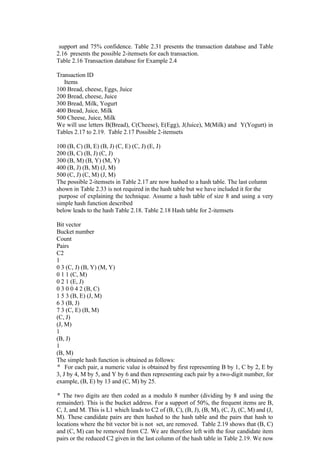
The possible 2-itemsets in Table 2.17 are now hashed to a hash table. The last column
shown in Table 2.33 is not required in the hash table but we have included it for the
purpose of explaining the technique. Assume a hash table of size 8 and using a very
simple hash function described
below leads to the hash Table 2.18. Table 2.18 Hash table for 2-itemsets
Bit vector
Bucket number
Count
Pairs
C2
1
0 3 (C, J) (B, Y) (M, Y)
0 1 1 (C, M)
0 2 1 (E, J)
0 3 0 0 4 2 (B, C)
1 5 3 (B, E) (J, M)
6 3 (B, J)
7 3 (C, E) (B, M)
(C, J)
(J, M)
1
(B, J)
1
(B, M)
The simple hash function is obtained as follows:
For each pair, a numeric value is obtained by first representing B by 1, C by 2, E by
3, J by 4, M by 5, and Y by 6 and then representing each pair by a two-digit number, for
example, (B, E) by 13 and (C, M) by 25.
The two digits are then coded as a modulo 8 number (dividing by 8 and using the
remainder). This is the bucket address. For a support of 50%, the frequent items are B,
C, J, and M. This is L1 which leads to C2 of (B, C), (B, J), (B, M), (C, J), (C, M) and (J,
M). These candidate pairs are then hashed to the hash table and the pairs that hash to
locations where the bit vector bit is not set, are removed. Table 2.19 shows that (B, C)
and (C, M) can be removed from C2. We are therefore left with the four candidate item
pairs or the reduced C2 given in the last column of the hash table in Table 2.19. We now
look at the transaction database and modify it to include only these candidate pairs
(Table 2.19). Table 2.19 Transaction database with candidate 2-item sets
100 (B, J) (C, J)
200 (B, J) (C, J)
300 (B, M)
400 (B, J) (B, M)
500 (C, J) (J, M)
It is now necessary to count support for each pair and while doing it we further trim the
database by removing items and deleting transactions that will not appear in frequent 3-
itemsets. The frequent pairs are (B, J) and (C, J). The candidate 3-itemsets must have
two pairs with the first item being the same. Only transaction 400 qualifies since it has
candidate pairs (B, J) and (B, M). Others can therefore be deleted and the transaction
database now looks like Table 2.20.Table 2.20 Reduced transaction database 400 (B, J,
M) In this simple example we can now conclude that (B, J, M) is the only potential
frequent 3-itemset but it cannot qualify since transaction 400 does not have the pair (J,
M) and the pairs (J, M) and (B, M) are not frequent pairs. That concludes this example.
2.8 DYNAMIC ITEMSET COUNTING (DIC)
The Apriori algorithm must do as many scans of the transaction database as the number
of items in the last candidate itemset that was checked for its support. The Dynamic
Item set Counting (DIC) algorithm reduces the number of scans required by not just
doing one scan for the frequent 1-itemset and another for the frequent 2-itemset but
combining the counting for a number of itemsets as soon as it appears that it might be
necessary to count it.
The basic algorithm is as follows:
1. Divide the transaction database into a number of, say q, partitions.
2. Start counting the 1-itemsets in the first partition of the transaction database.
3. At the beginning of the second partition, continue counting the 1-itemsets but also
start counting the 2-itemsets using the frequent 1-itemsets from the first partition.
4. At the beginning of the third partition, continue counting the 1-itemsets and the 2-
itemsets but also start counting the 3-itemsets using results from the first two partitions.
5. Continue like this until the whole database has been scanned once. We now have the
final set of frequent 1-itemsets.
6. Go back to the beginning of the transaction database and continue counting the 2-
itemsets and the 3-itemsets.
7. At the end of the first partition in the second scan of the database, we have scanned
the whole database for 2-itemsets and thus have the final set of frequent 2-itemsets.
8. Continue the process in a similar way until no frequent k-itemsets are found.The DIC
algorithm works well when the data is relatively homogeneous
throughout the file since it starts the 2-itemsetcount before having a final 1-itemset
count. If the data distribution is not homogeneous, the algorithm may not identify an
itemset to be large until most of the database has been scanned. In such cases it may be
possible to randomize the transaction data although this is not always possible.
Essentially, DIC attempts to finish the itemset counting in two scans of the database
while Apriori would often take three or more scans.
2.9 MINING FREQUENT PATTERNS WITHOUT CANDIDATE
GENERATION
(FP-GROWTH)
The algorithm uses an approach that is different from that used by methods based on the
Apriori algorithm. The major difference between frequent pattern-growth (FP-growth)
and the other algorithms is that FP-growth does not generate the candidates, it only
tests. In contrast, the Apriori algorithm generates the candidate itemsets and then tests.
The motivation for the FP-tree method is as follows:
Only the frequent items are needed to find the association rules, so it is best to find
the frequent items and ignore the others.
If the frequent items can be stored in a compact structure, then the original
transaction database does not need to be used repeatedly.
If multiple transactions share a set of frequent items, it may be possible to merge the
shared sets with the number of occurrences registered as count. To be able to do this, the
algorithm involves generating a frequent pattern tree (FP-tree). Generating FP-trees
The algorithm works as follows:
1. Scan the transaction database once, as in the Apriori algorithm, to find all the
frequent items and their support.
2. Sort the frequent items in descending order of their support.
3. Initailly, start creating the FP-tree with a root “null”.
4. Get the firs transaction from the transaction database. Remove all non-frequent items
and list the remaining items according to the order in the sorted frequent items.
5. Use the transaction to construct the first branch of the three with each node
corresponding to a frequent item and showing that item’s frequency, which is 1 for the
first transaction.
6. Get the next transaction from the transaction database. Remove all non-frequent items
and list the remaining items according to the order in the sorted frequent items.
7. Insert the transaction in the tree using any common prefix that may appear. Increase
the item counts.
8. Continue with step 6 until all transactions in the database are processed.
Let us see one example.
The minimum support required is 50% and confidence is 75%. Table 2.21
Transaction database for Example 2.5
Transaction ID Items
100 Bread, Cheese, Eggs, Juice
200 Bread, Cheese, Juice
300 Bread, Milk, Yogurt
400 Bread, Juice, Milk
500 Cheese, Juice, Milk
The frequent items sorted by their frequency are shown in Table 2.22. Table 2.22 Item
Frequent items for database in Table 2.21
Frequency
Bread 4
Juice 4
Cheese 3
Milk 3
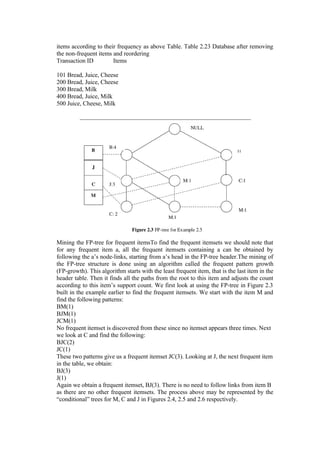
Now we remove the items that are not frequent from the transactions and order the
items according to their frequency as above Table. Table 2.23 Database after removing
the non-frequent items and reordering
Transaction ID Items
101 Bread, Juice, Cheese
200 Bread, Juice, Cheese
300 Bread, Milk
400 Bread, Juice, Milk
500 Juice, Cheese, Milk
Mining the FP-tree for frequent itemsTo find the frequent itemsets we should note that
for any frequent item a, all the frequent itemsets containing a can be obtained by
following the a’s node-links, starting from a’s head in the FP-tree header.The mining of
the FP-tree structure is done using an algorithm called the frequent pattern growth
(FP-growth). This algorithm starts with the least frequent item, that is the last item in the
header table. Then it finds all the paths from the root to this item and adjusts the count
according to this item’s support count. We first look at using the FP-tree in Figure 2.3
built in the example earlier to find the frequent itemsets. We start with the item M and
find the following patterns:
BM(1)
BJM(1)
JCM(1)
No frequent itemset is discovered from these since no itemset appears three times. Next
we look at C and find the following:
BJC(2)
JC(1)
These two patterns give us a frequent itemset JC(3). Looking at J, the next frequent item
in the table, we obtain:
BJ(3)
J(1)
Again we obtain a frequent itemset, BJ(3). There is no need to follow links from item B
as there are no other frequent itemsets. The process above may be represented by the
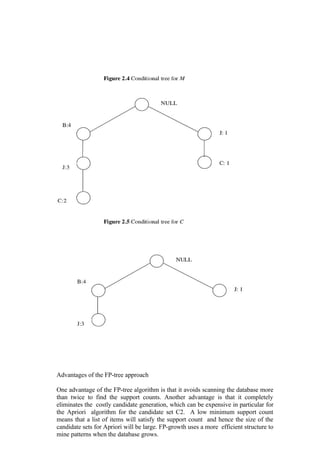
“conditional” trees for M, C and J in Figures 2.4, 2.5 and 2.6 respectively.
Advantages of the FP-tree approach
One advantage of the FP-tree algorithm is that it avoids scanning the database more
than twice to find the support counts. Another advantage is that it completely
eliminates the costly candidate generation, which can be expensive in particular for
the Apriori algorithm for the candidate set C2. A low minimum support count
means that a list of items will satisfy the support count and hence the size of the
candidate sets for Apriori will be large. FP-growth uses a more efficient structure to
mine patterns when the database grows.
2.10 PERFORMANCE EVALUATION OF ALGORITHMS
Performance evaluation has been carried out on a number of implementation of
different association mining algorithms. The study the compared the methods
including Apriori, CHARM and FP-growth using the real world data as well as
artificial data, it was concluded that:
1. The FP-growth method was usually better than the best implementation of the
Apriori algorithm.
2. CHARM was usually better than Apriori. In some cases, CHARM was better than
the FP-growth method.
3. Apriori was generally better than other algorithms if the support required was
high since high supports leads to a smaller number of frequent items which suits the
Apriori algorithm.
4. At very low support, the number of frequent items became large and none of the
algorithms were able to handle large frequent search gracefully. There were two
evaluations held in 2003 and November 2004. These evaluations have provided
many new and surprising insights into association rule mining. In the 2003
performance evaluation of programs, it was found that two algorithms were the best.
These were:
1. An efficient implementation of the FP-tree algorithm2. An algorithm that
combined a number of algorithms using multiple heuristics. The performance
evaluation also included algorithms for closed itemset mining as well as for
maximal itemset mining. The performance evaluation in 2004 found an
implementation of an algorithm that involves a tree traversal as the most
efficientalgorithm for finding frequent, frequent closed and maximal frequent
itemsets.
2.11 SOFTWARE FOR ASSOCIATION RULE MINING
Packages like Clementine and IBM Intelligent Miner include comprehensive
association rule mining software. We present some software designed for
association rules.
Apriori, FP-growth, Eclat and DIC implementation by Bart Goethals. The
algorithms generate all frequent itemsets for a given minimal support threshold and
for a given minimal confidence threshold (Free). For detailed particulars visit:
http://www.adrem.ua.ac.be/~goethals/software/index.html
ARMiner is a client-server data mining application specialized in finding
association rules. ARMiner has been written in Java and it is distributed under
theGNU General Public License. ARMiner was developed at UMass/Boston as a
Software Engineering project in Spring 2000. For a detailed study visit:
http://www.cs.umb.edu/~laur/ARMiner
ARtool has also been developed at UMass/Boston. It offers a collection of
algorithms and tools for the mining of association rules in binary databases. It is
distributed under the GNU General Public License
**********#########*************
UNIT II
CHAPTER 3
3.1 INTRODUCTION
Classification is a classical problem extensively studied by statisticians and
machine learning researchers. The word classification is difficult to define precisely.
According to one definition classification is the separation or ordering of objects (or
things) into classes. If the classes are created without looking at the data
(non-empirically), the classification is called apriori classification.
If however the classes are created empirically (by looking at the data), the
classification is called Posteriori classification. In most literature on classification it is
assumed that the classes have been deemed apriori and classification then consists of
training the system so that when a new object is presented to the trained system it is able
to assign the object to one of the existing classes.
This approach is also called supervised learning. Data mining has generated
renewed interest in classification. Since the datasets in data mining are often large, new
classification techniques have been developed to deal with millions of objects having
perhaps dozens or even hundreds of attributes.
3.2 DECISION TREE
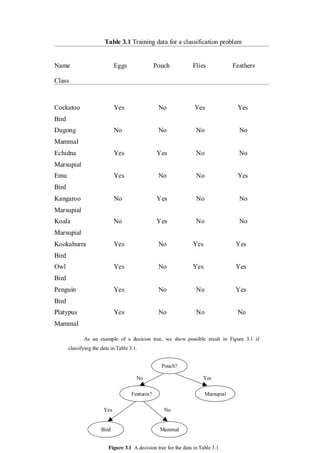
A decision tree is a popular classification method that results in a flow-chart like tree
structure where each node denotes a test on an attribute value and each branch represents
an outcome of the test. The tree leaves represent the classes.Let us imagine that we wish
to classify Australian animals. We have some training data in Table 3.1 which has
already been classified. We want to build a mode based on this data.
Table 3.1 Training data for a classification problem Name
3.3 BUILDING A DECISION TREE – THE TREE INDUCTION
ALGORITHM
The decision tree algorithm is a relatively simple top-down greedy algorithm. The
aim of the algorithm is to build a tree that has leaves that are as homogeneous as
possible. The major step of the algorithm is to continue to divide leaves that are not
homogeneous into leaves that are as homogeneous as possible until no further
division is possible. The decision tree algorithm is given below:
1. Let the set of training data be S. If some of the attributes are continuously-valued,
they should be discretized. For example, age values may be binned into the
following categories (under 18), (18-40), (41-65) and (over 65) and transformed
into A, B, C and D or more descriptive labels may be chosen. Once that is done,
put all of S in a single tree node.
2. If all instances in S are in the same class, then stop.
3. Split the next node by selection of an attribute A from amongst the independent
attributes that best divides or splits the objects in the node into subsets and create
a decision tree node.
4. Split the node according to the values of A.
5. Stop if either of the following conditions is met, otherwise continue with step 3.
(a) If this partition divides the data into subsets that belong to a single class
and no other node needs splitting.
(b) If there are no remaining attributes on which the sample may be further divided.
3.4 SPLIT ALGORITHM BASED ON INFORMATION THEORY
One of the techniques for selecting an attribute to split a node is based on the
concept of information theory or entropy. The concept is quite simple, although
often difficult to understand for many. It is based on Claude Shannon’s idea that if
you have uncertainty then you have information and if there is no uncertainty there
is no information. For example, if a coin has a head on both sides, then the result of
tossing it does not product any information but if a coin is normal with a head and a
tail then the result of the toss provides information.
Essentially, information is defined as –pilog pi where pi is the probability of some
event. Since the probability pi is always less than 1, log pi is always negative and
–pi log pi is always positive. For those who cannot recollect their high school
mathematics, we note that log of 1 is always zero whatever the base, the log of any
number greater than 1 is always positive and the log of any number smaller than 1
is always negative. Also,
log2(2) =1
log2(2n) = n
log2(1/2) = -1
log2(1/2n) = -n
Information of any event that is likely to have several possible outcomes is given by
I = ∑ i (-pi log pi ) Consider an event that can have one of two possible values. Let
the possibilities of the two values be p1 and p2. Obviously if p1 is 1 and p2 is zero,
then there is no information in the outcome and I=0. If p1=0.5, then the information
is I = -0.5 log(0.5) – 0.5 log(0.5) This comes out to 1.0 (using log base 2) is the
maximum information that you can have for an event with two possible outcomes.
This is also called entropy and is in effect a measure of the minimum number of bits
required to encode the information. If we consider the case of a die (singular of dice)
with six possible outcomes with equal probability, then the information is given by:
I = 6(-1/6) log(1/6)) = 2.585 Therefore three bits are required to represent the
outcome of rolling a die. Of course, if the die was loaded so that there was a 50% or
a 75% chance of getting a 6, then the information content of rolling the die would be
lower as given below. Note that we assume that the probability of getting any of 1
to 5 is equal (that is, equal to 10% for the 50% case and 5% for the 75% case).
50%: I = 5(-0.1) log(0.1)) – 0.5 log(0.5) = 2.16 75%: I = 5(-0.05) log(0.05)) – 0.75
log(0.75) = 1.39 Therefore we will need three bits to represent the outcome of
throwing a die that has 50% probability of throwing a six but only two bits when the
probability is 75%.
3.5 SPLIT ALGORITHM BASED ON THE GINI INDEX
Another commonly used split approach is called the Gini index which is used in the
widely used packages CART and IBM Intelligent Miner. Figure 3.3 shows the
Lorenz curve which is the basis of the Gini Index. The index is the ratio of the area
between the Lorenz curve and the 45-degree line to the area under 45-degree line.
The smaller the ratio, the less is the area between the two curves and the more
evenly distributed is the wealth. When wealth is evently distributed, asking any
person about his/her wealth provides no information at all since every person has the
same wealth while in a situation where wealth is very unevenly distributed finding
out how much wealth a person has provides information because of the uncertainty
of wealth distribution.
1. Attribute “Owns Home”
Value = Yes. There are five applicants who own their home. They are in classes
A=1, B=2, C=2. Value = No. There are five applicants who do not own their home.
They are in classes A=2, B=1, C=2. Using this attribute will divide objects into
those who own their home and those who do not. Computing the Gini index for each
of these two subtrees, G(y) = 1 -(1/5)2 – (2/5)2 – (2/5)2 = 0.64
G(n) = G(y) = 0.64 Total value of Gini Index = G = 0.5G(y) + 0.5G(n) = 0.64
2. Attribute “Married”There are five applicants who are married and five that are
not. Value = Yes has A = 0, B = 1, C = 4, total 5 Value = No has A = 3, B = 2, C =
0, total 5 Looking at the values above, it appears that this attribute will reduce the
uncertainty by more than the last attribute. Computing the information gain by using
this attribute, we have
G(y) = 1 -(1/5)2– (4/5)2 = 0.32
G(n) = 1 -(3/5)2 – (2/5)2 = 0.48
Total value of Gini Index = G = 0.5G(y) + 0.5G(n) = 0.40
3. Attribute “Gender” There are three applicants who are male and seven are female.
Value = Male has A = 0, B = 3, C = 0, total 3
Value = Female has A = 3, B = 0, C = 4, total 7
G(Male) = 1 -1 = 0
G(Female) = 1 - (3/7)2– (4/7)2 = 0.511
Total value of Gini Index = G = 0.3G(Male) + 0.7G(Female) = 0.358
4. Attribute “Employed”
There are eight applicants who are employed and two that are not.
Value = Yes has A = 3 B = 1, C = 4, total 8
Value = No has A = 0, B = 2, C = 0, total
G(y) = 1 - (3/8)2 – (1/8)2– (4/8)2 = 0.594
G(n) = 0 Total value of Gini Index = G = 0.8G(y) + 0.2G(n) = 0.475
5. Attribute “Credit Rating”
There are five applicants who have credit rating A and five that have B. Value = A has A
= 2, B = 1, C = 2, total 5Value = B has A = 1, B = 2, C = 2, total 5 G(A) = 1 - 2(2/5)2 –
(1/5)2 = 0.64 G(B) = G(A)
Total value of Gini Index = G = 0.5G(A) + 0.5G(B) = 0.64 Table 3.4 summarizes the
values of the Gini Index obtained for the following five attributes:
Owns Home Employed
Married Credit Rating
Gender
3.6 OVERFITTING AND PRUNING
The decision tree building algorithm given earlier continues until either all leaf nodes are
single class nodes or no more attributes are available for splitting a node that has objects
of more than one class. When the objects being classified have a large number of
attributes and a tree of maximum possible depth is built, the tree quality may not be high
since the tree is built to deal correctly with the training set. In fact, in order to do so, it
may become quite complex, with long and very uneven paths. Some branches of the tree
may reflect anomalies due to noise or outliers in the training samples. Such decision
trees are a result of overfitting the training data and may result in poor accuracy for
unseen samples. According to the Occam’s razor principle (due to the medieval
philosopher William of Occam) it is best to posit that the world is inherently simple and
to choose the simplest model from similar models since the simplest model is more
likely to be a better model. We can therefore “shave off” nodes and branches of a
decision tree, essentially replacing a whole subtree by a leaf node, if it can be established
that the expected error rate in the subtree is greater than that in the single leaf. This
makes the classifier simpler. A simpler model has less chance of introducing
inconsistencies, ambiguities and redundancies
3.7 DECISION TREE RULES
There are a number of advantages in converting a decision tree to rules. Decision
rules make it easier to make pruning decisions since it is easier to see the context of each
rule. Also, converting to rules removes the distinction between attribute tests that occur
near the roof of the tree and they are easier for people to understand.
IF-THEN rules may be derived based on the various paths from the root to the
leaf nodes. Although the simple approach will lead to as many rules as the leaf nodes,
rules can often be combined to produce a smaller set of rules. For example:
If Gender = “Male” then Class = B
If Gender = “Female” and Married = “Yes” then Class = C, else Class = A Once all the
rules have been generated, it may be possible to simplify the rules. Rules with only one
antecedent (e.g. if Gender=”Male” then Class=B) cannot be further simplified, so we
only consider those with two or more antecedents. It may be possible to eliminate
unnecessary rule antecedents that have no effect on the conclusion reached by the rule.
Some rules may be unnecessary and these may be removed. In some cases a number of
rules that lead to the same class may be combined.
3.8 NAÏVE BAYES METHOD
The Naïve Bayes method is based on the work of Thomas Bayes. Bayes was a British
minister and his theory was published only after his death. It is a mystery what Bayes
wanted to do with such calculations. Bayesian classification is quite different from the
decision tree approach. In Bayesian classification we have a hypothesis that the given
data belongs to a particular class. We then calculate the probability for the hypothesis to
be true. This is among the most practical approaches for certain types of problems. The
approach requires only one scan of the whole data. Also, if at some stage there are
additional training data then each training example can incrementally increase/decrease
the probability that a hypothesis is correct.
Now here is the Bayes theorem:
P(AB) = P(B|A)P(A)/P(B)
Once might wonder where did this theorem come from. Actually it is rather easyto
derive since we know the following:
P(A|B) = P(A & B)/P(B)
and
P(B|A) = P(A & B)/P(A)
Diving the first equation by the second gives us the Bayes’ theorem. Continuing with A
and B being courses, we can compute the conditional probabilities if we knew what the
probability of passing both courses was, that is P(A & B), and what the probabilities of
passing A and B separately were. If an event has already happened then we divide the
joint probability P(A & B) with the probability of what has just happened and obtain the
conditional probability.
3.9 ESTIMATING PREDICTIVE ACCURACY OF CLASSIFICATON
METHODS
1. Holdout Method: The holdout method (sometimes called the test sample method)
requires a training set and a test set. The sets are mutually exclusive. It may be that only
dataset is available which has been divided into two subsets (perhaps 2/3 and 1/3), the
training subset and the test or holdout subset.
2. Random Sub-sampling Method
Random sub-sampling is very much like the holdout method except that it does not rely
on a single text set. Essentially, the holdout estimation is repeated several times and
the accuracy estimate is obtained by computing the mean of the several trails. Random
sub-sampling is likely to produce better error estimates than those by the holdout
method.
3. k-fold Cross-validation MethodIn k-fold cross-validation, the available data is
randomly divided into k disjoint subsets of approximately equal size. One of the subsets
is then used as the test set and the emaining k-1 sets are used for building the classifier.
The test set is then used to estimate the accuracy. This is done repeatedly k times so that
each subset is used as a test subset once.
4. Leave-one-out Method: Leave-one-out is a simpler version of k-fold cross-validation.
In this method, one of the training samples is taken out and the model is generated using
the remaining training data.
5. Bootstrap Method: In this method, given a dataset of size n, a bootstrap sample is
randomly selected uniformly with replacement (that is, a sample may be selected more
than once) by sampling n times and used to build a model.
3.10 IMPROVING ACCURACY OF CLASSIFICATION METHODS
Bootstrapping, bagging and boosting are techniques for improving the accuracy of
classification results. They have been shown to be very successful for certain models, for
example, decision trees. All three involve combining several classification results from
the same training data that has been perturbed in some way. There is a lot of literature
available on bootstrapping, bagging, and boosting. This brief introduction only provides
a glimpse into these techniques but some of the points
made in the literature regarding the benefits of these methods are:
•These techniques can provide a level of accuracy that usually cannot be obtained by a
large single-tree model.
• Creating a single decision tree from a collection of trees in bagging and boosting is not
difficult.
•These methods can often help in avoiding the problem of over fitting since anumber of
trees based on random samples are used.
• Boosting appears to be on the average better than bagging although it is not always so.
On some problems bagging does better than boosting.
3.11 OTHER EVALUATION CRITERIA FOR CLASSIFICATION METHODS
The criteria for evaluation of classification methods are as follows:
1. Speed
2. Robustness
3. Scalability
4. Interpretability
5. Goodness of the model
6. Flexibility
7. Time complexity Speed
Speed involves not just the time or computation cost of constructing a model (e.g. a
decision tree), it also includes the time required to learn to use the model. Robustness
Data errors are common, in particular when data is being collected from a number of
sources and errors may remain even after data cleaning. Scalability Many data mining
methods were originally designed for small datasets. Many have been modified to deal
with large problems. Interpret-ability A data mining professional is to ensure that the
results of data mining are explained to the decision makers. Goodness of the Model
For a model to be effective, it needs to fit the problem that is being solved. For example,
in a decision tree classification,
3.12 CLASSIFICATION SOFTWARE
* CART 5.0 and TreeNet from Salford Systems are the well-known decision tree software
packages. TreeNet provides boosting. CART is the decision treesoftware. The packages
incorporate facilities for data pre-processing and predictive modeling including bagging
and arcing. DTREG, from a company with the same name, generates classification trees
when the classes are categorical, and regression decision trees when the classes are
numerical intervals, and finds the optimal tree size.
* SMILES provides new splitting criteria, non-greedy search, new partitions,extraction of
several and different solutions.
* NBC: a Simple Naïve Bayes Classifier. Written in awk.
CHAPTER 4
CLUSTER ANALYSIS
4.1 WHAT IS CLUSTER ANALYSIS?
We like to organize observations or objects or things (e.g. plants, animals, chemicals)into
meaningful groups so that we are able to make comments about the groups ratherthan
individual objects. Such groupings are often rather convenient since we can talkabout a
small number of groups rather than a large number of objects although certain details are
necessarily lost because objects in each group are not identical.
1. Alkali metals
2. Actinide series
3. Alkaline earth metals
4. Other metals
5. Transition metals
6. Nonmetals
7. Lanthanide series
8. Noble gases
he aim of cluster analysis is exploratory, to find if data naturally falls intomeaningful
groups with small within-group variations and large between-group variation. Often we
may not have a hypothesis that we are trying to test. The aim is to find any
interesting grouping of the data.
4.2 DESIRED FEATURES OF CLUSTER ANALYSIS
1. (For large datasets) Scalability: Data mining problems can be large and therefore it is
desirable that a cluster analysis method be able to deal with small as well as large problems
gracefully.
2. (For large datasets) Only one scan of the dataset: For large problems, the data must be
stored on the disk and the cost of I/O from the disk can then become significant in solving
the problem.
3. (For large datasets) Ability to stop and resume: When the dataset is very large, cluster
analysis may require considerable processor time to complete the task.
4. Minimal input parameters: The cluster analysis method should not expect too much
guidance from the user.
5. Robustness: Most data obtained from a variety of sources has errors.
6. Ability to discover different cluster shapes: Clusters come in different shapes and not all
clusters are spherical.
7. Different data types: Many problems have a mixture of data types, for example,
numerical, categorical and even textual.
8. Result independent of data input order: Although this is a simple
requirement, not all methods satisfy it.
4.3 TYPES OF DATA
Datasets come in a number of different forms. The data may be quantitative, binary,nominal
or ordinal.
1. Quantitative (or numerical) data is quite common, for example, weight, marks, height,
price, salary, and count. There are a number of methods for computing similarity between
quantitative data.
2. Binary data is also quite common, for example, gender, and marital status. Computing
similarity or distance between categorical variables is not as simple as for quantitative data
but a number of methods have been proposed. A simple method involves counting how
many attribute values of the two objects are different amongst n attributes and using this as
an indication of distance.
3. Qualitative nominal data is similar to binary data which may take more than two
values but has no natural order, for example, religion, food or colours. For nominal data
too, an approach similar to that suggested for computing distance for binary data may be
used.
4. Qualitative ordinal (or ranked) data is similar to nominal data except that the data has an
order associated with it, for example, grades A, B, C, D, sizes S, M, L, and XL. The
problem of measuring distance between ordinal variables is different than for nominal
variables since the order of the values is important.
4.4 COMPUTING DISTANCE
Distance is well understood concept that has a number of simple properties.
1. Distance is always positive,
2. Distance from point x to itself is always zero.
3. Distance from point x to point y cannot be greater than the sum of the distance from x to
some other point z and distance from z to y.
4. Distance from x to y is always the same as from y to x.
Let the distance between two points x and y (both vectors) be D(x,y). We now define a
number of distance measures.
4.5 TYPES OF CLUSTER ANALYSIS METHODS
The cluster analysis methods may be divided into the following categories:
Partitional methods : Partitional methods obtain a single level partition of objects. These
methods usually are based on greedy heuristics that are used iteratively to obtain a local
optimum solution.
Hierarchical methods: Hierarchical methods obtain a nested partition of the objects
resulting in a tree of clusters. These methods either start with one cluster and then split into
smaller and smaller clusters Density-based methods: Density-based methods can deal with
arbitrary shape clusters since the major requirement of such methods is that each cluster
be a dense region of points surrounded by regions of low density.
Grid-based methods: In this class of methods, the object space rather than the data is
divided into a grid. Grid partitioning is based on characteristics of the data and such
methods can deal with non- numeric data more easily. Grid-based methods are not affected
by data ordering.
Model-based methods: A model is assumed, perhaps based on a probability distribution.
Essentially, the algorithm tries to build clusters with a high level of similarity within them
and a low of similarity between them. Similarity measurement is based on the mean values
and the algorithm tries to minimize the squared-error function.
4.6 PARTITIONAL METHODS
Partitional methods are popular since they tend to be computationally efficient and are
more easily adapted for very large datasets.
The K-Means Method
K-Means is the simplest and most popular classical clustering method that is easy
toimplement. The classical method can only be used if the data about all the objects
islocated in the main memory. The method is called K-Means since each of the K clusters
is represented by the mean of the objects (called the centroid) within it. It is also called
the centroid method since at each step the centroid point of each cluster is assumed to be
known and each of the remaining points are allocated to the cluster whose centroid is
closest to it.
he K-means method uses the Euclidean distance measure, which appears towork well
with compact clusters. The K-means method may be described as follows:
1. Select the number of clusters. Let this number be k.
2. Pick k seeds as centroids of the k clusters. The seeds may be picked randomly unless
the user has some insight into the data.
3. Compute the Euclidean distance of each object in the dataset from each of the
centroids.
4. Allocate each object to the cluster it is nearest to based on the distances computed in
the previous step.
5. Compute the centroids of the clusters by computing the means of the
attribute values of the objects in each cluster.
6. Check if the stopping criterion has been met (e.g. the cluster membership
is unchanged). If yes, go to Step 7. If not, go to Step 3.7. [Optional] One may decide
tostop at this stage or to split a cluster or combine two clusters heuristically until a
stopping criterion is met. The method is scalable and efficient (the time complexity is of
O(n)) and is guaranteed to find a local minimum.
4.7 HIERARCHICAL METHODS
Hierarchical methods produce a nested series of clusters as opposed to the partitional
methods which produce only a flat set of clusters. Essentially the hierarchical methods
attempt to capture the structure of the data by constructing a tree of clusters. There are
two types of hierarchical approaches possible. In one approach, called the agglomerative
approach for merging groups (or bottom-up approach), each object at the start is a cluster
by itself and the nearby clusters are repeatedly merged resulting in larger and larger
clusters until some stopping criterion (often a given number of clusters) is met or all the
objects are merged into a single large cluster which is the highest level of the hierarchy.
In the second approach, called the divisive approach (or the top-down approach), all the
objects are put in a single cluster to start. The method then repeatedly performs splitting
of clusters resulting in smaller and smaller clusters until a stopping criterion is reached or
each cluster has only one object in it. Distance Between Clusters The hierarchical
clustering methods require distances between clusters to be computed.
These distance metrics are often called linkage metrics. The following methods for
computing distances between clusters:
1. Single-link algorithm
2. Complete-link algorithm
3. Centroid algorithm
4. Average-link algorithm
5. Ward’s minimum-variance algorithm
Single-link: The single-link (or the nearest neighbour) algorithm is perhaps the simplest
algorithm for computing distance between two clusters. The algorithm determines the
distance between two clusters as the minimum of the distances between all pairs of points
(a,x) where a is from the firs cluster and x is from the second.
Complete-link The complete-link algorithm is also called the farthest neighbour
algorithm. In this algorithm, the distance between two clusters is defined as the maximum
of the pairwise distances (a,x). Therefore if there are m elements in one cluster and n in
the other, all mn
pairwise distances therefore must be computed and the largest chosen.
Centroid
In the centroid algorithm the distance between two clusters is determined as the distance
between the centroids of the clusters as shown below. The centroid algorithm computes
the distance between two clusters as the distance between the average point of each of the
two clusters.
Average-link
The average-link algorithm on the other hand computes the distance between two clusters
as the average of all pairwise distances between an object from one cluster and another
from the other cluster.
Ward’s minimum-variance method: Ward’s minimum-variance distance measure on the
other hand is different. The method generally works well and results in creating small
tight clusters. An example for ward’s distance may be derived. It may be expressed as
follows:
DW(A,B) = NANBDC(A,B)/(NA + NB)Where DW(A,B) is the Ward’s
minimum-variance distance between clusters A and B with NA and NB objects in them
respectively. DC(A,B) is the centroid distance between the two clusters computed as
squared Euclidean distance between the centroids.
Agglomerative Method: The basic idea of the agglomerative method is to start out with n
clusters for n data points, that is, each cluster consisting of a single data point. Using a
measure of distance, at each step of the method, the method merges two nearest clusters,
thus reducing the number of clusters and building obtained or all the data points are in
one cluster.
The agglomerative method is basically a bottom-up approach which involves the
following steps.
1. Allocate each point to a cluster of its own. Thus we start with n clusters for n objects.
2. Create a distance matrix by computing distances between all pairs of clusters either
using, for example, the single-link metric or the complete-link metric. Some other metric
may also be used. Sort these distances in ascending order.
3. Find the two clusters that have the smallest distance between them.
4. Remove the pair of objects and merge them.
5. If there is only one cluster left then stop.
6. Compute all distances from the new cluster and update the distance matrix after the
merger and go to Step 3.
Divisive Hierarchical Method: The divisive method is the opposite of the agglomerative
method in that the method starts with the whole dataset as one cluster and then proceeds
to recursively divide the cluster into two sub-clusters and continues until each cluster has
only one object or some other stopping criterion has been reached. There are two types of
divisive methods:
1. Monothetic: It splits a cluster using only one attribute at a time. An nattribute that has
the most variation could be selected.
2. Polythetic: It splits a cluster using all of the attributes together. Two clusters far apart
could be built based on distance between objects.
4.8 DENSITY-BASED METHODS
The density-based methods are based on the assumption that clusters are high density
collections of data of arbitrary shape that are separated by a large space of low density
data (which is assumed to be noise).
4.9 DEALING WITH LARGE DATABASES
Most clustering methods implicitly assume that all data is accessible in the main memory.
Often the size of the database is not considered but a method requiring multiple scans of
data that is disk-resident could be quite inefficient for large problems.
4.10 QUALITY OF CLUSTER ANALYSIS METHODS
The quality of the clustering methods or results of a cluster analysis is a challenging task.
The quality of a method involves a number of criteria:
1. Efficiency of the method.
2. Ability of the method to deal with noisy and missing data.
3. Ability of the method to deal with large problems.
4. Ability of the method to deal with a variety of attribute types and magnitudes.
UNIT III
CHAPTER 5
WEB DATA MINING
5.1 INTRODUCTION
Definition:
Web mining is the application of data mining techniques to find interesting and potentially
useful knowledge from Web data. It is normally expected that either the hyperlink
structure of the Web or the Web log data or both have been used in the mining process.
Web mining can be divided into several categories:
1. Web content mining: it deals with discovering useful information or knowledge from
Web page contents.
2. Web structure mining: It deals with the discovering and modeling the link structure of
the Web.
3. Web usage mining: It deals with understanding user behavior in interacting with the
Web or with the Web site. The three categories above are not independent since Web
structure mining is closely related to Web content mining and both are related to Web
usage mining.
1. Hyperlink: The text documents do not have hyperlinks, while the links are very
important components of Web documents.
2. Types of Information: Web pages can consist of text, frames, multimedia objects,
animation and other types of information quite different from text documents which
mainly consist of text but may have some other objects like tables, diagrams, figures and
some images.
3. Dynamics: The text documents do not change unless a new edition of a book appears
while Web pages change frequently because the information on the Web including linkage
information is updated all the time (although some Web pages are out of date and never
seem to change!) and new pages appear every second.
4. Quality: The text documents are usually of high quality since they usually go through
some quality control process because they are very expensive to produce.
5. Huge size: Although some of the libraries are very large, the Web in comparison is
much larger, perhaps its size is appropriating 100 terabytes. That is equivalent to about
200 million books.
6. Document use: Compared to the use of conventional documents, the use of
Webdocuments is very different.
5.2 WEB TERMINOLOGY AND CHARACTERISTICS
The World Wide Web (WWW) is the set of all the nodes which are interconnected by
hypertext links. A link expresses one or more relationships between two or more
resources. Links may also be establishes within a document by using anchors. A Web page
is a collection of information, consisting of one or more Web resources,intended to be
rendered simultaneously, and identified by a single URL. A Web site is a collection of
interlinked Web pages, including a homepage, residing at the same network location.
A Uniform Resource Locator (URL) is an identifier for an abstract or physical resource,
A client is the role adopted by an application when it is retrieving a Web resource. A
proxy is an intermediary which acts as both a server and a client for the purpose of
retrieving resources on behalf of other clients. A cookie is the data sent by a Web server to
a Web client, to be stored locally by the client and sent back to the server on subsequent
requests. Obtaining information from the Web using a search engine is called information
“pull” while information sent to users is called information “push”. Graph Terminology
A directed graph as a set of nodes (pages) denoted by V and edges (links) denoted by E.
Thus a graph is (V,E) where all edges are directed, just like a link that points from one
page to another, and may be considered an ordered pair of nodes, the nodes that thy link.
An undirected graph also is represented by nodes and edges (V, E) but the edges have no
direction specified. Therefore an undirected graph is not like the pages and links on the
Web unless we assume the possibility of traversal in both directions. A graph may be
searched either by a breadth-first search or by a depth-first search. The breadth-first search
is based on first searching all the nodes that can be reached from the node where the
search is starting and once these nodes have been searched, searching the nodes at the next
level that can be reached from those nodes and so on. Abandoned sites therefore are a
nuisance.
To overcome these problems, it may become necessary to categorize Web pages. The
following categorization is one possibility:
1. a Web page that is guaranteed not to change ever
2. a Web page that will not delete any content, may add content/links but the page will not
disappear
3. a Web page that may change content/ links but the page will not disappear4. a Web
page without any guarantee.
Web Metrics
There have been a number of studies that have tried to measure the Web, for example, its
size and its structure. There are a number of other properties about the Web that are
useful to measure.
5.3 LOCALITY AND HIERARCHY IN THE WEB
A Web site of any enterprise usually has the homepage as the root of the tree as in any
hierarchical structure.for example, to:
Prospective students
Staff
Research
Information for current students
Information for current staff
The Prospective student’s node will have a number of links, for example, to: Courses
offered
Admission requirements
Information for international students
Information for graduate students
Scholarships available
Semester dates
Similar structure would be expected for other nodes at this level of the tree. It is possible
to classify Web pages into several types:
1. Homepage or the head page: These pages represent an entry for the Web site of an
enterprise or a section within the enterprise or an individual’s Web page.
2. Index page: These pages assist the user to navigate through of the enterprise Web site.
A homepage in some cases may also act as an index page.
3. Reference page: These pages provide some basic information that is used by anumber of
other pages.
4. Content page: These pages only provide content and have little role in assisting a user’s
navigation. For example, three basic principles are:
1. Relevant linkage principle: It is assured that links from a page point to other relevant
resources.
2. Topical unity principle: It is assumed that Web pages that are co-cited (i.e. linked from
the same pages) are related.
3. Lexical affinity principle: It is assumed that the text and the links within a page are
relevant to each other.
5.4 WEB CONTENT MINING
The area of Web mining deals with discovering useful information from the Web. The
algorithm proposed is called Dual Iterative Pattern Relation Extraction (DIPRE). It works
as follows:
1. Sample: Start with a Sample S provided by the user.
2. Occurrences: Find occurrences of tuples starting with those in S. Once tuples are
found the context of every occurrence is saved. Let these be O. O →S
3. Patterns: Generate patterns based on the set of occurrences O. This requires generating
patterns with similar contexts. P→O
4. Match Patterns The Web is now searched for the patterns.
5. Stop if enough matches are found, else go to step 2.
Web document clustering: Web document clustering is another approach to find relevant
documents on a topic or about query keywords. Suffix Tree Clustering (STC) is an
approach that takes a different path and is designed specifically for Web document cluster
analysis, and it uses a phrase-based clustering approach rather than use single word
frequency. In STC, the key requirements of a Web document clustering algorithm include
the following:
1. Relevance: This is the most obvious requirement. We want clusters that are relevant to
the user query and that cluster similar documents together.
2. Browsable summaries: The cluster must be easy to understand. The clustering method
should not require whole documents and should be able to produce relevant clusters based
only on the information that the search engine returns.
4. Performance: The clustering method should be able to process the results of the search
engine quickly and provide the resulting clusters to the user.There are many reasons for
identical pages. For example:
1. A local copy may have been made to enable faster access to the material.
2. FAQs on the important topics are duplicated since such pages may be used frequently
locally.
3. Online documentation of popular software like Unix or LATEX may be duplicated for
local use.
4. There are mirror sites that copy highly accessed sites to reduce traffic (e.g. to reduce
international traffic from India or Australia). Following algorithm be used to find similar
documents:
1. Collect all the documents that one wishes to compare.
2. Choose a suitable shingle width and compute the shingles for each document.
3. Compare the shingles for each pair of documents.
4. Identify those documents that are similar.
Full fingerprinting: The web is very large and this algorithm requires enormous storage
for the shingles and very long processing time to finish pair wise comparison for say even
100 million documents. This approach is called full fingerprinting.
5.6 WEB STRUCTURE MINING
The aim of web structure mining is to discover the link structure or the model that
isassumed to underlie the Web. The model may be based on the topology of the
hyperlinks.This can help in discovering similarity between sites or in discovering authority
sites for a particular topic or disciple or in discovering overview or survey sites that point
to many authority sites (such sites are called hubs). The HITS (Hyperlink-Induced Topic
Search) algorithm has 2 major steps:
1. Sampling step – It collects a set of relevant Web pages given a topic.
2. Iterative step – It finds hubs and authorities using the information collected during
sampling. The HITS method uses the following algorithm.
Step 1 – Sampling Step: The first step involves finding a subset of nodes or a subgraph S,
which is rich in relevant authoritative pages. To obtain such a subgraph, the algorithm
starts with a root set of, say, 200 pages selected from the result of searching for the query
in a traditional search engine. Let the root set be R. Starting from the root set R, wish to
obtain a set S that has the following properties:
1. S is relatively small
2. S is rich in relevant pages given the query
3. S contains most (or many) of the strongest authorities.
HITS Algorithm expands the root set R into a base set S by using the following algorithm:
1. Let S=R
2. For each page in S, do steps 3 to 5
3. Let T be the set of all pages S points to
4. Let F be the set of all pages that point to S
5. Let S = S + T + some of all of F (some if F is large)
6. Delete all links with the same domain name
7. This S is returned
Step 2 – Finding Hubs and Authorities
The algorithm for finding hubs and authorities works as follows:
1. Let a page p have a non-negative authority weight xp and a non-negative hub weight
yp, Pages with relatively large weights xp will be classified to be the authorities (similarly
for the hubs with large weights yp)
2. The weights are normalized so their squared sum for each type of weight is 1 since
only the relative weights are important.
3. For a page p, the value of xp is updated to be the sum of yq over all pages q that link to
p.
4. For a page p, the value of yp is updated to be the sum of xq over all pages q that p link
to.
5. Continue with step 2 unless a termination condition has been reached.
6. On termination, the output of the algorithm is a set of pages with the largest xp weighs
that can be assumed to be authorities and those with the largest yp weights that can be
assured to be the hubs. Kleinberg provides example of how the HITS algorithm works and
it is shown to perform well.
Theorem: The sequences of weights xp and yp converge.
Proof: Let G=(V,E). The graph can be represented by an adjacency matrix A where each
element (i, j) is 1 if there is an edge between the two vertices, and 0 otherwise.
The weights are modified according to simple operations x=ATy and y=Ax.
Therefore, x=AT Ax. Similarly, y=AATy. The iterations therefore converge to the
principal eigenvectors of AAT.
Problems with the HITS Algorithm
There has been much research done in evaluating the HITS algorithm and it has been
shown that while the algorithm works well for most queries, it does not work well for
some others. There are a number of reasons for this:
1. Hubs and authorities: A clear-cut distinction between hubs and authorities may not be
appropriate since many sites are hubs as well as authorities.
2. Topic drift: Certain documents of tightly connected documents, perhaps due to mutually
reinforcing relationships between hosts, can dominate the HITS computation. These
documents in some instances may not be the most relevant to the query that was posed. It
has been reported that in one case when the search item was “jaguar” the HITS
algorithm converged to a football team called Jaguars. Other examples of topic drift have
been found on topics like “gun control”, “abortion”, and “movies”. 3. Automatically
generated links: Some of the links are computer generated and represent no human
judgement but HITS still gives them equal importance.
4. Non-relevant documents: Some queries can return non-relevant documents in the highly
ranked queries and this can lead to erroneous results from the HITS still gives them equal
importance.
5. Efficiency: The real-time performance of the algorithm is not good given the steps that
involve finding sites that are pointed to by pages in the root pages.
These include:
•More careful selection of the base set will reduce the possibility of topic drift.
One possible approach might be to modify the HITS algorithm so that the hub
authority weights are modified only based on the best hubs and the best
authorities.
•One may argue that the in-link information is more important than the out-link
information. A hub can become important by pointing to a lot of authorities.
Web Communities A Web community is generated by a group of individuals that share a
common interest. It manifests on the Web as a collection of Web pages with a common
interest as the theme.
5.7 WEB MINING SOFTWARE
Many general purpose data mining software packages include Web mining software. For
eg. Clementine from SPSS includes Web mining modules. The following list includes
variety of Web mining software.
•123LogAnalyzer f
• Analog, claims to be ultra-fast, scalable
•Azure Web Log Analyzer
• Click Tracks from a company by the same name is Web mining software offering
number of modules including Analyzer
• Datanautics G2 and Insight 5 from Datanautics.
• LiveStats.NET and LiveStats.BIZ from DeepMetrix provide website analysis,
• NetTracker Web analytics from Sane Solutions claims to analyze log files
• Nihuo Web Log Analyzer from LogAnalyser provides reports on how many
visitors came to the website.
• WebAnalyst from Megaputer is based on PolyAnalyst text mining software.•
WebLog Expert 3.5 from a company with the same name produces reports that
include the following information
• WebTrends 7 from NetIQ is a collection of modules that provide a variety of
Web data including navigation analysis, customer segmentation and more.
• WUM; Web utilization Miner is an open source project.
CHAPTER 6
1 INTRODUCTION
The Web is a very large collection of documents, perhaps more than four billion in mid-
2004, with no catalogue. The search engines, directories, portals and indexes are the
Web’s “catalogues” allowing a user to carryout the task of the searching the Web for
information that he or she requires. Web search is very different from a normal
information retrieval search of the printed or text document because of the following
factors.: Bulk,Growth,Dynamic,Demanding users,Duplication,Hyperlinks,Index pages and
Queries.
6.2 CHARACTERISTICS OF SEARCH ENGINES
A more automated system is needed for the web given
volume of information. Web search engines follow two approaches although the line
between the two appears to be blurring: they either build directories (e.g. Yahoo!) or they
build full-text indexes (e.g Google) to allow searches. There are also some
meta-searchengines that do not build and maintain their own databases but instead search
the
databases of other search engines to find the information the user is searching for.
Search engines are huge databases of Web pages as well as software packages for
indexing and retrieving the pages that enable users to find information of interest to them.
For ex, if I wish to find what the search engines try to do, I could use
many different keywords including the following:
• Objectives of search engines
• Goals of search engines
• What search engines try to do
The Web is a search for a wide variety of information. Although the use is
changing with time, and the following topics were found to be a most common in 1999:
About computers
,•About business
, Related to education
,About medical issues
,About entertainment
, About politics and government
, Shopping and product information
, About hobbies
, Searching for images
, News
, About travel and holidays
and About finding jobs
.
The goals of Web Search
There has been considerable research into the nature of search engine queries. A recent
study deals with the information needs of the user making a query. It ha been suggested
that the information needs of the user may be divided into three classes:
1. Navigational: The primary information need in these queries is to reach a Web site
that the user has in mind.
2. Informational: The primary information need in such queries is to find a Web site that
provides useful information about a topic of interest.
3. Transactional: The primary need in such queries is to perform some kind of transaction.
The Quality of Search Results The results form a search engine ideally should satisfy the
following quality requirements:
1. Precision: Only relevant documents should be returned.
2. Recall: All the relevant documents should be returned
3. Ranking: A ranking of documents providing some indication of the relative ranking of
the results should be returned.
4. First screen: The first page of results should include the most relevant results.
5. Speed: Results should be provided quickly since users have little patience.
Definition – Precision and Recall
Precision is the proportion of items retrieved that are relevant.
Precision = number of relevant retrieved / total retrieved = {Total Retrieved ∩ Total
Relevant} /Total Retrieved Recall is the proportion of relevant items retrieved.
Recall = number of relevant retrieved / total relevant items = {Total Retrieved ∩ Total
Relevant} /Total Relevant
6.3 SEARCH ENGINE FUNCTIONALITYA search engine is rather complex
collection of software modules. Here we discuss a number of functional areas:
A search engine carries out a variety of tasks. These include:
1. Collecting information: A search engine would normally collect Web pages or
information about them by Web crawling or by human submission of pages.
2. Evaluating and categorizing information: In some cases, for example, when Web
pages are submitted to a directory.
3. Creating a database and creating indexes: The information collected needs to be
stored either in a database or some kind of file system. Indexes must be created so that
the information may be searched efficiently.
4. Computing ranks of the Web documents: A variety of methods are being used to
determine the rank of each page retrieved in response to a user query.
5. Checking queries and executing them: Queries posed by users need to be checked, for
example, for spelling errors and whether words in the query are recognizable.
6. Presenting results: How the search engine presents the results to the user is important.
7. Profiling the users: To improve search performance, the search engines carry out user
profiling that deals with the way users the search engines.
6.4 SEARCH ENGINE ARCHITECTURE
No two search engines are exactly the same in terms of size, indexing techniques, page
ranking algorithms, or speed of search.
1. The crawler and the indexer: It collects pages from the Web, creates and maintains
the index.
2. The user interface: It allows user to submit queries and enables result presentation
3. The database and query server: It stores information about the Web pages and
processes the query and returns results. All search engines include a crawler, an indexer
and a query server.
The crawler
The crawler is an application program that carries out a task similar to graph traversal. It
is given a set of starting URLs that it uses to automatically traverse the Web by retrieving
a page, initially from the starting set. Some search engines use a number of distributed
crawlers. A Web crawler must take into account the load (bandwidth, storage) on the
search engine machines and also on the machines being traversed in guiding its traversal.
Crawlers follow an algorithm like the following:
1. Find base URLs- a set of known and working hyperlinks are collected
2. Build a queue- put the base URLs the queue and add new URLs to the queue as more
are discovered
3. Retrieve the next page- retrieve the next page in the queue, process and store in the
search engine database.
4. Add to the queue- check if the out-links of the current page have already been
processed. Add the unprocessed out-links to the queue of URLs.
5. Continue the process until some stopping criteria are met.
The indexer
Building and index requires document analysis and term extraction.
6.5 RANKING OF WEB PAGES
The Web consists of a huge number of documents that have been published
without any quality control. Search engine differs in size significantly and so the number
of documents that they index may be quite different. Also, no two search engines will have
exactly the same pages on a given top ic even if they are of similar size. When ranking
pages, some search engines give importance to location on frequency of keywords and
some may consider the meta-tags. Page Rank Algorithm Google has the most well-known
ranking algorithm, called the Page Rank algorithm that has been claimed to supply top
ranking pages that are relevant. Given that the surfer has 1-d probability of jumping to
some random page, every page has a minimum page rank of 1-d. The algorithm essentially
works as follows. Let A be the page which has a minimum Page Rank PR(A) is required.
Let page A be pointed to by pages T1, T2 etc. Let C(T1) be the number of links going out
from page T1. Page Rank of A is then given by:PR(A) = (1-d) + d(PR(T1) / C(T1) +
PR(T2) / C(T2) + ...) The constant d is the damping factor. Therefore the Page Rank is
essentially a count of its votes. The strength of a vote depends on the Page Rank of the
voting page and the number of out-links from the voting page. Let us consider a simple
example followed by a more complex one.
Example 6.1 – A simple Three Page Example
Let us consider a simple example of only three pages. We are given the following
information:
1. The factor is 0.8
2. Page A has an out-link to B
3. Page B has an out-link to A and another to C.
4. Page C has an out-link to A
5. The starting Page Rank for each page is 1.
The Page Rank equations may be written as
PR(A) = 0.2 + 0.4 PR(B) + (0.8) PR(C)
PR(B) = 0.2 + 0.8 PR(A)
PR( C) = 0.2 + 0.4 PR(B)
Since these are three linear equations in three unknowns, we may solve them.
First we write them as follows, if we replace PR(A) by a and others similarly:
a – 0.4b – 0.8c = 0.2
b -0.8a = 0.2
c - 0.4b = 0.2
The solution of the above equations is given by
a = PR(A) = 1.19
b = PR(B) = 1.15
c = PR(C) = 0.66
Note that the total of the three Page Ranks is 3.0.
6.6 THE SEARCH ENGINE INDUSTRY
In this section we briefly discuss the search engine market – its recent past, the present
and what might happen in the future.
Recent past – Consolidation of Search Engines
The search engine market, that is only about 12 years old in 2006, has undergone
significant changes in the last few years as consolidation has been taking place in the
industry as described below.
1. AltaVista – Yahoo! has acquired this general-purpose search engine that was perhaps
the most popular search engine some years ago.
2. Ask Jeeves-a well known search engine now owned by IAC, www.ask.com
3. DogPile-a meta-search engine that still exists but is not widely used.
4. Excite-a popular search engine only 5-6 years ago but the business has essentially
folded. www.excite.com
5. HotBot-now uses results from Google or Ask Jeeves, so the business has folded.
www.hotbot.com
6. InfoSeek-a general-purpose search engine, widely used 5-6 years ago, now uses search
powered by Google. http://infoseek.go.com7. Lycos-another general purpose search
engine of the recent past, also widely used, now
uses results from Ask Jeeves. So the business has essentially folded. www.lycos.com
Features of Google
Google is the common spelling for googol or 10100. The aim of Google is to build a very
large scale search engine. Since Google is supported by
a team of top researchers, it has been able to keep one step ahead of its competition.
• Indexed Web pages about 4 billion (early 2004)
• Unindexed pages about 0.5 billion
• Pages refreshed daily about 3 million
Some of the features of the Google search engine are:
1. It has the largest number of pages indexed. It indexes the text content of all these ages.
2. It has been reported that Google refreshes more 3 million pages daily. for example
news-related pages. It has been reported that it refreshes news every 5 minutes. A large
number of news sites are refreshed.
3. It uses AND as the default between the keywords that the users specify, searches
for documents that contain all the keywords. It is possible to use OR as well .
4. It provides a variety of features in addition to the search engine features:
a. A calculator is available by simply putting an expression in the search
box. b. Definitions are available by entering the word “define” followed by word whose
definition id required.c. In title and in URL searches are possible for using intitle:word and
inurl:word.
d. Advanced search allows to search for recent documents only.
e. Google not only searches HTML documents but also PDF, Microsoft Office,
PostScript, Corel WordPerfect and Lotus 1-2-3 documents. The documents may be
converted into HTML documents, if required. f. It provides a facility that takes the user
directly to the first Web page returned by the query.5. Google is now also providing
special search for the following:
• US Government
• Liux
• BSD
• Microsoft
• Apple
• Scholarly publications
• Universities
• Catalogues and directories
• Froogle for shopping
Features of Yahoo!
Some of the features of Yahoo! Search are:
a) It is possible to search maps and weather by using these keywords followed by location.
b) News may be searched by using keywords news followed by words or a phrase.
c) Yellow page listing may be searched using the zip code and business type.
d) # site:word allows one to find all documents within a particular domain.
e) site:abcd.com allows one to find all documents from a particular host only.
f) # inurl:word allows one to find a specific keyword as a part of indexed URLs.
g) # intitle:word allows one to find a specific keyword as a part of indexed titles.
h) Local search is possible in the USA by specifying the zip code.
i) It is possible to search for images by specifying words or phrases.
HyPursuit: HyPursuit is a hierarchical search engine designed at MIT that builds multiple
coexistingcluster hierarchies of Web documents using the information embedded in the
hyperlinks as well as information from the content. Clustering in HyPursuit takes into
account the number of common terms, common ancestors and descendants as well as the
number or hyperlinks between them. Clustering is useful given that often page creators do
not create single independent pages that rather a collection of related pages.
6.7 ENTERPRISE SEARCH
Imagine a large university with many degree programs and considerable consulting and
research. Such a university is likely to have an enormous amount of information on the
Web including the following:
• Information about the university, its location and how to contact it.
• Information about degrees offered, admission requirements, degree
regulations and credit transfer requirements Material designed for under graduate and post
graduate students who may
be considering joining the university
•Information about courses offered including course descriptions,.
•Information about university research including grants obtained, books
and papers published and patents obtained
• Information about consulting and commercialization
• Information about graduation, in particular names of graduates and
degrees awarded
•University publications including annual reports of the university, the
faculties and departments, internal newsletters and student newspapers
• Internal newsgroups for employees
• Press releases
• Information about University facilities including laboratories and building
• Information about libraries, their catalogues and electronic collections
• Information about human resources including terms and conditions of
employment, enterprise agreement if the university has one, salary scales
for different types of staff, procedures for promotion, leave and sabbatical
leave policies
• Information about the student union, student clubs and societies
• Information about the staff union or association
There are many differences between an Intranet search and an Internet Search. Some
major differences are:
1. Intranet documents are created for simple information dissemination, rather than to
attract and hold the attention of any specific group of users.
2. A large proportion of queries tend to have a small set of correct answers, and the
unique answer pages do not usually have any special characteristics
3. Intranets are essentially spam-free
4. Large portions of intranets are not search-engine friendly. The search engine (ESE) task
is in some ways similar to the major search engine task but there are differences.
2. The need to respect fine-grained individual access control rights, typically at the
document level; thus two users issuing the same search/navigation request may see
differing sets of documents due to the differences in their privileges.
3. The need to index and search a large variety of document types (formats), such as
PDF, Microsoft Word and Powerpoint files, and different languages. 4. The need to
seamlessly and scalably combine structured (clustering, classification, etc) and for
personalization.
6.8 ENTERPRISE SEARCH ENGINE SOFTWARE
The ESE software markets have grown strongly. The major vendors, for example,
IBM and Google, are also offering search engine products. The following are
comprehensive list of enterprise search tools, which are collected from various vendors
Web sites
•ASPseek is Internet search engine software developed by Swsoft and
licensed as free software under GNU General Public License (GPL).
• Copernic includes three components (Agent Professional, Summarizer andTracker).
•Endeca ProFind from Endeca provides Intranet and portal search.
Integrated search and navigation technology allows search efficiency and effectiveness.
• Fast Search and Transfer (FAST) from Fast Search and Transfer (FAST) ASA
developed by the Norwegian University of Science and Technology (NTNU) allows
customers, employees, managers and partners to access departmental and enterprise-wide
information. IDOL Enterprise Desktop Search from Autonomy Corporation provides
search for secure corporate networks, Intranets, local data sources, the Web as well as
information on the desktop, such as email and office documents.
UNIT IV
DATA WAREHOUSING
7.1 INTRODUCTION
Major enterprises have many computers that run a variety of enterprise applications. For
an enterprise with branches in many locations, the branches may have their owns ystems.
For example, in a university with only one campus, the library may run its own catalog
and borrowing database system while the student administration may have own systems
running on another machine. A large company might have the following system.
• Human Resources,• Financials,• Billing,• Sales leads,• Web sales,• Customer support
Such systems are called online transaction processing (OLTP) systems. The OLTP
systems are mostly relational database systems designed for transaction processing.
7.2 OPERATIONAL DATA STORES
A data warehouse is a reporting database that contains relatively recent as well as
historical data and may also contain aggregate data. The ODS is subject-oriented. That is,
it is organized around the major data subjects of an enterprise. The ODS is integrated.
That is, it is a collection of subject-oriented data from a variety of systems to provide an
enterprise-wide view of the data. The ODS is current valued. That is, an ODS is
up-to-date and reflects the current status of the information. An ODS does not include
historical data. The ODS is volatile. That is, the data in the ODS changes frequently as
new information refreshes the ODS.
ODS Design and Implementation
The extraction of information from source databases needs to be efficient and the
quality of data needs to be maintained. Since the data is refreshed regularly and frequently,
suitable checks are required to ensure quality of data after each refresh. An ODS would of
course be required to satisfy normal integrity constraints,
Zero Latency Enterprise (ZLE)
The Gantner Group has used a term Zero Latency Enterprise (ZLE) for near real-time
integration of operational data so that there is no significant delay in getting information
from one part or one system of an enterprise to another system that needs the information.
The heart of a ZLE system is an operational data store. A ZLE data store is something like
an ODS that is integrated and up-to-date. The aim of a ZLE data store is to allow
management a single view of enterprise information Data. A ZLE usually has the
following characteristics. It has a unified view of the enterprise operational data. It has a
high level of availability and it involves online refreshing of information. The achieve
these, a ZLE requires information that is as current as possible.
7.3 ETL
An ODS or a data warehouse is based on a single global schema that integrates and
consolidates enterprise information from many sources. Building such a system requires
data acquisition from OLTP and legacy systems. The ETL process involves extracting,
transforming and loading data from source systems. The process may sound very simple
since it only involves reading information from source databases, transforming it to fit the
ODS database model and loading it in the ODS.
The following examples show the importance of data cleaning:
• If an enterprise wishes to contact its customers or its suppliers, it is essential that a
complete, accurate and up-to-date list of contact addresses, email addresses and telephone
numbers be available. Correspondence sent to a wrong address that is then redirected does
not create a very good impression about the enterprise.
• If a customer or supplier calls, the staff responding should be quickly ale to find the
person in the enterprise database but this requires that the caller’s name or his/her
company name is accurately listed in the database.
ETL Functions
The ETL process consists of data extraction from source systems, data transformation
which includes data cleaning, and loading data in the ODS or the data warehouse.
Transforming data that has been put in a staging area is a rather complex phase of ETL
since a variety of transformations may be required. Building an integrated database from a
number of such source systems may involve solving some or all of the following
problems, some of which may be single-source problems while others may be
multiple-source problems:
1. Instance identity problem: The same customer or client may be represented slightly
different in different source systems. For example, my name is represented as Gopal Gupta
in some systems and as GK Gupta in others.
2. Data errors: Many different types of data errors other than identity errors are possible.
For example:
•Data may have some missing attribute values.
•Coding of some values in one database may not match with coding in other databases (i.e.
different codes with the same meaning or same code for different meanings)
• Meanings of some code values may not be known.
• There may be duplicate records.
• There may be wrong aggregations.
• There may be inconsistent use of nulls, spaces and empty values.
• Some attribute values may be inconsistent (i.e. outside their domain)
• Some data may be wrong because of input errors.
• There may be inappropriate use of address lines.
• There may be non-unique identifiers.
The ETL process needs to ensure that all these types of errors and others are resolved
using a sound Technology.
3. Record linkage problem: Record linkage relates to the problem of linking information
from different databases that relate to the same customer or client. The problem can arise
if a unique identifier is not available in all databases that are being linked.
4. Semantic integration problem: This deals with the integration of information found in
heterogeneous OLTP and legacy sources.
5. Data integrity problem: This deals with issues like referential integrity, null values,
domain of values, etc.Overcoming all these problems is often a very tedious work.
Checking for duplicates is not always easy. The data can be sorted and duplicatesremoved
although for large files this can be expensive. It has been suggested that data cleaning
should be based on the following five steps:
1. Parsing: Parsing identifies various components of the source data files and then
establishes relationships between those and the fields in the target files.
2. Correcting: Correcting the identified components is usually based on a varietyof
sophisticated techniques including mathematical algorithms.
3. Standardizing: Business rules of the enterprise may now be used to transform the data to
standard form.
4. Matching: Much of the data extracted from a number of source systems is likely to be
related. Such data needs to be matched.
5. Consolidating: All corrected, standardized and matched data can now be consolidated
to build a single version of the enterprise data.
Selecting an ETL Tool : Selection of an appropriate ETL Tool is an important decision
that has to be made in choosing components of an ODS or data warehousing application.
The ETL tool is required to provide coordinated access to multiple data sources so that
relevant data maybe extracted from them. An ETL tool would normally include tools for
data cleansing, reorganization, transformation, aggregation, calculation and automatic
loading of data into the target database.
7.4 DATA WAREHOUSES
Data warehousing is a process for assembling and managing data from various sources
for the purpose of gaining a single detailed view of an enterprise. The definition of an
ODS to except that an ODS is a current-valued data store while a data warehouse is a
time-variant repository of data.
The benefits of implementing a data warehouse are as follows:
•To provide a single version of truth about enterprise information.
•To speed up ad hoc reports and queries that involve aggregations across many attributes
(that is, may GROUP BY’s) which are resource intensive.
•To provide a system in which managers who do not have a strong technical background
are able to run complex queries.
•To provide a database that stores relatively clean data. By using a good ETL process, the
data warehouse should have data of high quality.
•To provide a database that stores historical data that may have been deleted from the
OLTP systems. To improve response time, historical data is usually not retained in OLTP
systems other than that which is required to respond to customer queries. The data
warehouse can then store the data that is purged from the OLTP systems.
In building
and ODS,
data
warehousing is a process of integrating enterprise-wide data,
originating from a variety of sources, into a single repository. As shown in Figure 7.3, the
data warehouse may be a central enterprise-wide data warehouse for use by all the
decision makers in the enterprise or it may consist of a number of smaller data warehouse
(often called data marts or local data warehouses) A data mart stores information for a
limited number of subject areas. For example, a company might have a data mart about
marketing that supports marketing and sales. The data mart approach is attractive since
beginning with a single data mart is relatively inexpensive and easier to implement.
A centralized data warehouse project can be very resource intensive and requires
significant investment at the beginning although overall costs over a number of years for a
centralized data warehouse and for decentralized data marts are likely to be similar.
A centralized warehouse can provide better quality data and minimize data inconsistencies
since the data quality is controlled centrally. As an example of a data warehouse
application we consider the telecommunications industry which in most countries has
become very competitive during the last few years.
ODS and DW Architecture
A typical ODS structure was shown in Figure 7.1. It involved extracting information
from source systems by using ETL processes and then storing the information in theThe
architecture of a system that includes an ODS and a data warehouse shown in Figure7.4 is
more complex. It involves extracting information from source systems by using an ETL
process and then storing the information in a staging database. The daily changes also
come to the staging area. Another ETL process is used to transform information from the
staging area to populate the ODS. The ODS is then used for supplying information via
another ETL process to the area warehouse which in turn feeds a number of data marts that
generate the reports required by management. It should be noted that not all ETL
processes in this architecture involve data cleaning, some may only involve data extraction
and transformation to suit the target systems.
7.5 DATA WAREHOUSE DESIGN
There are a number of ways of conceptualizing a data warehouse. One approach is to
view it as a three-level structure. Another approach is possible if the enterprise has an
ODS. The three levels then might consist of OLTP and legacy systems at the bottom, the
ODS in the middle and the data warehouse at the top. A dimension is an ordinate within a
multidimensional structure consisting of a list of ordered values (sometimes called
members) just like the x-axis and y-axis values on a two-dimensional graph.A data
warehouse model often consists of a central fact table and a set of surrounding dimension
tables on which the facts depend. Such a model is called a star schema because of the
shape of the model representation. A simple example of such a schema is shown in Figure
7.5 for a university where we assume that the number of students is given by the four
dimensions – degree, year, country and scholarship. The fact table may look like table 7.1
and the dimension tables may look Tables 7.2 to
Star schema may be refined into snowflake schemas if we wish to provide support for
dimension hierarchies by allowing the dimension tables to have subtables to represent the
hierarchies. For example, Figure 7.8 shows a simple snowflake schema for a
two-dimensional example
The star and snowflake schemas are intuitive, easy to understand, can deal with aggregate
data and can be easily extended by adding new attributes or new dimensions. They are
the popular modeling techniques for a data warehouse. Entry-relationship modeling is
often not discussed in the context of data warehousing although it is quite straightforward
to look at the star schema as an ER model. Each dimension may be considered an entity
and the fact may be considered either a relationship between the dimension entities or
anentity in which the primary key is the combination of the foreign keys that refer to the
dimensions. The star and snowflake schemas are intuitive, easy to understand, can deal
with aggregatedata and can be easily extended by adding new attributes or new
dimensions. They arethe popular modeling techniques for a data warehouse.
Entity-relationship modeling isoften not discussed in the context of data warehousing
although it is quite straightforwardto look at the star schema as an ER model.
The dimensional structure of the star schema is called a multidimensional cube inonline
analytical processing (OALP). The cubes may be precomputed to provide veryquick
response to management OLAP queries regardless of the size of the datawarehouse.
7.6 GUIDELINES FOR DATA WAREHOUSE IMPLEMENTATION
Implementation steps
1. Requirements analysis and capacity planning: In other projects, the first step indata
warehousing involves defining enterprise needs, defining architecture, carrying out
capacity planning and selecting the hardware and software tools. This step will involve
consulting senior management as well as the various stakeholders.
2. Hardware integration: Once the hardware and software have been selected, theyneed to
be put together by integrating the servers, the storage devices and the client software tools.
3. Modelling: Modelling is a major step that involves designing the warehouse schema and
views. This may involve using a modelling tool if the data warehouse is complex.
4. Physical modelling: For the data warehouse to perform efficiently, physical modelling is
required. This involves designing the physical data warehouse organization, data
placement, data partitioning, deciding on access methods and indexing.
5. Sources: The data for the data warehouse is likely to come from a number of data
sources.
6. ETL: The data from the source systems will need to go through an ETL process. The
step of designing and implementing the ETL process may involve identifying a suitable
ETL tool vendor and purchasing and implementing the tool.
7. Populate the data warehouse: Once the ETL tools have been agreed upon, testing the
tools will be required, perhaps using a staging area.
8. User applications: For the data warehouse to be useful there must be end-user
applications. This step involves designing and implementing applications required by the
end users.
9. Roll-out the warehouse and applications: Once the data warehouse has been populated
and the end-user applications tested, the warehouse system and the applications may be
rolled out for the user community to use.
Implementation Guidelines
1. Build incrementally: Data warehouses must be built incrementally. Generally it is
recommended that a data mart may first be built with one particular project in mind and
once it is implemented a number of other sections of the enterprise may also wish to
implement similar systems.
2. Need a champion:
A data warehouse project must have a champion who is willing to carry out considerable
research into expected costs and benefits of the project.
3. Senior management support: A data warehouse project must be fully supported by the
senior management. Given the resource intensive nature of such projects and the time they
can take to implement, a warehouse project calls for a sustained commitment from senior
management.
4. Ensure quality:
Only data that has been cleaned and is of a quality that is understood by the organization
should be loaded in the data warehouse. The data quality in the source systems is not
always high and often little effort is made to improve data quality in the source systems.
5. Corporate strategy: A data warehouse project must fit with corporate strategyand
business objectives. The objectives of the project must be clearly defined before the start
of the project.
6. Business plan: The financial costs (hardware, software, peopleware), expected benefits
and a project plan (including an ETL plan) for a data warehouse project must be clearly
outlined and understood by all stakeholders.
7. Training: A data warehouse project must not overlook data warehouse training
requirements. For a data warehouse project to be successful, the users must be trained to
use the warehouse and to understand its capabilities.
8. Adaptability: The project should build in adaptability so that changes may be made to
the data warehouse if and when required. Like any system, a data warehouse will need to
change, as needs of an enterprise change.
9. Joint management: The project must be managed by both IT and business
professionals in the enterprise.
7.7 DATA WAREHOUSE METADATA
Given the complexity of information in an ODS and the data warehouse, it is essential
that there be a mechanism for users to easily find out what data is there and how it can be
used to meet their needs. Metadata is data about data or documentation about the data that
is needed by the users. A library catalogue may be considered metadata. The catalogue
metadata consists of a number of predefined elements representing specific attributes of a
resource, and each element can have one or more values. These elements could be the
name of the author, the name of the document, the publisher’s name, the publication date
and the category to which it belongs. They could even include an abstract of the data.
2. The table of contents and the index in a book may be considered metadata for thebook.
3. Suppose we say that a data element about a person is 80. This must then be described by
noting that it is the person’s weight and the unit is kilograms. Therefore (weight, kilogram)
is the metadata about the data 80.
4. A table (which is data) has a name (e.g. table titles inthis chapter) and there are column
names of the table that may be considered metadata. In a database, metadata usually
consists of table (relation) lists, primary key names, attributes names, their domains,
schemas, record counts and perhaps a list of the most common queries. Additional
information may be provided including logical and physical data structures and when and
what data was loaded.
UNIT - V
CHAPTER 8
ONLINE ANALYTICAL PROCESSING (OLAP)
8.1 INTRODUCTION
A dimension is an attribute or an ordinate within a multidimensional structure
consisting of a list of values (members). For example, the degree, the country, the
scholarship and the year were the four dimensions used in the student database.
Dimensions are used for selecting and aggregating data at the desired level. For example,
the dimension country may have a hierarchy that divides the world into continents and
continents into regions followed by regions into countries if such a hierarchy is useful for
the applications. Multiple hierarchies may be defined on a dimension. The non-null values
of facts are the numerical values stored in each data cube cell. They are called measures. A
measure is a non-key attribute in a fact table and the value of the measure is dependent on
the values of the dimensions.
8.2 OLAP
OLAP systems are data warehouse front-end software tools to make aggregate
data available efficiently, for advanced analysis, to managers of an enterprise. The analysis
often requires resource intensive aggregations processing and therefore it becomes
necessary to implement a special database (e.g. data warehouse) to improve OLAP
response time. It is essential that an OLAP system provides facilities for a manager to pose
ad hoc complex queries to obtain the information that he/she requires. Another term that is
being used increasingly is business intelligence. It is used to mean both data warehousing
and OLAP. It has been defined as a user-centered process of exploring data, data
relationships and trends, thereby helping to improve overall decision making.
A data warehouse and OLAP are based on a multidimensional conceptual view of
the enterprise data. Any enterprise data is multidimensional consisting of dimensions
degree, country, scholarship, and year.
As an example, table 8.1 shows one such two-dimensional
spreadsheet with dimensions Degree and Country, where the measure is the number of
students joining a university in a particular year or semester. OLAP is the dynamic
enterprise analysis required to create, manipulate, animate and synthesize information
from exegetical, contemplative and formulaic data analysis models.
8.3 CHARACTERISTICS OF OLAP SYSTEMS
The following are the differences between OLAP and OLTP systems.
1. Users: OLTP systems are designed for office workers while the OLAP systems are
designed for decision makers. Therefore while an OLTP system may be accessed by
hundreds or even thousands of users in a large enterprise, an OLAP system is likely to be
accessed only by a select group of managers and may be used only by dozens of users.
2. Functions: OLTP systems are mission-critical. They support day-to-day operations of
an enterprise and are mostly performance and availability driven. These systems carry out
simple repetitive operations. OLAP systems are management-critical to support decision
of an enterprise support functions using analytical investigations.
3. Nature: Although SQL queries often return a set of records, OLTP systems are
designed to process one record at a time, for example a record related to the customer
who might be on the phone or in the store.
4. Design: OLTP database systems are designed to be application-oriented while OLAP
systems are designed to be subject-oriented.
5. Data: OLTP systems normally deal only with the current status of information. For
example, information about an employee who left three years ago may not be available on
the Human Resources System.
6. Kind of use: OLTP systems are used for reading and writing operations while OLAP
systems normally do not update the data.
The differences between OLTP and OLAP systems are:
FASMI Characteristics
In the FASMI characteristics of OLAP systems, the name derived from the first letters of
the characteristics are:
Fast: As noted earlier, most OLAP queries should be answered very quickly,
perhaps within seconds. The performance of an OLAP system has to be like that of a
search engine. If the response takes more than say 20 seconds, the user is likely to move
away to something else assuming there is a problem with the query.
Analytic: An OLAP system must provide rich analytic functionality and it is
expected that most OLAP queries can be answered without any programming.
Shared: An OLAP system is shared resource although it is unlikely to be shared
by hundreds of users. An OLAP system is likely to be accessed only by a select group of
managers and may be used merely by dozens of users.
Multidimensional: This is the basic requirement. Whatever OLAP software is
being used, it must provide a multidimensional conceptual view of the data. It is because
of the multidimensional view of data that we often refer to the data as a cube.
Information: OLAP systems usually obtain information from a data warehouse.
The system should be able to handle a large amount of input data.
Codd’s OLAP Characteristics
Codd restructured the 18 rules into four groups. These rules provide
another point of view on what constitutes an OLAP system.
Here we
discuss 10 characteristics, that are most important.
1. Multidimensional conceptual view: By requiring a multidimensional view, it is
possible to carry out
operations like slice and dice.
2. Accessibility (OLAP as a mediator): The OLAP software should be sitting between
data sources (e.g data warehouse) and an OLAP front-end.
3. Batch extraction vs interpretive: An OLAP system should provide multidimensional
data staging plus precalculation of aggregates in large multidimensional databases.
4. Multi-user support: Since the OLAP system is shared, the OLAP software should
provide many normal database operations including retrieval, update, concurrency
control, integrity and security.
5. Storing OLAP results: OLAP results data should be kept separate from source data.
6. Extraction of missing values: The OLAP system should distinguish missing values
from zero values.
7. Treatment of missing values: An OLAP system should ignore all missing values
regardless of their source. Correct aggregate values will be computed once the missing
vlues are ignored.
8. Uniform reporting performance: Increasing the number of dimensions or database
size should not significantly degrade the reporting performance of the OLAP system.
9. Generic dimensionality: An OLAP system should treat each dimension as equivalent
in both is structure and operational capabilities.
10. Unlimited dimensions and aggregation levels: An OLAP system should allow
unlimited dimensions and aggregation levels.
8.4 MOTIVATIONS FOR USING OLAP
1. Understanding and improving sales: For an enterprise that has many products
and uses a number of channels for selling the products, OLAP can assist in finding the
most popular products and the most popular channels.
2. Understanding and reducing costs of doing business: Improving sales is one
aspect of improving a business, the other aspect is to analyze costs and to control
them as much as possible without affecting sales.
8.5 MULTIDIMENSIONAL VIEW AND DATA CUBE
The multidimensional view of data is in some ways natural view of any enterprise of
managers. The triangle diagram in Figure 8.1 shows that as we go higher in the triangle
hierarchy the managers need for detailed information declines. The multidimensional
view of data by using an example of a simple OLTP
database consists of the three tables.
it should be noted that the relation enrolment would normally not be required
since the degree a student is enrolled in could be included in the relation student but some
students are enrolled in double degrees and so the relation between the student and the
degree is multifold and hence the need for the relation enrolment.
student(Student_id, Student_name, Country, DOB, Address)
enrolment(Student_id, Degree_id, SSemester)
degree(Degree_id, Degree_name, Degree_length, Fee, Department)
8.6 DATA CUBE IMPLEMENTATIONS
1. Pre-compute and store all: This means that millions of aggregates will need to be
computed and stored.
2. Pre-compute (and store) none: This means that the aggregates are computed on-
the-fly using the raw data whenever a query is posed.
3. Pre-compute and store some:
This means that we pre-compute and store the
frequently queried aggregates and compute others as the need arises.
It can be shown that large numbers of cells do have an “ALL” value and may therefore be
derived from other aggregates. Let us reproduce the list of queries we had and define
them as (a, b, c) where a stands for a value of the degree dimension, b for country and c
for starting semester:
1. (ALL, ALL, ALL) null (e.g. how many students are there? Only 1 query)
2. (a, ALL, ALL) degrees (e.g. how many students are doing BSc? 5 queries)
3. (ALL, ALL, c) semester (e.g. how many students entered in semester 2000-01? 2
queries)
4. (ALL, b, ALL) country (e.g. how many students are from the USA? 7 queries)
5. (a, ALL, c) degrees, semester (e.g. how many students entered in 2000-01 to
enroll in BCom? 10 queries)
6. (ALL, b, c) semester, country (e.g. how many students from the UK entered in
2000-01? 14 queries)
7. (a, b, ALL) degrees, country (e.g. how many students from Singapore are enrolled
in BCom? 35 queries)
8. (a, b, c) all (e.g. how many students from Malaysia entered in 2000-01 to enroll in
BCom? 70 queries)
It is therefore possible to derive the other 74 of the 144 queries from the last 70
queries of type (a, b, c). .In Figure 8.3 we show how the aggregated above are related and
how an aggregate at the
higher level may be computed from the aggregates below. For example, aggregates
(ALL, ALL, c) may be derived from either (a, ALL, c) by summing over all a values
from (ALL, b, c) by summing over all b values.
Data cube products use different techniques for pre-computing aggregates and
storing them. They are generally based on one of two implementation models. The first
model, supported by vendors of traditional relational model databases, is called the
ROLAP model or the Relational OLAP model. The second model is called the MOLAP
model for multidimensional OLAP. The MLOAP model provides a direct
multidimensional view of the data whereas the RLOAP model provides a relational view
of the multidimensional data in the form of a fact table.
ROLAP
: ROLAP uses a relational DBMS to implement an OLAP environment. It may be
considered a bottom-up approach which is typically based on using a data warehouse that
has been designed using a star schema.
The advantage of using ROLAP is that it is more easily used with existing
relational
DBMS and the data can be stored efficiently using tables since no zero facts need to be
stored. The disadvantage of the ROLAP model is its poor query performance.
MOLAP
: MOLAP is based on using a multidimensional DBMS rather than a data warehouse to
store and access data. It may be considered as a top-down approach to OLAP. The
multidimensional database systems do not have a standard approach to storing and
maintaining their data.
8.7 DATA CUBE OPERATIONS
A number of operations may be applied to data cubes. The common ones are:
• Roll-p
• Drill-down
• Slice and dice
• Pivot
Roll-up
: Roll-up is like zooming out on the data cube. It is required when the user needs further
abstraction or less detail. This operation performs further aggregations on the data, for
example, from single degree programs to all programs offered by a School or department,
from single countries to a collection of countries, and from individual semesters
toacademic years.
Drill-down
: Drill-down is like zooming in on the data and is therefore the reverse of roll-up. It is an
appropriate operation when the user needs further details or when the user wants to
partition more finely or wants to focus on some particular values of certain dimensions.
Slice and dice
: Slice and dice are operations for browsing the data in the cube. The terms refer to the
ability to look at information from different viewpoints.
Pivot or Rotate
: The pivot operation is used when the user wishes to re-orient the view of the data cube. It
may involve swapping the rows and columns, or moving one of the row dimensions into
the column dimension.
8.8 GUIDELINES FOR OLAP IMPLEMENTATION
Following are a number of guidelines for successful implementation of OLAP. The
guidelines are, somewhat similar to those presented for data warehouse implementation.
1. Vision: The OLAP team must, in consultation with the users, develop a clear vision for
the OLAP system.
2. Senior management support: The OLAP project should be fully supported by the
senior managers.
3. Selecting an OLAP tool: The OLAP team should familiarize themselves with the
ROLAP and MOLAP tools available in the market.
4. Corporate strategy: The OLAP strategy should fit in with the enterprise strategy and
business objectives. A good fit will result in the OLAP tools being used more widely.
5. Focus on the users: The OLAP project should be focused on the users. Users should,
in consultation with the technical professional, decide what tasks will be done first and
what will be done later.
6. Joint management: The OLAP project must be managed by both the IT and business
professionals.
7. Review and adapt: organizations evolve and so must the
OLAP systems. Regular reviews of the project may be required to ensure that the project
is meeting the current needs of the enterprise.
8.9 OLAP SOFTWARE
There is much OLAP software available in the market.
The list below provides some major OLAP software.
•BI2M (Business Intelligence to Marketing and Management) from B&M Services
has three modules one of which is for OLAP.
Business Objects OLAP Intelligence from BusinessObjects allows access to
OLAP servers from Microsoft, Hyperion, IBM and SAP. Usual operations like
slice and dice, and drill directly on multidimensional sources are possible.
BusineeOjects also has widely used Crystal Analysis and Reports.
• ContourCube from Contour Components is an OLAP product that enables users
to slice and dice, roll-up, drill-down and pivot efficiently.
• DB2 Cube Views from IBM includes features and functions for managing and
deploying multidimensional data.
• Essbase Integration Services from Hyperion Solutions is a widely used suite of
tools.

ii mca juno

  • 1.
    UNIT I CHAPTER 1 INTRODUCTIONTO DATA MINING Learning Objectives 1. Explain what data mining is and where it may be useful 2. List the steps that a data mining process often involves 3. Discuss why data mining has become important 4. Introduce briefly some of the data mining techniques 5. Develop a good understanding of the data mining software available on the market 6. Identify data mining web resources and a bibliography of data mining 1.1 WHAT IS DATA MINING? Data mining or knowledge discovery in databases (KDD) is a collection of exploration techniques based on advanced analytical methods and tools for handling a large amount of information. The techniques can find novel patterns that may assist an enterprise in understanding the business better and in forecasting. Data mining is a collection of techniques for efficient automated discovery of previously unknown, valid, novel, useful and understandable patterns in large databases. The patterns must be actionable so that they may be used in a decision of an enterprise making process. Data mining is a complex process and may require a variety of steps before some useful results are obtained. Often data pre-processing including data cleaning may be needed. In some cases, sampling of data and testing of various hypotheses may be required before data mining can start. 1.2 WHY DATA MINING NOW? Data mining has found many applications in the last few years for a number of reasons.
  • 2.
    1. Growth ofOLAP data: The first database systems were implemented in the 1960’s and 1970’s. Many enterprises therefore have more than 30 years of experience in using database systems and they have accumulated large amounts of data during that time. 2. Growth of data due to cards: The growing use of credit cards and loyalty cards is an important area of data growth. In the USA, there has been a tremendous growth in the use of loyalty cards. Even in Australia, the use of cards like FlyBuys has grown considerably. Table 1.1 shows the total number of VISA and Mastercard credit cards in the top ten card holding countries. Table 1.1 Top ten card holding countries Rank Country Cards (millions) Population (millions) Cards per capita 1 USA 755 293 2.6 2 China 177 1294 0.14 3 Brazil 148 184 0.80 4 UK 126 60 2.1 5 Japan 121 127 0.95 6 Germany 109 83 1.31 7 South Korea 95 47 2.02 8 Taiwan 60 22 2.72 9 Spain 56 39 1.44 10 Canada 51 31 1.65 Total Top Ten 1700 2180 0.78 Total Global 2362 6443 0.43 3. Growth in data due to the web: E-commerce developments have resulted in information about visitors to Web sites being captures, once again resulting in mountains of data for some companies. 4. Growth in data due to other sources: There are many other sources of data. Some of them are: Telephone Transactions Frequent flyer transactions
  • 3.
    Medical transactions Immigration andcustoms transactions Banking transactions Motor vehicle transactions Utilities (e.g electricity and gas) transactions Shopping transactions 5. Growth in data storage capacity: Another way of illustrating data growth is to consider annual disk storage sales over the last few years. 6. Decline in the cost of processing The cost of computing hardware has declined rapidly the last 30 years coupled with the increase in hardware performance. Not only do the prices for processors continue to decline, but also the prices for computer peripherals have also been declining. 7. Competitive environment Owning to increased globalization of trade, the business environment in most countries has become very competitive. For example, in many countries the telecommunications industry used to be a state monopoly but it has mostly been privatized now, leading to intense competition in this industry. Businesses have to work harder to find new customers and to retain old ones. 8. Availability of software A number of companies have developed useful data mining software in the last few years. Companies that were already operating in the statistics software market and were familiar with statistical algorithms, some of which are now used in data mining, have developed some of the software. 1.3 THE DATA MINING PROCESS The data mining process involves much hard work, including building a data warehouse. The data mining process includes the following steps: 1. Requirement analysis: the enterprise decision makers need to formulate goals that the data mining process is expected to achieve. The business problem must be clearly defined. One cannot use data mining without a good idea of what kind of outcomes the enterprise is looking for, since the technique is to be used and the data is required. 2. Data Selection and collection: this step includes finding the best source the databases for the data that is required. If the enterprise has implemented a data warehouse, then most of the data could be available there. If the data is not available in the warehouse or the enterprise does not have a warehouse, the source OnLine Transaction processing (OLTP) systems need to be identified and the required information extracted and stored in some temporary system. 3. Cleaning and preparing data: This may not be an onerous task if a data warehouse containing the required data exists, since most of this must have already been done when data was loaded in the warehouse. Otherwise this task can be very resource intensive and sometimes more than 50% of effort in a data mining project is spent on
  • 4.
    this step. Essentially,a data store that integrates data from a number of databases may need to be created. When integrating data, one often encounters problems like identifying data, dealing with missing data, data conflicts and ambiguity. An ETL (extraction, transformation and loading) tool may be used to overcome these problems. 4. Data Mining exploration and validation: Once appropriate data has been collected and cleaned, it is possible to start data mining exploration. Assuming that the user has access to one or more data mining tools, a data mining model may be constructed based on the needs of the enterprise. It may be possible to take a sample of data and apply a number of relevant techniques. For each technique the results should be evaluated and their significance interpreted. This is to be an iterative process which should lead to selection of one or more techniques that are suitable for further exploration, testing and validation. 5. Implementing, evaluating and monitoring: Once a model has been selected and validated, the model can be implemented for use by the decision makers. This may involve software development for generating reports, or for results visualization and explanation, for managers. It may be that more than one technique is available for the given data mining task. It is then important to evaluate the results and choose the best technique. Evaluation may involve checking the accuracy and effectiveness of the technique. There is a need for regular monitoring of the performance of the techniques that have been implemented. It is essential that use of the tools by the managers be monitored and the results evaluated regularly. Every enterprise evolves with time and so too the data mining system. 6. Results visualization: Explaining the results of data mining to the decision makers is an important step of the data mining process. Most commercial data mining tools include data visualization modules. These tools are vital in communicating the data mining results to the managers; although a problem dealing with a number of dimensions must be visualized using a two-dimensional computer screen or printout. Clever data visualization tools are being developed to display results that deal with more than two dimensions. The visualization tools available should be tried and used if found effective for the given problem. 1.4 DATA MINING APPLICATIONS Data mining is being used for a wide variety of applications. We group the applications into the following six groups. These are related groups, not disjointed groups.
  • 5.
    1. Prediction anddescription: Data mining used to answer questions like “would this customer buy a product?” or “is this customer likely to leave?” Data mining techniques may also be used for sale forecasting and analysis. Usually the techniques involve selecting some or all the attributes of the objects available in a database to predict other variables of interest. 2. Relationship marketing: Data mining can help in analyzing customer profiles, discovering sales triggers, and in identifying critical issues that determine client loyalty and help in improving customer retention. This also includes analyzing customer profiles and improving direct marketing plans. It may be possible to use cluster analysis to identify customers suitable for cross-selling other products. 3. Customer profiling: It is the process of using the relevant and available information to describe the characteristics of a group of customers and to identify their discriminators from other customers or ordinary consumers and drivers for their purchasing decisions. Profiling can help an enterprise identify its most valuable customers so that the enterprise may differentiate their needs and values. 4. Outliers identification and detecting fraud: There are many uses of data mining in identifying outliers, fraud or unusual cases. These might be as simple as identifying unusual expense claims by staff, identifying anomalies in expenditure between similar units of an enterprise, perhaps during auditing, or identifying fraud, for example, involving credit or phone cards. 5. Customer segmentation: It is a way to assess and view individuals in the market based on their status and needs. Data mining can be used for customer segmentation, for promoting the cross-selling of services, and in increasing customer retention. Data mining may also be used for branch segmentation and for evaluating the performance of various banking channels, such as phone or online banking. Furthermore data mining may be used to understand and predict customer behavior and profitability, to develop new products and services, and to effectively market new offerings. 6. Web site design and promotion: Web mining may be used to discover how users navigate a Web site and the results can help in improving the site design and making it more visible on the Web. Data mining may also be used in cross-selling by suggesting to a Web customer items that he /she may be interested in, through correlating properties about the customers, or the items the person had ordered, with a database of items that other customers might have ordered previously. 1.5 DATA MINING TECHNIQUES Data mining employs number of techniques including the following: Association rules mining or market basket analysis Association rules mining, is a technique that analyses a set of transactions at a supermarket checkout, each transaction being a list of products or items purchased by one customer. The aim of association rule mining is to determine which items are purchased together frequently so that they may be grouped together on store shelves or the information may be used for cross-selling. Sometimes the term lift is used to measure the power of association between items that are purchased together. Lift essentially indicated how much more likely an item is to be purchased if the customer has bought the other item that has been identified. Association rules mining has many applications other than market basket analysis, including applications in marketing, customer segmentation, medicine, electronic commerce, classification, clustering, Web mining, bioinformatics, and finance. A simple algorithm called the Apriori algorithm is used to find associations. Supervised classification: Supervised classification is appropriate to use if the data is known to have a small number of classes, the classes are known and some training data with their classes known is available. The model built based on the training data may then be used to assign a
  • 6.
    new object toa predefined class. Supervised classification can be used in predicting the class to which an object or individual is likely to belong. This is useful, for example, in predicting whether an individual is likely to respond to a direct mail solicitation, in identifying a good candidate for a surgical procedure, or in identifying a good risk for granting a loan or insurance. One of the most widely used supervised classification techniques is decision tree. The decision tree technique is widely used because it generates easily understandable rules for classifying data.Cluster analysis Cluster analysis or clustering is similar to classification but, in contrast to supervised classification, cluster analysis is useful when the classes in the data are not already known and the training data is not available. The aim of cluster analysis is to find groups that are very different from each other in a collection of data. Cluster analysis breaks up a single collection of diverse data into a number of groups. Often these techniques require that the user specifies how many groups are expected. One of the most widely used cluster analysis methods is called the K-means algorithm, which requires that the user specified not only the number of clusters but also their starting seeds. The algorithm assigns each object in the given data to the closet seed which provides the initial clusters. Web data mining The last decade has witnessed the Web revolution which has ushered a new information retrieval age. The revolution has had a profound impact on the way we search and find information at home and at work. Searching the web has become an everyday experience for millions of people from all over the world (some estimates suggest over 500 million users). From its beginning in the early 1990s, the web had grown to more than four billion pages in 2004, and perhaps would grow to more than eight billion pages by the end of 2006. Search engines The search engine databases of Web pages are built and updated automatically by Web crawlers. When one searches the Web using one of the search engines, one is not searching the entire Web. Instead one is only searching the database that has been compiled by search engine. Data warehousing and OLAP Data warehousing is a process by which an enterprise collects data from the whole enterprise to build a single version of the truth. This information is useful for decision makers and may also be used for data mining. A data warehouse can be of real help indata mining since data cleaning and other problems of collecting data would have already been overcome. OLAP tools are decision support tools that are often built on the top of a data warehouse or another database (called a multidimensional database). 1.6 DATA MINING CASE STUDIES There are number of case studies from a variety of data mining applications. Aviation – Wipro’s Frequent Flyer Program Wipro has reported a study of frequent flyer data from an Indian airline. Before carrying out data mining, the data was selected and prepared. It was decided to use only the three most common sectors flown by each customer and the three most common sectors when points are reduced by each customer. It was discovered that much of the data supplied by the airline was incomplete or inaccurate. Also it was found that the customer data captured by the company could have been more complete. For example, the airline did not know customer’s martial status or their income or their reasons for taking a journey. Astronomy Astronomers produce huge amounts of data every night on the fluctuating intensity
  • 7.
    of around 20millions stars which are classified by their spectra and their surface temperature. dwarf, and white dwarf. Banking and Finance Banking and finance is a rapidly changing competitive industry. The industry is using data mining for a variety of tasks including building customer profiles to better understand the customers, to identify fraud, to evaluate risks in personal and home loans, and to better forecast stock prices, interest rates, exchange rates and commodity prices. Climate A study has been reported on atmospheric and oceanic parameters that cause drought in the state of Nebraska in USA. Many variables were considered including the following. 1. Standardized precipitation index (SPI) 2. Palmer drought severity index (PDSI) 3. Southern oscillation index (SOI) 4. Multivariate ENSO (El Nino Southern Oscillation) index (MEI) 5. Pacific / North American index (PNA) 6. North Atlantic oscillation index (NAO) 7. Pacific decadal oscillation index (PDO) As a result of the study, it was concluded that SOI, MEI and PDO rather than SPI and PDSI have relatively stronger relationships with drought episodes over selected stations in Nebraska. Crime Prevention A number of case studies have been published about the use of data mining techniques in analyzing crime data. In one particular study, the data mining techniques were used to link serious sexual crimes to other crimes that might have been committed by the same offenders. Direct Mail Service In this case study, a direct mail company held a list of a large number of potential customers. The response rate of the company had been only 1%, which the company wanted to improve Healthcare Healthcare. It has been found, for example, that in drug testing, data mining may assist in isolating those patients where the drug is most effective or where the drug is having unintended side effects. Data mining has been used in determining 1.7 FUTURE OF DATA MINING The use of data mining in business is growing as data mining techniques move from research algorithms to business applications and as storage prices continue to decline and enterprise data continues to grow, data mining is still not being used widely. Thus, there is considerable potential for data mining to continue to grow. Other techniques that are to receive more attention in the future are text and web-content mining, bioinformatics, and multimedia data mining. The issues related to information privacy and data mining will continue to attract serious concern in the community in the future. In particular, privacy concerns related to use of data mining tec hniques by governments, in particular the US Government, in fighting terrorism are likely to grow.1.8 GUIDELINES FOR SUCCESSFUL DATA MINING Every data mining project is different but the projects do have some common features. Following are some basic requirements for successful data mining project.
  • 8.
    The data mustbe available The data must be relevant, adequate, and clean There must be a well-defined problem The problem should not be solvable by means of ordinary query or OLAP tools The result must be actionable Once the basic prerequisites have been met, the following guidelines may be appropriate for a data mining project. 1. Data mining projects should be carried out by small teams with a strong internal integration and a loose management style 2. Before starting a major data mining project, it is recommended that a small pilot project be carried out. This may involve a steep learning curve for the project team. This is of vital importance. 3. A clear problem owner should be identified who is responsible for the project. Preferably such a person should not be a technical analyst or a consultant but someone with direct business responsibility, for example someone in a sales or marketing environment. This will benefit the external integration. 4. The positive return on investment should be realizes within 6 to 12 months. 5. Since the roll-out of the results in data mining application involves larger groups of people and is technically less complex, it should be a separate and more strictly managed project. 6. The whole project should have the support of the top management of the company. 1.9 DATA MINING SOFTWARE There is considerable data mining software available on the Market. Most major computing companies, for example IBM, Oracle and Microsoft, are providing data mining packages. Angoss Software - Angoss has data mining software called KnowledgeSTUDIO. It is a complete data mining package that includes facilities for classification, cluster analysis and prediction. KnowledgeSTUDIO claims to provide a visual, easy-to-use interface. Angoss also has another package called Knowledge SEEKERthat is designed to support decision tree classification.CARTand MARS – This software from Salford Systems includes CART Decision Trees, MARS predictive modeling, automated regression, TreeNet classification and regression, data access, preparation, cleaning and reporting Data Miner software Kit – It is a collection of data mining tools. DBMiner Technologies – DBMiner provides technique for association rules, classification and cluster analysis. It interfaces with SQL Server and is able to use some of the facilities of SQL Server. Enterprise Miner – SAS Institute has a comprehensive integrated data mining package. Enterprise Miner provides a user-friendly icon-based GUI front-end using their process model called SEMMA (Sample, Explore, Modify, Model, Access). GhostMiner – It is a complete data mining suite, including data preprocessing, feature selection, k-nearest neighbours, neural nets, decision tree, SVM, PCA, clustering, and visualization.Intelligent Miner – This is a comprehensive data mining package from IBM.Intelligent Miner uses DB2 but can access data from other databases. JDA Intellect – JDA Software Group has a comprehensive package called JDA Intellect that provides facilities for association rules, classification, cluster analysis, and prediction. Mantas – Mantas Software is a small company that was a spin-off from SRAInternational. The Mantas suite is designed to focus on detecting and analyzing suspicious behavior in financial markets and to assist in complying with global regulations.
  • 9.
    CHAPTER 2 ASSOCIATION RULESMINING 2.1 INTRODUCTION A huge amount data is stored electronically in most enterprises. In particular, in all retail outlets the amount of data stored has grown enormously due to bar coding of all goods sold. As an extreme example presented earlier, Wall-Mart, with more than 4000 stores, collects about 20 million point-of-sale transaction data each day. Analyzing a large database of supermarket transactions with the aim of finding association rule is called association rules mining or market basket analysis. It involves searching for interesting customer habits by looking at associations. Association rules mining has many applications other than market basket analysis, including applications in marketing, customer segmentation, medicine, electronic commerce, classification, clustering, web mining, bioinformatics and finance. 2.2 BASICS Let us first describe the association rule task, and also define some of the terminology by using an example of a small shop. We assume that the shop sells: Bread,Juice,,Biscuits,Cheese,Milk,Newspaper,Coffee,Tea,Sugar We assume that the shopkeeper keeps records of what each customer purchases. Such records of ten customers are given in Table 2.1. Each row in the table gives the set of items that one customer bought.The shopkeeper wants to find which products (call them items) are sold together frequently. If for example, sugar and tea are the two items that are sold together frequently then the shopkeeper might consider having a sale on one of them in the hope that it will not only increase the sale that item but also increase the sale of the other. Association rule are written as X Y meaning that whenever X appears Y also tends to appear. X and Y may be single items or sets of items (in which the same item does not appear in both sets). X is referred to as the antecedent of the rule and Y as the consequent.X Y is a probabilistic relationship found empirically. It indicates only that X and Y have been found together frequently in the given data and does not show a causal relationship implying that buying of X by a customer causes him/her to buy Y.
  • 10.
    As noted above,we assume that we have a set of transactions, each transaction being a list of items. Suppose items (or itemsets) X and Y appear together in only 10% of he transactions but whenever X appears there in as 80% of chance that Y also appears. The 10% presence of X and Y together is called the support (or prevalence) of the rule and the 80% chance is called the confidence (or predictability) of the rule. Let us define support and confidence more formally. The total number of transactions is N. Support of X is the number of times it appears in the database divided by N and support for X and Y together is the number of items they appear together divided by N. Therefore using P(X) to mean probability of X in the database, we have: Support(X) = ( Number of times X appears)/N = P(X) Support(XY) = ( Number of times X and Y appear together)/N = P(X∩Y) Confidence for X Y is defined as the ration of the support for X and Y together to the support for X. Therefore if X appears much more frequently than X and Y appear together, the confidence will be low. It does not depend on how frequently Y appears. Confidence of (X Y) = Support(XY) / Support(X) = P(X ∩ Y) /P(X) = P(Y/X) P(Y/X) is the probability of Y once X has taken place, also called the conditional probability of Y. 2.3 THE TASK AND A NAÏVE ALGORITHM Given a large set of transactions, we seek a procedure to discover all association rules which have at least p% support with at least q% confidence such that all rules satisfying these constraints are found and, of course, found efficiently. Example 2.1 – A Naïve Algorithm Let us consider n naïve brute force algorithm to do the task. Consider the following example (Table 2.2) which is even simpler than what we considered earlier in Table 2.1. We now have only the four transactions given in Table 2.2, each transaction showing the purchases of one customer. We are interested in finding association rules with a minimum “support” of 50% and minimum “confidence” of 75%. Table 2.2 Transactions for Example 2.1 Transaction ID Items 100 Bread, Cheese 200 Bread, Cheese, Juice 300 Bread, Milk 400 Cheese, Juice, Milk The basis of our naïve algorithm is as follows. If we can list all the combinations of the items that we have in stock and find which of these combinations are frequent, then we can find the association rules that have the “confidence” from these frequent combinations. The four items and all the combinations of these four items and their frequencies of occurrence in the transaction “database” in Table 2.2 are given in Table 2.3. Table 2.3 The list of all itemsets and their frequencies Itemsets Frequency Bread 3
  • 11.
    Cheese 3 Juice 2 Milk2 (Bread, Cheese) 2 (Bread, Juice) 1 (Bread, Milk) 1 (Cheese, Juice) 2 (Cheese, Milk) 1 (Juice, Milk) 1 (Bread, Cheese, Juice) 1 (Bread, Cheese, Milk) 0 (Bread, Juice, Milk) 0 (Cheese, Juice, Milk) 1 (Bread, Cheese, Juice, Milk) 0 Given the required minimum support of 50%, we find the itemsets that occur in at least two transactions. Such itemsets are called frequent. The list of frequencies shows that all four items Bread, Cheese, Juice and Milk are frequent. The frequency goes down as we look at 2-itemsets, 3-itemsets and 4-itemsets. The frequent itemsets are given in Table 2.4 Table 2.4 The set of all frequent itemsets Itemsets Frequency Bread 3 Cheese 3 Juice 2 Milk 2 Bread, Cheese 2 Cheese, Juice 2 We can now proceed to determine if the two 2-itemsets (Bread, Cheese) and (Cheese, Juice lead to association rules with required confidence of 75%. Every 2-itemset (A, B) can lead to two rules A B and B A if both satisfy the required confidence. As  defined earlier, confidence of A B is given by the support for A and B together divided by the support for A. We therefore have four possible rules and their confidence as follows: Bread Cheese with confidence of 2/3 = 67% Cheese Bread with confidence of 2/3 = 67% Cheese Juice with confidence of 2/3 = 67% Juice Cheese with confidence of 100% Therefore only the last rule Juice Cheese has confidence above the minimum 75% required and qualifies. Rules that have more than the user-specified minimum confidence are called confident. 2.4 THE APRIORI ALGORITHM The basic algorithm for finding the association rules was first proposed in 1993. In 1994, an improved algorithm was proposed. Our discussion is based on the 1994 algorithm called the Apriori algorithm. This algorithm may be considered to consist of two parts. In the first part, those itemsets that exceed the minimum support requirement are found. Asnoted earlier, such itemsets are called frequent itemsets. In the second part, the association rules that meet the minimum confidence requirement are found from the frequent itemsets. The second part is relatively straightforward, so much of the focus of the research in this field has been to improve the first part. First Part – Frequent Itemsets The first part of the algorithm itself may be divided into two steps (Steps 2 and 3 below). The first step essentially finds itemsets that are likely to be frequent or candidates for frequent itemsets. The second step finds a subset of these candidate
  • 12.
    itemsets that areactually frequent. The algorithm works given below are a given set of transactions (it is assumed that we require minimum support of p%): Step 1: Scan all transactions and find all frequent items that have support above p%. Let these frequent items be L1. Step 2: Build potential sets of k items from Lk-1 by using pairs of itemsets in Lk-1 such that each pair has the first k-2 items in common. Now the k-2 common items and the one remaining item from each of the two itemsets are combined to form a k-itemset. The set of such potentially frequent k itemsets is the candidate set Ck. (For k=2, build the potential frequent pairs by using the frequent item set L1 so that every item in L1 appears with every other item in L1. The set so generated is the candidate set C2). This step is called Apriori-gen. Step 3: Scan all transactions and find all k-itemsets in Ck that are frequent. The frequent set so obtained is Lk. (For k=2, C2 is the set of candidate pairs. The frequent pairs are L2.) Terminate when no further frequent itemsets are found, otherwise continue with Step 2. Terminate when no further frequent itemsets are found, otherwise continue with Step 2.The main notation for association rule mining that is used in the Apriori algorithm is the following: A k-itemset is a set of k items. The set Ck is a set of candidate k-itemsets that are potentially frequent. The set Lk is a subset of Ck and is the set of k-itemsets that are frequent. It is now worthwhile to discuss the algorithmic aspects of the Apriori algorithm. Some of the issues that need to be considered are: 1. Computing L1: We scan the disk-resident database only once to obtain L1. An item vector of length n with count for each item stored in the main memory may be used. Once the scan of the database is finished and the count for each item found, the items that meet the support criterion can be identified and L1 determined. 2. Apriori-gen function: This is step 2 of the Apriori algorithm. It takes an argument Lk-1 and returns a set of all candidate k-itemsets. In computing C3 from L2, we organize L2 so that the itemsets are stored in their lexicographic order. Observe that if an itemset in C3 is (a, b, c) then L2 must have items (a, b) and (a,c) since all subsets of C3 must be frequent. Therefore to find C3 we only need to look at pairs in L2 that have the same first item. Once we find two such matching pairs in L2, they are combined to form a candidate itemset in C3. Similarly when forming Ci from Li-1, we sort the itemsets in Li-1 and look for a pair of itemsets in Li-1 that have the same first i-2 items. If we find such a pair, we can combine them to produce a candidate itemset for Ci. 3. Pruning: Once a candidate set Ci has been produced, we can prune some of the candidate itemsets by checking that all subsets of every itemset in the set are frequent. For example, if we have derived a, b, c from a, b and a, c, then we check that b, c is also in L2. If it is not a, b,c may be removed from C3. The task of such pruning becomes harder as the number of items in the itemsets grows, but the number of large itemsets tends to be small. 4. Apriori subset function: To improve the efficiency of searching, the candidate itemsets Ck are stored in a hash tree. The leaves of the hash tree store itemsets while the internal nodes provide a roadmap to reach the leaves. Each leaf node is reached by traversing the tree whose root is at depth 1. Each internal node of depth d points to all the related nodes atdepth d+1 and the branch to be taken is determined by applying a hash function on the dth item. All nodes are initially created as leaf nodes and when the number of itemsets in leaf nodes exceeds a specified threshold, he leaf node is converted to an internal node. . Transactions storage: We assume the data is too large to be stored in the main memory. Should it be stored as a set of transactions, each transaction being a sequence of item numbers? Alternatively, should each transaction
  • 13.
    be stored asa Boolean vector of length n (n being the number of items in the store) with 1s showing for the items purchased? 6. Computing L2 (and more generally Lk): Assuming that C2 is available in the main memory, each candidate pair needs to be tested to find if the pair is frequent. Given that C2 is likely to be large, this testing must be done efficiently. In one scan, each transaction can be checked for the candidate pairs. Second Part – Finding the Rules To find the association rules from the frequent itemsets, we take a large frequent itemset, say p, and find each nonempty subset a. The rule a (p-a) is possible if it satisfies the confidence. Confidence of this rule is given by support (p) / support(a). It should be noted that when considering rules like a (p-a), it is possible to make the rule generation process more efficient as follows. We only want rules that have the minimum confidence required. Since confidence is given by support(p)/support(a), it is cleat that if for some a, the rule a (p-a) does not have minimum confidence then all rules like b (p-b), where b is a subset of a, will also not have the confidence since support(b) cannot be smaller than support(a). Another way to improve rule generation is to consider rules like (p-a) a. If this rule has the minimum confidence then all rules (p-b) b will also have minimum confidence if b is a subset of a since (p-b) has more items than (p-a, given that b is smaller than a and so cannot have support higher than that of (p-a). As an example, if A BCD has the minimum confidence then all rules like AB CD, AC BD and   ABC D will also have the minimum confidence. Once again this can be used in improving the efficiency of rule generation. Implementation Issue – Transaction Storage Representation of the transactions. To illustrate the different options, let the number of items be six. Let there be {A, B, C, D, E, F}. Let there be only eight transactions with transactions IDs (10, 20, 30, 40, 50, 60, 70, 80}. This set of eight transactions with six items can be represented in at least three different ways as follows. The first representation (Table 2.7) is the most obvious horizontal one. Each row in the table provides the transaction ID and the items that were purchased. 2.5 IMPROVING THE EFFICIENCY OF THE APRIORI ALGORITHM The Apriori algorithm is resource intensive for large sets of transactions that have a large set of frequent items. The major reasons for this may be summarized as follows: 1. the number of candidate items sets grows quickly and can result in huge candidate sets. For example, the size of the candidate sets, in particular C2, is crucial to the performance of the Apriori algorithm. The larger the candidate set, the higher the processing cost for scanning the transaction database to find the frequent item sets. Given that the early sets of candidate itemsets are very large, the initial iteration dominates the cost. 2. the Apriori algorithm requires many scans of the database. If n is the length of the longest itemset, then (n+1) scans are required 3. many trivial rules (eg. Buying milk with Tic Tacs) are derived and it can often be difficult to extract the most interesting rules from all the rules derived. For example, one may wish to remove all the rules involving very frequent sold items. 4. some rules can be in explicable and very fine grained, for example, toothbrush was the most frequently sold item on Thursday mornings 5. redundant rules are generated. For example, if A → B is a rule then any rule AC → B is redundant. A number of approaches have been suggested to avoid generating redundant rules. 6. the Apriori algorithm assumes sparseness since the number of items in each transaction is small compared with the total number of items. The algorithm works better with sparsity. Some applications produce dense data which may also have many
  • 14.
    frequently occurring items.A number of techniques for improving the performance of the Apriori algorithm have been suggested. They can be classified into 4 categories. Reduce the number of candidate itemsets. For example, use pruning to reduce the number of candidate 3- itemsets and, if necessary, larger itemsets. Reduce the number of transactions. This may involve scanning the transaction data after L1 has been computer and deleting all the transactions that do not have atleast two frequent items. More transaction reduction may be done if the frequent 2-itemset L2 is small. Reduce the number of comparisons. There may be no need to compare every candidate against every transaction if we use an appropriate data structure. Generate candidate sets efficiently. For example, it may be possible to compute Ck and from it compute Ck+1 rather than wait for Lk to be available. One could search for both k- itemsets and (k+1)- itemsets in one pass.We now discuss a number of algorithms that use one or more of the above approaches to improve the Apriori Algorithm. The last method, the Frequent Pattern Growth, does not generate candidate itemsets and is not based on the Apriori algorithm. 1. Apriori-TID 2. Direct Hashing and Pruning (DHP) 3. Dynamic Itemset Counting (DIC) 4. Frequent Pattern Growth 2.6 APRIORI-TID The Apriori-TID algorithm is outline below: 1. The entire transaction database is scanned to obtain T1 in terms of itemsets (i.e. each entry of T1 contains all items in the transaction along with the corresponding TID) 2. Frequent 1-itemset L1 is calculated with the help of T1 3. C2 is obtained by applying the Apriori-gen function 4. The support for the candidates in C2 is then calculated by using T1 5. Entries in T2 are then calculated. 6. L2 is then generated from C2 the usual means and then C3 can be generated from L2. 7. T3 is then generated with the help of T2 and C3. This process is repeated until the set of candidate k-itemsets is an empty set. Example 2.3 – Apriori-TID We consider the transactions in Example 2.2 again. As a first step, T1 is generated by scanning the database. It is assumed throughout the algorithm that the itemsets in each transaction are stored in lexicographical order. T1 is essentially the same as the whole database, the only difference being that each of the itemsets in a transaction is represented as a set of one item. Step 1 First scan the entire database and obtain T1 by treating each item as a 1-itemset. This is given in Table 2.12. Table 2.12 The transaction database T1 Transaction ID Items 100 Bread cheese Eggs Juice
  • 15.
    200 Bread cheeseJuice 300 Bread Milk Yogurt 400 Bread Juice Milk 500 Cheese Juice Milk Steps 2 and 3 The next step is to generate L1. This is generated with the help of T1. C2 calculated as previously in the Apriori algorithm. See Table 2.13. Table 2.13 The sets L1 and C2 L1 Itemset C2 Support {Bread} 4 {Cheese} 3 {Juice} 4 {Milk} 3 Itemset {B, C} {B, J} {B, M} {C, J} {C, M} {J, M}In Table 2.13, we have used single letters B(Bread), C(Cheese), J(Juice) and M(Milk) for C2. Step 4 The support for itemsets in C2 is now calculated with the help of T1, instead of scanning the actual database as in the Apriori algorithm and the result is shown in Table 2.14. Table 2.14 Frequency of itemsets in C2 Itemset Frequency {B, C} 2 {B, J} 3 {B, M} 2 {C, J} 3 {C, M} 1 {J, M} 2 Step 5 We now find T2 by using C2 and T1 as shown in Table 2.15. Table 2.15 Transaction database T2 TID Set-of-Itemsets 100 {{B, C}, {B, J}, {C, J}} 200 {{B, C}, {B, J}, {C, J}} 300 {{B, M}} 400 {{B, J}, {B, M}, {J, M}} 500 {{C, J}, {C, M}, {J, M}} {B, J}and {C, J} are the frequent pairs and they make up L2. C3 may now be generated but we find that C3 is empty. If it was not empty we would have used it to find T3 with the help of the transaction set T2. That would result in a smaller T2. This is the end of this simple example. The generation of association rules from the derived frequent set can be done in the usual way. The main advantage of the Apriori-TID algorithm is that the size of Tk is usually smaller than smaller, than the entry in the corresponding transaction for larger k values. Since the support for each candidate k-itemset is counted with the help of the corresponding Tk, the algorithm is often faster than the basic Apriori algorithm. It should be noted that both Apriori and Apriori-TID use the same candidate
  • 16.
    generation algorithm, andtherefore they count the same itemsets. Experiments have shown that the Apriori algorithm runs more efficiently during the earlier phases of the algorithm because for small values of k, each entry in Tk may be larger than the corresponding entry in the transaction database. 2.7 DIRECT HASHING AND PRUNING (DHP) This algorithm proposes overcoming some of the weakness of the Apriori algorithm by reducing the number of candidate k-itemsets, in particular the 2-itemsets, since that is the key to improving performance. Also, as noted earlier, as k increases, not only is there a smaller number of frequent k-itemsets but there are fewer transactions containing these itemsets. Thus it should not be necessary to scan the whole transaction database as k becomes larger than 2. The direct hashing and pruning (DHP) algorithm claims to be efficient in the generation of frequent itemsets and effective in trimming the transaction database by discarding items from the transactions or removing whole transactions that do not need to be scanned. The algorithm uses a hash-based technique to reduce the number of candidate itemsets generated in the first pass (that is, a significantly smaller C2 is constructed). It is claimed that the number of itemsets in C2 generated using DHP can be orders of magnitude smaller, so that the scan required to determine L2 is more efficient. The algorithm may be divided into the following three parts. The first part finds all the frequent 1-itemsets and all the candidate 2-itemsets. The second part is the moregeneral part including hashing and the third part is without the hashing. Both the second and third parts include pruning, Part 2 is used for early iterations and Part 3 for later iterations. Part 1-Essentially the algorithm goes through each transaction counting all the 1- itemsets. At the same time all the possible 2-itemsets in the current transaction are hashed to a hash table. The algorithm uses the hash table in the next pass to reduce the number of candidate itemsets. Each bucket in the hash table has a count, which is increased by one each time an itemset is hashed to that bucket. Collisions can occur when different itemsets are hashed to the same bucket. A bit vector is associated with the hash table to provide a flag for each bucket. If the bucket count is equal or above the minimum support count, the corresponding flag in the bit vector is set to 1, otherwise it is set to 0. Part 2-This part has two phases. In the first phase, Ck is generated. In the Apriori algorithm Ck is generated by Lk-1 X Lk-1 but the DHP algorithm uses the hash table to reduce the number of candidate itemsets in Ck. An item is included in Ck only if the corresponding bit in the hash table bit vector has been set, that is the number of items hashed to the location is greater than the support. Although having the corresponding bit vector bit set does not guarantee that the itemset is frequent due to collisions, the hash table filtering does reduce Ck and is stored in a hash tree, which is used to count the support for each itemset in the second phase of this part. In the second phase, the hash table for the next step is generated. Both in the support counting and when the hash table is generated, pruning of the database is carried out. Only itemsets that are important to future steps are kept in the database. A k-itemset is not considered useful in a frequent k+1 itemset unless it appears at least k times in a transaction. The pruning not only trims each transaction by removing the unwanted itemsets but also removes transactions that have no itemsets that could be frequent. Part 3-The third part of the algorithm continues until there are no more candidate itemsets. Instead of using a hash table to find the frequent itemsets, the transaction database is now scanned to find the support count for each itemset. The dataset is likely to be now significantly smaller because of the pruning. When the support count is established the algorithm determines the frequent itemsets as before by checking againstthe minimum support. The algorithm then generates candidate itemsets as the Apriori algorithm does. Example 2.4 -- DHP Algorithm We now use an example to illustrate the DHP algorithm. The transaction database is the same as we used in Example 2.2. We want to find association rules that satisfy 50%
  • 17.
    support and 75%confidence. Table 2.31 presents the transaction database and Table 2.16 presents the possible 2-itemsets for each transaction. Table 2.16 Transaction database for Example 2.4 Transaction ID Items 100 Bread, cheese, Eggs, Juice 200 Bread, cheese, Juice 300 Bread, Milk, Yogurt 400 Bread, Juice, Milk 500 Cheese, Juice, Milk We will use letters B(Bread), C(Cheese), E(Egg), J(Juice), M(Milk) and Y(Yogurt) in Tables 2.17 to 2.19. Table 2.17 Possible 2-itemsets 100 (B, C) (B, E) (B, J) (C, E) (C, J) (E, J) 200 (B, C) (B, J) (C, J) 300 (B, M) (B, Y) (M, Y) 400 (B, J) (B, M) (J, M) 500 (C, J) (C, M) (J, M) The possible 2-itemsets in Table 2.17 are now hashed to a hash table. The last column shown in Table 2.33 is not required in the hash table but we have included it for the purpose of explaining the technique. Assume a hash table of size 8 and using a very simple hash function described below leads to the hash Table 2.18. Table 2.18 Hash table for 2-itemsets Bit vector Bucket number Count Pairs C2 1 0 3 (C, J) (B, Y) (M, Y) 0 1 1 (C, M) 0 2 1 (E, J) 0 3 0 0 4 2 (B, C) 1 5 3 (B, E) (J, M) 6 3 (B, J) 7 3 (C, E) (B, M) (C, J) (J, M) 1 (B, J) 1 (B, M) The simple hash function is obtained as follows: For each pair, a numeric value is obtained by first representing B by 1, C by 2, E by 3, J by 4, M by 5, and Y by 6 and then representing each pair by a two-digit number, for example, (B, E) by 13 and (C, M) by 25. The two digits are then coded as a modulo 8 number (dividing by 8 and using the remainder). This is the bucket address. For a support of 50%, the frequent items are B, C, J, and M. This is L1 which leads to C2 of (B, C), (B, J), (B, M), (C, J), (C, M) and (J, M). These candidate pairs are then hashed to the hash table and the pairs that hash to locations where the bit vector bit is not set, are removed. Table 2.19 shows that (B, C) and (C, M) can be removed from C2. We are therefore left with the four candidate item pairs or the reduced C2 given in the last column of the hash table in Table 2.19. We now
  • 18.
    look at thetransaction database and modify it to include only these candidate pairs (Table 2.19). Table 2.19 Transaction database with candidate 2-item sets 100 (B, J) (C, J) 200 (B, J) (C, J) 300 (B, M) 400 (B, J) (B, M) 500 (C, J) (J, M) It is now necessary to count support for each pair and while doing it we further trim the database by removing items and deleting transactions that will not appear in frequent 3- itemsets. The frequent pairs are (B, J) and (C, J). The candidate 3-itemsets must have two pairs with the first item being the same. Only transaction 400 qualifies since it has candidate pairs (B, J) and (B, M). Others can therefore be deleted and the transaction database now looks like Table 2.20.Table 2.20 Reduced transaction database 400 (B, J, M) In this simple example we can now conclude that (B, J, M) is the only potential frequent 3-itemset but it cannot qualify since transaction 400 does not have the pair (J, M) and the pairs (J, M) and (B, M) are not frequent pairs. That concludes this example. 2.8 DYNAMIC ITEMSET COUNTING (DIC) The Apriori algorithm must do as many scans of the transaction database as the number of items in the last candidate itemset that was checked for its support. The Dynamic Item set Counting (DIC) algorithm reduces the number of scans required by not just doing one scan for the frequent 1-itemset and another for the frequent 2-itemset but combining the counting for a number of itemsets as soon as it appears that it might be necessary to count it. The basic algorithm is as follows: 1. Divide the transaction database into a number of, say q, partitions. 2. Start counting the 1-itemsets in the first partition of the transaction database. 3. At the beginning of the second partition, continue counting the 1-itemsets but also start counting the 2-itemsets using the frequent 1-itemsets from the first partition. 4. At the beginning of the third partition, continue counting the 1-itemsets and the 2- itemsets but also start counting the 3-itemsets using results from the first two partitions. 5. Continue like this until the whole database has been scanned once. We now have the final set of frequent 1-itemsets. 6. Go back to the beginning of the transaction database and continue counting the 2- itemsets and the 3-itemsets. 7. At the end of the first partition in the second scan of the database, we have scanned the whole database for 2-itemsets and thus have the final set of frequent 2-itemsets. 8. Continue the process in a similar way until no frequent k-itemsets are found.The DIC algorithm works well when the data is relatively homogeneous throughout the file since it starts the 2-itemsetcount before having a final 1-itemset count. If the data distribution is not homogeneous, the algorithm may not identify an itemset to be large until most of the database has been scanned. In such cases it may be possible to randomize the transaction data although this is not always possible. Essentially, DIC attempts to finish the itemset counting in two scans of the database while Apriori would often take three or more scans.
  • 19.
    2.9 MINING FREQUENTPATTERNS WITHOUT CANDIDATE GENERATION (FP-GROWTH) The algorithm uses an approach that is different from that used by methods based on the Apriori algorithm. The major difference between frequent pattern-growth (FP-growth) and the other algorithms is that FP-growth does not generate the candidates, it only tests. In contrast, the Apriori algorithm generates the candidate itemsets and then tests. The motivation for the FP-tree method is as follows: Only the frequent items are needed to find the association rules, so it is best to find the frequent items and ignore the others. If the frequent items can be stored in a compact structure, then the original transaction database does not need to be used repeatedly. If multiple transactions share a set of frequent items, it may be possible to merge the shared sets with the number of occurrences registered as count. To be able to do this, the algorithm involves generating a frequent pattern tree (FP-tree). Generating FP-trees The algorithm works as follows: 1. Scan the transaction database once, as in the Apriori algorithm, to find all the frequent items and their support. 2. Sort the frequent items in descending order of their support. 3. Initailly, start creating the FP-tree with a root “null”. 4. Get the firs transaction from the transaction database. Remove all non-frequent items and list the remaining items according to the order in the sorted frequent items. 5. Use the transaction to construct the first branch of the three with each node corresponding to a frequent item and showing that item’s frequency, which is 1 for the first transaction. 6. Get the next transaction from the transaction database. Remove all non-frequent items and list the remaining items according to the order in the sorted frequent items. 7. Insert the transaction in the tree using any common prefix that may appear. Increase the item counts. 8. Continue with step 6 until all transactions in the database are processed. Let us see one example. The minimum support required is 50% and confidence is 75%. Table 2.21 Transaction database for Example 2.5 Transaction ID Items 100 Bread, Cheese, Eggs, Juice 200 Bread, Cheese, Juice 300 Bread, Milk, Yogurt 400 Bread, Juice, Milk 500 Cheese, Juice, Milk The frequent items sorted by their frequency are shown in Table 2.22. Table 2.22 Item Frequent items for database in Table 2.21 Frequency Bread 4 Juice 4 Cheese 3 Milk 3 Now we remove the items that are not frequent from the transactions and order the
  • 20.
    items according totheir frequency as above Table. Table 2.23 Database after removing the non-frequent items and reordering Transaction ID Items 101 Bread, Juice, Cheese 200 Bread, Juice, Cheese 300 Bread, Milk 400 Bread, Juice, Milk 500 Juice, Cheese, Milk Mining the FP-tree for frequent itemsTo find the frequent itemsets we should note that for any frequent item a, all the frequent itemsets containing a can be obtained by following the a’s node-links, starting from a’s head in the FP-tree header.The mining of the FP-tree structure is done using an algorithm called the frequent pattern growth (FP-growth). This algorithm starts with the least frequent item, that is the last item in the header table. Then it finds all the paths from the root to this item and adjusts the count according to this item’s support count. We first look at using the FP-tree in Figure 2.3 built in the example earlier to find the frequent itemsets. We start with the item M and find the following patterns: BM(1) BJM(1) JCM(1) No frequent itemset is discovered from these since no itemset appears three times. Next we look at C and find the following: BJC(2) JC(1) These two patterns give us a frequent itemset JC(3). Looking at J, the next frequent item in the table, we obtain: BJ(3) J(1) Again we obtain a frequent itemset, BJ(3). There is no need to follow links from item B as there are no other frequent itemsets. The process above may be represented by the “conditional” trees for M, C and J in Figures 2.4, 2.5 and 2.6 respectively.
  • 22.
    Advantages of theFP-tree approach One advantage of the FP-tree algorithm is that it avoids scanning the database more than twice to find the support counts. Another advantage is that it completely eliminates the costly candidate generation, which can be expensive in particular for the Apriori algorithm for the candidate set C2. A low minimum support count means that a list of items will satisfy the support count and hence the size of the candidate sets for Apriori will be large. FP-growth uses a more efficient structure to mine patterns when the database grows.
  • 23.
    2.10 PERFORMANCE EVALUATIONOF ALGORITHMS Performance evaluation has been carried out on a number of implementation of different association mining algorithms. The study the compared the methods including Apriori, CHARM and FP-growth using the real world data as well as artificial data, it was concluded that: 1. The FP-growth method was usually better than the best implementation of the Apriori algorithm. 2. CHARM was usually better than Apriori. In some cases, CHARM was better than the FP-growth method. 3. Apriori was generally better than other algorithms if the support required was high since high supports leads to a smaller number of frequent items which suits the Apriori algorithm. 4. At very low support, the number of frequent items became large and none of the algorithms were able to handle large frequent search gracefully. There were two evaluations held in 2003 and November 2004. These evaluations have provided many new and surprising insights into association rule mining. In the 2003 performance evaluation of programs, it was found that two algorithms were the best. These were: 1. An efficient implementation of the FP-tree algorithm2. An algorithm that combined a number of algorithms using multiple heuristics. The performance evaluation also included algorithms for closed itemset mining as well as for maximal itemset mining. The performance evaluation in 2004 found an implementation of an algorithm that involves a tree traversal as the most efficientalgorithm for finding frequent, frequent closed and maximal frequent itemsets. 2.11 SOFTWARE FOR ASSOCIATION RULE MINING Packages like Clementine and IBM Intelligent Miner include comprehensive association rule mining software. We present some software designed for association rules. Apriori, FP-growth, Eclat and DIC implementation by Bart Goethals. The algorithms generate all frequent itemsets for a given minimal support threshold and for a given minimal confidence threshold (Free). For detailed particulars visit: http://www.adrem.ua.ac.be/~goethals/software/index.html ARMiner is a client-server data mining application specialized in finding association rules. ARMiner has been written in Java and it is distributed under theGNU General Public License. ARMiner was developed at UMass/Boston as a Software Engineering project in Spring 2000. For a detailed study visit: http://www.cs.umb.edu/~laur/ARMiner ARtool has also been developed at UMass/Boston. It offers a collection of algorithms and tools for the mining of association rules in binary databases. It is distributed under the GNU General Public License **********#########*************
  • 24.
    UNIT II CHAPTER 3 3.1INTRODUCTION Classification is a classical problem extensively studied by statisticians and machine learning researchers. The word classification is difficult to define precisely. According to one definition classification is the separation or ordering of objects (or things) into classes. If the classes are created without looking at the data (non-empirically), the classification is called apriori classification. If however the classes are created empirically (by looking at the data), the classification is called Posteriori classification. In most literature on classification it is assumed that the classes have been deemed apriori and classification then consists of training the system so that when a new object is presented to the trained system it is able to assign the object to one of the existing classes. This approach is also called supervised learning. Data mining has generated renewed interest in classification. Since the datasets in data mining are often large, new classification techniques have been developed to deal with millions of objects having perhaps dozens or even hundreds of attributes. 3.2 DECISION TREE A decision tree is a popular classification method that results in a flow-chart like tree structure where each node denotes a test on an attribute value and each branch represents an outcome of the test. The tree leaves represent the classes.Let us imagine that we wish to classify Australian animals. We have some training data in Table 3.1 which has already been classified. We want to build a mode based on this data. Table 3.1 Training data for a classification problem Name
  • 26.
    3.3 BUILDING ADECISION TREE – THE TREE INDUCTION ALGORITHM The decision tree algorithm is a relatively simple top-down greedy algorithm. The aim of the algorithm is to build a tree that has leaves that are as homogeneous as possible. The major step of the algorithm is to continue to divide leaves that are not homogeneous into leaves that are as homogeneous as possible until no further division is possible. The decision tree algorithm is given below: 1. Let the set of training data be S. If some of the attributes are continuously-valued, they should be discretized. For example, age values may be binned into the following categories (under 18), (18-40), (41-65) and (over 65) and transformed into A, B, C and D or more descriptive labels may be chosen. Once that is done, put all of S in a single tree node. 2. If all instances in S are in the same class, then stop. 3. Split the next node by selection of an attribute A from amongst the independent attributes that best divides or splits the objects in the node into subsets and create a decision tree node. 4. Split the node according to the values of A. 5. Stop if either of the following conditions is met, otherwise continue with step 3. (a) If this partition divides the data into subsets that belong to a single class and no other node needs splitting. (b) If there are no remaining attributes on which the sample may be further divided. 3.4 SPLIT ALGORITHM BASED ON INFORMATION THEORY One of the techniques for selecting an attribute to split a node is based on the concept of information theory or entropy. The concept is quite simple, although often difficult to understand for many. It is based on Claude Shannon’s idea that if you have uncertainty then you have information and if there is no uncertainty there is no information. For example, if a coin has a head on both sides, then the result of tossing it does not product any information but if a coin is normal with a head and a tail then the result of the toss provides information. Essentially, information is defined as –pilog pi where pi is the probability of some event. Since the probability pi is always less than 1, log pi is always negative and –pi log pi is always positive. For those who cannot recollect their high school mathematics, we note that log of 1 is always zero whatever the base, the log of any number greater than 1 is always positive and the log of any number smaller than 1 is always negative. Also, log2(2) =1 log2(2n) = n log2(1/2) = -1 log2(1/2n) = -n Information of any event that is likely to have several possible outcomes is given by I = ∑ i (-pi log pi ) Consider an event that can have one of two possible values. Let the possibilities of the two values be p1 and p2. Obviously if p1 is 1 and p2 is zero, then there is no information in the outcome and I=0. If p1=0.5, then the information is I = -0.5 log(0.5) – 0.5 log(0.5) This comes out to 1.0 (using log base 2) is the maximum information that you can have for an event with two possible outcomes. This is also called entropy and is in effect a measure of the minimum number of bits required to encode the information. If we consider the case of a die (singular of dice) with six possible outcomes with equal probability, then the information is given by:
  • 27.
    I = 6(-1/6)log(1/6)) = 2.585 Therefore three bits are required to represent the outcome of rolling a die. Of course, if the die was loaded so that there was a 50% or a 75% chance of getting a 6, then the information content of rolling the die would be lower as given below. Note that we assume that the probability of getting any of 1 to 5 is equal (that is, equal to 10% for the 50% case and 5% for the 75% case). 50%: I = 5(-0.1) log(0.1)) – 0.5 log(0.5) = 2.16 75%: I = 5(-0.05) log(0.05)) – 0.75 log(0.75) = 1.39 Therefore we will need three bits to represent the outcome of throwing a die that has 50% probability of throwing a six but only two bits when the probability is 75%. 3.5 SPLIT ALGORITHM BASED ON THE GINI INDEX Another commonly used split approach is called the Gini index which is used in the widely used packages CART and IBM Intelligent Miner. Figure 3.3 shows the Lorenz curve which is the basis of the Gini Index. The index is the ratio of the area between the Lorenz curve and the 45-degree line to the area under 45-degree line. The smaller the ratio, the less is the area between the two curves and the more evenly distributed is the wealth. When wealth is evently distributed, asking any person about his/her wealth provides no information at all since every person has the same wealth while in a situation where wealth is very unevenly distributed finding out how much wealth a person has provides information because of the uncertainty of wealth distribution. 1. Attribute “Owns Home” Value = Yes. There are five applicants who own their home. They are in classes A=1, B=2, C=2. Value = No. There are five applicants who do not own their home. They are in classes A=2, B=1, C=2. Using this attribute will divide objects into those who own their home and those who do not. Computing the Gini index for each of these two subtrees, G(y) = 1 -(1/5)2 – (2/5)2 – (2/5)2 = 0.64 G(n) = G(y) = 0.64 Total value of Gini Index = G = 0.5G(y) + 0.5G(n) = 0.64 2. Attribute “Married”There are five applicants who are married and five that are not. Value = Yes has A = 0, B = 1, C = 4, total 5 Value = No has A = 3, B = 2, C = 0, total 5 Looking at the values above, it appears that this attribute will reduce the uncertainty by more than the last attribute. Computing the information gain by using this attribute, we have G(y) = 1 -(1/5)2– (4/5)2 = 0.32 G(n) = 1 -(3/5)2 – (2/5)2 = 0.48 Total value of Gini Index = G = 0.5G(y) + 0.5G(n) = 0.40 3. Attribute “Gender” There are three applicants who are male and seven are female. Value = Male has A = 0, B = 3, C = 0, total 3 Value = Female has A = 3, B = 0, C = 4, total 7 G(Male) = 1 -1 = 0 G(Female) = 1 - (3/7)2– (4/7)2 = 0.511 Total value of Gini Index = G = 0.3G(Male) + 0.7G(Female) = 0.358
  • 28.
    4. Attribute “Employed” Thereare eight applicants who are employed and two that are not. Value = Yes has A = 3 B = 1, C = 4, total 8 Value = No has A = 0, B = 2, C = 0, total G(y) = 1 - (3/8)2 – (1/8)2– (4/8)2 = 0.594 G(n) = 0 Total value of Gini Index = G = 0.8G(y) + 0.2G(n) = 0.475 5. Attribute “Credit Rating” There are five applicants who have credit rating A and five that have B. Value = A has A = 2, B = 1, C = 2, total 5Value = B has A = 1, B = 2, C = 2, total 5 G(A) = 1 - 2(2/5)2 – (1/5)2 = 0.64 G(B) = G(A) Total value of Gini Index = G = 0.5G(A) + 0.5G(B) = 0.64 Table 3.4 summarizes the values of the Gini Index obtained for the following five attributes: Owns Home Employed Married Credit Rating Gender 3.6 OVERFITTING AND PRUNING The decision tree building algorithm given earlier continues until either all leaf nodes are single class nodes or no more attributes are available for splitting a node that has objects of more than one class. When the objects being classified have a large number of attributes and a tree of maximum possible depth is built, the tree quality may not be high since the tree is built to deal correctly with the training set. In fact, in order to do so, it may become quite complex, with long and very uneven paths. Some branches of the tree may reflect anomalies due to noise or outliers in the training samples. Such decision trees are a result of overfitting the training data and may result in poor accuracy for unseen samples. According to the Occam’s razor principle (due to the medieval philosopher William of Occam) it is best to posit that the world is inherently simple and to choose the simplest model from similar models since the simplest model is more likely to be a better model. We can therefore “shave off” nodes and branches of a decision tree, essentially replacing a whole subtree by a leaf node, if it can be established that the expected error rate in the subtree is greater than that in the single leaf. This makes the classifier simpler. A simpler model has less chance of introducing inconsistencies, ambiguities and redundancies 3.7 DECISION TREE RULES There are a number of advantages in converting a decision tree to rules. Decision rules make it easier to make pruning decisions since it is easier to see the context of each rule. Also, converting to rules removes the distinction between attribute tests that occur near the roof of the tree and they are easier for people to understand. IF-THEN rules may be derived based on the various paths from the root to the leaf nodes. Although the simple approach will lead to as many rules as the leaf nodes, rules can often be combined to produce a smaller set of rules. For example: If Gender = “Male” then Class = B If Gender = “Female” and Married = “Yes” then Class = C, else Class = A Once all the rules have been generated, it may be possible to simplify the rules. Rules with only one antecedent (e.g. if Gender=”Male” then Class=B) cannot be further simplified, so we only consider those with two or more antecedents. It may be possible to eliminate unnecessary rule antecedents that have no effect on the conclusion reached by the rule. Some rules may be unnecessary and these may be removed. In some cases a number of rules that lead to the same class may be combined.
  • 29.
    3.8 NAÏVE BAYESMETHOD The Naïve Bayes method is based on the work of Thomas Bayes. Bayes was a British minister and his theory was published only after his death. It is a mystery what Bayes wanted to do with such calculations. Bayesian classification is quite different from the decision tree approach. In Bayesian classification we have a hypothesis that the given data belongs to a particular class. We then calculate the probability for the hypothesis to be true. This is among the most practical approaches for certain types of problems. The approach requires only one scan of the whole data. Also, if at some stage there are additional training data then each training example can incrementally increase/decrease the probability that a hypothesis is correct. Now here is the Bayes theorem: P(AB) = P(B|A)P(A)/P(B) Once might wonder where did this theorem come from. Actually it is rather easyto derive since we know the following: P(A|B) = P(A & B)/P(B) and P(B|A) = P(A & B)/P(A) Diving the first equation by the second gives us the Bayes’ theorem. Continuing with A and B being courses, we can compute the conditional probabilities if we knew what the probability of passing both courses was, that is P(A & B), and what the probabilities of passing A and B separately were. If an event has already happened then we divide the joint probability P(A & B) with the probability of what has just happened and obtain the conditional probability. 3.9 ESTIMATING PREDICTIVE ACCURACY OF CLASSIFICATON METHODS 1. Holdout Method: The holdout method (sometimes called the test sample method) requires a training set and a test set. The sets are mutually exclusive. It may be that only dataset is available which has been divided into two subsets (perhaps 2/3 and 1/3), the training subset and the test or holdout subset. 2. Random Sub-sampling Method Random sub-sampling is very much like the holdout method except that it does not rely on a single text set. Essentially, the holdout estimation is repeated several times and the accuracy estimate is obtained by computing the mean of the several trails. Random sub-sampling is likely to produce better error estimates than those by the holdout method. 3. k-fold Cross-validation MethodIn k-fold cross-validation, the available data is randomly divided into k disjoint subsets of approximately equal size. One of the subsets is then used as the test set and the emaining k-1 sets are used for building the classifier. The test set is then used to estimate the accuracy. This is done repeatedly k times so that each subset is used as a test subset once. 4. Leave-one-out Method: Leave-one-out is a simpler version of k-fold cross-validation. In this method, one of the training samples is taken out and the model is generated using the remaining training data. 5. Bootstrap Method: In this method, given a dataset of size n, a bootstrap sample is randomly selected uniformly with replacement (that is, a sample may be selected more than once) by sampling n times and used to build a model. 3.10 IMPROVING ACCURACY OF CLASSIFICATION METHODS Bootstrapping, bagging and boosting are techniques for improving the accuracy of
  • 30.
    classification results. Theyhave been shown to be very successful for certain models, for example, decision trees. All three involve combining several classification results from the same training data that has been perturbed in some way. There is a lot of literature available on bootstrapping, bagging, and boosting. This brief introduction only provides a glimpse into these techniques but some of the points made in the literature regarding the benefits of these methods are: •These techniques can provide a level of accuracy that usually cannot be obtained by a large single-tree model. • Creating a single decision tree from a collection of trees in bagging and boosting is not difficult. •These methods can often help in avoiding the problem of over fitting since anumber of trees based on random samples are used. • Boosting appears to be on the average better than bagging although it is not always so. On some problems bagging does better than boosting. 3.11 OTHER EVALUATION CRITERIA FOR CLASSIFICATION METHODS The criteria for evaluation of classification methods are as follows: 1. Speed 2. Robustness 3. Scalability 4. Interpretability 5. Goodness of the model 6. Flexibility 7. Time complexity Speed Speed involves not just the time or computation cost of constructing a model (e.g. a decision tree), it also includes the time required to learn to use the model. Robustness Data errors are common, in particular when data is being collected from a number of sources and errors may remain even after data cleaning. Scalability Many data mining methods were originally designed for small datasets. Many have been modified to deal with large problems. Interpret-ability A data mining professional is to ensure that the results of data mining are explained to the decision makers. Goodness of the Model For a model to be effective, it needs to fit the problem that is being solved. For example, in a decision tree classification, 3.12 CLASSIFICATION SOFTWARE * CART 5.0 and TreeNet from Salford Systems are the well-known decision tree software packages. TreeNet provides boosting. CART is the decision treesoftware. The packages incorporate facilities for data pre-processing and predictive modeling including bagging and arcing. DTREG, from a company with the same name, generates classification trees when the classes are categorical, and regression decision trees when the classes are numerical intervals, and finds the optimal tree size. * SMILES provides new splitting criteria, non-greedy search, new partitions,extraction of several and different solutions. * NBC: a Simple Naïve Bayes Classifier. Written in awk.
  • 31.
    CHAPTER 4 CLUSTER ANALYSIS 4.1WHAT IS CLUSTER ANALYSIS? We like to organize observations or objects or things (e.g. plants, animals, chemicals)into meaningful groups so that we are able to make comments about the groups ratherthan individual objects. Such groupings are often rather convenient since we can talkabout a small number of groups rather than a large number of objects although certain details are necessarily lost because objects in each group are not identical. 1. Alkali metals 2. Actinide series 3. Alkaline earth metals 4. Other metals 5. Transition metals 6. Nonmetals 7. Lanthanide series 8. Noble gases he aim of cluster analysis is exploratory, to find if data naturally falls intomeaningful groups with small within-group variations and large between-group variation. Often we may not have a hypothesis that we are trying to test. The aim is to find any interesting grouping of the data. 4.2 DESIRED FEATURES OF CLUSTER ANALYSIS 1. (For large datasets) Scalability: Data mining problems can be large and therefore it is desirable that a cluster analysis method be able to deal with small as well as large problems gracefully. 2. (For large datasets) Only one scan of the dataset: For large problems, the data must be stored on the disk and the cost of I/O from the disk can then become significant in solving the problem. 3. (For large datasets) Ability to stop and resume: When the dataset is very large, cluster analysis may require considerable processor time to complete the task. 4. Minimal input parameters: The cluster analysis method should not expect too much guidance from the user. 5. Robustness: Most data obtained from a variety of sources has errors. 6. Ability to discover different cluster shapes: Clusters come in different shapes and not all clusters are spherical. 7. Different data types: Many problems have a mixture of data types, for example, numerical, categorical and even textual. 8. Result independent of data input order: Although this is a simple requirement, not all methods satisfy it. 4.3 TYPES OF DATA Datasets come in a number of different forms. The data may be quantitative, binary,nominal or ordinal. 1. Quantitative (or numerical) data is quite common, for example, weight, marks, height, price, salary, and count. There are a number of methods for computing similarity between quantitative data. 2. Binary data is also quite common, for example, gender, and marital status. Computing similarity or distance between categorical variables is not as simple as for quantitative data but a number of methods have been proposed. A simple method involves counting how many attribute values of the two objects are different amongst n attributes and using this as an indication of distance.
  • 32.
    3. Qualitative nominaldata is similar to binary data which may take more than two values but has no natural order, for example, religion, food or colours. For nominal data too, an approach similar to that suggested for computing distance for binary data may be used. 4. Qualitative ordinal (or ranked) data is similar to nominal data except that the data has an order associated with it, for example, grades A, B, C, D, sizes S, M, L, and XL. The problem of measuring distance between ordinal variables is different than for nominal variables since the order of the values is important. 4.4 COMPUTING DISTANCE Distance is well understood concept that has a number of simple properties. 1. Distance is always positive, 2. Distance from point x to itself is always zero. 3. Distance from point x to point y cannot be greater than the sum of the distance from x to some other point z and distance from z to y. 4. Distance from x to y is always the same as from y to x. Let the distance between two points x and y (both vectors) be D(x,y). We now define a number of distance measures. 4.5 TYPES OF CLUSTER ANALYSIS METHODS The cluster analysis methods may be divided into the following categories: Partitional methods : Partitional methods obtain a single level partition of objects. These methods usually are based on greedy heuristics that are used iteratively to obtain a local optimum solution. Hierarchical methods: Hierarchical methods obtain a nested partition of the objects resulting in a tree of clusters. These methods either start with one cluster and then split into smaller and smaller clusters Density-based methods: Density-based methods can deal with arbitrary shape clusters since the major requirement of such methods is that each cluster be a dense region of points surrounded by regions of low density. Grid-based methods: In this class of methods, the object space rather than the data is divided into a grid. Grid partitioning is based on characteristics of the data and such methods can deal with non- numeric data more easily. Grid-based methods are not affected by data ordering. Model-based methods: A model is assumed, perhaps based on a probability distribution. Essentially, the algorithm tries to build clusters with a high level of similarity within them and a low of similarity between them. Similarity measurement is based on the mean values and the algorithm tries to minimize the squared-error function.
  • 33.
    4.6 PARTITIONAL METHODS Partitionalmethods are popular since they tend to be computationally efficient and are more easily adapted for very large datasets. The K-Means Method K-Means is the simplest and most popular classical clustering method that is easy toimplement. The classical method can only be used if the data about all the objects islocated in the main memory. The method is called K-Means since each of the K clusters is represented by the mean of the objects (called the centroid) within it. It is also called the centroid method since at each step the centroid point of each cluster is assumed to be known and each of the remaining points are allocated to the cluster whose centroid is closest to it. he K-means method uses the Euclidean distance measure, which appears towork well with compact clusters. The K-means method may be described as follows: 1. Select the number of clusters. Let this number be k. 2. Pick k seeds as centroids of the k clusters. The seeds may be picked randomly unless the user has some insight into the data. 3. Compute the Euclidean distance of each object in the dataset from each of the centroids. 4. Allocate each object to the cluster it is nearest to based on the distances computed in the previous step. 5. Compute the centroids of the clusters by computing the means of the attribute values of the objects in each cluster. 6. Check if the stopping criterion has been met (e.g. the cluster membership is unchanged). If yes, go to Step 7. If not, go to Step 3.7. [Optional] One may decide tostop at this stage or to split a cluster or combine two clusters heuristically until a stopping criterion is met. The method is scalable and efficient (the time complexity is of O(n)) and is guaranteed to find a local minimum. 4.7 HIERARCHICAL METHODS Hierarchical methods produce a nested series of clusters as opposed to the partitional
  • 34.
    methods which produceonly a flat set of clusters. Essentially the hierarchical methods attempt to capture the structure of the data by constructing a tree of clusters. There are two types of hierarchical approaches possible. In one approach, called the agglomerative approach for merging groups (or bottom-up approach), each object at the start is a cluster by itself and the nearby clusters are repeatedly merged resulting in larger and larger clusters until some stopping criterion (often a given number of clusters) is met or all the objects are merged into a single large cluster which is the highest level of the hierarchy. In the second approach, called the divisive approach (or the top-down approach), all the objects are put in a single cluster to start. The method then repeatedly performs splitting of clusters resulting in smaller and smaller clusters until a stopping criterion is reached or each cluster has only one object in it. Distance Between Clusters The hierarchical clustering methods require distances between clusters to be computed. These distance metrics are often called linkage metrics. The following methods for computing distances between clusters: 1. Single-link algorithm 2. Complete-link algorithm 3. Centroid algorithm 4. Average-link algorithm 5. Ward’s minimum-variance algorithm Single-link: The single-link (or the nearest neighbour) algorithm is perhaps the simplest algorithm for computing distance between two clusters. The algorithm determines the distance between two clusters as the minimum of the distances between all pairs of points (a,x) where a is from the firs cluster and x is from the second. Complete-link The complete-link algorithm is also called the farthest neighbour algorithm. In this algorithm, the distance between two clusters is defined as the maximum of the pairwise distances (a,x). Therefore if there are m elements in one cluster and n in the other, all mn pairwise distances therefore must be computed and the largest chosen.
  • 35.
    Centroid In the centroidalgorithm the distance between two clusters is determined as the distance between the centroids of the clusters as shown below. The centroid algorithm computes the distance between two clusters as the distance between the average point of each of the two clusters. Average-link The average-link algorithm on the other hand computes the distance between two clusters as the average of all pairwise distances between an object from one cluster and another
  • 36.
    from the othercluster. Ward’s minimum-variance method: Ward’s minimum-variance distance measure on the other hand is different. The method generally works well and results in creating small tight clusters. An example for ward’s distance may be derived. It may be expressed as follows: DW(A,B) = NANBDC(A,B)/(NA + NB)Where DW(A,B) is the Ward’s minimum-variance distance between clusters A and B with NA and NB objects in them respectively. DC(A,B) is the centroid distance between the two clusters computed as squared Euclidean distance between the centroids. Agglomerative Method: The basic idea of the agglomerative method is to start out with n clusters for n data points, that is, each cluster consisting of a single data point. Using a measure of distance, at each step of the method, the method merges two nearest clusters, thus reducing the number of clusters and building obtained or all the data points are in one cluster. The agglomerative method is basically a bottom-up approach which involves the following steps. 1. Allocate each point to a cluster of its own. Thus we start with n clusters for n objects. 2. Create a distance matrix by computing distances between all pairs of clusters either using, for example, the single-link metric or the complete-link metric. Some other metric may also be used. Sort these distances in ascending order. 3. Find the two clusters that have the smallest distance between them. 4. Remove the pair of objects and merge them. 5. If there is only one cluster left then stop. 6. Compute all distances from the new cluster and update the distance matrix after the merger and go to Step 3. Divisive Hierarchical Method: The divisive method is the opposite of the agglomerative method in that the method starts with the whole dataset as one cluster and then proceeds to recursively divide the cluster into two sub-clusters and continues until each cluster has only one object or some other stopping criterion has been reached. There are two types of divisive methods: 1. Monothetic: It splits a cluster using only one attribute at a time. An nattribute that has the most variation could be selected.
  • 37.
    2. Polythetic: Itsplits a cluster using all of the attributes together. Two clusters far apart could be built based on distance between objects. 4.8 DENSITY-BASED METHODS The density-based methods are based on the assumption that clusters are high density collections of data of arbitrary shape that are separated by a large space of low density data (which is assumed to be noise). 4.9 DEALING WITH LARGE DATABASES Most clustering methods implicitly assume that all data is accessible in the main memory. Often the size of the database is not considered but a method requiring multiple scans of data that is disk-resident could be quite inefficient for large problems. 4.10 QUALITY OF CLUSTER ANALYSIS METHODS The quality of the clustering methods or results of a cluster analysis is a challenging task. The quality of a method involves a number of criteria: 1. Efficiency of the method. 2. Ability of the method to deal with noisy and missing data. 3. Ability of the method to deal with large problems. 4. Ability of the method to deal with a variety of attribute types and magnitudes.
  • 38.
    UNIT III CHAPTER 5 WEBDATA MINING 5.1 INTRODUCTION Definition: Web mining is the application of data mining techniques to find interesting and potentially useful knowledge from Web data. It is normally expected that either the hyperlink structure of the Web or the Web log data or both have been used in the mining process. Web mining can be divided into several categories: 1. Web content mining: it deals with discovering useful information or knowledge from Web page contents. 2. Web structure mining: It deals with the discovering and modeling the link structure of the Web. 3. Web usage mining: It deals with understanding user behavior in interacting with the Web or with the Web site. The three categories above are not independent since Web structure mining is closely related to Web content mining and both are related to Web usage mining. 1. Hyperlink: The text documents do not have hyperlinks, while the links are very important components of Web documents. 2. Types of Information: Web pages can consist of text, frames, multimedia objects, animation and other types of information quite different from text documents which mainly consist of text but may have some other objects like tables, diagrams, figures and some images. 3. Dynamics: The text documents do not change unless a new edition of a book appears while Web pages change frequently because the information on the Web including linkage information is updated all the time (although some Web pages are out of date and never seem to change!) and new pages appear every second. 4. Quality: The text documents are usually of high quality since they usually go through some quality control process because they are very expensive to produce. 5. Huge size: Although some of the libraries are very large, the Web in comparison is much larger, perhaps its size is appropriating 100 terabytes. That is equivalent to about 200 million books. 6. Document use: Compared to the use of conventional documents, the use of Webdocuments is very different. 5.2 WEB TERMINOLOGY AND CHARACTERISTICS The World Wide Web (WWW) is the set of all the nodes which are interconnected by hypertext links. A link expresses one or more relationships between two or more resources. Links may also be establishes within a document by using anchors. A Web page is a collection of information, consisting of one or more Web resources,intended to be rendered simultaneously, and identified by a single URL. A Web site is a collection of interlinked Web pages, including a homepage, residing at the same network location. A Uniform Resource Locator (URL) is an identifier for an abstract or physical resource, A client is the role adopted by an application when it is retrieving a Web resource. A proxy is an intermediary which acts as both a server and a client for the purpose of
  • 39.
    retrieving resources onbehalf of other clients. A cookie is the data sent by a Web server to a Web client, to be stored locally by the client and sent back to the server on subsequent requests. Obtaining information from the Web using a search engine is called information “pull” while information sent to users is called information “push”. Graph Terminology A directed graph as a set of nodes (pages) denoted by V and edges (links) denoted by E. Thus a graph is (V,E) where all edges are directed, just like a link that points from one page to another, and may be considered an ordered pair of nodes, the nodes that thy link. An undirected graph also is represented by nodes and edges (V, E) but the edges have no direction specified. Therefore an undirected graph is not like the pages and links on the Web unless we assume the possibility of traversal in both directions. A graph may be searched either by a breadth-first search or by a depth-first search. The breadth-first search is based on first searching all the nodes that can be reached from the node where the search is starting and once these nodes have been searched, searching the nodes at the next level that can be reached from those nodes and so on. Abandoned sites therefore are a nuisance. To overcome these problems, it may become necessary to categorize Web pages. The following categorization is one possibility: 1. a Web page that is guaranteed not to change ever 2. a Web page that will not delete any content, may add content/links but the page will not disappear 3. a Web page that may change content/ links but the page will not disappear4. a Web page without any guarantee. Web Metrics There have been a number of studies that have tried to measure the Web, for example, its size and its structure. There are a number of other properties about the Web that are useful to measure. 5.3 LOCALITY AND HIERARCHY IN THE WEB A Web site of any enterprise usually has the homepage as the root of the tree as in any hierarchical structure.for example, to: Prospective students Staff Research Information for current students Information for current staff The Prospective student’s node will have a number of links, for example, to: Courses offered Admission requirements Information for international students Information for graduate students Scholarships available Semester dates Similar structure would be expected for other nodes at this level of the tree. It is possible to classify Web pages into several types: 1. Homepage or the head page: These pages represent an entry for the Web site of an enterprise or a section within the enterprise or an individual’s Web page. 2. Index page: These pages assist the user to navigate through of the enterprise Web site. A homepage in some cases may also act as an index page. 3. Reference page: These pages provide some basic information that is used by anumber of other pages. 4. Content page: These pages only provide content and have little role in assisting a user’s navigation. For example, three basic principles are:
  • 40.
    1. Relevant linkageprinciple: It is assured that links from a page point to other relevant resources. 2. Topical unity principle: It is assumed that Web pages that are co-cited (i.e. linked from the same pages) are related. 3. Lexical affinity principle: It is assumed that the text and the links within a page are relevant to each other. 5.4 WEB CONTENT MINING The area of Web mining deals with discovering useful information from the Web. The algorithm proposed is called Dual Iterative Pattern Relation Extraction (DIPRE). It works as follows: 1. Sample: Start with a Sample S provided by the user. 2. Occurrences: Find occurrences of tuples starting with those in S. Once tuples are found the context of every occurrence is saved. Let these be O. O →S 3. Patterns: Generate patterns based on the set of occurrences O. This requires generating patterns with similar contexts. P→O 4. Match Patterns The Web is now searched for the patterns. 5. Stop if enough matches are found, else go to step 2. Web document clustering: Web document clustering is another approach to find relevant documents on a topic or about query keywords. Suffix Tree Clustering (STC) is an approach that takes a different path and is designed specifically for Web document cluster analysis, and it uses a phrase-based clustering approach rather than use single word frequency. In STC, the key requirements of a Web document clustering algorithm include the following: 1. Relevance: This is the most obvious requirement. We want clusters that are relevant to the user query and that cluster similar documents together. 2. Browsable summaries: The cluster must be easy to understand. The clustering method should not require whole documents and should be able to produce relevant clusters based only on the information that the search engine returns. 4. Performance: The clustering method should be able to process the results of the search engine quickly and provide the resulting clusters to the user.There are many reasons for identical pages. For example: 1. A local copy may have been made to enable faster access to the material. 2. FAQs on the important topics are duplicated since such pages may be used frequently locally. 3. Online documentation of popular software like Unix or LATEX may be duplicated for local use. 4. There are mirror sites that copy highly accessed sites to reduce traffic (e.g. to reduce international traffic from India or Australia). Following algorithm be used to find similar documents: 1. Collect all the documents that one wishes to compare. 2. Choose a suitable shingle width and compute the shingles for each document. 3. Compare the shingles for each pair of documents. 4. Identify those documents that are similar. Full fingerprinting: The web is very large and this algorithm requires enormous storage for the shingles and very long processing time to finish pair wise comparison for say even 100 million documents. This approach is called full fingerprinting. 5.6 WEB STRUCTURE MINING The aim of web structure mining is to discover the link structure or the model that isassumed to underlie the Web. The model may be based on the topology of the hyperlinks.This can help in discovering similarity between sites or in discovering authority sites for a particular topic or disciple or in discovering overview or survey sites that point
  • 41.
    to many authoritysites (such sites are called hubs). The HITS (Hyperlink-Induced Topic Search) algorithm has 2 major steps: 1. Sampling step – It collects a set of relevant Web pages given a topic. 2. Iterative step – It finds hubs and authorities using the information collected during sampling. The HITS method uses the following algorithm. Step 1 – Sampling Step: The first step involves finding a subset of nodes or a subgraph S, which is rich in relevant authoritative pages. To obtain such a subgraph, the algorithm starts with a root set of, say, 200 pages selected from the result of searching for the query in a traditional search engine. Let the root set be R. Starting from the root set R, wish to obtain a set S that has the following properties: 1. S is relatively small 2. S is rich in relevant pages given the query 3. S contains most (or many) of the strongest authorities. HITS Algorithm expands the root set R into a base set S by using the following algorithm: 1. Let S=R 2. For each page in S, do steps 3 to 5 3. Let T be the set of all pages S points to 4. Let F be the set of all pages that point to S 5. Let S = S + T + some of all of F (some if F is large) 6. Delete all links with the same domain name 7. This S is returned Step 2 – Finding Hubs and Authorities The algorithm for finding hubs and authorities works as follows: 1. Let a page p have a non-negative authority weight xp and a non-negative hub weight yp, Pages with relatively large weights xp will be classified to be the authorities (similarly for the hubs with large weights yp) 2. The weights are normalized so their squared sum for each type of weight is 1 since only the relative weights are important. 3. For a page p, the value of xp is updated to be the sum of yq over all pages q that link to p. 4. For a page p, the value of yp is updated to be the sum of xq over all pages q that p link to. 5. Continue with step 2 unless a termination condition has been reached. 6. On termination, the output of the algorithm is a set of pages with the largest xp weighs that can be assumed to be authorities and those with the largest yp weights that can be assured to be the hubs. Kleinberg provides example of how the HITS algorithm works and it is shown to perform well. Theorem: The sequences of weights xp and yp converge. Proof: Let G=(V,E). The graph can be represented by an adjacency matrix A where each element (i, j) is 1 if there is an edge between the two vertices, and 0 otherwise. The weights are modified according to simple operations x=ATy and y=Ax. Therefore, x=AT Ax. Similarly, y=AATy. The iterations therefore converge to the principal eigenvectors of AAT. Problems with the HITS Algorithm There has been much research done in evaluating the HITS algorithm and it has been shown that while the algorithm works well for most queries, it does not work well for some others. There are a number of reasons for this: 1. Hubs and authorities: A clear-cut distinction between hubs and authorities may not be appropriate since many sites are hubs as well as authorities. 2. Topic drift: Certain documents of tightly connected documents, perhaps due to mutually reinforcing relationships between hosts, can dominate the HITS computation. These documents in some instances may not be the most relevant to the query that was posed. It has been reported that in one case when the search item was “jaguar” the HITS
  • 42.
    algorithm converged toa football team called Jaguars. Other examples of topic drift have been found on topics like “gun control”, “abortion”, and “movies”. 3. Automatically generated links: Some of the links are computer generated and represent no human judgement but HITS still gives them equal importance. 4. Non-relevant documents: Some queries can return non-relevant documents in the highly ranked queries and this can lead to erroneous results from the HITS still gives them equal importance. 5. Efficiency: The real-time performance of the algorithm is not good given the steps that involve finding sites that are pointed to by pages in the root pages. These include: •More careful selection of the base set will reduce the possibility of topic drift. One possible approach might be to modify the HITS algorithm so that the hub authority weights are modified only based on the best hubs and the best authorities. •One may argue that the in-link information is more important than the out-link information. A hub can become important by pointing to a lot of authorities. Web Communities A Web community is generated by a group of individuals that share a common interest. It manifests on the Web as a collection of Web pages with a common interest as the theme. 5.7 WEB MINING SOFTWARE Many general purpose data mining software packages include Web mining software. For eg. Clementine from SPSS includes Web mining modules. The following list includes variety of Web mining software. •123LogAnalyzer f • Analog, claims to be ultra-fast, scalable •Azure Web Log Analyzer • Click Tracks from a company by the same name is Web mining software offering number of modules including Analyzer • Datanautics G2 and Insight 5 from Datanautics. • LiveStats.NET and LiveStats.BIZ from DeepMetrix provide website analysis, • NetTracker Web analytics from Sane Solutions claims to analyze log files • Nihuo Web Log Analyzer from LogAnalyser provides reports on how many visitors came to the website. • WebAnalyst from Megaputer is based on PolyAnalyst text mining software.• WebLog Expert 3.5 from a company with the same name produces reports that include the following information • WebTrends 7 from NetIQ is a collection of modules that provide a variety of Web data including navigation analysis, customer segmentation and more. • WUM; Web utilization Miner is an open source project.
  • 43.
    CHAPTER 6 1 INTRODUCTION TheWeb is a very large collection of documents, perhaps more than four billion in mid- 2004, with no catalogue. The search engines, directories, portals and indexes are the Web’s “catalogues” allowing a user to carryout the task of the searching the Web for information that he or she requires. Web search is very different from a normal information retrieval search of the printed or text document because of the following factors.: Bulk,Growth,Dynamic,Demanding users,Duplication,Hyperlinks,Index pages and Queries. 6.2 CHARACTERISTICS OF SEARCH ENGINES A more automated system is needed for the web given volume of information. Web search engines follow two approaches although the line between the two appears to be blurring: they either build directories (e.g. Yahoo!) or they build full-text indexes (e.g Google) to allow searches. There are also some meta-searchengines that do not build and maintain their own databases but instead search the databases of other search engines to find the information the user is searching for. Search engines are huge databases of Web pages as well as software packages for indexing and retrieving the pages that enable users to find information of interest to them. For ex, if I wish to find what the search engines try to do, I could use many different keywords including the following: • Objectives of search engines • Goals of search engines • What search engines try to do The Web is a search for a wide variety of information. Although the use is changing with time, and the following topics were found to be a most common in 1999: About computers ,•About business , Related to education ,About medical issues ,About entertainment , About politics and government , Shopping and product information , About hobbies , Searching for images , News , About travel and holidays and About finding jobs . The goals of Web Search There has been considerable research into the nature of search engine queries. A recent study deals with the information needs of the user making a query. It ha been suggested that the information needs of the user may be divided into three classes:
  • 44.
    1. Navigational: Theprimary information need in these queries is to reach a Web site that the user has in mind. 2. Informational: The primary information need in such queries is to find a Web site that provides useful information about a topic of interest. 3. Transactional: The primary need in such queries is to perform some kind of transaction. The Quality of Search Results The results form a search engine ideally should satisfy the following quality requirements: 1. Precision: Only relevant documents should be returned. 2. Recall: All the relevant documents should be returned 3. Ranking: A ranking of documents providing some indication of the relative ranking of the results should be returned. 4. First screen: The first page of results should include the most relevant results. 5. Speed: Results should be provided quickly since users have little patience. Definition – Precision and Recall Precision is the proportion of items retrieved that are relevant. Precision = number of relevant retrieved / total retrieved = {Total Retrieved ∩ Total Relevant} /Total Retrieved Recall is the proportion of relevant items retrieved. Recall = number of relevant retrieved / total relevant items = {Total Retrieved ∩ Total Relevant} /Total Relevant 6.3 SEARCH ENGINE FUNCTIONALITYA search engine is rather complex collection of software modules. Here we discuss a number of functional areas: A search engine carries out a variety of tasks. These include: 1. Collecting information: A search engine would normally collect Web pages or information about them by Web crawling or by human submission of pages. 2. Evaluating and categorizing information: In some cases, for example, when Web pages are submitted to a directory. 3. Creating a database and creating indexes: The information collected needs to be stored either in a database or some kind of file system. Indexes must be created so that the information may be searched efficiently. 4. Computing ranks of the Web documents: A variety of methods are being used to determine the rank of each page retrieved in response to a user query. 5. Checking queries and executing them: Queries posed by users need to be checked, for example, for spelling errors and whether words in the query are recognizable. 6. Presenting results: How the search engine presents the results to the user is important. 7. Profiling the users: To improve search performance, the search engines carry out user profiling that deals with the way users the search engines.
  • 45.
    6.4 SEARCH ENGINEARCHITECTURE No two search engines are exactly the same in terms of size, indexing techniques, page ranking algorithms, or speed of search. 1. The crawler and the indexer: It collects pages from the Web, creates and maintains the index. 2. The user interface: It allows user to submit queries and enables result presentation 3. The database and query server: It stores information about the Web pages and processes the query and returns results. All search engines include a crawler, an indexer and a query server. The crawler The crawler is an application program that carries out a task similar to graph traversal. It is given a set of starting URLs that it uses to automatically traverse the Web by retrieving a page, initially from the starting set. Some search engines use a number of distributed crawlers. A Web crawler must take into account the load (bandwidth, storage) on the search engine machines and also on the machines being traversed in guiding its traversal. Crawlers follow an algorithm like the following: 1. Find base URLs- a set of known and working hyperlinks are collected 2. Build a queue- put the base URLs the queue and add new URLs to the queue as more are discovered 3. Retrieve the next page- retrieve the next page in the queue, process and store in the search engine database. 4. Add to the queue- check if the out-links of the current page have already been processed. Add the unprocessed out-links to the queue of URLs. 5. Continue the process until some stopping criteria are met. The indexer Building and index requires document analysis and term extraction. 6.5 RANKING OF WEB PAGES The Web consists of a huge number of documents that have been published without any quality control. Search engine differs in size significantly and so the number
  • 46.
    of documents thatthey index may be quite different. Also, no two search engines will have exactly the same pages on a given top ic even if they are of similar size. When ranking pages, some search engines give importance to location on frequency of keywords and some may consider the meta-tags. Page Rank Algorithm Google has the most well-known ranking algorithm, called the Page Rank algorithm that has been claimed to supply top ranking pages that are relevant. Given that the surfer has 1-d probability of jumping to some random page, every page has a minimum page rank of 1-d. The algorithm essentially works as follows. Let A be the page which has a minimum Page Rank PR(A) is required. Let page A be pointed to by pages T1, T2 etc. Let C(T1) be the number of links going out from page T1. Page Rank of A is then given by:PR(A) = (1-d) + d(PR(T1) / C(T1) + PR(T2) / C(T2) + ...) The constant d is the damping factor. Therefore the Page Rank is essentially a count of its votes. The strength of a vote depends on the Page Rank of the voting page and the number of out-links from the voting page. Let us consider a simple example followed by a more complex one. Example 6.1 – A simple Three Page Example Let us consider a simple example of only three pages. We are given the following information: 1. The factor is 0.8 2. Page A has an out-link to B 3. Page B has an out-link to A and another to C. 4. Page C has an out-link to A 5. The starting Page Rank for each page is 1. The Page Rank equations may be written as PR(A) = 0.2 + 0.4 PR(B) + (0.8) PR(C) PR(B) = 0.2 + 0.8 PR(A) PR( C) = 0.2 + 0.4 PR(B) Since these are three linear equations in three unknowns, we may solve them. First we write them as follows, if we replace PR(A) by a and others similarly: a – 0.4b – 0.8c = 0.2 b -0.8a = 0.2 c - 0.4b = 0.2 The solution of the above equations is given by a = PR(A) = 1.19 b = PR(B) = 1.15 c = PR(C) = 0.66 Note that the total of the three Page Ranks is 3.0.
  • 47.
    6.6 THE SEARCHENGINE INDUSTRY In this section we briefly discuss the search engine market – its recent past, the present and what might happen in the future. Recent past – Consolidation of Search Engines The search engine market, that is only about 12 years old in 2006, has undergone significant changes in the last few years as consolidation has been taking place in the industry as described below. 1. AltaVista – Yahoo! has acquired this general-purpose search engine that was perhaps the most popular search engine some years ago. 2. Ask Jeeves-a well known search engine now owned by IAC, www.ask.com 3. DogPile-a meta-search engine that still exists but is not widely used. 4. Excite-a popular search engine only 5-6 years ago but the business has essentially folded. www.excite.com 5. HotBot-now uses results from Google or Ask Jeeves, so the business has folded. www.hotbot.com 6. InfoSeek-a general-purpose search engine, widely used 5-6 years ago, now uses search powered by Google. http://infoseek.go.com7. Lycos-another general purpose search engine of the recent past, also widely used, now uses results from Ask Jeeves. So the business has essentially folded. www.lycos.com Features of Google Google is the common spelling for googol or 10100. The aim of Google is to build a very large scale search engine. Since Google is supported by a team of top researchers, it has been able to keep one step ahead of its competition. • Indexed Web pages about 4 billion (early 2004) • Unindexed pages about 0.5 billion • Pages refreshed daily about 3 million Some of the features of the Google search engine are: 1. It has the largest number of pages indexed. It indexes the text content of all these ages. 2. It has been reported that Google refreshes more 3 million pages daily. for example news-related pages. It has been reported that it refreshes news every 5 minutes. A large number of news sites are refreshed. 3. It uses AND as the default between the keywords that the users specify, searches for documents that contain all the keywords. It is possible to use OR as well . 4. It provides a variety of features in addition to the search engine features: a. A calculator is available by simply putting an expression in the search box. b. Definitions are available by entering the word “define” followed by word whose definition id required.c. In title and in URL searches are possible for using intitle:word and inurl:word. d. Advanced search allows to search for recent documents only. e. Google not only searches HTML documents but also PDF, Microsoft Office, PostScript, Corel WordPerfect and Lotus 1-2-3 documents. The documents may be converted into HTML documents, if required. f. It provides a facility that takes the user directly to the first Web page returned by the query.5. Google is now also providing special search for the following: • US Government • Liux • BSD • Microsoft • Apple • Scholarly publications • Universities • Catalogues and directories • Froogle for shopping
  • 48.
    Features of Yahoo! Someof the features of Yahoo! Search are: a) It is possible to search maps and weather by using these keywords followed by location. b) News may be searched by using keywords news followed by words or a phrase. c) Yellow page listing may be searched using the zip code and business type. d) # site:word allows one to find all documents within a particular domain. e) site:abcd.com allows one to find all documents from a particular host only. f) # inurl:word allows one to find a specific keyword as a part of indexed URLs. g) # intitle:word allows one to find a specific keyword as a part of indexed titles. h) Local search is possible in the USA by specifying the zip code. i) It is possible to search for images by specifying words or phrases. HyPursuit: HyPursuit is a hierarchical search engine designed at MIT that builds multiple coexistingcluster hierarchies of Web documents using the information embedded in the hyperlinks as well as information from the content. Clustering in HyPursuit takes into account the number of common terms, common ancestors and descendants as well as the number or hyperlinks between them. Clustering is useful given that often page creators do not create single independent pages that rather a collection of related pages. 6.7 ENTERPRISE SEARCH Imagine a large university with many degree programs and considerable consulting and research. Such a university is likely to have an enormous amount of information on the Web including the following: • Information about the university, its location and how to contact it. • Information about degrees offered, admission requirements, degree regulations and credit transfer requirements Material designed for under graduate and post graduate students who may be considering joining the university •Information about courses offered including course descriptions,. •Information about university research including grants obtained, books and papers published and patents obtained • Information about consulting and commercialization • Information about graduation, in particular names of graduates and degrees awarded •University publications including annual reports of the university, the faculties and departments, internal newsletters and student newspapers • Internal newsgroups for employees • Press releases • Information about University facilities including laboratories and building • Information about libraries, their catalogues and electronic collections • Information about human resources including terms and conditions of employment, enterprise agreement if the university has one, salary scales for different types of staff, procedures for promotion, leave and sabbatical leave policies • Information about the student union, student clubs and societies • Information about the staff union or association There are many differences between an Intranet search and an Internet Search. Some major differences are: 1. Intranet documents are created for simple information dissemination, rather than to attract and hold the attention of any specific group of users. 2. A large proportion of queries tend to have a small set of correct answers, and the unique answer pages do not usually have any special characteristics 3. Intranets are essentially spam-free 4. Large portions of intranets are not search-engine friendly. The search engine (ESE) task is in some ways similar to the major search engine task but there are differences.
  • 49.
    2. The needto respect fine-grained individual access control rights, typically at the document level; thus two users issuing the same search/navigation request may see differing sets of documents due to the differences in their privileges. 3. The need to index and search a large variety of document types (formats), such as PDF, Microsoft Word and Powerpoint files, and different languages. 4. The need to seamlessly and scalably combine structured (clustering, classification, etc) and for personalization. 6.8 ENTERPRISE SEARCH ENGINE SOFTWARE The ESE software markets have grown strongly. The major vendors, for example, IBM and Google, are also offering search engine products. The following are comprehensive list of enterprise search tools, which are collected from various vendors Web sites •ASPseek is Internet search engine software developed by Swsoft and licensed as free software under GNU General Public License (GPL). • Copernic includes three components (Agent Professional, Summarizer andTracker). •Endeca ProFind from Endeca provides Intranet and portal search. Integrated search and navigation technology allows search efficiency and effectiveness. • Fast Search and Transfer (FAST) from Fast Search and Transfer (FAST) ASA developed by the Norwegian University of Science and Technology (NTNU) allows customers, employees, managers and partners to access departmental and enterprise-wide information. IDOL Enterprise Desktop Search from Autonomy Corporation provides search for secure corporate networks, Intranets, local data sources, the Web as well as information on the desktop, such as email and office documents.
  • 50.
    UNIT IV DATA WAREHOUSING 7.1INTRODUCTION Major enterprises have many computers that run a variety of enterprise applications. For an enterprise with branches in many locations, the branches may have their owns ystems. For example, in a university with only one campus, the library may run its own catalog and borrowing database system while the student administration may have own systems running on another machine. A large company might have the following system. • Human Resources,• Financials,• Billing,• Sales leads,• Web sales,• Customer support Such systems are called online transaction processing (OLTP) systems. The OLTP systems are mostly relational database systems designed for transaction processing. 7.2 OPERATIONAL DATA STORES A data warehouse is a reporting database that contains relatively recent as well as historical data and may also contain aggregate data. The ODS is subject-oriented. That is, it is organized around the major data subjects of an enterprise. The ODS is integrated. That is, it is a collection of subject-oriented data from a variety of systems to provide an enterprise-wide view of the data. The ODS is current valued. That is, an ODS is up-to-date and reflects the current status of the information. An ODS does not include historical data. The ODS is volatile. That is, the data in the ODS changes frequently as new information refreshes the ODS. ODS Design and Implementation The extraction of information from source databases needs to be efficient and the quality of data needs to be maintained. Since the data is refreshed regularly and frequently, suitable checks are required to ensure quality of data after each refresh. An ODS would of course be required to satisfy normal integrity constraints, Zero Latency Enterprise (ZLE)
  • 51.
    The Gantner Grouphas used a term Zero Latency Enterprise (ZLE) for near real-time integration of operational data so that there is no significant delay in getting information from one part or one system of an enterprise to another system that needs the information. The heart of a ZLE system is an operational data store. A ZLE data store is something like an ODS that is integrated and up-to-date. The aim of a ZLE data store is to allow management a single view of enterprise information Data. A ZLE usually has the following characteristics. It has a unified view of the enterprise operational data. It has a high level of availability and it involves online refreshing of information. The achieve these, a ZLE requires information that is as current as possible. 7.3 ETL An ODS or a data warehouse is based on a single global schema that integrates and consolidates enterprise information from many sources. Building such a system requires data acquisition from OLTP and legacy systems. The ETL process involves extracting, transforming and loading data from source systems. The process may sound very simple since it only involves reading information from source databases, transforming it to fit the ODS database model and loading it in the ODS. The following examples show the importance of data cleaning: • If an enterprise wishes to contact its customers or its suppliers, it is essential that a complete, accurate and up-to-date list of contact addresses, email addresses and telephone numbers be available. Correspondence sent to a wrong address that is then redirected does not create a very good impression about the enterprise. • If a customer or supplier calls, the staff responding should be quickly ale to find the person in the enterprise database but this requires that the caller’s name or his/her company name is accurately listed in the database. ETL Functions The ETL process consists of data extraction from source systems, data transformation which includes data cleaning, and loading data in the ODS or the data warehouse. Transforming data that has been put in a staging area is a rather complex phase of ETL since a variety of transformations may be required. Building an integrated database from a number of such source systems may involve solving some or all of the following problems, some of which may be single-source problems while others may be multiple-source problems: 1. Instance identity problem: The same customer or client may be represented slightly different in different source systems. For example, my name is represented as Gopal Gupta in some systems and as GK Gupta in others. 2. Data errors: Many different types of data errors other than identity errors are possible. For example: •Data may have some missing attribute values. •Coding of some values in one database may not match with coding in other databases (i.e. different codes with the same meaning or same code for different meanings) • Meanings of some code values may not be known. • There may be duplicate records. • There may be wrong aggregations. • There may be inconsistent use of nulls, spaces and empty values. • Some attribute values may be inconsistent (i.e. outside their domain) • Some data may be wrong because of input errors. • There may be inappropriate use of address lines. • There may be non-unique identifiers. The ETL process needs to ensure that all these types of errors and others are resolved using a sound Technology. 3. Record linkage problem: Record linkage relates to the problem of linking information from different databases that relate to the same customer or client. The problem can arise if a unique identifier is not available in all databases that are being linked. 4. Semantic integration problem: This deals with the integration of information found in
  • 52.
    heterogeneous OLTP andlegacy sources. 5. Data integrity problem: This deals with issues like referential integrity, null values, domain of values, etc.Overcoming all these problems is often a very tedious work. Checking for duplicates is not always easy. The data can be sorted and duplicatesremoved although for large files this can be expensive. It has been suggested that data cleaning should be based on the following five steps: 1. Parsing: Parsing identifies various components of the source data files and then establishes relationships between those and the fields in the target files. 2. Correcting: Correcting the identified components is usually based on a varietyof sophisticated techniques including mathematical algorithms. 3. Standardizing: Business rules of the enterprise may now be used to transform the data to standard form. 4. Matching: Much of the data extracted from a number of source systems is likely to be related. Such data needs to be matched. 5. Consolidating: All corrected, standardized and matched data can now be consolidated to build a single version of the enterprise data. Selecting an ETL Tool : Selection of an appropriate ETL Tool is an important decision that has to be made in choosing components of an ODS or data warehousing application. The ETL tool is required to provide coordinated access to multiple data sources so that relevant data maybe extracted from them. An ETL tool would normally include tools for data cleansing, reorganization, transformation, aggregation, calculation and automatic loading of data into the target database. 7.4 DATA WAREHOUSES Data warehousing is a process for assembling and managing data from various sources for the purpose of gaining a single detailed view of an enterprise. The definition of an ODS to except that an ODS is a current-valued data store while a data warehouse is a time-variant repository of data. The benefits of implementing a data warehouse are as follows: •To provide a single version of truth about enterprise information. •To speed up ad hoc reports and queries that involve aggregations across many attributes (that is, may GROUP BY’s) which are resource intensive. •To provide a system in which managers who do not have a strong technical background are able to run complex queries. •To provide a database that stores relatively clean data. By using a good ETL process, the data warehouse should have data of high quality. •To provide a database that stores historical data that may have been deleted from the OLTP systems. To improve response time, historical data is usually not retained in OLTP systems other than that which is required to respond to customer queries. The data warehouse can then store the data that is purged from the OLTP systems. In building and ODS, data warehousing is a process of integrating enterprise-wide data,
  • 53.
    originating from avariety of sources, into a single repository. As shown in Figure 7.3, the data warehouse may be a central enterprise-wide data warehouse for use by all the decision makers in the enterprise or it may consist of a number of smaller data warehouse (often called data marts or local data warehouses) A data mart stores information for a limited number of subject areas. For example, a company might have a data mart about marketing that supports marketing and sales. The data mart approach is attractive since beginning with a single data mart is relatively inexpensive and easier to implement. A centralized data warehouse project can be very resource intensive and requires significant investment at the beginning although overall costs over a number of years for a centralized data warehouse and for decentralized data marts are likely to be similar. A centralized warehouse can provide better quality data and minimize data inconsistencies since the data quality is controlled centrally. As an example of a data warehouse application we consider the telecommunications industry which in most countries has become very competitive during the last few years. ODS and DW Architecture A typical ODS structure was shown in Figure 7.1. It involved extracting information from source systems by using ETL processes and then storing the information in theThe architecture of a system that includes an ODS and a data warehouse shown in Figure7.4 is more complex. It involves extracting information from source systems by using an ETL process and then storing the information in a staging database. The daily changes also come to the staging area. Another ETL process is used to transform information from the staging area to populate the ODS. The ODS is then used for supplying information via another ETL process to the area warehouse which in turn feeds a number of data marts that generate the reports required by management. It should be noted that not all ETL processes in this architecture involve data cleaning, some may only involve data extraction and transformation to suit the target systems.
  • 54.
    7.5 DATA WAREHOUSEDESIGN There are a number of ways of conceptualizing a data warehouse. One approach is to
  • 55.
    view it asa three-level structure. Another approach is possible if the enterprise has an ODS. The three levels then might consist of OLTP and legacy systems at the bottom, the ODS in the middle and the data warehouse at the top. A dimension is an ordinate within a multidimensional structure consisting of a list of ordered values (sometimes called members) just like the x-axis and y-axis values on a two-dimensional graph.A data warehouse model often consists of a central fact table and a set of surrounding dimension tables on which the facts depend. Such a model is called a star schema because of the shape of the model representation. A simple example of such a schema is shown in Figure 7.5 for a university where we assume that the number of students is given by the four dimensions – degree, year, country and scholarship. The fact table may look like table 7.1 and the dimension tables may look Tables 7.2 to
  • 56.
    Star schema maybe refined into snowflake schemas if we wish to provide support for dimension hierarchies by allowing the dimension tables to have subtables to represent the hierarchies. For example, Figure 7.8 shows a simple snowflake schema for a two-dimensional example
  • 57.
    The star andsnowflake schemas are intuitive, easy to understand, can deal with aggregate data and can be easily extended by adding new attributes or new dimensions. They are the popular modeling techniques for a data warehouse. Entry-relationship modeling is often not discussed in the context of data warehousing although it is quite straightforward to look at the star schema as an ER model. Each dimension may be considered an entity and the fact may be considered either a relationship between the dimension entities or anentity in which the primary key is the combination of the foreign keys that refer to the dimensions. The star and snowflake schemas are intuitive, easy to understand, can deal with aggregatedata and can be easily extended by adding new attributes or new dimensions. They arethe popular modeling techniques for a data warehouse. Entity-relationship modeling isoften not discussed in the context of data warehousing although it is quite straightforwardto look at the star schema as an ER model.
  • 58.
    The dimensional structureof the star schema is called a multidimensional cube inonline analytical processing (OALP). The cubes may be precomputed to provide veryquick response to management OLAP queries regardless of the size of the datawarehouse. 7.6 GUIDELINES FOR DATA WAREHOUSE IMPLEMENTATION Implementation steps 1. Requirements analysis and capacity planning: In other projects, the first step indata warehousing involves defining enterprise needs, defining architecture, carrying out capacity planning and selecting the hardware and software tools. This step will involve consulting senior management as well as the various stakeholders. 2. Hardware integration: Once the hardware and software have been selected, theyneed to be put together by integrating the servers, the storage devices and the client software tools. 3. Modelling: Modelling is a major step that involves designing the warehouse schema and views. This may involve using a modelling tool if the data warehouse is complex. 4. Physical modelling: For the data warehouse to perform efficiently, physical modelling is required. This involves designing the physical data warehouse organization, data placement, data partitioning, deciding on access methods and indexing. 5. Sources: The data for the data warehouse is likely to come from a number of data sources. 6. ETL: The data from the source systems will need to go through an ETL process. The step of designing and implementing the ETL process may involve identifying a suitable ETL tool vendor and purchasing and implementing the tool. 7. Populate the data warehouse: Once the ETL tools have been agreed upon, testing the tools will be required, perhaps using a staging area. 8. User applications: For the data warehouse to be useful there must be end-user applications. This step involves designing and implementing applications required by the
  • 59.
    end users. 9. Roll-outthe warehouse and applications: Once the data warehouse has been populated and the end-user applications tested, the warehouse system and the applications may be rolled out for the user community to use. Implementation Guidelines 1. Build incrementally: Data warehouses must be built incrementally. Generally it is recommended that a data mart may first be built with one particular project in mind and once it is implemented a number of other sections of the enterprise may also wish to implement similar systems. 2. Need a champion: A data warehouse project must have a champion who is willing to carry out considerable research into expected costs and benefits of the project. 3. Senior management support: A data warehouse project must be fully supported by the senior management. Given the resource intensive nature of such projects and the time they can take to implement, a warehouse project calls for a sustained commitment from senior management. 4. Ensure quality: Only data that has been cleaned and is of a quality that is understood by the organization should be loaded in the data warehouse. The data quality in the source systems is not always high and often little effort is made to improve data quality in the source systems. 5. Corporate strategy: A data warehouse project must fit with corporate strategyand business objectives. The objectives of the project must be clearly defined before the start of the project. 6. Business plan: The financial costs (hardware, software, peopleware), expected benefits and a project plan (including an ETL plan) for a data warehouse project must be clearly outlined and understood by all stakeholders. 7. Training: A data warehouse project must not overlook data warehouse training requirements. For a data warehouse project to be successful, the users must be trained to use the warehouse and to understand its capabilities. 8. Adaptability: The project should build in adaptability so that changes may be made to the data warehouse if and when required. Like any system, a data warehouse will need to change, as needs of an enterprise change. 9. Joint management: The project must be managed by both IT and business professionals in the enterprise. 7.7 DATA WAREHOUSE METADATA Given the complexity of information in an ODS and the data warehouse, it is essential that there be a mechanism for users to easily find out what data is there and how it can be used to meet their needs. Metadata is data about data or documentation about the data that is needed by the users. A library catalogue may be considered metadata. The catalogue metadata consists of a number of predefined elements representing specific attributes of a resource, and each element can have one or more values. These elements could be the name of the author, the name of the document, the publisher’s name, the publication date and the category to which it belongs. They could even include an abstract of the data. 2. The table of contents and the index in a book may be considered metadata for thebook. 3. Suppose we say that a data element about a person is 80. This must then be described by noting that it is the person’s weight and the unit is kilograms. Therefore (weight, kilogram) is the metadata about the data 80. 4. A table (which is data) has a name (e.g. table titles inthis chapter) and there are column names of the table that may be considered metadata. In a database, metadata usually consists of table (relation) lists, primary key names, attributes names, their domains, schemas, record counts and perhaps a list of the most common queries. Additional information may be provided including logical and physical data structures and when and what data was loaded.
  • 60.
    UNIT - V CHAPTER8 ONLINE ANALYTICAL PROCESSING (OLAP) 8.1 INTRODUCTION A dimension is an attribute or an ordinate within a multidimensional structure consisting of a list of values (members). For example, the degree, the country, the scholarship and the year were the four dimensions used in the student database. Dimensions are used for selecting and aggregating data at the desired level. For example, the dimension country may have a hierarchy that divides the world into continents and continents into regions followed by regions into countries if such a hierarchy is useful for the applications. Multiple hierarchies may be defined on a dimension. The non-null values of facts are the numerical values stored in each data cube cell. They are called measures. A measure is a non-key attribute in a fact table and the value of the measure is dependent on the values of the dimensions. 8.2 OLAP OLAP systems are data warehouse front-end software tools to make aggregate data available efficiently, for advanced analysis, to managers of an enterprise. The analysis often requires resource intensive aggregations processing and therefore it becomes necessary to implement a special database (e.g. data warehouse) to improve OLAP response time. It is essential that an OLAP system provides facilities for a manager to pose ad hoc complex queries to obtain the information that he/she requires. Another term that is being used increasingly is business intelligence. It is used to mean both data warehousing and OLAP. It has been defined as a user-centered process of exploring data, data relationships and trends, thereby helping to improve overall decision making. A data warehouse and OLAP are based on a multidimensional conceptual view of the enterprise data. Any enterprise data is multidimensional consisting of dimensions degree, country, scholarship, and year. As an example, table 8.1 shows one such two-dimensional spreadsheet with dimensions Degree and Country, where the measure is the number of students joining a university in a particular year or semester. OLAP is the dynamic enterprise analysis required to create, manipulate, animate and synthesize information from exegetical, contemplative and formulaic data analysis models.
  • 61.
    8.3 CHARACTERISTICS OFOLAP SYSTEMS The following are the differences between OLAP and OLTP systems. 1. Users: OLTP systems are designed for office workers while the OLAP systems are designed for decision makers. Therefore while an OLTP system may be accessed by hundreds or even thousands of users in a large enterprise, an OLAP system is likely to be accessed only by a select group of managers and may be used only by dozens of users. 2. Functions: OLTP systems are mission-critical. They support day-to-day operations of an enterprise and are mostly performance and availability driven. These systems carry out simple repetitive operations. OLAP systems are management-critical to support decision of an enterprise support functions using analytical investigations. 3. Nature: Although SQL queries often return a set of records, OLTP systems are designed to process one record at a time, for example a record related to the customer who might be on the phone or in the store. 4. Design: OLTP database systems are designed to be application-oriented while OLAP systems are designed to be subject-oriented. 5. Data: OLTP systems normally deal only with the current status of information. For example, information about an employee who left three years ago may not be available on the Human Resources System. 6. Kind of use: OLTP systems are used for reading and writing operations while OLAP systems normally do not update the data. The differences between OLTP and OLAP systems are: FASMI Characteristics In the FASMI characteristics of OLAP systems, the name derived from the first letters of the characteristics are: Fast: As noted earlier, most OLAP queries should be answered very quickly, perhaps within seconds. The performance of an OLAP system has to be like that of a search engine. If the response takes more than say 20 seconds, the user is likely to move away to something else assuming there is a problem with the query. Analytic: An OLAP system must provide rich analytic functionality and it is expected that most OLAP queries can be answered without any programming. Shared: An OLAP system is shared resource although it is unlikely to be shared by hundreds of users. An OLAP system is likely to be accessed only by a select group of managers and may be used merely by dozens of users. Multidimensional: This is the basic requirement. Whatever OLAP software is being used, it must provide a multidimensional conceptual view of the data. It is because
  • 62.
    of the multidimensionalview of data that we often refer to the data as a cube. Information: OLAP systems usually obtain information from a data warehouse. The system should be able to handle a large amount of input data. Codd’s OLAP Characteristics Codd restructured the 18 rules into four groups. These rules provide another point of view on what constitutes an OLAP system. Here we discuss 10 characteristics, that are most important. 1. Multidimensional conceptual view: By requiring a multidimensional view, it is possible to carry out operations like slice and dice. 2. Accessibility (OLAP as a mediator): The OLAP software should be sitting between data sources (e.g data warehouse) and an OLAP front-end. 3. Batch extraction vs interpretive: An OLAP system should provide multidimensional data staging plus precalculation of aggregates in large multidimensional databases. 4. Multi-user support: Since the OLAP system is shared, the OLAP software should provide many normal database operations including retrieval, update, concurrency control, integrity and security. 5. Storing OLAP results: OLAP results data should be kept separate from source data. 6. Extraction of missing values: The OLAP system should distinguish missing values from zero values. 7. Treatment of missing values: An OLAP system should ignore all missing values regardless of their source. Correct aggregate values will be computed once the missing vlues are ignored. 8. Uniform reporting performance: Increasing the number of dimensions or database size should not significantly degrade the reporting performance of the OLAP system. 9. Generic dimensionality: An OLAP system should treat each dimension as equivalent in both is structure and operational capabilities. 10. Unlimited dimensions and aggregation levels: An OLAP system should allow unlimited dimensions and aggregation levels. 8.4 MOTIVATIONS FOR USING OLAP 1. Understanding and improving sales: For an enterprise that has many products and uses a number of channels for selling the products, OLAP can assist in finding the most popular products and the most popular channels. 2. Understanding and reducing costs of doing business: Improving sales is one aspect of improving a business, the other aspect is to analyze costs and to control them as much as possible without affecting sales. 8.5 MULTIDIMENSIONAL VIEW AND DATA CUBE The multidimensional view of data is in some ways natural view of any enterprise of
  • 63.
    managers. The trianglediagram in Figure 8.1 shows that as we go higher in the triangle hierarchy the managers need for detailed information declines. The multidimensional view of data by using an example of a simple OLTP database consists of the three tables. it should be noted that the relation enrolment would normally not be required since the degree a student is enrolled in could be included in the relation student but some students are enrolled in double degrees and so the relation between the student and the degree is multifold and hence the need for the relation enrolment. student(Student_id, Student_name, Country, DOB, Address) enrolment(Student_id, Degree_id, SSemester) degree(Degree_id, Degree_name, Degree_length, Fee, Department) 8.6 DATA CUBE IMPLEMENTATIONS 1. Pre-compute and store all: This means that millions of aggregates will need to be computed and stored. 2. Pre-compute (and store) none: This means that the aggregates are computed on- the-fly using the raw data whenever a query is posed. 3. Pre-compute and store some: This means that we pre-compute and store the frequently queried aggregates and compute others as the need arises. It can be shown that large numbers of cells do have an “ALL” value and may therefore be derived from other aggregates. Let us reproduce the list of queries we had and define them as (a, b, c) where a stands for a value of the degree dimension, b for country and c for starting semester:
  • 64.
    1. (ALL, ALL,ALL) null (e.g. how many students are there? Only 1 query) 2. (a, ALL, ALL) degrees (e.g. how many students are doing BSc? 5 queries) 3. (ALL, ALL, c) semester (e.g. how many students entered in semester 2000-01? 2 queries) 4. (ALL, b, ALL) country (e.g. how many students are from the USA? 7 queries) 5. (a, ALL, c) degrees, semester (e.g. how many students entered in 2000-01 to enroll in BCom? 10 queries) 6. (ALL, b, c) semester, country (e.g. how many students from the UK entered in 2000-01? 14 queries) 7. (a, b, ALL) degrees, country (e.g. how many students from Singapore are enrolled in BCom? 35 queries) 8. (a, b, c) all (e.g. how many students from Malaysia entered in 2000-01 to enroll in BCom? 70 queries) It is therefore possible to derive the other 74 of the 144 queries from the last 70 queries of type (a, b, c). .In Figure 8.3 we show how the aggregated above are related and how an aggregate at the higher level may be computed from the aggregates below. For example, aggregates (ALL, ALL, c) may be derived from either (a, ALL, c) by summing over all a values from (ALL, b, c) by summing over all b values. Data cube products use different techniques for pre-computing aggregates and
  • 65.
    storing them. Theyare generally based on one of two implementation models. The first model, supported by vendors of traditional relational model databases, is called the ROLAP model or the Relational OLAP model. The second model is called the MOLAP model for multidimensional OLAP. The MLOAP model provides a direct multidimensional view of the data whereas the RLOAP model provides a relational view of the multidimensional data in the form of a fact table. ROLAP : ROLAP uses a relational DBMS to implement an OLAP environment. It may be considered a bottom-up approach which is typically based on using a data warehouse that has been designed using a star schema. The advantage of using ROLAP is that it is more easily used with existing relational DBMS and the data can be stored efficiently using tables since no zero facts need to be stored. The disadvantage of the ROLAP model is its poor query performance. MOLAP : MOLAP is based on using a multidimensional DBMS rather than a data warehouse to store and access data. It may be considered as a top-down approach to OLAP. The multidimensional database systems do not have a standard approach to storing and maintaining their data. 8.7 DATA CUBE OPERATIONS A number of operations may be applied to data cubes. The common ones are: • Roll-p • Drill-down • Slice and dice • Pivot Roll-up : Roll-up is like zooming out on the data cube. It is required when the user needs further abstraction or less detail. This operation performs further aggregations on the data, for example, from single degree programs to all programs offered by a School or department, from single countries to a collection of countries, and from individual semesters toacademic years. Drill-down : Drill-down is like zooming in on the data and is therefore the reverse of roll-up. It is an appropriate operation when the user needs further details or when the user wants to partition more finely or wants to focus on some particular values of certain dimensions. Slice and dice : Slice and dice are operations for browsing the data in the cube. The terms refer to the ability to look at information from different viewpoints. Pivot or Rotate : The pivot operation is used when the user wishes to re-orient the view of the data cube. It may involve swapping the rows and columns, or moving one of the row dimensions into the column dimension. 8.8 GUIDELINES FOR OLAP IMPLEMENTATION Following are a number of guidelines for successful implementation of OLAP. The guidelines are, somewhat similar to those presented for data warehouse implementation.
  • 66.
    1. Vision: TheOLAP team must, in consultation with the users, develop a clear vision for the OLAP system. 2. Senior management support: The OLAP project should be fully supported by the senior managers. 3. Selecting an OLAP tool: The OLAP team should familiarize themselves with the ROLAP and MOLAP tools available in the market. 4. Corporate strategy: The OLAP strategy should fit in with the enterprise strategy and business objectives. A good fit will result in the OLAP tools being used more widely. 5. Focus on the users: The OLAP project should be focused on the users. Users should, in consultation with the technical professional, decide what tasks will be done first and what will be done later. 6. Joint management: The OLAP project must be managed by both the IT and business professionals. 7. Review and adapt: organizations evolve and so must the OLAP systems. Regular reviews of the project may be required to ensure that the project is meeting the current needs of the enterprise. 8.9 OLAP SOFTWARE There is much OLAP software available in the market. The list below provides some major OLAP software. •BI2M (Business Intelligence to Marketing and Management) from B&M Services has three modules one of which is for OLAP. Business Objects OLAP Intelligence from BusinessObjects allows access to OLAP servers from Microsoft, Hyperion, IBM and SAP. Usual operations like slice and dice, and drill directly on multidimensional sources are possible. BusineeOjects also has widely used Crystal Analysis and Reports. • ContourCube from Contour Components is an OLAP product that enables users to slice and dice, roll-up, drill-down and pivot efficiently. • DB2 Cube Views from IBM includes features and functions for managing and deploying multidimensional data. • Essbase Integration Services from Hyperion Solutions is a widely used suite of tools.