© ABCC Australia 2015
THE FOUR FUNDAMENTAL FORCES
© ABCC Australia 2015
Particle Accelerators
The search for the nature of momentum and force had been yielding no
results even into the twentieth century when science and technology began
again to progress forward by leaps and bounds. The concepts about force had
also undergone serious changes mainly due to the advanced research into the
microscopic world with the aid of more and more powerful accelerators.
CMS acceleratorChicago's Tevatron particle accelerator
© ABCC Australia 2015
The Four Fundamental
Forces
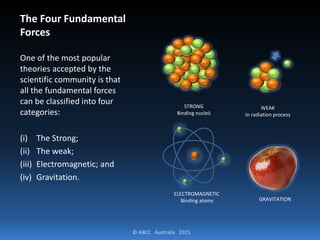
One of the most popular
theories accepted by the
scientific community is that
all the fundamental forces
can be classified into four
categories:
(i) The Strong;
(ii) The weak;
(iii) Electromagnetic; and
(iv) Gravitation.
GRAVITATION
WEAK
In radiation process
STRONG
Binding nucleii
ELECTROMAGNETIC
Binding atoms
© ABCC Australia 2015
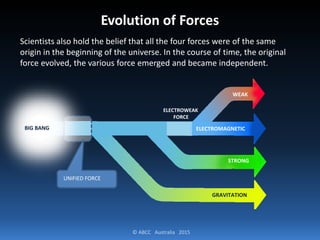
WEAK
ELECTROMAGNETIC
STRONG
GRAVITATION
ELECTROWEAK
FORCE
Evolution of Forces
Scientists also hold the belief that all the four forces were of the same
origin in the beginning of the universe. In the course of time, the original
force evolved, the various force emerged and became independent.
UNIFIED FORCE
BIG BANG
© ABCC Australia 2015
The Scale of Strengths
These forces are shown here
in the order of strength. The
difference among them is in
fact much greater by the
factor of trillions. Here they
are represented roughly by
their relative strength.
STRONG
ELECTROMAGNETIC
WEAK
GRAVITATION
© ABCC Australia 2015
Relative Strength of the Forces
In numerical terms, their strength may be represented as follows. We take
the strong force as unity, then the other forces are weaker by the
exponential numbers as -2, -8, and -45. One can see that gravitational force
is utterly and absolutely out of class.
1. Strong (nuclear) force (1)
The force that holds nuclei together.
2. Electromagnetic force (10-2)
Interaction among electrically and magnetically charged particles.
3. Weak force (10-8)
Responsible for certain nuclear decays and reactions.
4. Gravitational force (10-45)
Interaction between masses (all particles) familiar to us as weight.
© ABCC Australia 2015
PARTICLE EXCHANGE
Forces by
© ABCC Australia 2015
Force by Particle Exchange
In the 1930’s, Werner Heisenberg (1901-1976) and Ettore Majorana
(1906-1938) in postulated that the force between particles is due to the
exchange of force carrying particles. For example the electromagnetic
force is produced by the exchange of photons between electrons.
Positive Positron Mediating Photon Negative Electron
© ABCC Australia 2015
Passing Ball as Analogy
The mechanism of particle exchange may be compared to a basketball
exchange between two players on frictionless ground wearing skates. As
the second player catches the ball, he will recoil and moves away from
the first player. When he returns the ball to the first player, she will move
away on her turn. The actions carry on until both are pushed far apart.
Moves back
upon receiving
the ball
Moves back
upon throwing
the ball
© ABCC Australia 2015
No Analogy for Particles
The basketball scenario is, of course, a very crude analogy since it can only
explain repulsive forces and gives no clue for example of how exchanging
particles can result in attractive forces. However it is a good example of contact
force which the physicists may have overlooked. What the basketball represents
is actually the mechanical momentum which is not included in the basic forces.
This momentum exchanges could be viewed as momentum changing hosts.
Momentum
© ABCC Australia 2015
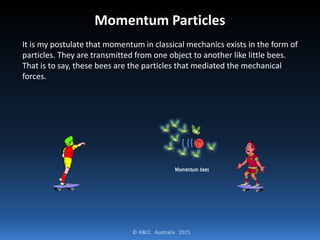
Momentum Particles
It is my postulate that momentum in classical mechanics exists in the form of
particles. They are transmitted from one object to another like little bees.
That is to say, these bees are the particles that mediated the mechanical
forces.
Momentum bees
© ABCC Australia 2015
From Angels to Particles
It had been a long journey and lots of changes. But the road to maturity is
firm and clearly oriented: from impetus to momentum; from momentum to
particles; (from angels to bees) the true cause of motion has finally unveiled
itself as phonons, even if it is a quasi-one for the time being as classified by
scientists.
© ABCC Australia 2015
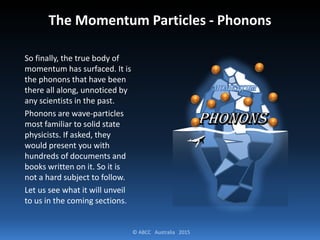
The Momentum Particles - Phonons
So finally, the true body of
momentum has surfaced. It is
the phonons that have been
there all along, unnoticed by
any scientists in the past.
Phonons are wave-particles
most familiar to solid state
physicists. If asked, they
would present you with
hundreds of documents and
books written on it. So it is
not a hard subject to follow.
Let us see what it will unveil
to us in the coming sections.
© ABCC Australia 2015
PHONON
The Quasi-Particle
© ABCC Australia 2015
Igor Tamm & the
Phonon
The idea of phonons was
introduced in 1932 by the
Russian physicist Igor Tamm
(1895-1971).
The phonon was not a real
particle but was fabricated as
a concept which facilitated
many treatment of heat and
sound in solids. The virtual
particle became a great and
successful idea used by all
scientists in solid state
physics.
© ABCC Australia 2015
Importance of
Phonons
Phonons play a major roles in
deciphering many of the physical
properties of solids. They are
responsible for the electrical
conductivity and thermal property
of the condensed matter.
Interactions between phonons and
electrons are thought to be
responsible for such phenomena as
superconductivity.
The importance of phonons in
matter is equivalent to the
importance of photons in free space.
© ABCC Australia 2015
The real Nature of Phonon Overlooked
Little did Igor and his follower scientists know that this phonon concept is
actually one of the greatest discoveries in the history of physics. Its
usefulness has led people to concentrate on the practicality ONLY and not on
its real nature. In solid state physics, phonons are only regarded as quasi-
particles, that is, it is not in the same rank of real particles.
© ABCC Australia 2015
Characteristics of Phonons
1. Phonons carry momenta.
2. Phonons do not play any part in altering the internal structure of any
hosting body.
3. According to current studies, phonons do not have a rest mass so that
the overall mass change in the particle or in collisions is negligible.
4. Phonons can travel from one object to another.
5. The transfer of phonon from one place to another is so fast that the
motion is not measurable in conventional collision experiment.
© ABCC Australia 2015
Fulfilment of Newton’s Work
With these characteristics recognized,
all the pictures about motion come
fitting together. It is a simple matter to
replace all momentum terms by
phonons.
In Newton’s time, the concept of
particles mediating forces was not yet
available. So his concepts about motion
could not extend beyond force and
momentum. We cannot blame Newton
for not providing something more solid
than force and momentum.
Now it seems settled. All we need to do
is to confirm the existence of the
phonon particle. In doing so, we may be
able to put a smile on Newton’s face
which was hardly seen in his life.
That is what I have been
looking for!
© ABCC Australia 2015
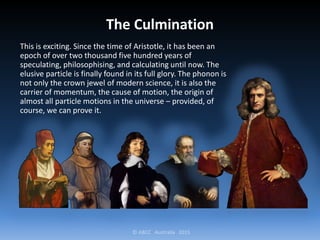
The Culmination
This is exciting. Since the time of Aristotle, it has been an
epoch of over two thousand five hundred years of
speculating, philosophising, and calculating until now. The
elusive particle is finally found in its full glory. The phonon is
not only the crown jewel of modern science, it is also the
carrier of momentum, the cause of motion, the origin of
almost all particle motions in the universe – provided, of
course, we can prove it.
© ABCC Australia 2015
PHONON REPRESENTATION
The Art of
© ABCC Australia 2015
From Angels to Particles
In the past, we had been representing momentum by angels or cherubs. Now
scientists use balls to stand for phonon particles. Angels and cherubs are
religious or mythical, suitable only when the concept of impetus or
momentum were introduced. Balls are not what the phonons may look like,
especially when they can perform so many functions.
© ABCC Australia 2015
Representation by Bees or Butterflies
According to conventional theories, phonons can vibrate, carry out wavy
motions, attract and repulse, perform heat and sound functions so on and so
forth. These duties are beyond what simple balls can perform. So we think
that bees and butterflies are still the best alternative before the true forms of
the phonons are identified. To have more fun, we can use the images of
fairies to show the versatilities of these little particles.
© ABCC Australia 2015
Phonon Data
• Phonon symbol 𝛿𝛿 (delta → delton)
• Mass 𝑚𝑚 This is the rest mass or average mass .
• Velocity 𝑣𝑣 Velocity inside matter.
• Photum (momentum) 𝑝𝑝 = 𝑚𝑚𝑚𝑚 The average
momentum.
• Frequency 𝑓𝑓 The original frequency as the photon.
• Angular frequency ⍵ Internal rotation
or spin [5}.
• Wave Number 𝜅𝜅 With velocity 𝑣𝑣 and not 𝑐𝑐.
• Energy 𝐸𝐸 = ℎ𝑓𝑓 = ℏ⍵=𝑚𝑚𝑐𝑐2
The original photon energy.
© ABCC Australia 2015
Major References
1. Isaac Newton: Philosophiæ Naturalis Principia Mathematica. Royal Society.
Latin original 1686. English version. 1728.
2. Richard Sorabji: Matter, Space & Motion. Gerald Duckworth & Co. Ltd. 1988.
3. Max Jammer: Concept of Force. Harvard University Press. 1957.
4. Mary Hesse: Forces and Fields. Cambridge University Press. T. Nelson. 1961.
5. Wikipedia: The free internet Encyclopaedia.
6. Rod Nave: HyperPhysics. Department of Physics and Astronomy, Georgia
State University
7. Charles Kittel: Solid State Physics. John Wiley & Son. 1953.
8. Isaac Asimov: Understanding Physics: Motion, Sound, and Heat. Walker and
Company. 1966.
9. Lucretius: On the Nature of the Universe. R. E. Latham. Penguin Books Ltd..
1951
10. New-Physics web site: www.new-physics.com. Publications: 01-05-2015 to
29-05-2015.
© ABCC Australia 2015
Picture Credits
1. Wikipedia.
2. Jade Comics.
Hong Kong
3. Dragon Ball and
Others. Japan
4. Starwar Movies.
5. Art Explosion.
Nova
Development
Corporation.
1995.
6. Various Art and
Science
Museums of the
world.

Part 5. conclusion phonons

  • 1.
    © ABCC Australia2015 THE FOUR FUNDAMENTAL FORCES
  • 2.
    © ABCC Australia2015 Particle Accelerators The search for the nature of momentum and force had been yielding no results even into the twentieth century when science and technology began again to progress forward by leaps and bounds. The concepts about force had also undergone serious changes mainly due to the advanced research into the microscopic world with the aid of more and more powerful accelerators. CMS acceleratorChicago's Tevatron particle accelerator
  • 3.
    © ABCC Australia2015 The Four Fundamental Forces One of the most popular theories accepted by the scientific community is that all the fundamental forces can be classified into four categories: (i) The Strong; (ii) The weak; (iii) Electromagnetic; and (iv) Gravitation. GRAVITATION WEAK In radiation process STRONG Binding nucleii ELECTROMAGNETIC Binding atoms
  • 4.
    © ABCC Australia2015 WEAK ELECTROMAGNETIC STRONG GRAVITATION ELECTROWEAK FORCE Evolution of Forces Scientists also hold the belief that all the four forces were of the same origin in the beginning of the universe. In the course of time, the original force evolved, the various force emerged and became independent. UNIFIED FORCE BIG BANG
  • 5.
    © ABCC Australia2015 The Scale of Strengths These forces are shown here in the order of strength. The difference among them is in fact much greater by the factor of trillions. Here they are represented roughly by their relative strength. STRONG ELECTROMAGNETIC WEAK GRAVITATION
  • 6.
    © ABCC Australia2015 Relative Strength of the Forces In numerical terms, their strength may be represented as follows. We take the strong force as unity, then the other forces are weaker by the exponential numbers as -2, -8, and -45. One can see that gravitational force is utterly and absolutely out of class. 1. Strong (nuclear) force (1) The force that holds nuclei together. 2. Electromagnetic force (10-2) Interaction among electrically and magnetically charged particles. 3. Weak force (10-8) Responsible for certain nuclear decays and reactions. 4. Gravitational force (10-45) Interaction between masses (all particles) familiar to us as weight.
  • 7.
    © ABCC Australia2015 PARTICLE EXCHANGE Forces by
  • 8.
    © ABCC Australia2015 Force by Particle Exchange In the 1930’s, Werner Heisenberg (1901-1976) and Ettore Majorana (1906-1938) in postulated that the force between particles is due to the exchange of force carrying particles. For example the electromagnetic force is produced by the exchange of photons between electrons. Positive Positron Mediating Photon Negative Electron
  • 9.
    © ABCC Australia2015 Passing Ball as Analogy The mechanism of particle exchange may be compared to a basketball exchange between two players on frictionless ground wearing skates. As the second player catches the ball, he will recoil and moves away from the first player. When he returns the ball to the first player, she will move away on her turn. The actions carry on until both are pushed far apart. Moves back upon receiving the ball Moves back upon throwing the ball
  • 10.
    © ABCC Australia2015 No Analogy for Particles The basketball scenario is, of course, a very crude analogy since it can only explain repulsive forces and gives no clue for example of how exchanging particles can result in attractive forces. However it is a good example of contact force which the physicists may have overlooked. What the basketball represents is actually the mechanical momentum which is not included in the basic forces. This momentum exchanges could be viewed as momentum changing hosts. Momentum
  • 11.
    © ABCC Australia2015 Momentum Particles It is my postulate that momentum in classical mechanics exists in the form of particles. They are transmitted from one object to another like little bees. That is to say, these bees are the particles that mediated the mechanical forces. Momentum bees
  • 12.
    © ABCC Australia2015 From Angels to Particles It had been a long journey and lots of changes. But the road to maturity is firm and clearly oriented: from impetus to momentum; from momentum to particles; (from angels to bees) the true cause of motion has finally unveiled itself as phonons, even if it is a quasi-one for the time being as classified by scientists.
  • 13.
    © ABCC Australia2015 The Momentum Particles - Phonons So finally, the true body of momentum has surfaced. It is the phonons that have been there all along, unnoticed by any scientists in the past. Phonons are wave-particles most familiar to solid state physicists. If asked, they would present you with hundreds of documents and books written on it. So it is not a hard subject to follow. Let us see what it will unveil to us in the coming sections.
  • 14.
    © ABCC Australia2015 PHONON The Quasi-Particle
  • 15.
    © ABCC Australia2015 Igor Tamm & the Phonon The idea of phonons was introduced in 1932 by the Russian physicist Igor Tamm (1895-1971). The phonon was not a real particle but was fabricated as a concept which facilitated many treatment of heat and sound in solids. The virtual particle became a great and successful idea used by all scientists in solid state physics.
  • 16.
    © ABCC Australia2015 Importance of Phonons Phonons play a major roles in deciphering many of the physical properties of solids. They are responsible for the electrical conductivity and thermal property of the condensed matter. Interactions between phonons and electrons are thought to be responsible for such phenomena as superconductivity. The importance of phonons in matter is equivalent to the importance of photons in free space.
  • 17.
    © ABCC Australia2015 The real Nature of Phonon Overlooked Little did Igor and his follower scientists know that this phonon concept is actually one of the greatest discoveries in the history of physics. Its usefulness has led people to concentrate on the practicality ONLY and not on its real nature. In solid state physics, phonons are only regarded as quasi- particles, that is, it is not in the same rank of real particles.
  • 18.
    © ABCC Australia2015 Characteristics of Phonons 1. Phonons carry momenta. 2. Phonons do not play any part in altering the internal structure of any hosting body. 3. According to current studies, phonons do not have a rest mass so that the overall mass change in the particle or in collisions is negligible. 4. Phonons can travel from one object to another. 5. The transfer of phonon from one place to another is so fast that the motion is not measurable in conventional collision experiment.
  • 19.
    © ABCC Australia2015 Fulfilment of Newton’s Work With these characteristics recognized, all the pictures about motion come fitting together. It is a simple matter to replace all momentum terms by phonons. In Newton’s time, the concept of particles mediating forces was not yet available. So his concepts about motion could not extend beyond force and momentum. We cannot blame Newton for not providing something more solid than force and momentum. Now it seems settled. All we need to do is to confirm the existence of the phonon particle. In doing so, we may be able to put a smile on Newton’s face which was hardly seen in his life. That is what I have been looking for!
  • 20.
    © ABCC Australia2015 The Culmination This is exciting. Since the time of Aristotle, it has been an epoch of over two thousand five hundred years of speculating, philosophising, and calculating until now. The elusive particle is finally found in its full glory. The phonon is not only the crown jewel of modern science, it is also the carrier of momentum, the cause of motion, the origin of almost all particle motions in the universe – provided, of course, we can prove it.
  • 21.
    © ABCC Australia2015 PHONON REPRESENTATION The Art of
  • 22.
    © ABCC Australia2015 From Angels to Particles In the past, we had been representing momentum by angels or cherubs. Now scientists use balls to stand for phonon particles. Angels and cherubs are religious or mythical, suitable only when the concept of impetus or momentum were introduced. Balls are not what the phonons may look like, especially when they can perform so many functions.
  • 23.
    © ABCC Australia2015 Representation by Bees or Butterflies According to conventional theories, phonons can vibrate, carry out wavy motions, attract and repulse, perform heat and sound functions so on and so forth. These duties are beyond what simple balls can perform. So we think that bees and butterflies are still the best alternative before the true forms of the phonons are identified. To have more fun, we can use the images of fairies to show the versatilities of these little particles.
  • 24.
    © ABCC Australia2015 Phonon Data • Phonon symbol 𝛿𝛿 (delta → delton) • Mass 𝑚𝑚 This is the rest mass or average mass . • Velocity 𝑣𝑣 Velocity inside matter. • Photum (momentum) 𝑝𝑝 = 𝑚𝑚𝑚𝑚 The average momentum. • Frequency 𝑓𝑓 The original frequency as the photon. • Angular frequency ⍵ Internal rotation or spin [5}. • Wave Number 𝜅𝜅 With velocity 𝑣𝑣 and not 𝑐𝑐. • Energy 𝐸𝐸 = ℎ𝑓𝑓 = ℏ⍵=𝑚𝑚𝑐𝑐2 The original photon energy.
  • 25.
    © ABCC Australia2015 Major References 1. Isaac Newton: Philosophiæ Naturalis Principia Mathematica. Royal Society. Latin original 1686. English version. 1728. 2. Richard Sorabji: Matter, Space & Motion. Gerald Duckworth & Co. Ltd. 1988. 3. Max Jammer: Concept of Force. Harvard University Press. 1957. 4. Mary Hesse: Forces and Fields. Cambridge University Press. T. Nelson. 1961. 5. Wikipedia: The free internet Encyclopaedia. 6. Rod Nave: HyperPhysics. Department of Physics and Astronomy, Georgia State University 7. Charles Kittel: Solid State Physics. John Wiley & Son. 1953. 8. Isaac Asimov: Understanding Physics: Motion, Sound, and Heat. Walker and Company. 1966. 9. Lucretius: On the Nature of the Universe. R. E. Latham. Penguin Books Ltd.. 1951 10. New-Physics web site: www.new-physics.com. Publications: 01-05-2015 to 29-05-2015.
  • 26.
    © ABCC Australia2015 Picture Credits 1. Wikipedia. 2. Jade Comics. Hong Kong 3. Dragon Ball and Others. Japan 4. Starwar Movies. 5. Art Explosion. Nova Development Corporation. 1995. 6. Various Art and Science Museums of the world.