17-1
Physics I
Class 17
Newton’s Theory of
Gravitation
Rev. 03-Nov-04 GB
17-2
Forces Known to Physics
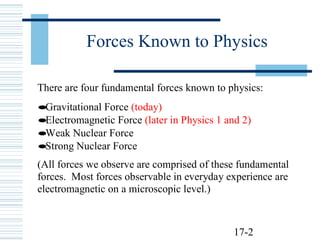
There are four fundamental forces known to physics:
•Gravitational Force (today)
•Electromagnetic Force (later in Physics 1 and 2)
•Weak Nuclear Force
•Strong Nuclear Force
(All forces we observe are comprised of these fundamental
forces. Most forces observable in everyday experience are
electromagnetic on a microscopic level.)
17-3
Forces in Physics 1
(so far)
We have encountered the following forces in Physics 1:
•Gravity
•Ideal Springs (Hooke’s Law)
•Pushes and Pulls
•Friction
What makes gravity different from the other three?
(Hint: The ideal spring force is also conservative,
so that isn’t the answer.)
17-4
Newton’s Theory of Gravitation
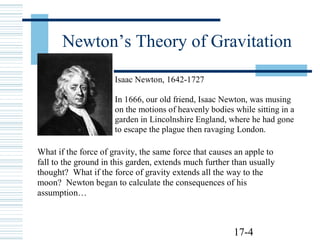
Isaac Newton, 1642-1727
In 1666, our old friend, Isaac Newton, was musing
on the motions of heavenly bodies while sitting in a
garden in Lincolnshire England, where he had gone
to escape the plague then ravaging London.
What if the force of gravity, the same force that causes an apple to
fall to the ground in this garden, extends much further than usually
thought? What if the force of gravity extends all the way to the
moon? Newton began to calculate the consequences of his
assumption…
17-5
Newton’s Law of
Universal Gravitation
rˆ
r
mm
GF 2
21
=

The meaning of each term:
F

: Gravitational force on object 1 from object 2.
G: Universal gravitational constant = 6.673 x 10
–11
N m
2
/kg
2
.
1m : Mass of object 1.
2m : Mass of object 2.
2
r : Center distance from object 1 to object 2, squared.
rˆ: Unit vector from object 1 to object 2.
17-6
Properties of Gravity
Object 1
Object 2
Gravitational Force on 1 from 2
•Every object with mass is attracted by every other object with mass.
•Gravity is a force at a distance (through occupied or empty space).
•Gravity is a “central” force (center-to-center for spherical bodies).
•Gravity varies as the inverse square of the center distance.
•Gravity varies as the product of the masses.
17-7
If Gravity Varies As 1/r2
,
Where Does g = 9.8 m/s2
Fit In?
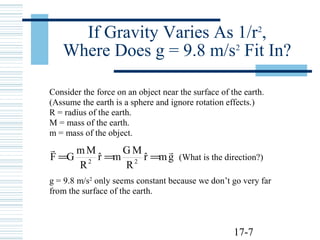
Consider the force on an object near the surface of the earth.
(Assume the earth is a sphere and ignore rotation effects.)
R = radius of the earth.
M = mass of the earth.
m = mass of the object.
gmrˆ
R
MG
mrˆ
R
Mm
GF 22

=== (What is the direction?)
g = 9.8 m/s2
only seems constant because we don’t go very far
from the surface of the earth.
17-8
Gravity is a
Conservative Force
Both the mathematical form of Newton’s Law of Universal
Gravitation and experimental evidence show that gravity is a
conservative force. Therefore, we can find a gravitational
potential energy for an object with mass m being attracted by
another object with mass M.
The gravitational potential energy is defined (for convenience)
to be zero at infinity. We can calculate it by finding the
positive work from any point to infinity – you can find the
details in the book in section 13-6.
r
MmG
rd
)r(
MmG
rdF)r(U
r
2
r
g ∫∫
∞∞
−=′
′
−=′⋅=

17-9
We Have Two Formulas for
Gravitational Potential Energy!
Old: )yy(gm)y(U 0g −=
New:
r
MmG
)r(Ug −=
How could these be the same?
Consider a location near the surface of the earth, y0
= R, y = R+h.
The only thing that matters is ∆U, not U itself.
Old: hgm)RhR(gmUg =−+=∆
New: 





+
−=





−−
+
−=∆
hR
1
R
1
MmG
R
MmG
hR
MmG
Ug






+
=





+
−=
hRR
h
MGm
hR
1
R
1
MGm 2
(h << R)
hgmh
R
MG
m
R
h
MGm 22
==≈
17-10
Class #17
Take-Away Concepts
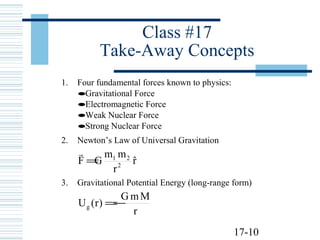
1. Four fundamental forces known to physics:
•Gravitational Force
•Electromagnetic Force
•Weak Nuclear Force
•Strong Nuclear Force
2. Newton’s Law of Universal Gravitation
rˆ
r
mm
GF 2
21
=

3. Gravitational Potential Energy (long-range form)
r
MmG
)r(Ug −=
17-11
Class #17
Problems of the Day
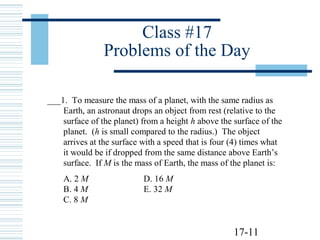
___1. To measure the mass of a planet, with the same radius as
Earth, an astronaut drops an object from rest (relative to the
surface of the planet) from a height h above the surface of the
planet. (h is small compared to the radius.) The object
arrives at the surface with a speed that is four (4) times what
it would be if dropped from the same distance above Earth’s
surface. If M is the mass of Earth, the mass of the planet is:
A. 2 M D. 16 M
B. 4 M E. 32 M
C. 8 M
17-12
Class #17
Problems of the Day
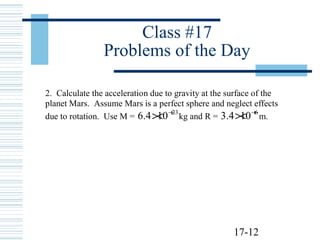
2. Calculate the acceleration due to gravity at the surface of the
planet Mars. Assume Mars is a perfect sphere and neglect effects
due to rotation. Use M =
23
104.6 +
× kg and R =
6
104.3 +
× m.
17-13
Activity #17
Gravitation
(Pencil and Paper Activity)
Objective of the Activity:
1. Think about Newton’s Law of Universal Gravitation.
2. Consider the implications of Newton’s formula.
3. Practice calculating gravitational force vectors.
17-14
Class #17 Optional Material
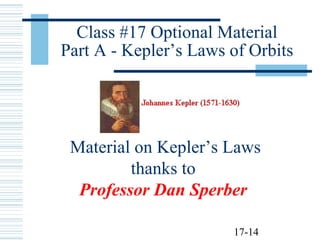
Part A - Kepler’s Laws of Orbits
Material on Kepler’s Laws
thanks to
Professor Dan Sperber
17-15
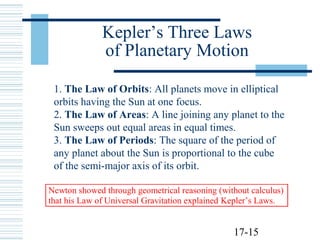
Kepler’s Three Laws
of Planetary Motion
1. The Law of Orbits: All planets move in elliptical
orbits having the Sun at one focus.
2. The Law of Areas: A line joining any planet to the
Sun sweeps out equal areas in equal times.
3. The Law of Periods: The square of the period of
any planet about the Sun is proportional to the cube
of the semi-major axis of its orbit.
Newton showed through geometrical reasoning (without calculus)
that his Law of Universal Gravitation explained Kepler’s Laws.
17-16
Kepler’s Three Laws
of Planetary Motion
Try this link to see an animation:
http://home.cvc.org/science/kepler.htm
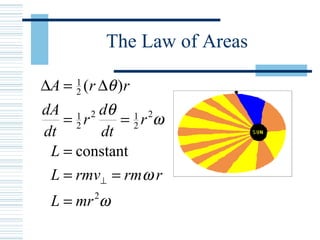
The Law of Areas
∆ ∆A r r
dA
dt
r
d
dt
r
L
L rmv rm r
L mr
=
= =
=
= =
=
⊥
1
2
1
2
2 1
2
2
2
( )θ
θ
ω
ω
ω
constant
The Law of Periods
F ma
GMm
r
m r
GM
r T
T
GM
r
=
=
= = 



=
2
2
3
2
2
2
2
3
2
2
ω
ω
π
π( )
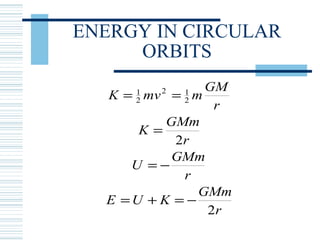
ENERGY IN CIRCULAR
ORBITS
K mv m
GM
r
K
GMm
r
U
GMm
r
E U K
GMm
r
= =
=
= −
= + = −
1
2
2 1
2
2
2
17-20
Class #17 Optional Material
Part B - General Relativity
Material on General Relativity
thanks to
Albert Einstein
17-21
Where Did Newton Go Wrong?
(Again!)
Albert Einstein (1879–1955)
(Check back to the optional material for classes 3 and 6 first…)
Einstein realized that something must be wrong with Newton’s
theory of gravity, because it implied that the force of gravity is
transmitted instantaneously to all points in the universe. This
contradicts the fundamental limitation in the Theory of Special
Relativity that the fastest speed information or energy of any type
can travel is the speed of light.
To overcome this problem Einstein postulated a third principle, the
Principle of Equivalence, to go with his two principles of Special
Relativity. (1907)
17-22
The Principle of Equivalence
In broad terms, the Principle of Equivalence states that there is no
experiment that one can perform to distinguish a frame of reference
in a gravitational force field from one that is accelerating with a
corresponding magnitude and direction.
This is sometimes called the “Elevator Postulate” because we can
imagine a physicist in a closed elevator cab trying to determine
whether he is at rest on earth, or accelerating at 9.8 m/s2
far from
any planet, or perhaps on a planet where gravity is half that of earth
and the elevator is accelerating upward at 4.9 m/s2
. According to
Einstein, there is no experiment that could detect a difference.
17-23
The Principle of Equivalence
17-24
General Theory of Relativity
By 1915, Einstein had worked through all the math (with some help)
to show that his postulates led to a new theory of gravity based on
the effect of mass and energy to curve the structure of space and
time. His theory has some startling implications, one being the
existence of “black holes” – regions of space where the gravity field
is so high that even light cannot escape. The predictions of General
Relativity, including the existence of black holes, have been
confirmed by all experiments to date.
17-25
Black Holes
Black holes are detected by the characteristic
x-rays given off by matter falling into them.
17-26
If Newton’s Gravity isn’t true,
why do we still use it?
It’s a good approximation for most engineering purposes.
Massive Black Holes
In Galaxies
NGC 3377, NGC 3379
And NGC 4486B

Gravitation

  • 1.
    17-1 Physics I Class 17 Newton’sTheory of Gravitation Rev. 03-Nov-04 GB
  • 2.
    17-2 Forces Known toPhysics There are four fundamental forces known to physics: •Gravitational Force (today) •Electromagnetic Force (later in Physics 1 and 2) •Weak Nuclear Force •Strong Nuclear Force (All forces we observe are comprised of these fundamental forces. Most forces observable in everyday experience are electromagnetic on a microscopic level.)
  • 3.
    17-3 Forces in Physics1 (so far) We have encountered the following forces in Physics 1: •Gravity •Ideal Springs (Hooke’s Law) •Pushes and Pulls •Friction What makes gravity different from the other three? (Hint: The ideal spring force is also conservative, so that isn’t the answer.)
  • 4.
    17-4 Newton’s Theory ofGravitation Isaac Newton, 1642-1727 In 1666, our old friend, Isaac Newton, was musing on the motions of heavenly bodies while sitting in a garden in Lincolnshire England, where he had gone to escape the plague then ravaging London. What if the force of gravity, the same force that causes an apple to fall to the ground in this garden, extends much further than usually thought? What if the force of gravity extends all the way to the moon? Newton began to calculate the consequences of his assumption…
  • 5.
    17-5 Newton’s Law of UniversalGravitation rˆ r mm GF 2 21 =  The meaning of each term: F  : Gravitational force on object 1 from object 2. G: Universal gravitational constant = 6.673 x 10 –11 N m 2 /kg 2 . 1m : Mass of object 1. 2m : Mass of object 2. 2 r : Center distance from object 1 to object 2, squared. rˆ: Unit vector from object 1 to object 2.
  • 6.
    17-6 Properties of Gravity Object1 Object 2 Gravitational Force on 1 from 2 •Every object with mass is attracted by every other object with mass. •Gravity is a force at a distance (through occupied or empty space). •Gravity is a “central” force (center-to-center for spherical bodies). •Gravity varies as the inverse square of the center distance. •Gravity varies as the product of the masses.
  • 7.
    17-7 If Gravity VariesAs 1/r2 , Where Does g = 9.8 m/s2 Fit In? Consider the force on an object near the surface of the earth. (Assume the earth is a sphere and ignore rotation effects.) R = radius of the earth. M = mass of the earth. m = mass of the object. gmrˆ R MG mrˆ R Mm GF 22  === (What is the direction?) g = 9.8 m/s2 only seems constant because we don’t go very far from the surface of the earth.
  • 8.
    17-8 Gravity is a ConservativeForce Both the mathematical form of Newton’s Law of Universal Gravitation and experimental evidence show that gravity is a conservative force. Therefore, we can find a gravitational potential energy for an object with mass m being attracted by another object with mass M. The gravitational potential energy is defined (for convenience) to be zero at infinity. We can calculate it by finding the positive work from any point to infinity – you can find the details in the book in section 13-6. r MmG rd )r( MmG rdF)r(U r 2 r g ∫∫ ∞∞ −=′ ′ −=′⋅= 
  • 9.
    17-9 We Have TwoFormulas for Gravitational Potential Energy! Old: )yy(gm)y(U 0g −= New: r MmG )r(Ug −= How could these be the same? Consider a location near the surface of the earth, y0 = R, y = R+h. The only thing that matters is ∆U, not U itself. Old: hgm)RhR(gmUg =−+=∆ New:       + −=      −− + −=∆ hR 1 R 1 MmG R MmG hR MmG Ug       + =      + −= hRR h MGm hR 1 R 1 MGm 2 (h << R) hgmh R MG m R h MGm 22 ==≈
  • 10.
    17-10 Class #17 Take-Away Concepts 1.Four fundamental forces known to physics: •Gravitational Force •Electromagnetic Force •Weak Nuclear Force •Strong Nuclear Force 2. Newton’s Law of Universal Gravitation rˆ r mm GF 2 21 =  3. Gravitational Potential Energy (long-range form) r MmG )r(Ug −=
  • 11.
    17-11 Class #17 Problems ofthe Day ___1. To measure the mass of a planet, with the same radius as Earth, an astronaut drops an object from rest (relative to the surface of the planet) from a height h above the surface of the planet. (h is small compared to the radius.) The object arrives at the surface with a speed that is four (4) times what it would be if dropped from the same distance above Earth’s surface. If M is the mass of Earth, the mass of the planet is: A. 2 M D. 16 M B. 4 M E. 32 M C. 8 M
  • 12.
    17-12 Class #17 Problems ofthe Day 2. Calculate the acceleration due to gravity at the surface of the planet Mars. Assume Mars is a perfect sphere and neglect effects due to rotation. Use M = 23 104.6 + × kg and R = 6 104.3 + × m.
  • 13.
    17-13 Activity #17 Gravitation (Pencil andPaper Activity) Objective of the Activity: 1. Think about Newton’s Law of Universal Gravitation. 2. Consider the implications of Newton’s formula. 3. Practice calculating gravitational force vectors.
  • 14.
    17-14 Class #17 OptionalMaterial Part A - Kepler’s Laws of Orbits Material on Kepler’s Laws thanks to Professor Dan Sperber
  • 15.
    17-15 Kepler’s Three Laws ofPlanetary Motion 1. The Law of Orbits: All planets move in elliptical orbits having the Sun at one focus. 2. The Law of Areas: A line joining any planet to the Sun sweeps out equal areas in equal times. 3. The Law of Periods: The square of the period of any planet about the Sun is proportional to the cube of the semi-major axis of its orbit. Newton showed through geometrical reasoning (without calculus) that his Law of Universal Gravitation explained Kepler’s Laws.
  • 16.
    17-16 Kepler’s Three Laws ofPlanetary Motion Try this link to see an animation: http://home.cvc.org/science/kepler.htm
  • 17.
    The Law ofAreas ∆ ∆A r r dA dt r d dt r L L rmv rm r L mr = = = = = = = ⊥ 1 2 1 2 2 1 2 2 2 ( )θ θ ω ω ω constant
  • 18.
    The Law ofPeriods F ma GMm r m r GM r T T GM r = = = =     = 2 2 3 2 2 2 2 3 2 2 ω ω π π( )
  • 19.
    ENERGY IN CIRCULAR ORBITS Kmv m GM r K GMm r U GMm r E U K GMm r = = = = − = + = − 1 2 2 1 2 2 2
  • 20.
    17-20 Class #17 OptionalMaterial Part B - General Relativity Material on General Relativity thanks to Albert Einstein
  • 21.
    17-21 Where Did NewtonGo Wrong? (Again!) Albert Einstein (1879–1955) (Check back to the optional material for classes 3 and 6 first…) Einstein realized that something must be wrong with Newton’s theory of gravity, because it implied that the force of gravity is transmitted instantaneously to all points in the universe. This contradicts the fundamental limitation in the Theory of Special Relativity that the fastest speed information or energy of any type can travel is the speed of light. To overcome this problem Einstein postulated a third principle, the Principle of Equivalence, to go with his two principles of Special Relativity. (1907)
  • 22.
    17-22 The Principle ofEquivalence In broad terms, the Principle of Equivalence states that there is no experiment that one can perform to distinguish a frame of reference in a gravitational force field from one that is accelerating with a corresponding magnitude and direction. This is sometimes called the “Elevator Postulate” because we can imagine a physicist in a closed elevator cab trying to determine whether he is at rest on earth, or accelerating at 9.8 m/s2 far from any planet, or perhaps on a planet where gravity is half that of earth and the elevator is accelerating upward at 4.9 m/s2 . According to Einstein, there is no experiment that could detect a difference.
  • 23.
  • 24.
    17-24 General Theory ofRelativity By 1915, Einstein had worked through all the math (with some help) to show that his postulates led to a new theory of gravity based on the effect of mass and energy to curve the structure of space and time. His theory has some startling implications, one being the existence of “black holes” – regions of space where the gravity field is so high that even light cannot escape. The predictions of General Relativity, including the existence of black holes, have been confirmed by all experiments to date.
  • 25.
    17-25 Black Holes Black holesare detected by the characteristic x-rays given off by matter falling into them.
  • 26.
    17-26 If Newton’s Gravityisn’t true, why do we still use it? It’s a good approximation for most engineering purposes. Massive Black Holes In Galaxies NGC 3377, NGC 3379 And NGC 4486B

Editor's Notes

  • #18 &amp;lt;number&amp;gt;
  • #19 &amp;lt;number&amp;gt;
  • #20 &amp;lt;number&amp;gt;