BY:
VIKAS CHANDRA SHARMA
ASST. PROF., DEPARTMENT OF CHEMISTRY
SHRI SHANKARACHARYA MAHAVIDYALAYA
MAGNETIC PROPERTIES
1
PRESENTATION OVERVIEW
 Terms and Definitions
 Types of Magnets
 Ways of Producing Artificial Magnets
 Permeability of Magnetic Materials
 Magnetic Properties
 The Use of the Left-hand Rule for Conductors and
Coils
 Induction
 Practical Applications of Induction in the Electronics
Field
2
.
TERMS & DEFINITIONS
A. Magnetism- A property of certain materials (e.g. iron, nickel. and
cobalt) which exerts a mechanical force on other magnetic materials,
and which can cause induced voltages in conductors when relative
movement is present
B. Magnet- An object which will attract iron, nickel, or cobalt and
which will produce an external magnetic field
C. Natural magnet- Any material found in the earth which exhibits
the properties of magnetism
Example: The lodestone, which contains magnetite, a form or iron,
and which has been magnetized by the earth’s magnetic field
D. Artificial magnet- A device which has been made magnetic by
induction
E. Induction- The process of magnetizing an object by bringing it
into the magnetic field of an electromagnet or permanent magnet
F. Magnetic lines of force- An imaginary line in a magnetic field
that coincides in direction with the field intensity at each point and
which has a direction from the North to the South pole
3
G. Magnetic field- The area around a magnet through which the lines of
force flow
H. Permanent magnet- A magnetic device which remains its
magnetism after it is removed from a magnetic field
I. Electromagnet- A core of soft iron that is temporarily magnetized by
sending current through a coil of wire wound around the core
J. Permeability- A measure of effectiveness of a material as a path for
magnetic lines of force as compared with the effectiveness of air
(NOTE: Some materials such as iron have high permeability, others such as
aluminum have medium permeability, and others such as silver and gold
have low permeability.)
K. Magnetic Poles- The portion of a magnet where the magnetic lines
appear to concentrate
(NOTE: By convention the north-seeking pole is marked with N, or plus, or is
colored red.)
L. Ferromagnetic- Magnetic materials with high values of permeability
which range from 50 to 5000
(NOTE: Steel, cobalt, nickel are ferromagnetic materials. )
M. Diamagnetic- Magnetic materials with a a permeability of less than one
(NOTE: Diamagnetic materials include bismuth, antimony, copper, and zinc.)
4
TYPES OF MAGNETS
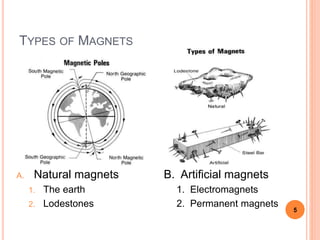
A. Natural magnets B. Artificial magnets
1. The earth 1. Electromagnets
2. Lodestones 2. Permanent magnets
5
WAYS OF PRODUCING ARTIFICIAL MAGNETS
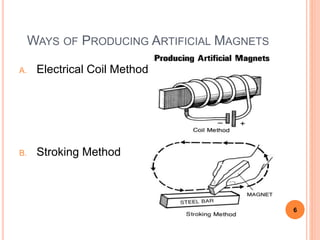
A. Electrical Coil Method
B. Stroking Method
6
PERMEABILITY OF
MAGNETIC MATERIALS
A. High permeability
1. Iron 5. Commercially made alloys of iron,
nickel,
2. Steel cobalt and other elements
3. Nickel a. Silicon steel (used in
transformers)
4. Cobalt b. Almico (used in audio
speakers)
B. Medium permeability
1. Aluminum 2. Platinum 3. Manganese 4. Chromium
C. Low permeability
1. Bismuth 2. Antimony 3. Copper 4. Zinc
5. Rare metals (mercury, gold, silver)
D. Nonmagnetic materials
1. Glass 2. Paper 3. Rubber 4. Wood 5. Air
7
MAGNETIC PROPERTIES
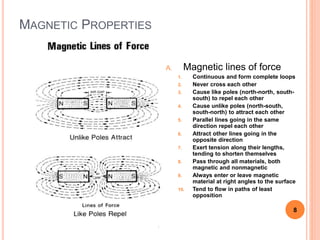
A. Magnetic lines of force
1. Continuous and form complete loops
2. Never cross each other
3. Cause like poles (north-north, south-
south) to repel each other
4. Cause unlike poles (north-south,
south-north) to attract each other
5. Parallel lines going in the same
direction repel each other
6. Attract other lines going in the
opposite direction
7. Exert tension along their lengths,
tending to shorten themselves
8. Pass through all materials, both
magnetic and nonmagnetic
9. Always enter or leave magnetic
material at right angles to the surface
10. Tend to flow in paths of least
opposition
8
.
MAGNETIC PROPERTIES (CONT’D)
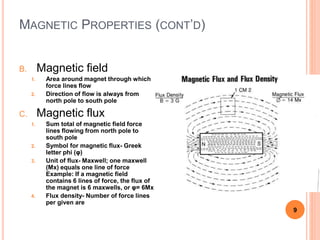
B. Magnetic field
1. Area around magnet through which
force lines flow
2. Direction of flow is always from
north pole to south pole
C. Magnetic flux
1. Sum total of magnetic field force
lines flowing from north pole to
south pole
2. Symbol for magnetic flux- Greek
letter phi (φ)
3. Unit of flux- Maxwell; one maxwell
(Mx) equals one line of force
Example: If a magnetic field
contains 6 lines of force, the flux of
the magnet is 6 maxwells, or φ= 6Mx
4. Flux density- Number of force lines
per given are
9
FLUX DENSITY
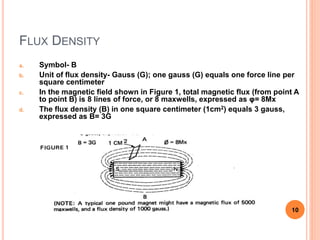
a. Symbol- B
b. Unit of flux density- Gauss (G); one gauss (G) equals one force line per
square centimeter
c. In the magnetic field shown in Figure 1, total magnetic flux (from point A
to point B) is 8 lines of force, or 8 maxwells, expressed as φ= 8Mx
d. The flux density (B) in one square centimeter (1cm2) equals 3 gauss,
expressed as B= 3G
10
THE USE OF THE LEFT-HAND RULE FOR
CONDUCTORS AND COILS
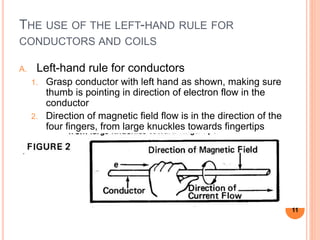
A. Left-hand rule for conductors
1. Grasp conductor with left hand as shown, making sure
thumb is pointing in direction of electron flow in the
conductor
2. Direction of magnetic field flow is in the direction of the
four fingers, from large knuckles towards fingertips
11
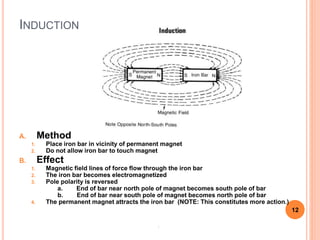
INDUCTION
A. Method
1. Place iron bar in vicinity of permanent magnet
2. Do not allow iron bar to touch magnet
B. Effect
1. Magnetic field lines of force flow through the iron bar
2. The iron bar becomes electromagnetized
3. Pole polarity is reversed
a. End of bar near north pole of magnet becomes south pole of bar
b. End of bar near south pole of magnet becomes north pole of bar
4. The permanent magnet attracts the iron bar (NOTE: This constitutes more action.)
12
.
PRACTICAL APPLICATIONS OF INDUCTION IN
THE ELECTRONICS FIELD
A. Radio and Television transmission and reception
B. Transformers
C. Relays and solenoids
D. Coils, chokes, and inductors
E. Audio speakers
F. Motors and generators
G. Magnetic memory
13
PRESENTATION SUMMARY
 Terms and Definitions
 Types of Magnets
 Ways of Producing Artificial Magnets
 Permeability of Magnetic Materials
 Magnetic Properties
 The Use of the Left-hand Rule for Conductors and
Coils
 Induction
 Practical Applications of Induction in the Electronics
Field
14
.

Magnetic Properties

  • 1.
    BY: VIKAS CHANDRA SHARMA ASST.PROF., DEPARTMENT OF CHEMISTRY SHRI SHANKARACHARYA MAHAVIDYALAYA MAGNETIC PROPERTIES 1
  • 2.
    PRESENTATION OVERVIEW  Termsand Definitions  Types of Magnets  Ways of Producing Artificial Magnets  Permeability of Magnetic Materials  Magnetic Properties  The Use of the Left-hand Rule for Conductors and Coils  Induction  Practical Applications of Induction in the Electronics Field 2 .
  • 3.
    TERMS & DEFINITIONS A.Magnetism- A property of certain materials (e.g. iron, nickel. and cobalt) which exerts a mechanical force on other magnetic materials, and which can cause induced voltages in conductors when relative movement is present B. Magnet- An object which will attract iron, nickel, or cobalt and which will produce an external magnetic field C. Natural magnet- Any material found in the earth which exhibits the properties of magnetism Example: The lodestone, which contains magnetite, a form or iron, and which has been magnetized by the earth’s magnetic field D. Artificial magnet- A device which has been made magnetic by induction E. Induction- The process of magnetizing an object by bringing it into the magnetic field of an electromagnet or permanent magnet F. Magnetic lines of force- An imaginary line in a magnetic field that coincides in direction with the field intensity at each point and which has a direction from the North to the South pole 3
  • 4.
    G. Magnetic field-The area around a magnet through which the lines of force flow H. Permanent magnet- A magnetic device which remains its magnetism after it is removed from a magnetic field I. Electromagnet- A core of soft iron that is temporarily magnetized by sending current through a coil of wire wound around the core J. Permeability- A measure of effectiveness of a material as a path for magnetic lines of force as compared with the effectiveness of air (NOTE: Some materials such as iron have high permeability, others such as aluminum have medium permeability, and others such as silver and gold have low permeability.) K. Magnetic Poles- The portion of a magnet where the magnetic lines appear to concentrate (NOTE: By convention the north-seeking pole is marked with N, or plus, or is colored red.) L. Ferromagnetic- Magnetic materials with high values of permeability which range from 50 to 5000 (NOTE: Steel, cobalt, nickel are ferromagnetic materials. ) M. Diamagnetic- Magnetic materials with a a permeability of less than one (NOTE: Diamagnetic materials include bismuth, antimony, copper, and zinc.) 4
  • 5.
    TYPES OF MAGNETS A.Natural magnets B. Artificial magnets 1. The earth 1. Electromagnets 2. Lodestones 2. Permanent magnets 5
  • 6.
    WAYS OF PRODUCINGARTIFICIAL MAGNETS A. Electrical Coil Method B. Stroking Method 6
  • 7.
    PERMEABILITY OF MAGNETIC MATERIALS A.High permeability 1. Iron 5. Commercially made alloys of iron, nickel, 2. Steel cobalt and other elements 3. Nickel a. Silicon steel (used in transformers) 4. Cobalt b. Almico (used in audio speakers) B. Medium permeability 1. Aluminum 2. Platinum 3. Manganese 4. Chromium C. Low permeability 1. Bismuth 2. Antimony 3. Copper 4. Zinc 5. Rare metals (mercury, gold, silver) D. Nonmagnetic materials 1. Glass 2. Paper 3. Rubber 4. Wood 5. Air 7
  • 8.
    MAGNETIC PROPERTIES A. Magneticlines of force 1. Continuous and form complete loops 2. Never cross each other 3. Cause like poles (north-north, south- south) to repel each other 4. Cause unlike poles (north-south, south-north) to attract each other 5. Parallel lines going in the same direction repel each other 6. Attract other lines going in the opposite direction 7. Exert tension along their lengths, tending to shorten themselves 8. Pass through all materials, both magnetic and nonmagnetic 9. Always enter or leave magnetic material at right angles to the surface 10. Tend to flow in paths of least opposition 8 .
  • 9.
    MAGNETIC PROPERTIES (CONT’D) B.Magnetic field 1. Area around magnet through which force lines flow 2. Direction of flow is always from north pole to south pole C. Magnetic flux 1. Sum total of magnetic field force lines flowing from north pole to south pole 2. Symbol for magnetic flux- Greek letter phi (φ) 3. Unit of flux- Maxwell; one maxwell (Mx) equals one line of force Example: If a magnetic field contains 6 lines of force, the flux of the magnet is 6 maxwells, or φ= 6Mx 4. Flux density- Number of force lines per given are 9
  • 10.
    FLUX DENSITY a. Symbol-B b. Unit of flux density- Gauss (G); one gauss (G) equals one force line per square centimeter c. In the magnetic field shown in Figure 1, total magnetic flux (from point A to point B) is 8 lines of force, or 8 maxwells, expressed as φ= 8Mx d. The flux density (B) in one square centimeter (1cm2) equals 3 gauss, expressed as B= 3G 10
  • 11.
    THE USE OFTHE LEFT-HAND RULE FOR CONDUCTORS AND COILS A. Left-hand rule for conductors 1. Grasp conductor with left hand as shown, making sure thumb is pointing in direction of electron flow in the conductor 2. Direction of magnetic field flow is in the direction of the four fingers, from large knuckles towards fingertips 11
  • 12.
    INDUCTION A. Method 1. Placeiron bar in vicinity of permanent magnet 2. Do not allow iron bar to touch magnet B. Effect 1. Magnetic field lines of force flow through the iron bar 2. The iron bar becomes electromagnetized 3. Pole polarity is reversed a. End of bar near north pole of magnet becomes south pole of bar b. End of bar near south pole of magnet becomes north pole of bar 4. The permanent magnet attracts the iron bar (NOTE: This constitutes more action.) 12 .
  • 13.
    PRACTICAL APPLICATIONS OFINDUCTION IN THE ELECTRONICS FIELD A. Radio and Television transmission and reception B. Transformers C. Relays and solenoids D. Coils, chokes, and inductors E. Audio speakers F. Motors and generators G. Magnetic memory 13
  • 14.
    PRESENTATION SUMMARY  Termsand Definitions  Types of Magnets  Ways of Producing Artificial Magnets  Permeability of Magnetic Materials  Magnetic Properties  The Use of the Left-hand Rule for Conductors and Coils  Induction  Practical Applications of Induction in the Electronics Field 14 .

Editor's Notes