PHYSICAL WORLD
UNIT-1
• WHAT IS SCIENCE?
• STEPS INVOLVED IN SCIENTIFIC METHOD
• WHAT IS PHYSICS?
• SCOPE AND EXPERIMENT OF PHYSICS
• PHYSICS AND TECHNOLOGY AND SOCIETY
• FUNDAMENTAL FORCES IN NATURE
• NATURE OF PHYSICAL LAWS
• The word science originates from the Latin
word 'scientia', meaning 'to know'. The
knowledge which man has gained through
observations and experiments, when organised
systematically, is called science.
• .
• The sciences which deal with non-living things
are called physical sciences. Examples of
physical sciences are physics, chemistry,
geology, geography, astronomy, astrology and
oceanology
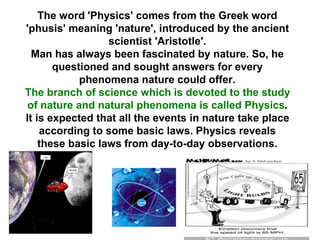
The word 'Physics' comes from the Greek word
'phusis' meaning 'nature', introduced by the ancient
scientist 'Aristotle'.
Man has always been fascinated by nature. So, he
questioned and sought answers for every
phenomena nature could offer.
The branch of science which is devoted to the study
of nature and natural phenomena is called Physics.
It is expected that all the events in nature take place
according to some basic laws. Physics reveals
these basic laws from day-to-day observations.
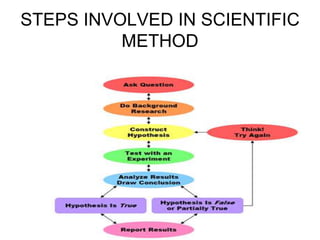
STEPS INVOLVED IN SCIENTIFIC
METHOD
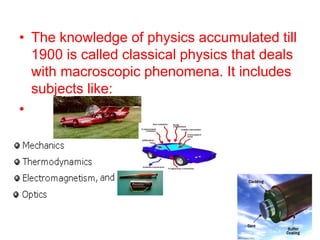
• The knowledge of physics accumulated till
1900 is called classical physics that deals
with macroscopic phenomena. It includes
subjects like:
•
• The recent knowledge (beyond 1900) is
termed 'modern physics', consisting of 2
basic theories.
• Relativity
• Quantum mechanics
Scope and excitement of physics
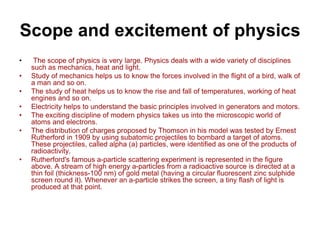
• The scope of physics is very large. Physics deals with a wide variety of disciplines
such as mechanics, heat and light.
• Study of mechanics helps us to know the forces involved in the flight of a bird, walk of
a man and so on.
• The study of heat helps us to know the rise and fall of temperatures, working of heat
engines and so on.
• Electricity helps to understand the basic principles involved in generators and motors.
• The exciting discipline of modern physics takes us into the microscopic world of
atoms and electrons.
• The distribution of charges proposed by Thomson in his model was tested by Ernest
Rutherford in 1909 by using subatomic projectiles to bombard a target of atoms.
These projectiles, called alpha (a) particles, were identified as one of the products of
radioactivity.
• Rutherford's famous a-particle scattering experiment is represented in the figure
above. A stream of high energy a-particles from a radioactive source is directed at a
thin foil (thickness-100 nm) of gold metal (having a circular fluorescent zinc sulphide
screen round it). Whenever an a-particle strikes the screen, a tiny flash of light is
produced at that point.
Physics in relation to science,
society and technology
• Among the various disciplines of science, the only discipline which can be
regarded as being most fundamental, is physics. It has played a key role in
the development of all other disciplines. For example,
• Physics in relation to chemistry The study of structure of atoms,
radioactivity, X-ray, diffraction, etc., in physics has enabled chemists to
rearrange elements in the periodic table and to have a better understanding
of chemical bonding and complex chemical structures.
•
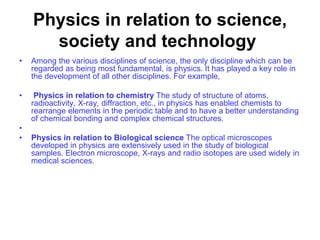
• Physics in relation to Biological science The optical microscopes
developed in physics are extensively used in the study of biological
samples. Electron microscope, X-rays and radio isotopes are used widely in
medical sciences.
• Physics in relation to astronomy The giant astronomical telescopes and radio
telescopes have enabled the astronomers to observe planets and other heavenly
objects.
• Physics related to mathematics Mathematics has served as a powerful tool in the
development of modern theoretical physics.
• Physics related to other sciences The other sciences like Biophysics, Geology,
Heterology and Oceanography and Seismology use some of the laws of physics.
•
• Physics related to society and technology The development of telephone,
telegraph and telex enables us to transmit messages instantly. The development of
radio and television satellites has revolutionised the means of
communication. Advances in electronics (computers, calculators and lasers) have
greatly enriched the society. Rapid means of transport are important for the
society. Generation of power from nuclear reactors is based on the phenomenon of
controlled nuclear chain reaction. Digital electronics is widely used in modern
technological developments.
The Basic Forces in Nature
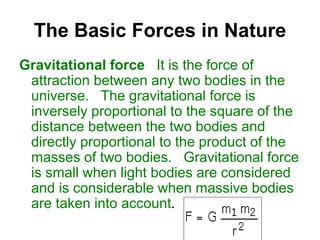
Gravitational force It is the force of
attraction between any two bodies in the
universe. The gravitational force is
inversely proportional to the square of the
distance between the two bodies and
directly proportional to the product of the
masses of two bodies. Gravitational force
is small when light bodies are considered
and is considerable when massive bodies
are taken into account.
Electrostatic force
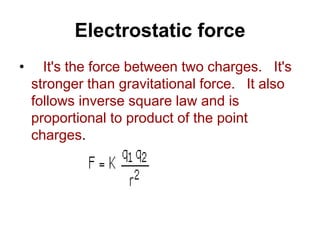
• It's the force between two charges. It's
stronger than gravitational force. It also
follows inverse square law and is
proportional to product of the point
charges.
• Magnetic force It can be either attractive or
repulsive. It can be the force between two magnets or
force on a magnet placed in a magnetic field.
• Electromagnetic force An electric charge moving in a
magnetic field experiences a force. This is called
electromagnetic force. It is a combination of electricity
and magnetism.
• Nuclear force This is a strong force with a short
range. It is non-central, i.e., it isn't directed along the
line joining the centres of the interacting particles. This
force acts within the nucleus.
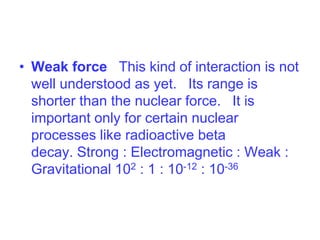
• Weak force This kind of interaction is not
well understood as yet. Its range is
shorter than the nuclear force. It is
important only for certain nuclear
processes like radioactive beta
decay. Strong : Electromagnetic : Weak :
Gravitational 102 : 1 : 10-12 : 10-36
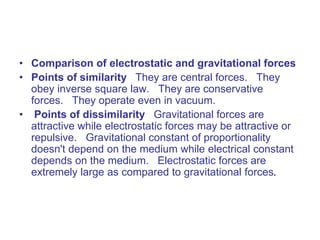
• Comparison of electrostatic and gravitational forces
• Points of similarity They are central forces. They
obey inverse square law. They are conservative
forces. They operate even in vacuum.
• Points of dissimilarity Gravitational forces are
attractive while electrostatic forces may be attractive or
repulsive. Gravitational constant of proportionality
doesn't depend on the medium while electrical constant
depends on the medium. Electrostatic forces are
extremely large as compared to gravitational forces.
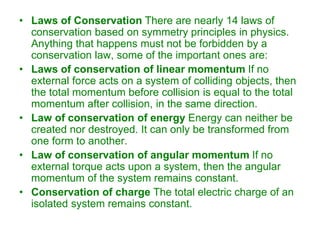
• Laws of Conservation There are nearly 14 laws of
conservation based on symmetry principles in physics.
Anything that happens must not be forbidden by a
conservation law, some of the important ones are:
• Laws of conservation of linear momentum If no
external force acts on a system of colliding objects, then
the total momentum before collision is equal to the total
momentum after collision, in the same direction.
• Law of conservation of energy Energy can neither be
created nor destroyed. It can only be transformed from
one form to another.
• Law of conservation of angular momentum If no
external torque acts upon a system, then the angular
momentum of the system remains constant.
• Conservation of charge The total electric charge of an
isolated system remains constant.

Physical world for class eleven science physics

  • 1.
    PHYSICAL WORLD UNIT-1 • WHATIS SCIENCE? • STEPS INVOLVED IN SCIENTIFIC METHOD • WHAT IS PHYSICS? • SCOPE AND EXPERIMENT OF PHYSICS • PHYSICS AND TECHNOLOGY AND SOCIETY • FUNDAMENTAL FORCES IN NATURE • NATURE OF PHYSICAL LAWS
  • 2.
    • The wordscience originates from the Latin word 'scientia', meaning 'to know'. The knowledge which man has gained through observations and experiments, when organised systematically, is called science. • . • The sciences which deal with non-living things are called physical sciences. Examples of physical sciences are physics, chemistry, geology, geography, astronomy, astrology and oceanology
  • 3.
    The word 'Physics'comes from the Greek word 'phusis' meaning 'nature', introduced by the ancient scientist 'Aristotle'. Man has always been fascinated by nature. So, he questioned and sought answers for every phenomena nature could offer. The branch of science which is devoted to the study of nature and natural phenomena is called Physics. It is expected that all the events in nature take place according to some basic laws. Physics reveals these basic laws from day-to-day observations.
  • 4.
    STEPS INVOLVED INSCIENTIFIC METHOD
  • 5.
    • The knowledgeof physics accumulated till 1900 is called classical physics that deals with macroscopic phenomena. It includes subjects like: •
  • 6.
    • The recentknowledge (beyond 1900) is termed 'modern physics', consisting of 2 basic theories. • Relativity • Quantum mechanics
  • 7.
    Scope and excitementof physics • The scope of physics is very large. Physics deals with a wide variety of disciplines such as mechanics, heat and light. • Study of mechanics helps us to know the forces involved in the flight of a bird, walk of a man and so on. • The study of heat helps us to know the rise and fall of temperatures, working of heat engines and so on. • Electricity helps to understand the basic principles involved in generators and motors. • The exciting discipline of modern physics takes us into the microscopic world of atoms and electrons. • The distribution of charges proposed by Thomson in his model was tested by Ernest Rutherford in 1909 by using subatomic projectiles to bombard a target of atoms. These projectiles, called alpha (a) particles, were identified as one of the products of radioactivity. • Rutherford's famous a-particle scattering experiment is represented in the figure above. A stream of high energy a-particles from a radioactive source is directed at a thin foil (thickness-100 nm) of gold metal (having a circular fluorescent zinc sulphide screen round it). Whenever an a-particle strikes the screen, a tiny flash of light is produced at that point.
  • 8.
    Physics in relationto science, society and technology • Among the various disciplines of science, the only discipline which can be regarded as being most fundamental, is physics. It has played a key role in the development of all other disciplines. For example, • Physics in relation to chemistry The study of structure of atoms, radioactivity, X-ray, diffraction, etc., in physics has enabled chemists to rearrange elements in the periodic table and to have a better understanding of chemical bonding and complex chemical structures. • • Physics in relation to Biological science The optical microscopes developed in physics are extensively used in the study of biological samples. Electron microscope, X-rays and radio isotopes are used widely in medical sciences.
  • 9.
    • Physics inrelation to astronomy The giant astronomical telescopes and radio telescopes have enabled the astronomers to observe planets and other heavenly objects. • Physics related to mathematics Mathematics has served as a powerful tool in the development of modern theoretical physics. • Physics related to other sciences The other sciences like Biophysics, Geology, Heterology and Oceanography and Seismology use some of the laws of physics. • • Physics related to society and technology The development of telephone, telegraph and telex enables us to transmit messages instantly. The development of radio and television satellites has revolutionised the means of communication. Advances in electronics (computers, calculators and lasers) have greatly enriched the society. Rapid means of transport are important for the society. Generation of power from nuclear reactors is based on the phenomenon of controlled nuclear chain reaction. Digital electronics is widely used in modern technological developments.
  • 10.
    The Basic Forcesin Nature Gravitational force It is the force of attraction between any two bodies in the universe. The gravitational force is inversely proportional to the square of the distance between the two bodies and directly proportional to the product of the masses of two bodies. Gravitational force is small when light bodies are considered and is considerable when massive bodies are taken into account.
  • 11.
    Electrostatic force • It'sthe force between two charges. It's stronger than gravitational force. It also follows inverse square law and is proportional to product of the point charges.
  • 12.
    • Magnetic forceIt can be either attractive or repulsive. It can be the force between two magnets or force on a magnet placed in a magnetic field. • Electromagnetic force An electric charge moving in a magnetic field experiences a force. This is called electromagnetic force. It is a combination of electricity and magnetism. • Nuclear force This is a strong force with a short range. It is non-central, i.e., it isn't directed along the line joining the centres of the interacting particles. This force acts within the nucleus.
  • 13.
    • Weak forceThis kind of interaction is not well understood as yet. Its range is shorter than the nuclear force. It is important only for certain nuclear processes like radioactive beta decay. Strong : Electromagnetic : Weak : Gravitational 102 : 1 : 10-12 : 10-36
  • 14.
    • Comparison ofelectrostatic and gravitational forces • Points of similarity They are central forces. They obey inverse square law. They are conservative forces. They operate even in vacuum. • Points of dissimilarity Gravitational forces are attractive while electrostatic forces may be attractive or repulsive. Gravitational constant of proportionality doesn't depend on the medium while electrical constant depends on the medium. Electrostatic forces are extremely large as compared to gravitational forces.
  • 15.
    • Laws ofConservation There are nearly 14 laws of conservation based on symmetry principles in physics. Anything that happens must not be forbidden by a conservation law, some of the important ones are: • Laws of conservation of linear momentum If no external force acts on a system of colliding objects, then the total momentum before collision is equal to the total momentum after collision, in the same direction. • Law of conservation of energy Energy can neither be created nor destroyed. It can only be transformed from one form to another. • Law of conservation of angular momentum If no external torque acts upon a system, then the angular momentum of the system remains constant. • Conservation of charge The total electric charge of an isolated system remains constant.