Photomicrograpghy
Nandeesha .s
Plant science
Bangalore central university
Introductions
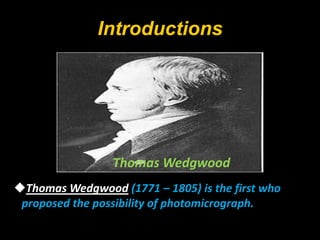
Thomas Wedgwood (1771 – 1805) is the first who
proposed the possibility of photomicrograph.
Thomas Wedgwood
Introduction
Photomicrography
A light micrograph or photomicrograph is a
micrograph prepared using an optical
microscope, a process referred to as
photomicroscopy.
a photomicrograph is a technical document
that can be of great value to science or
industry, a good photomicrograph is also an
object of beauty.
Photomicrography encompasses the
techniques of both black and white and
color photography.
Photomicrography is used to study the external
appearance and structure of objects.
 The ultimate function of the microscope
and its illumination is to produce the best
possible image of the specimen.
The ultimate function of the camera is to
capture the best possible image of the
specimen.
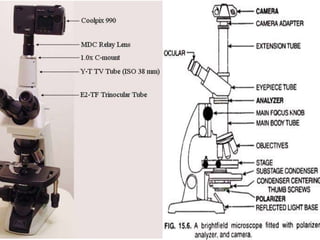
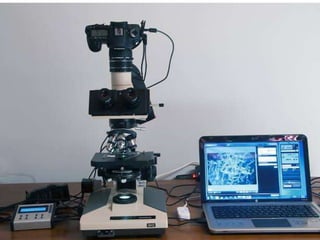
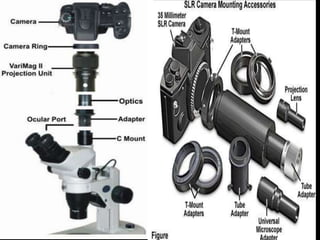
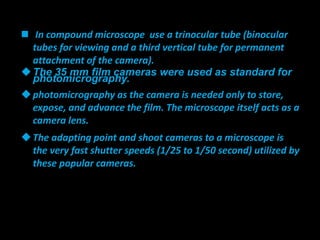
 In compound microscope use a trinocular tube (binocular
tubes for viewing and a third vertical tube for permanent
attachment of the camera).
The 35 mm film cameras were used as standard for
photomicrography.
photomicrography as the camera is needed only to store,
expose, and advance the film. The microscope itself acts as a
camera lens.
The adapting point and shoot cameras to a microscope is
the very fast shutter speeds (1/25 to 1/50 second) utilized by
these popular cameras.
Advantages Of Cameras
cheap
portable
can be operated without PC due to “Memory Cards”
Disadvantages of Cameras
image compression JPEG or FLASHPIX
loss of resolution, image artifacts
often low spatial resolution
all single chip cameras
integrated lenses: difficult adaptation
often noisy images
Light Source
Natural Sunlight (5400°K)
Florescent (7500°K)
Florescent (5000°K)
Florescent “Black-Light”
Incandescent (±2500°K)
Mercury Vapour
Metal Halides
Quartz-Iodine
Carbon Arc
Lasers
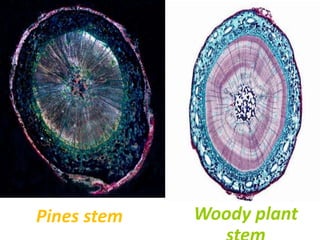
Pines stem Woody plant
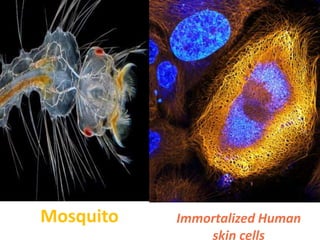
Mosquito Immortalized Human
skin cells
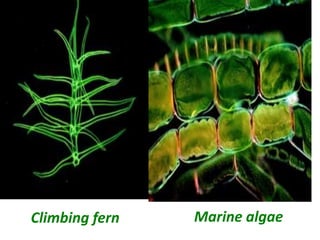
Climbing fern Marine algae
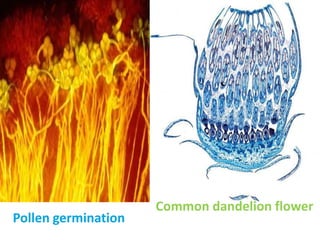
Pollen germination
Common dandelion flower
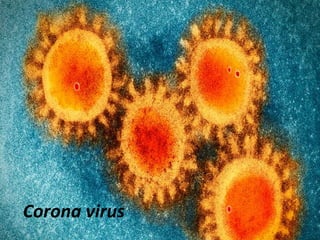
Corona virus
 Medical research and diagnostics
 Ecology and environmental contaminants
 Agriculture and food-microbial processes
 Criminal investigations
 Forestry and forest products
 Electronics
 Publications
 Educational textbooks, curricula and interactive CD-ROMs
 Exhibitions
Application of photomicrography
Thank you

Photomicrography histry, introdution, camera, application

  • 1.
  • 2.
    Introductions Thomas Wedgwood (1771– 1805) is the first who proposed the possibility of photomicrograph. Thomas Wedgwood
  • 3.
  • 4.
    Photomicrography A light micrographor photomicrograph is a micrograph prepared using an optical microscope, a process referred to as photomicroscopy. a photomicrograph is a technical document that can be of great value to science or industry, a good photomicrograph is also an object of beauty. Photomicrography encompasses the techniques of both black and white and color photography.
  • 5.
    Photomicrography is usedto study the external appearance and structure of objects.  The ultimate function of the microscope and its illumination is to produce the best possible image of the specimen. The ultimate function of the camera is to capture the best possible image of the specimen.
  • 10.
     In compoundmicroscope use a trinocular tube (binocular tubes for viewing and a third vertical tube for permanent attachment of the camera). The 35 mm film cameras were used as standard for photomicrography. photomicrography as the camera is needed only to store, expose, and advance the film. The microscope itself acts as a camera lens. The adapting point and shoot cameras to a microscope is the very fast shutter speeds (1/25 to 1/50 second) utilized by these popular cameras.
  • 11.
    Advantages Of Cameras cheap portable canbe operated without PC due to “Memory Cards” Disadvantages of Cameras image compression JPEG or FLASHPIX loss of resolution, image artifacts often low spatial resolution all single chip cameras integrated lenses: difficult adaptation often noisy images
  • 12.
    Light Source Natural Sunlight(5400°K) Florescent (7500°K) Florescent (5000°K) Florescent “Black-Light” Incandescent (±2500°K) Mercury Vapour Metal Halides Quartz-Iodine Carbon Arc Lasers
  • 13.
  • 14.
  • 15.
  • 16.
  • 17.
  • 18.
     Medical researchand diagnostics  Ecology and environmental contaminants  Agriculture and food-microbial processes  Criminal investigations  Forestry and forest products  Electronics  Publications  Educational textbooks, curricula and interactive CD-ROMs  Exhibitions Application of photomicrography
  • 19.