BY-
ROHIT SRIVASTAVA
 Introduction
 Fuzzy Logic
 Definition
 Development process
 Linguistic variables and hedges
 Operations on Fuzzy System
 Pros And Cons
 An Example:Air Conditioner
 Applicability
 Experts rely on common sense when they solve
problems.
 How can we represent expert knowledge that
uses vague and ambiguous terms in a computer?
 Fuzzy logic is not logic that is fuzzy, but logic
that is used to describe fuzziness.
 Fuzzy logic is the theory of fuzzy sets, sets that
calibrate vagueness.
 Fuzzy logic is based on the idea that all things
admit of degrees.
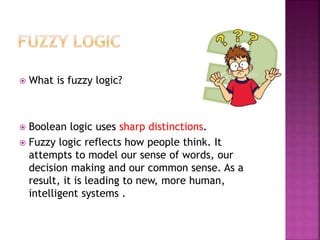
 What is fuzzy logic?
 Boolean logic uses sharp distinctions.
 Fuzzy logic reflects how people think. It
attempts to model our sense of words, our
decision making and our common sense. As a
result, it is leading to new, more human,
intelligent systems .
Why fuzzy?
 As Zadeh said, the term is concrete, immediate and
descriptive.
Why logic?
 Fuzziness rests on fuzzy set theory, and fuzzy logic is just a
small part of that theory.
 Fuzzy logic is useful for commercial and practical
purposes.
 It can control machines and consumer products. It may not
give accurate reasoning, but acceptable reasoning.
 Fuzzy logic helps to deal with the uncertainty in
engineering.
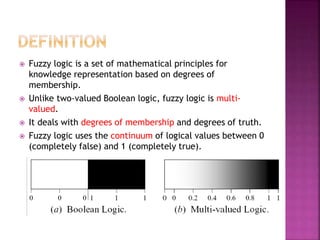
 Fuzzy logic is a set of mathematical principles for
knowledge representation based on degrees of
membership.
 Unlike two-valued Boolean logic, fuzzy logic is multi-
valued.
 It deals with degrees of membership and degrees of truth.
 Fuzzy logic uses the continuum of logical values between 0
(completely false) and 1 (completely true).
 Specify the problem;define linguistic variables.
 Determine fuzzy sets.
 Elicit and construct fuzzy rules.
 Encode the fuzzy sets,fuzzy rules and procedures
required to perform fuzzy inference into expert
system.
 Evaluate and tune the system.
 At the root of fuzzy set theory lies the idea of linguistic
variables.
 A linguistic variable is a fuzzy variable. For example, the
statement “John is tall” implies that the linguistic variable
John takes the linguistic value tall.
 Example
IF wind is strong
THEN sailing is good
IF project_duration is long
THEN completion_risk is high
IF speed is slow
THEN stopping_distance is short
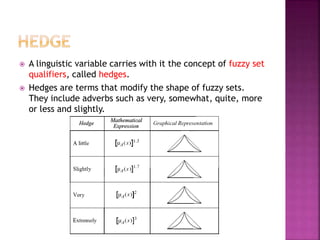
 A linguistic variable carries with it the concept of fuzzy set
qualifiers, called hedges.
 Hedges are terms that modify the shape of fuzzy sets.
They include adverbs such as very, somewhat, quite, more
or less and slightly.
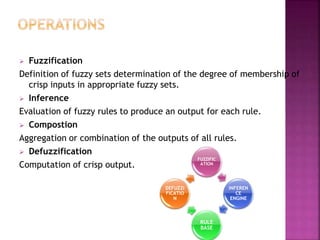
 Fuzzification
Definition of fuzzy sets determination of the degree of membership of
crisp inputs in appropriate fuzzy sets.
 Inference
Evaluation of fuzzy rules to produce an output for each rule.
 Compostion
Aggregation or combination of the outputs of all rules.
 Defuzzification
Computation of crisp output.
FUZZIFIC
ATION
INFEREN
CE
ENGINE
RULE
BASE
DEFUZZI
FICATIO
N
 PROS
 Mathematical concepts within fuzzy reasoning are very
simple.
 You can modify a FLS by just adding or deleting rules due
to flexibility of fuzzy logic.
 Fuzzy logic Systems can take imprecise, distorted, noisy
input information.
 FLSs are easy to construct and understand.
 Fuzzy logic is a solution to complex problems in all fields
of life, including medicine, as it resembles human
reasoning and decision making.
 CONS
 There is no systematic approach to fuzzy system designing.
 They are understandable only when simple. They are
suitable for the problems which do not need high accuracy.
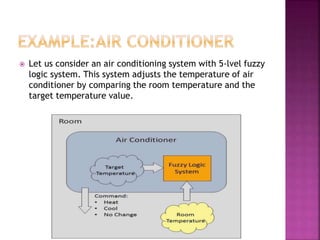
 Let us consider an air conditioning system with 5-lvel fuzzy
logic system. This system adjusts the temperature of air
conditioner by comparing the room temperature and the
target temperature value.
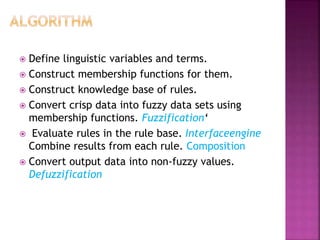
 Define linguistic variables and terms.
 Construct membership functions for them.
 Construct knowledge base of rules.
 Convert crisp data into fuzzy data sets using
membership functions. Fuzzification‘
 Evaluate rules in the rule base. Interfaceengine
Combine results from each rule. Composition
 Convert output data into non-fuzzy values.
Defuzzification
 Step 1: Define linguistic variables and
terms
 Linguistic variables are input and output
variables in the form of simple words or
sentences. For room temperature, cold,
warm, hot, etc., are linguistic terms.
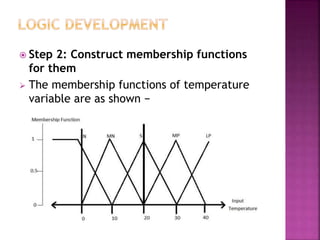
 Temperature t = {very-cold, cold, warm,
very-warm, hot}
 Step 2: Construct membership functions
for them
 The membership functions of temperature
variable are as shown −
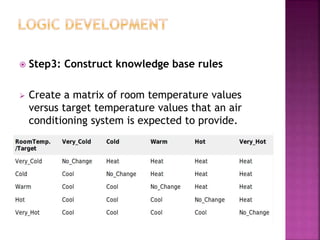
 Step3: Construct knowledge base rules
 Create a matrix of room temperature values
versus target temperature values that an air
conditioning system is expected to provide.
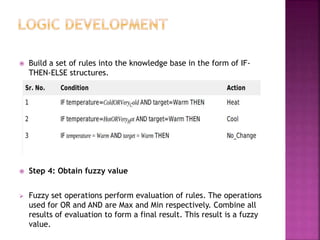
 Build a set of rules into the knowledge base in the form of IF-
THEN-ELSE structures.
 Step 4: Obtain fuzzy value
 Fuzzy set operations perform evaluation of rules. The operations
used for OR and AND are Max and Min respectively. Combine all
results of evaluation to form a final result. This result is a fuzzy
value.
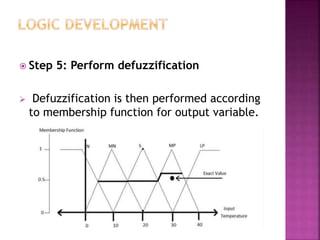
 Step 5: Perform defuzzification
 Defuzzification is then performed according
to membership function for output variable.
The key application areas of fuzzy logic are as given −
 Automotive Systems
 Automatic Gearboxes
 Four-Wheel Steering
 Consumer Electronic Goods
 Hi-Fi Systems
 Television
 Domestic Goods
 Microwave Ovens
 Refrigerators
 Environment Control
 Air Conditioners/Dryers/Heaters
 Humidifiers
Fuzzy expert system

Fuzzy expert system

  • 1.
  • 2.
     Introduction  FuzzyLogic  Definition  Development process  Linguistic variables and hedges  Operations on Fuzzy System  Pros And Cons  An Example:Air Conditioner  Applicability
  • 3.
     Experts relyon common sense when they solve problems.  How can we represent expert knowledge that uses vague and ambiguous terms in a computer?  Fuzzy logic is not logic that is fuzzy, but logic that is used to describe fuzziness.  Fuzzy logic is the theory of fuzzy sets, sets that calibrate vagueness.  Fuzzy logic is based on the idea that all things admit of degrees.
  • 4.
     What isfuzzy logic?  Boolean logic uses sharp distinctions.  Fuzzy logic reflects how people think. It attempts to model our sense of words, our decision making and our common sense. As a result, it is leading to new, more human, intelligent systems .
  • 5.
    Why fuzzy?  AsZadeh said, the term is concrete, immediate and descriptive. Why logic?  Fuzziness rests on fuzzy set theory, and fuzzy logic is just a small part of that theory.  Fuzzy logic is useful for commercial and practical purposes.  It can control machines and consumer products. It may not give accurate reasoning, but acceptable reasoning.  Fuzzy logic helps to deal with the uncertainty in engineering.
  • 6.
     Fuzzy logicis a set of mathematical principles for knowledge representation based on degrees of membership.  Unlike two-valued Boolean logic, fuzzy logic is multi- valued.  It deals with degrees of membership and degrees of truth.  Fuzzy logic uses the continuum of logical values between 0 (completely false) and 1 (completely true).
  • 7.
     Specify theproblem;define linguistic variables.  Determine fuzzy sets.  Elicit and construct fuzzy rules.  Encode the fuzzy sets,fuzzy rules and procedures required to perform fuzzy inference into expert system.  Evaluate and tune the system.
  • 8.
     At theroot of fuzzy set theory lies the idea of linguistic variables.  A linguistic variable is a fuzzy variable. For example, the statement “John is tall” implies that the linguistic variable John takes the linguistic value tall.  Example IF wind is strong THEN sailing is good IF project_duration is long THEN completion_risk is high IF speed is slow THEN stopping_distance is short
  • 9.
     A linguisticvariable carries with it the concept of fuzzy set qualifiers, called hedges.  Hedges are terms that modify the shape of fuzzy sets. They include adverbs such as very, somewhat, quite, more or less and slightly.
  • 10.
     Fuzzification Definition offuzzy sets determination of the degree of membership of crisp inputs in appropriate fuzzy sets.  Inference Evaluation of fuzzy rules to produce an output for each rule.  Compostion Aggregation or combination of the outputs of all rules.  Defuzzification Computation of crisp output. FUZZIFIC ATION INFEREN CE ENGINE RULE BASE DEFUZZI FICATIO N
  • 11.
     PROS  Mathematicalconcepts within fuzzy reasoning are very simple.  You can modify a FLS by just adding or deleting rules due to flexibility of fuzzy logic.  Fuzzy logic Systems can take imprecise, distorted, noisy input information.  FLSs are easy to construct and understand.  Fuzzy logic is a solution to complex problems in all fields of life, including medicine, as it resembles human reasoning and decision making.  CONS  There is no systematic approach to fuzzy system designing.  They are understandable only when simple. They are suitable for the problems which do not need high accuracy.
  • 12.
     Let usconsider an air conditioning system with 5-lvel fuzzy logic system. This system adjusts the temperature of air conditioner by comparing the room temperature and the target temperature value.
  • 13.
     Define linguisticvariables and terms.  Construct membership functions for them.  Construct knowledge base of rules.  Convert crisp data into fuzzy data sets using membership functions. Fuzzification‘  Evaluate rules in the rule base. Interfaceengine Combine results from each rule. Composition  Convert output data into non-fuzzy values. Defuzzification
  • 14.
     Step 1:Define linguistic variables and terms  Linguistic variables are input and output variables in the form of simple words or sentences. For room temperature, cold, warm, hot, etc., are linguistic terms.  Temperature t = {very-cold, cold, warm, very-warm, hot}
  • 15.
     Step 2:Construct membership functions for them  The membership functions of temperature variable are as shown −
  • 16.
     Step3: Constructknowledge base rules  Create a matrix of room temperature values versus target temperature values that an air conditioning system is expected to provide.
  • 17.
     Build aset of rules into the knowledge base in the form of IF- THEN-ELSE structures.  Step 4: Obtain fuzzy value  Fuzzy set operations perform evaluation of rules. The operations used for OR and AND are Max and Min respectively. Combine all results of evaluation to form a final result. This result is a fuzzy value.
  • 18.
     Step 5:Perform defuzzification  Defuzzification is then performed according to membership function for output variable.
  • 19.
    The key applicationareas of fuzzy logic are as given −  Automotive Systems  Automatic Gearboxes  Four-Wheel Steering  Consumer Electronic Goods  Hi-Fi Systems  Television  Domestic Goods  Microwave Ovens  Refrigerators  Environment Control  Air Conditioners/Dryers/Heaters  Humidifiers