HEALTH SURVEILLANCE
AND HEALTH
INFORMATICS
PRESENTED
TO YOU BY:
ABHISHEK
SINGH
MSC
NURSING 1
ST YEAR
HFCON
EDIT IN POWERPOINT®
Click on the button under the presentation
preview that says "Download as
PowerPoint template". You will get a
.pptx file that you can edit in PowerPoint.
Remember to download and install the
fonts used in this presentation (you’ll find
the links to the font files needed in the
Presentation design slide)
EDIT IN GOOGLE SLIDES
Click on the button under the presentation
preview that says "Use as Google Slides
Theme".
You will get a copy of this document on
your Google Drive and will be able to edit,
add or delete slides.
You have to be signed in to your Google
account.
More info on how to use this template at www.slidescarnival.com/help-use-
presentation-template
This template is free to use under Creative Commons Attribution license. You can keep
the Credits slide or mention SlidesCarnival and other resources used in a slide footer.
3
INTRODUCTION
In the everyday life of hustle and bustle, it is almost a
lacking hour to keep a watch on health. As being noted by
many great leaders and personalities around us “health is
life”. We must keep an eye to look for it. As it is a need of
the hour to keep our health maintained and to keep a keen
watch over it. Thus emphasizing its “SURVEILLANCE”.
4
“It is health that is real wealth
and not pieces of gold and silver.”
– Mahatma Gandhi
5
DEFINITION
▫ Surveillance is a systematic process of collection,
transmission, analysis and feedback of public
health data for decision making.
▫ The surveillance means supervision or close watch
especially on suspected person. Epidemiologically
surveillance means close vigilance on occurrence
and distribution of diseases, health related
problems, population of dynamics, community
behavior as well as environmental processes
resulting in increased risk of ill health in the
community
6
WHY IS IT
IMPORTANT TO
SURVEILLANCE
THE HEALTH ?
▫ It serves as an early warning system for
impending public health emergencies.
▫ It document the impact of an
intervention, or track progress towards
specified goals
▫ Monitor and clarify the epidemiology of
health problems, to allow priorities to be
set and to inform public health policy
and strategies.
7
PURPOSES OF
HEALTH
SURVEILLANCE
8
TYPES OF
HEALTH
SURVEIILANCE
9
INDIVIDUAL OR
FAMILY
SURVEILLANCE
• COMMUNITY
OR LOCAL
POPULATION
SURVEILLANC
E
• NATIONAL
SURVEILLANCE
INTERNATIONAL
SURVEILLANCE
INDIVIDUAL OR FAMILY
SURVEILLANCE
It includes surveillance of an
infected person in a family as
long as the individual is the
source of infection to others . e.g.
typhoid case and carriers
10
COMMUNITY OR LOCAL
POPULATION
SURVEILLANCE
▫ It includes surveillance of the
whole community for early
detection and prevention &
control of a disease e.g.
malaria
11
NATIONAL
SURVEILLANCE
▫ It includes surveillance at the
National level e.g
surveillance of small pox
after its eradication.
12
INTERNATIONAL
SURVEILLANCE
▫ It includes surveillance of
some of the diseases which
are listed by WHO e.g
malaria, influenza etc. are to
be reported information to
the countries in the world to
take timely actions.
13
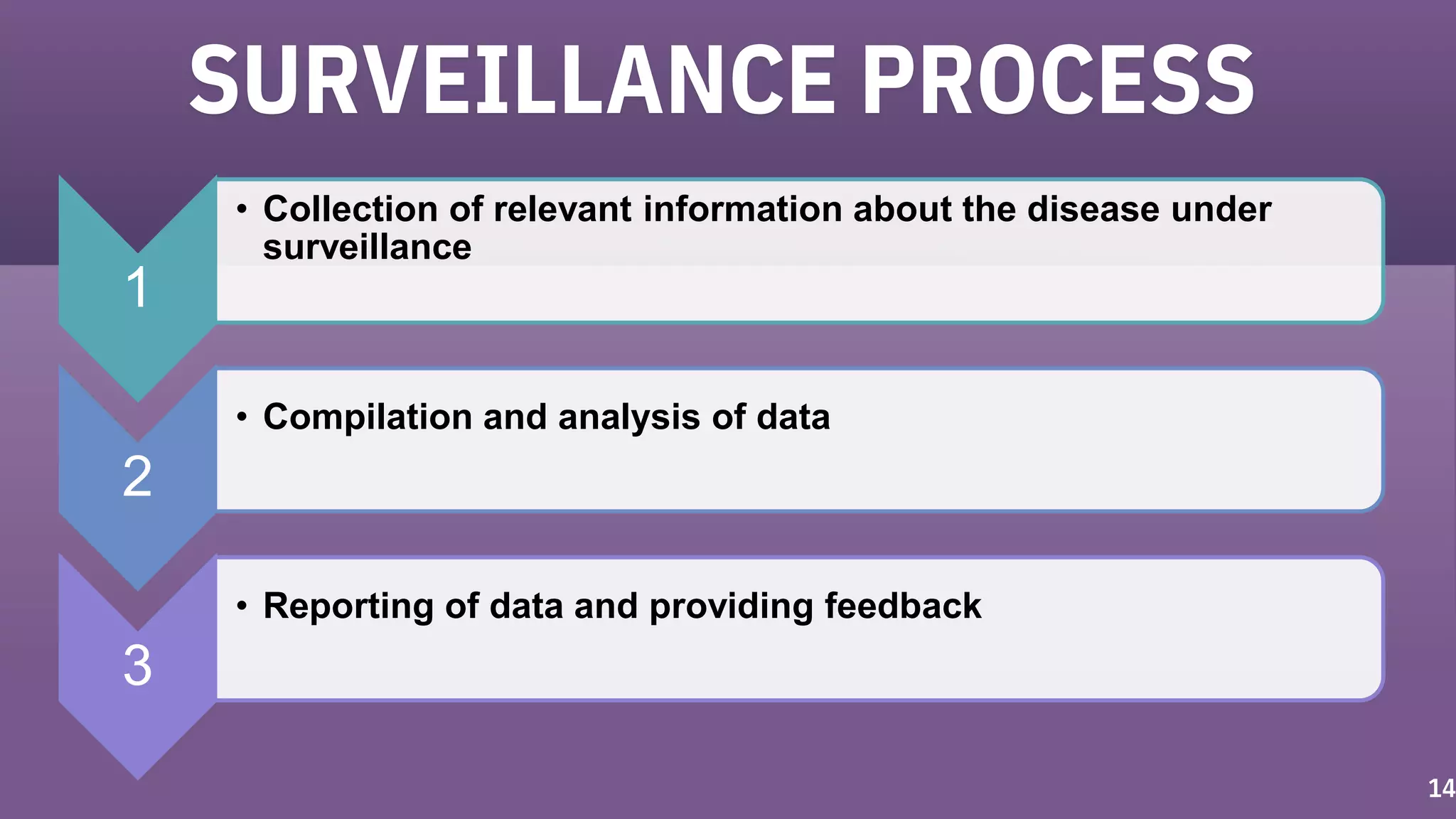
SURVEILLANCE PROCESS
14
1
• Collection of relevant information about the disease under
surveillance
2
• Compilation and analysis of data
3
• Reporting of data and providing feedback
HEALTH INFORMATICS .
15
WHAT DO YOU
MEAN BY
HEALTH
INFORMATICS
?
16
Lorem ipsum congue
tempus
Lorem ipsum
tempus
DEFINITION ▫ To define this information of health or
the term “HEALTH INFORMATICS”.
IT can be stated as “a mechanism for
the collection, processing, analysis,
and transmission of information
required for organizing and operating
health services and also for research
& training”.
17
Subsets of
Health
Informatics
Includes
18
Nursing
informatics
▫ Nursing informatics (NI) is the specialty that
integrates nursing science with multiple information
management and analytical sciences to identify,
define, manage, and communicate data, information,
knowledge, and wisdom in nursing practice.
▫ NI supports nurses, consumers, patients, the
interprofessional healthcare team, and other
stakeholders in their decision-making in all roles and
settings to achieve desired outcomes. This support is
accomplished through the use of information
structures, information processes, and information
technology
19
OBJECTIVES
▫ The health information system serves a primary objective of
providing reliable, relevant, up-to-date, adequate, timely and
reasonably complete information for health managers at all the
managing levels.
▫
▫ To share technical and specific information by all health personnel
participating in all the health services of country.
▫
▫ To provide at periodic intervals the data that will show the general
performance of the health services.
▫
▫ To assist planners in studying their current functioning and trends
in demand and work load.
20
DATA V/S
INFORMATION !
LETS SEE WHO
WINS ?
21
DATA INFORMATION
 It consist of discrete observation of
events that carry little meaning
when considered alone.
 As data collected fromoperating
health care systems are inadequate
for planning.
 So this data needs to be transformed into
“INFORMATION” by reducing,
summarizing, adjusting themfor variation
 Such as age, sex, composition of
population so that comparisons over time
and place are possible.
WHO
STANDARD
CRITERIA FOR
HEALTH
INFORMATION
SYSTEM.
22
A WHO expert committee identified the following requirements to be satisfied by the
health information system
 The system should be population-based
 The system should avoid the unnecessary agglomeration of data
 The system should be problem oriented
 The system should employ functional and operational terms (e.g episodes of
illness, treatment regimens, laboratory tests )
 The system should express information briefly and imaginatively
 The system should make provisions for feedback of data
USES OF
HEALTH
INFORMATICS
▫ To measure the health status of the people & to
quantify their health problems and medical as well as
health care needs
▫ For local, national & international comparisons of
health status.
▫ For planning , administration & effective management
of health services and programmes
▫ For assessing whether health services are
accomplishing their objectives in term of
effectiveness and efficiency
▫ For assessing the attitude and degree of satisfaction
of the beneficiaries with the health system
▫ For research into particular problem and disease
23
24
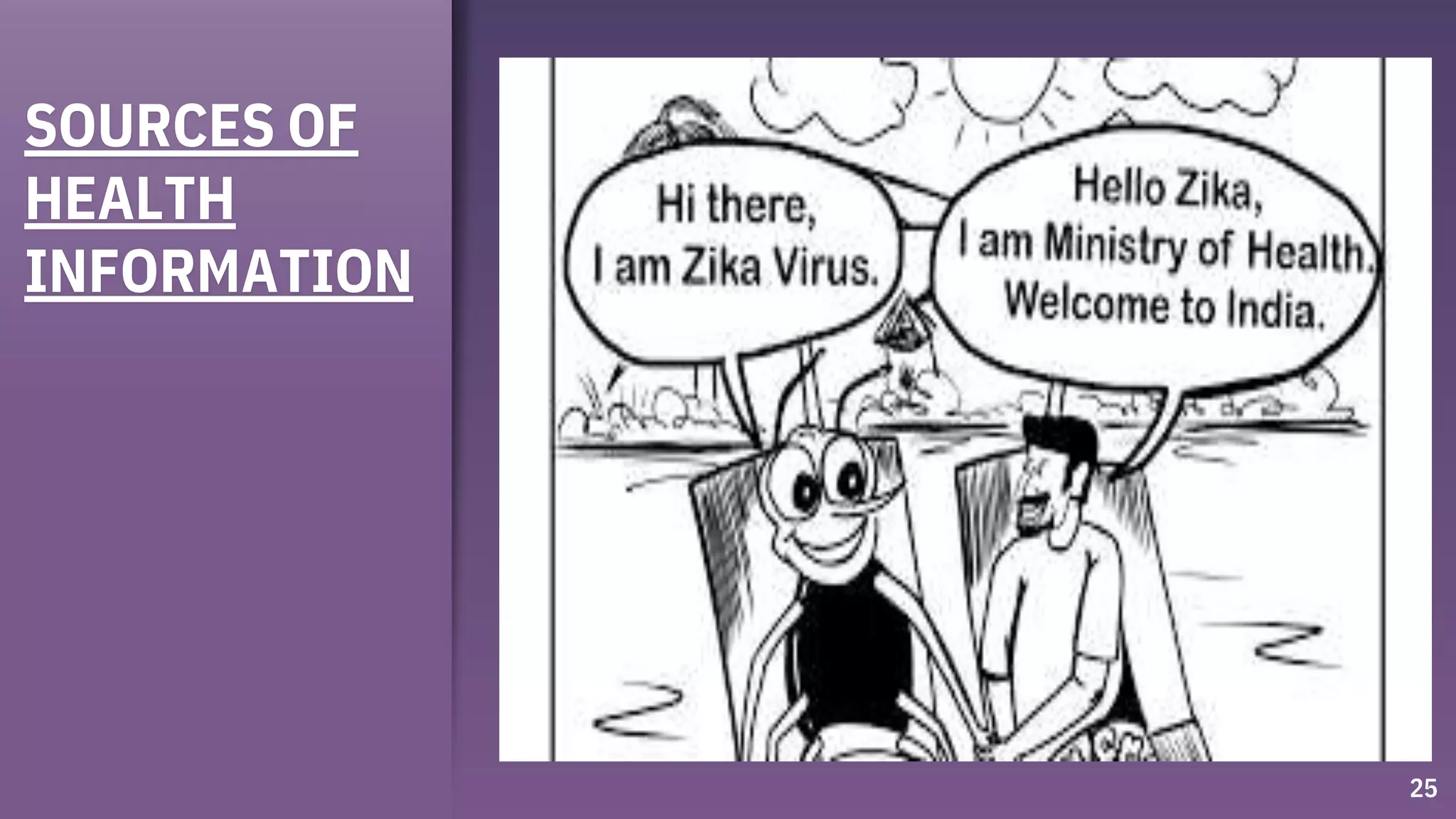
SOURCES OF
HEALTH
INFORMATION
25
LETS TAKE
A TOUR !
▫ EVER HEARD OF DIGITAL HEALTH ?
▫ https://mohfw.gov.in/about-
us/departments/departments-
health-and-family-welfare/e-
Health%20%26%20Telemedicine
26
CENSUS ▫ The census is an important source of
health information. It is taken in most
of the countries of the world at regular
intervals usually of 10years. A census
is defined by the united nations as the
total process of collecting , compiling
and publishing demographic,
economic and social data pertaining at
a specific times at all persons in the
country or delimited territory.
27
REGISTRATION
OF VITAL
EVENTS
▫ Registration of vital events (e.g, births and deaths )
keeps a continuous check on demographic changes. If
registration of vital events is complete or accurate, it
can serve as a reliable source of health information.
▫
▫ The united nations defines a vital events as
registration as including legal registration, statistical
recording of the occurrence of , and the collection ,
compilation, presentation, analysis and distribution of
statics pertaining to vital events i.e, live birth, deaths ,
fetal deaths, marriages, divorces, adoptions, legal
limitations, recognitions, annulments and legal
separations.
28
SAMPLE
REGISTRATION
SYSTEM (SRS)
▫ SRS was initiated in mid 1960’s to provide reliable estimates of
birth and deaths rates at the national & state level. The Sample
Registration System (SRS) is a large-scale demographic survey for
providing reliable annual estimates of Infant mortality rate, birth
rate, death rate and other fertility & mortality indicators at the
national and subnational levels.
▫ The current Sample is based on the 2011 Census frame. At
present, SRS is operational in 8850 sample units (4,961 rural and
3,889 urban) covering about 7.9 million population, spread across
all States and Union territories.
▫ This system is more reliable for information on birth and death
rates, age specific fertility and mortality rates, infant and adults,
mortality etc.
29
NOTIFICATION
OF DISEASES
It provides information
of about fluctuations in
disease frequency and
provides early warning
about ne occurrences
and outbreak of
diseases
▫ The primary purpose of notification is no
effect prevention and control of the
diseases. Notification is also a valuable
source of morbidity data i.e the
incidence & distribution of certain
diseases which are modified.
▫ .
30
HOSPITALS
RECORDS
▫ In India , where
registration of vital events
is defective & notification
of infectious disease is
extremely inadequate,
hospital data constitutes a
basic source of information
about disease prevalent in
the community.
31
DISEASE
REGISTER
▫ A Register requires data that a permanent record
be established , that the cases be followed up& the
basic statistical tabulations be prepared both on
frequency and on survival.
▫ These registers are of valuable information as to
duration of illness , case fatality and & survival .
▫ These registers provide follow up of patients and
provide a continuous account at the frequency of
disease in the community.
32
RECORD
LINKAGE ▫ The term record linkage is used to describe the
process of bringing together records relating to one
individual, the records originating in different times
or place.
▫ The term medical record linkage implies the
assembly and maintenance of each individual in a
population, of a file of the more important records
relating to his health.
▫ Therefore in practice record linkage has been
applied only on a limited scale .
▫ The events recorded are birth, marriage, death,
hospital admission and discharge.
▫
33
EPIDEMIOLO
GICAL
SURVEILLANC
E
▫ In many countries where particular diseases are endemic
special control eradication programmes have been
instituted. For example, National Disease Control
Programmes against malaria, tuberculosis, leprosy etc.
These programmes have yielded considerable morbidity
and mortality data for the specific diseases.
34
OTHER
HEALTH
SERVICE
RECORDS
▫ These are hospital out patient departments,
primary health centers, sub centres, polyclinics,
private practionioners, mother and child health
centres. For example maternal and child health
centres provide information in birth weight, height,
arm circumference, immunization, disease specific.
35
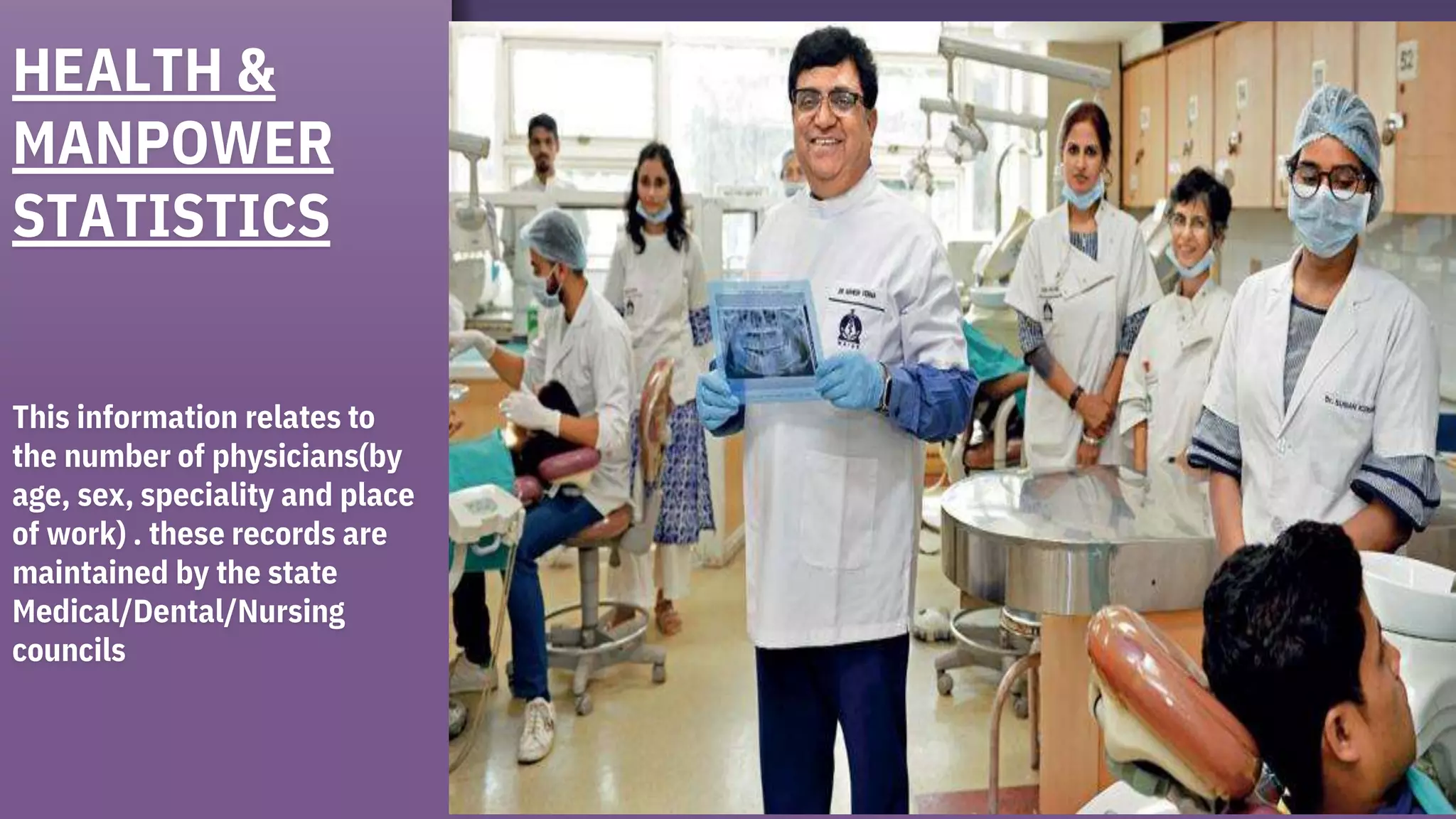
HEALTH &
MANPOWER
STATISTICS
This information relates to
the number of physicians(by
age, sex, speciality and place
of work) . these records are
maintained by the state
Medical/Dental/Nursing
councils
36
POPULATION
SURVEYS
The term survey is used
for surveys relating to
any aspect of health-
morbidity, mortality,
nutritional status etc
37
Emerging
concepts
▫ Integration with natural language-based systems
▫ Real-time addition of new data to integrate with clinical
probability database
▫ Learning systems that improve their accuracy with time
▫ Will require an expanded and holistic understanding of health
care
▫ Requires an understanding of mathematical and computer-
based concepts of management
▫ Changing concepts related to the practice of medicine
▫ Improving surveillance of disease and health issues
▫ Improving accuracy of diagnosis, reducing time to diagnosis,
and improving accuracy and efficacy of treatment
▫ Potential for cost-savings related to best evidence-based
practice
38
ROLE OF A
NURSE
39
• Nursing, as with healthcare in general, informatics is
being used to address the challenges of the day,
significantly impacting the way nurses function in
patient care.
• The Healthcare Information and Management Systems
Society reported that as the result of electronic
charting, nurses are able to obtain information quickly
and efficiently, using the information to improve the
daily workflow. Storing the information electronically is
more easily available to all members of the care team,
including the physician and other care providers, as
well as staff teams at other healthcare organizations
that the patient may visit.
Maps
our office
40
ANY SUGGESTIONS ?
41
89,526,124$
That’s a lot of money
100%
Total success!
185,244 users
And a lot of users
42

Health surveillnace and informatics ppt

  • 2.
  • 3.
    PRESENTED TO YOU BY: ABHISHEK SINGH MSC NURSING1 ST YEAR HFCON EDIT IN POWERPOINT® Click on the button under the presentation preview that says "Download as PowerPoint template". You will get a .pptx file that you can edit in PowerPoint. Remember to download and install the fonts used in this presentation (you’ll find the links to the font files needed in the Presentation design slide) EDIT IN GOOGLE SLIDES Click on the button under the presentation preview that says "Use as Google Slides Theme". You will get a copy of this document on your Google Drive and will be able to edit, add or delete slides. You have to be signed in to your Google account. More info on how to use this template at www.slidescarnival.com/help-use- presentation-template This template is free to use under Creative Commons Attribution license. You can keep the Credits slide or mention SlidesCarnival and other resources used in a slide footer. 3
  • 4.
    INTRODUCTION In the everydaylife of hustle and bustle, it is almost a lacking hour to keep a watch on health. As being noted by many great leaders and personalities around us “health is life”. We must keep an eye to look for it. As it is a need of the hour to keep our health maintained and to keep a keen watch over it. Thus emphasizing its “SURVEILLANCE”. 4
  • 5.
    “It is healththat is real wealth and not pieces of gold and silver.” – Mahatma Gandhi 5
  • 6.
    DEFINITION ▫ Surveillance isa systematic process of collection, transmission, analysis and feedback of public health data for decision making. ▫ The surveillance means supervision or close watch especially on suspected person. Epidemiologically surveillance means close vigilance on occurrence and distribution of diseases, health related problems, population of dynamics, community behavior as well as environmental processes resulting in increased risk of ill health in the community 6
  • 7.
    WHY IS IT IMPORTANTTO SURVEILLANCE THE HEALTH ? ▫ It serves as an early warning system for impending public health emergencies. ▫ It document the impact of an intervention, or track progress towards specified goals ▫ Monitor and clarify the epidemiology of health problems, to allow priorities to be set and to inform public health policy and strategies. 7
  • 8.
  • 9.
    TYPES OF HEALTH SURVEIILANCE 9 INDIVIDUAL OR FAMILY SURVEILLANCE •COMMUNITY OR LOCAL POPULATION SURVEILLANC E • NATIONAL SURVEILLANCE INTERNATIONAL SURVEILLANCE
  • 10.
    INDIVIDUAL OR FAMILY SURVEILLANCE Itincludes surveillance of an infected person in a family as long as the individual is the source of infection to others . e.g. typhoid case and carriers 10
  • 11.
    COMMUNITY OR LOCAL POPULATION SURVEILLANCE ▫It includes surveillance of the whole community for early detection and prevention & control of a disease e.g. malaria 11
  • 12.
    NATIONAL SURVEILLANCE ▫ It includessurveillance at the National level e.g surveillance of small pox after its eradication. 12
  • 13.
    INTERNATIONAL SURVEILLANCE ▫ It includessurveillance of some of the diseases which are listed by WHO e.g malaria, influenza etc. are to be reported information to the countries in the world to take timely actions. 13
  • 14.
    SURVEILLANCE PROCESS 14 1 • Collectionof relevant information about the disease under surveillance 2 • Compilation and analysis of data 3 • Reporting of data and providing feedback
  • 15.
  • 16.
    WHAT DO YOU MEANBY HEALTH INFORMATICS ? 16 Lorem ipsum congue tempus Lorem ipsum tempus
  • 17.
    DEFINITION ▫ Todefine this information of health or the term “HEALTH INFORMATICS”. IT can be stated as “a mechanism for the collection, processing, analysis, and transmission of information required for organizing and operating health services and also for research & training”. 17
  • 18.
  • 19.
    Nursing informatics ▫ Nursing informatics(NI) is the specialty that integrates nursing science with multiple information management and analytical sciences to identify, define, manage, and communicate data, information, knowledge, and wisdom in nursing practice. ▫ NI supports nurses, consumers, patients, the interprofessional healthcare team, and other stakeholders in their decision-making in all roles and settings to achieve desired outcomes. This support is accomplished through the use of information structures, information processes, and information technology 19
  • 20.
    OBJECTIVES ▫ The healthinformation system serves a primary objective of providing reliable, relevant, up-to-date, adequate, timely and reasonably complete information for health managers at all the managing levels. ▫ ▫ To share technical and specific information by all health personnel participating in all the health services of country. ▫ ▫ To provide at periodic intervals the data that will show the general performance of the health services. ▫ ▫ To assist planners in studying their current functioning and trends in demand and work load. 20
  • 21.
    DATA V/S INFORMATION ! LETSSEE WHO WINS ? 21 DATA INFORMATION  It consist of discrete observation of events that carry little meaning when considered alone.  As data collected fromoperating health care systems are inadequate for planning.  So this data needs to be transformed into “INFORMATION” by reducing, summarizing, adjusting themfor variation  Such as age, sex, composition of population so that comparisons over time and place are possible.
  • 22.
    WHO STANDARD CRITERIA FOR HEALTH INFORMATION SYSTEM. 22 A WHOexpert committee identified the following requirements to be satisfied by the health information system  The system should be population-based  The system should avoid the unnecessary agglomeration of data  The system should be problem oriented  The system should employ functional and operational terms (e.g episodes of illness, treatment regimens, laboratory tests )  The system should express information briefly and imaginatively  The system should make provisions for feedback of data
  • 23.
    USES OF HEALTH INFORMATICS ▫ Tomeasure the health status of the people & to quantify their health problems and medical as well as health care needs ▫ For local, national & international comparisons of health status. ▫ For planning , administration & effective management of health services and programmes ▫ For assessing whether health services are accomplishing their objectives in term of effectiveness and efficiency ▫ For assessing the attitude and degree of satisfaction of the beneficiaries with the health system ▫ For research into particular problem and disease 23
  • 24.
  • 25.
  • 26.
    LETS TAKE A TOUR! ▫ EVER HEARD OF DIGITAL HEALTH ? ▫ https://mohfw.gov.in/about- us/departments/departments- health-and-family-welfare/e- Health%20%26%20Telemedicine 26
  • 27.
    CENSUS ▫ Thecensus is an important source of health information. It is taken in most of the countries of the world at regular intervals usually of 10years. A census is defined by the united nations as the total process of collecting , compiling and publishing demographic, economic and social data pertaining at a specific times at all persons in the country or delimited territory. 27
  • 28.
    REGISTRATION OF VITAL EVENTS ▫ Registrationof vital events (e.g, births and deaths ) keeps a continuous check on demographic changes. If registration of vital events is complete or accurate, it can serve as a reliable source of health information. ▫ ▫ The united nations defines a vital events as registration as including legal registration, statistical recording of the occurrence of , and the collection , compilation, presentation, analysis and distribution of statics pertaining to vital events i.e, live birth, deaths , fetal deaths, marriages, divorces, adoptions, legal limitations, recognitions, annulments and legal separations. 28
  • 29.
    SAMPLE REGISTRATION SYSTEM (SRS) ▫ SRSwas initiated in mid 1960’s to provide reliable estimates of birth and deaths rates at the national & state level. The Sample Registration System (SRS) is a large-scale demographic survey for providing reliable annual estimates of Infant mortality rate, birth rate, death rate and other fertility & mortality indicators at the national and subnational levels. ▫ The current Sample is based on the 2011 Census frame. At present, SRS is operational in 8850 sample units (4,961 rural and 3,889 urban) covering about 7.9 million population, spread across all States and Union territories. ▫ This system is more reliable for information on birth and death rates, age specific fertility and mortality rates, infant and adults, mortality etc. 29
  • 30.
    NOTIFICATION OF DISEASES It providesinformation of about fluctuations in disease frequency and provides early warning about ne occurrences and outbreak of diseases ▫ The primary purpose of notification is no effect prevention and control of the diseases. Notification is also a valuable source of morbidity data i.e the incidence & distribution of certain diseases which are modified. ▫ . 30
  • 31.
    HOSPITALS RECORDS ▫ In India, where registration of vital events is defective & notification of infectious disease is extremely inadequate, hospital data constitutes a basic source of information about disease prevalent in the community. 31
  • 32.
    DISEASE REGISTER ▫ A Registerrequires data that a permanent record be established , that the cases be followed up& the basic statistical tabulations be prepared both on frequency and on survival. ▫ These registers are of valuable information as to duration of illness , case fatality and & survival . ▫ These registers provide follow up of patients and provide a continuous account at the frequency of disease in the community. 32
  • 33.
    RECORD LINKAGE ▫ Theterm record linkage is used to describe the process of bringing together records relating to one individual, the records originating in different times or place. ▫ The term medical record linkage implies the assembly and maintenance of each individual in a population, of a file of the more important records relating to his health. ▫ Therefore in practice record linkage has been applied only on a limited scale . ▫ The events recorded are birth, marriage, death, hospital admission and discharge. ▫ 33
  • 34.
    EPIDEMIOLO GICAL SURVEILLANC E ▫ In manycountries where particular diseases are endemic special control eradication programmes have been instituted. For example, National Disease Control Programmes against malaria, tuberculosis, leprosy etc. These programmes have yielded considerable morbidity and mortality data for the specific diseases. 34
  • 35.
    OTHER HEALTH SERVICE RECORDS ▫ These arehospital out patient departments, primary health centers, sub centres, polyclinics, private practionioners, mother and child health centres. For example maternal and child health centres provide information in birth weight, height, arm circumference, immunization, disease specific. 35
  • 36.
    HEALTH & MANPOWER STATISTICS This informationrelates to the number of physicians(by age, sex, speciality and place of work) . these records are maintained by the state Medical/Dental/Nursing councils 36
  • 37.
    POPULATION SURVEYS The term surveyis used for surveys relating to any aspect of health- morbidity, mortality, nutritional status etc 37
  • 38.
    Emerging concepts ▫ Integration withnatural language-based systems ▫ Real-time addition of new data to integrate with clinical probability database ▫ Learning systems that improve their accuracy with time ▫ Will require an expanded and holistic understanding of health care ▫ Requires an understanding of mathematical and computer- based concepts of management ▫ Changing concepts related to the practice of medicine ▫ Improving surveillance of disease and health issues ▫ Improving accuracy of diagnosis, reducing time to diagnosis, and improving accuracy and efficacy of treatment ▫ Potential for cost-savings related to best evidence-based practice 38
  • 39.
    ROLE OF A NURSE 39 •Nursing, as with healthcare in general, informatics is being used to address the challenges of the day, significantly impacting the way nurses function in patient care. • The Healthcare Information and Management Systems Society reported that as the result of electronic charting, nurses are able to obtain information quickly and efficiently, using the information to improve the daily workflow. Storing the information electronically is more easily available to all members of the care team, including the physician and other care providers, as well as staff teams at other healthcare organizations that the patient may visit.
  • 40.
  • 41.
  • 42.
    89,526,124$ That’s a lotof money 100% Total success! 185,244 users And a lot of users 42