



Prof.Dr.Chinna Chadayan.N
Ph.D (N).,
Professor,
Enam Nursing College – Savar,
UNIT-5
M.Sc(N)
Theoretical /
Conceptual Framework
1
Meaning of Theory
• A theory, as a general term, is a notion / belief
or an idea that explains experience, interprets
observation, describes relationships, and
projects outcomes.
2
Definition of Theory
 A theory is an imaginative grouping of
knowledge, ideas, and experience that are
represented symbolically and seek to
illuminate a given phenomenon.”
(Watson,1985, p. 1).
 Theory is a creative and rigorous
structuring of ideas that projects a
tentative, purposeful, and systematic view
of phenomena (Chinn & Kramer, 2004, p.
268). 3
Defining Terms
 Philosophy. These are beliefs and values that define a way of thinking and are generally known and
understood by a group or discipline.
 Phenomena. A fact or situation that is observed to exist or happen, especially one whose cause or
explanation is in question
 Theory. A belief, policy, or procedure proposed or followed as the basis of action. It refers to a logical
group of general propositions used as principles of explanation. Theories are also used to describe,
predict, or control phenomena.
 Concept. Concepts are often called the building blocks of theories. They are primarily the vehicles of
thought that involve images.
 Models. Models are representations of the interaction among and between the concepts showing patterns.
They present an overview of the theory’s thinking and may demonstrate how theory can be introduced
into practice.
 Conceptual framework. A conceptual framework is a group of related ideas, statements, or concepts. It
is often used interchangeably with the conceptual model and with grand theories. 4
 Proposition. Propositions are statements that describe the relationship between the
concepts.
 Domain. The domain is the perspective or territory of a profession or discipline.
 Process. Processes are organized steps, changes, or functions intended to bring about
the desired result.
 Paradigm. A paradigm refers to a pattern of shared understanding and assumptions
about reality and the world, worldview, or widely accepted value system.
 Metaparadigm. A metaparadigm is the most general statement of discipline and
functions as a framework in which the more restricted structures of conceptual models
develop. Much of the theoretical work in nursing focused on articulating relationships
among four major concepts: person, environment, health, and nursing.
5
Components of Nursing
Theories
COMPONENTS OF NURSING THEORIES
• For a theory to be a theory, it has to contain concepts, definitions, relational statements, and
assumptions that explain a phenomenon. It should also explain how these components relate to
each other.
PHENOMENON
• A term given to describe an idea or response about an event, a situation, a process, a group of
events, or a group of situations. Phenomena may be temporary or permanent. Nursing theories
focus on the phenomena of nursing.
CONCEPTS
• Interrelated concepts define a theory. Concepts are used to help describe or label a
phenomenon. They are words or phrases that identify, define, and establish structure and
boundaries for ideas generated about a particular phenomenon. Concepts may be abstract or
concrete.
1. Abstract Concepts. Defined as mentally constructed independently of a specific time or
place.
2. Concrete Concepts. Are directly experienced and related to a particular time or place.
6
DEFINITIONS
• Definitions are used to convey the general meaning of the concepts of the theory. Definitions
can be theoretical or operational.
1. Theoretical Definitions. Define a particular concept based on the theorist’s perspective.
2. Operational Definitions. States how concepts are measured.
RELATIONAL STATEMENTS
• Relational statements define the relationships between two or more concepts. They are the
chains that link concepts to one another.
ASSUMPTIONS
• Assumptions are accepted as truths and are based on values and beliefs. These statements
explain the nature of concepts, definitions, purpose, relationships, and structure of a theory. 7
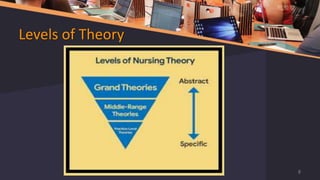
Levels of Theory
8
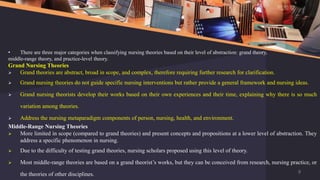
• There are three major categories when classifying nursing theories based on their level of abstraction: grand theory,
middle-range theory, and practice-level theory.
Grand Nursing Theories
 Grand theories are abstract, broad in scope, and complex, therefore requiring further research for clarification.
 Grand nursing theories do not guide specific nursing interventions but rather provide a general framework and nursing ideas.
 Grand nursing theorists develop their works based on their own experiences and their time, explaining why there is so much
variation among theories.
 Address the nursing metaparadigm components of person, nursing, health, and environment.
Middle-Range Nursing Theories
 More limited in scope (compared to grand theories) and present concepts and propositions at a lower level of abstraction. They
address a specific phenomenon in nursing.
 Due to the difficulty of testing grand theories, nursing scholars proposed using this level of theory.
 Most middle-range theories are based on a grand theorist’s works, but they can be conceived from research, nursing practice, or
the theories of other disciplines. 9
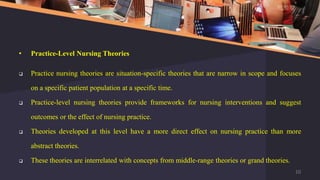
• Practice-Level Nursing Theories
 Practice nursing theories are situation-specific theories that are narrow in scope and focuses
on a specific patient population at a specific time.
 Practice-level nursing theories provide frameworks for nursing interventions and suggest
outcomes or the effect of nursing practice.
 Theories developed at this level have a more direct effect on nursing practice than more
abstract theories.
 These theories are interrelated with concepts from middle-range theories or grand theories.
10
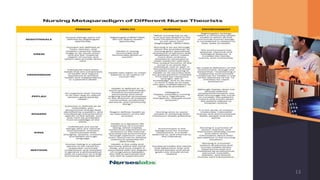
The Nursing Metaparadigm
11
Four major concepts are frequently interrelated and fundamental to
nursing theory: person, environment, health, and nursing. These four
are collectively referred to as metaparadigm for nursing.
Person
• Person (also referred to as Client or Human Beings) is the recipient of nursing
care and may include individuals, patients, groups, families, and communities.
Environment
• Environment (or situation) is defined as the internal and external surroundings
that affect the client. It includes all positive or negative conditions that affect the
patient, the physical environment, such as families, friends, and significant others, and
the setting for where they go for their healthcare.
Health
• Health is defined as the degree of wellness or well-being that the client
experiences. It may have different meanings for each patient, the clinical setting, and
the health care provider.
Nursing
• The nurse’s attributes, characteristics, and actions provide care on behalf of or in
conjunction with the client. There are numerous definitions of nursing, though nursing
scholars may have difficulty agreeing on its exact definition. The ultimate goal of
nursing theories is to improve patient care.
12
13
Models and Frame works
In 1860, Florence Nightingale defined nursing in her “Environmental
Theory” as “the act of utilizing the patient’s environment to assist him in
his recovery.”
In the 1950s, there is a consensus among nursing scholars that nursing
needed to validate itself through the production of its own scientifically
tested body of knowledge.
In 1952, Hildegard Peplau introduced her Theory of Interpersonal
Relations that emphasizes the nurse-client relationship as the foundation
of nursing practice.
In 1955, Virginia Henderson conceptualized the nurse’s role as assisting
sick or healthy individuals to gain independence in meeting 14
fundamental needs. Thus her Nursing Need Theory was developed.
In 1960, Faye Abdellah published her work “Typology of 21 Nursing
Problems,” which shifted the focus of nursing from a disease-centered
approach to a patient-centered approach.
14
 In 1962, Ida Jean Orlando emphasized the
reciprocal relationship between patient and nurse
and viewed nursing’s professional function as
finding out and meeting the patient’s immediate
need for help.
 In 1968, Dorothy Johnson pioneered
the Behavioral System Model and upheld the
fostering of efficient and effective behavioral
functioning in the patient to prevent illness.
 In 1970, Martha Rogers viewed nursing as both a
science and an art as it provides a way to view the
unitary human being, who is integral with the
universe.
15
 In 1971, Dorothea Orem stated in her theory that nursing care is
required if the client is unable to fulfill biological, psychological,
developmental, or social needs.
 In 1971, Imogene King‘s Theory of Goal attainment stated that the
nurse is considered part of the patient’s environment and the nurse-
patient relationship is for meeting goals towards good health.
 In 1972, Betty Neuman, in her theory, states that many needs exist,
and each may disrupt client balance or stability. Stress reduction is the
goal of the system model of nursing practice.
 In 1979, Sr. Callista Roy viewed the individual as a set of interrelated
systems that maintain the balance between these various stimuli.
 In 1979, Jean Watson developed the philosophy of caring,
highlighted humanistic aspects of nursing as they intertwine with
scientific knowledge and nursing practice.
16
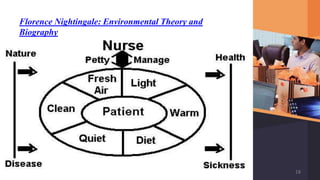
Florence Nightingale: Environmental Theory and Biography
 Founder of Modern Nursing and Pioneer of
the Environmental Theory.
 Defined Nursing as “the act of utilizing the environment of
the patient to assist him in his recovery.”
 Stated that nursing “ought to signify the proper use of
fresh air, light, warmth, cleanliness, quiet, and the proper
selection and administration of diet – all at the least
expense of vital power to the patient.”
 Identified five (5) environmental factors: fresh air, pure
water, efficient drainage, cleanliness or sanitation, and
light or direct sunlight.
17
Florence Nightingale: Environmental Theory and
Biography
18
Hildegard Peplau: Interpersonal
Relations Theory
 Pioneered the Theory of Interpersonal Relations
 Peplau’s theory defined Nursing as “An interpersonal
process of therapeutic interactions between an individual
who is sick or in need of health services and a nurse
specially educated to recognize, respond to the need for
help.”
 Her work is influenced by Henry Stack Sullivan, Percival
Symonds, Abraham Maslow, and Neal Elgar Miller.
 It helps nurses and healthcare providers develop more
therapeutic interventions in the clinical setting.
19
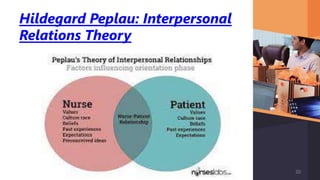
Hildegard Peplau: Interpersonal
Relations Theory
20
Virginia Henderson: Nursing
Need Theory
 Developed the Nursing Need Theory
 Focuses on the importance of increasing the patient’s
independence to hasten their progress in the hospital.
 Emphasizes the basic human needs and how nurses can
assist in meeting those needs.
 “The nurse is expected to carry out a physician’s
therapeutic plan, but individualized care is the result of
the nurse’s creativity in planning for care.”
21
22
Faye Glenn Abdellah: 21 Nursing
Problems Theory
 Developed the 21 Nursing Problems Theory
 “Nursing is based on an art and science that molds the
attitudes, intellectual competencies, and technical skills of
the individual nurse into the desire and ability to help
people, sick or well, cope with their health needs.”
 Changed the focus of nursing from disease-centered to
patient-centered and began to include families and
the elderly in nursing care.
 The nursing model is intended to guide care in hospital
institutions but can also be applied to community health
nursing, as well.
23
Faye Glenn Abdellah: 21 Nursing Problems
Theory
1. To maintain good hygiene and physical comfort.
2. To promote optimal activity: exercise, rest, sleep
3. To promote safety by preventing accidents, injuries, or other trauma and preventing the spread of infection.
4. To maintain good body mechanics and prevent and correct the deformity.
5. To facilitate the maintenance of a supply of oxygen to all body cells.
6. To facilitate the maintenance of nutrition for all body cells.
7. To facilitate the maintenance of elimination.
8. To facilitate the maintenance of fluid and electrolyte balance.
9. To recognize the physiologic responses of the body to disease conditions—pathologic, physiologic, and
compensatory.
10. To facilitate the maintenance of regulatory mechanisms and functions.
11. To facilitate the maintenance of sensory function.
12. To identify and accept positive and negative expressions, feelings, and reactions.
13. To identify and accept interrelatedness of emotions and organic illness.
14. To facilitate the maintenance of effective verbal and nonverbal communication.
15. To promote the development of productive interpersonal relationships.
16. To facilitate progress toward achievement and personal spiritual goals.
17. To create or maintain a therapeutic environment.
18. To facilitate awareness of self as an individual with varying physical, emotional, and developmental needs.
19. To accept the optimum possible goals in the light of limitations, physical and emotional.
20. To use community resources as an aid in resolving problems that arise from an illness. 24
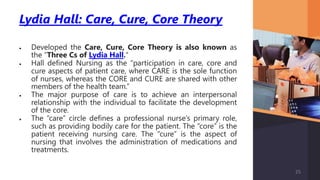
Lydia Hall: Care, Cure, Core Theory
 Developed the Care, Cure, Core Theory is also known as
the “Three Cs of Lydia Hall.“
 Hall defined Nursing as the “participation in care, core and
cure aspects of patient care, where CARE is the sole function
of nurses, whereas the CORE and CURE are shared with other
members of the health team.”
 The major purpose of care is to achieve an interpersonal
relationship with the individual to facilitate the development
of the core.
 The “care” circle defines a professional nurse’s primary role,
such as providing bodily care for the patient. The “core” is the
patient receiving nursing care. The “cure” is the aspect of
nursing that involves the administration of medications and
treatments.
25
Lydia Hall: Care, Cure, Core Theory
26
Ida Jean Orlando: Nursing Process
Theory
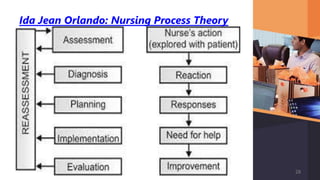
 She developed the Nursing Process Theory.
 “Patients have their own meanings and interpretations of
situations, and therefore nurses must validate their inferences
and analyses with patients before drawing conclusions.”
 Allows nurses to formulate an effective nursing care plan that
can also be easily adapted when and if any complexity comes
up with the patient.
 According to her, persons become patients requiring nursing
care when they have needs for help that cannot be met
independently because of their physical limitations, negative
reactions to an environment, or experience that prevents
them from communicating their needs.
 The role of the nurse is to find out and meet the patient’s
immediate needs for help.
27
Ida Jean Orlando: Nursing Process Theory
28
Jean Watson: Theory of Human
Caring
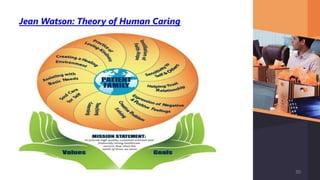
 She pioneered the Philosophy and Theory
of Transpersonal Caring.
 “Nursing is concerned with promoting health, preventing
illness, caring for the sick, and restoring health.”
 Mainly concerns with how nurses care for their patients
and how that caring progresses into better plans to
promote health and wellness, prevent illness and restore
health.
 Focuses on health promotion, as well as the treatment of
diseases.
 Caring is central to nursing practice and promotes health
better than a simple medical cure.
29
Jean Watson: Theory of Human Caring
30
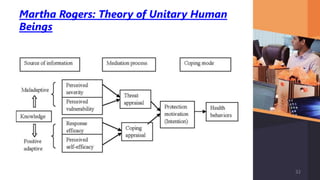
Martha Rogers: Theory of Unitary
Human Beings
 In Roger’s Theory of Human Beings, she defined Nursing
as “an art and science that is humanistic and
humanitarian.
 The Science of Unitary Human Beings contains two
dimensions: the science of nursing, which is the
knowledge specific to the field of nursing that comes from
scientific research; and the art of nursing, which involves
using nursing creatively to help better the lives of the
patient.
 A patient can’t be separated from his or her environment
when addressing health and treatment.
31
Martha Rogers: Theory of Unitary Human
Beings
32
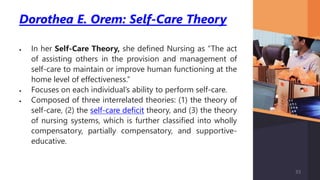
Dorothea E. Orem: Self-Care Theory
 In her Self-Care Theory, she defined Nursing as “The act
of assisting others in the provision and management of
self-care to maintain or improve human functioning at the
home level of effectiveness.”
 Focuses on each individual’s ability to perform self-care.
 Composed of three interrelated theories: (1) the theory of
self-care, (2) the self-care deficit theory, and (3) the theory
of nursing systems, which is further classified into wholly
compensatory, partially compensatory, and supportive-
educative.
33
Dorothea E. Orem: Self-Care Theory
34
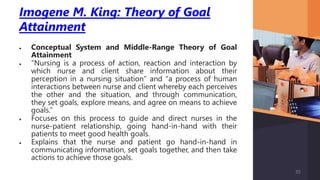
Imogene M. King: Theory of Goal
Attainment
 Conceptual System and Middle-Range Theory of Goal
Attainment
 “Nursing is a process of action, reaction and interaction by
which nurse and client share information about their
perception in a nursing situation” and “a process of human
interactions between nurse and client whereby each perceives
the other and the situation, and through communication,
they set goals, explore means, and agree on means to achieve
goals.”
 Focuses on this process to guide and direct nurses in the
nurse-patient relationship, going hand-in-hand with their
patients to meet good health goals.
 Explains that the nurse and patient go hand-in-hand in
communicating information, set goals together, and then take
actions to achieve those goals.
35
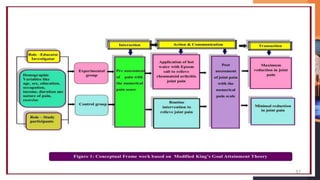
Imogene M. King: Theory of Goal Attainment
36
37
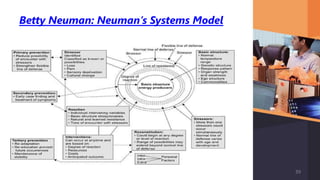
Betty Neuman: Neuman’s Systems
Model
 In Neuman’s System Model, she defined nursing as a
“unique profession in that is concerned with all of the
variables affecting an individual’s response to stress.”
 The focus is on the client as a system (which may be an
individual, family, group, or community) and on the
client’s responses to stressors.
 The client system includes five variables (physiological,
psychological, sociocultural, developmental, and spiritual).
It is conceptualized as an inner core (basic energy
resources) surrounded by concentric circles that include
lines of resistance, a normal defense line, and a flexible
line of defense.
38
Betty Neuman: Neuman’s Systems Model
39
Sister Callista Roy: Adaptation
Model of Nursing
 In Adaptation Model, Roy defined nursing as a “health
care profession that focuses on human life processes and
patterns and emphasizes the promotion of health for
individuals, families, groups, and society as a whole.”
 Views the individual as a set of interrelated systems that
strives to maintain a balance between various stimuli.
 Inspired the development of many middle-range nursing
theories and adaptation instruments.
40
Sister Callista Roy: Adaptation Model of Nursing
41
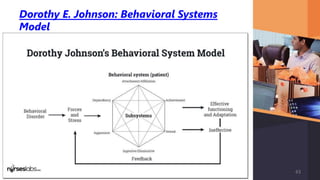
Dorothy E. Johnson: Behavioral
Systems Model
 The Behavioral System Model defined Nursing as “an
external regulatory force that acts to preserve the
organization and integrate the patients’ behaviors at an
optimum level under those conditions in which the behavior
constitutes a threat to the physical or social health or in
which illness is found.”
 Advocates to foster efficient and effective behavioral
functioning in the patient to prevent illness and stresses the
importance of research-based knowledge about the effect of
nursing care on patients.
 Describes the person as a behavioral system with seven
subsystems: the achievement, attachment-affiliative,
aggressive-protective, dependency, ingestive, eliminative, and
sexual subsystems.
42
Dorothy E. Johnson: Behavioral Systems
Model
43
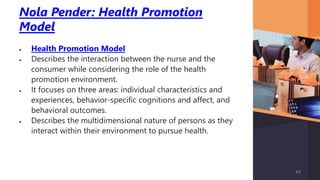
Nola Pender: Health Promotion
Model
 Health Promotion Model
 Describes the interaction between the nurse and the
consumer while considering the role of the health
promotion environment.
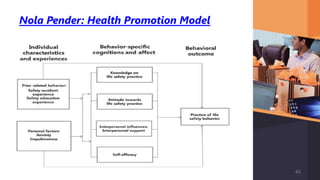
 It focuses on three areas: individual characteristics and
experiences, behavior-specific cognitions and affect, and
behavioral outcomes.
 Describes the multidimensional nature of persons as they
interact within their environment to pursue health.
44
Nola Pender: Health Promotion Model
45
Kristen M. Swanson Theory of
Caring
 “Caring is a nurturing way of relating to a valued other
toward whom one feels a personal sense of commitment
and responsibility.”
 Defines nursing as informed caring for the well-being of
others.
 Offers a structure for improving up-to-date nursing
practice, education, and research while bringing the
discipline to its traditional values and caring-healing roots.
46
Kristen M. Swanson Theory of Caring
47
Application of conceptual
framework in Research
48
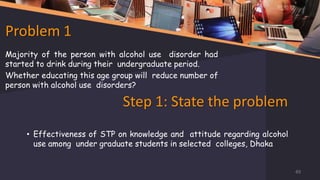
Problem 1
Majority of the person with alcohol use disorder had
started to drink during their undergraduate period.
Whether educating this age group will reduce number of
person with alcohol use disorders?
Step 1: State the problem
• Effectiveness of STP on knowledge and attitude regarding alcohol
use among under graduate students in selected colleges, Dhaka
49
Step 2: Define the
concept
• STP
• Knowledge
• Attitude
Step 3: Relational
statement
• STP improves Knowledge
• Knowledge positively modifies Attitude
50
Step 4 & 5: Review
literature
• General system theory
• Roy’s adaptation theory
• Orem’s self care theory
• Betty numen stress theory
• Health belief model
• Goal attainment theory
• Health promotion model etc
Step 6: Select
theory
• Health belief model
51
Individual perceptions
Feed back
Demographic variables
Perceived threat
Cues to action
Modifying
Factors
Perceived benefits of action:
Perceived barriers to action
Likelihood
Of Actions
Figure 1: Rosenstocks Health belief Model (1950)
52
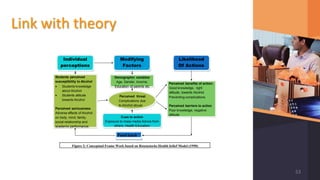
Individual
perceptions
Students perceived
susceptibility to Alcohol
 Students knowledge
about Alcohol
 Students attitude
towards Alcohol
Perceived seriousness
Adverse effects of Alcohol
on body, mind, family,
social relationship and
academic performance.
Feed back
Demographic variables
Age, Gender, Income,
Education of parents etc
Perceived threat
Complications due
to Alcohol abuse
Cues to action
Exposure to mass media Advice from
others, Health Education
Modifying
Factors
Perceived benefits of action:
Good knowledge, right
attitude, towards Alcohol.
Preventing complications
Perceived barriers to action
Poor knowledge, negative
attitude
Likelihood
Of Actions
Figure 2: Conceptual Frame Work based on Rosenstocks Health belief Model (1950)
Link with theory
53
Relationship
among
Theory, Research
and
Practice
54
Theory
• is a product of knowledge
• is a group of concepts that describe a pattern of reality which
can be tested, changed, or used to guide a research
Research
• is a process of inquiry
• is a method used to gather data needed for the theory
Practice
• To do or perform (something) repeatedly in order to acquire or
polish a skill 55
Nursing Theory
• is a set of concepts, definitions, relationships, and assumptions or
propositions derived from nursing models or from other
disciplines and project a purposive, systematic view of
phenomena by designing specific inter-relationships among
concepts for the purposes of describing, explaining, predicting,
and/or prescribing
56
Nursing Research
• is a scientific process that validates and refines existing
knowledge and generates new knowledge that directly and
indirectly influences nursing practice
Nursing Practice
• is the actual provision of nursing care
57
58
• Nursing theory is used to predict patient responses to treatment and
overall improvement outcomes using observation and analysis throughout
the course of treatment. Theory approaches come in four general
categories: descriptive, explanatory, predictive and prescriptive.
• Descriptive frameworks rely on concrete variables to analyze and predict
treatment progress and outcome.
• Explanatory frameworks focus on how a patient's physical, emotional and
environmental characteristics relate to an assigned course of treatment.
• Predictive theories are based on expected treatment outcomes based on a
patient's existing condition.
• Prescriptive theories emphasize the therapeutic impact of the nurse-
patient relationship and how it affect the treatment outcomes. 59
• First, theory is often based on observations that are taken from
practice. Then it will be tested in clinical practice by clinical
research.
• The research process can validate the theory, cause it to be
modified, or invalidate it. The more research that is conducted
about a theory, the more useful the theory is to practice.
• Practice is based on the theories of the discipline that are validated
through research. Theory guides the research process, forms the
research questions, aids in design, analysis and interpretation.
60
• Second, decisions made in practice are often determined by drawing
on nursing theories.
• In some cases, the relationship between nursing theory and nursing
practice is that of a theory being used as a tool in practice.
61
• For example, if a patient with a certain condition or illness is taken
under a nurse's care, the nurse may look to nursing theory to figure
out which pharmaceuticals to describe, which reactions to expect,
and even how to speak to the patient.
• A nurse can have faith that a nursing theory is accurate because it is
probably based on years of observation.
62
• The relationship between nursing theory and nursing practice can
also work the other way.
• As nurses work with different kinds of patients who may be
experiencing new conditions or displaying unfamiliar behaviors,
new nursing theory can be produced, and existing nursing theory
can change.
• Many experts believe that a theory can only be successful if it
accurately describes real life situations with consistency.
•
63
• Nursing theory is also often used to explain nursing practice.
• In this sense, the relationship between nursing theory and nursing
practice is most visible in the context of nursing education.
• Students learning nursing procedures consult theory to better
understand why certain practices are performed.
64
• Systematization of nursing practice is another key component of the
relationship between theory and practice.
• When research determines the optimal care protocols for a particular
condition, it is important that nurses provide that same care to care
when dealing with all patients suffering from the condition.
• A theory can act as a guide for nurses so that they can know which
treatments already have been provided and which steps should come
next.
65
• Theory also can be helpful in predicting the behaviors and reactions of
patients. In nursing practice, a professional can predict how patients from
different age groups and with different conditions might behave according
to established nursing theories.
• This function of theory also can allow nurses to determine which kinds of
preventative measures they should take prior to treating a patient so as to
avoid accidents and miscalculations.
66
USING THEORIES
Silvia 1986 identified three different ways in
which nursing theories can be incorporated
in nursing research:
⦿ First manner was minimal use of theory; in
this the theory is explicitly identified as a
research framework but minimally integrated
into the study.
67
USING THEORIES
⦿ Second approach was, concepts from theories
were used to organize the research usually for
the descriptive rather than the theory testing
purpose.
⦿ Third way was adequate use of model for
theory testing, characterized by explicit
indication of model use along with a study
purpose for determining the model’s validity
68
TESTING THEORIES
⦿ Theory testing is done through deductive
reasoning approach, where researcher
proceeds from general (theory) to more specific
(empirical findings).
⦿ The researcher deduces / traces implications
and develops research hypotheses.
⦿ The hypotheses are then subjected to
empirical testing through systematic
research. 69
TESTING THEORIES
⦿ Comparisons’ between the observed outcome
of research and the predicted relationships of
hypotheses are the major focus of testing
process.
⦿ The testing process continues until pieces of
evidences cannot be interpreted within the
context of the theory.
70
PURPOSES OF TESTING
THEORIES
⦿ To devise logically adequate deductions from
theories.
⦿ To develop a research design that reduces the
credibility of alternative explanations of observed
relationship.
⦿ To select the methods that assess the theory’s
validity under maximally heterogeneous situations,
so that potentially competing theories can be ruled
out. 71
CONCEPTUAL
FRAMEWORK
72
DEFINITION
⦿ A written or visual presentation that explains
either graphically, or by narration, the main
things to be studied, the key factors,
concepts or variables and the presumed
relationship among them”.
- (Miles and Huberman, 1994)
73
PREREQUISITES
⦿Knowledge of theories
⦿ Findings of the previous similar research
studies and related field experience
⦿ Skills of creativity in identifying and
establishing the relationship among two or
more study concepts
74
PREREQUISITES
⦿ Power of observation, understanding the
problem, imagination and conceptualizing
about abstract ideas
⦿ Ability to link the ideas with a logical scheme
to generalize facts
⦿Ability of inductive reasoning
75
HOW TO DEVELOP A
CONCEPTUAL FRAMEWORK
⚫Identify the key words used in the subject area of
your study.
⚫Draw out the key things within something you
have already written about the subject area –
literature review.
⚫Take one key concept, idea or term at a time and
brainstorm all the other things that might be related
and then go back and select those that seem most
relevant. 76
SOURCES OF CONCEPTS
•The pieces of the conceptual framework
are borrowed but the researcher provides
the structure.Concepts may be borrowed
from:-
⚫existing theories
⚫previous research models
⚫personal real life experiences
⚫findings of the previous study
⚫concepts of the several theories and models
77
THEORETICAL FRAMEWORK
VS
CONCEPTUAL FRAMEWORK
78
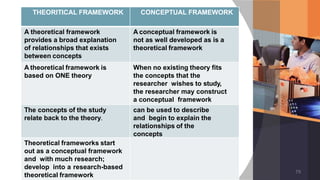
THEORITICAL FRAMEWORK CONCEPTUAL FRAMEWORK
A theoretical framework
provides a broad explanation
of relationships that exists
between concepts
A conceptual framework is
not as well developed as is a
theoretical framework
A theoretical framework is
based on ONE theory
When no existing theory fits
the concepts that the
researcher wishes to study,
the researcher may construct
a conceptual framework
The concepts of the study
relate back to the theory.
can be used to describe
and begin to explain the
relationships of the
concepts
Theoretical frameworks start
out as a conceptual framework
and with much research;
develop into a research-based
theoretical framework
79
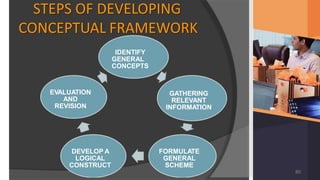
STEPS OF DEVELOPING
CONCEPTUAL FRAMEWORK
IDENTIFY
GENERAL
CONCEPTS
GATHERING
RELEVANT
INFORMATION
FORMULATE
GENERAL
SCHEME
DEVELOP A
LOGICAL
CONSTRUCT
EVALUATION
AND
REVISION
80
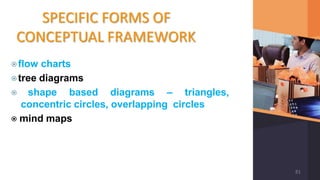
SPECIFIC FORMS OF
CONCEPTUAL FRAMEWORK
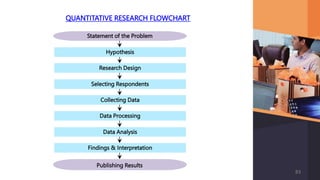
⦿flow charts
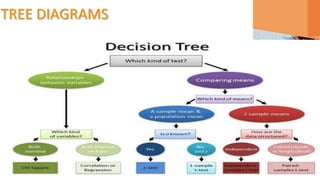
⦿tree diagrams
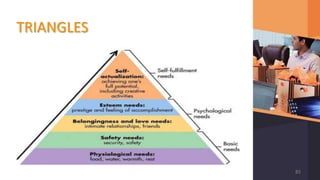
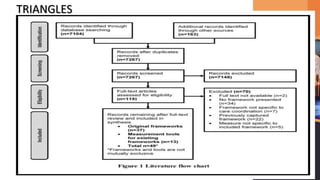
⦿ shape based diagrams – triangles,
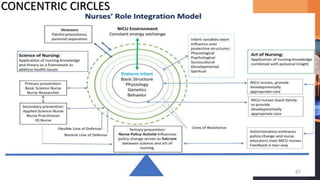
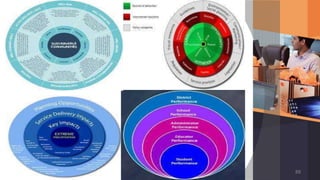
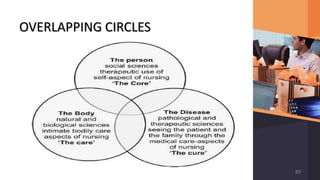
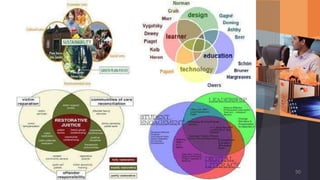
concentric circles, overlapping circles
⦿ mind maps
81
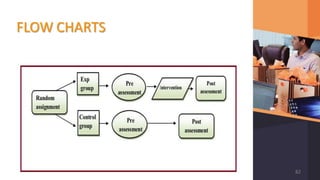
FLOW CHARTS
82
QUANTITATIVE RESEARCH FLOWCHART
83
Statement of the Problem
Hypothesis
Research Design
Selecting Respondents
Collecting Data
Data Processing
Data Analysis
Findings & Interpretation
Publishing Results
TREE DIAGRAMS
84
TRIANGLES
85
86
TRIANGLES
87
CONCENTRIC CIRCLES
88
OVERLAPPING CIRCLES
89
90
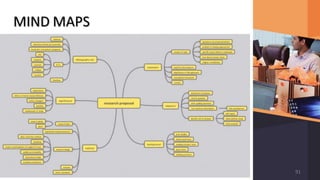
MIND MAPS
91
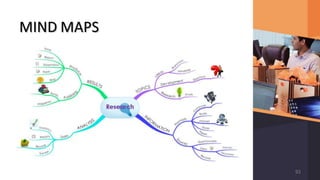
MIND MAPS
92
UTILITY
1. Defining the research problem
2. Establishing theoretical coherence
3. Organising research design and
implementation
4. Framing conceptual conclusions
93
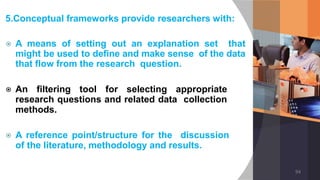
5.Conceptual frameworks provide researchers with:
⦿ A means of setting out an explanation set that
might be used to define and make sense of the data
that flow from the research question.
⦿ An filtering tool for selecting appropriate
research questions and related data collection
methods.
⦿ A reference point/structure for the discussion
of the literature, methodology and results.
94
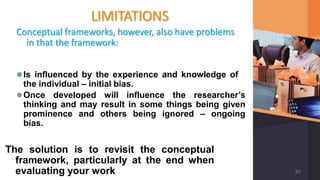
LIMITATIONS
Conceptual frameworks, however, also have problems
in that the framework:
⚫Is influenced by the experience and knowledge of
the individual – initial bias.
⚫Once developed will influence the researcher’s
thinking and may result in some things being given
prominence and others being ignored – ongoing
bias.
The solution is to revisit the conceptual
framework, particularly at the end when
evaluating your work 95
Critique: Theoretical/Conceptual
Framework:
•  Check if conceptual framework described?
•  If not, does it detract from the research?
•  Are the concepts to be studied identified and
defined?
•  Are measures for each of the concepts identified
and described?
•  Does the research problem flow naturally from
the conceptual framework?
96
• THANK YOU
97

ENC Msc 5 Unit Research Concept framework.pptx

  • 1.
    Prof.Dr.Chinna Chadayan.N Ph.D (N)., Professor, EnamNursing College – Savar, UNIT-5 M.Sc(N) Theoretical / Conceptual Framework 1
  • 2.
    Meaning of Theory •A theory, as a general term, is a notion / belief or an idea that explains experience, interprets observation, describes relationships, and projects outcomes. 2
  • 3.
    Definition of Theory A theory is an imaginative grouping of knowledge, ideas, and experience that are represented symbolically and seek to illuminate a given phenomenon.” (Watson,1985, p. 1).  Theory is a creative and rigorous structuring of ideas that projects a tentative, purposeful, and systematic view of phenomena (Chinn & Kramer, 2004, p. 268). 3
  • 4.
    Defining Terms  Philosophy.These are beliefs and values that define a way of thinking and are generally known and understood by a group or discipline.  Phenomena. A fact or situation that is observed to exist or happen, especially one whose cause or explanation is in question  Theory. A belief, policy, or procedure proposed or followed as the basis of action. It refers to a logical group of general propositions used as principles of explanation. Theories are also used to describe, predict, or control phenomena.  Concept. Concepts are often called the building blocks of theories. They are primarily the vehicles of thought that involve images.  Models. Models are representations of the interaction among and between the concepts showing patterns. They present an overview of the theory’s thinking and may demonstrate how theory can be introduced into practice.  Conceptual framework. A conceptual framework is a group of related ideas, statements, or concepts. It is often used interchangeably with the conceptual model and with grand theories. 4
  • 5.
     Proposition. Propositionsare statements that describe the relationship between the concepts.  Domain. The domain is the perspective or territory of a profession or discipline.  Process. Processes are organized steps, changes, or functions intended to bring about the desired result.  Paradigm. A paradigm refers to a pattern of shared understanding and assumptions about reality and the world, worldview, or widely accepted value system.  Metaparadigm. A metaparadigm is the most general statement of discipline and functions as a framework in which the more restricted structures of conceptual models develop. Much of the theoretical work in nursing focused on articulating relationships among four major concepts: person, environment, health, and nursing. 5
  • 6.
    Components of Nursing Theories COMPONENTSOF NURSING THEORIES • For a theory to be a theory, it has to contain concepts, definitions, relational statements, and assumptions that explain a phenomenon. It should also explain how these components relate to each other. PHENOMENON • A term given to describe an idea or response about an event, a situation, a process, a group of events, or a group of situations. Phenomena may be temporary or permanent. Nursing theories focus on the phenomena of nursing. CONCEPTS • Interrelated concepts define a theory. Concepts are used to help describe or label a phenomenon. They are words or phrases that identify, define, and establish structure and boundaries for ideas generated about a particular phenomenon. Concepts may be abstract or concrete. 1. Abstract Concepts. Defined as mentally constructed independently of a specific time or place. 2. Concrete Concepts. Are directly experienced and related to a particular time or place. 6
  • 7.
    DEFINITIONS • Definitions areused to convey the general meaning of the concepts of the theory. Definitions can be theoretical or operational. 1. Theoretical Definitions. Define a particular concept based on the theorist’s perspective. 2. Operational Definitions. States how concepts are measured. RELATIONAL STATEMENTS • Relational statements define the relationships between two or more concepts. They are the chains that link concepts to one another. ASSUMPTIONS • Assumptions are accepted as truths and are based on values and beliefs. These statements explain the nature of concepts, definitions, purpose, relationships, and structure of a theory. 7
  • 8.
  • 9.
    • There arethree major categories when classifying nursing theories based on their level of abstraction: grand theory, middle-range theory, and practice-level theory. Grand Nursing Theories  Grand theories are abstract, broad in scope, and complex, therefore requiring further research for clarification.  Grand nursing theories do not guide specific nursing interventions but rather provide a general framework and nursing ideas.  Grand nursing theorists develop their works based on their own experiences and their time, explaining why there is so much variation among theories.  Address the nursing metaparadigm components of person, nursing, health, and environment. Middle-Range Nursing Theories  More limited in scope (compared to grand theories) and present concepts and propositions at a lower level of abstraction. They address a specific phenomenon in nursing.  Due to the difficulty of testing grand theories, nursing scholars proposed using this level of theory.  Most middle-range theories are based on a grand theorist’s works, but they can be conceived from research, nursing practice, or the theories of other disciplines. 9
  • 10.
    • Practice-Level NursingTheories  Practice nursing theories are situation-specific theories that are narrow in scope and focuses on a specific patient population at a specific time.  Practice-level nursing theories provide frameworks for nursing interventions and suggest outcomes or the effect of nursing practice.  Theories developed at this level have a more direct effect on nursing practice than more abstract theories.  These theories are interrelated with concepts from middle-range theories or grand theories. 10
  • 11.
  • 12.
    Four major conceptsare frequently interrelated and fundamental to nursing theory: person, environment, health, and nursing. These four are collectively referred to as metaparadigm for nursing. Person • Person (also referred to as Client or Human Beings) is the recipient of nursing care and may include individuals, patients, groups, families, and communities. Environment • Environment (or situation) is defined as the internal and external surroundings that affect the client. It includes all positive or negative conditions that affect the patient, the physical environment, such as families, friends, and significant others, and the setting for where they go for their healthcare. Health • Health is defined as the degree of wellness or well-being that the client experiences. It may have different meanings for each patient, the clinical setting, and the health care provider. Nursing • The nurse’s attributes, characteristics, and actions provide care on behalf of or in conjunction with the client. There are numerous definitions of nursing, though nursing scholars may have difficulty agreeing on its exact definition. The ultimate goal of nursing theories is to improve patient care. 12
  • 13.
  • 14.
    Models and Frameworks In 1860, Florence Nightingale defined nursing in her “Environmental Theory” as “the act of utilizing the patient’s environment to assist him in his recovery.” In the 1950s, there is a consensus among nursing scholars that nursing needed to validate itself through the production of its own scientifically tested body of knowledge. In 1952, Hildegard Peplau introduced her Theory of Interpersonal Relations that emphasizes the nurse-client relationship as the foundation of nursing practice. In 1955, Virginia Henderson conceptualized the nurse’s role as assisting sick or healthy individuals to gain independence in meeting 14 fundamental needs. Thus her Nursing Need Theory was developed. In 1960, Faye Abdellah published her work “Typology of 21 Nursing Problems,” which shifted the focus of nursing from a disease-centered approach to a patient-centered approach. 14
  • 15.
     In 1962,Ida Jean Orlando emphasized the reciprocal relationship between patient and nurse and viewed nursing’s professional function as finding out and meeting the patient’s immediate need for help.  In 1968, Dorothy Johnson pioneered the Behavioral System Model and upheld the fostering of efficient and effective behavioral functioning in the patient to prevent illness.  In 1970, Martha Rogers viewed nursing as both a science and an art as it provides a way to view the unitary human being, who is integral with the universe. 15
  • 16.
     In 1971,Dorothea Orem stated in her theory that nursing care is required if the client is unable to fulfill biological, psychological, developmental, or social needs.  In 1971, Imogene King‘s Theory of Goal attainment stated that the nurse is considered part of the patient’s environment and the nurse- patient relationship is for meeting goals towards good health.  In 1972, Betty Neuman, in her theory, states that many needs exist, and each may disrupt client balance or stability. Stress reduction is the goal of the system model of nursing practice.  In 1979, Sr. Callista Roy viewed the individual as a set of interrelated systems that maintain the balance between these various stimuli.  In 1979, Jean Watson developed the philosophy of caring, highlighted humanistic aspects of nursing as they intertwine with scientific knowledge and nursing practice. 16
  • 17.
    Florence Nightingale: EnvironmentalTheory and Biography  Founder of Modern Nursing and Pioneer of the Environmental Theory.  Defined Nursing as “the act of utilizing the environment of the patient to assist him in his recovery.”  Stated that nursing “ought to signify the proper use of fresh air, light, warmth, cleanliness, quiet, and the proper selection and administration of diet – all at the least expense of vital power to the patient.”  Identified five (5) environmental factors: fresh air, pure water, efficient drainage, cleanliness or sanitation, and light or direct sunlight. 17
  • 18.
    Florence Nightingale: EnvironmentalTheory and Biography 18
  • 19.
    Hildegard Peplau: Interpersonal RelationsTheory  Pioneered the Theory of Interpersonal Relations  Peplau’s theory defined Nursing as “An interpersonal process of therapeutic interactions between an individual who is sick or in need of health services and a nurse specially educated to recognize, respond to the need for help.”  Her work is influenced by Henry Stack Sullivan, Percival Symonds, Abraham Maslow, and Neal Elgar Miller.  It helps nurses and healthcare providers develop more therapeutic interventions in the clinical setting. 19
  • 20.
  • 21.
    Virginia Henderson: Nursing NeedTheory  Developed the Nursing Need Theory  Focuses on the importance of increasing the patient’s independence to hasten their progress in the hospital.  Emphasizes the basic human needs and how nurses can assist in meeting those needs.  “The nurse is expected to carry out a physician’s therapeutic plan, but individualized care is the result of the nurse’s creativity in planning for care.” 21
  • 22.
  • 23.
    Faye Glenn Abdellah:21 Nursing Problems Theory  Developed the 21 Nursing Problems Theory  “Nursing is based on an art and science that molds the attitudes, intellectual competencies, and technical skills of the individual nurse into the desire and ability to help people, sick or well, cope with their health needs.”  Changed the focus of nursing from disease-centered to patient-centered and began to include families and the elderly in nursing care.  The nursing model is intended to guide care in hospital institutions but can also be applied to community health nursing, as well. 23
  • 24.
    Faye Glenn Abdellah:21 Nursing Problems Theory 1. To maintain good hygiene and physical comfort. 2. To promote optimal activity: exercise, rest, sleep 3. To promote safety by preventing accidents, injuries, or other trauma and preventing the spread of infection. 4. To maintain good body mechanics and prevent and correct the deformity. 5. To facilitate the maintenance of a supply of oxygen to all body cells. 6. To facilitate the maintenance of nutrition for all body cells. 7. To facilitate the maintenance of elimination. 8. To facilitate the maintenance of fluid and electrolyte balance. 9. To recognize the physiologic responses of the body to disease conditions—pathologic, physiologic, and compensatory. 10. To facilitate the maintenance of regulatory mechanisms and functions. 11. To facilitate the maintenance of sensory function. 12. To identify and accept positive and negative expressions, feelings, and reactions. 13. To identify and accept interrelatedness of emotions and organic illness. 14. To facilitate the maintenance of effective verbal and nonverbal communication. 15. To promote the development of productive interpersonal relationships. 16. To facilitate progress toward achievement and personal spiritual goals. 17. To create or maintain a therapeutic environment. 18. To facilitate awareness of self as an individual with varying physical, emotional, and developmental needs. 19. To accept the optimum possible goals in the light of limitations, physical and emotional. 20. To use community resources as an aid in resolving problems that arise from an illness. 24
  • 25.
    Lydia Hall: Care,Cure, Core Theory  Developed the Care, Cure, Core Theory is also known as the “Three Cs of Lydia Hall.“  Hall defined Nursing as the “participation in care, core and cure aspects of patient care, where CARE is the sole function of nurses, whereas the CORE and CURE are shared with other members of the health team.”  The major purpose of care is to achieve an interpersonal relationship with the individual to facilitate the development of the core.  The “care” circle defines a professional nurse’s primary role, such as providing bodily care for the patient. The “core” is the patient receiving nursing care. The “cure” is the aspect of nursing that involves the administration of medications and treatments. 25
  • 26.
    Lydia Hall: Care,Cure, Core Theory 26
  • 27.
    Ida Jean Orlando:Nursing Process Theory  She developed the Nursing Process Theory.  “Patients have their own meanings and interpretations of situations, and therefore nurses must validate their inferences and analyses with patients before drawing conclusions.”  Allows nurses to formulate an effective nursing care plan that can also be easily adapted when and if any complexity comes up with the patient.  According to her, persons become patients requiring nursing care when they have needs for help that cannot be met independently because of their physical limitations, negative reactions to an environment, or experience that prevents them from communicating their needs.  The role of the nurse is to find out and meet the patient’s immediate needs for help. 27
  • 28.
    Ida Jean Orlando:Nursing Process Theory 28
  • 29.
    Jean Watson: Theoryof Human Caring  She pioneered the Philosophy and Theory of Transpersonal Caring.  “Nursing is concerned with promoting health, preventing illness, caring for the sick, and restoring health.”  Mainly concerns with how nurses care for their patients and how that caring progresses into better plans to promote health and wellness, prevent illness and restore health.  Focuses on health promotion, as well as the treatment of diseases.  Caring is central to nursing practice and promotes health better than a simple medical cure. 29
  • 30.
    Jean Watson: Theoryof Human Caring 30
  • 31.
    Martha Rogers: Theoryof Unitary Human Beings  In Roger’s Theory of Human Beings, she defined Nursing as “an art and science that is humanistic and humanitarian.  The Science of Unitary Human Beings contains two dimensions: the science of nursing, which is the knowledge specific to the field of nursing that comes from scientific research; and the art of nursing, which involves using nursing creatively to help better the lives of the patient.  A patient can’t be separated from his or her environment when addressing health and treatment. 31
  • 32.
    Martha Rogers: Theoryof Unitary Human Beings 32
  • 33.
    Dorothea E. Orem:Self-Care Theory  In her Self-Care Theory, she defined Nursing as “The act of assisting others in the provision and management of self-care to maintain or improve human functioning at the home level of effectiveness.”  Focuses on each individual’s ability to perform self-care.  Composed of three interrelated theories: (1) the theory of self-care, (2) the self-care deficit theory, and (3) the theory of nursing systems, which is further classified into wholly compensatory, partially compensatory, and supportive- educative. 33
  • 34.
    Dorothea E. Orem:Self-Care Theory 34
  • 35.
    Imogene M. King:Theory of Goal Attainment  Conceptual System and Middle-Range Theory of Goal Attainment  “Nursing is a process of action, reaction and interaction by which nurse and client share information about their perception in a nursing situation” and “a process of human interactions between nurse and client whereby each perceives the other and the situation, and through communication, they set goals, explore means, and agree on means to achieve goals.”  Focuses on this process to guide and direct nurses in the nurse-patient relationship, going hand-in-hand with their patients to meet good health goals.  Explains that the nurse and patient go hand-in-hand in communicating information, set goals together, and then take actions to achieve those goals. 35
  • 36.
    Imogene M. King:Theory of Goal Attainment 36
  • 37.
  • 38.
    Betty Neuman: Neuman’sSystems Model  In Neuman’s System Model, she defined nursing as a “unique profession in that is concerned with all of the variables affecting an individual’s response to stress.”  The focus is on the client as a system (which may be an individual, family, group, or community) and on the client’s responses to stressors.  The client system includes five variables (physiological, psychological, sociocultural, developmental, and spiritual). It is conceptualized as an inner core (basic energy resources) surrounded by concentric circles that include lines of resistance, a normal defense line, and a flexible line of defense. 38
  • 39.
    Betty Neuman: Neuman’sSystems Model 39
  • 40.
    Sister Callista Roy:Adaptation Model of Nursing  In Adaptation Model, Roy defined nursing as a “health care profession that focuses on human life processes and patterns and emphasizes the promotion of health for individuals, families, groups, and society as a whole.”  Views the individual as a set of interrelated systems that strives to maintain a balance between various stimuli.  Inspired the development of many middle-range nursing theories and adaptation instruments. 40
  • 41.
    Sister Callista Roy:Adaptation Model of Nursing 41
  • 42.
    Dorothy E. Johnson:Behavioral Systems Model  The Behavioral System Model defined Nursing as “an external regulatory force that acts to preserve the organization and integrate the patients’ behaviors at an optimum level under those conditions in which the behavior constitutes a threat to the physical or social health or in which illness is found.”  Advocates to foster efficient and effective behavioral functioning in the patient to prevent illness and stresses the importance of research-based knowledge about the effect of nursing care on patients.  Describes the person as a behavioral system with seven subsystems: the achievement, attachment-affiliative, aggressive-protective, dependency, ingestive, eliminative, and sexual subsystems. 42
  • 43.
    Dorothy E. Johnson:Behavioral Systems Model 43
  • 44.
    Nola Pender: HealthPromotion Model  Health Promotion Model  Describes the interaction between the nurse and the consumer while considering the role of the health promotion environment.  It focuses on three areas: individual characteristics and experiences, behavior-specific cognitions and affect, and behavioral outcomes.  Describes the multidimensional nature of persons as they interact within their environment to pursue health. 44
  • 45.
    Nola Pender: HealthPromotion Model 45
  • 46.
    Kristen M. SwansonTheory of Caring  “Caring is a nurturing way of relating to a valued other toward whom one feels a personal sense of commitment and responsibility.”  Defines nursing as informed caring for the well-being of others.  Offers a structure for improving up-to-date nursing practice, education, and research while bringing the discipline to its traditional values and caring-healing roots. 46
  • 47.
    Kristen M. SwansonTheory of Caring 47
  • 48.
  • 49.
    Problem 1 Majority ofthe person with alcohol use disorder had started to drink during their undergraduate period. Whether educating this age group will reduce number of person with alcohol use disorders? Step 1: State the problem • Effectiveness of STP on knowledge and attitude regarding alcohol use among under graduate students in selected colleges, Dhaka 49
  • 50.
    Step 2: Definethe concept • STP • Knowledge • Attitude Step 3: Relational statement • STP improves Knowledge • Knowledge positively modifies Attitude 50
  • 51.
    Step 4 &5: Review literature • General system theory • Roy’s adaptation theory • Orem’s self care theory • Betty numen stress theory • Health belief model • Goal attainment theory • Health promotion model etc Step 6: Select theory • Health belief model 51
  • 52.
    Individual perceptions Feed back Demographicvariables Perceived threat Cues to action Modifying Factors Perceived benefits of action: Perceived barriers to action Likelihood Of Actions Figure 1: Rosenstocks Health belief Model (1950) 52
  • 53.
    Individual perceptions Students perceived susceptibility toAlcohol  Students knowledge about Alcohol  Students attitude towards Alcohol Perceived seriousness Adverse effects of Alcohol on body, mind, family, social relationship and academic performance. Feed back Demographic variables Age, Gender, Income, Education of parents etc Perceived threat Complications due to Alcohol abuse Cues to action Exposure to mass media Advice from others, Health Education Modifying Factors Perceived benefits of action: Good knowledge, right attitude, towards Alcohol. Preventing complications Perceived barriers to action Poor knowledge, negative attitude Likelihood Of Actions Figure 2: Conceptual Frame Work based on Rosenstocks Health belief Model (1950) Link with theory 53
  • 54.
  • 55.
    Theory • is aproduct of knowledge • is a group of concepts that describe a pattern of reality which can be tested, changed, or used to guide a research Research • is a process of inquiry • is a method used to gather data needed for the theory Practice • To do or perform (something) repeatedly in order to acquire or polish a skill 55
  • 56.
    Nursing Theory • isa set of concepts, definitions, relationships, and assumptions or propositions derived from nursing models or from other disciplines and project a purposive, systematic view of phenomena by designing specific inter-relationships among concepts for the purposes of describing, explaining, predicting, and/or prescribing 56
  • 57.
    Nursing Research • isa scientific process that validates and refines existing knowledge and generates new knowledge that directly and indirectly influences nursing practice Nursing Practice • is the actual provision of nursing care 57
  • 58.
  • 59.
    • Nursing theoryis used to predict patient responses to treatment and overall improvement outcomes using observation and analysis throughout the course of treatment. Theory approaches come in four general categories: descriptive, explanatory, predictive and prescriptive. • Descriptive frameworks rely on concrete variables to analyze and predict treatment progress and outcome. • Explanatory frameworks focus on how a patient's physical, emotional and environmental characteristics relate to an assigned course of treatment. • Predictive theories are based on expected treatment outcomes based on a patient's existing condition. • Prescriptive theories emphasize the therapeutic impact of the nurse- patient relationship and how it affect the treatment outcomes. 59
  • 60.
    • First, theoryis often based on observations that are taken from practice. Then it will be tested in clinical practice by clinical research. • The research process can validate the theory, cause it to be modified, or invalidate it. The more research that is conducted about a theory, the more useful the theory is to practice. • Practice is based on the theories of the discipline that are validated through research. Theory guides the research process, forms the research questions, aids in design, analysis and interpretation. 60
  • 61.
    • Second, decisionsmade in practice are often determined by drawing on nursing theories. • In some cases, the relationship between nursing theory and nursing practice is that of a theory being used as a tool in practice. 61
  • 62.
    • For example,if a patient with a certain condition or illness is taken under a nurse's care, the nurse may look to nursing theory to figure out which pharmaceuticals to describe, which reactions to expect, and even how to speak to the patient. • A nurse can have faith that a nursing theory is accurate because it is probably based on years of observation. 62
  • 63.
    • The relationshipbetween nursing theory and nursing practice can also work the other way. • As nurses work with different kinds of patients who may be experiencing new conditions or displaying unfamiliar behaviors, new nursing theory can be produced, and existing nursing theory can change. • Many experts believe that a theory can only be successful if it accurately describes real life situations with consistency. • 63
  • 64.
    • Nursing theoryis also often used to explain nursing practice. • In this sense, the relationship between nursing theory and nursing practice is most visible in the context of nursing education. • Students learning nursing procedures consult theory to better understand why certain practices are performed. 64
  • 65.
    • Systematization ofnursing practice is another key component of the relationship between theory and practice. • When research determines the optimal care protocols for a particular condition, it is important that nurses provide that same care to care when dealing with all patients suffering from the condition. • A theory can act as a guide for nurses so that they can know which treatments already have been provided and which steps should come next. 65
  • 66.
    • Theory alsocan be helpful in predicting the behaviors and reactions of patients. In nursing practice, a professional can predict how patients from different age groups and with different conditions might behave according to established nursing theories. • This function of theory also can allow nurses to determine which kinds of preventative measures they should take prior to treating a patient so as to avoid accidents and miscalculations. 66
  • 67.
    USING THEORIES Silvia 1986identified three different ways in which nursing theories can be incorporated in nursing research: ⦿ First manner was minimal use of theory; in this the theory is explicitly identified as a research framework but minimally integrated into the study. 67
  • 68.
    USING THEORIES ⦿ Secondapproach was, concepts from theories were used to organize the research usually for the descriptive rather than the theory testing purpose. ⦿ Third way was adequate use of model for theory testing, characterized by explicit indication of model use along with a study purpose for determining the model’s validity 68
  • 69.
    TESTING THEORIES ⦿ Theorytesting is done through deductive reasoning approach, where researcher proceeds from general (theory) to more specific (empirical findings). ⦿ The researcher deduces / traces implications and develops research hypotheses. ⦿ The hypotheses are then subjected to empirical testing through systematic research. 69
  • 70.
    TESTING THEORIES ⦿ Comparisons’between the observed outcome of research and the predicted relationships of hypotheses are the major focus of testing process. ⦿ The testing process continues until pieces of evidences cannot be interpreted within the context of the theory. 70
  • 71.
    PURPOSES OF TESTING THEORIES ⦿To devise logically adequate deductions from theories. ⦿ To develop a research design that reduces the credibility of alternative explanations of observed relationship. ⦿ To select the methods that assess the theory’s validity under maximally heterogeneous situations, so that potentially competing theories can be ruled out. 71
  • 72.
  • 73.
    DEFINITION ⦿ A writtenor visual presentation that explains either graphically, or by narration, the main things to be studied, the key factors, concepts or variables and the presumed relationship among them”. - (Miles and Huberman, 1994) 73
  • 74.
    PREREQUISITES ⦿Knowledge of theories ⦿Findings of the previous similar research studies and related field experience ⦿ Skills of creativity in identifying and establishing the relationship among two or more study concepts 74
  • 75.
    PREREQUISITES ⦿ Power ofobservation, understanding the problem, imagination and conceptualizing about abstract ideas ⦿ Ability to link the ideas with a logical scheme to generalize facts ⦿Ability of inductive reasoning 75
  • 76.
    HOW TO DEVELOPA CONCEPTUAL FRAMEWORK ⚫Identify the key words used in the subject area of your study. ⚫Draw out the key things within something you have already written about the subject area – literature review. ⚫Take one key concept, idea or term at a time and brainstorm all the other things that might be related and then go back and select those that seem most relevant. 76
  • 77.
    SOURCES OF CONCEPTS •Thepieces of the conceptual framework are borrowed but the researcher provides the structure.Concepts may be borrowed from:- ⚫existing theories ⚫previous research models ⚫personal real life experiences ⚫findings of the previous study ⚫concepts of the several theories and models 77
  • 78.
  • 79.
    THEORITICAL FRAMEWORK CONCEPTUALFRAMEWORK A theoretical framework provides a broad explanation of relationships that exists between concepts A conceptual framework is not as well developed as is a theoretical framework A theoretical framework is based on ONE theory When no existing theory fits the concepts that the researcher wishes to study, the researcher may construct a conceptual framework The concepts of the study relate back to the theory. can be used to describe and begin to explain the relationships of the concepts Theoretical frameworks start out as a conceptual framework and with much research; develop into a research-based theoretical framework 79
  • 80.
    STEPS OF DEVELOPING CONCEPTUALFRAMEWORK IDENTIFY GENERAL CONCEPTS GATHERING RELEVANT INFORMATION FORMULATE GENERAL SCHEME DEVELOP A LOGICAL CONSTRUCT EVALUATION AND REVISION 80
  • 81.
    SPECIFIC FORMS OF CONCEPTUALFRAMEWORK ⦿flow charts ⦿tree diagrams ⦿ shape based diagrams – triangles, concentric circles, overlapping circles ⦿ mind maps 81
  • 82.
  • 83.
    QUANTITATIVE RESEARCH FLOWCHART 83 Statementof the Problem Hypothesis Research Design Selecting Respondents Collecting Data Data Processing Data Analysis Findings & Interpretation Publishing Results
  • 84.
  • 85.
  • 86.
  • 87.
  • 88.
  • 89.
  • 90.
  • 91.
  • 92.
  • 93.
    UTILITY 1. Defining theresearch problem 2. Establishing theoretical coherence 3. Organising research design and implementation 4. Framing conceptual conclusions 93
  • 94.
    5.Conceptual frameworks provideresearchers with: ⦿ A means of setting out an explanation set that might be used to define and make sense of the data that flow from the research question. ⦿ An filtering tool for selecting appropriate research questions and related data collection methods. ⦿ A reference point/structure for the discussion of the literature, methodology and results. 94
  • 95.
    LIMITATIONS Conceptual frameworks, however,also have problems in that the framework: ⚫Is influenced by the experience and knowledge of the individual – initial bias. ⚫Once developed will influence the researcher’s thinking and may result in some things being given prominence and others being ignored – ongoing bias. The solution is to revisit the conceptual framework, particularly at the end when evaluating your work 95
  • 96.
    Critique: Theoretical/Conceptual Framework: • Check if conceptual framework described? •  If not, does it detract from the research? •  Are the concepts to be studied identified and defined? •  Are measures for each of the concepts identified and described? •  Does the research problem flow naturally from the conceptual framework? 96
  • 97.