MANET
Introduction: what's ad-hoc network
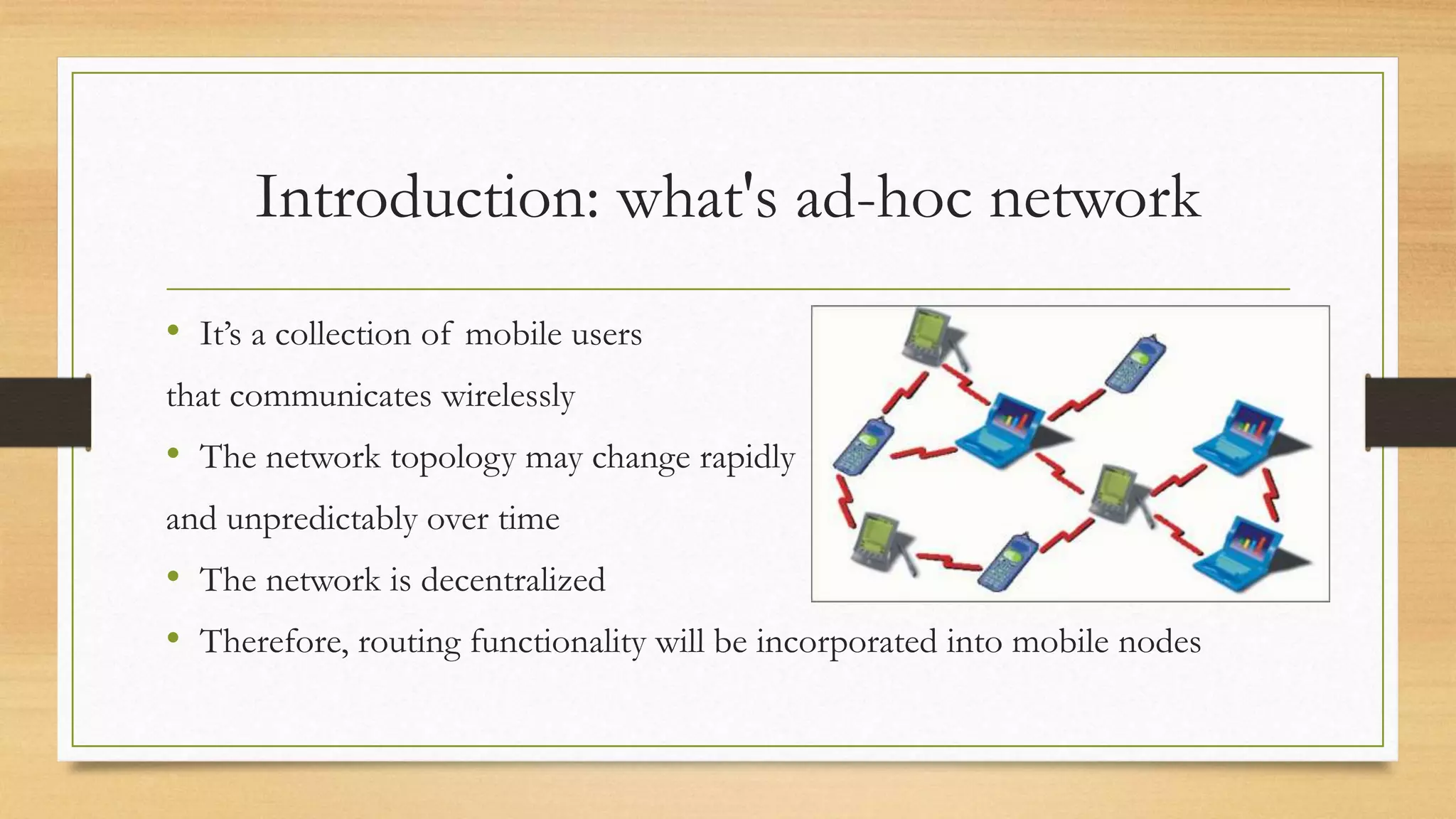
• It’s a collection of mobile users
that communicates wirelessly
• The network topology may change rapidly
and unpredictably over time
• The network is decentralized
• Therefore, routing functionality will be incorporated into mobile nodes
Type of Ad-hoc Network
• MANET is a continuously self-configuring, infrastructure-less network of
mobile devices connected wirelessly. Each device in a MANET is free to
move independently in any direction, and will therefore change its links to
other devices frequently example (laptops communicate between each other
or VANET).
• VANET is a technology that uses moving cars as nodes in a network to
create a mobile network. VANET turns every participating car into a
wireless router or node, allowing cars approximately 100 to 300 metres of
each other to connect and, in turn, create a network with a wide range
Examples
Ad-hoc usage
• Military scenarios
• Sensor networks
• Rescue operations
• Students on campus
• Free Internet connection sharing
Ad-hoc Characteristics and challenges
Characteristics Challenges
Peer-to-peer Bandwidth [ capacity links]
Auto configured Dynamic Topologies [any node can join/leave at
any time]
Multi-hop Energy-constrained [Battery]
Zero-administration Limited Physical security [catch poisoning]
Dynamic Scalability [memory search time, processing]
Ad-hoc Routing Protocol
Protocol Route discovery Advantages Disavantages
Reactive discover route only when you
need it.
• Lower routing overhead
• Save energy
• Save bandwidth
• Latency
• Route discovery broadcast
• Bursty during high activity
Proactive All nodes will know each
other in advance (each node
store routing table)
• Low latency
• Adaptive
• High routing overhead
• Waste of bandwidth
because of updates
Hybrid Two type:
• Proactive for
neighborhood, Reactive
for far away (Zone
Routing Protocol, Haas
group)
• Proactive for long
distance, Reactive for
neighborhood (Safari)
Scalable More resources for large zone
Protocols that we cover in our research
• DSR (Dynamic Source Routing) It’s a protocol that is based on source
routing which is a technique where the sender of the packet can specify the
route that a packet can take through the network and it’s a typical On-
Demand Reactive Protocol.
• AODV (Ad hoc On-Demand Distance Vector routing) It uses the DV
technique which is every node know its neighbor and know the cost of it. It
also uses Destination Sequence Number (DESTSEQNUM) which is to
determine an-up-to-date path to destination a node only update it path
information if the received destseqnum greater than the last destseqnum
Protocols that we cover in our research (cont..)
• OLSR (optimized link state routing) It uses an optimized link state technique In
OLSR instead of flooding it use multipoint relay-(MPR: it’s a set of selected
neighbour in such that It cover all nodes that are two hops away from the source)-
to reduce the number of broadcast messages in the network.
Protocol Advantages Disadvanatages
DSR • Route is established only when its
require
• High delay
• Route overhead
AODV • Adaptable
• Reduce overhead
• Inconsistent route
OLSR • Less delay • Need more time to rediscover
the broken link
Now to our comparison
• We used 18 mobile node
• We used a mobile DB Server
with High Load
• We run the simulation for 10
Minutes
• We used Riverbed to do it
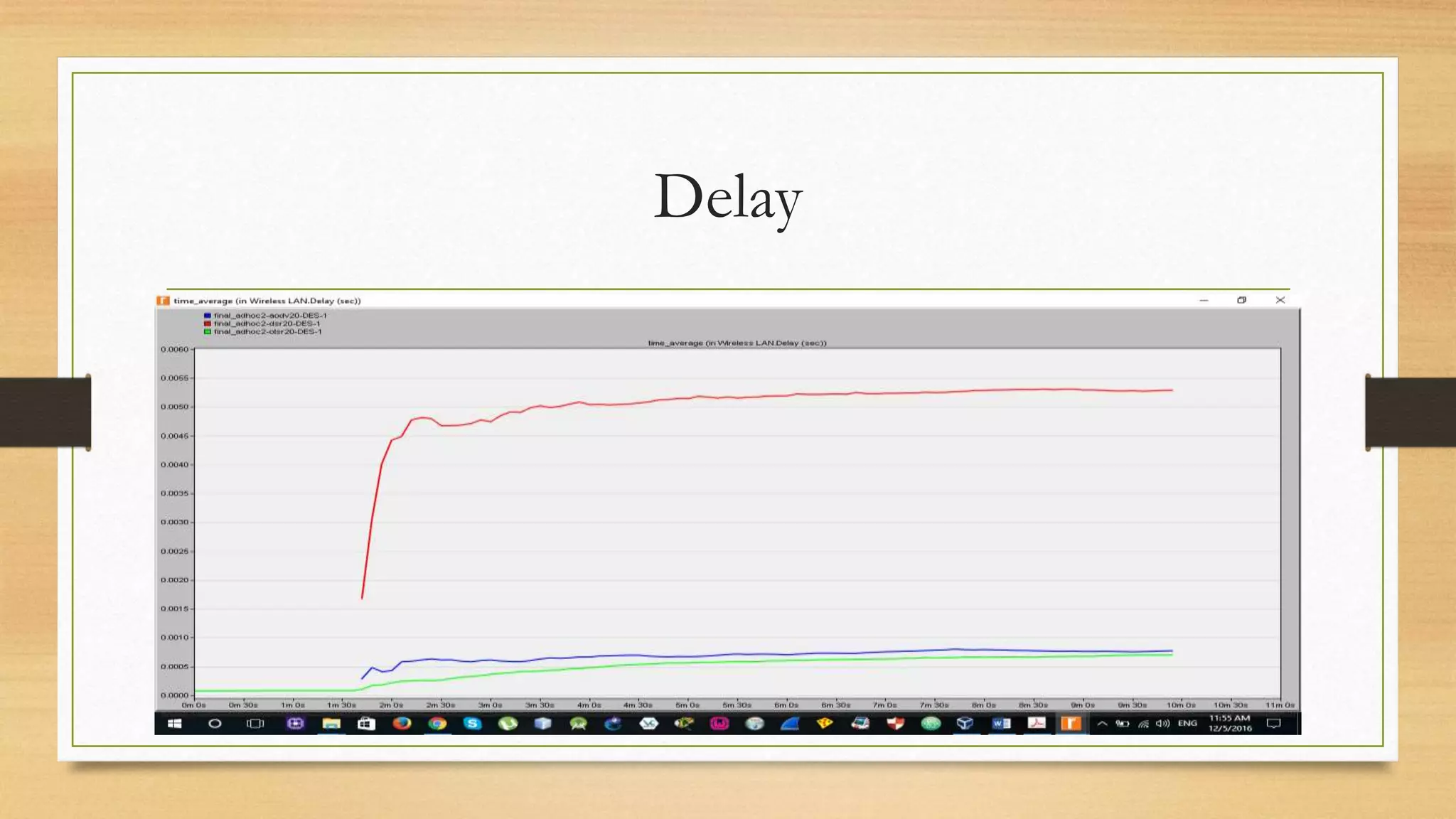
Delay
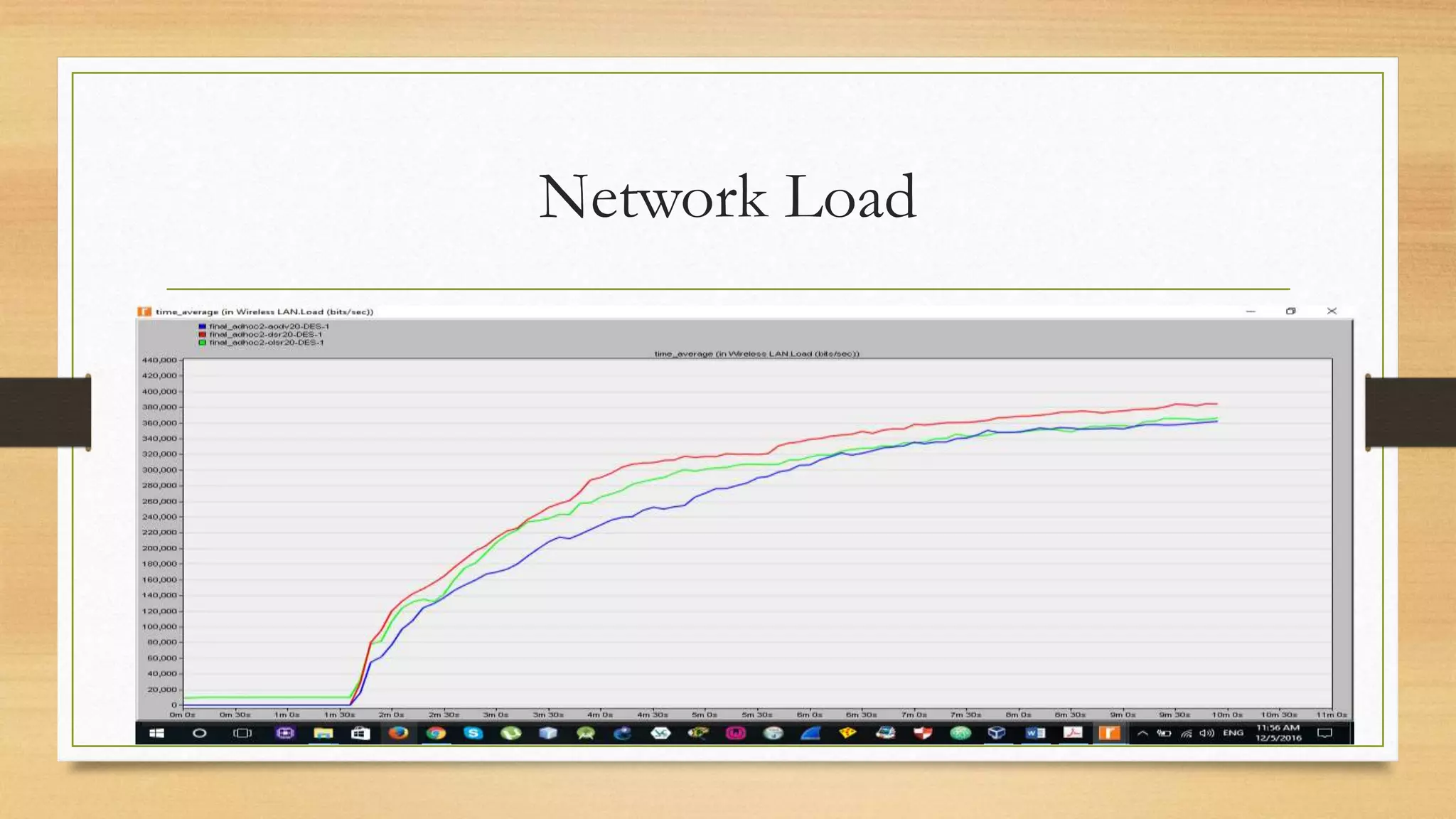
Network Load
Throughput
Conclusion
• We found out that OLSR have the lowest end-end delay because it will simply do a
routing lookup.
• We found out that the DSR will have the highest network load because all nodes will
flood the network in order to communicate and AODV have the lowest cause it will
chose the lowest path (the number of hops is the cost).
• We found out that the OLSR have the highest maximum throughput because
choosing node as MPR will avoid network flooding (lower the number of
transmission).
• We concluded that using OLSR will enhance the performance of our MANET.

Manet

  • 1.
  • 2.
    Introduction: what's ad-hocnetwork • It’s a collection of mobile users that communicates wirelessly • The network topology may change rapidly and unpredictably over time • The network is decentralized • Therefore, routing functionality will be incorporated into mobile nodes
  • 3.
    Type of Ad-hocNetwork • MANET is a continuously self-configuring, infrastructure-less network of mobile devices connected wirelessly. Each device in a MANET is free to move independently in any direction, and will therefore change its links to other devices frequently example (laptops communicate between each other or VANET). • VANET is a technology that uses moving cars as nodes in a network to create a mobile network. VANET turns every participating car into a wireless router or node, allowing cars approximately 100 to 300 metres of each other to connect and, in turn, create a network with a wide range
  • 4.
  • 5.
    Ad-hoc usage • Militaryscenarios • Sensor networks • Rescue operations • Students on campus • Free Internet connection sharing
  • 6.
    Ad-hoc Characteristics andchallenges Characteristics Challenges Peer-to-peer Bandwidth [ capacity links] Auto configured Dynamic Topologies [any node can join/leave at any time] Multi-hop Energy-constrained [Battery] Zero-administration Limited Physical security [catch poisoning] Dynamic Scalability [memory search time, processing]
  • 7.
  • 8.
    Protocol Route discoveryAdvantages Disavantages Reactive discover route only when you need it. • Lower routing overhead • Save energy • Save bandwidth • Latency • Route discovery broadcast • Bursty during high activity Proactive All nodes will know each other in advance (each node store routing table) • Low latency • Adaptive • High routing overhead • Waste of bandwidth because of updates Hybrid Two type: • Proactive for neighborhood, Reactive for far away (Zone Routing Protocol, Haas group) • Proactive for long distance, Reactive for neighborhood (Safari) Scalable More resources for large zone
  • 9.
    Protocols that wecover in our research • DSR (Dynamic Source Routing) It’s a protocol that is based on source routing which is a technique where the sender of the packet can specify the route that a packet can take through the network and it’s a typical On- Demand Reactive Protocol. • AODV (Ad hoc On-Demand Distance Vector routing) It uses the DV technique which is every node know its neighbor and know the cost of it. It also uses Destination Sequence Number (DESTSEQNUM) which is to determine an-up-to-date path to destination a node only update it path information if the received destseqnum greater than the last destseqnum
  • 10.
    Protocols that wecover in our research (cont..) • OLSR (optimized link state routing) It uses an optimized link state technique In OLSR instead of flooding it use multipoint relay-(MPR: it’s a set of selected neighbour in such that It cover all nodes that are two hops away from the source)- to reduce the number of broadcast messages in the network. Protocol Advantages Disadvanatages DSR • Route is established only when its require • High delay • Route overhead AODV • Adaptable • Reduce overhead • Inconsistent route OLSR • Less delay • Need more time to rediscover the broken link
  • 11.
    Now to ourcomparison • We used 18 mobile node • We used a mobile DB Server with High Load • We run the simulation for 10 Minutes • We used Riverbed to do it
  • 12.
  • 13.
  • 14.
  • 15.
    Conclusion • We foundout that OLSR have the lowest end-end delay because it will simply do a routing lookup. • We found out that the DSR will have the highest network load because all nodes will flood the network in order to communicate and AODV have the lowest cause it will chose the lowest path (the number of hops is the cost). • We found out that the OLSR have the highest maximum throughput because choosing node as MPR will avoid network flooding (lower the number of transmission). • We concluded that using OLSR will enhance the performance of our MANET.