DSR: The Dynamic Source Routing
Protocol for Multi-Hop Wireless Ad Hoc
Networks
                         Presenter
                 Ashraf Uddin
                  Sujit Singh
           South Asian University
      (Master of Computer Applications)
        http://ashrafsau.blogspot.in/


          http://ashrafsau.blogspot.in/
Routing Overview

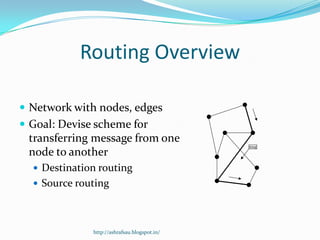
 Network with nodes, edges
 Goal: Devise scheme for
 transferring message from one
                                              msg
 node to another
   Destination routing
   Source routing


              http://ashrafsau.blogspot.in/
Source (“path”) routing


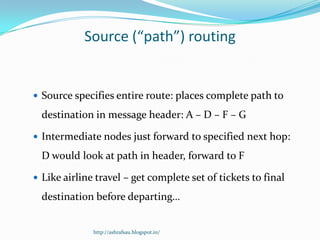
 Source specifies entire route: places complete path to

  destination in message header: A – D – F – G

 Intermediate nodes just forward to specified next hop:

  D would look at path in header, forward to F

 Like airline travel – get complete set of tickets to final

  destination before departing…


              http://ashrafsau.blogspot.in/
Destination (“hop-by-hop”) routing


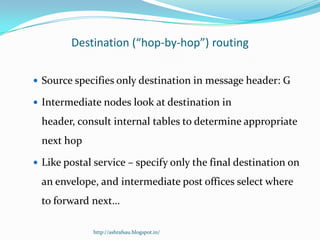
 Source specifies only destination in message header: G

 Intermediate nodes look at destination in

 header, consult internal tables to determine appropriate
 next hop

 Like postal service – specify only the final destination on

 an envelope, and intermediate post offices select where
 to forward next…

             http://ashrafsau.blogspot.in/
Ad Hoc Routing
 Every node participates in routing: no distinction
 between “routers” and “end nodes”

 No external network setup: “self-configuring”

 Especially useful when network topology is dynamic
 (frequent network changes – links break, nodes come
 and go)

               http://ashrafsau.blogspot.in/
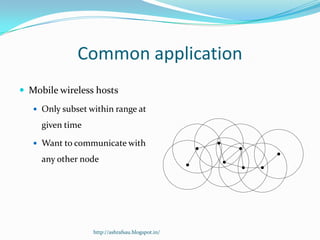
Common application
 Mobile wireless hosts
    Only subset within range at

     given time

    Want to communicate with

     any other node


                  http://ashrafsau.blogspot.in/
DSR Protocol Activities
 Route discovery

   Undertaken when source needs a route to a destination

 Route maintenance

   Used when link breaks, rendering specified path

    unusable


                http://ashrafsau.blogspot.in/
Route Discovery
• The source sends a broadcast packet which contains
 source address, destination address, request id and
 path.
• If a host saw the packet before, discards it.
• Otherwise, the route looks up its route caches to
 look for a route to destination, If not find, appends its
 address into the packet, rebroadcast,
• If finds a route in its route cache, sends a route reply
 packet, which is sent to the source by route cache or
 the route discovery.

               http://ashrafsau.blogspot.in/
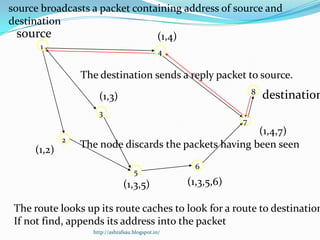
source broadcasts a packet containing address of source and
destination
  source                        (1,4)
       1
                                               4

                 The destination sends a reply packet to source.
                                                                   8
                     (1,3)                                             destination
                     3
                                                               7
                                                       (1,4,7)
             2
                 The node discards the packets having been seen
     (1,2)
                                                     6
                                    5
                                (1,3,5)            (1,3,5,6)

 The route looks up its route caches to look for a route to destination
 If not find, appends its address into the packet
                   http://ashrafsau.blogspot.in/
How to send a reply packet
 If the destination has a route to the source in its route
  cache, use it

 Else if symmetric links are supported, use the reverse
  of route record

 Else if symmetric links are not supported, the
  destination initiates route discovery to source


                  http://ashrafsau.blogspot.in/
Route Maintenance
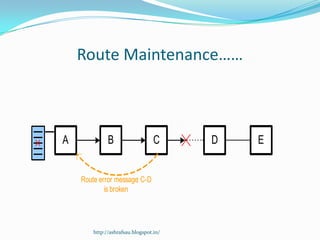
 Whenever a node transmits a data packet, a route
  reply, or a route error, it must verify that the next
  hop correctly receives the packet.
 If not, the node must send a route error to the
  node responsible for generating this route header
   Intermediate nodes “eavesdrop”, adjust cached routes
 Source deletes route; tries another if one cached, or
  The source restart the route discovery


               http://ashrafsau.blogspot.in/
Route Maintenance……


A             B                   C     D   E


    Route error message: C-D
            is broken


        http://ashrafsau.blogspot.in/
DSR Optimization: Route Caching
 Each node caches a new route it learns by any means
 When node S finds route [S,E,F,J,D] to node D, node S
    also learns route [S,E,F] to node F
   When node K receives Route Request [S,C,G] destined
    for node, node K learns route [K,G,C,S] to node S
   When node F forwards Route Reply RREP
    [S,E,F,J,D], node F learns route [F,J,D] to node D
   When node E forwards Data [S,E,F,J,D] it learns route
    [E,F,J,D] to node D
   A node may also learn a route when it overhears Data
                http://ashrafsau.blogspot.in/
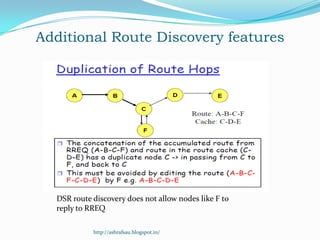
Additional Route Discovery features


  DSR route discovery does not allow nodes like F to
  reply to RREQ

            http://ashrafsau.blogspot.in/
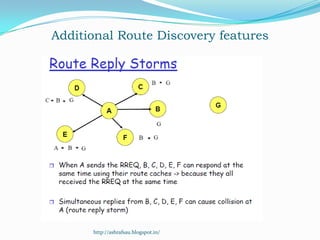
Additional Route Discovery features


      http://ashrafsau.blogspot.in/
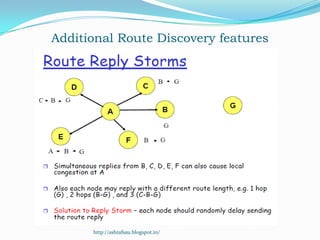
Additional Route Discovery features


      http://ashrafsau.blogspot.in/
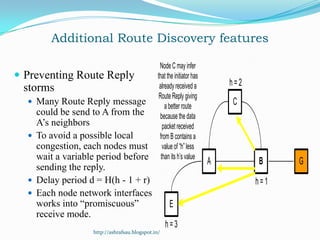
Additional Route Discovery features

                                               Node C may infer
 Preventing Route Reply                      that the initiator has
                                               already received a          h=2
 storms
                                               Route Reply giving
   Many Route Reply message                                               C
                                                  a better route
    could be send to A from the                because the data
    A’s neighbors                                packet received
   To avoid a possible local                  from B contains a
    congestion, each nodes must                  value of “h” less
    wait a variable period before               than its h’s value
                                                                       A         B     G
    sending the reply.
   Delay period d = H(h - 1 + r)                                                h=1
   Each node network interfaces
    works into “promiscuous”                        E
    receive mode.
                                                  h=3
                  http://ashrafsau.blogspot.in/
Additional Route Discovery features

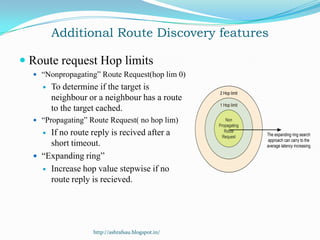
 Route request Hop limits
   “Nonpropagating” Route Request(hop lim 0)
       To determine if the target is
                                                   2 Hop limit
        neighbour or a neighbour has a route
                                                   1 Hop limit
        to the target cached.
   “Propagating” Route Request( no hop lim)           Non
                                                   Propagating
     If no route reply is recived after a            Route
                                                     Request     The expanding ring search
                                                                 approach can carry to the
      short timeout.                                             average latency increasing

   “Expanding ring”
     Increase hop value stepwise if no
      route reply is recieved.


                   http://ashrafsau.blogspot.in/
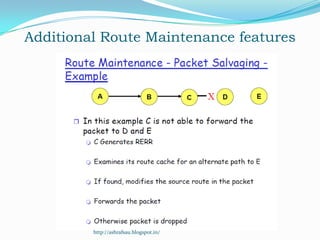
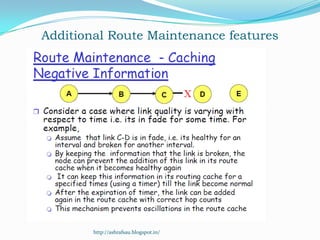
Additional Route Maintenance features


         http://ashrafsau.blogspot.in/
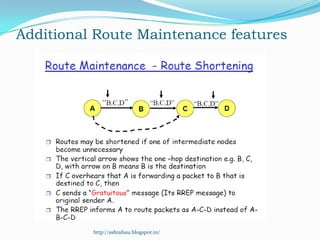
Additional Route Maintenance features


          http://ashrafsau.blogspot.in/
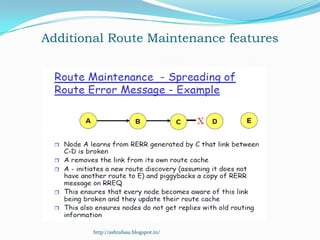
Additional Route Maintenance features


        http://ashrafsau.blogspot.in/
Additional Route Maintenance features


        http://ashrafsau.blogspot.in/
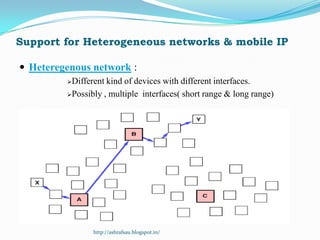
Support for Heterogeneous networks & mobile IP

 Heteregenous network :
         Different kind of devices with different interfaces.
         Possibly , multiple interfaces( short range & long range)


                http://ashrafsau.blogspot.in/
DSR evaluation
 Simulation
    To analyse the behavior and performance of DSR.
    To Compare with other routing protocols
 Set Up:
    Ad hoc of 50 mobiles nodes
    15 minutes ( 900 seconds) simulation time.
    CBR data traffic
    20 mobile nodes traffic sources; 4 packets/sec.
    Random waypoint mobility model ( pause time)


                http://ashrafsau.blogspot.in/
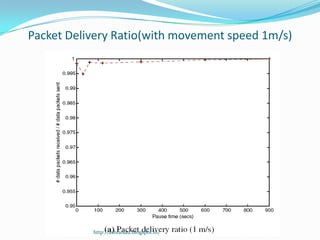
Packet Delivery Ratio(with movement speed 1m/s)


           http://ashrafsau.blogspot.in/
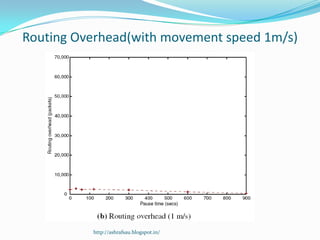
Routing Overhead(with movement speed 1m/s)


          http://ashrafsau.blogspot.in/
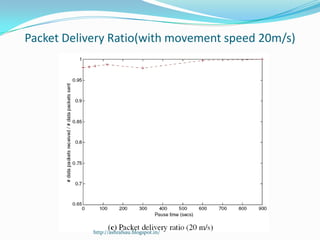
Packet Delivery Ratio(with movement speed 20m/s)


            http://ashrafsau.blogspot.in/
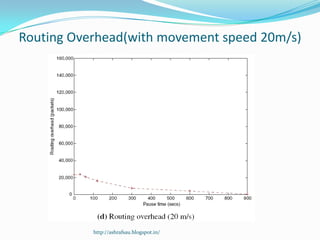
Routing Overhead(with movement speed 20m/s)


           http://ashrafsau.blogspot.in/
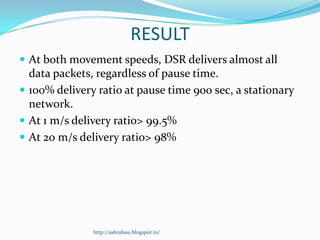
RESULT
 At both movement speeds, DSR delivers almost all
  data packets, regardless of pause time.
 100% delivery ratio at pause time 900 sec, a stationary
  network.
 At 1 m/s delivery ratio> 99.5%
 At 20 m/s delivery ratio> 98%


               http://ashrafsau.blogspot.in/
Advantages
 Routes maintain only between nodes who need to
  communicate. Reduces overhead of routing
  maintenance.
 route caching reduces route discovery overhead.
 A single route may yield many routes to the
  destination.


              http://ashrafsau.blogspot.in/
Disadvantages

 Packet header size grows with route length due to
  source routing.
 Flood route request may potentially reach all nodes in
  the network.
 Route reply storm problem.


               http://ashrafsau.blogspot.in/
Conclusion

 Excellent performance for routing in multi-hop ad hoc.
 Very low routing overhead.
 Able to deliver almost all originated data packets, even
  with rapid motion of all nodes.


                http://ashrafsau.blogspot.in/
THANKS


http://ashrafsau.blogspot.in/
Reference
[1]. David B. Johnson, David A. Maltz, and Josh
 Broch, "DSR: The Dynamic Source Routing Protocol
 for Multi-Hop Wireless Ad Hoc Networks", in Ad Hoc
 Networking, edited by Charles
 E. Perkins, Chapter 5, pp. 139-172, Addison-
 Wesley, 2001. Invited paper.


               http://ashrafsau.blogspot.in/
??????
     QUESTION


??????
http://ashrafsau.blogspot.in/

Dynamic source routing

  • 1.
    DSR: The DynamicSource Routing Protocol for Multi-Hop Wireless Ad Hoc Networks Presenter Ashraf Uddin Sujit Singh South Asian University (Master of Computer Applications) http://ashrafsau.blogspot.in/ http://ashrafsau.blogspot.in/
  • 2.
    Routing Overview  Networkwith nodes, edges  Goal: Devise scheme for transferring message from one msg node to another  Destination routing  Source routing http://ashrafsau.blogspot.in/
  • 3.
    Source (“path”) routing Source specifies entire route: places complete path to destination in message header: A – D – F – G  Intermediate nodes just forward to specified next hop: D would look at path in header, forward to F  Like airline travel – get complete set of tickets to final destination before departing… http://ashrafsau.blogspot.in/
  • 4.
    Destination (“hop-by-hop”) routing Source specifies only destination in message header: G  Intermediate nodes look at destination in header, consult internal tables to determine appropriate next hop  Like postal service – specify only the final destination on an envelope, and intermediate post offices select where to forward next… http://ashrafsau.blogspot.in/
  • 5.
    Ad Hoc Routing Every node participates in routing: no distinction between “routers” and “end nodes”  No external network setup: “self-configuring”  Especially useful when network topology is dynamic (frequent network changes – links break, nodes come and go) http://ashrafsau.blogspot.in/
  • 6.
    Common application  Mobilewireless hosts  Only subset within range at given time  Want to communicate with any other node http://ashrafsau.blogspot.in/
  • 7.
    DSR Protocol Activities Route discovery  Undertaken when source needs a route to a destination  Route maintenance  Used when link breaks, rendering specified path unusable http://ashrafsau.blogspot.in/
  • 8.
    Route Discovery • Thesource sends a broadcast packet which contains source address, destination address, request id and path. • If a host saw the packet before, discards it. • Otherwise, the route looks up its route caches to look for a route to destination, If not find, appends its address into the packet, rebroadcast, • If finds a route in its route cache, sends a route reply packet, which is sent to the source by route cache or the route discovery. http://ashrafsau.blogspot.in/
  • 9.
    source broadcasts apacket containing address of source and destination source (1,4) 1 4 The destination sends a reply packet to source. 8 (1,3) destination 3 7 (1,4,7) 2 The node discards the packets having been seen (1,2) 6 5 (1,3,5) (1,3,5,6) The route looks up its route caches to look for a route to destination If not find, appends its address into the packet http://ashrafsau.blogspot.in/
  • 10.
    How to senda reply packet  If the destination has a route to the source in its route cache, use it  Else if symmetric links are supported, use the reverse of route record  Else if symmetric links are not supported, the destination initiates route discovery to source http://ashrafsau.blogspot.in/
  • 11.
    Route Maintenance  Whenevera node transmits a data packet, a route reply, or a route error, it must verify that the next hop correctly receives the packet.  If not, the node must send a route error to the node responsible for generating this route header  Intermediate nodes “eavesdrop”, adjust cached routes  Source deletes route; tries another if one cached, or The source restart the route discovery http://ashrafsau.blogspot.in/
  • 12.
    Route Maintenance…… A B C D E Route error message: C-D is broken http://ashrafsau.blogspot.in/
  • 13.
    DSR Optimization: RouteCaching  Each node caches a new route it learns by any means  When node S finds route [S,E,F,J,D] to node D, node S also learns route [S,E,F] to node F  When node K receives Route Request [S,C,G] destined for node, node K learns route [K,G,C,S] to node S  When node F forwards Route Reply RREP [S,E,F,J,D], node F learns route [F,J,D] to node D  When node E forwards Data [S,E,F,J,D] it learns route [E,F,J,D] to node D  A node may also learn a route when it overhears Data http://ashrafsau.blogspot.in/
  • 14.
    Additional Route Discoveryfeatures DSR route discovery does not allow nodes like F to reply to RREQ http://ashrafsau.blogspot.in/
  • 15.
    Additional Route Discoveryfeatures http://ashrafsau.blogspot.in/
  • 16.
    Additional Route Discoveryfeatures http://ashrafsau.blogspot.in/
  • 17.
    Additional Route Discoveryfeatures Node C may infer  Preventing Route Reply that the initiator has already received a h=2 storms Route Reply giving  Many Route Reply message C a better route could be send to A from the because the data A’s neighbors packet received  To avoid a possible local from B contains a congestion, each nodes must value of “h” less wait a variable period before than its h’s value A B G sending the reply.  Delay period d = H(h - 1 + r) h=1  Each node network interfaces works into “promiscuous” E receive mode. h=3 http://ashrafsau.blogspot.in/
  • 18.
    Additional Route Discoveryfeatures  Route request Hop limits  “Nonpropagating” Route Request(hop lim 0)  To determine if the target is 2 Hop limit neighbour or a neighbour has a route 1 Hop limit to the target cached.  “Propagating” Route Request( no hop lim) Non Propagating  If no route reply is recived after a Route Request The expanding ring search approach can carry to the short timeout. average latency increasing  “Expanding ring”  Increase hop value stepwise if no route reply is recieved. http://ashrafsau.blogspot.in/
  • 19.
    Additional Route Maintenancefeatures http://ashrafsau.blogspot.in/
  • 20.
    Additional Route Maintenancefeatures http://ashrafsau.blogspot.in/
  • 21.
    Additional Route Maintenancefeatures http://ashrafsau.blogspot.in/
  • 22.
    Additional Route Maintenancefeatures http://ashrafsau.blogspot.in/
  • 23.
    Support for Heterogeneousnetworks & mobile IP  Heteregenous network : Different kind of devices with different interfaces. Possibly , multiple interfaces( short range & long range) http://ashrafsau.blogspot.in/
  • 24.
    DSR evaluation  Simulation  To analyse the behavior and performance of DSR.  To Compare with other routing protocols  Set Up:  Ad hoc of 50 mobiles nodes  15 minutes ( 900 seconds) simulation time.  CBR data traffic  20 mobile nodes traffic sources; 4 packets/sec.  Random waypoint mobility model ( pause time) http://ashrafsau.blogspot.in/
  • 25.
    Packet Delivery Ratio(withmovement speed 1m/s) http://ashrafsau.blogspot.in/
  • 26.
    Routing Overhead(with movementspeed 1m/s) http://ashrafsau.blogspot.in/
  • 27.
    Packet Delivery Ratio(withmovement speed 20m/s) http://ashrafsau.blogspot.in/
  • 28.
    Routing Overhead(with movementspeed 20m/s) http://ashrafsau.blogspot.in/
  • 29.
    RESULT  At bothmovement speeds, DSR delivers almost all data packets, regardless of pause time.  100% delivery ratio at pause time 900 sec, a stationary network.  At 1 m/s delivery ratio> 99.5%  At 20 m/s delivery ratio> 98% http://ashrafsau.blogspot.in/
  • 30.
    Advantages  Routes maintainonly between nodes who need to communicate. Reduces overhead of routing maintenance.  route caching reduces route discovery overhead.  A single route may yield many routes to the destination. http://ashrafsau.blogspot.in/
  • 31.
    Disadvantages  Packet headersize grows with route length due to source routing.  Flood route request may potentially reach all nodes in the network.  Route reply storm problem. http://ashrafsau.blogspot.in/
  • 32.
    Conclusion  Excellent performancefor routing in multi-hop ad hoc.  Very low routing overhead.  Able to deliver almost all originated data packets, even with rapid motion of all nodes. http://ashrafsau.blogspot.in/
  • 33.
  • 34.
    Reference [1]. David B.Johnson, David A. Maltz, and Josh Broch, "DSR: The Dynamic Source Routing Protocol for Multi-Hop Wireless Ad Hoc Networks", in Ad Hoc Networking, edited by Charles E. Perkins, Chapter 5, pp. 139-172, Addison- Wesley, 2001. Invited paper. http://ashrafsau.blogspot.in/
  • 35.
    ?????? QUESTION ?????? http://ashrafsau.blogspot.in/