ROUTING PROTOCOLS IN WIRELESS NETWORK PRESENTED BY :- PANKAJ BARODIA ROLL NO. :- 09112019 M.TECH (CSE) Deenbandhu Chhotu Ram University of Science and Technology Murthal, Sonipat (Haryana), June 2011
What is routing ? Routing is the process of selecting paths in a  network along which to send network traffic. It is of two types – Static Routing Dynamic Routing What is protocol ? A specific set of communication rules by which computers communicate with each other.
What is routing protocols ? A routing protocol is a protocol that specifies how  routers communicate with each other. Routing protocols use metrics to evaluate what path will be the best for a packet to travel. A metric   is a standard of measurement, such as   - Path bandwidth  - Reliability  - Delay  - Current load on that path
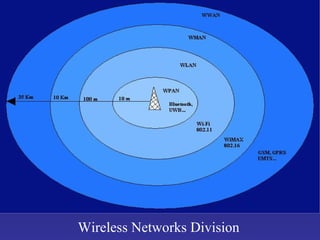
Types of Wireless Network There are basically four different types of wireless networks. - WPAN (Wireless Personal Area Network)  - WLAN (Wireless Local Area Network)  WMAN (Wireless Metropolitan Area Network) WWAN (Wireless Wide Area Network)
Wireless Networks Division
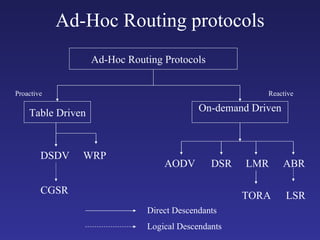
Ad-Hoc Routing protocols Ad-Hoc Routing Protocols Table Driven On-demand Driven WRP DSDV CGSR AODV  DSR   LMR   ABR TORA LSR Direct Descendants Logical   Descendants Proactive Reactive
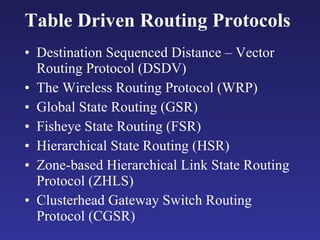
Table Driven Routing Protocols Destination Sequenced Distance – Vector Routing Protocol (DSDV) The Wireless Routing Protocol (WRP) Global State Routing (GSR) Fisheye State Routing (FSR) Hierarchical State Routing (HSR) Zone-based Hierarchical Link State Routing Protocol (ZHLS) Clusterhead Gateway Switch Routing Protocol (CGSR)
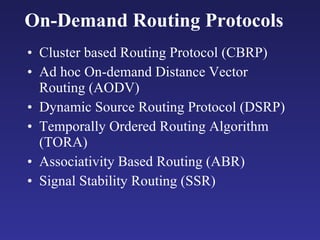
On-Demand Routing Protocols  Cluster based Routing Protocol (CBRP) Ad hoc On-demand Distance Vector Routing (AODV) Dynamic Source Routing Protocol (DSRP) Temporally Ordered Routing Algorithm (TORA) Associativity Based Routing (ABR) Signal Stability Routing (SSR)
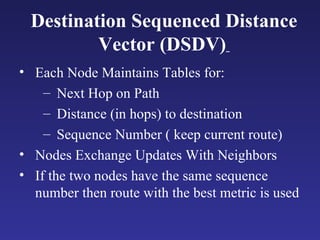
Destination Sequenced Distance Vector (DSDV)   Each Node Maintains Tables for: Next Hop on Path Distance (in hops) to destination Sequence Number ( keep current route) Nodes Exchange Updates With Neighbors If the two nodes have the same sequence number then route with the best metric is used
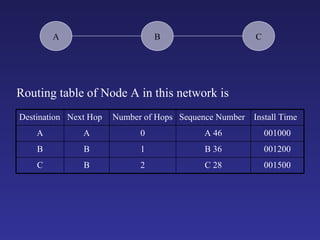
Routing table of Node A in this network is A B C Destination Next Hop Number of Hops Sequence Number Install Time A A 0 A 46 001000 B B 1 B 36 001200 C B 2 C 28 001500
Advantages of DSDV It is quite suitable for creating ad-hoc networks with small number of nodes Solve the Routing Loop problem Count to infinity problem is reduced DSDV maintains only the best path instead of maintaining multiple paths to every destination
Disadvantages of DSDV DSDV requires a regular update of its routing tables, which uses up battery power and a small amount of bandwidth even when the network is idle Whenever the topology of the network changes, a new sequence number is necessary DSDV is not suitable for highly dynamic networks
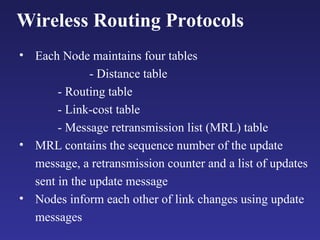
Wireless Routing Protocols Each Node maintains four tables   - Distance table - Routing table - Link-cost table - Message retransmission list (MRL) table MRL contains the sequence number of the update message, a retransmission counter and a list of updates sent in the update message Nodes inform each other of link changes using update messages
Nodes send update messages after processing updates from their neighbors or after detecting a change in the link If a node is not sending messages, it must send a HELLO message within a specified time to ensure connectivity If the node receives a HELLO message from a new node, that node is added to the table It avoids the “count to infinity” problem
Disadvantages of WRP Four tables requires a large amount of memory Periodic hello message consumes power and bandwidth Advantages of WRP A problem of the Bellman-Ford protocol is the count-to-infinity problem. This is a problem that is solved by WRP
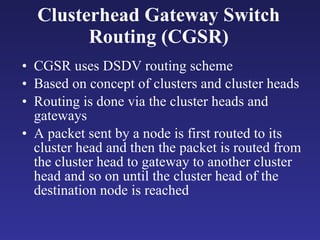
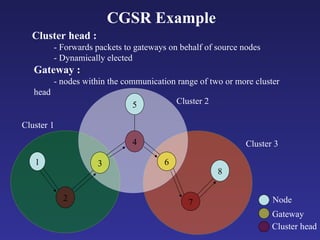
CGSR uses DSDV routing scheme Based on concept of clusters and cluster heads Routing is done via the cluster heads and gateways A packet sent by a node is first routed to its cluster head and then the packet is routed from the cluster head to gateway to another cluster head and so on until the cluster head of the destination node is reached Clusterhead Gateway Switch Routing (CGSR)
CGSR Example Cluster head : - Forwards packets to gateways on behalf of source nodes - Dynamically elected Gateway : - nodes within the communication range of two or more cluster head 1 2 3 5 4 6 7 8 Gateway Cluster head Node Cluster 1 Cluster 2 Cluster 3
Advantages of CGSR Better bandwidth utilization Reduce the size of distance vector table because the routing is performed only over cluster head
Disadvantages of CGSR More time is spend in selection of cluster heads and gateways If the mobile node uses CDMA/TDMA then it can take some time to get permission to send packets Changes in the cluster-head, may result in multiple path breaks
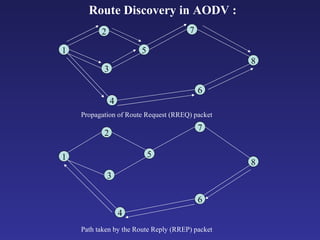
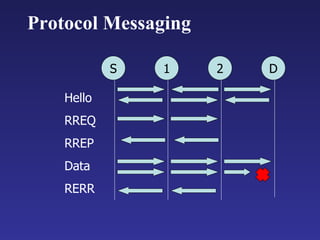
Ad Hoc On-demand Distance Vector Routing  (AODV)  Route Discovery Process : Source Node initiates path discovery process by broadcasting RREQ RREQ is forwarded until it reaches an intermediate node that has a recent route information about the destination or till it reaches the destination   The RREQ uses sequence numbers to ensure that the routes are loop free and reply contains latest information only
When a node forwards a route request packet to its neighbors, it also records in its tables the node from which the first copy of the request came This table is used to construct the reverse path for the RREQ As the RREP traverses back to the source, the nodes along the path enter the forward route into their tables   Route reply process :
If one of the intermediate nodes move then the moved nodes neighbor realizes the link failure and sends a link failure notification to its upstream neighbors and so on till it reaches the source  Route Error Packets (RERR) are used to erase broken links
1 2 3 5 7 8 4 6 1 2 3 5 7 8 4 Propagation of Route Request (RREQ) packet 6 Path taken by the Route Reply (RREP) packet Route Discovery in AODV :
Protocol Messaging S 1 2 D Hello RREQ RREP Data RERR
Advantages of AODV The main advantage of this protocol is that routes are established on demand and destination sequence numbers are used to find the latest route to the destination  The connection setup delay is lower
Disadvantages of AODV Intermediate nodes can lead to inconsistent routes if the source sequence number is very old  The periodic beaconing leads to unnecessary bandwidth consumption
Dynamic Source Routing   (DSR)   The two major phases of the protocol are : 1. Route discovery  2. Route maintenance
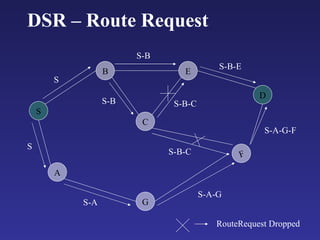
DSR - Route Discovery The sender : broadcast a route request packet The receiver : I t looks up its route cache to determine if it already  contains a route to the destination If   host's address is already listed in the route record   -  Discard If  host is the target - Send a route reply Else - Append this host's address to the route record, and    re-broadcast
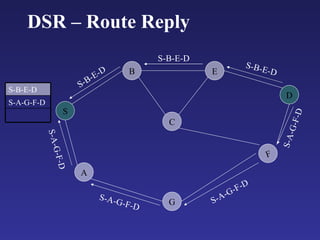
Route reply is generated when the route request reaches either destination itself or intermediate node  When destination is reached then destination returns RouteReply with full path  Source node caches all paths that it receives and choose Shortest Path among all the path that it receives
DSR – Route Request S A G C F D B E S S-B S-B-E S-A S S-A-G S-A-G-F S-B S-B-C S-B-C RouteRequest Dropped
DSR – Route Reply S A G C F D B E S-B-E-D S-B-E-D S-B-E-D S-A-G-F-D S-A-G-F-D S-A-G-F-D S-A-G-F-D S-B-E-D S-A-G-F-D
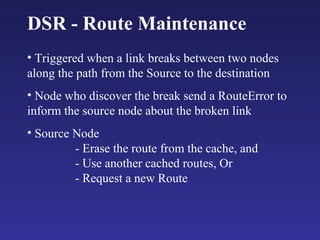
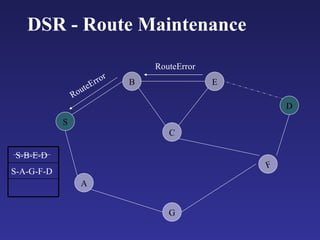
DSR - Route Maintenance Triggered when a link breaks between two nodes along the path from the Source to the destination Node who discover the break send a RouteError to inform the source node about the broken link Source Node - Erase the route from the cache, and - Use another cached routes, Or  - Request a new Route
DSR - Route Maintenance S A G C F D B E RouteError RouteError S-B-E-D S-A-G-F-D
Advantages of DSR A route is established only when it is required and hence the need to find routes to all other nodes is eliminated The intermediate nodes utilize the route cache information to reduce the control overhead
Disadvantages of DSR The route maintenance mechanism does not locally repair a broken link The connection setup delay is higher than in table-driven protocols This routing overhead is directly proportional to the path length
Temporally Ordered Routing Algorithm   (TORA)  It is based on Link Reversal Algorithms  It is a source-initiated on-demand routing protocol and it finds multiple routes from a source node to a destination node It has three basic functions - Route creation - Route maintenance - Route erasure
TORA – Route Discovery Route Creation is done using QRY and UPD packets QRY packet  : contains the destination-ID (did) for    which the algorithm is running UPD packet  : contains the (did) and the Height of the    node i (Hi) that is broadcasting the packet The height of destination set to 0 and all other node's height set to NULL  The source broadcasts a QRY packet with the destination node's ID in it
A node with not NULL height responds with a UPD packet that has its height in it  A node receiving a UPD packet sets its height to one more than that of the node that generated the UPD   A node with higher height is considered upstream and a node with lower height considered downstream  In this way a directed acyclic graph is constructed from source to the destination
Route Erasure : - A clear packet (CLR) is flooded through network to erase invalid routes
Illustration of TORA height metric Source Destination H = 0 H = 1 H = 2 H = 3
Route  Creation  of TORA 1 2 3 4 5 6 7 8 1 2 3 4 5 6 7 8 s s d d Propagation of QRY (reference level, height) Height of each node  updated by UPD (-,-) (-,-) (-,-) (-,-) (-,-) (-,-) (0,0) (-,-) (0,3) (0,3) (0,3) (0,2) (0,1) (0,0) (0,1) (0,2)
C A B E G (DEST) F H D QRY Route Creation of TORA QRY QRY UPD QRY QRY UPD UPD UPD UPD UPD UPD
Route maintenance C A B E F D UPD X UPD G (DEST) H
Advantages of TORA An on-demand routing protocol create a DAG only when necessary  Multiple paths created Good in dense networks
Disadvantages of TORA Not much used since DSR and AODV outperform TORA Performance degrades with increasing mobility
References : Jochen Schiller. Mobile Communications. Addison-Wesley Andrew S. Tanenbaum. Computer Networks, 4th Edition. PRENTICE HALL David B. Johnson, Davis A. Maltz, "Dynamic Source Routing in Ad Hoc Networks", Mobile Computing, T. Imielinski and H. Korth, Eds., Kulwer http://www.fesb.hr/~mcagalj/publications/ZurkindenCH03.pdf  http://wiki.uni.lu/secan-lab/Dynamic+Source+Routing.html http://www.ietf.org/html.charters/manet-charter.html http://compnetworking.about.com/cs/wireless80211/a/aa80211standard.htm (802.11)
http://cst.mi.fu-berlin.de/teaching/ss06/19554-s-ti/georgy%20sklyrenko%20-%20aodv%20routing%20protocol.pdf (AODV) http://moment.cs.ucsb.edu/AODV/aodv.html http://wiki.uni.lu/secan-lab/Signal+Stability-based+Adaptive+Routing+Protocol.html (SSR)

Wireless routing protocols

  • 1.
    ROUTING PROTOCOLS INWIRELESS NETWORK PRESENTED BY :- PANKAJ BARODIA ROLL NO. :- 09112019 M.TECH (CSE) Deenbandhu Chhotu Ram University of Science and Technology Murthal, Sonipat (Haryana), June 2011
  • 2.
    What is routing? Routing is the process of selecting paths in a network along which to send network traffic. It is of two types – Static Routing Dynamic Routing What is protocol ? A specific set of communication rules by which computers communicate with each other.
  • 3.
    What is routingprotocols ? A routing protocol is a protocol that specifies how routers communicate with each other. Routing protocols use metrics to evaluate what path will be the best for a packet to travel. A metric is a standard of measurement, such as - Path bandwidth - Reliability - Delay - Current load on that path
  • 4.
    Types of WirelessNetwork There are basically four different types of wireless networks. - WPAN (Wireless Personal Area Network) - WLAN (Wireless Local Area Network) WMAN (Wireless Metropolitan Area Network) WWAN (Wireless Wide Area Network)
  • 5.
  • 6.
    Ad-Hoc Routing protocolsAd-Hoc Routing Protocols Table Driven On-demand Driven WRP DSDV CGSR AODV DSR LMR ABR TORA LSR Direct Descendants Logical Descendants Proactive Reactive
  • 7.
    Table Driven RoutingProtocols Destination Sequenced Distance – Vector Routing Protocol (DSDV) The Wireless Routing Protocol (WRP) Global State Routing (GSR) Fisheye State Routing (FSR) Hierarchical State Routing (HSR) Zone-based Hierarchical Link State Routing Protocol (ZHLS) Clusterhead Gateway Switch Routing Protocol (CGSR)
  • 8.
    On-Demand Routing Protocols Cluster based Routing Protocol (CBRP) Ad hoc On-demand Distance Vector Routing (AODV) Dynamic Source Routing Protocol (DSRP) Temporally Ordered Routing Algorithm (TORA) Associativity Based Routing (ABR) Signal Stability Routing (SSR)
  • 9.
    Destination Sequenced DistanceVector (DSDV) Each Node Maintains Tables for: Next Hop on Path Distance (in hops) to destination Sequence Number ( keep current route) Nodes Exchange Updates With Neighbors If the two nodes have the same sequence number then route with the best metric is used
  • 10.
    Routing table ofNode A in this network is A B C Destination Next Hop Number of Hops Sequence Number Install Time A A 0 A 46 001000 B B 1 B 36 001200 C B 2 C 28 001500
  • 11.
    Advantages of DSDVIt is quite suitable for creating ad-hoc networks with small number of nodes Solve the Routing Loop problem Count to infinity problem is reduced DSDV maintains only the best path instead of maintaining multiple paths to every destination
  • 12.
    Disadvantages of DSDVDSDV requires a regular update of its routing tables, which uses up battery power and a small amount of bandwidth even when the network is idle Whenever the topology of the network changes, a new sequence number is necessary DSDV is not suitable for highly dynamic networks
  • 13.
    Wireless Routing ProtocolsEach Node maintains four tables - Distance table - Routing table - Link-cost table - Message retransmission list (MRL) table MRL contains the sequence number of the update message, a retransmission counter and a list of updates sent in the update message Nodes inform each other of link changes using update messages
  • 14.
    Nodes send updatemessages after processing updates from their neighbors or after detecting a change in the link If a node is not sending messages, it must send a HELLO message within a specified time to ensure connectivity If the node receives a HELLO message from a new node, that node is added to the table It avoids the “count to infinity” problem
  • 15.
    Disadvantages of WRPFour tables requires a large amount of memory Periodic hello message consumes power and bandwidth Advantages of WRP A problem of the Bellman-Ford protocol is the count-to-infinity problem. This is a problem that is solved by WRP
  • 16.
    CGSR uses DSDVrouting scheme Based on concept of clusters and cluster heads Routing is done via the cluster heads and gateways A packet sent by a node is first routed to its cluster head and then the packet is routed from the cluster head to gateway to another cluster head and so on until the cluster head of the destination node is reached Clusterhead Gateway Switch Routing (CGSR)
  • 17.
    CGSR Example Clusterhead : - Forwards packets to gateways on behalf of source nodes - Dynamically elected Gateway : - nodes within the communication range of two or more cluster head 1 2 3 5 4 6 7 8 Gateway Cluster head Node Cluster 1 Cluster 2 Cluster 3
  • 18.
    Advantages of CGSRBetter bandwidth utilization Reduce the size of distance vector table because the routing is performed only over cluster head
  • 19.
    Disadvantages of CGSRMore time is spend in selection of cluster heads and gateways If the mobile node uses CDMA/TDMA then it can take some time to get permission to send packets Changes in the cluster-head, may result in multiple path breaks
  • 20.
    Ad Hoc On-demandDistance Vector Routing (AODV) Route Discovery Process : Source Node initiates path discovery process by broadcasting RREQ RREQ is forwarded until it reaches an intermediate node that has a recent route information about the destination or till it reaches the destination The RREQ uses sequence numbers to ensure that the routes are loop free and reply contains latest information only
  • 21.
    When a nodeforwards a route request packet to its neighbors, it also records in its tables the node from which the first copy of the request came This table is used to construct the reverse path for the RREQ As the RREP traverses back to the source, the nodes along the path enter the forward route into their tables Route reply process :
  • 22.
    If one ofthe intermediate nodes move then the moved nodes neighbor realizes the link failure and sends a link failure notification to its upstream neighbors and so on till it reaches the source Route Error Packets (RERR) are used to erase broken links
  • 23.
    1 2 35 7 8 4 6 1 2 3 5 7 8 4 Propagation of Route Request (RREQ) packet 6 Path taken by the Route Reply (RREP) packet Route Discovery in AODV :
  • 24.
    Protocol Messaging S1 2 D Hello RREQ RREP Data RERR
  • 25.
    Advantages of AODVThe main advantage of this protocol is that routes are established on demand and destination sequence numbers are used to find the latest route to the destination The connection setup delay is lower
  • 26.
    Disadvantages of AODVIntermediate nodes can lead to inconsistent routes if the source sequence number is very old The periodic beaconing leads to unnecessary bandwidth consumption
  • 27.
    Dynamic Source Routing (DSR) The two major phases of the protocol are : 1. Route discovery 2. Route maintenance
  • 28.
    DSR - RouteDiscovery The sender : broadcast a route request packet The receiver : I t looks up its route cache to determine if it already contains a route to the destination If host's address is already listed in the route record - Discard If host is the target - Send a route reply Else - Append this host's address to the route record, and re-broadcast
  • 29.
    Route reply isgenerated when the route request reaches either destination itself or intermediate node When destination is reached then destination returns RouteReply with full path Source node caches all paths that it receives and choose Shortest Path among all the path that it receives
  • 30.
    DSR – RouteRequest S A G C F D B E S S-B S-B-E S-A S S-A-G S-A-G-F S-B S-B-C S-B-C RouteRequest Dropped
  • 31.
    DSR – RouteReply S A G C F D B E S-B-E-D S-B-E-D S-B-E-D S-A-G-F-D S-A-G-F-D S-A-G-F-D S-A-G-F-D S-B-E-D S-A-G-F-D
  • 32.
    DSR - RouteMaintenance Triggered when a link breaks between two nodes along the path from the Source to the destination Node who discover the break send a RouteError to inform the source node about the broken link Source Node - Erase the route from the cache, and - Use another cached routes, Or - Request a new Route
  • 33.
    DSR - RouteMaintenance S A G C F D B E RouteError RouteError S-B-E-D S-A-G-F-D
  • 34.
    Advantages of DSRA route is established only when it is required and hence the need to find routes to all other nodes is eliminated The intermediate nodes utilize the route cache information to reduce the control overhead
  • 35.
    Disadvantages of DSRThe route maintenance mechanism does not locally repair a broken link The connection setup delay is higher than in table-driven protocols This routing overhead is directly proportional to the path length
  • 36.
    Temporally Ordered RoutingAlgorithm (TORA) It is based on Link Reversal Algorithms It is a source-initiated on-demand routing protocol and it finds multiple routes from a source node to a destination node It has three basic functions - Route creation - Route maintenance - Route erasure
  • 37.
    TORA – RouteDiscovery Route Creation is done using QRY and UPD packets QRY packet : contains the destination-ID (did) for which the algorithm is running UPD packet : contains the (did) and the Height of the node i (Hi) that is broadcasting the packet The height of destination set to 0 and all other node's height set to NULL The source broadcasts a QRY packet with the destination node's ID in it
  • 38.
    A node withnot NULL height responds with a UPD packet that has its height in it A node receiving a UPD packet sets its height to one more than that of the node that generated the UPD A node with higher height is considered upstream and a node with lower height considered downstream In this way a directed acyclic graph is constructed from source to the destination
  • 39.
    Route Erasure :- A clear packet (CLR) is flooded through network to erase invalid routes
  • 40.
    Illustration of TORAheight metric Source Destination H = 0 H = 1 H = 2 H = 3
  • 41.
    Route Creation of TORA 1 2 3 4 5 6 7 8 1 2 3 4 5 6 7 8 s s d d Propagation of QRY (reference level, height) Height of each node updated by UPD (-,-) (-,-) (-,-) (-,-) (-,-) (-,-) (0,0) (-,-) (0,3) (0,3) (0,3) (0,2) (0,1) (0,0) (0,1) (0,2)
  • 42.
    C A BE G (DEST) F H D QRY Route Creation of TORA QRY QRY UPD QRY QRY UPD UPD UPD UPD UPD UPD
  • 43.
    Route maintenance CA B E F D UPD X UPD G (DEST) H
  • 44.
    Advantages of TORAAn on-demand routing protocol create a DAG only when necessary Multiple paths created Good in dense networks
  • 45.
    Disadvantages of TORANot much used since DSR and AODV outperform TORA Performance degrades with increasing mobility
  • 46.
    References : JochenSchiller. Mobile Communications. Addison-Wesley Andrew S. Tanenbaum. Computer Networks, 4th Edition. PRENTICE HALL David B. Johnson, Davis A. Maltz, "Dynamic Source Routing in Ad Hoc Networks", Mobile Computing, T. Imielinski and H. Korth, Eds., Kulwer http://www.fesb.hr/~mcagalj/publications/ZurkindenCH03.pdf http://wiki.uni.lu/secan-lab/Dynamic+Source+Routing.html http://www.ietf.org/html.charters/manet-charter.html http://compnetworking.about.com/cs/wireless80211/a/aa80211standard.htm (802.11)
  • 47.