IJSRD - International Journal for Scientific Research & Development| Vol. 2, Issue 07, 2014 | ISSN (online): 2321-0613
All rights reserved by www.ijsrd.com 77
Performance Evaluation of DSDV & OLSR Proactive Protocols in
MANET
Sanju Verma1 Professor Sandeep Jaglan2
1
M.Tech Student 2
Associate professor
1,2
Department of Computer Science
1,2
NCCE, Israna, Panipat
Abstract— MANETS are working in distributed
environment and dynamically changing the network
topology. MANET protocols can be table driven or on
demand as per requirement. DSDV (Destination Sequenced
Distance Vector) and OLSR (Optimized Link State Routing
protocol) both are table driven (proactive) protocol.
Performances of both proactive protocols are evaluated
using NS-2 simulator under various metrics and no. of
mobile nodes is 10 in the network.
Keywords: MANET, DSDV, OLSR, MPR, MID
I. INTRODUCTION
Mobile Ad Hoc Network (MANET) is a collection of
mobile nodes communicating with each other. MANETS are
working in distributed environment and dynamically
changing the network topology. It is self-organizing
infrastructure less networks without any central
coordinators. Routing is used for select and finds the best
route from source to destination through intermediate
mobile nodes for communication. In this paper Analysis of
DSDV and OLSR protocol is considered. In recent years,
there are many protocols that have been developed. Existing
protocols for ad-hoc network can generally be categorized
into pro-active and re-active protocols types. In Proactive
protocols (table driven routing protocols) every node
maintains the network topology information in the form of
routing tables by periodically exchanging routing
information. Reactive (on-demand routing protocols) do not
maintain the network topology information.
II. DSDV PROTOCOL
DSDV protocol is proactive protocol and enhanced version
Of Bellman ford algorithm. This protocol maintains table
that contains shortest path and with increasing sequence no.
to avoid the loops in the network. Tables are exchanged
between the nodes to keep neighbour node up to date to
destination node. The tables are updated either using a “full
dump" or an incremental update. A full dump send the full
routing table to the neighbors and could span many packets
whereas in an incremental update only those entries from the
routing table are sent that has a metric change since the last
update and it must fit in a packet.
The route information broadcast by each node
contain
 Its new Sequence Number
 Each route
 The Destination’s address
 The number of hops required to reach the
destination
 The Destination Sequence Number.
Each row of the update send is of the following
form:
<Destination IP address, Destination sequence
number, Hop count>
After receiving an update neighbouring nodes
utilizes it to compute the routing table entries. To damp the
routing fluctuations due to unsynchronized nature of
periodic updates, routing updates for a given destination can
propagate along different paths at different rates. To prevent
a node from announcing a routing path change for a given
estimation while another better update for that destination is
still in route, DSDV requires node to wait a settling time
before announcing a new route with higher metric for a
destination. In DSDV, the sequence number of a source is
increased periodically. A route becomes feasible again after
the source increases its sequence number, and the new
sequence number is propagated through the network, which
may, in general, require a significant amount of time.
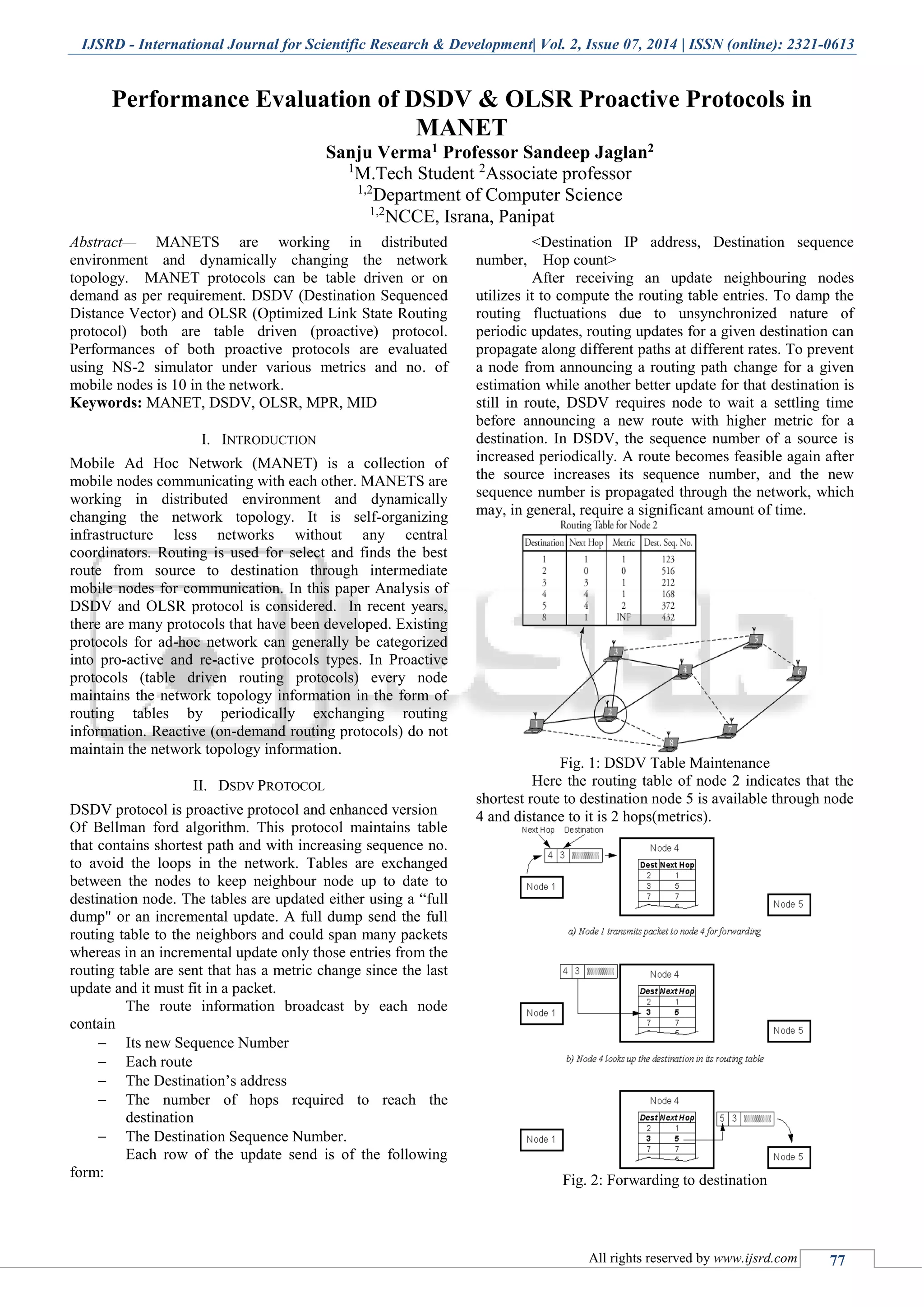
Fig. 1: DSDV Table Maintenance
Here the routing table of node 2 indicates that the
shortest route to destination node 5 is available through node
4 and distance to it is 2 hops(metrics).
Fig. 2: Forwarding to destination
Performance Evaluation of DSDV & OLSR Proactive Protocols in MANET
(IJSRD/Vol. 2/Issue 07/2014/019)
All rights reserved by www.ijsrd.com 78
III. OLSR PROTOCOL
The protocol is an optimization of the classical link state
algorithm tailored to the requirements of a mobile wireless
LAN. It operates as a table driven, proactive protocol, i.e.,
exchanges topology information with other nodes of the
network regularly. Each node selects a set of its neighbor
nodes as "multipoint relays" (MPR). In OLSR, only nodes,
selected as such MPRs are responsible for forwarding
control traffic, intended for diffusion into the entire network.
MPRs provide an efficient mechanism for flooding control
traffic by reducing the number of transmissions required.
OLSR minimizes the overhead from flooding of control
traffic by using only selected nodes, called MPRs, to
retransmit control messages. This technique significantly
reduces the number of retransmissions required to flood a
message to all nodes in the network. Secondly, OLSR
requires only partial link state to be flooded in order to
provide shortest path routes. The minimal set of link state
information required is, that all nodes, selected as MPRs,
MUST declare the links to their MPR selectors. Additional
topological information, if present, may be utilized e.g., for
redundancy purposes. Also, OLSR does not require
sequenced delivery of messages. Each control message
contains a sequence number which is incremented for each
message. Thus the recipient of a control message can, if
required, easily identify which information is more recent -
even if messages have been re-ordered while in
transmission.
OLSR defines three basic types of control
messages
A. HELLO
HELLO messages are transmitted to all neighbors. These
messages are used for neighbor sensing and MPR
calculation.
B. TC
Topology Control messages are the link state signaling done
by OLSR. This messaging is optimized in several ways
using MPRs.
C. MID
Multiple Interface Declaration messages are transmitted by
nodes running OLSR on more than one interface. These
messages list all IP addresses used by a node.
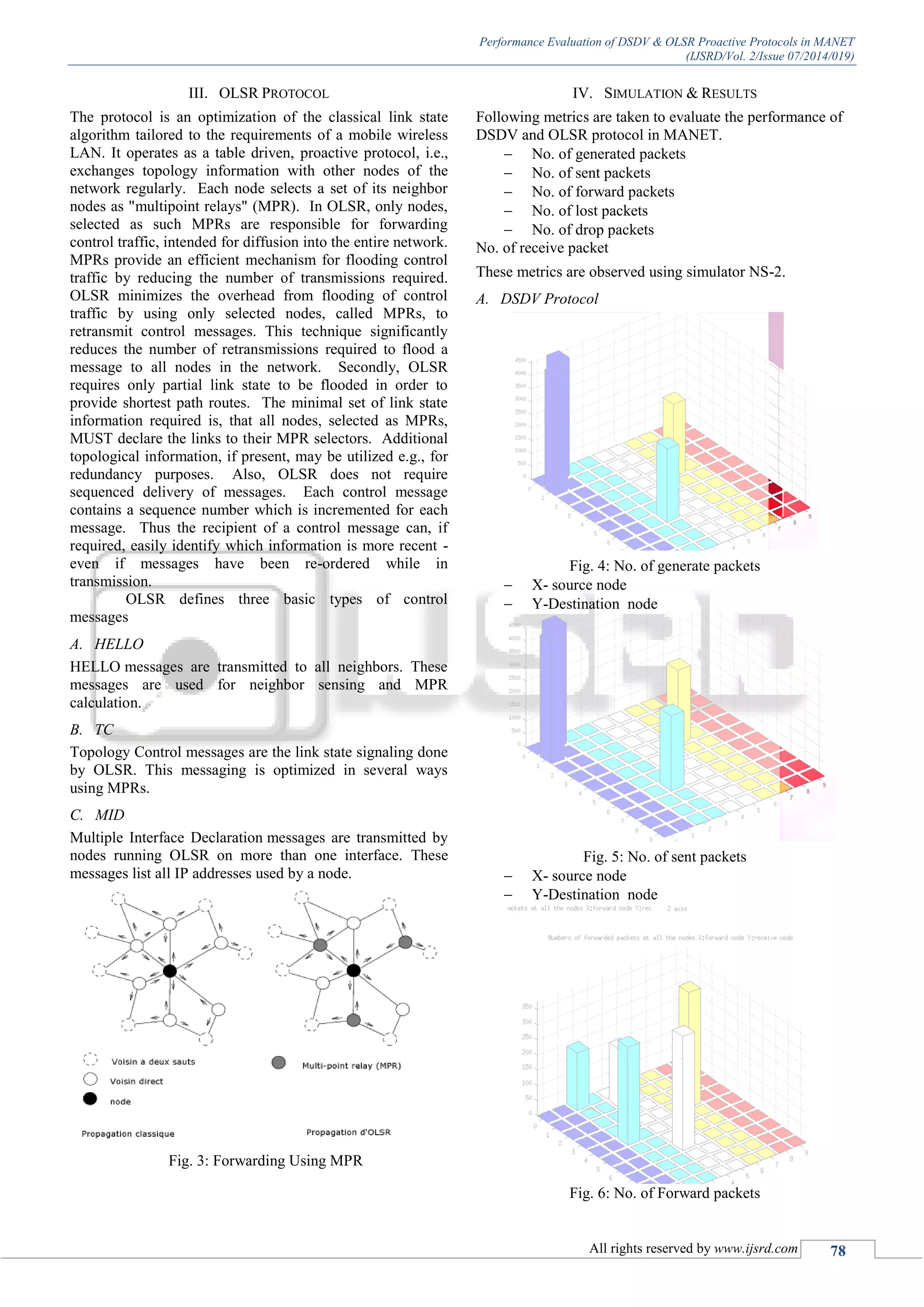
Fig. 3: Forwarding Using MPR
IV. SIMULATION & RESULTS
Following metrics are taken to evaluate the performance of
DSDV and OLSR protocol in MANET.
 No. of generated packets
 No. of sent packets
 No. of forward packets
 No. of lost packets
 No. of drop packets
No. of receive packet
These metrics are observed using simulator NS-2.
A. DSDV Protocol
Fig. 4: No. of generate packets
 X- source node
 Y-Destination node
Fig. 5: No. of sent packets
 X- source node
 Y-Destination node
Fig. 6: No. of Forward packets
Performance Evaluation of DSDV & OLSR Proactive Protocols in MANET
(IJSRD/Vol. 2/Issue 07/2014/019)
All rights reserved by www.ijsrd.com 79
 X- source node
 Y-Destination node
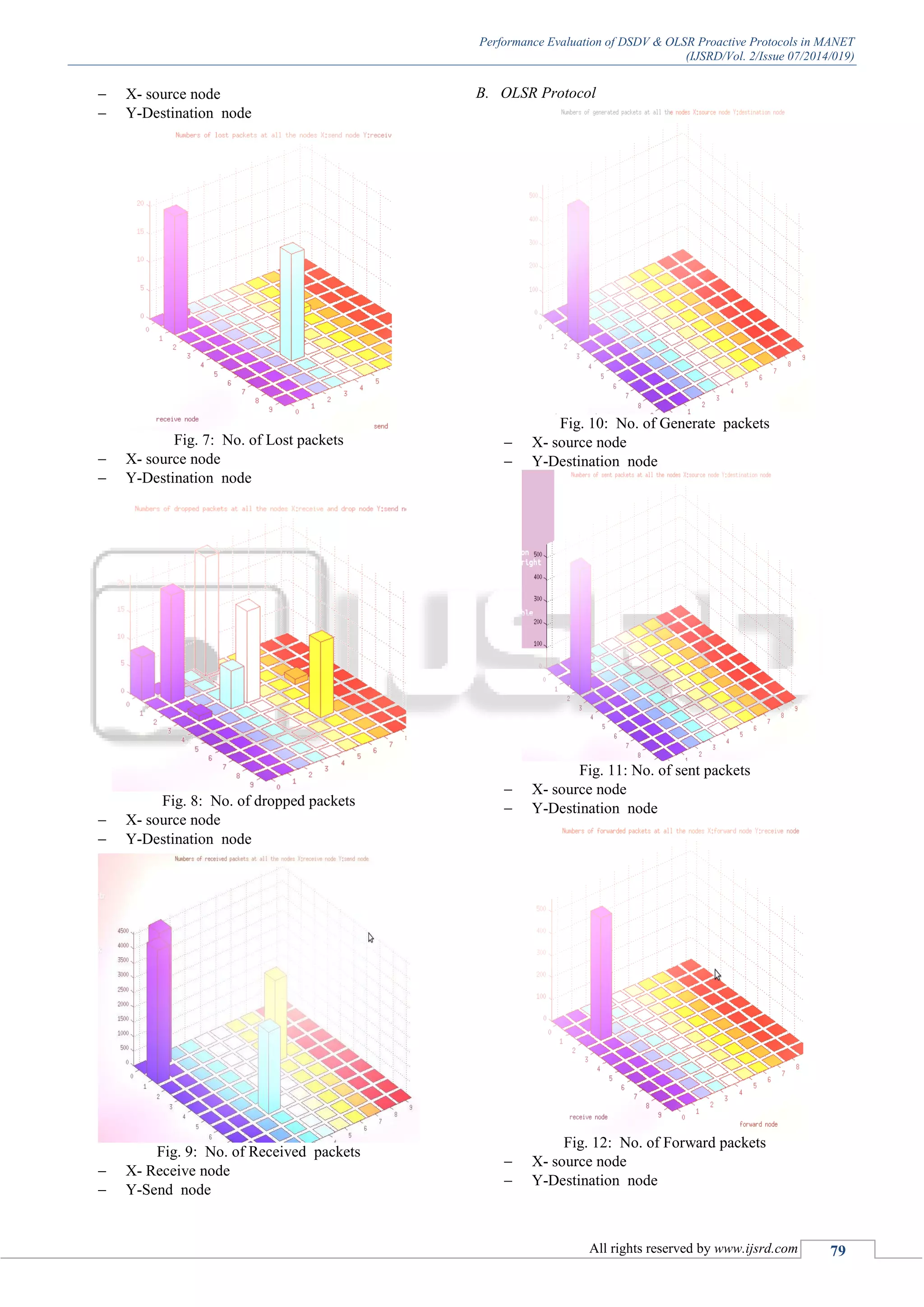
Fig. 7: No. of Lost packets
 X- source node
 Y-Destination node
Fig. 8: No. of dropped packets
 X- source node
 Y-Destination node
Fig. 9: No. of Received packets
 X- Receive node
 Y-Send node
B. OLSR Protocol
Fig. 10: No. of Generate packets
 X- source node
 Y-Destination node
Fig. 11: No. of sent packets
 X- source node
 Y-Destination node
Fig. 12: No. of Forward packets
 X- source node
 Y-Destination node
Performance Evaluation of DSDV & OLSR Proactive Protocols in MANET
(IJSRD/Vol. 2/Issue 07/2014/019)
All rights reserved by www.ijsrd.com 80
Fig. 13: No. of Lost packets
 X- source node
 Y-Destination node
Fig. 14: No. of dropped packets
 X- source node
 Y-Destination node
Fig. 15: No. of Received packets
 X- Receive node
 Y-Send node
REFERENCES
[1] C.E. Perkins & P. Bhagwat, “Highly Dynamic
Destination Sequence-Vector Routing (DSDV) for
Mobile Computers”, Computer Communication
Review, vol. 24, no.4, 1994, pp. 234-244.
[2] V. SAMESWARI and DR. E. Ramaraj “A Study of
Table-Driven and On-Demand Routing Protocols in
MANET” IJCTA Vol 5 (2), 2014,522-529.
[3] Ramprasad Kumawat and Vinay Somani
“Comparative Analysis of DSDV and OLSR
Routing Protocols in MANET at Different
Traffic Load” International Conference on
Computer Communication and Networks CSI-
COMNET-2011.
[4] Akshai Aggarwal, Savita Gandhi and Nirbhay
Chaubey “PERFORMANCE ANALYSIS OF
AODV,DSDV AND DSR IN MANETS”
International Journal of Distributed and Parallel
Systems (IJDPS) Vol.2, No.6, November 2011.
[5] T. Clausen and P. Jacquet, OLSR RFC
(3626)(Experimental).
[6] Changling Liu, Jörg Kaiser “A Survey of Mobile Ad
Hoc network Routing Protocols” Department of
Computer Structures University of Ulm, Germany
October 2003.
[7] www.isi.edu/nsnam/ns/tutorial Marc Greis tutorial
on ns2
[8] Matthias Transier “Ns2 tutorial running
simulations”.

Performance Evaluation of DSDV & OLSR Proactive Protocols in MANET

  • 1.
    IJSRD - InternationalJournal for Scientific Research & Development| Vol. 2, Issue 07, 2014 | ISSN (online): 2321-0613 All rights reserved by www.ijsrd.com 77 Performance Evaluation of DSDV & OLSR Proactive Protocols in MANET Sanju Verma1 Professor Sandeep Jaglan2 1 M.Tech Student 2 Associate professor 1,2 Department of Computer Science 1,2 NCCE, Israna, Panipat Abstract— MANETS are working in distributed environment and dynamically changing the network topology. MANET protocols can be table driven or on demand as per requirement. DSDV (Destination Sequenced Distance Vector) and OLSR (Optimized Link State Routing protocol) both are table driven (proactive) protocol. Performances of both proactive protocols are evaluated using NS-2 simulator under various metrics and no. of mobile nodes is 10 in the network. Keywords: MANET, DSDV, OLSR, MPR, MID I. INTRODUCTION Mobile Ad Hoc Network (MANET) is a collection of mobile nodes communicating with each other. MANETS are working in distributed environment and dynamically changing the network topology. It is self-organizing infrastructure less networks without any central coordinators. Routing is used for select and finds the best route from source to destination through intermediate mobile nodes for communication. In this paper Analysis of DSDV and OLSR protocol is considered. In recent years, there are many protocols that have been developed. Existing protocols for ad-hoc network can generally be categorized into pro-active and re-active protocols types. In Proactive protocols (table driven routing protocols) every node maintains the network topology information in the form of routing tables by periodically exchanging routing information. Reactive (on-demand routing protocols) do not maintain the network topology information. II. DSDV PROTOCOL DSDV protocol is proactive protocol and enhanced version Of Bellman ford algorithm. This protocol maintains table that contains shortest path and with increasing sequence no. to avoid the loops in the network. Tables are exchanged between the nodes to keep neighbour node up to date to destination node. The tables are updated either using a “full dump" or an incremental update. A full dump send the full routing table to the neighbors and could span many packets whereas in an incremental update only those entries from the routing table are sent that has a metric change since the last update and it must fit in a packet. The route information broadcast by each node contain  Its new Sequence Number  Each route  The Destination’s address  The number of hops required to reach the destination  The Destination Sequence Number. Each row of the update send is of the following form: <Destination IP address, Destination sequence number, Hop count> After receiving an update neighbouring nodes utilizes it to compute the routing table entries. To damp the routing fluctuations due to unsynchronized nature of periodic updates, routing updates for a given destination can propagate along different paths at different rates. To prevent a node from announcing a routing path change for a given estimation while another better update for that destination is still in route, DSDV requires node to wait a settling time before announcing a new route with higher metric for a destination. In DSDV, the sequence number of a source is increased periodically. A route becomes feasible again after the source increases its sequence number, and the new sequence number is propagated through the network, which may, in general, require a significant amount of time. Fig. 1: DSDV Table Maintenance Here the routing table of node 2 indicates that the shortest route to destination node 5 is available through node 4 and distance to it is 2 hops(metrics). Fig. 2: Forwarding to destination
  • 2.
    Performance Evaluation ofDSDV & OLSR Proactive Protocols in MANET (IJSRD/Vol. 2/Issue 07/2014/019) All rights reserved by www.ijsrd.com 78 III. OLSR PROTOCOL The protocol is an optimization of the classical link state algorithm tailored to the requirements of a mobile wireless LAN. It operates as a table driven, proactive protocol, i.e., exchanges topology information with other nodes of the network regularly. Each node selects a set of its neighbor nodes as "multipoint relays" (MPR). In OLSR, only nodes, selected as such MPRs are responsible for forwarding control traffic, intended for diffusion into the entire network. MPRs provide an efficient mechanism for flooding control traffic by reducing the number of transmissions required. OLSR minimizes the overhead from flooding of control traffic by using only selected nodes, called MPRs, to retransmit control messages. This technique significantly reduces the number of retransmissions required to flood a message to all nodes in the network. Secondly, OLSR requires only partial link state to be flooded in order to provide shortest path routes. The minimal set of link state information required is, that all nodes, selected as MPRs, MUST declare the links to their MPR selectors. Additional topological information, if present, may be utilized e.g., for redundancy purposes. Also, OLSR does not require sequenced delivery of messages. Each control message contains a sequence number which is incremented for each message. Thus the recipient of a control message can, if required, easily identify which information is more recent - even if messages have been re-ordered while in transmission. OLSR defines three basic types of control messages A. HELLO HELLO messages are transmitted to all neighbors. These messages are used for neighbor sensing and MPR calculation. B. TC Topology Control messages are the link state signaling done by OLSR. This messaging is optimized in several ways using MPRs. C. MID Multiple Interface Declaration messages are transmitted by nodes running OLSR on more than one interface. These messages list all IP addresses used by a node. Fig. 3: Forwarding Using MPR IV. SIMULATION & RESULTS Following metrics are taken to evaluate the performance of DSDV and OLSR protocol in MANET.  No. of generated packets  No. of sent packets  No. of forward packets  No. of lost packets  No. of drop packets No. of receive packet These metrics are observed using simulator NS-2. A. DSDV Protocol Fig. 4: No. of generate packets  X- source node  Y-Destination node Fig. 5: No. of sent packets  X- source node  Y-Destination node Fig. 6: No. of Forward packets
  • 3.
    Performance Evaluation ofDSDV & OLSR Proactive Protocols in MANET (IJSRD/Vol. 2/Issue 07/2014/019) All rights reserved by www.ijsrd.com 79  X- source node  Y-Destination node Fig. 7: No. of Lost packets  X- source node  Y-Destination node Fig. 8: No. of dropped packets  X- source node  Y-Destination node Fig. 9: No. of Received packets  X- Receive node  Y-Send node B. OLSR Protocol Fig. 10: No. of Generate packets  X- source node  Y-Destination node Fig. 11: No. of sent packets  X- source node  Y-Destination node Fig. 12: No. of Forward packets  X- source node  Y-Destination node
  • 4.
    Performance Evaluation ofDSDV & OLSR Proactive Protocols in MANET (IJSRD/Vol. 2/Issue 07/2014/019) All rights reserved by www.ijsrd.com 80 Fig. 13: No. of Lost packets  X- source node  Y-Destination node Fig. 14: No. of dropped packets  X- source node  Y-Destination node Fig. 15: No. of Received packets  X- Receive node  Y-Send node REFERENCES [1] C.E. Perkins & P. Bhagwat, “Highly Dynamic Destination Sequence-Vector Routing (DSDV) for Mobile Computers”, Computer Communication Review, vol. 24, no.4, 1994, pp. 234-244. [2] V. SAMESWARI and DR. E. Ramaraj “A Study of Table-Driven and On-Demand Routing Protocols in MANET” IJCTA Vol 5 (2), 2014,522-529. [3] Ramprasad Kumawat and Vinay Somani “Comparative Analysis of DSDV and OLSR Routing Protocols in MANET at Different Traffic Load” International Conference on Computer Communication and Networks CSI- COMNET-2011. [4] Akshai Aggarwal, Savita Gandhi and Nirbhay Chaubey “PERFORMANCE ANALYSIS OF AODV,DSDV AND DSR IN MANETS” International Journal of Distributed and Parallel Systems (IJDPS) Vol.2, No.6, November 2011. [5] T. Clausen and P. Jacquet, OLSR RFC (3626)(Experimental). [6] Changling Liu, Jörg Kaiser “A Survey of Mobile Ad Hoc network Routing Protocols” Department of Computer Structures University of Ulm, Germany October 2003. [7] www.isi.edu/nsnam/ns/tutorial Marc Greis tutorial on ns2 [8] Matthias Transier “Ns2 tutorial running simulations”.