Design for Learning:  making educational sense in digital contexts Helen Beetham
Design for Learning (2004-08) Explored the convergence of technical developments such as LAMS and IMS LD with an increasingly design-led approach to learning and teaching practice Over a dozen projects, involving LAMS, Moodle, ReCourse and the two UK pedagogic planners Premises: pedagogic intention can be articulated articulations can usefully be shared with other people and systems involved in the learning process intentions can be enacted/instantiated in real learning opportunities through learning activity design
Lessons learned from D4L phase 1 (2004-06) Existing  design practice is very varied , depending on subject and institutional culture, personal style etc  (non-linear, emergent, responsive) Educational design tools are rarely experienced by practitioners as pedagogically neutral or flexible  Design tools must enable   collaborative design, contingent/responsive design,  and  effective sharing  of design processes and outcomes Design processes need to be  integrated  with other institutional processes if design practice is to be transformed Practitioners want rich expressions of   curricular purpose   AND bite-sized   curriculum elements   that can easily be re-purposed and re-used
Models of learning and teaching All approaches emphasise  learning activity  and: Constructive   alignment  of curriculum elements e.g. activities with outcomes and assessment tasks The importance of  feedback  (intrinsic or extrinsic) on action Integration  across activities, e.g. Associatively (building component skills & knowledge into extended performance) Constructively (integrating skills & knowledge, planning, reflecting) Situatively (developing identities & roles) They differ in: The role and importance of  other people  in mediating activity The  authenticity  of the activity (situated/abstracted) The balance of  scaffolding  (routines, structures, protocols) with  flexibility  (exploration, responsive support) The  locus of control  (learner, peer, tutor, other)
Lessons learned from D4L phase 2 (2006-08) Tensions exposed around: Different levels of design Design for learning/design for teaching Representational forms Structure/flexibility of designs Aggregation/orchestration approaches and tools The role of face to face interaction in learning and learning design ...
Pedagogic intentions need to be represented differently to/by different actors in the learning 'system' The representational dilemma
There is a tension between articulating designs clearly in educational terms, and working powerfully with designs in educational systems The representational dilemma
The representational dilemma Practitioners discussing how to teach a particular topic: natural language, often used in specialist and expert ways Learners discussing what they want out of a course:  natural language, highly personal agendas Systematic representations of learning activity: graphical interfaces, mapping and modelling, workflows and storyboards, an underpinning of technical standards.  Representations that can be used for modelling in learning systems: computational expressions 'pragmatic' features of design easier to represent computationally than 'educational' features which may be lost in the process
The representational dilemma Modelling of educational intention remains elusive Mod4L project concluded that there is no obvious typology of decontextualised design or patterns, in which a finite number of educationally meaningful intentions can be described. It may be more productive to try modelling relationships between design elements, but... …  need to distinguish pragmatic and educational relationships - e.g. IMS LD (a pragmatic language of system interoperability) may not be useful for modelling educational aspects of the decision-making process.
The learning/teaching dilemma Good teaching (conception and enactment of a pedagogic intention) is not the same as good self-directed learning (conception and enactment of a personal learning goal) Different but dialogically related human activities  ‘ Teaching-supportive’ and 'learning-supportive' tools/services fulfil different needs Learners’ and teachers’ skills are different but need to develop in dialogue What are the points of intersection, both in terms of activity and in terms of the supporting tools/services?
The describing/prescribing dilemma There is a tension between modelling ‘good’ design practice and offering tools for educators to express their own pedagogic intentions Modelling concepts allows strong forms of guidance in the design process (the system support 'good' design but must define it) Open-ended tools are often more acceptable to practitioners but sacrifice interoperability and consensus about ‘good’ design. How can visualisation/articulation tools carry design messages while remaining relatively neutral and open-ended?
The contingency dilemma Pedagogic intention can accommodate contingency in a variety of ways, offering different compromises between structure and flexibility But there are trade-offs – logistically and educationally Total contingency/responsiveness -> diminishing returns on educational design Educationally meaningful guidance makes sense only in situations which are  to some extent  pre-determined
The web 2.0/'power to the user' dilemma web 2.0 technologies allow users to determine the purposes, values and meanings of knowledge:  applied to learning there are fundamental challenges for 'design' and for educational practice as a whole.
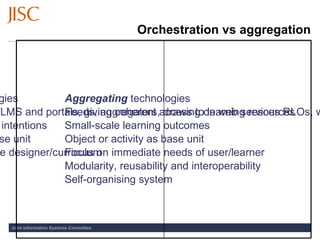
Orchestration vs aggregation Orchestrating  technologies  Institutional VLEs, CMS/LMS and portals, giving coherent access to learning resources Large-scale educational intentions Course or module as base unit Focus on purposes of the designer/curriculum Top-down management Self-regulated system Aggregating  technologies Feeds, aggregators, drawing on web services RLOs, widgets and applets Small-scale learning outcomes Object or activity as base unit Focus on immediate needs of user/learner Modularity, reusability and interoperability Self-organising system
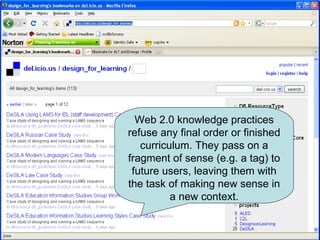
Web 2.0 knowledge practices refuse any final order or finished curriculum. They pass on a fragment of sense (e.g. a tag) to future users, leaving them with the task of making new sense in a new context.
Conclusions 'Design' is a contested space There is a continued need for well-designed tools to support the teaching process, closely aligned with tools for learning Contingency and collaboration remain key features of the learning/teaching process: designs and design tools must afford opportunities for both There is probably no one tool that can resolve all the conflicting requirements but... …  teaching- and learning-centred tools and services can inter-operate... …  remembering that our aim as educators is to put learners progressively more in control of their own learning

Design for learning

  • 1.
    Design for Learning: making educational sense in digital contexts Helen Beetham
  • 2.
    Design for Learning(2004-08) Explored the convergence of technical developments such as LAMS and IMS LD with an increasingly design-led approach to learning and teaching practice Over a dozen projects, involving LAMS, Moodle, ReCourse and the two UK pedagogic planners Premises: pedagogic intention can be articulated articulations can usefully be shared with other people and systems involved in the learning process intentions can be enacted/instantiated in real learning opportunities through learning activity design
  • 3.
    Lessons learned fromD4L phase 1 (2004-06) Existing design practice is very varied , depending on subject and institutional culture, personal style etc (non-linear, emergent, responsive) Educational design tools are rarely experienced by practitioners as pedagogically neutral or flexible Design tools must enable collaborative design, contingent/responsive design, and effective sharing of design processes and outcomes Design processes need to be integrated with other institutional processes if design practice is to be transformed Practitioners want rich expressions of curricular purpose AND bite-sized curriculum elements that can easily be re-purposed and re-used
  • 4.
    Models of learningand teaching All approaches emphasise learning activity and: Constructive alignment of curriculum elements e.g. activities with outcomes and assessment tasks The importance of feedback (intrinsic or extrinsic) on action Integration across activities, e.g. Associatively (building component skills & knowledge into extended performance) Constructively (integrating skills & knowledge, planning, reflecting) Situatively (developing identities & roles) They differ in: The role and importance of other people in mediating activity The authenticity of the activity (situated/abstracted) The balance of scaffolding (routines, structures, protocols) with flexibility (exploration, responsive support) The locus of control (learner, peer, tutor, other)
  • 5.
    Lessons learned fromD4L phase 2 (2006-08) Tensions exposed around: Different levels of design Design for learning/design for teaching Representational forms Structure/flexibility of designs Aggregation/orchestration approaches and tools The role of face to face interaction in learning and learning design ...
  • 6.
    Pedagogic intentions needto be represented differently to/by different actors in the learning 'system' The representational dilemma
  • 7.
    There is atension between articulating designs clearly in educational terms, and working powerfully with designs in educational systems The representational dilemma
  • 8.
    The representational dilemmaPractitioners discussing how to teach a particular topic: natural language, often used in specialist and expert ways Learners discussing what they want out of a course: natural language, highly personal agendas Systematic representations of learning activity: graphical interfaces, mapping and modelling, workflows and storyboards, an underpinning of technical standards. Representations that can be used for modelling in learning systems: computational expressions 'pragmatic' features of design easier to represent computationally than 'educational' features which may be lost in the process
  • 9.
    The representational dilemmaModelling of educational intention remains elusive Mod4L project concluded that there is no obvious typology of decontextualised design or patterns, in which a finite number of educationally meaningful intentions can be described. It may be more productive to try modelling relationships between design elements, but... … need to distinguish pragmatic and educational relationships - e.g. IMS LD (a pragmatic language of system interoperability) may not be useful for modelling educational aspects of the decision-making process.
  • 10.
    The learning/teaching dilemmaGood teaching (conception and enactment of a pedagogic intention) is not the same as good self-directed learning (conception and enactment of a personal learning goal) Different but dialogically related human activities ‘ Teaching-supportive’ and 'learning-supportive' tools/services fulfil different needs Learners’ and teachers’ skills are different but need to develop in dialogue What are the points of intersection, both in terms of activity and in terms of the supporting tools/services?
  • 11.
    The describing/prescribing dilemmaThere is a tension between modelling ‘good’ design practice and offering tools for educators to express their own pedagogic intentions Modelling concepts allows strong forms of guidance in the design process (the system support 'good' design but must define it) Open-ended tools are often more acceptable to practitioners but sacrifice interoperability and consensus about ‘good’ design. How can visualisation/articulation tools carry design messages while remaining relatively neutral and open-ended?
  • 12.
    The contingency dilemmaPedagogic intention can accommodate contingency in a variety of ways, offering different compromises between structure and flexibility But there are trade-offs – logistically and educationally Total contingency/responsiveness -> diminishing returns on educational design Educationally meaningful guidance makes sense only in situations which are to some extent pre-determined
  • 13.
    The web 2.0/'powerto the user' dilemma web 2.0 technologies allow users to determine the purposes, values and meanings of knowledge: applied to learning there are fundamental challenges for 'design' and for educational practice as a whole.
  • 14.
    Orchestration vs aggregationOrchestrating technologies Institutional VLEs, CMS/LMS and portals, giving coherent access to learning resources Large-scale educational intentions Course or module as base unit Focus on purposes of the designer/curriculum Top-down management Self-regulated system Aggregating technologies Feeds, aggregators, drawing on web services RLOs, widgets and applets Small-scale learning outcomes Object or activity as base unit Focus on immediate needs of user/learner Modularity, reusability and interoperability Self-organising system
  • 15.
    Web 2.0 knowledgepractices refuse any final order or finished curriculum. They pass on a fragment of sense (e.g. a tag) to future users, leaving them with the task of making new sense in a new context.
  • 16.
    Conclusions 'Design' isa contested space There is a continued need for well-designed tools to support the teaching process, closely aligned with tools for learning Contingency and collaboration remain key features of the learning/teaching process: designs and design tools must afford opportunities for both There is probably no one tool that can resolve all the conflicting requirements but... … teaching- and learning-centred tools and services can inter-operate... … remembering that our aim as educators is to put learners progressively more in control of their own learning