Supporting teachers as designers:
Patterns, architectures and
environments
Prof. Yannis Dimitriadis
GSIC/EMIC group
University of Valladolid, Spain
Dec. 11, 2017
CHILI, EPFL
Deep Acknowledgements
to collaborators and GSIC/EMIC
2
Are there any problems to solve? (I)
n Has Technology-Enhanced Learning (TEL)
been successful?
– ICT has been adopted by the political
stakeholders and used rather regularly
n But important drawbacks exist
– Innovative pedagogies, such as collaborative
or inquiry learning, have not been adopted
– TEL adoption is not yet scalable and
sustainable
3
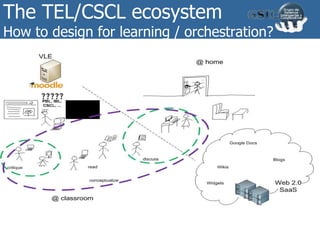
The TEL/CSCL ecosystem
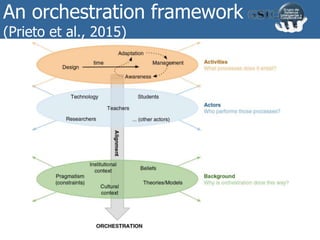
How to design for learning / orchestration?
An orchestration framework
(Prieto et al., 2015)
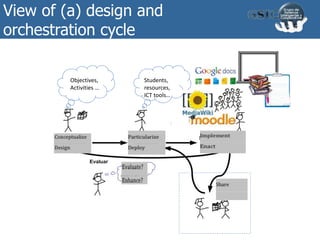
Objectives,
Activities …
Students,
resources,
ICT tools…
How to
Enhance?
View of (a) design and
orchestration cycle
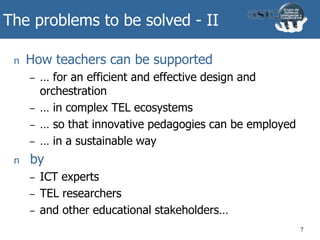
The problems to be solved - II
n How teachers can be supported
– … for an efficient and effective design and
orchestration
– … in complex TEL ecosystems
– … so that innovative pedagogies can be employed
– … in a sustainable way
n by
– ICT experts
– TEL researchers
– and other educational stakeholders…
7
Overview
8
n Underlying issue
n Teachers as designers: What can be
designed and how it can be done “well”?
n Design for learning (partially ICT view)
n Patterns
n Tools
n Architectures
n Environments
n Illustrated by some GSIC-EMIC proposals
Learning Design (LD)
or Design for Learning (D4L) - I
n Learning is the objective of education
– Can we (pedagogically) inform and (technologically)
support teachers (and other stakeholders) in
creating effective (and efficient?) learning situations
n Main metaphor:
– “Teachers as designers”
9
Design for Learning (D4L) - II
n What can be designed for learning? (Goodyear &
Dimitriadis, 2013)
n The learning (performed by students) and support
(made by teachers) tasks
n The “physical” environment
n Spaces, tools, infrastructures, artifacts-resources (to be
consumed and/or produced)
n The social architecture
n Groupings, interactions with external agents
n Design is indirect (tasks vs. activities)
n Learners may change-interpret tasks in learntime
10
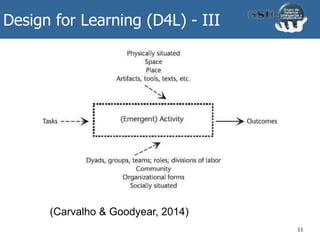
Design for Learning (D4L) - III
11
(Carvalho & Goodyear, 2014)
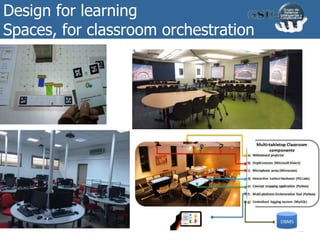
Design for learning
Spaces, for classroom orchestration
12
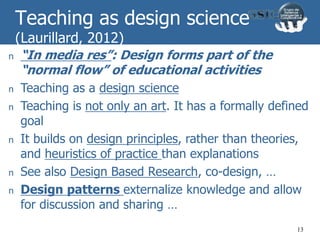
Teaching as design science
(Laurillard, 2012)
n “In media res”: Design forms part of the
“normal flow” of educational activities
n Teaching as a design science
n Teaching is not only an art. It has a formally defined
goal
n It builds on design principles, rather than theories,
and heuristics of practice than explanations
n See also Design Based Research, co-design, …
n Design patterns externalize knowledge and allow
for discussion and sharing …
13
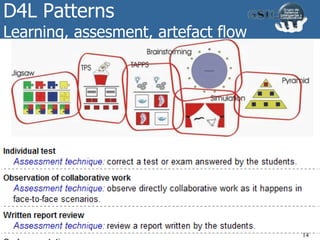
D4L Patterns
Learning, assesment, artefact flow
14
14
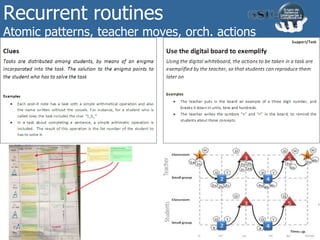
Recurrent routines
Atomic patterns, teacher moves, orch. actions
15
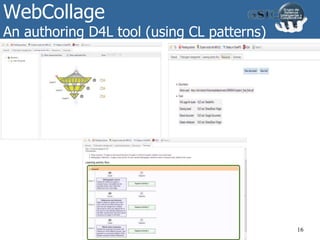
WebCollage
An authoring D4L tool (using CL patterns)
16
From pedagogical patterns to tools
… and to architectures …
n Web Collage is a learning design tool that allows
– authoring of learning designs that are informed
by sound collaborative learning patterns
n But should learning take place in a single Virtual
Learning Environment
– Without any external Web 2.0 tools?
– What could be the target learning environment?
n Is it sustainable to create always new learning
environments
– Or should we integrate external tools to existing
popular existing VLEs? 17
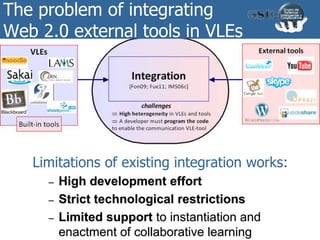
The problem of integrating
Web 2.0 external tools in VLEs
Limitations of existing integration works:
– High development effort
– Strict technological restrictions
– Limited support to instantiation and
enactment of collaborative learning
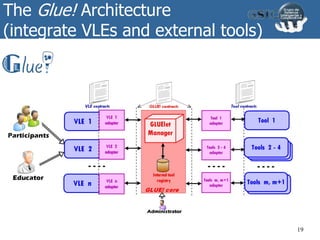
The Glue! Architecture
(integrate VLEs and external tools)
19
Deploying the designs:
The “bricolage” approach
20
n Have the learning design “in mind”
n Use the VLE (e.g. Moodle) interface and “translate”
the design to a course/lesson plan
n But in the “bricolage” approach
n The pedagogical knowledge may not be exploited
well
n Learning designs cannot be reused and shared
within a community
n Deployment of non-trivial collaborative learning
activities may be complex
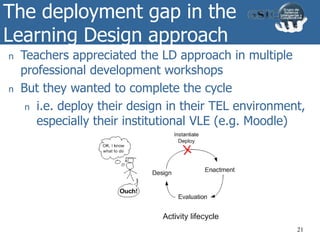
The deployment gap in the
Learning Design approach
21
n Teachers appreciated the LD approach in multiple
professional development workshops
n But they wanted to complete the cycle
n i.e. deploy their design in their TEL environment,
especially their institutional VLE (e.g. Moodle)
Alternatives for deployment
in the LD approach
22
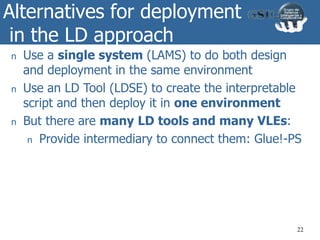
n Use a single system (LAMS) to do both design
and deployment in the same environment
n Use an LD Tool (LDSE) to create the interpretable
script and then deploy it in one environment
n But there are many LD tools and many VLEs:
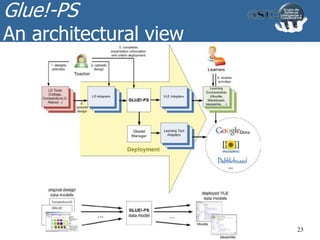
n Provide intermediary to connect them: Glue!-PS
Glue!-PS
An architectural view
23
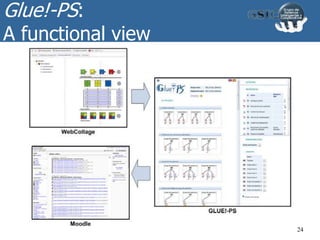
Glue!-PS:
A functional view
24
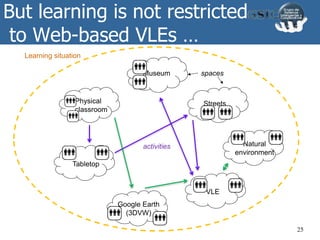
But learning is not restricted
to Web-based VLEs …
25
Museum
Streets
VLE
Physical
classroom
Tabletop
Google Earth
(3DVW)
Natural
environment
Learning situation
activities
spaces
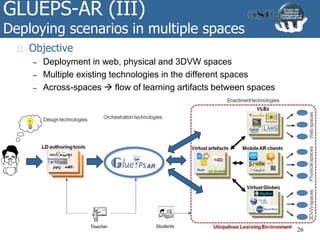
GLUEPS-AR (III)
Deploying scenarios in multiple spaces
26
Objective
– Deployment in web, physical and 3DVW spaces
– Multiple existing technologies in the different spaces
– Across-spaces  flow of learning artifacts between spaces
Teacher Students
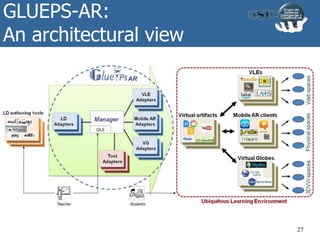
GLUEPS-AR:
An architectural view
27
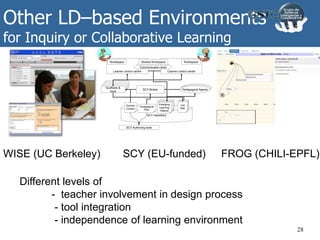
Other LD–based Environments
for Inquiry or Collaborative Learning
28
WISE (UC Berkeley)
Cognitive ToolCognitive ToolCognitive ToolCognitive ToolScaffolds &
tools
Cognitive ToolCognitive ToolCognitive ToolCognitive ToolScaffolds &
tools
Learner control centre Learner control centre
SCY Authoring tools
Workspace WorkspaceShared Workspace
Communication tools
EDM AgentEDM AgentPedagogical Agents
EDM AgentEDM AgentPedagogical AgentsSCY Broker
SCY repository
Pedagogical
Plan
Learning
Object
Learning
Object
Learning
Object
Emerging
Learning
Objects
Learning
Object
Learning
Object
Learning
Object
Emerging
Learning
Objects
Domain
Content
Log
file
Log
file
Log
files
Log
file
Log
file
Log
files
SCY (EU-funded) FROG (CHILI-EPFL)
Different levels of
- teacher involvement in design process
- tool integration
- independence of learning environment
Summary of GSIC/EMIC proposals
Pedagogical conceptual support
– Patterns (learning, assessment, atomic)
– Associated PD workshops
Technological support (tools and architectures)
– Pattern-aware design: WebCollage
– Integration of Distributed Learning Environments
(Web 2.0 tools and VLEs): Glue!
– Deployment of designs in distributed learning
environments: Glue!PS
– Integration of AR and 3DW spaces: Glue!PS-AR
29
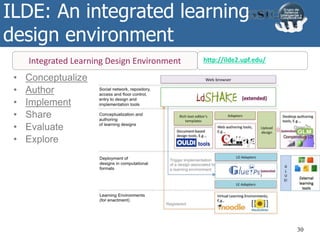
ILDE: An integrated learning
design environment
30
• Conceptualize
• Author
• Implement
• Share
• Evaluate
• Explore
Integrated Learning Design Environment http://ilde2.upf.edu/
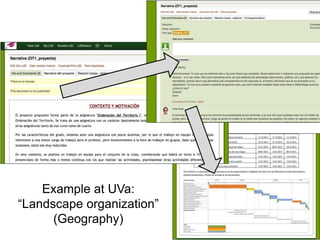
Example at UVa:
“Landscape organization”
(Geography)
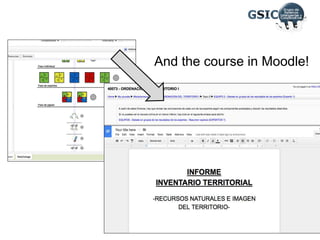
And the course in Moodle!
Some conclusions
Pedagogical (and other types of) patterns
capture some good practices and may help
teachers
Teachers work as designers in many cases:
Empower them through professional
development workshops and ICT tools
The TEL/CSCL ecosystem is very complex:
Design for learning / orchestration is a need …
Architectures with loose coupling integration
(adapter pattern) may attend the teacher needs
for flexible design and orchestration 33
Many lessons learnt
Design for environments with “soft integration”
so that multiple design “paths” can be supported
The majority of needs is still on the “dark” side
(pedagogy!)
Design for learning needs support for teachers
(workshops, tools, follow up, community)
Capture and embed D4L knowledge in the
support (in the designer language, if possible)
34
And the current work …
Is there a need to align Design for Learning
(D4L) and Learning Analytics (LA)?
– Most predictive models do not consider the
“script” in order to explain student behavior
– The LA solutions may be designed in order to
provide meaningful actionable information within a
given learning design
35
6
Figure 1. Learning design of the Translation MOOC (adapted from [7])
BLOCK 6
Introduction to
module
Discussion
Forum
Peer Review for
IA3 in Week 5
Quiz 7 Peer Review for
GA2 in Week 5
Peer Review for
OA3 in Week 5
Optional
Activity
BLOCK 5
Introduction
[BLK5_0]
Lecture Content
[BLK5_1]
Discussion Forum
[BLK5_2]
Detailed
Description
[BLK5_31]
Introduction &
Submission
[BLK5_30]
Peer Review for
GA1 in Week 4
Peer Review for
OA2 in Week 4
Optional
Activity
Discussion
Forum
[BLK5_32]
Group Assignment 2 [GA2]
BLOCK 4
Introduction
[BLK4_0]
Lecture Content
[BLK4_1]
Discussion Forum
[BLK4_2]
Peer Review for
IA2 in Week 3
[BLK4_4]
Review Video
[BLK4_5]
BLOCK 3
Introduction
[BLK3_0]
Lecture Content
[BLK3_1]
Discussion Forum
[BLK3_2]
Detailed
Description
[BLK3_31]
Optional Activity
[BLK3_4]
Discussion
Forum
[BLK3_32]
Group Assignment 1 [GA1]
Review Video
[BLK3_5]
Review Video
[OA2]
[OA3]
[OA4]
[IA3]
Introduction &
Submission
[BLK4_3]
Introduction &
Submission
[BLK3_30]
And the current work …
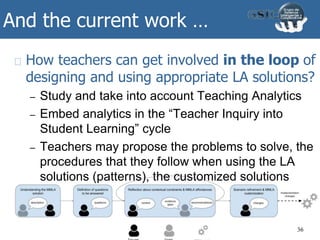
How teachers can get involved in the loop of
designing and using appropriate LA solutions?
– Study and take into account Teaching Analytics
– Embed analytics in the “Teacher Inquiry into
Student Learning” cycle
– Teachers may propose the problems to solve, the
procedures that they follow when using the LA
solutions (patterns), the customized solutions
36
And the current work …
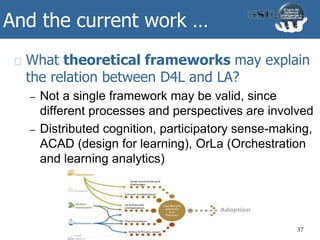
What theoretical frameworks may explain
the relation between D4L and LA?
– Not a single framework may be valid, since
different processes and perspectives are involved
– Distributed cognition, participatory sense-making,
ACAD (design for learning), OrLa (Orchestration
and learning analytics)
37
And the current work …
How can we design for LA solutions that
provide actionable information for
orchestration, taking into account the D4L
products and processes?
– Design for embedded analytics that provide
continuous data, in order to enable a more fluid
interplay between LA, LD, learning environment
– Check constraints of scripts and allow for suitable
orchestration actions (LD-aware analytics)
– Use LA in order to form and modify groups (LA-
aware design) 38

Yannis@chili 20171211b

  • 1.
    Supporting teachers asdesigners: Patterns, architectures and environments Prof. Yannis Dimitriadis GSIC/EMIC group University of Valladolid, Spain Dec. 11, 2017 CHILI, EPFL
  • 2.
  • 3.
    Are there anyproblems to solve? (I) n Has Technology-Enhanced Learning (TEL) been successful? – ICT has been adopted by the political stakeholders and used rather regularly n But important drawbacks exist – Innovative pedagogies, such as collaborative or inquiry learning, have not been adopted – TEL adoption is not yet scalable and sustainable 3
  • 4.
    The TEL/CSCL ecosystem Howto design for learning / orchestration?
  • 5.
  • 6.
    Objectives, Activities … Students, resources, ICT tools… Howto Enhance? View of (a) design and orchestration cycle
  • 7.
    The problems tobe solved - II n How teachers can be supported – … for an efficient and effective design and orchestration – … in complex TEL ecosystems – … so that innovative pedagogies can be employed – … in a sustainable way n by – ICT experts – TEL researchers – and other educational stakeholders… 7
  • 8.
    Overview 8 n Underlying issue nTeachers as designers: What can be designed and how it can be done “well”? n Design for learning (partially ICT view) n Patterns n Tools n Architectures n Environments n Illustrated by some GSIC-EMIC proposals
  • 9.
    Learning Design (LD) orDesign for Learning (D4L) - I n Learning is the objective of education – Can we (pedagogically) inform and (technologically) support teachers (and other stakeholders) in creating effective (and efficient?) learning situations n Main metaphor: – “Teachers as designers” 9
  • 10.
    Design for Learning(D4L) - II n What can be designed for learning? (Goodyear & Dimitriadis, 2013) n The learning (performed by students) and support (made by teachers) tasks n The “physical” environment n Spaces, tools, infrastructures, artifacts-resources (to be consumed and/or produced) n The social architecture n Groupings, interactions with external agents n Design is indirect (tasks vs. activities) n Learners may change-interpret tasks in learntime 10
  • 11.
    Design for Learning(D4L) - III 11 (Carvalho & Goodyear, 2014)
  • 12.
    Design for learning Spaces,for classroom orchestration 12
  • 13.
    Teaching as designscience (Laurillard, 2012) n “In media res”: Design forms part of the “normal flow” of educational activities n Teaching as a design science n Teaching is not only an art. It has a formally defined goal n It builds on design principles, rather than theories, and heuristics of practice than explanations n See also Design Based Research, co-design, … n Design patterns externalize knowledge and allow for discussion and sharing … 13
  • 14.
  • 15.
    Recurrent routines Atomic patterns,teacher moves, orch. actions 15
  • 16.
    WebCollage An authoring D4Ltool (using CL patterns) 16
  • 17.
    From pedagogical patternsto tools … and to architectures … n Web Collage is a learning design tool that allows – authoring of learning designs that are informed by sound collaborative learning patterns n But should learning take place in a single Virtual Learning Environment – Without any external Web 2.0 tools? – What could be the target learning environment? n Is it sustainable to create always new learning environments – Or should we integrate external tools to existing popular existing VLEs? 17
  • 18.
    The problem ofintegrating Web 2.0 external tools in VLEs Limitations of existing integration works: – High development effort – Strict technological restrictions – Limited support to instantiation and enactment of collaborative learning
  • 19.
    The Glue! Architecture (integrateVLEs and external tools) 19
  • 20.
    Deploying the designs: The“bricolage” approach 20 n Have the learning design “in mind” n Use the VLE (e.g. Moodle) interface and “translate” the design to a course/lesson plan n But in the “bricolage” approach n The pedagogical knowledge may not be exploited well n Learning designs cannot be reused and shared within a community n Deployment of non-trivial collaborative learning activities may be complex
  • 21.
    The deployment gapin the Learning Design approach 21 n Teachers appreciated the LD approach in multiple professional development workshops n But they wanted to complete the cycle n i.e. deploy their design in their TEL environment, especially their institutional VLE (e.g. Moodle)
  • 22.
    Alternatives for deployment inthe LD approach 22 n Use a single system (LAMS) to do both design and deployment in the same environment n Use an LD Tool (LDSE) to create the interpretable script and then deploy it in one environment n But there are many LD tools and many VLEs: n Provide intermediary to connect them: Glue!-PS
  • 23.
  • 24.
  • 25.
    But learning isnot restricted to Web-based VLEs … 25 Museum Streets VLE Physical classroom Tabletop Google Earth (3DVW) Natural environment Learning situation activities spaces
  • 26.
    GLUEPS-AR (III) Deploying scenariosin multiple spaces 26 Objective – Deployment in web, physical and 3DVW spaces – Multiple existing technologies in the different spaces – Across-spaces  flow of learning artifacts between spaces Teacher Students
  • 27.
  • 28.
    Other LD–based Environments forInquiry or Collaborative Learning 28 WISE (UC Berkeley) Cognitive ToolCognitive ToolCognitive ToolCognitive ToolScaffolds & tools Cognitive ToolCognitive ToolCognitive ToolCognitive ToolScaffolds & tools Learner control centre Learner control centre SCY Authoring tools Workspace WorkspaceShared Workspace Communication tools EDM AgentEDM AgentPedagogical Agents EDM AgentEDM AgentPedagogical AgentsSCY Broker SCY repository Pedagogical Plan Learning Object Learning Object Learning Object Emerging Learning Objects Learning Object Learning Object Learning Object Emerging Learning Objects Domain Content Log file Log file Log files Log file Log file Log files SCY (EU-funded) FROG (CHILI-EPFL) Different levels of - teacher involvement in design process - tool integration - independence of learning environment
  • 29.
    Summary of GSIC/EMICproposals Pedagogical conceptual support – Patterns (learning, assessment, atomic) – Associated PD workshops Technological support (tools and architectures) – Pattern-aware design: WebCollage – Integration of Distributed Learning Environments (Web 2.0 tools and VLEs): Glue! – Deployment of designs in distributed learning environments: Glue!PS – Integration of AR and 3DW spaces: Glue!PS-AR 29
  • 30.
    ILDE: An integratedlearning design environment 30 • Conceptualize • Author • Implement • Share • Evaluate • Explore Integrated Learning Design Environment http://ilde2.upf.edu/
  • 31.
    Example at UVa: “Landscapeorganization” (Geography)
  • 32.
    And the coursein Moodle!
  • 33.
    Some conclusions Pedagogical (andother types of) patterns capture some good practices and may help teachers Teachers work as designers in many cases: Empower them through professional development workshops and ICT tools The TEL/CSCL ecosystem is very complex: Design for learning / orchestration is a need … Architectures with loose coupling integration (adapter pattern) may attend the teacher needs for flexible design and orchestration 33
  • 34.
    Many lessons learnt Designfor environments with “soft integration” so that multiple design “paths” can be supported The majority of needs is still on the “dark” side (pedagogy!) Design for learning needs support for teachers (workshops, tools, follow up, community) Capture and embed D4L knowledge in the support (in the designer language, if possible) 34
  • 35.
    And the currentwork … Is there a need to align Design for Learning (D4L) and Learning Analytics (LA)? – Most predictive models do not consider the “script” in order to explain student behavior – The LA solutions may be designed in order to provide meaningful actionable information within a given learning design 35 6 Figure 1. Learning design of the Translation MOOC (adapted from [7]) BLOCK 6 Introduction to module Discussion Forum Peer Review for IA3 in Week 5 Quiz 7 Peer Review for GA2 in Week 5 Peer Review for OA3 in Week 5 Optional Activity BLOCK 5 Introduction [BLK5_0] Lecture Content [BLK5_1] Discussion Forum [BLK5_2] Detailed Description [BLK5_31] Introduction & Submission [BLK5_30] Peer Review for GA1 in Week 4 Peer Review for OA2 in Week 4 Optional Activity Discussion Forum [BLK5_32] Group Assignment 2 [GA2] BLOCK 4 Introduction [BLK4_0] Lecture Content [BLK4_1] Discussion Forum [BLK4_2] Peer Review for IA2 in Week 3 [BLK4_4] Review Video [BLK4_5] BLOCK 3 Introduction [BLK3_0] Lecture Content [BLK3_1] Discussion Forum [BLK3_2] Detailed Description [BLK3_31] Optional Activity [BLK3_4] Discussion Forum [BLK3_32] Group Assignment 1 [GA1] Review Video [BLK3_5] Review Video [OA2] [OA3] [OA4] [IA3] Introduction & Submission [BLK4_3] Introduction & Submission [BLK3_30]
  • 36.
    And the currentwork … How teachers can get involved in the loop of designing and using appropriate LA solutions? – Study and take into account Teaching Analytics – Embed analytics in the “Teacher Inquiry into Student Learning” cycle – Teachers may propose the problems to solve, the procedures that they follow when using the LA solutions (patterns), the customized solutions 36
  • 37.
    And the currentwork … What theoretical frameworks may explain the relation between D4L and LA? – Not a single framework may be valid, since different processes and perspectives are involved – Distributed cognition, participatory sense-making, ACAD (design for learning), OrLa (Orchestration and learning analytics) 37
  • 38.
    And the currentwork … How can we design for LA solutions that provide actionable information for orchestration, taking into account the D4L products and processes? – Design for embedded analytics that provide continuous data, in order to enable a more fluid interplay between LA, LD, learning environment – Check constraints of scripts and allow for suitable orchestration actions (LD-aware analytics) – Use LA in order to form and modify groups (LA- aware design) 38