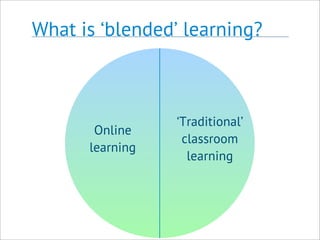
What is ‘blended’ learning?
‘Traditional’
classroom
learning
Online
learning
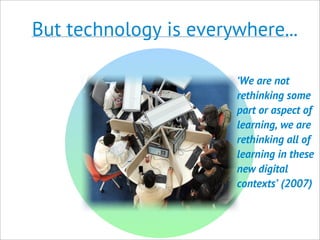
But technology is everywhere...
‘We are not
rethinking some
part or aspect of
learning, we are
rethinking all of
learning in these
new digital
contexts’ (2007)
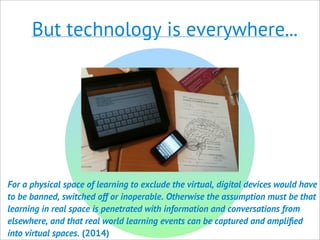
But technology is everywhere...
For a physical space of learning to exclude the virtual, digital devices would have
to be banned, switched off or inoperable. Otherwise the assumption must be that
learning in real space is penetrated with information and conversations from
elsewhere, and that real world learning events can be captured and amplified
into virtual spaces. (2014)
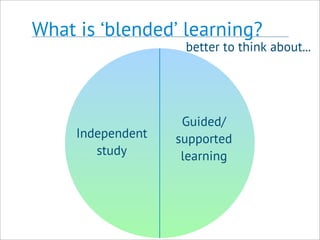
What is ‘blended’ learning?
Independent
study
Guided/
supported
learning
better to think about...
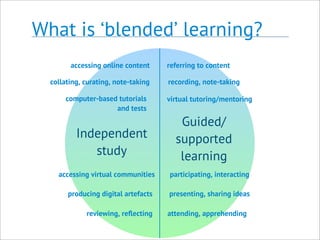
What is ‘blended’ learning?
Independent
study
Guided/
supported
learning
accessing online content
computer-based tutorials
and tests
producing digital artefacts
collating, curating, note-taking
reviewing, reflecting attending, apprehending
recording, note-taking
virtual tutoring/mentoring
referring to content
accessing virtual communities participating, interacting
presenting, sharing ideas
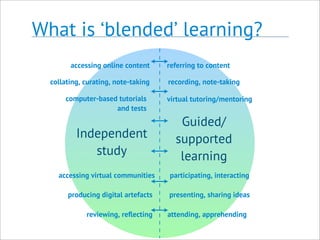
What is ‘blended’ learning?
Independent
study
Guided/
supported
learning
accessing online content
computer-based tutorials
and tests
producing digital artefacts
collating, curating, note-taking
reviewing, reflecting attending, apprehending
recording, note-taking
virtual tutoring/mentoring
referring to content
accessing virtual communities participating, interacting
presenting, sharing ideas
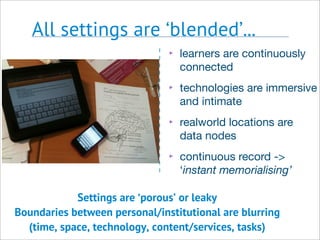
All settings are ‘blended’...
Settings are ‘porous’ or leaky
Boundaries between personal/institutional are blurring
(time, space, technology, content/services, tasks)
‣ learners are continuously
connected
‣ technologies are immersive
and intimate
‣ realworld locations are
data nodes
‣ continuous record ->
‘instant memorialising’
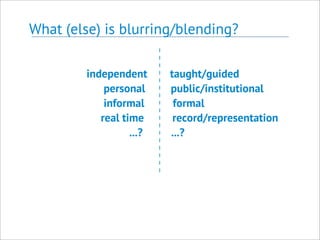
What (else) is blurring/blending?
independent taught/guided
personal public/institutional
informal formal
real time record/representation
...? ...?
Impacts on the curriculum
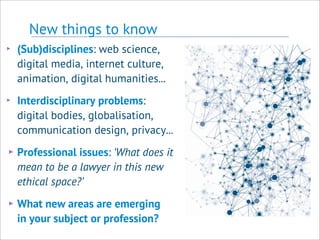
New things to know
‣ (Sub)disciplines: web science,
digital media, internet culture,
animation, digital humanities...
‣ Interdisciplinary problems:
digital bodies, globalisation,
communication design, privacy...
‣Professional issues: ‘What does it
mean to be a lawyer in this new
ethical space?’
‣What new areas are emerging
in your subject or profession?
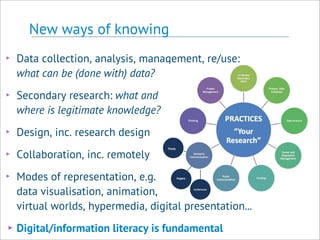
New ways of knowing
‣ Data collection, analysis, management, re/use:
what can be (done with) data?
‣ Secondary research: what and
where is legitimate knowledge?
‣ Design, inc. research design
‣ Collaboration, inc. remotely
‣ Modes of representation, e.g.
data visualisation, animation,
virtual worlds, hypermedia, digital presentation...
‣Digital/information literacy is fundamental
New motives for learning
‣ fewer traditional graduate jobs,
more informal ‘knowledge’ work
‣ most high value jobs involve
digital technologies
‣ 7-10 career changes, loose ties,
portfolio careers
‣ constant upgrade (the capable
self as lifelong project)
‣ alternatives to a degree: informal learning, online credits,
OERs, MOOCs, TED talks, Kahn academy, Google...
‣ Digital/information literacy is fundamental
New practices of learning
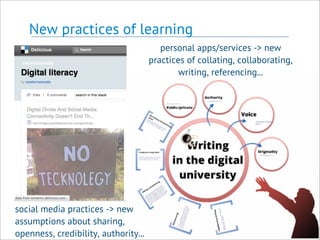
social media practices -> new
assumptions about sharing,
openness, credibility, authority...
personal apps/services -> new
practices of collating, collaborating,
writing, referencing...
New practices of learning
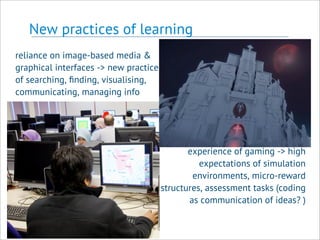
reliance on image-based media &
graphical interfaces -> new practices
of searching, finding, visualising,
communicating, managing info
experience of gaming -> high
expectations of simulation
environments, micro-reward
structures, assessment tasks (coding
as communication of ideas? )
New practices of teaching?
Borderless, blended, flipped classrooms
Networked, connected, rhizomatic learning
Open, public, massive, online courses
New practices of teaching?
1. Students locate, evaluate and work with information
2. Students collaborate using virtual tools
3. Students communicate ideas in a variety of media
4. Students create digital artefacts and leave a digital trace
5. Real time is precious: students are prepared, teaching is responsive
6. Authentic (academic/professional) tasks: authentic digital practices
7. Engagement and feedback from beyond the classroom/cohort
8. Students’ digital resources - tools, services, skills, identities -
are recognised and valued
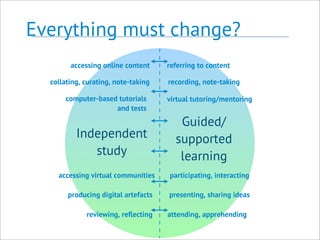
Everything must change?
Independent
study
Guided/
supported
learning
accessing online content
computer-based tutorials
and tests
producing digital artefacts
collating, curating, note-taking
reviewing, reflecting attending, apprehending
recording, note-taking
virtual tutoring/mentoring
referring to content
accessing virtual communities participating, interacting
presenting, sharing ideas
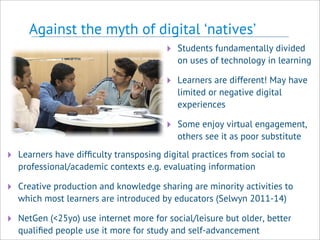
Against the myth of digital ‘natives’
‣ Students fundamentally divided
on uses of technology in learning
‣ Learners are different! May have
limited or negative digital
experiences
‣ Some enjoy virtual engagement,
others see it as poor substitute
‣ Learners have difficulty transposing digital practices from social to
professional/academic contexts e.g. evaluating information
‣ Creative production and knowledge sharing are minority activities to
which most learners are introduced by educators (Selwyn 2011-14)
‣ NetGen (<25yo) use internet more for social/leisure but older, better
qualified people use it more for study and self-advancement
‘Digital’ learners still want...
shared places and spaces of learning
shared time-of-life, cohort experience
transformational encounters with
inspiring teachers
sense of belonging
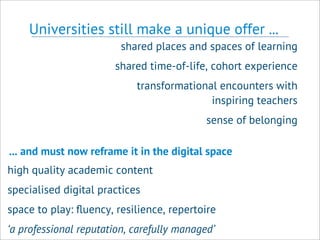
Universities still make a unique offer ...
shared places and spaces of learning
shared time-of-life, cohort experience
transformational encounters with
inspiring teachers
sense of belonging
high quality academic content
specialised digital practices
space to play: fluency, resilience, repertoire
‘a professional reputation, carefully managed’
... and must now reframe it in the digital space
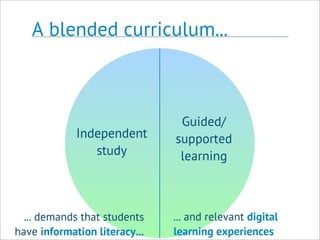
A blended curriculum...
Independent
study
Guided/
supported
learning
... demands that students
have information literacy...
... and relevant digital
learning experiences
Continuities and disruptions
Independent
study
Guided/
supported
learning
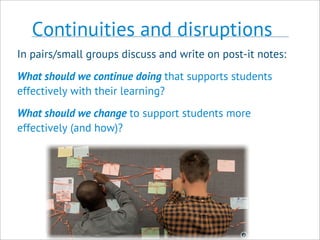
Continuities and disruptions
In pairs/small groups discuss and write on post-it notes:
What should we continue doing that supports students
effectively with their learning?
What should we change to support students more
effectively (and how)?

What is blended learning?

  • 1.
    What is ‘blended’learning? ‘Traditional’ classroom learning Online learning
  • 2.
    But technology iseverywhere... ‘We are not rethinking some part or aspect of learning, we are rethinking all of learning in these new digital contexts’ (2007)
  • 3.
    But technology iseverywhere... For a physical space of learning to exclude the virtual, digital devices would have to be banned, switched off or inoperable. Otherwise the assumption must be that learning in real space is penetrated with information and conversations from elsewhere, and that real world learning events can be captured and amplified into virtual spaces. (2014)
  • 4.
    What is ‘blended’learning? Independent study Guided/ supported learning better to think about...
  • 5.
    What is ‘blended’learning? Independent study Guided/ supported learning accessing online content computer-based tutorials and tests producing digital artefacts collating, curating, note-taking reviewing, reflecting attending, apprehending recording, note-taking virtual tutoring/mentoring referring to content accessing virtual communities participating, interacting presenting, sharing ideas
  • 6.
    What is ‘blended’learning? Independent study Guided/ supported learning accessing online content computer-based tutorials and tests producing digital artefacts collating, curating, note-taking reviewing, reflecting attending, apprehending recording, note-taking virtual tutoring/mentoring referring to content accessing virtual communities participating, interacting presenting, sharing ideas
  • 7.
    All settings are‘blended’... Settings are ‘porous’ or leaky Boundaries between personal/institutional are blurring (time, space, technology, content/services, tasks) ‣ learners are continuously connected ‣ technologies are immersive and intimate ‣ realworld locations are data nodes ‣ continuous record -> ‘instant memorialising’
  • 8.
    What (else) isblurring/blending? independent taught/guided personal public/institutional informal formal real time record/representation ...? ...?
  • 9.
    Impacts on thecurriculum
  • 10.
    New things toknow ‣ (Sub)disciplines: web science, digital media, internet culture, animation, digital humanities... ‣ Interdisciplinary problems: digital bodies, globalisation, communication design, privacy... ‣Professional issues: ‘What does it mean to be a lawyer in this new ethical space?’ ‣What new areas are emerging in your subject or profession?
  • 11.
    New ways ofknowing ‣ Data collection, analysis, management, re/use: what can be (done with) data? ‣ Secondary research: what and where is legitimate knowledge? ‣ Design, inc. research design ‣ Collaboration, inc. remotely ‣ Modes of representation, e.g. data visualisation, animation, virtual worlds, hypermedia, digital presentation... ‣Digital/information literacy is fundamental
  • 12.
    New motives forlearning ‣ fewer traditional graduate jobs, more informal ‘knowledge’ work ‣ most high value jobs involve digital technologies ‣ 7-10 career changes, loose ties, portfolio careers ‣ constant upgrade (the capable self as lifelong project) ‣ alternatives to a degree: informal learning, online credits, OERs, MOOCs, TED talks, Kahn academy, Google... ‣ Digital/information literacy is fundamental
  • 13.
    New practices oflearning social media practices -> new assumptions about sharing, openness, credibility, authority... personal apps/services -> new practices of collating, collaborating, writing, referencing...
  • 14.
    New practices oflearning reliance on image-based media & graphical interfaces -> new practices of searching, finding, visualising, communicating, managing info experience of gaming -> high expectations of simulation environments, micro-reward structures, assessment tasks (coding as communication of ideas? )
  • 15.
    New practices ofteaching? Borderless, blended, flipped classrooms Networked, connected, rhizomatic learning Open, public, massive, online courses
  • 16.
    New practices ofteaching? 1. Students locate, evaluate and work with information 2. Students collaborate using virtual tools 3. Students communicate ideas in a variety of media 4. Students create digital artefacts and leave a digital trace 5. Real time is precious: students are prepared, teaching is responsive 6. Authentic (academic/professional) tasks: authentic digital practices 7. Engagement and feedback from beyond the classroom/cohort 8. Students’ digital resources - tools, services, skills, identities - are recognised and valued
  • 17.
    Everything must change? Independent study Guided/ supported learning accessingonline content computer-based tutorials and tests producing digital artefacts collating, curating, note-taking reviewing, reflecting attending, apprehending recording, note-taking virtual tutoring/mentoring referring to content accessing virtual communities participating, interacting presenting, sharing ideas
  • 18.
    Against the mythof digital ‘natives’ ‣ Students fundamentally divided on uses of technology in learning ‣ Learners are different! May have limited or negative digital experiences ‣ Some enjoy virtual engagement, others see it as poor substitute ‣ Learners have difficulty transposing digital practices from social to professional/academic contexts e.g. evaluating information ‣ Creative production and knowledge sharing are minority activities to which most learners are introduced by educators (Selwyn 2011-14) ‣ NetGen (<25yo) use internet more for social/leisure but older, better qualified people use it more for study and self-advancement
  • 19.
    ‘Digital’ learners stillwant... shared places and spaces of learning shared time-of-life, cohort experience transformational encounters with inspiring teachers sense of belonging
  • 20.
    Universities still makea unique offer ... shared places and spaces of learning shared time-of-life, cohort experience transformational encounters with inspiring teachers sense of belonging high quality academic content specialised digital practices space to play: fluency, resilience, repertoire ‘a professional reputation, carefully managed’ ... and must now reframe it in the digital space
  • 21.
    A blended curriculum... Independent study Guided/ supported learning ...demands that students have information literacy... ... and relevant digital learning experiences
  • 22.
  • 23.
    Continuities and disruptions Inpairs/small groups discuss and write on post-it notes: What should we continue doing that supports students effectively with their learning? What should we change to support students more effectively (and how)?