Digital Literacies Materials
Competence frameworks
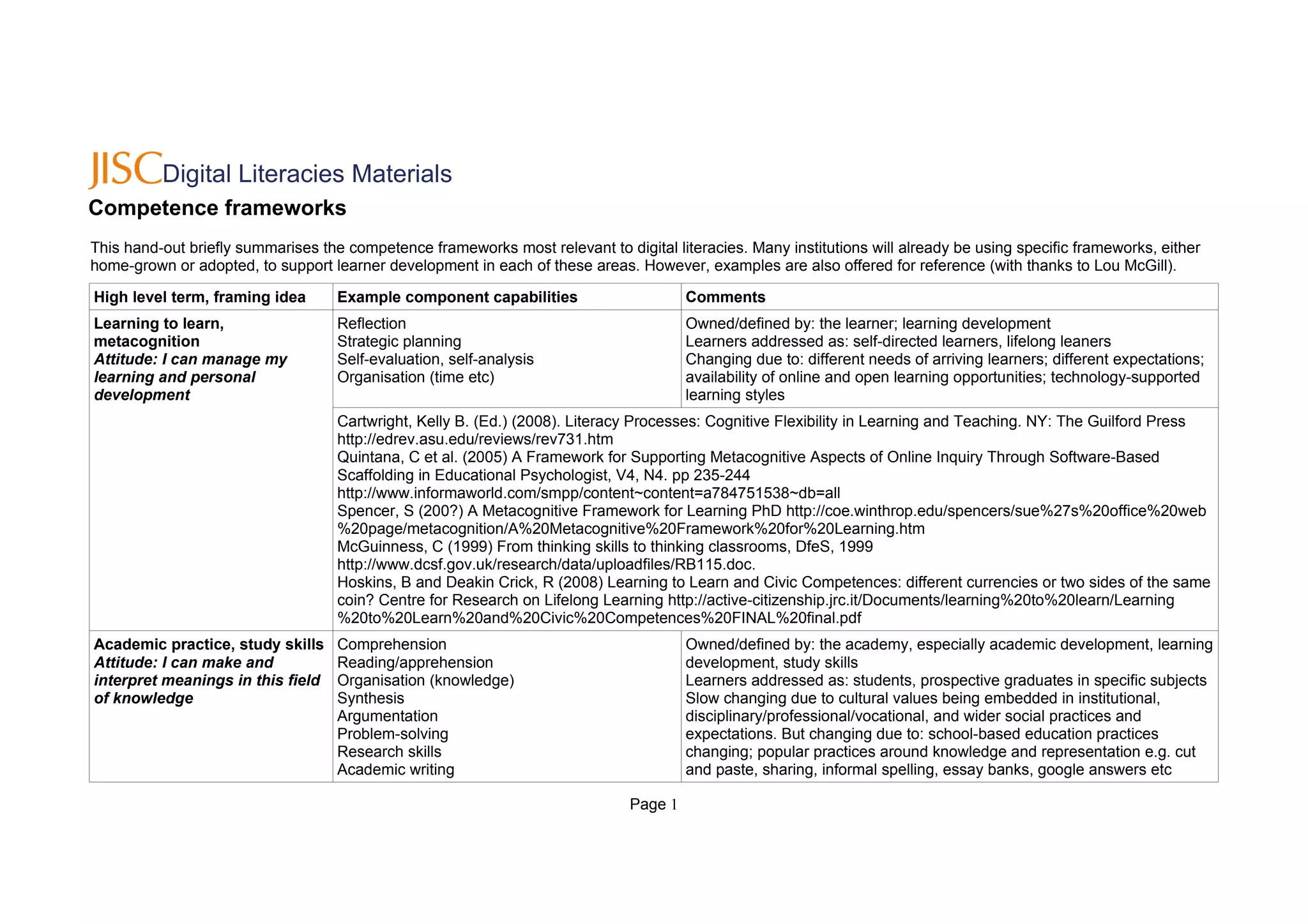
This hand-out briefly summarises the competence frameworks most relevant to digital literacies. Many institutions will already be using specific frameworks, either
home-grown or adopted, to support learner development in each of these areas. However, examples are also offered for reference (with thanks to Lou McGill).

High level term, framing idea       Example component capabilities                      Comments
Learning to learn,                  Reflection                                          Owned/defined by: the learner; learning development
metacognition                       Strategic planning                                  Learners addressed as: self-directed learners, lifelong leaners
Attitude: I can manage my           Self-evaluation, self-analysis                      Changing due to: different needs of arriving learners; different expectations;
learning and personal               Organisation (time etc)                             availability of online and open learning opportunities; technology-supported
development                                                                             learning styles
                                    Cartwright, Kelly B. (Ed.) (2008). Literacy Processes: Cognitive Flexibility in Learning and Teaching. NY: The Guilford Press
                                    http://edrev.asu.edu/reviews/rev731.htm
                                    Quintana, C et al. (2005) A Framework for Supporting Metacognitive Aspects of Online Inquiry Through Software-Based
                                    Scaffolding in Educational Psychologist, V4, N4. pp 235-244
                                    http://www.informaworld.com/smpp/content~content=a784751538~db=all
                                    Spencer, S (200?) A Metacognitive Framework for Learning PhD http://coe.winthrop.edu/spencers/sue%27s%20office%20web
                                    %20page/metacognition/A%20Metacognitive%20Framework%20for%20Learning.htm
                                    McGuinness, C (1999) From thinking skills to thinking classrooms, DfeS, 1999
                                    http://www.dcsf.gov.uk/research/data/uploadfiles/RB115.doc.
                                    Hoskins, B and Deakin Crick, R (2008) Learning to Learn and Civic Competences: different currencies or two sides of the same
                                    coin? Centre for Research on Lifelong Learning http://active-citizenship.jrc.it/Documents/learning%20to%20learn/Learning
                                    %20to%20Learn%20and%20Civic%20Competences%20FINAL%20final.pdf
Academic practice, study skills     Comprehension                                       Owned/defined by: the academy, especially academic development, learning
Attitude: I can make and            Reading/apprehension                                development, study skills
interpret meanings in this field    Organisation (knowledge)                            Learners addressed as: students, prospective graduates in specific subjects
of knowledge                        Synthesis                                           Slow changing due to cultural values being embedded in institutional,
                                    Argumentation                                       disciplinary/professional/vocational, and wider social practices and
                                    Problem-solving                                     expectations. But changing due to: school-based education practices
                                    Research skills                                     changing; popular practices around knowledge and representation e.g. cut
                                    Academic writing                                    and paste, sharing, informal spelling, essay banks, google answers etc

                                                                               Page 1
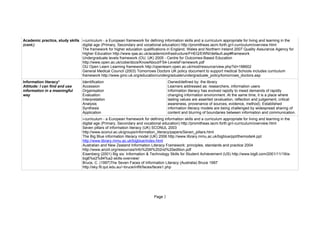
Academic practice, study skills i-curriculum - a European framework for defining information skills and a curriculum appropriate for living and learning in the
(cont.)                         digital age (Primary, Secondary and vocational education) http://promitheas.iacm.forth.gr/i-curriculum/overview.html
                                The framework for higher education qualifications in England, Wales and Northern Ireland 2007 Quality Assurance Agency for
                                Higher Education http://www.qaa.ac.uk/academicinfrastructure/FHEQ/EWNI/default.asp#framework
                                Undergraduate levels framework (OU, UK) 2005 - Centre for Outcomes-Based Education
                                http://www.open.ac.uk/cobe/docs/KnowAbout/FS4-LevelsFramework.pdf
                                OU Open Learn Learning framework http://openlearn.open.ac.uk/mod/resource/view.php?id=188602
                                General Medical Council (2003) Tomorrows Doctors UK policy document to support medical Schools includes curriculum
                                framework http://www.gmc-uk.org/education/undergraduate/undergraduate_policy/tomorrows_doctors.asp
Information literacy*             Identification                                      Owned/defined by: the library
Attitude: I can find and use      Accession                                           Learners addressed as: researchers, information users
information in a meaningful       Organisation                                        Information literacy has evolved rapidly to meed demands of rapidly
way                               Evaluation                                          changing information environment. At the same time, it is a place where
                                  Interpretation                                      lasting values are asserted (evaluation, reflection and judgement, critical
                                  Analysis                                            awareness, provenance of sources, evidence, method). Established
                                  Synthesis                                           information literacy models are being challenged by widespread sharing of
                                  Application                                         content and blurring of boundaries between information and communication.
                                  i-curriculum - a European framework for defining information skills and a curriculum appropriate for living and learning in the
                                  digital age (Primary, Secondary and vocational education) http://promitheas.iacm.forth.gr/i-curriculum/overview.html
                                  Seven pillars of information literacy (UK) SCONUL 2003
                                  http://www.sconul.ac.uk/groups/information_literacy/papers/Seven_pillars.html
                                  The Big Blue information literacy model (UK) 2006 http://www.library.mmu.ac.uk/bigblue/ppt/themodel4.ppt
                                  http://www.library.mmu.ac.uk/bigblue/index.html
                                  Australian and New Zealand Information Literacy Framework: principles, standards and practice 2004
                                  http://www.anziil.org/resources/Info%20lit%202nd%20edition.pdf
                                  Eisenberg (2001) Big six: Information & Technology Skills for Student Achievement (US) http://www.big6.com/2001/11/19/a-
                                  big6%e2%84%a2-skills-overview/
                                  Bruce, C. (1997)The Seven Faces of Information Literacy (Australia) Bruce 1997
                                  http://sky.fit.qut.edu.au/~bruce/inflit/faces/faces1.php


                                                                             Page 2
High level term, framing idea      Example component capabilities                      Comments
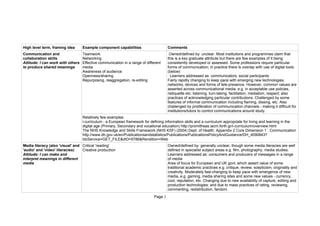
Communication and                  Teamwork                                             Owned/defined by: unclear. Most institutions and programmes claim that
collaboration skills               Networking                                          this is a key graduate attribute but there are few examples of it being
Attitude: I can work with others   Effective communication in a range of different     consistently developed or assessed. Some professions require particular
to produce shared meanings         media                                               forms of communication; in practice there is overlap with use of digital tools
                                   Awareness of audience                               (below)
                                   Openness/sharing                                      Learners addressed as: communicators, social participants
                                   Repurposing, reaggregation, re-editing              Fairly rapidly changing to keep pace with emerging new technologies,
                                                                                       networks, devices and forms of tele-presence. However, common values are
                                                                                       asserted across communicational media, e.g. in acceptable use policies,
                                                                                       netiquette etc: listening, turn-taking, facilitation, mediation, respect; also
                                                                                       practices of acknowledging particular contributions. Challenged by some
                                                                                       features of informal communication including flaming, dissing, etc. Also
                                                                                       challenged by proliferation of communication channels - making it difficult for
                                                                                       institutions/tutors to control communications around study.
                                   Relatively few examples:
                                   i-curriculum - a European framework for defining information skills and a curriculum appropriate for living and learning in the
                                   digital age (Primary, Secondary and vocational education) http://promitheas.iacm.forth.gr/i-curriculum/overview.html
                                   The NHS Knowledge and Skills Framework (NHS KSF) (2004) Dept. of Health. Appendix 2 Core Dimension 1 : Communication
                                   http://www.dh.gov.uk/en/Publicationsandstatistics/Publications/PublicationsPolicyAndGuidance/DH_4090843?
                                   IdcService=GET_FILE&dID=5786&Rendition=Web
Media literacy (also 'visual' and Critical 'reading'                                   Owned/defined by: generally unclear, though some media literacies are well
'audio' and 'video' literacies)   Creative production                                  defined in specialist subject areas e.g. film, photography, media studies.
Attitude: I can make and                                                               Learners addressed as: consumers and producers of messages in a range
interpret meanings in different                                                        of media
media                                                                                  Area of focus for European and UK govt, which assert value of some
                                                                                       traditional academic practices e.g. critique, review, scepticism, originality and
                                                                                       creativity. Moderately fast-changing to keep pace with emergence of new
                                                                                       media, e.g. gaming, media sharing sites and some new values - currency,
                                                                                       cool, reputation, etc. Changing due to new availability of capture, editing and
                                                                                       production technologies; and due to mass practices of rating, reviewing,
                                                                                       commenting, redistribution, fandom.
                                                                              Page 3
High level term, framing idea     Example component capabilities                     Comments
Media literacy (also 'visual' and European Charter for Media Literacy 2006 http://www.euromedialiteracy.eu/index.php
'audio' and 'video' literacies)   UK Charter for Media Literacy (2006) http://www.medialiteracy.org.uk/
cont.                             Media literacy (Ofcom - UK) 2007 - Office of Communications http://www.ofcom.org.uk/advice/media_literacy/
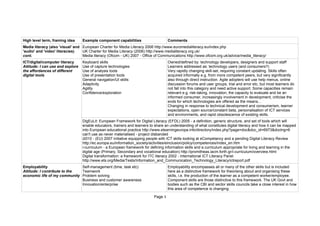
ICT/digital/computer literacy     Keyboard skills                                    Owned/defined by: technology developers, designers and support staff
Attitude: I can use and explore   Use of capture technologies                        Learners addressed as: technology users (and consumers?)
the affordances of different      Use of analysis tools                              Very rapidly changing skill-set, requiring constant updating. Skills often
digital tools                     Use of presentation tools                          acquired informally e.g. from more competent peers, but very significantly
                                  General navigation/UI skills                       also through direct instruction. Agile adopters will use help menus, online
                                  Adaptivity                                         discussion forums and user groups, trial and error etc, but most learners do
                                  Agility                                            not fall into this category and need active support. Some capacities remain
                                  Confidence/exploration                             relevant e.g. risk-taking, innovation, the capacity to evaluate and be an
                                                                                     informed consumer, increasingly involvement in development, criticise the
                                                                                     ends for which technologies are offered as the means...
                                                                                     Changing in response to technical development and consumerism, learner
                                                                                     expectations, open source/constant beta, personalisation of ICT services
                                                                                     and environments, and rapid obsolescence of existing skills.
                                  DigEuLit: European Framework for Digital Literacy (EFDL) 2005 - a definition, generic structure, and set of tools which will
                                  enable educators, trainers and learners to share an understanding of what constitutes digital literacy and how it can be mapped
                                  into European educational practice http://www.elearningeuropa.info/directory/index.php?page=doc&doc_id=6973&doclng=6
                                  can't use as never materialised - project disbanded
                                  i2010 - (EU) 2007 initiative equipping people with ICT skills looking at eCompetancy and a pending Digital Literacy Review
                                  http://ec.europa.eu/information_society/activities/einclusion/policy/competences/index_en.htm
                                  i-curriculum - a European framework for defining information skills and a curriculum appropriate for living and learning in the
                                  digital age (Primary, Secondary and vocational education) http://promitheas.iacm.forth.gr/i-curriculum/overview.html
                                  Digital transformation: a framework for ITC literacy 2002 - International ICT Literacy Panel
                                  http://www.ets.org/Media/Tests/Information_and_Communication_Technology_Literacy/ictreport.pdf
Employability                 Self-management (time, task etc)                       Employability encompasses all or many of the other skills but is included
Attitude: I contribute to the Teamwork                                               here as a distinctive framework for theorising about and organising these
economic life of my community Problem solving                                        skills, i.e. the production of the learner as a competent worker/employee.
                              Business and customer awareness                        Component skills are those distinctive to this framework. The UK Govt and
                              Innovation/enterprise                                  bodies such as the CBI and sector skills councils take a close interest in how
                                                                                     this area of competence is changing.

                                                                            Page 4
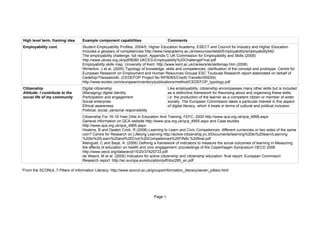
High level term, framing idea      Example component capabilities                        Comments
Employability cont.                Student Employability Profiles, 2004/5, Higher Education Academy, ESECT and Council for Industry and Higher Education
                                   Includes a glossary of competencies http://www.heacademy.ac.uk/resources/detail/Employability/employability542
                                   The employability challenge: full report, Appendix C UK Commission for Employability and Skills (2009)
                                   http://www.ukces.org.uk/pdf/8080-UKCES-Employability%20ChallengeFinal.pdf
                                   Employability skills map, University of Kent. http://www.kent.ac.uk/careers/sk/skillsmap.htm (2008)
                                   Winterton, J et al. (2005) Typology of knowledge, skills and competences: clarification of the concept and prototype. Centre for
                                   European Research on Employment and Human Resources Groupe ESC Toulouse Research report elaborated on behalf of
                                   Cedefop/Thessaloniki. (CEDEFOP Project No RP/B/BS/Credit Transfer/005/04)
                                   http://www.ecotec.com/europeaninventory/publications/method/CEDEFOP_typology.pdf
Citizenship                        Digital citizenship                                   Like employability, citizenship encompasses many other skills but is included
Attitude: I contribute to the      (Managing) digital identity                           as a distinctive framework for theorising about and organising these skills,
social life of my community        Participation and engagement                          i.e. the production of the learner as a competent citizen or member of wider
                                   Social enterprise                                     society. The European Commission takes a particular interest in this aspect
                                   Ethical awareness                                     of digital literacy, which it treats in terms of cultural and political inclusion.
                                   Political, social, personal responsibility
                                   Citizenship For 16-19 Year Olds In Education And Training, FEFC, 2000 http://www.qca.org.uk/qca_4858.aspx
                                   General information on QCA website http://www.qca.org.uk/qca_4855.aspx and Case studies
                                   http://www.qca.org.uk/qca_4865.aspx
                                   Hoskins, B and Deakin Crick, R (2008) Learning to Learn and Civic Competences: different currencies or two sides of the same
                                   coin? Centre for Research on Lifelong Learning http://active-citizenship.jrc.it/Documents/learning%20to%20learn/Learning
                                   %20to%20Learn%20and%20Civic%20Competences%20FINAL%20final.pdf
                                   Mainguet, C and Baye, A. (2006) Defining a framework of indicators to measure the social outcomes of learning in Measuring
                                   the effects of education on health and civic engagement: proceedings of the Copenhagen Symposium OECD 2006
                                   http://www.oecd.org/dataoecd/15/20/37425733.pdf
                                   de Weerd, M et al. (2005) Indicators for active citizenship and citizenship education: final report. European Commision
                                   Research report. http://ec.europa.eu/education/pdf/doc280_en.pdf

*From the SCONUL 7 Pillars of Information Literacy: http://www.sconul.ac.uk/groups/information_literacy/seven_pillars.html


                                                                                Page 5

Competence frameworks v1

  • 1.
    Digital Literacies Materials Competenceframeworks This hand-out briefly summarises the competence frameworks most relevant to digital literacies. Many institutions will already be using specific frameworks, either home-grown or adopted, to support learner development in each of these areas. However, examples are also offered for reference (with thanks to Lou McGill). High level term, framing idea Example component capabilities Comments Learning to learn, Reflection Owned/defined by: the learner; learning development metacognition Strategic planning Learners addressed as: self-directed learners, lifelong leaners Attitude: I can manage my Self-evaluation, self-analysis Changing due to: different needs of arriving learners; different expectations; learning and personal Organisation (time etc) availability of online and open learning opportunities; technology-supported development learning styles Cartwright, Kelly B. (Ed.) (2008). Literacy Processes: Cognitive Flexibility in Learning and Teaching. NY: The Guilford Press http://edrev.asu.edu/reviews/rev731.htm Quintana, C et al. (2005) A Framework for Supporting Metacognitive Aspects of Online Inquiry Through Software-Based Scaffolding in Educational Psychologist, V4, N4. pp 235-244 http://www.informaworld.com/smpp/content~content=a784751538~db=all Spencer, S (200?) A Metacognitive Framework for Learning PhD http://coe.winthrop.edu/spencers/sue%27s%20office%20web %20page/metacognition/A%20Metacognitive%20Framework%20for%20Learning.htm McGuinness, C (1999) From thinking skills to thinking classrooms, DfeS, 1999 http://www.dcsf.gov.uk/research/data/uploadfiles/RB115.doc. Hoskins, B and Deakin Crick, R (2008) Learning to Learn and Civic Competences: different currencies or two sides of the same coin? Centre for Research on Lifelong Learning http://active-citizenship.jrc.it/Documents/learning%20to%20learn/Learning %20to%20Learn%20and%20Civic%20Competences%20FINAL%20final.pdf Academic practice, study skills Comprehension Owned/defined by: the academy, especially academic development, learning Attitude: I can make and Reading/apprehension development, study skills interpret meanings in this field Organisation (knowledge) Learners addressed as: students, prospective graduates in specific subjects of knowledge Synthesis Slow changing due to cultural values being embedded in institutional, Argumentation disciplinary/professional/vocational, and wider social practices and Problem-solving expectations. But changing due to: school-based education practices Research skills changing; popular practices around knowledge and representation e.g. cut Academic writing and paste, sharing, informal spelling, essay banks, google answers etc Page 1
  • 2.
    Academic practice, studyskills i-curriculum - a European framework for defining information skills and a curriculum appropriate for living and learning in the (cont.) digital age (Primary, Secondary and vocational education) http://promitheas.iacm.forth.gr/i-curriculum/overview.html The framework for higher education qualifications in England, Wales and Northern Ireland 2007 Quality Assurance Agency for Higher Education http://www.qaa.ac.uk/academicinfrastructure/FHEQ/EWNI/default.asp#framework Undergraduate levels framework (OU, UK) 2005 - Centre for Outcomes-Based Education http://www.open.ac.uk/cobe/docs/KnowAbout/FS4-LevelsFramework.pdf OU Open Learn Learning framework http://openlearn.open.ac.uk/mod/resource/view.php?id=188602 General Medical Council (2003) Tomorrows Doctors UK policy document to support medical Schools includes curriculum framework http://www.gmc-uk.org/education/undergraduate/undergraduate_policy/tomorrows_doctors.asp Information literacy* Identification Owned/defined by: the library Attitude: I can find and use Accession Learners addressed as: researchers, information users information in a meaningful Organisation Information literacy has evolved rapidly to meed demands of rapidly way Evaluation changing information environment. At the same time, it is a place where Interpretation lasting values are asserted (evaluation, reflection and judgement, critical Analysis awareness, provenance of sources, evidence, method). Established Synthesis information literacy models are being challenged by widespread sharing of Application content and blurring of boundaries between information and communication. i-curriculum - a European framework for defining information skills and a curriculum appropriate for living and learning in the digital age (Primary, Secondary and vocational education) http://promitheas.iacm.forth.gr/i-curriculum/overview.html Seven pillars of information literacy (UK) SCONUL 2003 http://www.sconul.ac.uk/groups/information_literacy/papers/Seven_pillars.html The Big Blue information literacy model (UK) 2006 http://www.library.mmu.ac.uk/bigblue/ppt/themodel4.ppt http://www.library.mmu.ac.uk/bigblue/index.html Australian and New Zealand Information Literacy Framework: principles, standards and practice 2004 http://www.anziil.org/resources/Info%20lit%202nd%20edition.pdf Eisenberg (2001) Big six: Information & Technology Skills for Student Achievement (US) http://www.big6.com/2001/11/19/a- big6%e2%84%a2-skills-overview/ Bruce, C. (1997)The Seven Faces of Information Literacy (Australia) Bruce 1997 http://sky.fit.qut.edu.au/~bruce/inflit/faces/faces1.php Page 2
  • 3.
    High level term,framing idea Example component capabilities Comments Communication and Teamwork Owned/defined by: unclear. Most institutions and programmes claim that collaboration skills Networking this is a key graduate attribute but there are few examples of it being Attitude: I can work with others Effective communication in a range of different consistently developed or assessed. Some professions require particular to produce shared meanings media forms of communication; in practice there is overlap with use of digital tools Awareness of audience (below) Openness/sharing Learners addressed as: communicators, social participants Repurposing, reaggregation, re-editing Fairly rapidly changing to keep pace with emerging new technologies, networks, devices and forms of tele-presence. However, common values are asserted across communicational media, e.g. in acceptable use policies, netiquette etc: listening, turn-taking, facilitation, mediation, respect; also practices of acknowledging particular contributions. Challenged by some features of informal communication including flaming, dissing, etc. Also challenged by proliferation of communication channels - making it difficult for institutions/tutors to control communications around study. Relatively few examples: i-curriculum - a European framework for defining information skills and a curriculum appropriate for living and learning in the digital age (Primary, Secondary and vocational education) http://promitheas.iacm.forth.gr/i-curriculum/overview.html The NHS Knowledge and Skills Framework (NHS KSF) (2004) Dept. of Health. Appendix 2 Core Dimension 1 : Communication http://www.dh.gov.uk/en/Publicationsandstatistics/Publications/PublicationsPolicyAndGuidance/DH_4090843? IdcService=GET_FILE&dID=5786&Rendition=Web Media literacy (also 'visual' and Critical 'reading' Owned/defined by: generally unclear, though some media literacies are well 'audio' and 'video' literacies) Creative production defined in specialist subject areas e.g. film, photography, media studies. Attitude: I can make and Learners addressed as: consumers and producers of messages in a range interpret meanings in different of media media Area of focus for European and UK govt, which assert value of some traditional academic practices e.g. critique, review, scepticism, originality and creativity. Moderately fast-changing to keep pace with emergence of new media, e.g. gaming, media sharing sites and some new values - currency, cool, reputation, etc. Changing due to new availability of capture, editing and production technologies; and due to mass practices of rating, reviewing, commenting, redistribution, fandom. Page 3
  • 4.
    High level term,framing idea Example component capabilities Comments Media literacy (also 'visual' and European Charter for Media Literacy 2006 http://www.euromedialiteracy.eu/index.php 'audio' and 'video' literacies) UK Charter for Media Literacy (2006) http://www.medialiteracy.org.uk/ cont. Media literacy (Ofcom - UK) 2007 - Office of Communications http://www.ofcom.org.uk/advice/media_literacy/ ICT/digital/computer literacy Keyboard skills Owned/defined by: technology developers, designers and support staff Attitude: I can use and explore Use of capture technologies Learners addressed as: technology users (and consumers?) the affordances of different Use of analysis tools Very rapidly changing skill-set, requiring constant updating. Skills often digital tools Use of presentation tools acquired informally e.g. from more competent peers, but very significantly General navigation/UI skills also through direct instruction. Agile adopters will use help menus, online Adaptivity discussion forums and user groups, trial and error etc, but most learners do Agility not fall into this category and need active support. Some capacities remain Confidence/exploration relevant e.g. risk-taking, innovation, the capacity to evaluate and be an informed consumer, increasingly involvement in development, criticise the ends for which technologies are offered as the means... Changing in response to technical development and consumerism, learner expectations, open source/constant beta, personalisation of ICT services and environments, and rapid obsolescence of existing skills. DigEuLit: European Framework for Digital Literacy (EFDL) 2005 - a definition, generic structure, and set of tools which will enable educators, trainers and learners to share an understanding of what constitutes digital literacy and how it can be mapped into European educational practice http://www.elearningeuropa.info/directory/index.php?page=doc&doc_id=6973&doclng=6 can't use as never materialised - project disbanded i2010 - (EU) 2007 initiative equipping people with ICT skills looking at eCompetancy and a pending Digital Literacy Review http://ec.europa.eu/information_society/activities/einclusion/policy/competences/index_en.htm i-curriculum - a European framework for defining information skills and a curriculum appropriate for living and learning in the digital age (Primary, Secondary and vocational education) http://promitheas.iacm.forth.gr/i-curriculum/overview.html Digital transformation: a framework for ITC literacy 2002 - International ICT Literacy Panel http://www.ets.org/Media/Tests/Information_and_Communication_Technology_Literacy/ictreport.pdf Employability Self-management (time, task etc) Employability encompasses all or many of the other skills but is included Attitude: I contribute to the Teamwork here as a distinctive framework for theorising about and organising these economic life of my community Problem solving skills, i.e. the production of the learner as a competent worker/employee. Business and customer awareness Component skills are those distinctive to this framework. The UK Govt and Innovation/enterprise bodies such as the CBI and sector skills councils take a close interest in how this area of competence is changing. Page 4
  • 5.
    High level term,framing idea Example component capabilities Comments Employability cont. Student Employability Profiles, 2004/5, Higher Education Academy, ESECT and Council for Industry and Higher Education Includes a glossary of competencies http://www.heacademy.ac.uk/resources/detail/Employability/employability542 The employability challenge: full report, Appendix C UK Commission for Employability and Skills (2009) http://www.ukces.org.uk/pdf/8080-UKCES-Employability%20ChallengeFinal.pdf Employability skills map, University of Kent. http://www.kent.ac.uk/careers/sk/skillsmap.htm (2008) Winterton, J et al. (2005) Typology of knowledge, skills and competences: clarification of the concept and prototype. Centre for European Research on Employment and Human Resources Groupe ESC Toulouse Research report elaborated on behalf of Cedefop/Thessaloniki. (CEDEFOP Project No RP/B/BS/Credit Transfer/005/04) http://www.ecotec.com/europeaninventory/publications/method/CEDEFOP_typology.pdf Citizenship Digital citizenship Like employability, citizenship encompasses many other skills but is included Attitude: I contribute to the (Managing) digital identity as a distinctive framework for theorising about and organising these skills, social life of my community Participation and engagement i.e. the production of the learner as a competent citizen or member of wider Social enterprise society. The European Commission takes a particular interest in this aspect Ethical awareness of digital literacy, which it treats in terms of cultural and political inclusion. Political, social, personal responsibility Citizenship For 16-19 Year Olds In Education And Training, FEFC, 2000 http://www.qca.org.uk/qca_4858.aspx General information on QCA website http://www.qca.org.uk/qca_4855.aspx and Case studies http://www.qca.org.uk/qca_4865.aspx Hoskins, B and Deakin Crick, R (2008) Learning to Learn and Civic Competences: different currencies or two sides of the same coin? Centre for Research on Lifelong Learning http://active-citizenship.jrc.it/Documents/learning%20to%20learn/Learning %20to%20Learn%20and%20Civic%20Competences%20FINAL%20final.pdf Mainguet, C and Baye, A. (2006) Defining a framework of indicators to measure the social outcomes of learning in Measuring the effects of education on health and civic engagement: proceedings of the Copenhagen Symposium OECD 2006 http://www.oecd.org/dataoecd/15/20/37425733.pdf de Weerd, M et al. (2005) Indicators for active citizenship and citizenship education: final report. European Commision Research report. http://ec.europa.eu/education/pdf/doc280_en.pdf *From the SCONUL 7 Pillars of Information Literacy: http://www.sconul.ac.uk/groups/information_literacy/seven_pillars.html Page 5