Trouble with critical: 

open education and critical digital literacies -
an open space for exploration
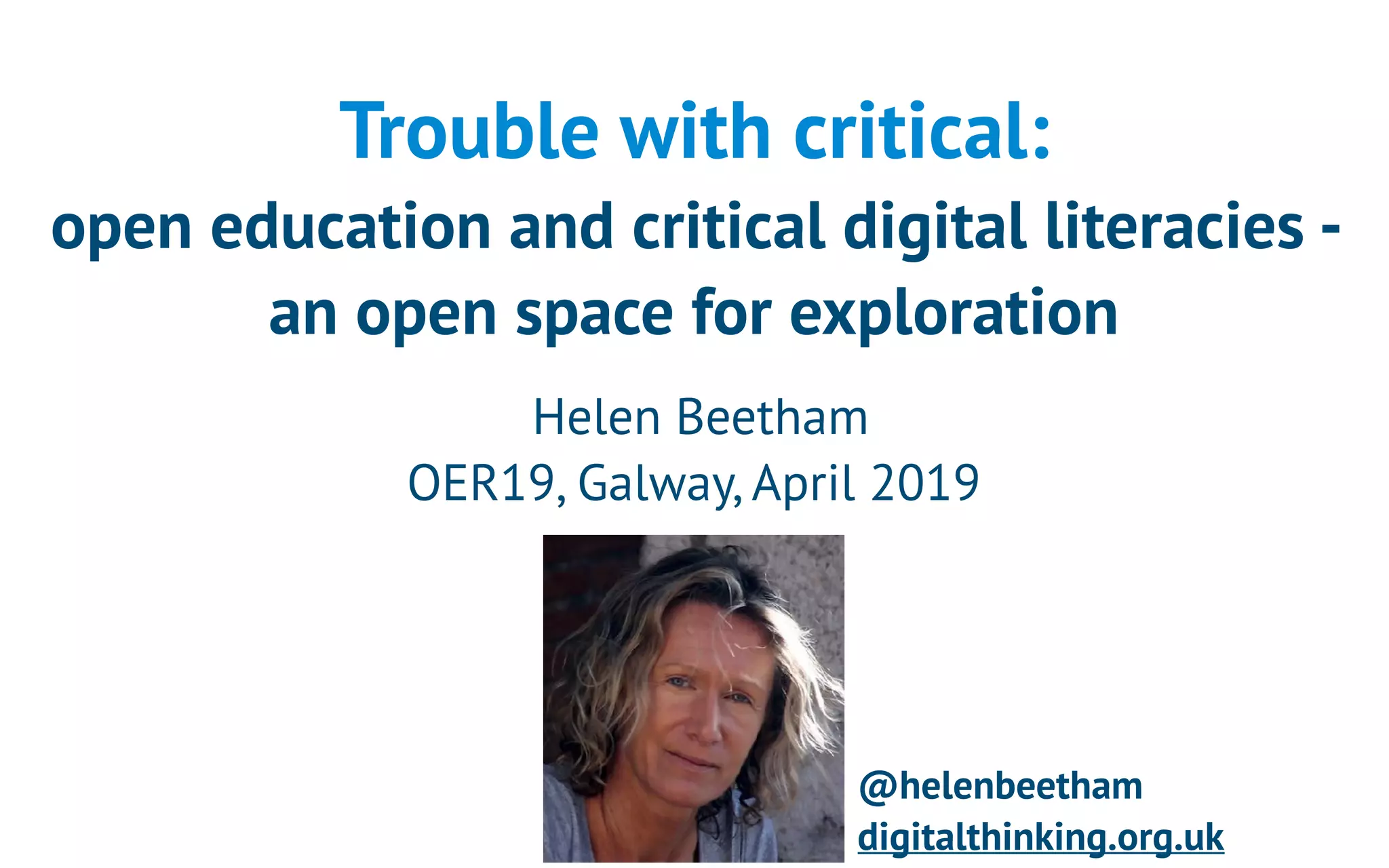
Helen Beetham
OER19, Galway, April 2019
@helenbeetham
digitalthinking.org.uk
1. Opening the space
2. Open questions for you (15 mins)
3. Short contribution from me (5 mins)
4. Further developing themes
blog post: tinyurl.com/oer19digital
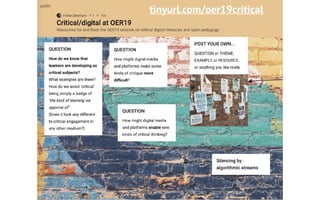
padlet: tinyurl.com/oer19critical
gdoc (for later): tinyurl.com/oer19themes
‘Writing is a technology that restructures thought’ 

Walter Ong, Orality and Literacy (1962)
Our session
‘Multiple, critical techno-literacies’ 

(Kahn and Kellner 2005)


Critical computer literacy involves learning
how to use computer technologies to do research and
gather information,to perceive computer culture as a contested
terrain… as well as to interrogate the political economy,cultural bias and
environmental effects of computer-related technologies.

Critical media literacy not only teaches students to learn from media,to
resist media manipulation and to use media materials in constructive
ways,it is also concerned with developing skills that will help
create good citizens and make them more motivated and
competent participants in social life.
A. Open education demands ‘critically’ resourceful
learners
1. Does not foreclose questions of pathway, interface, time and
timing: How best shall I learn this?
2. May not foreclose questions of platform, tool, content, mode of
engagement, activity/production, outcome, community… 

What should I learn? What does (this) learning mean to me? Who
am I as a learner?
3. Learners must be critical users/navigators of their own learning
4. They may need to be critical subjects in the domain of
knowledge/learning
B. Open education entails critical educators and
pedagogies
1. A pedagogical practice that develops critical subjects must
challenge power / privilege in the pedagogic relationship
2. As a matter of historical and political contingency:
‣ Digital open education movement met an intensification of
neoliberalism and marketisation
‣ Conflict within open ed between creating new market models and
developing a new, public, democratic knowledge commons
‣ Market models have largely won out and/or open education has lost
out in real, existing universities
‣ Open education is the ideal of the university as knowledge commons,
in critical revolt against really existing universities…?
tinyurl.com/oer19critical
Open questions
1. How do we know that learners are developing as critical subjects?
‣ What examples are there? How do we avoid ‘critical’ being
simply a badge of ‘the kind of learning we approve of’?
2. Do digital technologies and networks provide new opportunities
for learners to develop critical tools and stances?
‣ Materially what are they?
‣ Historically, contingently, what are they?
3. Are there new risks to criticality?
‣ What are they, specifically and without moral panic?
Open questions
1. How do we know that learners are developing as critical subjects?
‣ What examples are there? How do we avoid ‘critical’ being
simply a badge of ‘the kind of learning we approve of’?
2. Do digital technologies and networks provide new opportunities
for learners to develop critical tools and stances?
‣ Materially what are they?
‣ Historically, contingently, what are they?
3. Are there new risks to criticality?
‣ What are they, specifically and without moral panic?
Open questions
1. How do we know that learners are developing as critical subjects?
‣ What examples are there? How do we avoid ‘critical’ being
simply a badge of ‘the kind of learning we approve of’?
2. Do digital technologies and networks provide new opportunities
for learners to develop critical tools and stances?
‣ Materially what are they?
‣ Historically, contingently, what are they?
3. Are there new risks to criticality?
‣ What are they, specifically and without moral panic?
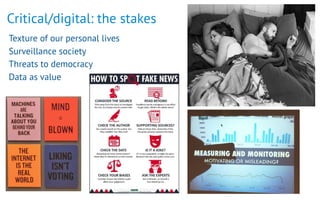
Critical/digital: the stakes
Texture of our personal lives
Surveillance society
Threats to democracy
Data as value
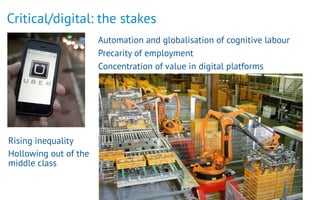
Automation and globalisation of cognitive labour
Precarity of employment
Concentration of value in digital platforms
Rising inequality
Hollowing out of the
middle class
Critical/digital: the stakes
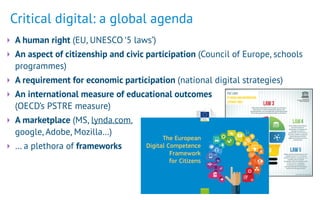
Critical digital: a global agenda
‣ A human right (EU, UNESCO ‘5 laws’)
‣ An aspect of citizenship and civic participation (Council of Europe, schools
programmes)
‣ A requirement for economic participation (national digital strategies)
‣ An international measure of educational outcomes 

(OECD’s PSTRE measure)
‣ A marketplace (MS, lynda.com,

google, Adobe, Mozilla…)
‣ … a plethora of frameworks
Social Europe
The European
Digital Competence
Framework
for Citizens
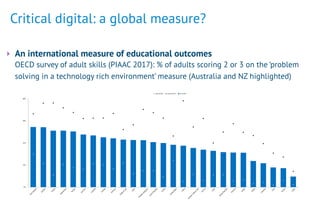
Critical digital: a global measure?
‣ An international measure of educational outcomes 

OECD survey of adult skills (PIAAC 2017): % of adults scoring 2 or 3 on the ‘problem
solving in a technology rich environment’ measure (Australia and NZ highlighted)

0%
16%
33%
49%
65%
N
ew
Zealand
Sw
eden
Finland
N
etherlands
N
orw
ay
D
enm
ark
Australia
C
anada
G
erm
any
England
(U
K)
Japan
Flanders
(Belgium
)
C
zech
R
epublic
Austria
U
nited
States
Korea
N
orthern
Ireland
(U
K)
Estonia
Israel
Slovak
R
epublic
Slovenia
Ireland
Poland
Lithuania
C
hile
G
reece
Turkey
older (55-65) young (16-25) all (16-65)
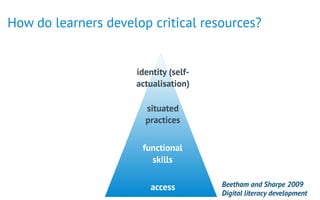
Beetham and Sharpe 2009

Digital literacy development
How do learners develop critical resources?
access
situated

practices
functional

skills
identity (self-
actualisation)
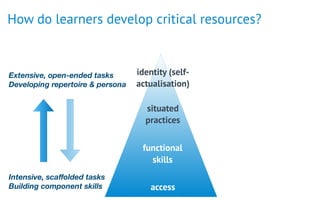
How do learners develop critical resources?
Extensive, open-ended tasks

Developing repertoire & persona


Intensive, scaffolded tasks 

Building component skills
	
access
situated

practices
functional

skills
identity (self-
actualisation)
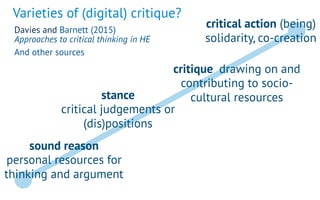
Varieties of (digital) critique?
Davies and Barnett (2015)

Approaches to critical thinking in HE
And other sources
sound reason

personal resources for
thinking and argument
stance

critical judgements or
(dis)positions

critique drawing on and
contributing to socio-
cultural resources
critical action (being)

solidarity, co-creation
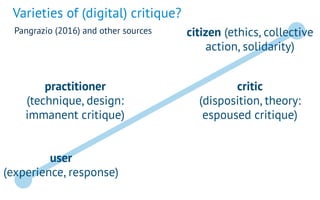
Varieties of (digital) critique?
Pangrazio (2016) and other sources
user

(experience, response)
practitioner

(technique, design:
immanent critique) 

critic 

(disposition, theory:
espoused critique)
citizen (ethics, collective
action, solidarity)
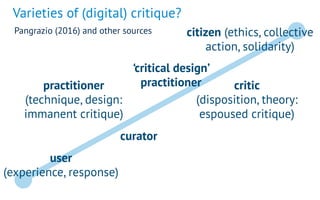
Varieties of (digital) critique?
Pangrazio (2016) and other sources
user

(experience, response)
practitioner

(technique, design:
immanent critique) 

critic 

(disposition, theory:
espoused critique)
citizen (ethics, collective
action, solidarity)
curator

‘critical design’
practitioner
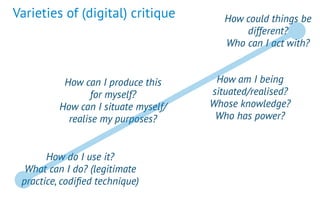
Varieties of (digital) critique
How can I produce this
for myself?
How can I situate myself/
realise my purposes?
How do I use it?
What can I do? (legitimate
practice, codified technique)
How am I being
situated/realised?

Whose knowledge?
Who has power?
How could things be
different? 

Who can I act with?
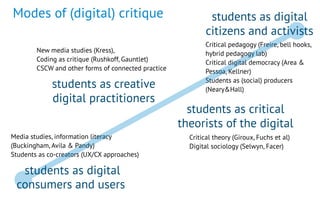
Modes of (digital) critique
Media studies, information literacy
(Buckingham, Avila & Pandy)
Students as co-creators (UX/CX approaches)

New media studies (Kress), 

Coding as critique (Rushkoff, Gauntlet)
CSCW and other forms of connected practice

Critical pedagogy (Freire, bell hooks,
hybrid pedagogy lab)

Critical digital democracy (Area &
Pessoa, Kellner)
Students as (social) producers
(Neary&Hall)
Critical theory (Giroux, Fuchs et al)

Digital sociology (Selwyn, Facer)
students as digital
consumers and users
students as digital
citizens and activists
students as creative
digital practitioners
students as critical
theorists of the digital
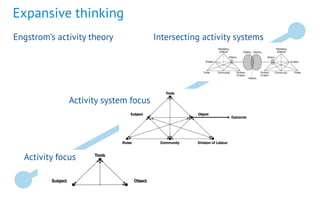
Expansive thinking
Engstrom’s activity theory
Activity focus
Activity system focus
Intersecting activity systems
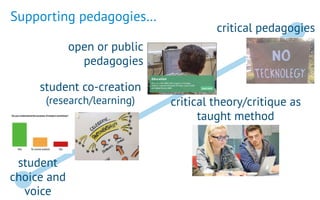
student co-creation
(research/learning)
critical pedagogies
student
choice and
voice
open or public

pedagogies
Supporting pedagogies…
critical theory/critique as
taught method
1. Opening the space
2. Open questions for you (15 mins)
3. Short contribution from me (5 mins)
4. Further developing themes (please!)
blog post: tinyurl.com/oer19digital
padlet: tinyurl.com/oer19critical
gdoc (for later): tinyurl.com/oer19themes
‘Writing is a technology that restructures thought’ 

Walter Ong, Orality and Literacy (1962)
Our session
Who can we learn from/with?


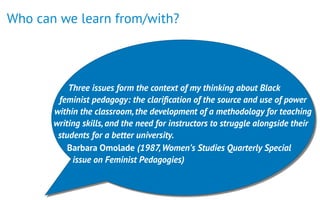
Three issues form the context of my thinking about Black
feminist pedagogy: the clarification of the source and use of power
within the classroom,the development of a methodology for teaching
writing skills,and the need for instructors to struggle alongside their
students for a better university.
Barbara Omolade (1987,Women’s Studies Quarterly Special
issue on Feminist Pedagogies)
Who can we learn from/with?


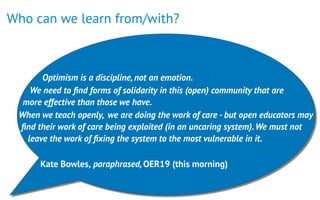
Optimism is a discipline,not an emotion.
We need to find forms of solidarity in this (open) community that are
more effective than those we have.
When we teach openly, we are doing the work of care - but open educators may
find their work of care being exploited (in an uncaring system).We must not
leave the work of fixing the system to the most vulnerable in it.
Kate Bowles, paraphrased,OER19 (this morning)
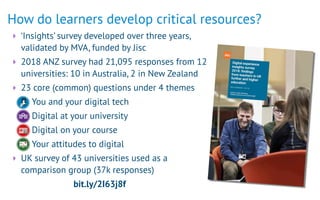
‣ ‘Insights’ survey developed over three years,
validated by MVA, funded by Jisc
‣ 2018 ANZ survey had 21,095 responses from 12
universities: 10 in Australia, 2 in New Zealand
‣ 23 core (common) questions under 4 themes
-You and your digital tech
-Digital at your university
-Digital on your course
-Your attitudes to digital
‣ UK survey of 43 universities used as a
comparison group (37k responses)
bit.ly/2I63j8f
How do learners develop critical resources?
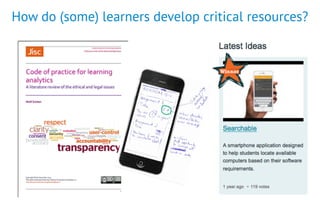
How do (some) learners develop critical resources?
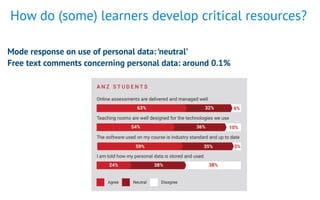
Mode response on use of personal data: ‘neutral’
Free text comments concerning personal data: around 0.1%
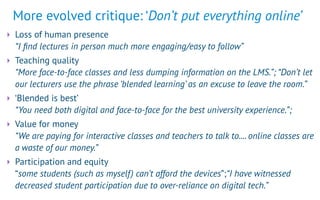
How do (some) learners develop critical resources?
More evolved critique: ‘Don’t put everything online’
‣ Loss of human presence

“I find lectures in person much more engaging/easy to follow”
‣ Teaching quality

“More face-to-face classes and less dumping information on the LMS.”; “Don’t let
our lecturers use the phrase ‘blended learning’ as an excuse to leave the room.”
‣ ‘Blended is best’

“You need both digital and face-to-face for the best university experience.”;
‣ Value for money

“We are paying for interactive classes and teachers to talk to.... online classes are
a waste of our money.”
‣ Participation and equity

“some students (such as myself) can’t afford the devices”;“I have witnessed
decreased student participation due to over-reliance on digital tech.”
Reflections and contributions

Oer19 critical open space

  • 1.
    Trouble with critical:
 open education and critical digital literacies - an open space for exploration Helen Beetham OER19, Galway, April 2019 @helenbeetham digitalthinking.org.uk
  • 2.
    1. Opening thespace 2. Open questions for you (15 mins) 3. Short contribution from me (5 mins) 4. Further developing themes blog post: tinyurl.com/oer19digital padlet: tinyurl.com/oer19critical gdoc (for later): tinyurl.com/oer19themes ‘Writing is a technology that restructures thought’ 
 Walter Ong, Orality and Literacy (1962) Our session
  • 3.
    ‘Multiple, critical techno-literacies’
 (Kahn and Kellner 2005) 
 Critical computer literacy involves learning how to use computer technologies to do research and gather information,to perceive computer culture as a contested terrain… as well as to interrogate the political economy,cultural bias and environmental effects of computer-related technologies.
 Critical media literacy not only teaches students to learn from media,to resist media manipulation and to use media materials in constructive ways,it is also concerned with developing skills that will help create good citizens and make them more motivated and competent participants in social life.
  • 4.
    A. Open educationdemands ‘critically’ resourceful learners 1. Does not foreclose questions of pathway, interface, time and timing: How best shall I learn this? 2. May not foreclose questions of platform, tool, content, mode of engagement, activity/production, outcome, community… 
 What should I learn? What does (this) learning mean to me? Who am I as a learner? 3. Learners must be critical users/navigators of their own learning 4. They may need to be critical subjects in the domain of knowledge/learning
  • 5.
    B. Open educationentails critical educators and pedagogies 1. A pedagogical practice that develops critical subjects must challenge power / privilege in the pedagogic relationship 2. As a matter of historical and political contingency: ‣ Digital open education movement met an intensification of neoliberalism and marketisation ‣ Conflict within open ed between creating new market models and developing a new, public, democratic knowledge commons ‣ Market models have largely won out and/or open education has lost out in real, existing universities ‣ Open education is the ideal of the university as knowledge commons, in critical revolt against really existing universities…?
  • 6.
  • 7.
    Open questions 1. Howdo we know that learners are developing as critical subjects? ‣ What examples are there? How do we avoid ‘critical’ being simply a badge of ‘the kind of learning we approve of’? 2. Do digital technologies and networks provide new opportunities for learners to develop critical tools and stances? ‣ Materially what are they? ‣ Historically, contingently, what are they? 3. Are there new risks to criticality? ‣ What are they, specifically and without moral panic?
  • 8.
    Open questions 1. Howdo we know that learners are developing as critical subjects? ‣ What examples are there? How do we avoid ‘critical’ being simply a badge of ‘the kind of learning we approve of’? 2. Do digital technologies and networks provide new opportunities for learners to develop critical tools and stances? ‣ Materially what are they? ‣ Historically, contingently, what are they? 3. Are there new risks to criticality? ‣ What are they, specifically and without moral panic?
  • 9.
    Open questions 1. Howdo we know that learners are developing as critical subjects? ‣ What examples are there? How do we avoid ‘critical’ being simply a badge of ‘the kind of learning we approve of’? 2. Do digital technologies and networks provide new opportunities for learners to develop critical tools and stances? ‣ Materially what are they? ‣ Historically, contingently, what are they? 3. Are there new risks to criticality? ‣ What are they, specifically and without moral panic?
  • 10.
    Critical/digital: the stakes Textureof our personal lives Surveillance society Threats to democracy Data as value
  • 11.
    Automation and globalisationof cognitive labour Precarity of employment Concentration of value in digital platforms Rising inequality Hollowing out of the middle class Critical/digital: the stakes
  • 12.
    Critical digital: aglobal agenda ‣ A human right (EU, UNESCO ‘5 laws’) ‣ An aspect of citizenship and civic participation (Council of Europe, schools programmes) ‣ A requirement for economic participation (national digital strategies) ‣ An international measure of educational outcomes 
 (OECD’s PSTRE measure) ‣ A marketplace (MS, lynda.com,
 google, Adobe, Mozilla…) ‣ … a plethora of frameworks Social Europe The European Digital Competence Framework for Citizens
  • 13.
    Critical digital: aglobal measure? ‣ An international measure of educational outcomes 
 OECD survey of adult skills (PIAAC 2017): % of adults scoring 2 or 3 on the ‘problem solving in a technology rich environment’ measure (Australia and NZ highlighted)
 0% 16% 33% 49% 65% N ew Zealand Sw eden Finland N etherlands N orw ay D enm ark Australia C anada G erm any England (U K) Japan Flanders (Belgium ) C zech R epublic Austria U nited States Korea N orthern Ireland (U K) Estonia Israel Slovak R epublic Slovenia Ireland Poland Lithuania C hile G reece Turkey older (55-65) young (16-25) all (16-65)
  • 14.
    Beetham and Sharpe2009
 Digital literacy development How do learners develop critical resources? access situated
 practices functional
 skills identity (self- actualisation)
  • 15.
    How do learnersdevelop critical resources? Extensive, open-ended tasks
 Developing repertoire & persona
 
 Intensive, scaffolded tasks 
 Building component skills access situated
 practices functional
 skills identity (self- actualisation)
  • 16.
    Varieties of (digital)critique? Davies and Barnett (2015)
 Approaches to critical thinking in HE And other sources sound reason
 personal resources for thinking and argument stance
 critical judgements or (dis)positions
 critique drawing on and contributing to socio- cultural resources critical action (being)
 solidarity, co-creation
  • 17.
    Varieties of (digital)critique? Pangrazio (2016) and other sources user
 (experience, response) practitioner
 (technique, design: immanent critique) 
 critic 
 (disposition, theory: espoused critique) citizen (ethics, collective action, solidarity)
  • 18.
    Varieties of (digital)critique? Pangrazio (2016) and other sources user
 (experience, response) practitioner
 (technique, design: immanent critique) 
 critic 
 (disposition, theory: espoused critique) citizen (ethics, collective action, solidarity) curator
 ‘critical design’ practitioner
  • 19.
    Varieties of (digital)critique How can I produce this for myself? How can I situate myself/ realise my purposes? How do I use it? What can I do? (legitimate practice, codified technique) How am I being situated/realised?
 Whose knowledge? Who has power? How could things be different? 
 Who can I act with?
  • 20.
    Modes of (digital)critique Media studies, information literacy (Buckingham, Avila & Pandy) Students as co-creators (UX/CX approaches)
 New media studies (Kress), 
 Coding as critique (Rushkoff, Gauntlet) CSCW and other forms of connected practice
 Critical pedagogy (Freire, bell hooks, hybrid pedagogy lab)
 Critical digital democracy (Area & Pessoa, Kellner) Students as (social) producers (Neary&Hall) Critical theory (Giroux, Fuchs et al)
 Digital sociology (Selwyn, Facer) students as digital consumers and users students as digital citizens and activists students as creative digital practitioners students as critical theorists of the digital
  • 21.
    Expansive thinking Engstrom’s activitytheory Activity focus Activity system focus Intersecting activity systems
  • 22.
    student co-creation (research/learning) critical pedagogies student choiceand voice open or public
 pedagogies Supporting pedagogies… critical theory/critique as taught method
  • 23.
    1. Opening thespace 2. Open questions for you (15 mins) 3. Short contribution from me (5 mins) 4. Further developing themes (please!) blog post: tinyurl.com/oer19digital padlet: tinyurl.com/oer19critical gdoc (for later): tinyurl.com/oer19themes ‘Writing is a technology that restructures thought’ 
 Walter Ong, Orality and Literacy (1962) Our session
  • 24.
    Who can welearn from/with? 
 Three issues form the context of my thinking about Black feminist pedagogy: the clarification of the source and use of power within the classroom,the development of a methodology for teaching writing skills,and the need for instructors to struggle alongside their students for a better university. Barbara Omolade (1987,Women’s Studies Quarterly Special issue on Feminist Pedagogies)
  • 25.
    Who can welearn from/with? 
 Optimism is a discipline,not an emotion. We need to find forms of solidarity in this (open) community that are more effective than those we have. When we teach openly, we are doing the work of care - but open educators may find their work of care being exploited (in an uncaring system).We must not leave the work of fixing the system to the most vulnerable in it. Kate Bowles, paraphrased,OER19 (this morning)
  • 26.
    ‣ ‘Insights’ surveydeveloped over three years, validated by MVA, funded by Jisc ‣ 2018 ANZ survey had 21,095 responses from 12 universities: 10 in Australia, 2 in New Zealand ‣ 23 core (common) questions under 4 themes -You and your digital tech -Digital at your university -Digital on your course -Your attitudes to digital ‣ UK survey of 43 universities used as a comparison group (37k responses) bit.ly/2I63j8f How do learners develop critical resources?
  • 27.
    How do (some)learners develop critical resources? Mode response on use of personal data: ‘neutral’ Free text comments concerning personal data: around 0.1%
  • 28.
    How do (some)learners develop critical resources?
  • 29.
    More evolved critique:‘Don’t put everything online’ ‣ Loss of human presence
 “I find lectures in person much more engaging/easy to follow” ‣ Teaching quality
 “More face-to-face classes and less dumping information on the LMS.”; “Don’t let our lecturers use the phrase ‘blended learning’ as an excuse to leave the room.” ‣ ‘Blended is best’
 “You need both digital and face-to-face for the best university experience.”; ‣ Value for money
 “We are paying for interactive classes and teachers to talk to.... online classes are a waste of our money.” ‣ Participation and equity
 “some students (such as myself) can’t afford the devices”;“I have witnessed decreased student participation due to over-reliance on digital tech.”
  • 30.