What can students’ digital
experiences today teach us about the
university of the future?
Helen Beetham
ACODE 78, University of Tasmania, March 2019
@helenbeetham
1. Focus on the here and now
2. ‘Digital’ for students tends to be transactional rather than
transformational
3. Teaching staff with more varied experience can often
(unexpectedly?) see further
‘Writing is a technology that restructures thought’ 

Walter Ong, Orality and Literacy (1962)
Limited horizon of the student experience
Learning Literacies for a Digital Age (2009)
those capabilities that allow an individual to thrive (live,learn and work)
in a digital society“
”
Shift in the discourse towards developing
people in relation to technology


‘Literacy’ implies:
‣ a foundational knowledge or practice
‣ a cultural entitlement or democratic right
‣ meaning-making
‣ socially and culturally situated/specific
‣ an aspect of personal identity
‣ continuously developed, multiply expressed
Learning Literacies for a Digital Age (2009)
those capabilities that allow an individual to thrive (live,learn and work)
in a digital society“
”
Attention paid to the 

co-curriculum and informal curriculum 

as well as what is taught:
‣ students’ digital study habits (note-making,
writing, curation, recording)
‣ students’ personal access to educational
materials (software, services, resources)
‣ role of non-teaching professionals in the
student experience
access
situated

practices
functional

skills
identity:

attributes
Digital literacy development pyramid
Learning Literacies for a Digital Age (2009)
A taxonomy of learning outcomes?
Learning Literacies for a Digital Age (2009)
Extensive, open-ended tasks

Developing repertoire & persona


Intensive, scaffolded tasks 

Building component skills
	
access
situated

practices
functional

skills
identity:

attributes
Developing digital capabilities (2015-18)
Identity & well-being
Communication, collaboration
(engaged participation)
Creativity, innovation &
scholarship (creative production)
Information, media & data
literacy (critical use)
Learning & development
ICT proficiency and productivity
A global agenda: digital literacy as…
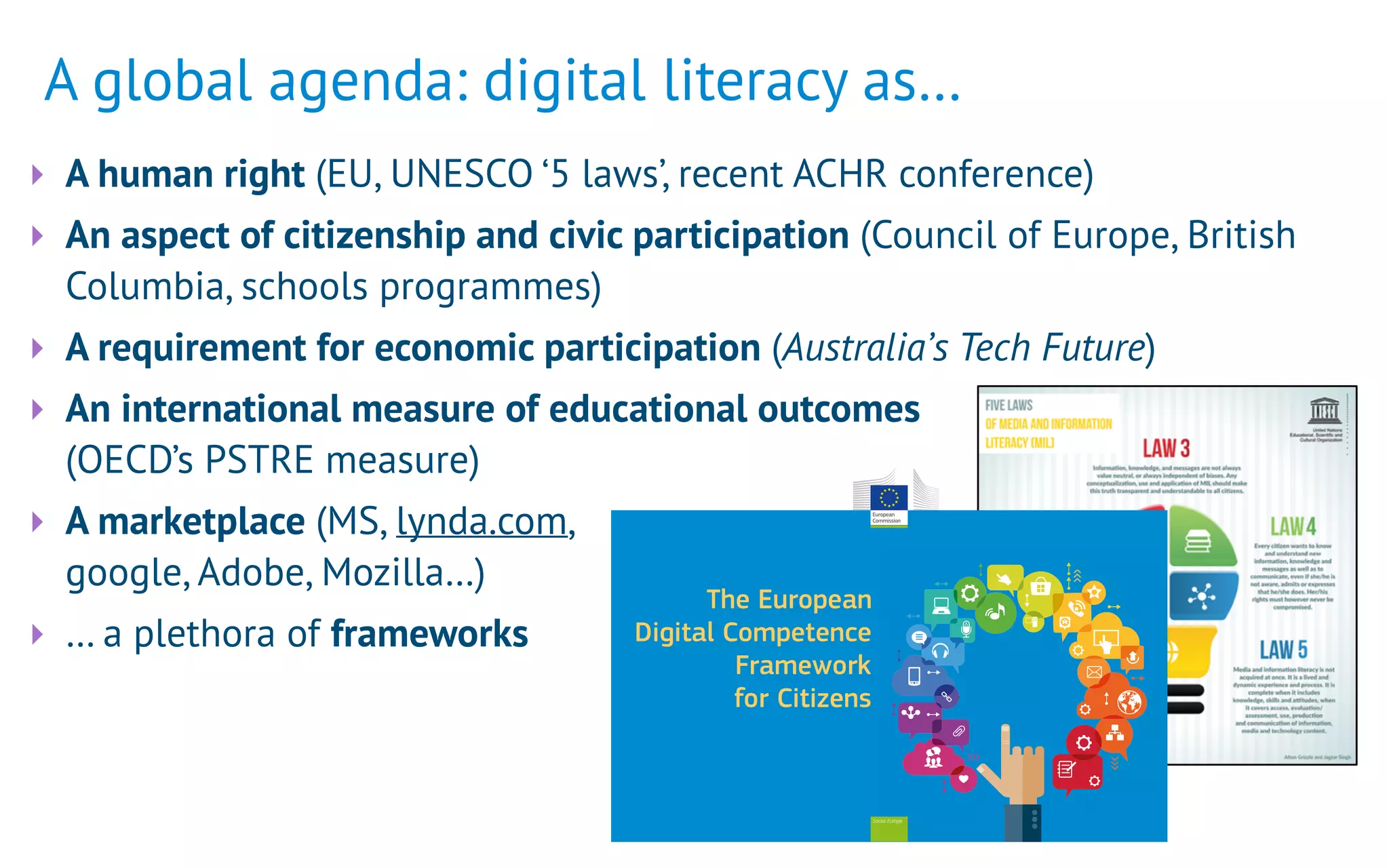
‣ A human right (EU, UNESCO ‘5 laws’, recent ACHR conference)
‣ An aspect of citizenship and civic participation (Council of Europe, British
Columbia, schools programmes)
‣ A requirement for economic participation (Australia’s Tech Future)
‣ An international measure of educational outcomes 

(OECD’s PSTRE measure)
‣ A marketplace (MS, lynda.com,

google, Adobe, Mozilla…)
‣ … a plethora of frameworks
Social Europe
The European
Digital Competence
Framework
for Citizens
A global agenda: digital literacy as…
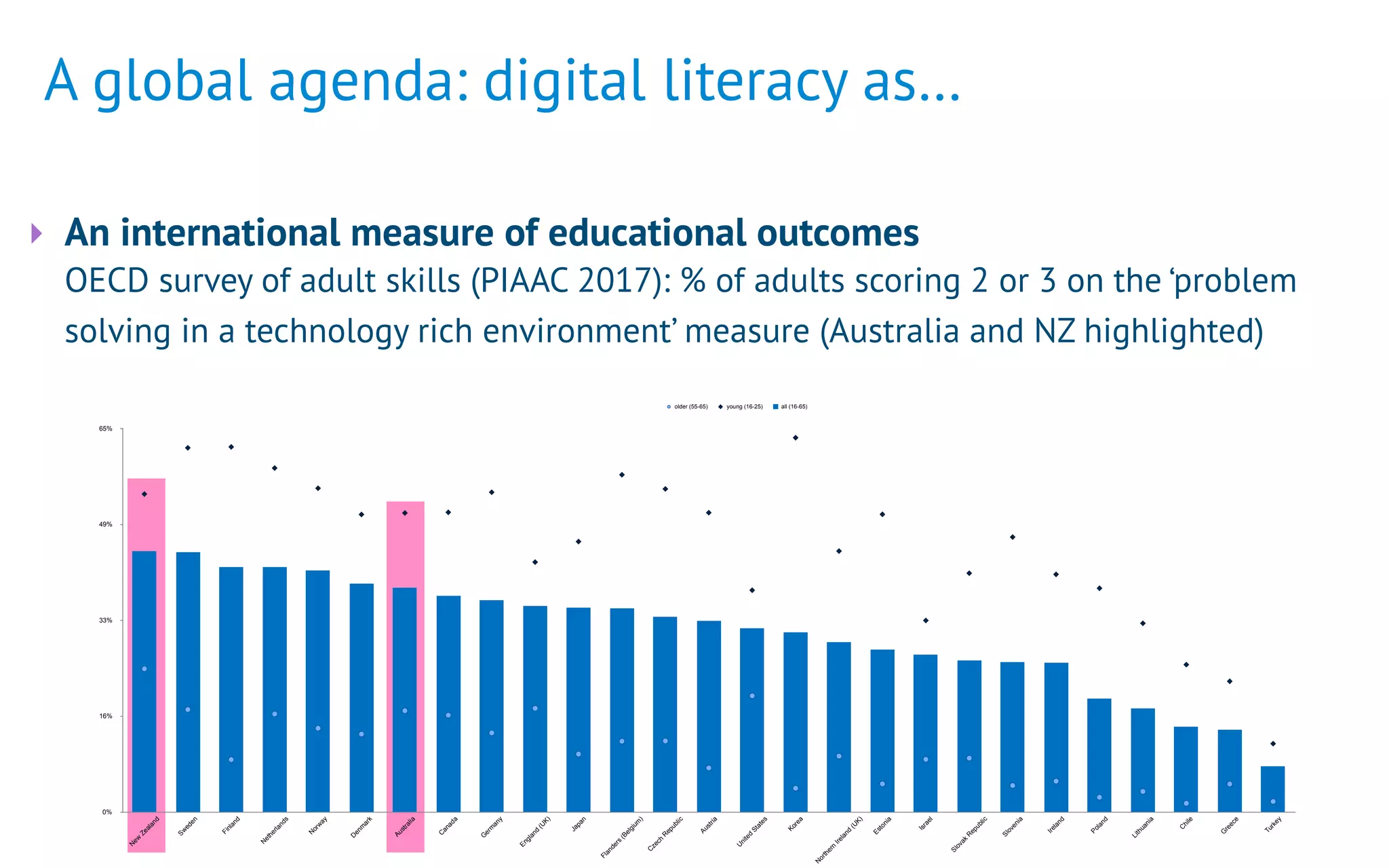
‣ An international measure of educational outcomes 

OECD survey of adult skills (PIAAC 2017): % of adults scoring 2 or 3 on the ‘problem
solving in a technology rich environment’ measure (Australia and NZ highlighted)

0%
16%
33%
49%
65%
N
ew
Zealand
Sw
eden
Finland
N
etherlands
N
orw
ay
D
enm
ark
Australia
C
anada
G
erm
any
England
(U
K)
Japan
Flanders
(Belgium
)
C
zech
R
epublic
Austria
U
nited
States
Korea
N
orthern
Ireland
(U
K)
Estonia
Israel
Slovak
R
epublic
Slovenia
Ireland
Poland
Lithuania
C
hile
G
reece
Turkey
older (55-65) young (16-25) all (16-65)
Developing digital literacies (2012-15): 

a university agenda
‣ Institutional and government funding (12 whole-organisation projects)
‣ Curriculum change (e.g. graduate attributes) and co-curricular engagement
(prof bodies)
‣ Employability drivers (‘digital economy’)
‣ QAA Review topic
‣ New questions in NSS/Student Engagement surveys
Critical/creative/engaged: the evidence?
‣ Local evaluation
‣ Use of the terms digital literacy (capability, fluency, competence etc)
remains fluid and contested, e.g.Spante et al. (2018): “linked to many
different agendas and perspectives”; Pangrazio (2016): “a variety of academic
approaches underpinned by particular values and priorities”; Brown (2015)
‣ Dearth of reliable qualitative or longitudinal studies: technical/
instrumental skills (and testing/metrics) continue to dominate
‣ Creativity framed as employability, adaptability, soft skills
‣ Is it possible to be critical ‘about’ pervasive technologies? (Kress 2003 &
2010, Jenkins 2006, Sheridan and Rowsell 2010: coding and making)
‣ Critique of the digital/education project: a specialist discourse (e.g. Selwyn,
Williamson, Watters)
Digital literacy: a university agenda?
‣ Can universities lead a response to digital technology that is critical and
socially/politically engaged?
‣ What would that look like in terms of pedagogy and student development?
Researching the student ‘digital experience’ 

(2015-present)
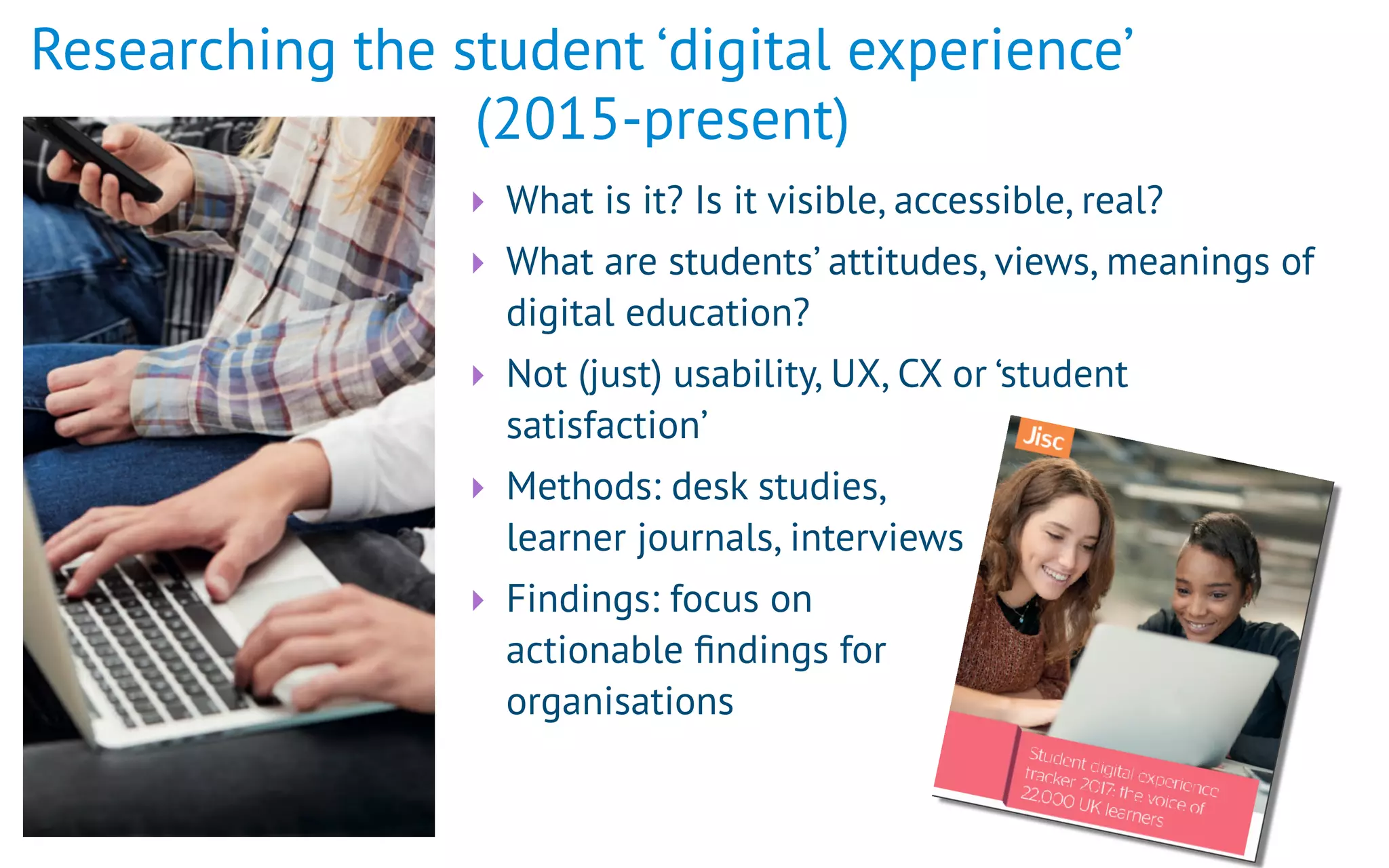
‣ What is it? Is it visible, accessible, real?
‣ What are students’ attitudes, views, meanings of
digital education?
‣ Not (just) usability, UX, CX or ‘student
satisfaction’
‣ Methods: desk studies, 

learner journals, interviews
‣ Findings: focus on 

actionable findings for

organisations
Student differences: not all students thrive
equally in digital spaces
‣ 'Digital divide' is narrowing but deepening: it
amplifies other inequalities
‣ Digital practices are hard to transfer from personal
and social to study settings
‣ Digital natives' story hides many contradictions
‣ Consumer practices, populist values, trolling, hate
speech and discrimination dominate in digital spaces
Student differences: not all students thrive
equally in digital spaces
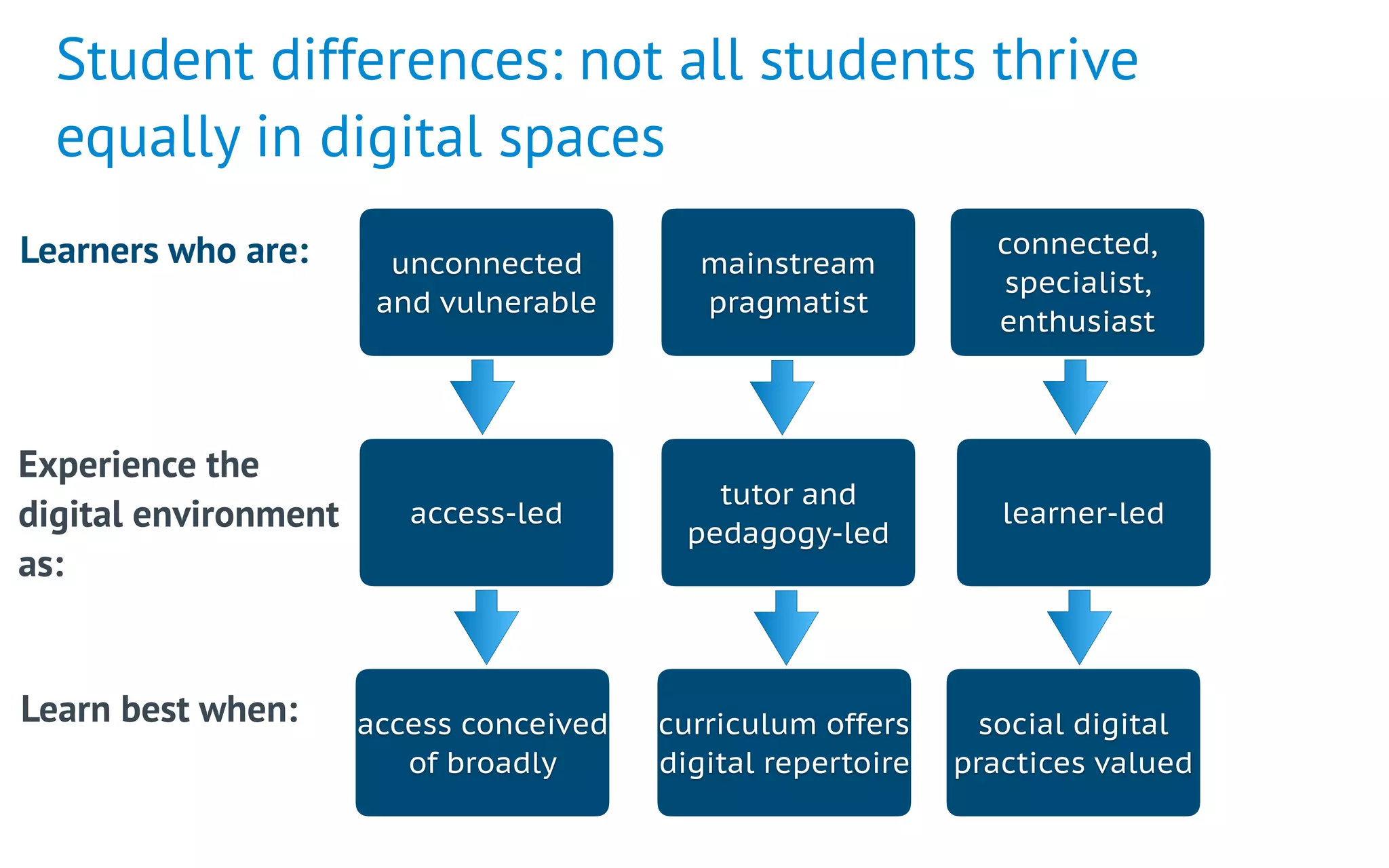
Learners who are:
Experience the
digital environment
as:
Learn best when:
unconnected
and vulnerable
mainstream
pragmatist
connected,

specialist,

enthusiast
access-led
tutor and
pedagogy-led
learner-led
access conceived
of broadly
curriculum offers
digital repertoire
social digital
practices valued
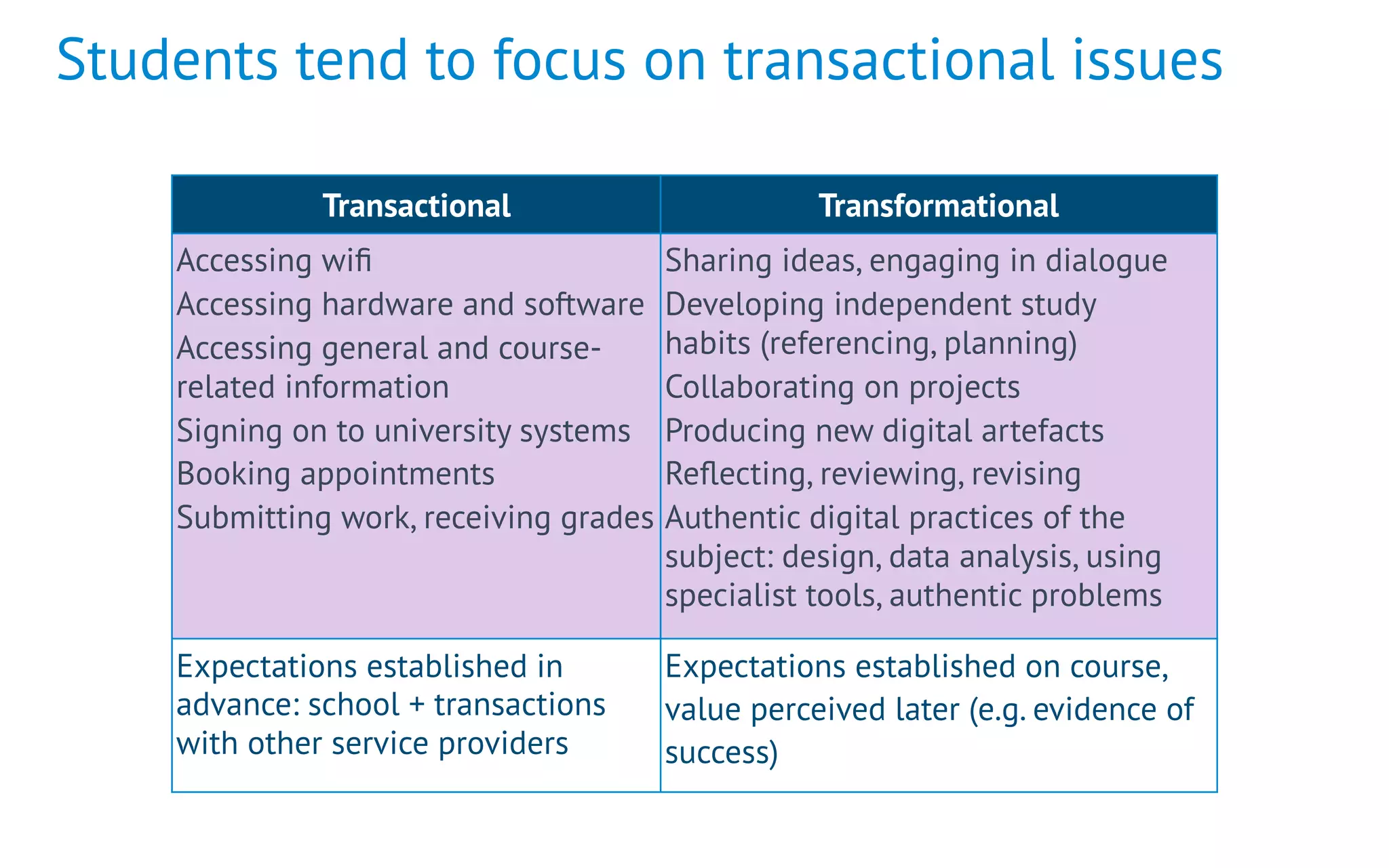
Students tend to focus on transactional issues
Transactional Transformational
Accessing wifi
Accessing hardware and software
Accessing general and course-
related information
Signing on to university systems
Booking appointments
Submitting work, receiving grades
Sharing ideas, engaging in dialogue
Developing independent study
habits (referencing, planning)
Collaborating on projects
Producing new digital artefacts
Reflecting, reviewing, revising
Authentic digital practices of the
subject: design, data analysis, using
specialist tools, authentic problems
Expectations established in
advance: school + transactions
with other service providers
Expectations established on course,
value perceived later (e.g. evidence of
success)
Students tend to focus on transactional issues
access
situated

practices
functional

skills
identity:

attributesTransactional
Transformational
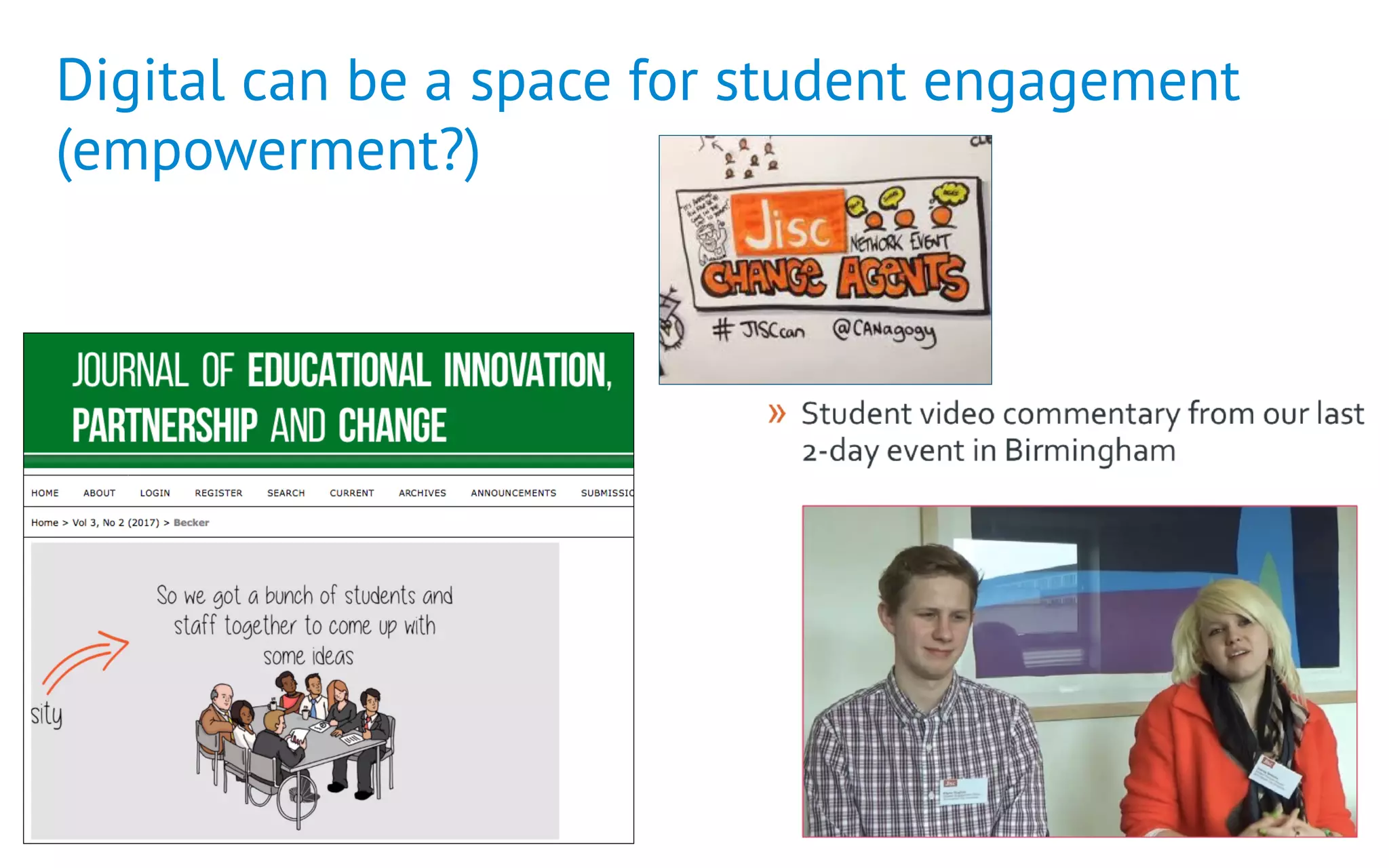
Digital can be a space for student engagement
(empowerment?)
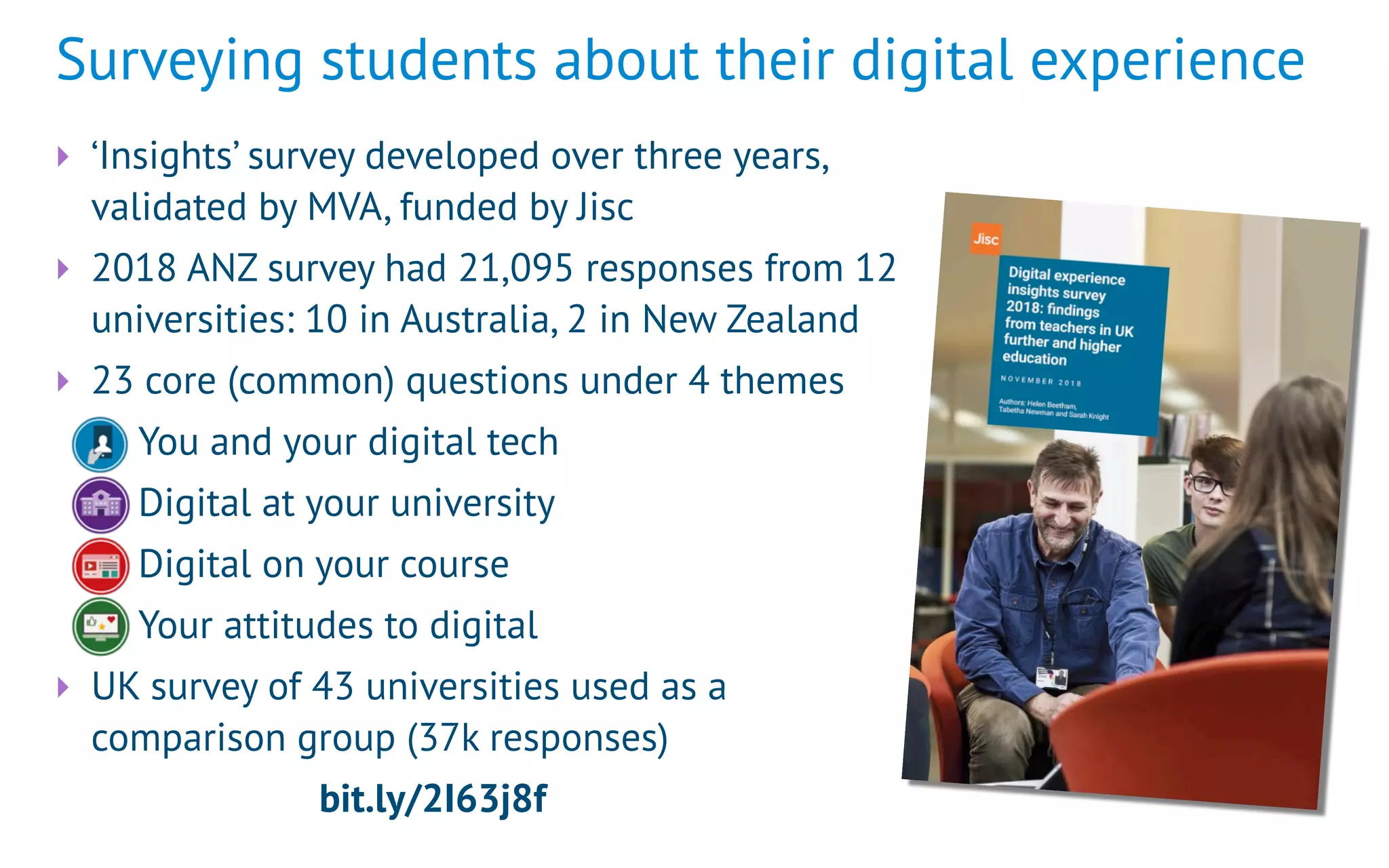
Surveying students about their digital experience
‣ ‘Insights’ survey developed over three years,
validated by MVA, funded by Jisc
‣ 2018 ANZ survey had 21,095 responses from 12
universities: 10 in Australia, 2 in New Zealand
‣ 23 core (common) questions under 4 themes
-You and your digital tech
-Digital at your university
-Digital on your course
-Your attitudes to digital
‣ UK survey of 43 universities used as a
comparison group (37k responses)
bit.ly/2I63j8f
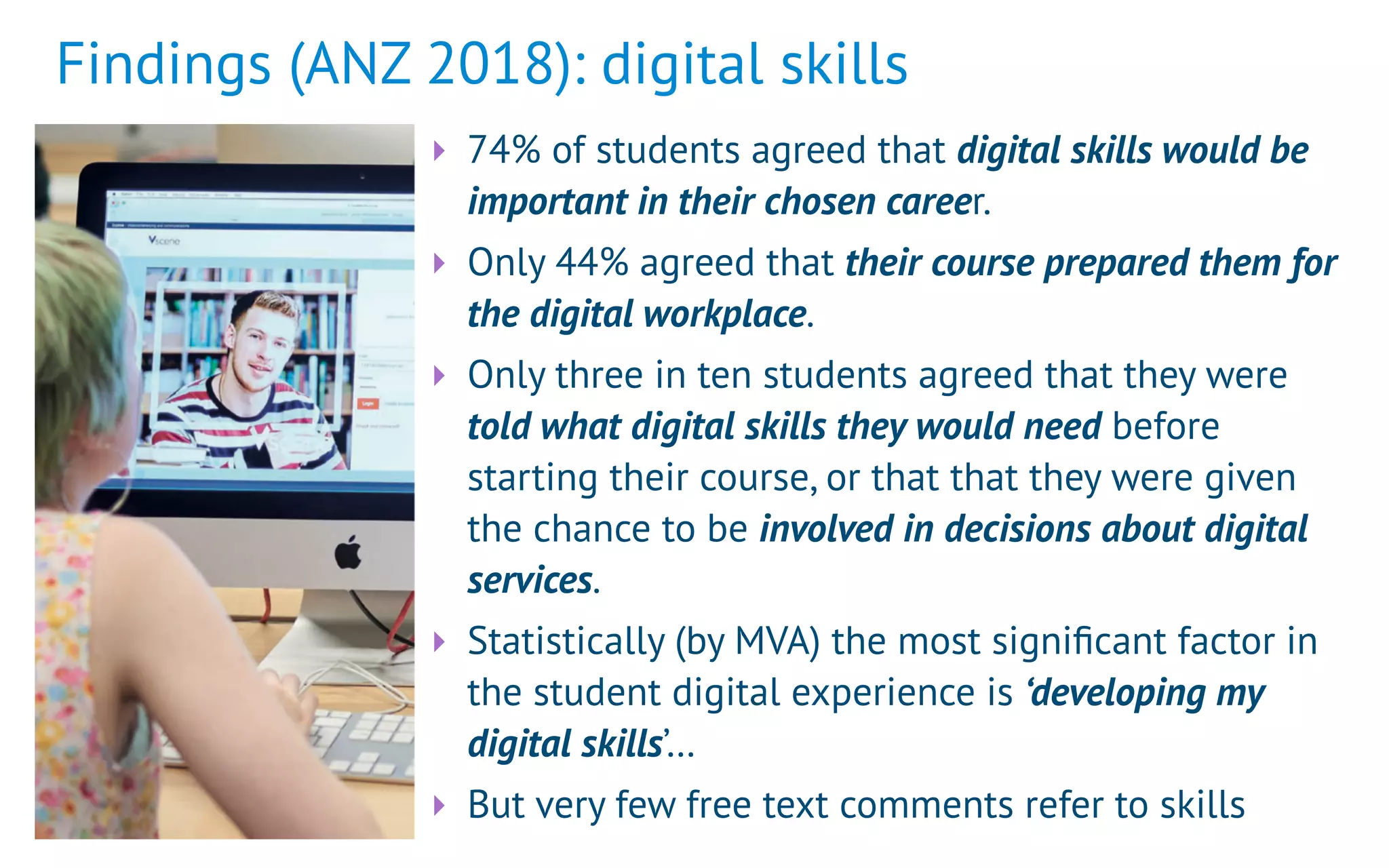
Findings (ANZ 2018): digital skills
‣ 74% of students agreed that digital skills would be
important in their chosen career.
‣ Only 44% agreed that their course prepared them for
the digital workplace.
‣ Only three in ten students agreed that they were
told what digital skills they would need before
starting their course, or that that they were given
the chance to be involved in decisions about digital
services.
‣ Statistically (by MVA) the most significant factor in
the student digital experience is ‘developing my
digital skills’…
‣ But very few free text comments refer to skills
‣ Independence,flexibility and being able to organise their study time are
benefits that students have come to rely on from digital learning.
‣ Students are less likely to say that digital approaches enhance their
feelings of connectedness; they are more likely to be distracted.
‣ Students tend to value: subject-specialist

applications e.g. data analysis and design, 

up-to-date tools for the digital workplace, 

scholarly digital content.
‣ Some students are digitally disadvantaged. 

They may have poor connectivity or devices,

struggle with distraction, or lack essential skills.
‣ Others are digitally disengaged or cynical,

particularly about value for money

What students value (ANZ 2018)
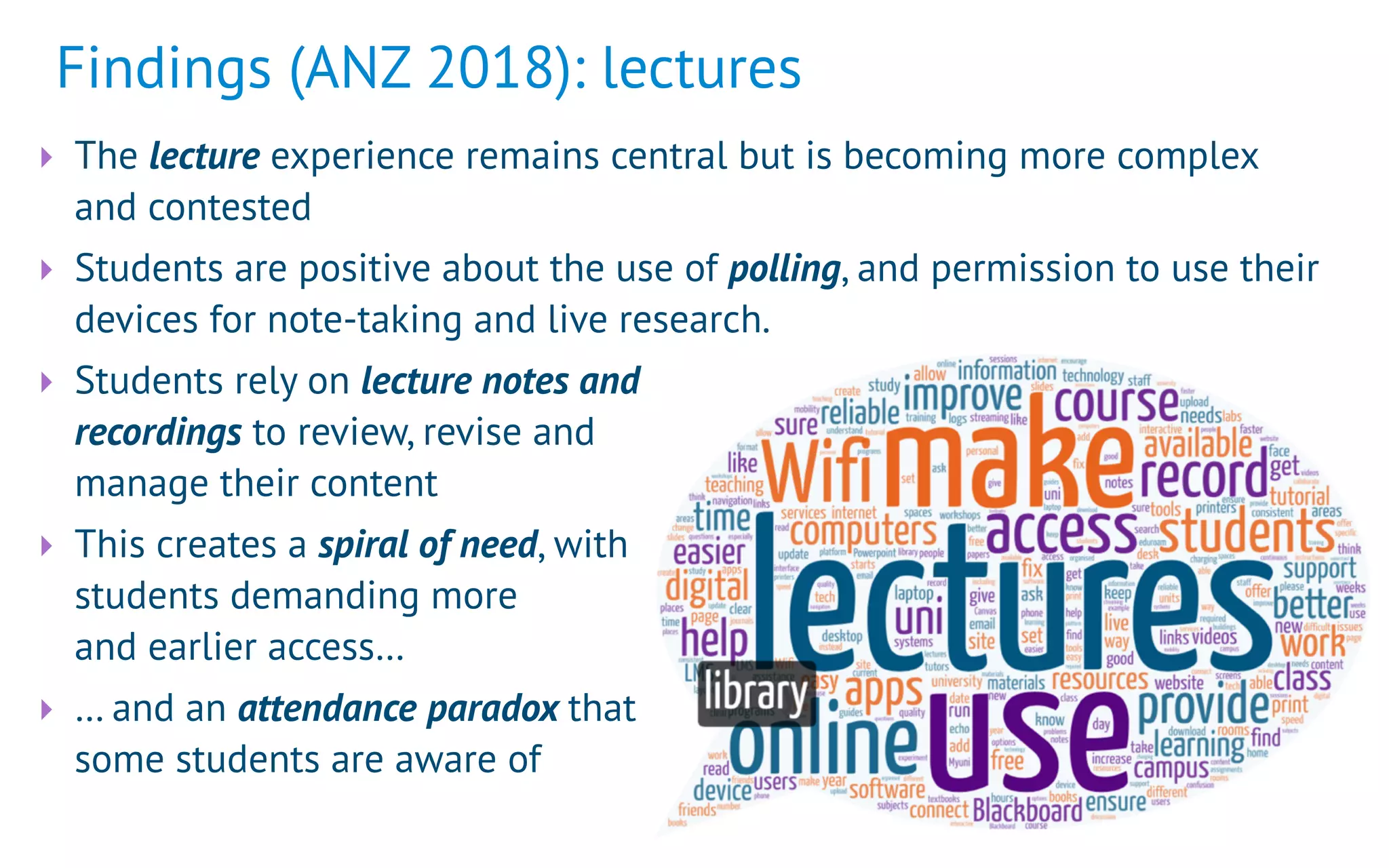
Findings (ANZ 2018): lectures
‣ The lecture experience remains central but is becoming more complex
and contested
‣ Students are positive about the use of polling, and permission to use their
devices for note-taking and live research.
‣ Students rely on lecture notes and

recordings to review, revise and

manage their content
‣ This creates a spiral of need, with

students demanding more

and earlier access…
‣ … and an attendance paradox that

some students are aware of
ANZ/UK student differences (2018)
‣ ANZ students carried out all but one of the independent digital learning
activities more often than UK students (significant difference)
‣ ANZ students carried out all but one of the course-related digital learning
activities more often than UK students (significant difference)
‣ ANZ students were significantly more likely to agree with POSITIVE
statements about their LMS/VLE experience than UK students
but
‣ ANZ students were more likely to agree with NEGATIVE statements about their
digital learning experience overall than UK students
‣ ANZ students were much more likely to say they might not attend class if
digital is used
‣ ANZ students were less likely to want digital technologies used MORE, and
more likely to want digital technologies used LESS in their learning
More evolved critique: “Don’t put everything online”
‣ Loss of human presence

“I find lectures in person much more engaging/easy to follow”
‣ Teaching quality

“More face-to-face classes and less dumping information on the LMS.”; “Don’t let
our lecturers use the phrase ‘blended learning’ as an excuse to leave the room.”
‣ ‘Blended is best’

“You need both digital and face-to-face for the best university experience.”;
‣ Value for money

“We are paying for interactive classes and teachers to talk to.... online classes are
a waste of our money.”
‣ Participation and equity

“some students (such as myself) can’t afford the devices”;“I have witnessed
decreased student participation due to over-reliance on digital tech.”
What makes some students “critical”

and how can we value this response?
Mode response on use of personal data: ‘neutral’
Free text comments concerning personal data: around 0.1%
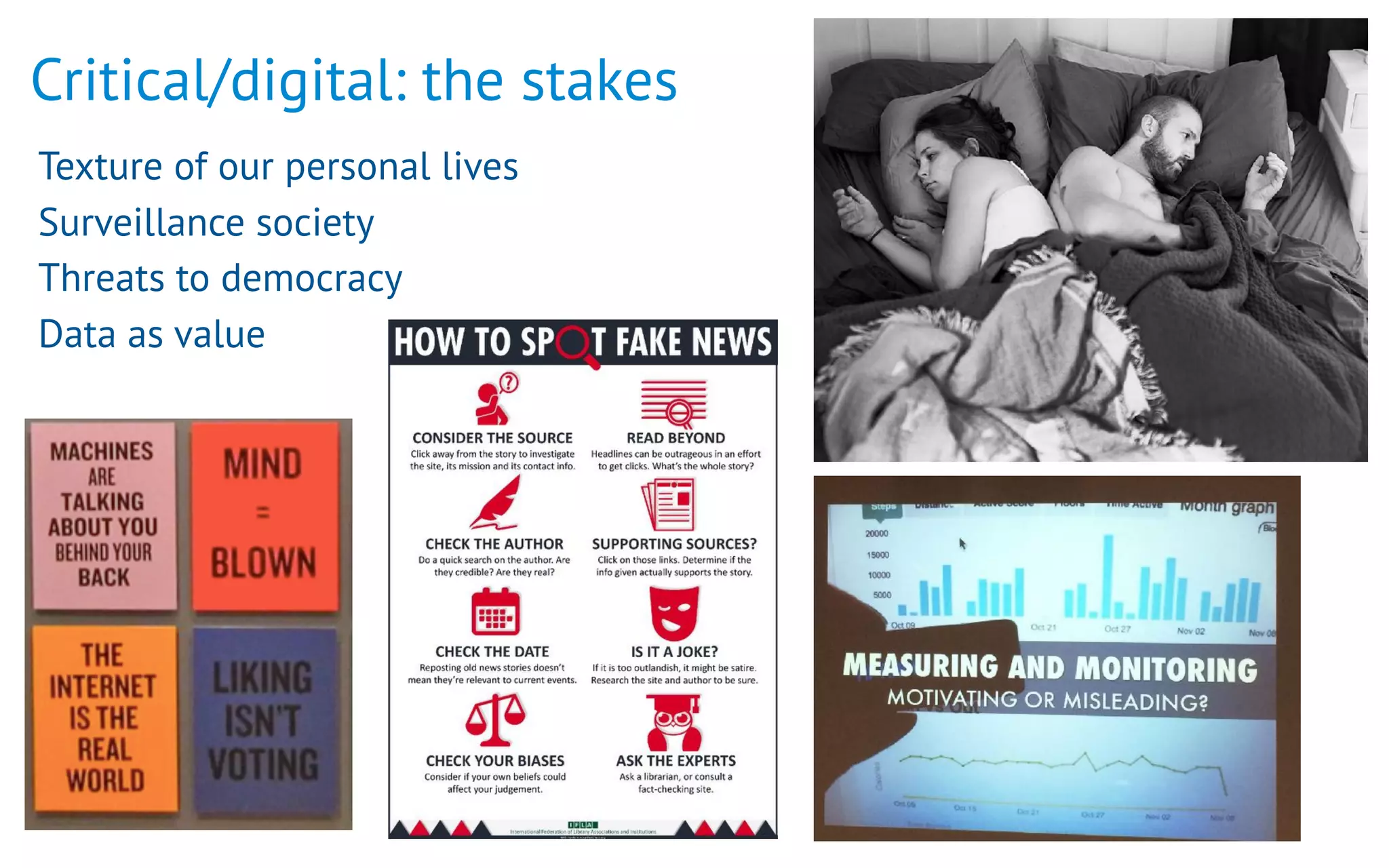
Critical/digital: the stakes
Texture of our personal lives
Surveillance society
Threats to democracy
Data as value
Automation and off-shoring of cognitive labour
Precarity of employment
Concentration of value in digital platforms
Rising inequality
Hollowing out of the
middle class
Critical/digital: the stakes
Digital literacy: a university agenda?
‣ Can universities lead a response to digital technology that is critical and
socially/politically engaged?
‣ What would that look like in terms of pedagogy and student development?
Students as agents of change
projects,journals,conferences
change management projects
Students as co-researchers
Authentic projects

or re-intepreting
open data
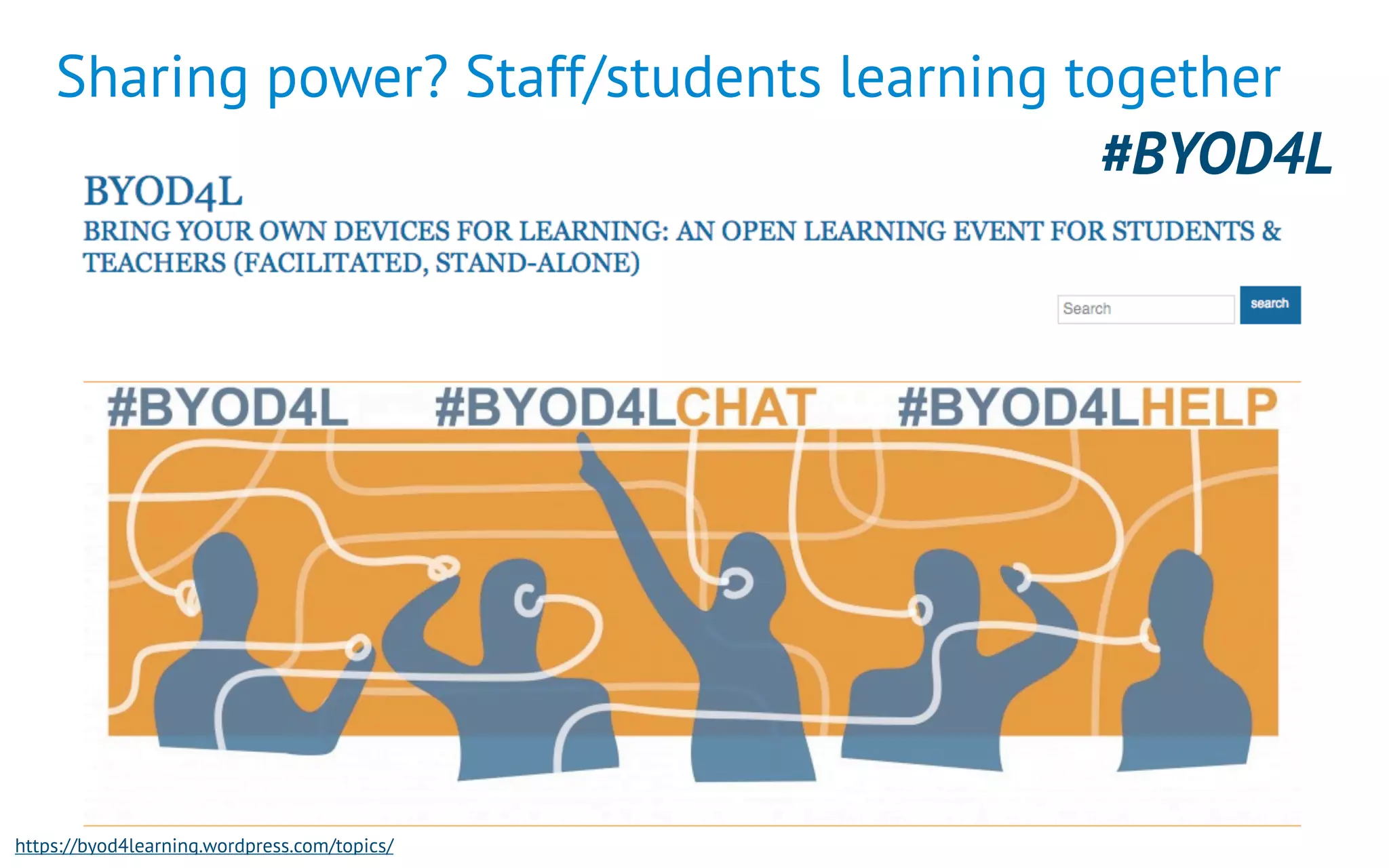
Sharing power? Staff/students learning together
#BYOD4L
https://byod4learning.wordpress.com/topics/
Public knowledge production
wikipedia, wikimedia, youtube, slideshare...
Critical thinking about technology: in public
www.followthethings.com
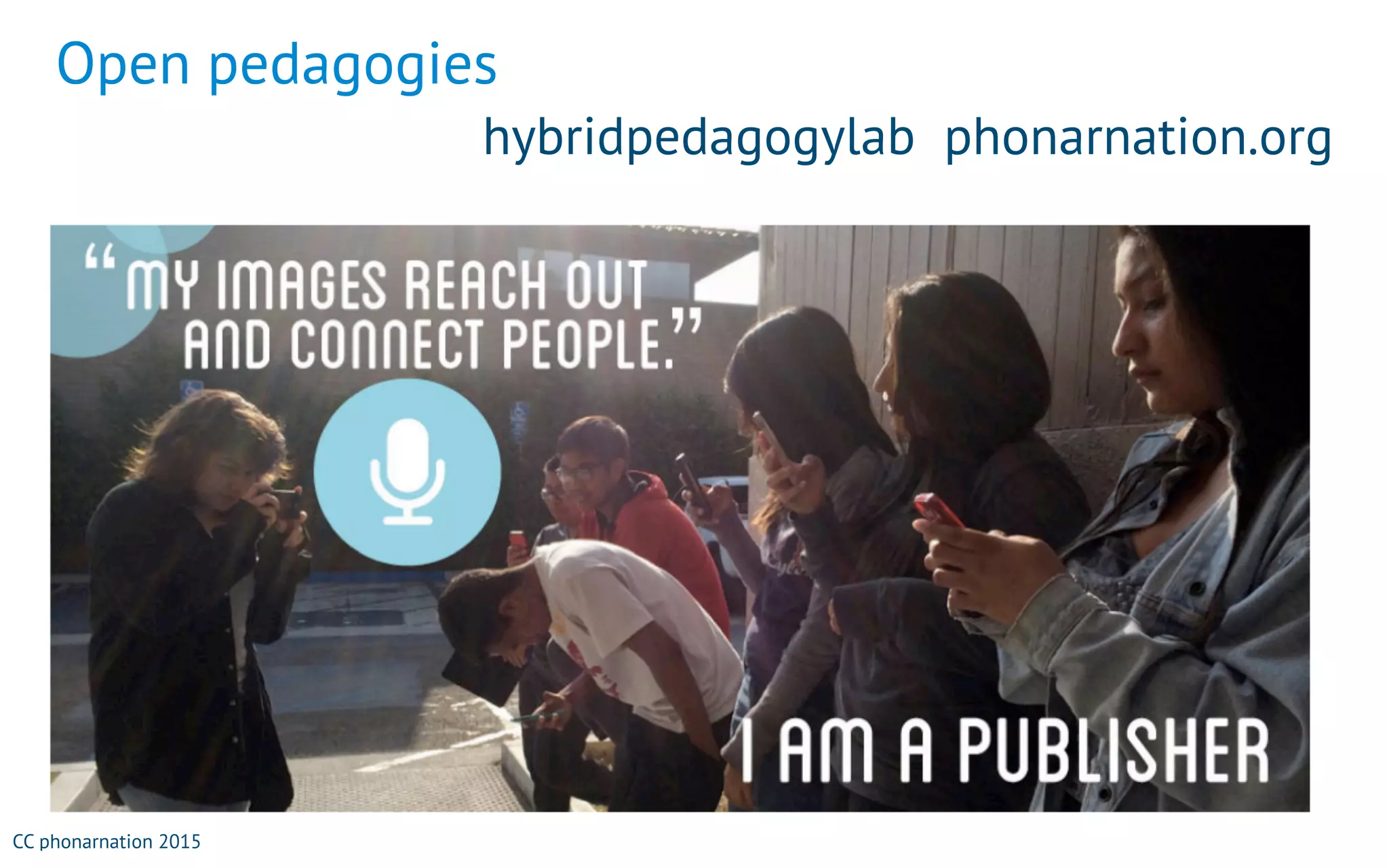
Open pedagogies
hybridpedagogylab phonarnation.org
CC phonarnation 2015
Questioning the ends as well as the means:
hackathons and code bashes
student co-creation
(research/learning)
critical pedagogies
student
choice and
voice
open or public

pedagogies
Supporting pedagogies?
critical theory/critique as
taught method
‘Multiple, critical techno-literacies’ 

(Kahn and Kellner 2005)


Critical computer literacy involves learning
how to use computer technologies to do research and
gather information,to perceive computer culture as a contested
terrain… as well as to interrogate the political economy,cultural bias and
environmental effects of computer-related technologies.

Critical media literacy not only teaches students to learn from media,to
resist media manipulation and to use media materials in constructive
ways,it is also concerned with developing skills that will help
create good citizens and make them more motivated and
competent participants in social life.
Reflections and contributions
What does your subject discipline bring to the
critical/digital project?
CC Eric Pickersgill via http://www.boredpanda.com/portraits-holding-
devices-removed-eric-pickersgill/

Douglas Coupland: 21st Century Slogans (detail)
I use pedagogy [to mean] a relationship of
responsibility with and to another.With the attachment of
‘critical’,the meaning of pedagogy problematises the relationship of
the ‘other’ [and] the various ways in which the discourse of power produces
its subjects’
Kathleen Berry, Critical Pedagogy: Where are we now? 2007)
The choice to work against the grain,to challenge the status quo,often has
negative consequences.And that is part of what makes that choice
one that is not politically neutral.

bell hooks, teaching to transgress, 2009)
Critical pedagogies and pedagogies of care
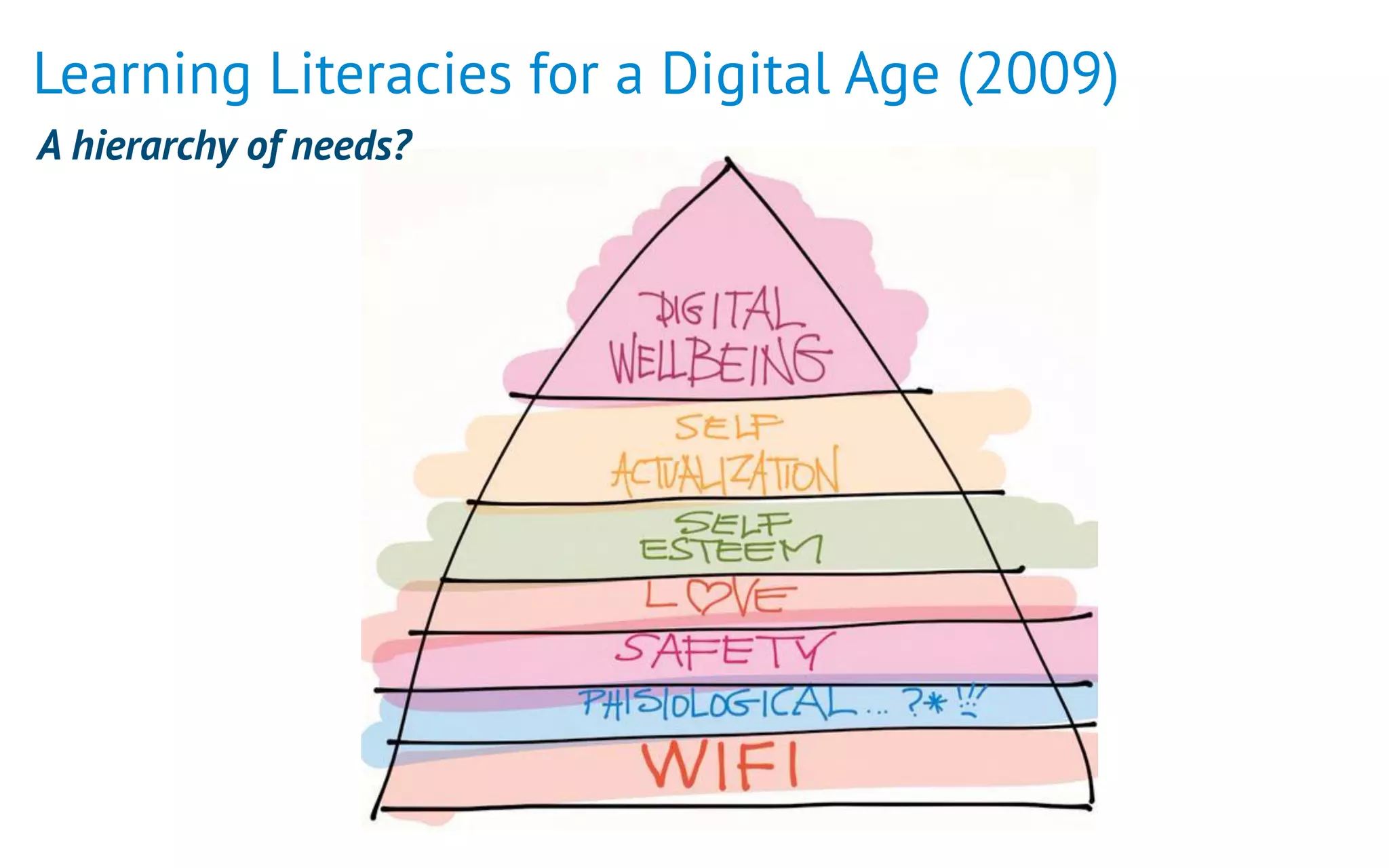
Learning Literacies for a Digital Age (2009)
A hierarchy of needs?

Acode keynote 2019

  • 1.
    What can students’digital experiences today teach us about the university of the future? Helen Beetham ACODE 78, University of Tasmania, March 2019 @helenbeetham
  • 2.
    1. Focus onthe here and now 2. ‘Digital’ for students tends to be transactional rather than transformational 3. Teaching staff with more varied experience can often (unexpectedly?) see further ‘Writing is a technology that restructures thought’ 
 Walter Ong, Orality and Literacy (1962) Limited horizon of the student experience
  • 3.
    Learning Literacies fora Digital Age (2009) those capabilities that allow an individual to thrive (live,learn and work) in a digital society“ ” Shift in the discourse towards developing people in relation to technology 
 ‘Literacy’ implies: ‣ a foundational knowledge or practice ‣ a cultural entitlement or democratic right ‣ meaning-making ‣ socially and culturally situated/specific ‣ an aspect of personal identity ‣ continuously developed, multiply expressed
  • 4.
    Learning Literacies fora Digital Age (2009) those capabilities that allow an individual to thrive (live,learn and work) in a digital society“ ” Attention paid to the 
 co-curriculum and informal curriculum 
 as well as what is taught: ‣ students’ digital study habits (note-making, writing, curation, recording) ‣ students’ personal access to educational materials (software, services, resources) ‣ role of non-teaching professionals in the student experience
  • 5.
  • 6.
    A taxonomy oflearning outcomes? Learning Literacies for a Digital Age (2009) Extensive, open-ended tasks
 Developing repertoire & persona
 
 Intensive, scaffolded tasks 
 Building component skills access situated
 practices functional
 skills identity:
 attributes
  • 7.
    Developing digital capabilities(2015-18) Identity & well-being Communication, collaboration (engaged participation) Creativity, innovation & scholarship (creative production) Information, media & data literacy (critical use) Learning & development ICT proficiency and productivity
  • 8.
    A global agenda:digital literacy as… ‣ A human right (EU, UNESCO ‘5 laws’, recent ACHR conference) ‣ An aspect of citizenship and civic participation (Council of Europe, British Columbia, schools programmes) ‣ A requirement for economic participation (Australia’s Tech Future) ‣ An international measure of educational outcomes 
 (OECD’s PSTRE measure) ‣ A marketplace (MS, lynda.com,
 google, Adobe, Mozilla…) ‣ … a plethora of frameworks Social Europe The European Digital Competence Framework for Citizens
  • 9.
    A global agenda:digital literacy as… ‣ An international measure of educational outcomes 
 OECD survey of adult skills (PIAAC 2017): % of adults scoring 2 or 3 on the ‘problem solving in a technology rich environment’ measure (Australia and NZ highlighted)
 0% 16% 33% 49% 65% N ew Zealand Sw eden Finland N etherlands N orw ay D enm ark Australia C anada G erm any England (U K) Japan Flanders (Belgium ) C zech R epublic Austria U nited States Korea N orthern Ireland (U K) Estonia Israel Slovak R epublic Slovenia Ireland Poland Lithuania C hile G reece Turkey older (55-65) young (16-25) all (16-65)
  • 10.
    Developing digital literacies(2012-15): 
 a university agenda ‣ Institutional and government funding (12 whole-organisation projects) ‣ Curriculum change (e.g. graduate attributes) and co-curricular engagement (prof bodies) ‣ Employability drivers (‘digital economy’) ‣ QAA Review topic ‣ New questions in NSS/Student Engagement surveys
  • 11.
    Critical/creative/engaged: the evidence? ‣Local evaluation ‣ Use of the terms digital literacy (capability, fluency, competence etc) remains fluid and contested, e.g.Spante et al. (2018): “linked to many different agendas and perspectives”; Pangrazio (2016): “a variety of academic approaches underpinned by particular values and priorities”; Brown (2015) ‣ Dearth of reliable qualitative or longitudinal studies: technical/ instrumental skills (and testing/metrics) continue to dominate ‣ Creativity framed as employability, adaptability, soft skills ‣ Is it possible to be critical ‘about’ pervasive technologies? (Kress 2003 & 2010, Jenkins 2006, Sheridan and Rowsell 2010: coding and making) ‣ Critique of the digital/education project: a specialist discourse (e.g. Selwyn, Williamson, Watters)
  • 12.
    Digital literacy: auniversity agenda? ‣ Can universities lead a response to digital technology that is critical and socially/politically engaged? ‣ What would that look like in terms of pedagogy and student development?
  • 13.
    Researching the student‘digital experience’ 
 (2015-present) ‣ What is it? Is it visible, accessible, real? ‣ What are students’ attitudes, views, meanings of digital education? ‣ Not (just) usability, UX, CX or ‘student satisfaction’ ‣ Methods: desk studies, 
 learner journals, interviews ‣ Findings: focus on 
 actionable findings for
 organisations
  • 14.
    Student differences: notall students thrive equally in digital spaces ‣ 'Digital divide' is narrowing but deepening: it amplifies other inequalities ‣ Digital practices are hard to transfer from personal and social to study settings ‣ Digital natives' story hides many contradictions ‣ Consumer practices, populist values, trolling, hate speech and discrimination dominate in digital spaces
  • 15.
    Student differences: notall students thrive equally in digital spaces Learners who are: Experience the digital environment as: Learn best when: unconnected and vulnerable mainstream pragmatist connected,
 specialist,
 enthusiast access-led tutor and pedagogy-led learner-led access conceived of broadly curriculum offers digital repertoire social digital practices valued
  • 16.
    Students tend tofocus on transactional issues Transactional Transformational Accessing wifi Accessing hardware and software Accessing general and course- related information Signing on to university systems Booking appointments Submitting work, receiving grades Sharing ideas, engaging in dialogue Developing independent study habits (referencing, planning) Collaborating on projects Producing new digital artefacts Reflecting, reviewing, revising Authentic digital practices of the subject: design, data analysis, using specialist tools, authentic problems Expectations established in advance: school + transactions with other service providers Expectations established on course, value perceived later (e.g. evidence of success)
  • 17.
    Students tend tofocus on transactional issues access situated
 practices functional
 skills identity:
 attributesTransactional Transformational
  • 18.
    Digital can bea space for student engagement (empowerment?)
  • 19.
    Surveying students abouttheir digital experience ‣ ‘Insights’ survey developed over three years, validated by MVA, funded by Jisc ‣ 2018 ANZ survey had 21,095 responses from 12 universities: 10 in Australia, 2 in New Zealand ‣ 23 core (common) questions under 4 themes -You and your digital tech -Digital at your university -Digital on your course -Your attitudes to digital ‣ UK survey of 43 universities used as a comparison group (37k responses) bit.ly/2I63j8f
  • 20.
    Findings (ANZ 2018):digital skills ‣ 74% of students agreed that digital skills would be important in their chosen career. ‣ Only 44% agreed that their course prepared them for the digital workplace. ‣ Only three in ten students agreed that they were told what digital skills they would need before starting their course, or that that they were given the chance to be involved in decisions about digital services. ‣ Statistically (by MVA) the most significant factor in the student digital experience is ‘developing my digital skills’… ‣ But very few free text comments refer to skills
  • 21.
    ‣ Independence,flexibility andbeing able to organise their study time are benefits that students have come to rely on from digital learning. ‣ Students are less likely to say that digital approaches enhance their feelings of connectedness; they are more likely to be distracted. ‣ Students tend to value: subject-specialist
 applications e.g. data analysis and design, 
 up-to-date tools for the digital workplace, 
 scholarly digital content. ‣ Some students are digitally disadvantaged. 
 They may have poor connectivity or devices,
 struggle with distraction, or lack essential skills. ‣ Others are digitally disengaged or cynical,
 particularly about value for money
 What students value (ANZ 2018)
  • 22.
    Findings (ANZ 2018):lectures ‣ The lecture experience remains central but is becoming more complex and contested ‣ Students are positive about the use of polling, and permission to use their devices for note-taking and live research. ‣ Students rely on lecture notes and
 recordings to review, revise and
 manage their content ‣ This creates a spiral of need, with
 students demanding more
 and earlier access… ‣ … and an attendance paradox that
 some students are aware of
  • 23.
    ANZ/UK student differences(2018) ‣ ANZ students carried out all but one of the independent digital learning activities more often than UK students (significant difference) ‣ ANZ students carried out all but one of the course-related digital learning activities more often than UK students (significant difference) ‣ ANZ students were significantly more likely to agree with POSITIVE statements about their LMS/VLE experience than UK students but ‣ ANZ students were more likely to agree with NEGATIVE statements about their digital learning experience overall than UK students ‣ ANZ students were much more likely to say they might not attend class if digital is used ‣ ANZ students were less likely to want digital technologies used MORE, and more likely to want digital technologies used LESS in their learning
  • 24.
    More evolved critique:“Don’t put everything online” ‣ Loss of human presence
 “I find lectures in person much more engaging/easy to follow” ‣ Teaching quality
 “More face-to-face classes and less dumping information on the LMS.”; “Don’t let our lecturers use the phrase ‘blended learning’ as an excuse to leave the room.” ‣ ‘Blended is best’
 “You need both digital and face-to-face for the best university experience.”; ‣ Value for money
 “We are paying for interactive classes and teachers to talk to.... online classes are a waste of our money.” ‣ Participation and equity
 “some students (such as myself) can’t afford the devices”;“I have witnessed decreased student participation due to over-reliance on digital tech.”
  • 25.
    What makes somestudents “critical”
 and how can we value this response? Mode response on use of personal data: ‘neutral’ Free text comments concerning personal data: around 0.1%
  • 26.
    Critical/digital: the stakes Textureof our personal lives Surveillance society Threats to democracy Data as value
  • 27.
    Automation and off-shoringof cognitive labour Precarity of employment Concentration of value in digital platforms Rising inequality Hollowing out of the middle class Critical/digital: the stakes
  • 28.
    Digital literacy: auniversity agenda? ‣ Can universities lead a response to digital technology that is critical and socially/politically engaged? ‣ What would that look like in terms of pedagogy and student development?
  • 29.
    Students as agentsof change projects,journals,conferences change management projects
  • 30.
    Students as co-researchers Authenticprojects
 or re-intepreting open data
  • 31.
    Sharing power? Staff/studentslearning together #BYOD4L https://byod4learning.wordpress.com/topics/
  • 32.
    Public knowledge production wikipedia,wikimedia, youtube, slideshare...
  • 33.
    Critical thinking abouttechnology: in public www.followthethings.com
  • 34.
  • 35.
    Questioning the endsas well as the means: hackathons and code bashes
  • 36.
    student co-creation (research/learning) critical pedagogies student choiceand voice open or public
 pedagogies Supporting pedagogies? critical theory/critique as taught method
  • 37.
    ‘Multiple, critical techno-literacies’
 (Kahn and Kellner 2005) 
 Critical computer literacy involves learning how to use computer technologies to do research and gather information,to perceive computer culture as a contested terrain… as well as to interrogate the political economy,cultural bias and environmental effects of computer-related technologies.
 Critical media literacy not only teaches students to learn from media,to resist media manipulation and to use media materials in constructive ways,it is also concerned with developing skills that will help create good citizens and make them more motivated and competent participants in social life.
  • 38.
  • 39.
    What does yoursubject discipline bring to the critical/digital project? CC Eric Pickersgill via http://www.boredpanda.com/portraits-holding- devices-removed-eric-pickersgill/
 Douglas Coupland: 21st Century Slogans (detail)
  • 40.
    I use pedagogy[to mean] a relationship of responsibility with and to another.With the attachment of ‘critical’,the meaning of pedagogy problematises the relationship of the ‘other’ [and] the various ways in which the discourse of power produces its subjects’ Kathleen Berry, Critical Pedagogy: Where are we now? 2007) The choice to work against the grain,to challenge the status quo,often has negative consequences.And that is part of what makes that choice one that is not politically neutral.
 bell hooks, teaching to transgress, 2009) Critical pedagogies and pedagogies of care
  • 41.
    Learning Literacies fora Digital Age (2009) A hierarchy of needs?