Developing Digital Literacies programme
what have we done and what have we learned ?

Helen Beetham
Programme synthesis consultant
Developing Digital Literacies
                                                   #jiscdiglit
A two-year programme promoting the development of coherent,
inclusive and holistic institutional strategies and approaches for
developing digital literacies in UK further and higher education
    University of Greenwich      University of the Arts London
    University of Exeter         Coleg Llandrillo
    University of Plymouth       University of Reading
    University of Bath           University College London
    Oxford Brookes University Cardiff University
    Worcester College            Institute of Education
Plus ten sector bodies: ALDinHE, ALT, AUA, HEDG, ODHE, SCAP,
SCONUL, SDF, SEDA, Vitae
   www.jisc.ac.uk/whatwedo/programmes/elearning/
               developingdigitalliteracies/
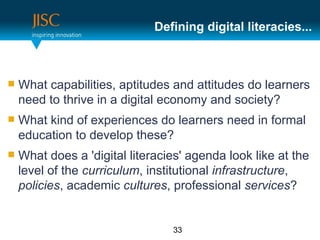
Defining digital literacies...


   What capabilities, aptitudes and attitudes do learners
    need to thrive in a digital economy and society?
   What kind of experiences do learners need in formal
    education to develop these?
   What does a 'digital literacies' agenda look like at the
    level of the curriculum, institutional infrastructure,
    policies, academic cultures, professional services?


                                 33
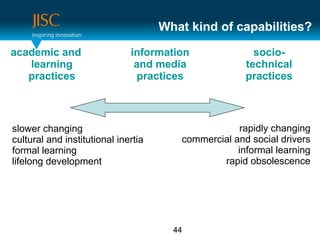
What kind of capabilities?

academic and                  information               socio-
   learning                    and media              technical
   practices                   practices              practices


slower changing                                     rapidly changing
cultural and institutional inertia      commercial and social drivers
formal learning                                     informal learning
lifelong development                            rapid obsolescence


                                       44
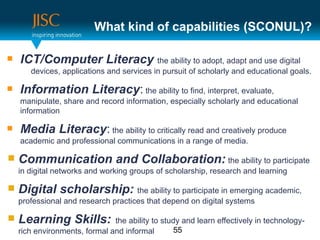
What kind of capabilities (SCONUL)?

   ICT/Computer Literacy the ability to adopt, adapt and use digital
       devices, applications and services in pursuit of scholarly and educational goals.

   Information Literacy: the ability to find, interpret, evaluate,
    manipulate, share and record information, especially scholarly and educational
    information

   Media Literacy: the ability to critically read and creatively produce
    academic and professional communications in a range of media.

   Communication and Collaboration: the ability to participate
    in digital networks and working groups of scholarship, research and learning

   Digital scholarship: the ability to participate in emerging academic,
    professional and research practices that depend on digital systems

   Learning Skills:           the ability to study and learn effectively in technology-
    rich environments, formal and informal       55
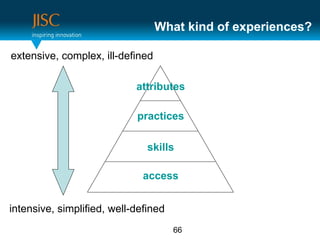
What kind of experiences?

extensive, complex, ill-defined

                            attributes

                            practices

                               skills

                              access


intensive, simplified, well-defined
                                      66
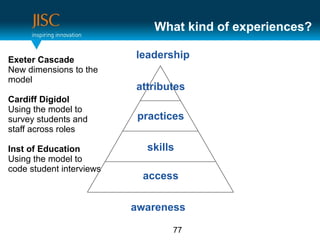
What kind of experiences?

Exeter Cascade            leadership
New dimensions to the
model
                          attributes
Cardiff Digidol
Using the model to
survey students and        practices
staff across roles

Inst of Education           skills
Using the model to
code student interviews
                            access

                          awareness

                                 77
Emerging themes

Digital literacies for further and higher education are:
 Multiple and complex
 Hybrid – academic practice + digital know-how
 Based in subject areas: disciplines, vocations,

  professions
 Both generic and role-specific
 Aspects of personal style – ownership, choice,

  performance of identity
 Acquired and developed as needed – best practiced in

  authentic contexts
 Often acquired from close peers, but
 likely to require formal support if specialised
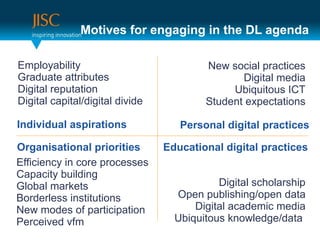
Motives for engaging in the DL agenda

Employability                            New social practices
Graduate attributes                             Digital media
Digital reputation                            Ubiquitous ICT
Digital capital/digital divide           Student expectations

Individual aspirations              Personal digital practices

Organisational priorities        Educational digital practices
Efficiency in core processes
Capacity building
Global markets                              Digital scholarship
Borderless institutions            Open publishing/open data
New modes of participation             Digital academic media
Perceived vfm                      Ubiquitous knowledge/data
Baselining digital literacies

1. Policy and strategy (public messages)
2. Infrastructure (networks, buildings, spaces,
hardware, software, data services, IT support)
3. Support (professional services)

4. Practices (e.g. curriculum design, teaching,
learning, research, KT, admin.)
5. Expertise (courses, frameworks, IAG, sharing,
development opps, recognition and reward)
6. Culture (expectations, understanding, values,
needs, attitudes, beliefs)
Baselining digital literacies

Look at the 'forward thinking Universities' posters
on your table
1.Choose one category
2.Consider: How many of these things is my
institution doing (a) with full commitment (b)
somewhat/in places (c) not at all?
3.Discuss: Are these useful indicators? How
would I know that the digital literacy agenda was
being taken forward at my institution (alternative
indicators)?
Strategies

Average = 6-10 strategies
The diversity of documents covering... digital matters for
  staff and students means there are few members of the
  University aware of it all – and policies may be devised
  and revised without much engagement across
  departments...
With regard to the rapidly changing world of information
  technology, it may be argued that the traditional
  mechanisms for developing and agreeing strategies lack
  sufficient agility.
Neither the programme specification, guidance notes or
  checklist mention or give examples of digital literacies;
  the same applies to the definitive documentation for
  2010-2011
Strategies

   Fragmentation or diverse manifestations of a digital
    agenda?
   As well as internal strategies, need to assess the public
    mission/offer, especially to prospective students
   Need for digitally literate senior managers...
   … but also people with vision at all levels


                   Corporate Plan
      Learning and Teaching | e-learning | IS/ICT
        Library and Information Management
      Research and Knowledge Transfer | Estates
      Student Experience | Student Charter | HR
Infrastructure issues

   BYODevice/BYOService/BYOSkills – what are the
    assumptions? Who is at a digital disadvantage?
   Data/information environment that is platform, device,
    and application agnostic
   Providing an equivalent infrastructure across distributed
    sites of learning – even in workplaces/other countries??
   Breaking down boundaries within institutions e.g.
    library/study/social spaces
   Borderless institutions - what are the infrastructure
    issues?
Professional services in support of DDL


   Enhancing digital capability of professional staff
   Building links across professional and support services
   Involving students as change agents, in supporting other
    students' and reverse-mentoring staff
   Providing students with clear signposts to existing
    support and guidance


        Educational development/enhancement
     Careers/employability | e-learning | IT support
    Learner Development | Researcher Development
                Library | Student Union
Support for DDL in FE


   Support more focused on the individual learner
   Personal tutors, subject-related 'study areas' integrate
    provision
   More likely to explicitly assess and progress digital
    capabilities
   Teaching staff undertake ILT training
   Much greater focus on e-safety
   Lower level of personal device use in college
What can HE learn from FE and vice versa?
Emerging practices


   Hybrid practices: informal/formal contexts,
    institutional/personal/public technologies,
    academic/digital know-how
    work/home life
   Hidden practices: personal study habits, outsourced
    curriculum, third party software/services, 'workarounds'
   Practice innovators may be ignored/undervalued e.g.
    teaching administrators, PGRs
Developing expertise

   Self-reliance for adoption and basic use
   Structured development for complex systems that
    support complex practices
    – e.g. data analysis, reference management, business
      systems, editing software, design systems
   Local peer or mentor support for advanced and
    contextualised use
    students’ digital literacy practices are predominantly
    contextualised within their programmes of study
   Perceived lack of relevant, timely, local
    training/support
   Academic 'generation gap' makes reverse mentoring
    attractive
Attitudes and cultures


   Students' digital capability still regarded with more
    fear than excitement by many staff
   Culture clash seems more evident at 'traditional'
    universities and where the 'academic generation
    gap' is widest
   Experience with technology leads to a more critical
    and discriminating attitude
   We need a shift of focus from teaching staff using
    technologies to use by students: 'feel the fear'
Feedforward


What kind of outcomes/resources would you find
most helpful from the programme?
- resources for direct access by students
- resources to repurpose/embed into the
curriculum
- guidance for curriculum teams
- guidance for professional services
- guidance for strategic managers
- other
There are some examples coming up!
Further information on baselining


    Summary of the project baseline reports:
    http://bit.ly/JiUV0m

    Summary of the professional association baseline
    reports: http://bit.ly/KWFJUo

    Institutional videos from the Developing Digital
    Literacies projects visit http://bit.ly/jiscdlprogvideos to
    hear about how they are implementing digital literacies
    at a strategic level

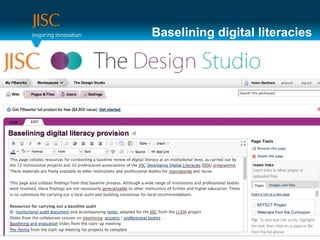
    Baselining resources from the JISC Design Studio
    including institutional audit tools: http://bit.ly/Nz1g8t
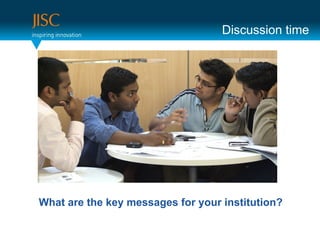
Discussion time


What are the key messages for your institution?
Digital capability is...

  The claims of top departments to be pushing the
      boundaries of research require a sustained
engagement with digital scholarship. The claims of
     top teaching universities to offer a personal,
      relevant and engaging learning experience
demand sustained innovation in methods. Neither
 is possible unless universities rethink their offer...
  in terms of the digital experiences students have
        and the digital practices they encounter
                 (Beetham et al, 2009).
Further resources

JISC Developing Digital Literacies programme:

Developing Digital Literacies on the Design Studio

SEDA page on the Design Studio

Baselining Digital Literacies page

Learning Literacies in a Digital Age (original audit
study)
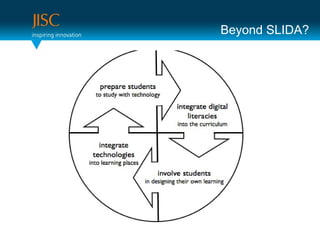
Beyond SLIDA?

Experts meeting july 2012

  • 1.
    Developing Digital Literaciesprogramme what have we done and what have we learned ? Helen Beetham Programme synthesis consultant
  • 2.
    Developing Digital Literacies #jiscdiglit A two-year programme promoting the development of coherent, inclusive and holistic institutional strategies and approaches for developing digital literacies in UK further and higher education University of Greenwich University of the Arts London University of Exeter Coleg Llandrillo University of Plymouth University of Reading University of Bath University College London Oxford Brookes University Cardiff University Worcester College Institute of Education Plus ten sector bodies: ALDinHE, ALT, AUA, HEDG, ODHE, SCAP, SCONUL, SDF, SEDA, Vitae www.jisc.ac.uk/whatwedo/programmes/elearning/ developingdigitalliteracies/
  • 3.
    Defining digital literacies...  What capabilities, aptitudes and attitudes do learners need to thrive in a digital economy and society?  What kind of experiences do learners need in formal education to develop these?  What does a 'digital literacies' agenda look like at the level of the curriculum, institutional infrastructure, policies, academic cultures, professional services? 33
  • 4.
    What kind ofcapabilities? academic and information socio- learning and media technical practices practices practices slower changing rapidly changing cultural and institutional inertia commercial and social drivers formal learning informal learning lifelong development rapid obsolescence 44
  • 5.
    What kind ofcapabilities (SCONUL)?  ICT/Computer Literacy the ability to adopt, adapt and use digital devices, applications and services in pursuit of scholarly and educational goals.  Information Literacy: the ability to find, interpret, evaluate, manipulate, share and record information, especially scholarly and educational information  Media Literacy: the ability to critically read and creatively produce academic and professional communications in a range of media.  Communication and Collaboration: the ability to participate in digital networks and working groups of scholarship, research and learning  Digital scholarship: the ability to participate in emerging academic, professional and research practices that depend on digital systems  Learning Skills: the ability to study and learn effectively in technology- rich environments, formal and informal 55
  • 6.
    What kind ofexperiences? extensive, complex, ill-defined attributes practices skills access intensive, simplified, well-defined 66
  • 7.
    What kind ofexperiences? Exeter Cascade leadership New dimensions to the model attributes Cardiff Digidol Using the model to survey students and practices staff across roles Inst of Education skills Using the model to code student interviews access awareness 77
  • 8.
    Emerging themes Digital literaciesfor further and higher education are:  Multiple and complex  Hybrid – academic practice + digital know-how  Based in subject areas: disciplines, vocations, professions  Both generic and role-specific  Aspects of personal style – ownership, choice, performance of identity  Acquired and developed as needed – best practiced in authentic contexts  Often acquired from close peers, but  likely to require formal support if specialised
  • 9.
    Motives for engagingin the DL agenda Employability New social practices Graduate attributes Digital media Digital reputation Ubiquitous ICT Digital capital/digital divide Student expectations Individual aspirations Personal digital practices Organisational priorities Educational digital practices Efficiency in core processes Capacity building Global markets Digital scholarship Borderless institutions Open publishing/open data New modes of participation Digital academic media Perceived vfm Ubiquitous knowledge/data
  • 10.
    Baselining digital literacies 1.Policy and strategy (public messages) 2. Infrastructure (networks, buildings, spaces, hardware, software, data services, IT support) 3. Support (professional services) 4. Practices (e.g. curriculum design, teaching, learning, research, KT, admin.) 5. Expertise (courses, frameworks, IAG, sharing, development opps, recognition and reward) 6. Culture (expectations, understanding, values, needs, attitudes, beliefs)
  • 11.
  • 12.
    Baselining digital literacies Lookat the 'forward thinking Universities' posters on your table 1.Choose one category 2.Consider: How many of these things is my institution doing (a) with full commitment (b) somewhat/in places (c) not at all? 3.Discuss: Are these useful indicators? How would I know that the digital literacy agenda was being taken forward at my institution (alternative indicators)?
  • 13.
    Strategies Average = 6-10strategies The diversity of documents covering... digital matters for staff and students means there are few members of the University aware of it all – and policies may be devised and revised without much engagement across departments... With regard to the rapidly changing world of information technology, it may be argued that the traditional mechanisms for developing and agreeing strategies lack sufficient agility. Neither the programme specification, guidance notes or checklist mention or give examples of digital literacies; the same applies to the definitive documentation for 2010-2011
  • 14.
    Strategies  Fragmentation or diverse manifestations of a digital agenda?  As well as internal strategies, need to assess the public mission/offer, especially to prospective students  Need for digitally literate senior managers...  … but also people with vision at all levels Corporate Plan Learning and Teaching | e-learning | IS/ICT Library and Information Management Research and Knowledge Transfer | Estates Student Experience | Student Charter | HR
  • 15.
    Infrastructure issues  BYODevice/BYOService/BYOSkills – what are the assumptions? Who is at a digital disadvantage?  Data/information environment that is platform, device, and application agnostic  Providing an equivalent infrastructure across distributed sites of learning – even in workplaces/other countries??  Breaking down boundaries within institutions e.g. library/study/social spaces  Borderless institutions - what are the infrastructure issues?
  • 16.
    Professional services insupport of DDL  Enhancing digital capability of professional staff  Building links across professional and support services  Involving students as change agents, in supporting other students' and reverse-mentoring staff  Providing students with clear signposts to existing support and guidance Educational development/enhancement Careers/employability | e-learning | IT support Learner Development | Researcher Development Library | Student Union
  • 17.
    Support for DDLin FE  Support more focused on the individual learner  Personal tutors, subject-related 'study areas' integrate provision  More likely to explicitly assess and progress digital capabilities  Teaching staff undertake ILT training  Much greater focus on e-safety  Lower level of personal device use in college What can HE learn from FE and vice versa?
  • 18.
    Emerging practices  Hybrid practices: informal/formal contexts, institutional/personal/public technologies, academic/digital know-how work/home life  Hidden practices: personal study habits, outsourced curriculum, third party software/services, 'workarounds'  Practice innovators may be ignored/undervalued e.g. teaching administrators, PGRs
  • 19.
    Developing expertise  Self-reliance for adoption and basic use  Structured development for complex systems that support complex practices – e.g. data analysis, reference management, business systems, editing software, design systems  Local peer or mentor support for advanced and contextualised use students’ digital literacy practices are predominantly contextualised within their programmes of study  Perceived lack of relevant, timely, local training/support  Academic 'generation gap' makes reverse mentoring attractive
  • 20.
    Attitudes and cultures  Students' digital capability still regarded with more fear than excitement by many staff  Culture clash seems more evident at 'traditional' universities and where the 'academic generation gap' is widest  Experience with technology leads to a more critical and discriminating attitude  We need a shift of focus from teaching staff using technologies to use by students: 'feel the fear'
  • 21.
    Feedforward What kind ofoutcomes/resources would you find most helpful from the programme? - resources for direct access by students - resources to repurpose/embed into the curriculum - guidance for curriculum teams - guidance for professional services - guidance for strategic managers - other There are some examples coming up!
  • 22.
    Further information onbaselining  Summary of the project baseline reports: http://bit.ly/JiUV0m  Summary of the professional association baseline reports: http://bit.ly/KWFJUo  Institutional videos from the Developing Digital Literacies projects visit http://bit.ly/jiscdlprogvideos to hear about how they are implementing digital literacies at a strategic level  Baselining resources from the JISC Design Studio including institutional audit tools: http://bit.ly/Nz1g8t
  • 23.
    Discussion time What arethe key messages for your institution?
  • 24.
    Digital capability is... The claims of top departments to be pushing the boundaries of research require a sustained engagement with digital scholarship. The claims of top teaching universities to offer a personal, relevant and engaging learning experience demand sustained innovation in methods. Neither is possible unless universities rethink their offer... in terms of the digital experiences students have and the digital practices they encounter (Beetham et al, 2009).
  • 25.
    Further resources JISC DevelopingDigital Literacies programme: Developing Digital Literacies on the Design Studio SEDA page on the Design Studio Baselining Digital Literacies page Learning Literacies in a Digital Age (original audit study)
  • 26.