


PAVEMENT MATERIALSPAVEMENT MATERIALS
ENGINEERINGENGINEERING
(CE-862)(CE-862)
Lec-09
Fall Semester 2016
 
Dr. Arshad Hussain
arshad_nit@yahoo.com , Office Room#111, Tel: 05190854163,
Cell: 03419756251
National Institute of Transportation (NIT)
School of Civil & Environmental Engineering (SCEE)
National University of Science and Technology (NUST)
NUST Campus, Sector H-12, Islamabad
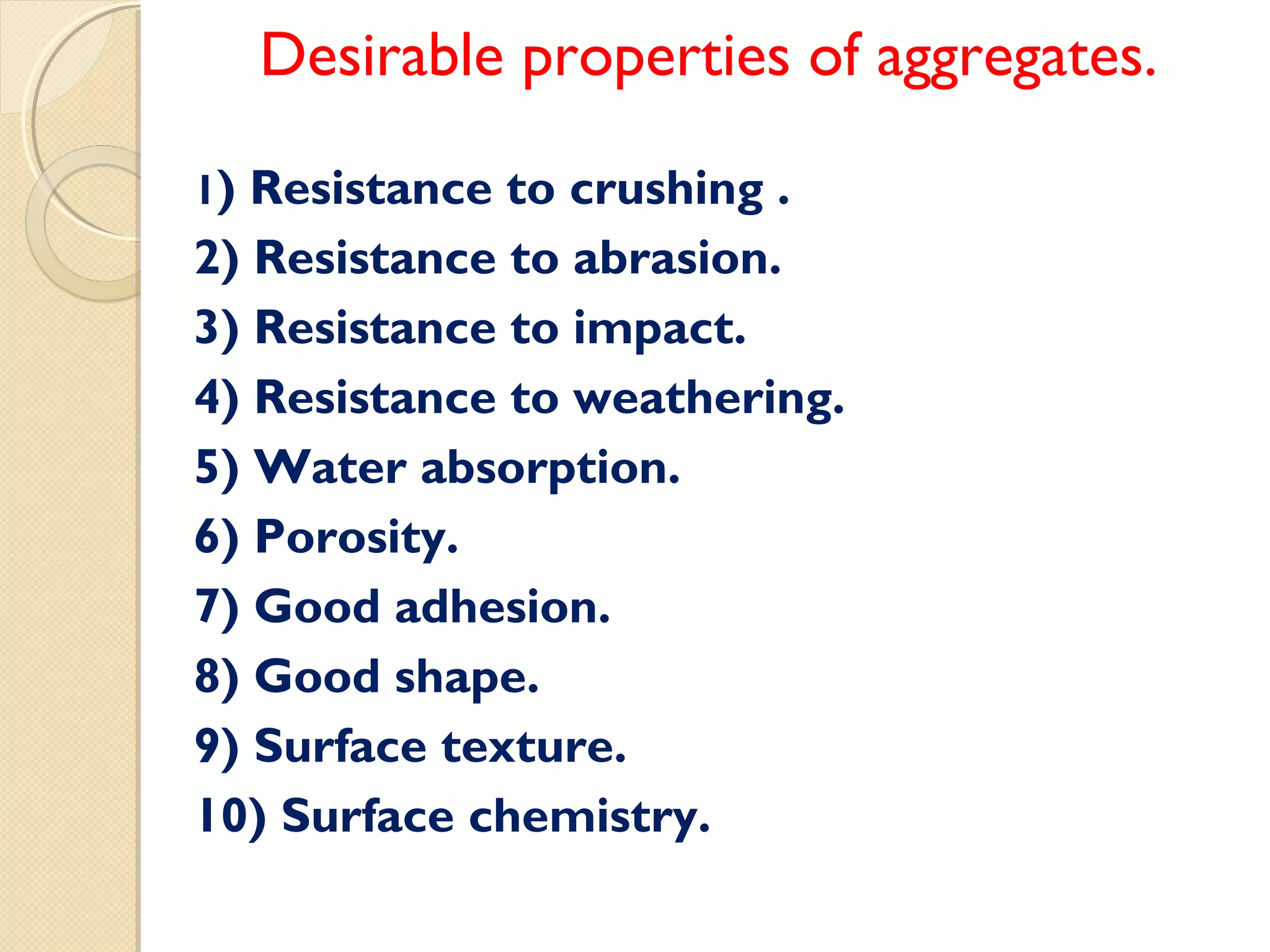
ROAD AGGREGATESROAD AGGREGATES
Desirable properties of aggregates.
1) Resistance to crushing .
2) Resistance to abrasion.
3) Resistance to impact.
4) Resistance to weathering.
5) Water absorption.
6) Porosity.
7) Good adhesion.
8) Good shape.
9) Surface texture.
10) Surface chemistry.
SUBBASESUBBASE
A subbase is layer of material between base
and subgrade. Sometimes a granular material
under a rigid pavement is called a subbase.
Subbase may consist of select materials,
such as natural gravels, that are stable but
that have characteristics which make them
not completely suitable as base course.
They may also be of stabilized soil or merely
select borrow.
SUBBASESUBBASE
The purpose of a subbase is to permit the
building of relatively thick pavements at low
cost. Thus , the quality of subbase can vary
within wide limits , as long as the thickness
design criteria are fulfilled.
BASEBASE
A base course is defined as a layer of
granular material which lies immediately
below the wearing surface of a pavement .
PURPOSE OF BASE COURSESPURPOSE OF BASE COURSES
 Base and subbase courses under flexible
pavements are primarily to increase the load
supporting capacity by distributing the load
through a finite thickness of pavement this will
reduce shear and consolidation deformation in
the subgrade.
PURPOSE OF BASE COURSESPURPOSE OF BASE COURSES
Base courses are used under rigid pavements for
1) Prevention of pumping.
2) Protection against frost action.
3) Prevention of volume change of subgrade
4) Drainage.
5) Increased structural capacity.
6) Expedition of construction.
PURPOSE OF BASE COURSESPURPOSE OF BASE COURSES
To prevent pumping a base course must be
relatively well graded, must be free from
excessive fines and should be compacted to
a relatively high density.
To provide drainage the base may or may
not be a well graded material but it should
contain little or no fines.
PURPOSE OF BASE COURSESPURPOSE OF BASE COURSES
Base course designed for frost action
should be non frost susceptible and free
draining.
Base course need not to be free draining to
provide adequate structural capacity.
Base course should be well graded and
should resist deformation due to loading.
PROPERTIES OF SOIL AGGREGATE MIXPROPERTIES OF SOIL AGGREGATE MIX
Density and stability: depends upon particle
size distribution, particle shape, relative
density, internal friction and cohesion.
An aggregate which contains little or no
fines and is well graded gains its stability
from grain to grain contact but usually has
relatively low density but is pervious and
non frost susceptible. This material is very
difficult to handle during construction
because of its noncohesive nature.
PROPERTIES OF SOIL AGGREGATE MIXPROPERTIES OF SOIL AGGREGATE MIX
An aggregate which contains sufficient fines
to fill all the voids will still gain its strength
from grain contact but with increased
resistance against deformation. Its density is
high, its permeability is low, and it may be
frost susceptible. This material is moderately
difficult to compact but is ideal from stability
point, it will have relatively high shearing
resistance.
An aggregate which contains great amount of
fines has no grain to grain contact ,and the
aggregate merely floats in the soil. Its density
is low; it is practically impervious, and it is
frost susceptible. In addition the stability of
this type of mixture is greatly affected by
adverse water conditions. The material is at
times is quite easy to handle during
construction and compacts quite readily.
PROPERTIES OF SOIL AGGREGATE MIX
Maximum CBR resulted when the
quantity of fines was somewhat less than
that indicated for maximum density.
CBR of mixtures made up of angular
particles are usually somewhat greater
than those containing mostly rounded
particles .
PROPERTIES OF SOIL AGGREGATE MIX
Density as well as CBR increases as size
of aggregate increased but optimum soil
content decreased.
PROPERTIES OF SOIL AGGREGATE MIX
Permeability: The permeability characteristics
of soil aggregate mixtures are dependent
upon :
1) Grain size distribution.
2) Type of coarse aggregate.
3) Type of binder.
4) Density.
Effect of plasticity: The liquid limit for
base courses is 25 % and the plasticity
index is 6 %.
Soundness: Soundness is defined as the
ability of aggregate to withstand abrasion/
crushing. This is important from the
standpoint of generation of fines under
the action of rollers and traffic. Soft
aggregate should not be used.
PROPERTIES OF SOIL AGGREGATE MIX
Aggregate which breakdown excessively
under freezing and thawing should not be
used.
Behavior under load : Laboratory test, as
well as field performance, have indicated that
the behavior of base course - subgrade
combinations under load is reflected by the
stability of base course itself.
PROPERTIES OF SOIL AGGREGATE MIX
Laboratory and field data indicate that a base
course which contains quantity of fines slightly
less than that required for maximum density
will be stable.
If a granular base course is used for drainage
purpose or for protection against frost action,
it is essential that it remain open graded
throughout the pavement life. This can be
done by placing a thin blanket of sand or
other fine granular material between the
subgrade and base course.
PROPERTIES OF SOIL AGGREGATE MIX
GRADING REQUIREMENTSGRADING REQUIREMENTS
The purpose of gradation specifications for
base courses and sub bases is to assure
adequate stability under repeated loads.
Proportioning materials of different specific
gravities: Any gradation specification is valid
only so long as the fine fractions and the
coarse aggregates have approximately the
same specific gravity.
GRADING REQUIREMENTSGRADING REQUIREMENTS
Although the physical characteristics of the
soil aggregate mixture are dependent upon
relative volumes of the course to fine
aggregate. However it is not practical to
attempt proportioning of materials on the
basis of volume; therefore, specifications are
always set up on the per cent by weight
basis.
GRADING REQUIREMENTSGRADING REQUIREMENTS
If the coarse aggregate has a specific gravity
considerably higher than that of the fine
fraction, gradation will result in mixtures
which are too rich. Conversely , if the
specific gravity of the fine fraction is higher
than that of the coarse aggregate, the
quantity of fines will be low.
CONSTRUCTIONCONSTRUCTION
Soil aggregate mixtures: To ensure
adequate stability, base and subbase
materials must be compacted to a high
density . Moisture control is extremely
important.
CONSTRUCTIONCONSTRUCTION
Granular base course materials may be
compacted in lifts ranging upto 6”,
depending upon the type of compaction
equipment. If smooth wheeled compactors
are used , the lift should be controlled to
about 4”.However if vibratory compactors
are used , lifts upto 8 or 10” are permitted.
CONSTRUCTIONCONSTRUCTION
Field experience has indicated that
compaction of base course materials to
densities in excess of the modified
AASHO values is quite common when
vibrating compactors are used.
CONSTRUCTIONCONSTRUCTION
Care should be exercised to insure
uniform distribution of the base course
materials over the subgrade to prevent
segregation.
Make certain that the clay binder and
aggregate are thoroughly mixed.
AGGREGATE PRODUCTIONAGGREGATE PRODUCTION
Aggregate production in the US is large—
some annual production figures include:
Natural aggregates
 Sand and gravel: 1.13 billion metric tons
 Crushed stone: 1.49 billion metric tons
Recycled aggregates: 200 million metric
tons produced from demolition wastes
(includes roads and buildings).
AGGREGATE PRODUCTIONAGGREGATE PRODUCTION
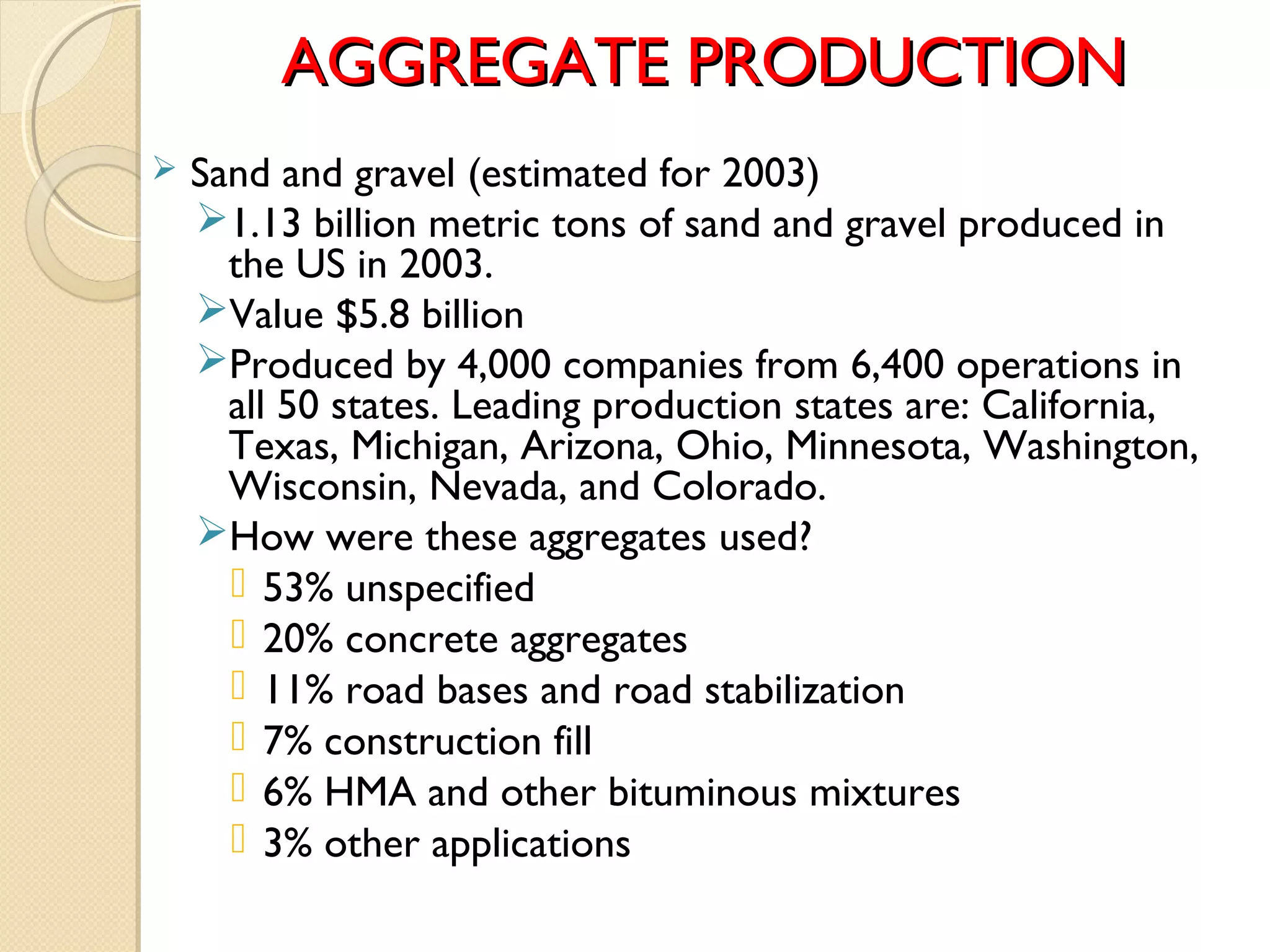
 Sand and gravel (estimated for 2003)
1.13 billion metric tons of sand and gravel produced in
the US in 2003.
Value $5.8 billion
Produced by 4,000 companies from 6,400 operations in
all 50 states. Leading production states are: California,
Texas, Michigan, Arizona, Ohio, Minnesota, Washington,
Wisconsin, Nevada, and Colorado.
How were these aggregates used?
 53% unspecified
 20% concrete aggregates
 11% road bases and road stabilization
 7% construction fill
 6% HMA and other bituminous mixtures
 3% other applications
AGGREGATE PRODUCTIONAGGREGATE PRODUCTION
 Crushed stone (estimated for 2003)
◦ 1.49 billion metric tons of crushed stone produced in
the US in 2003.
◦ Value $8.6 billion
◦ Produced by 1,260 companies from 3,300 operations in
49 states. Leading production states are: Texas, Florida,
Pennsylvania, Missouri, Illinois, Georgia, Ohio, North
Carolina, Virginia, and California.
◦ How were these aggregates used? 35% was for
unspecified uses followed by construction aggregates
mostly for highway and road construction and
maintenance, chemical and metallurgical uses (including
cement and lime production), agricultural uses, etc.
Recycled aggregates (1999)
200 million metric tons of recycled aggregates
produced (or generated) in the US in 2000.
100 million metric tons of recycled asphalt
paving materials recovered annually. 80% of this
material is recycled with the other 20% going to
landfills. Of the 80% that is recycled—2/3 used
as aggregates for road base and 1/3 reused as
aggregate for new HMA.
AGGREGATE PRODUCTIONAGGREGATE PRODUCTION
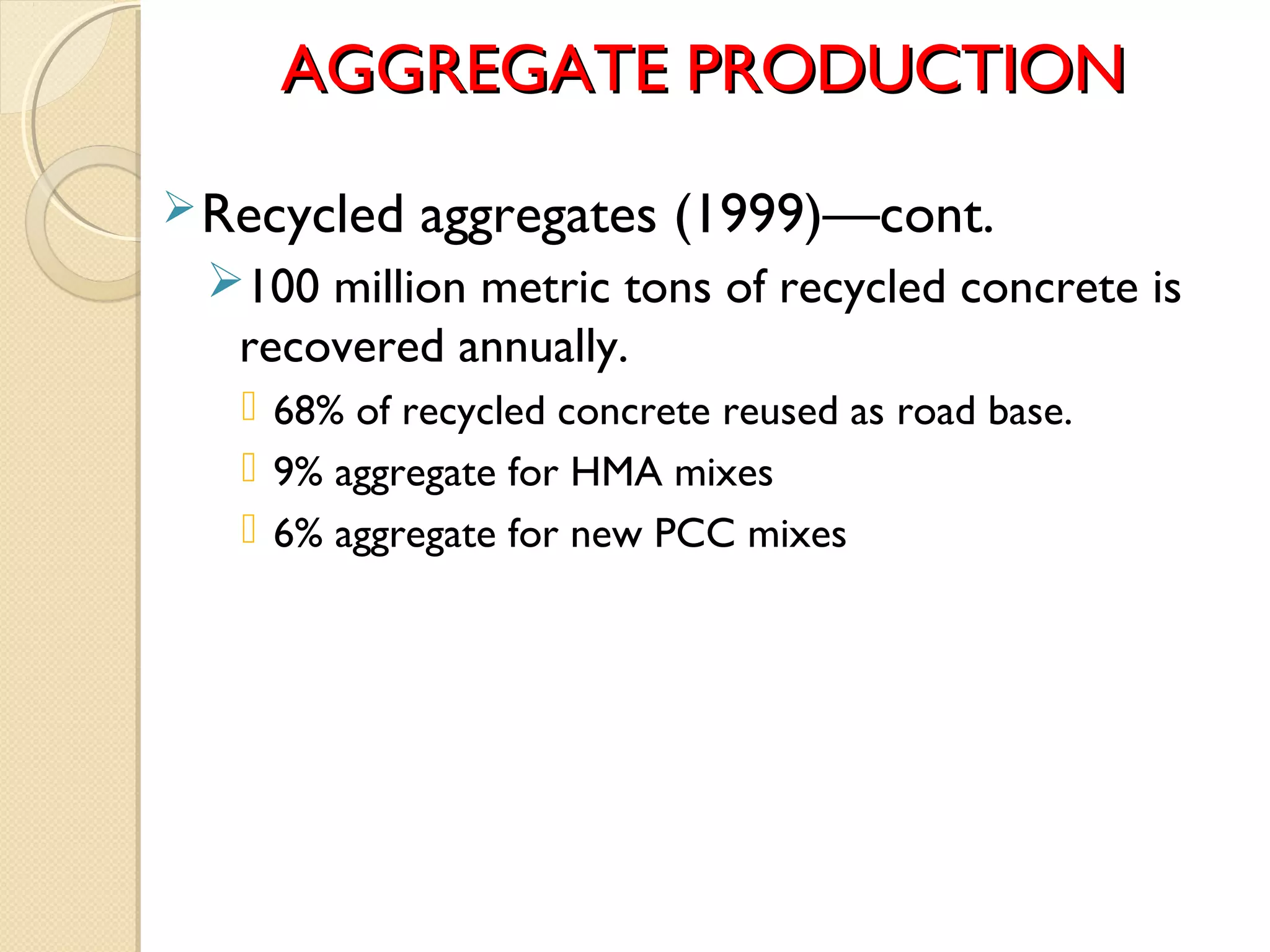
Recycled aggregates (1999)—cont.
100 million metric tons of recycled concrete is
recovered annually.
 68% of recycled concrete reused as road base.
 9% aggregate for HMA mixes
 6% aggregate for new PCC mixes
AGGREGATE PRODUCTIONAGGREGATE PRODUCTION
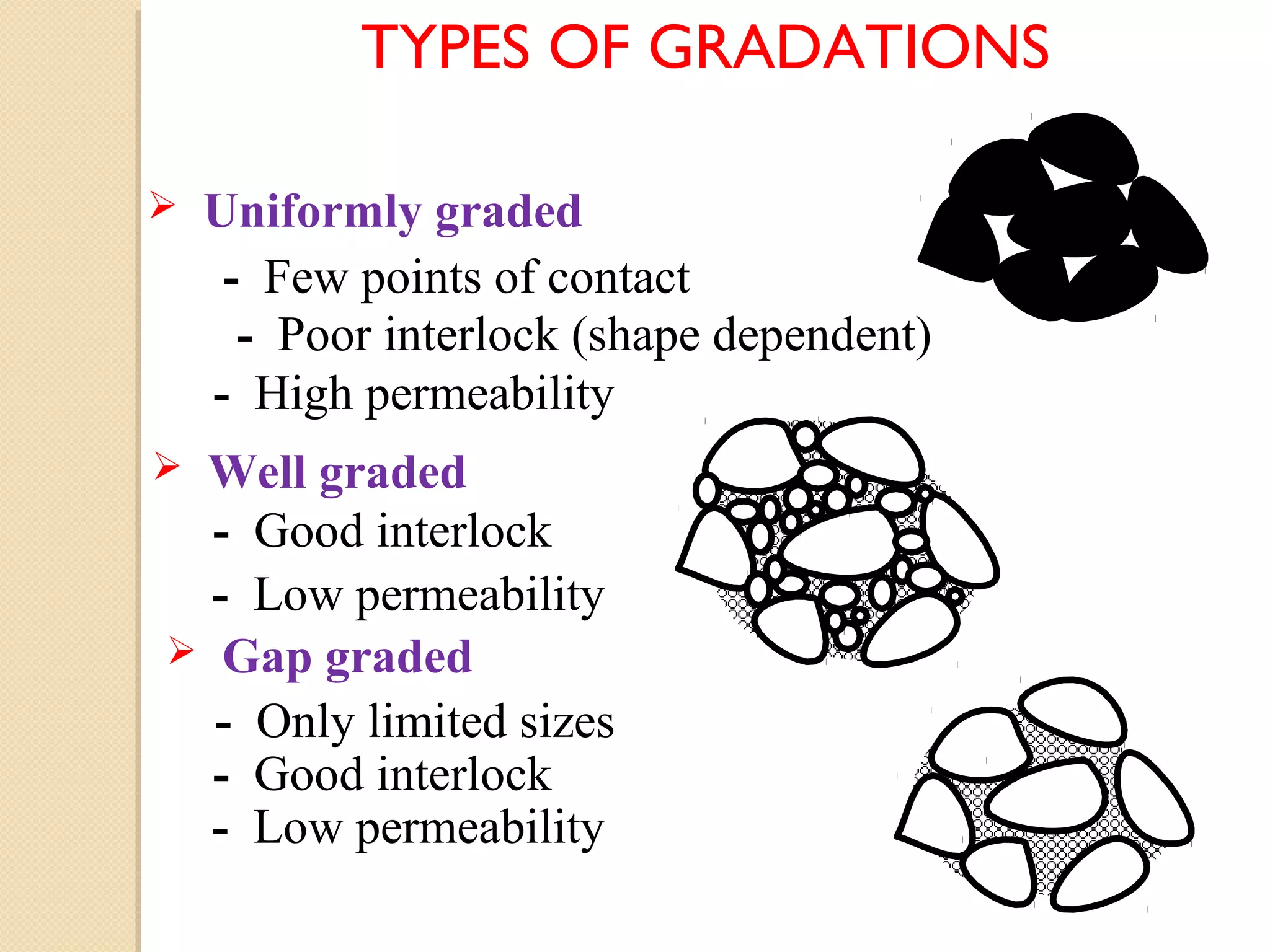
 Uniformly graded
- Few points of contact
- Poor interlock (shape dependent)
- High permeability
 Well graded
- Good interlock
- Low permeability
 Gap graded
- Only limited sizes
- Good interlock
- Low permeability
TYPES OF GRADATIONS
ThanksThanks

Road Aggregates

  • 2.
    PAVEMENT MATERIALSPAVEMENT MATERIALS ENGINEERINGENGINEERING (CE-862)(CE-862) Lec-09 FallSemester 2016   Dr. Arshad Hussain arshad_nit@yahoo.com , Office Room#111, Tel: 05190854163, Cell: 03419756251 National Institute of Transportation (NIT) School of Civil & Environmental Engineering (SCEE) National University of Science and Technology (NUST) NUST Campus, Sector H-12, Islamabad
  • 3.
  • 4.
    Desirable properties ofaggregates. 1) Resistance to crushing . 2) Resistance to abrasion. 3) Resistance to impact. 4) Resistance to weathering. 5) Water absorption. 6) Porosity. 7) Good adhesion. 8) Good shape. 9) Surface texture. 10) Surface chemistry.
  • 5.
    SUBBASESUBBASE A subbase islayer of material between base and subgrade. Sometimes a granular material under a rigid pavement is called a subbase. Subbase may consist of select materials, such as natural gravels, that are stable but that have characteristics which make them not completely suitable as base course. They may also be of stabilized soil or merely select borrow.
  • 6.
    SUBBASESUBBASE The purpose ofa subbase is to permit the building of relatively thick pavements at low cost. Thus , the quality of subbase can vary within wide limits , as long as the thickness design criteria are fulfilled.
  • 7.
    BASEBASE A base courseis defined as a layer of granular material which lies immediately below the wearing surface of a pavement .
  • 8.
    PURPOSE OF BASECOURSESPURPOSE OF BASE COURSES  Base and subbase courses under flexible pavements are primarily to increase the load supporting capacity by distributing the load through a finite thickness of pavement this will reduce shear and consolidation deformation in the subgrade.
  • 9.
    PURPOSE OF BASECOURSESPURPOSE OF BASE COURSES Base courses are used under rigid pavements for 1) Prevention of pumping. 2) Protection against frost action. 3) Prevention of volume change of subgrade 4) Drainage. 5) Increased structural capacity. 6) Expedition of construction.
  • 10.
    PURPOSE OF BASECOURSESPURPOSE OF BASE COURSES To prevent pumping a base course must be relatively well graded, must be free from excessive fines and should be compacted to a relatively high density. To provide drainage the base may or may not be a well graded material but it should contain little or no fines.
  • 11.
    PURPOSE OF BASECOURSESPURPOSE OF BASE COURSES Base course designed for frost action should be non frost susceptible and free draining. Base course need not to be free draining to provide adequate structural capacity. Base course should be well graded and should resist deformation due to loading.
  • 12.
    PROPERTIES OF SOILAGGREGATE MIXPROPERTIES OF SOIL AGGREGATE MIX Density and stability: depends upon particle size distribution, particle shape, relative density, internal friction and cohesion. An aggregate which contains little or no fines and is well graded gains its stability from grain to grain contact but usually has relatively low density but is pervious and non frost susceptible. This material is very difficult to handle during construction because of its noncohesive nature.
  • 13.
    PROPERTIES OF SOILAGGREGATE MIXPROPERTIES OF SOIL AGGREGATE MIX An aggregate which contains sufficient fines to fill all the voids will still gain its strength from grain contact but with increased resistance against deformation. Its density is high, its permeability is low, and it may be frost susceptible. This material is moderately difficult to compact but is ideal from stability point, it will have relatively high shearing resistance.
  • 14.
    An aggregate whichcontains great amount of fines has no grain to grain contact ,and the aggregate merely floats in the soil. Its density is low; it is practically impervious, and it is frost susceptible. In addition the stability of this type of mixture is greatly affected by adverse water conditions. The material is at times is quite easy to handle during construction and compacts quite readily. PROPERTIES OF SOIL AGGREGATE MIX
  • 15.
    PROPERTIES OF SOILAGGREGATE MIX Maximum CBR resulted when the quantity of fines was somewhat less than that indicated for maximum density. CBR of mixtures made up of angular particles are usually somewhat greater than those containing mostly rounded particles .
  • 16.
    PROPERTIES OF SOILAGGREGATE MIX Density as well as CBR increases as size of aggregate increased but optimum soil content decreased.
  • 17.
    PROPERTIES OF SOILAGGREGATE MIX Permeability: The permeability characteristics of soil aggregate mixtures are dependent upon : 1) Grain size distribution. 2) Type of coarse aggregate. 3) Type of binder. 4) Density.
  • 18.
    Effect of plasticity:The liquid limit for base courses is 25 % and the plasticity index is 6 %. Soundness: Soundness is defined as the ability of aggregate to withstand abrasion/ crushing. This is important from the standpoint of generation of fines under the action of rollers and traffic. Soft aggregate should not be used. PROPERTIES OF SOIL AGGREGATE MIX
  • 19.
    Aggregate which breakdownexcessively under freezing and thawing should not be used. Behavior under load : Laboratory test, as well as field performance, have indicated that the behavior of base course - subgrade combinations under load is reflected by the stability of base course itself. PROPERTIES OF SOIL AGGREGATE MIX
  • 20.
    Laboratory and fielddata indicate that a base course which contains quantity of fines slightly less than that required for maximum density will be stable. If a granular base course is used for drainage purpose or for protection against frost action, it is essential that it remain open graded throughout the pavement life. This can be done by placing a thin blanket of sand or other fine granular material between the subgrade and base course. PROPERTIES OF SOIL AGGREGATE MIX
  • 21.
    GRADING REQUIREMENTSGRADING REQUIREMENTS Thepurpose of gradation specifications for base courses and sub bases is to assure adequate stability under repeated loads. Proportioning materials of different specific gravities: Any gradation specification is valid only so long as the fine fractions and the coarse aggregates have approximately the same specific gravity.
  • 22.
    GRADING REQUIREMENTSGRADING REQUIREMENTS Althoughthe physical characteristics of the soil aggregate mixture are dependent upon relative volumes of the course to fine aggregate. However it is not practical to attempt proportioning of materials on the basis of volume; therefore, specifications are always set up on the per cent by weight basis.
  • 23.
    GRADING REQUIREMENTSGRADING REQUIREMENTS Ifthe coarse aggregate has a specific gravity considerably higher than that of the fine fraction, gradation will result in mixtures which are too rich. Conversely , if the specific gravity of the fine fraction is higher than that of the coarse aggregate, the quantity of fines will be low.
  • 24.
    CONSTRUCTIONCONSTRUCTION Soil aggregate mixtures:To ensure adequate stability, base and subbase materials must be compacted to a high density . Moisture control is extremely important.
  • 25.
    CONSTRUCTIONCONSTRUCTION Granular base coursematerials may be compacted in lifts ranging upto 6”, depending upon the type of compaction equipment. If smooth wheeled compactors are used , the lift should be controlled to about 4”.However if vibratory compactors are used , lifts upto 8 or 10” are permitted.
  • 26.
    CONSTRUCTIONCONSTRUCTION Field experience hasindicated that compaction of base course materials to densities in excess of the modified AASHO values is quite common when vibrating compactors are used.
  • 27.
    CONSTRUCTIONCONSTRUCTION Care should beexercised to insure uniform distribution of the base course materials over the subgrade to prevent segregation. Make certain that the clay binder and aggregate are thoroughly mixed.
  • 28.
    AGGREGATE PRODUCTIONAGGREGATE PRODUCTION Aggregateproduction in the US is large— some annual production figures include: Natural aggregates  Sand and gravel: 1.13 billion metric tons  Crushed stone: 1.49 billion metric tons Recycled aggregates: 200 million metric tons produced from demolition wastes (includes roads and buildings).
  • 29.
    AGGREGATE PRODUCTIONAGGREGATE PRODUCTION Sand and gravel (estimated for 2003) 1.13 billion metric tons of sand and gravel produced in the US in 2003. Value $5.8 billion Produced by 4,000 companies from 6,400 operations in all 50 states. Leading production states are: California, Texas, Michigan, Arizona, Ohio, Minnesota, Washington, Wisconsin, Nevada, and Colorado. How were these aggregates used?  53% unspecified  20% concrete aggregates  11% road bases and road stabilization  7% construction fill  6% HMA and other bituminous mixtures  3% other applications
  • 30.
    AGGREGATE PRODUCTIONAGGREGATE PRODUCTION Crushed stone (estimated for 2003) ◦ 1.49 billion metric tons of crushed stone produced in the US in 2003. ◦ Value $8.6 billion ◦ Produced by 1,260 companies from 3,300 operations in 49 states. Leading production states are: Texas, Florida, Pennsylvania, Missouri, Illinois, Georgia, Ohio, North Carolina, Virginia, and California. ◦ How were these aggregates used? 35% was for unspecified uses followed by construction aggregates mostly for highway and road construction and maintenance, chemical and metallurgical uses (including cement and lime production), agricultural uses, etc.
  • 31.
    Recycled aggregates (1999) 200million metric tons of recycled aggregates produced (or generated) in the US in 2000. 100 million metric tons of recycled asphalt paving materials recovered annually. 80% of this material is recycled with the other 20% going to landfills. Of the 80% that is recycled—2/3 used as aggregates for road base and 1/3 reused as aggregate for new HMA. AGGREGATE PRODUCTIONAGGREGATE PRODUCTION
  • 32.
    Recycled aggregates (1999)—cont. 100million metric tons of recycled concrete is recovered annually.  68% of recycled concrete reused as road base.  9% aggregate for HMA mixes  6% aggregate for new PCC mixes AGGREGATE PRODUCTIONAGGREGATE PRODUCTION
  • 33.
     Uniformly graded -Few points of contact - Poor interlock (shape dependent) - High permeability  Well graded - Good interlock - Low permeability  Gap graded - Only limited sizes - Good interlock - Low permeability TYPES OF GRADATIONS
  • 34.

Editor's Notes

  • #29 Sources: USGS (2004) and USGS (1999).
  • #30 Source: USGS (2004).
  • #31 Source: USGS (2004).
  • #32 Source: USGS (1999).
  • #33 Source: USGS (1999).
  • #34 There are several general types of aggregate gradations. Uniform gradations have large percentages of one size. Well graded aggregates have approximately equal amounts on each sieve in the stack. Gap graded aggregates have large and small but few intermediate sizes. The properties of the aggregate gradation depends strongly on the distribution of aggregates sizes.