PAVEMENT MATERIALSPAVEMENT MATERIALS
ENGINEERINGENGINEERING
(CE-862)(CE-862)
Lec-08
Fall Semester 2016
 
Dr. Arshad Hussain
arshad_nit@yahoo.com , Office Room#111, Tel: 05190854163,
Cell: 03419756251
National Institute of Transportation (NIT)
School of Civil & Environmental Engineering (SCEE)
National University of Science and Technology (NUST)
NUST Campus, Sector H-12, Islamabad
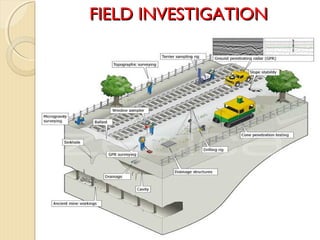
FIELD EVALUATIONSFIELD EVALUATIONS
Methods of Explorations
 Excavations
◦ Drilling
◦ Test Pits
 Sampling
 Geophysical Testing
◦ Surface Seismic
◦ Electrical Resistivity
FIELD INVESTIGATIONFIELD INVESTIGATION
GEOPHYSICALGEOPHYSICAL TESTINGTESTING
WHAT ?WHAT ?
Geophysical Exploration consists of
making indirect measurements
from the earth’s surface or in borehole
to obtain subsurface information.
WHY ?WHY ?
 Requirement of Geotechnical Investigations
◦ Grouping of the Subsurface strata with similar
Geotechnical Properties
◦ Strength
◦ Stiffness
 Geophysical Exploration helps in
 Rapid location and correlation of geological features
◦ Stratigraphy
◦ Lithology
◦ Discontinuities
◦ Ground Water
 In-situ measurement of
◦ Modulli and Densities
FAILURESFAILURES
Leaning Tower of PisaLeaning Tower of Pisa
and Sinkholesand Sinkholes
HOW ?HOW ?
General Techniques
◦ Seismic
◦ Electrical
◦ Sonic
◦ Magnetic
◦ Radar
◦ Gravity
SEISMIC TECHNIQUESSEISMIC TECHNIQUES
PRINCIPLE
• difference in stiffness of different soil/rock layers
PROCEDURE
• An elastic wave is generated in the ground
 by Impactive force (Falling Weight or Hammer Blow)
 Explosive Charge
• Resulting Ground motion is measured using
vibration detectors (geophones)
• Time elapsed will help to evaluate different Wave
Velocities in different layers
SEISMIC TECHNIQUESSEISMIC TECHNIQUES
Wave Types
◦ Longitudinal Waves (P waves)
◦ Transverse or Shear Waves (S waves)
◦ Rayleigh Waves
◦ Love Waves
-0.08
-0.06
-0.04
-0.02
0
0.02
0.04
0.06
0.08
0 50 100 150 200
Time (ms)
Amplitude
P-Wave S-Wave
SEISMIC TECHNIQUESSEISMIC TECHNIQUES
Methods
◦ Refraction
◦ Reflection
◦ Cross-Hole
◦ Down-Hole
SEISMIC METHODSSEISMIC METHODS
Reflection: standard in oil exploration
(deep)
Refraction: for shallow features like depth
to bedrock or thickness of the
unconsolidated material,
Also used in deciphering the internal
structure of the earth (very deep, need a
strong source of vibration like an
earthquake)
Wave/ ray behavior similar to light
SEISMIC WAVESSEISMIC WAVES
Surface wave: considered noise
Body waves: P (compressional) and S
(shear)
Velocity depends on the density of the
layers; increases with increasing density
Incident, reflected, and refracted rays
Ray gets deflected away from the normal
(lighter to a denser medium)
Critical angle: refracted wave travels along
the interface
SEISMIC REFRACTIONSEISMIC REFRACTION
Energy source: vibration created by a
hammer blow or explosive in a drill hole
Wave propagation: spherical waves in a
homogeneous medium, wave fronts
Rays: perpendicular to wave fronts, shown
on diagrams
Geophone: device that detects vibrations
Seismograph: device that records the
arrival times
GEOPHONE
SEISMIC REFRACTION
Seismic RefractionSeismic Refraction
Vertical Geophones
Source
(Plate)
Rock: Vp2
ASTM D 5777
Soil: Vp1
oscilloscope
x1
x2
x3
x4
t1
t2
t3
t4
Note: Vp1 < Vp2
zR
Determine depth
to rock layer, zR
Seismic RefractionSeismic Refraction
0.000
0.005
0.010
0.015
0.020
TravelTime(seconds)
0 10 20 30 40 50
Distance From Source (meters)
Horizontal Soil Layer over Rock
Vp1 = 1350 m/s
1
Vp2 = 4880 m/s
1
z
x
2
V V
V V
c
c p 2 p 1
p 2 p 1
=
−
+
Depth to Rock:
zc = 5.65 m
xc = 15.0 m
x values
tvalues
SEISMIC REFLECTION
REFRACTION and REFLECTIONREFRACTION and REFLECTION
Refracted Wave
Reflected Wave
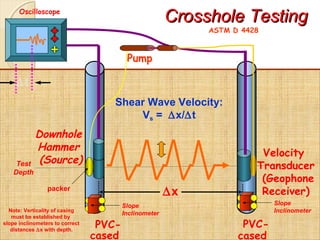
CrossholeCrosshole TestingTestingOscilloscope
PVC-
cased
PVC-
cased
Downhole
Hammer
(Source)
Velocity
Transducer
(Geophone
Receiver)
∆t
∆x
Shear Wave Velocity:
Vs = ∆x/∆t
Test
Depth
ASTM D 4428
Pump
packer
Note: Verticality of casing
must be established by
slope inclinometers to correct
distances ∆x with depth.
Slope
Inclinometer
Slope
Inclinometer
Downhole TestingDownhole TestingOscilloscope
Cased
Borehole
∆x
Test
Depth
Interval
Horizontal
Velocity
Transducers
(Geophone
Receivers)
packer
Pump Horizontal Plank
with normal load
Shear Wave Velocity:
Vs = ∆R/∆t
z1
z2
∆t
R1
2 = z1
2 + x2
R2
2 = z2
2 + x2
x
Hammer
APPLICATIONSAPPLICATIONS
Vp and Vs
LIMITATIONLIMITATION
In case of Saturated Media ?
Waves will pass through water
(1500 m/s) and not through the soil
structure
LIMITATIONS- SEISMIC REFRACTIONLIMITATIONS- SEISMIC REFRACTION
Seismic refraction method: density of the
layers must increase with depth
V3 > V2 >V1 ( if V2 < V1 andV3 > V1 then V2
will not be “seen” by seis. refraction
The ray bends towards the normal when
going from denser (V1) to lighter (V2)
medium; refracted into the earth
When going from a lighter to denser
medium the ray is refracted back to the
surface
ELECTRICAL TECHNIQUESELECTRICAL TECHNIQUES
PRINCIPLE
odifference in electrical Resistivity of different
soil/rock layers
PROCEDURE
oAn electrical current is made to flow through
the ground under an electrical potential
oResulting Apparent Resistivity of the Ground
is measured.
THEORY OF MEASUREMENTSTHEORY OF MEASUREMENTS
APPARENT RESISTIVITYAPPARENT RESISTIVITY
EVALUATIONSEVALUATIONS
DIFFERENT CONFIGURATIONSDIFFERENT CONFIGURATIONS
DIFFERENT MODELSDIFFERENT MODELS
2-D MODELS2-D MODELS
3-D MODEL3-D MODEL
APPLICATIONSAPPLICATIONS
SUBGRADE CONSTRUCTIONSUBGRADE CONSTRUCTION
 Construction Principles
 Construction Equipment
 Construction Processes
SUBGRADE CONSTRUCTIONSUBGRADE CONSTRUCTION
 What is SUBGRADE Construction ?
 Compaction
◦ Objectives
◦ Factors
◦ Mechanism
◦ Created Fabric and Structure
◦ Effect on Engineering Properties
 Strength
 Stiffness
 Stability
SUBGRADE CONSTRUCTIONSUBGRADE CONSTRUCTION
1. Establishment of Grade Line
◦ Natural Ground (Cut)
◦ Embankment (Fill)
2. Compaction
SUBGRADE CONSTRUCTIONSUBGRADE CONSTRUCTION
1. Establishment of Grade Line
 The subgrade line should be established
◦ to obtain the optimum natural support for the pavement
◦ consistent with economic utilization of available materials
◦ traffic requirements
 a . Balancing Cut and Fill: Optimizing subgrade support
and drainage should take precedence over balancing cut and
fill.
SUBGRADE CONSTRUCTIONSUBGRADE CONSTRUCTION
b . Ground Water: The subgrade line will be above the
flood plain and a minimum of 2 feet above wet season
ground water level . Where not practicable, provide for
permanent lowering of water table by drainage.
 c . Rock: Rock excavation is to be avoided for economic
reasons . Where excavation of rock is unavoidable,
undercut to provide for full depth of base course under
surface courses .
SUBGRADE CONSTRUCTIONSUBGRADE CONSTRUCTION
2. COMPACTION
PURPOSE:
 In engineering practice the soils at a given site do not often
meet the ideal requirements or the intended purpose.
 They may be weak, highly compressible, or have a higher/lower
permeability than desirable from an engineering or economic
point of view.
 It would seem reasonable in such instances to simply relocate
the structure or facility. However, considerations other than
geotechnical often govern the location of a structure, and the
engineer is forced to design for the site at hand.
 One possibility is to adapt and design according to the
geotechnical conditions at the site.
SUBGRADE CONSTRUCTIONSUBGRADE CONSTRUCTION
2. COMPACTION
PURPOSE:
 Another possibility is to try to stabilize or improve the
engineering properties of the soils at the site. Depending on
the circumstances, this second approach may be the most
economical solution to the problem.
SUBGRADE CONSTRUCTIONSUBGRADE CONSTRUCTION
 Stabilization Methods are generally classified as:
Mechanical
Physical
Chemical
Thermal
Electrical
COMPACTION
EQUIPMENT REQUIREDEQUIPMENT REQUIRED
Clearing & Grubbing Tractor Dozer,
Rooter/Ripper
Excavation Shovels, Dozers,
Draglines, Scrapers
Transportation Scrapers, Trucks,
Dumpers
Spreading Grader, Dozer
Watering Tankers, Sprinklers
Compaction Rollers of Different
Types
COMPACTIONCOMPACTION
Objectives of Compaction
 Detrimental settlements can be reduced or
prevented.
 Soil strength increases and slope stability can be
improved.
 Bearing capacity of pavement subgrades can be
improved.
 Undesirable volume changes, for example,
caused by frost action, swelling, and shrinkage
may be controlled.
COMPACTIONCOMPACTION
 Compaction is a function of four variables:
 Dry Density
 Water Content
 Compactive Effort/Type
 Soil Type
◦ gradation, presence of clay minerals, etc.
PROCTOR COMPACTION TESTPROCTOR COMPACTION TEST
Dry Density
Moisture Content (%)
MDD
OMC
Wet of OptimumDry of Optimum
SUBGRADE COMPACTIONSUBGRADE COMPACTION
Natural Subgrade
 Compact at Grade Level to a depth of
 Compact from the surface (cohesionless soils except silts) .
 Remove, process to desired water content, replace in lifts, and
compact .
Embankment
 Once borrow material has been transported to the fill area, bull-dozers,
front loaders, and motor graders, called blades, spread the material to
the desired layer or lift thickness.
 Lift thickness may range from 150 to 500 mm (6 to 18 in.) or so,
depending on the size and type of compaction equipment and on the
maximum grain size of the fill.
COMPACTION ACHIEVEMENTCOMPACTION ACHIEVEMENT
 NUMBER OF
PASSES
 ?
 SPEED
 ?
COMPACTION ACHIEVEMENTCOMPACTION ACHIEVEMENT
COMPACTION DEPTH (Lift Thickness)
 Cohesive Soils
◦ Compacted By Pressure, Kneading,....
 Cohesionless Soils
◦ Compacted by Vibrations
COMPACTION ACHIEVEMENTCOMPACTION ACHIEVEMENT
Compaction Depth (Lift Thickness)
Cohesive Soils
Depends on
◦ Pressure
◦ Impact
◦ Vibration (if any)
◦ Initial Density of Soil
COMPACTION ACHIEVEMENTCOMPACTION ACHIEVEMENT
Cohesionless Soils
 Difference Between Compaction Characteristics
 Compaction Pressure
 Vibration Frequency
COMPACTION ACHIEVEMENTCOMPACTION ACHIEVEMENT
ThanksThanks

Soil Exploration