Transportation
Planning
(Trip Generation)
Trip Generation
 Mathematical Models for Trip
Generation
◦ Regression Models
◦ Trip-Rate Analysis
◦ Cross-Classification
Trip Generation
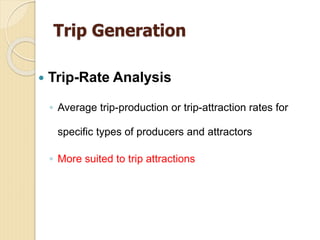
 Trip-Rate Analysis
◦ Average trip-production or trip-attraction rates for
specific types of producers and attractors
◦ More suited to trip attractions
Trip-Rate Analysis
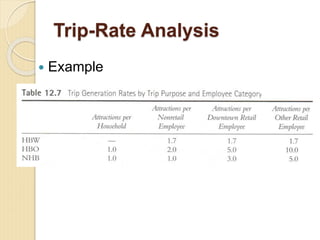
 Example
Trip-Rate Analysis
For 100 employees in a retail shopping center, calculate the total
number of trips
Home-based work (HBW) =
100 employees x 1.7 trips/employee = 170
Home-based Other (HBO) =
100 employees x 10 trips/employee = 1,000
Non-home-based (NHB) =
100 employees x 5 trips/employee = 500
Total = 170 + 1000 + 500 = 1,670 daily trips
Trip Generation
 Manuals for Trip Rates
◦ Institute of Transportation
Engineers (ITE) Trip Generation
Manual
◦ Dubai Trip Generation Manual
Dubai Trip Generation Manual
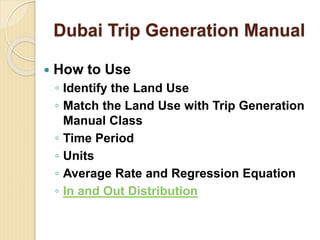
 How to Use
◦ Identify the Land Use
◦ Match the Land Use with Trip Generation
Manual Class
◦ Time Period
◦ Units
◦ Average Rate and Regression Equation
◦ In and Out Distribution
Abu Dhabi Trip Generation
Manual
 Developed in Year 2013
 Based upon studies done in
Emirates of Abu Dhabi
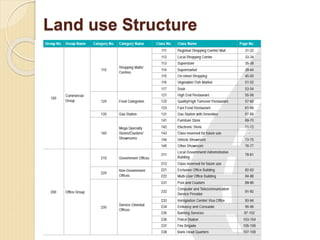
Land use Structure
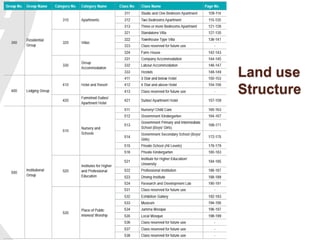
Land use
Structure
Land use
Structure
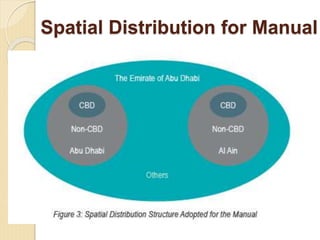
Spatial Distribution for Manual
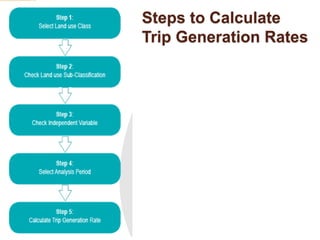
Steps to Calculate
Trip Generation Rates
Examples for Trip Generation Manual
 Residential Building in Al Ain CBD with
a total of 100 Apartments. Within
residential Building”
◦ 30 (1 bedroom apartments)
◦ 30 (2 bedroom apartments)
◦ 40 (3 bedroom apartments)
Trip Generation
 Cross Classification Models
◦ Uses trip rates based on one or more explanatory
or "independent" variables
◦ Trip rates are determined by aggregating data
from surveys such as household travel surveys
Cross Classification Models
 House hold characteristics used in
Cross Classification Models
◦ House hold Size
◦ Car ownership
◦ Income
Cross-classification (category analysis)
Situation: Zone 1 characteristics are
Home based work (HBW) trip production data
Households Income level
Household size <10,000 10,000 to 30,000 >30,000
1 10 100 50
2 10 200 50
3+ 30 100 50
HBW trip rate Income level
Household size <10,000 10,000 to 30,000 >30,000
1 1.5 2.5 2.5
2 2.5 4 5
3+ 3 5 7
 Advantages of cross-classification
 Independent of zone system
 No regression related assumptions necessary
 Disadvantages
 No extrapolation
 No trip rate for cells with no observations
 Difficult to add additional stratifying variables
 Difficult to choose household groups
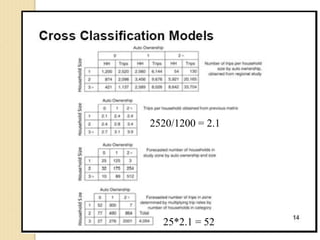
Cross-classification Models
2520/1200 = 2.1
25*2.1 = 52
Norman W. Garrick
Using Trip Generation Manual
Proposed Trip Generation
Dwelling Units
Houses 131 DU 9.60 1,258
Town Houses 42 DU 5.60 235
Live Work DU 42 DU 3.60 151
Apartments 140 DU 6.70 938
Commercial
Live Work 21,000 SF 11.60 244
Mixed Use 1 181,800 SF 44.32 8,057
Mixed Use 2 181,800 SF 42.90 7,799
Lodging
Hotel 350 Rooms 8.90 3,115
Civic
Town Hall 42,000 SF 34.00 1,428
Library 30,000 SF 44.00 1,320
Pool 5,150 SF 16.00 82
Totals 24,628
Daily Trips
Land Use Size Trip Generation Classification
Trip Gen
Rates
Trip Gen
Single Tenant Office (715)
Specialty Retail Center (814)
Shopping Center (820)
Single-Family Detached Housing (210)
Condominium/Townhouse (230)
Apartment (220)
Library (590)
Recreation Center (495)
Hotel (310)
Government Office (730)
Estimated number of trip ends = 24,600
ITE Trip Generation Manual
Proposed size of project
Trip Generation
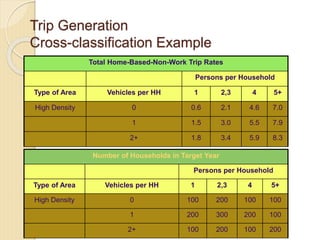
Cross-classification Example
Total Home-Based-Non-Work Trip Rates
Persons per Household
Type of Area Vehicles per HH 1 2,3 4 5+
High Density 0 0.6 2.1 4.6 7.0
1 1.5 3.0 5.5 7.9
2+ 1.8 3.4 5.9 8.3
Number of Households in Target Year
Persons per Household
Type of Area Vehicles per HH 1 2,3 4 5+
High Density 0 100 200 100 100
1 200 300 200 100
2+ 100 200 100 200

Trip generation

  • 1.
  • 2.
    Trip Generation  MathematicalModels for Trip Generation ◦ Regression Models ◦ Trip-Rate Analysis ◦ Cross-Classification
  • 3.
    Trip Generation  Trip-RateAnalysis ◦ Average trip-production or trip-attraction rates for specific types of producers and attractors ◦ More suited to trip attractions
  • 4.
  • 5.
    Trip-Rate Analysis For 100employees in a retail shopping center, calculate the total number of trips Home-based work (HBW) = 100 employees x 1.7 trips/employee = 170 Home-based Other (HBO) = 100 employees x 10 trips/employee = 1,000 Non-home-based (NHB) = 100 employees x 5 trips/employee = 500 Total = 170 + 1000 + 500 = 1,670 daily trips
  • 6.
    Trip Generation  Manualsfor Trip Rates ◦ Institute of Transportation Engineers (ITE) Trip Generation Manual ◦ Dubai Trip Generation Manual
  • 7.
    Dubai Trip GenerationManual  How to Use ◦ Identify the Land Use ◦ Match the Land Use with Trip Generation Manual Class ◦ Time Period ◦ Units ◦ Average Rate and Regression Equation ◦ In and Out Distribution
  • 8.
    Abu Dhabi TripGeneration Manual  Developed in Year 2013  Based upon studies done in Emirates of Abu Dhabi
  • 10.
  • 11.
  • 12.
  • 13.
  • 14.
    Steps to Calculate TripGeneration Rates
  • 15.
    Examples for TripGeneration Manual  Residential Building in Al Ain CBD with a total of 100 Apartments. Within residential Building” ◦ 30 (1 bedroom apartments) ◦ 30 (2 bedroom apartments) ◦ 40 (3 bedroom apartments)
  • 16.
    Trip Generation  CrossClassification Models ◦ Uses trip rates based on one or more explanatory or "independent" variables ◦ Trip rates are determined by aggregating data from surveys such as household travel surveys
  • 17.
    Cross Classification Models House hold characteristics used in Cross Classification Models ◦ House hold Size ◦ Car ownership ◦ Income
  • 18.
    Cross-classification (category analysis) Situation:Zone 1 characteristics are Home based work (HBW) trip production data Households Income level Household size <10,000 10,000 to 30,000 >30,000 1 10 100 50 2 10 200 50 3+ 30 100 50 HBW trip rate Income level Household size <10,000 10,000 to 30,000 >30,000 1 1.5 2.5 2.5 2 2.5 4 5 3+ 3 5 7
  • 19.
     Advantages ofcross-classification  Independent of zone system  No regression related assumptions necessary  Disadvantages  No extrapolation  No trip rate for cells with no observations  Difficult to add additional stratifying variables  Difficult to choose household groups Cross-classification Models
  • 20.
  • 21.
    Norman W. Garrick UsingTrip Generation Manual Proposed Trip Generation Dwelling Units Houses 131 DU 9.60 1,258 Town Houses 42 DU 5.60 235 Live Work DU 42 DU 3.60 151 Apartments 140 DU 6.70 938 Commercial Live Work 21,000 SF 11.60 244 Mixed Use 1 181,800 SF 44.32 8,057 Mixed Use 2 181,800 SF 42.90 7,799 Lodging Hotel 350 Rooms 8.90 3,115 Civic Town Hall 42,000 SF 34.00 1,428 Library 30,000 SF 44.00 1,320 Pool 5,150 SF 16.00 82 Totals 24,628 Daily Trips Land Use Size Trip Generation Classification Trip Gen Rates Trip Gen Single Tenant Office (715) Specialty Retail Center (814) Shopping Center (820) Single-Family Detached Housing (210) Condominium/Townhouse (230) Condominium/Townhouse (230) Apartment (220) Library (590) Recreation Center (495) Hotel (310) Government Office (730) Estimated number of trip ends = 24,600 ITE Trip Generation Manual Proposed size of project
  • 22.
    Trip Generation Cross-classification Example TotalHome-Based-Non-Work Trip Rates Persons per Household Type of Area Vehicles per HH 1 2,3 4 5+ High Density 0 0.6 2.1 4.6 7.0 1 1.5 3.0 5.5 7.9 2+ 1.8 3.4 5.9 8.3 Number of Households in Target Year Persons per Household Type of Area Vehicles per HH 1 2,3 4 5+ High Density 0 100 200 100 100 1 200 300 200 100 2+ 100 200 100 200