Understanding  Major  Depression
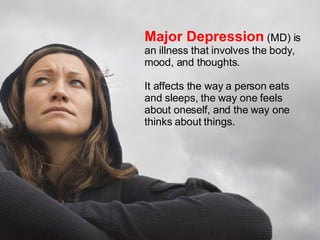
Major Depression   (MD) is an illness that involves the body, mood, and thoughts.  It affects the way a person eats and sleeps, the way one feels about oneself, and the way one thinks about things.
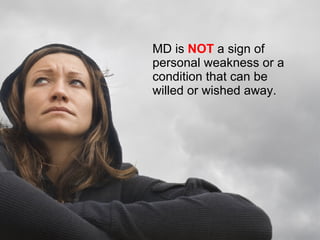
MD is  NOT  a sign of personal weakness or a condition that can be willed or wished away.
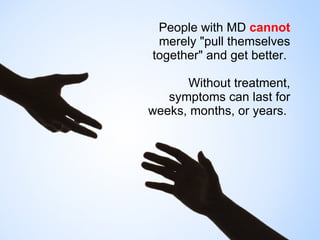
People with MD  cannot  merely "pull themselves together" and get better.  Without treatment, symptoms can last for weeks, months, or years.
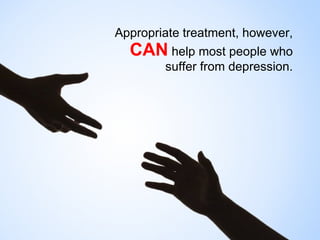
Appropriate treatment, however,  CAN  help most people who suffer from depression.
Major depression (MD) is manifested by a  combination of symptoms  that interfere with the ability to work, study, sleep, eat, and enjoy once pleasurable activities, including: Loss of interest  Loss of sex drive Restlessness/irritability  Insomnia Thoughts of death/suicide Guilt/worthlessness MD : What does it look like? Decreased energy or fatigue Difficulty concentrating/remembering Changes in appetite/weight Changes in sleep patterns Sad, anxious or empty mood Hopelessness/pessimism
MD is often accompanied by persistent  physical symptoms  that do not respond to treatment, including:  Headaches  Chronic pain Digestive disorders MD : What does it look like?
Major depression  CAN  be treated!  The great majority of people with depression (even those whose depression is extremely severe)  can be helped.  Unfortunately, most people with a depressive illness do not seek treatment. MD: Getting a diagnosis
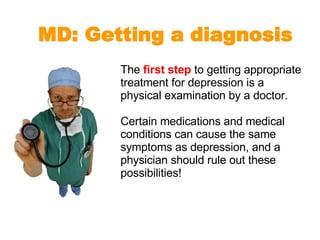
The  first step  to getting appropriate treatment for depression is a physical examination by a doctor.  Certain medications and medical conditions can cause the same symptoms as depression, and a physician should rule out these possibilities! MD: Getting a diagnosis
If a physical cause for the depression is ruled out, a psychological evaluation should be done by the physician or by referral to a psychiatrist or psychologist.  MD: Getting a diagnosis
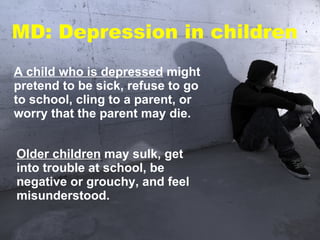
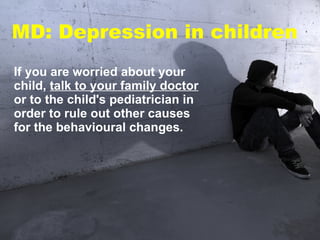
A child who is depressed  might pretend to be sick, refuse to go to school, cling to a parent, or worry that the parent may die.  Older children  may sulk, get into trouble at school, be negative or grouchy, and feel misunderstood.  MD: Depression in children
Because normal behaviors vary from one childhood stage to another, it  can be difficult to tell  whether a child is just going through a temporary "phase" or is suffering from depression. MD: Depression in children
If you are worried about your child,  talk to your family doctor  or to the child's pediatrician in order to rule out other causes for the behavioural changes.  MD: Depression in children
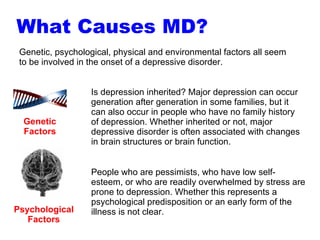
Genetic, psychological, physical and environmental factors all seem to be involved in the onset of a depressive disorder.  Genetic Factors Is depression inherited? Major depression can occur generation after generation in some families, but it can also occur in people who have no family history of depression. Whether inherited or not, major depressive disorder is often associated with changes in brain structures or brain function.  Psychological Factors People who are pessimists, who have low self-esteem, or who are readily overwhelmed by stress are prone to depression. Whether this represents a psychological predisposition or an early form of the illness is not clear.  What Causes MD?
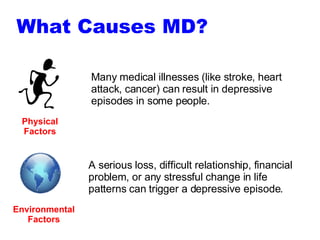
Physical Factors Many medical illnesses (like stroke, heart attack, cancer) can result in depressive episodes in some people. Environmental Factors A serious loss, difficult relationship, financial problem, or any stressful change in life patterns can trigger a depressive episode. What Causes MD?
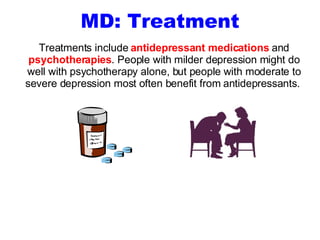
MD: Treatment Treatments include  antidepressant medications  and  psychotherapies . People with milder depression might do well with psychotherapy alone, but people with moderate to severe depression most often benefit from antidepressants.
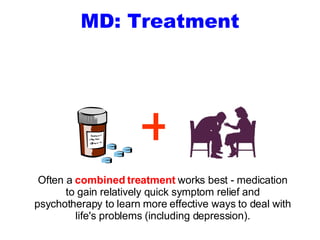
MD: Treatment Often a  combined treatment  works best - medication to gain relatively quick symptom relief and psychotherapy to learn more effective ways to deal with life's problems (including depression). +
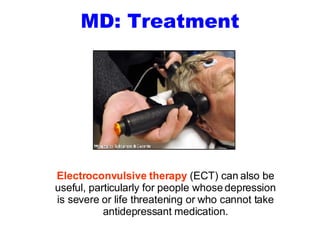
MD: Treatment Electroconvulsive therapy  (ECT) can also be useful, particularly for people whose depression is severe or life threatening or who cannot take antidepressant medication.
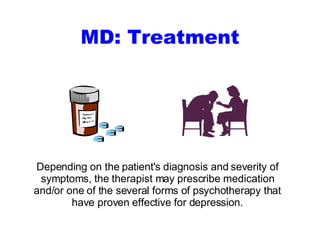
MD: Treatment Depending on the patient's diagnosis and severity of symptoms, the therapist may prescribe medication and/or one of the several forms of psychotherapy that have proven effective for depression.
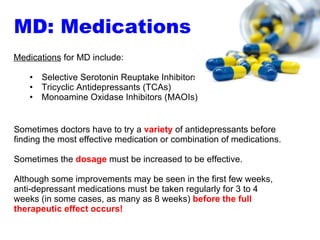
Sometimes doctors have to try a  variety  of antidepressants before finding the most effective medication or combination of medications.  Sometimes the  dosage  must be increased to be effective.  Although some improvements may be seen in the first few weeks, anti-depressant medications must be taken regularly for 3 to 4 weeks (in some cases, as many as 8 weeks)  before the full therapeutic effect occurs! Medications  for MD include: Selective Serotonin Reuptake Inhibitors (SSRIs) Tricyclic Antidepressants (TCAs) Monoamine Oxidase Inhibitors (MAOIs) MD: Medications
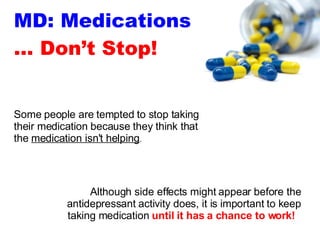
MD: Medications … Don’t Stop! Although side effects might appear before the antidepressant activity does, it is important to keep taking medication  until it has a chance to work!   Some people are tempted to stop taking their medication because they think that the  medication isn't helping .
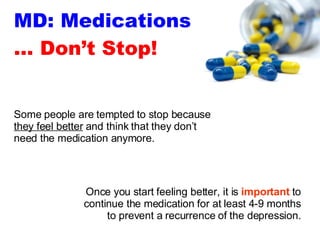
MD: Medications … Don’t Stop! Once you start feeling better, it is  important  to continue the medication for at least 4-9 months to prevent a recurrence of the depression. Some people are tempted to stop because  they feel better  and think that they don’t need the medication anymore.
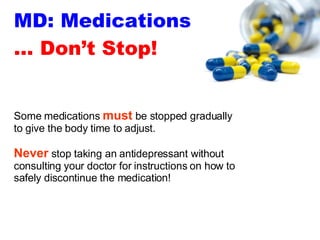
MD: Medications … Don’t Stop! Some medications  must  be stopped gradually to give the body time to adjust.  Never  stop taking an antidepressant without consulting your doctor for instructions on how to safely discontinue the medication!
Want to know more about  Major Depression? The information provided in this presentation is based on information provided by the National Institute of Mental Health.  For more information about MD, visit their website at  www.nimh.nih.gov  or talk to your family physician. _______________________________ Image Credits Slide 1:  Paulo Correa aka Nookiez -  http://www.sxc.hu/profile/nookiez
Sun Life Financial Chair In Adolescent Mental Health For more information visit WWW.TEENMENTALHEALTH.ORG BLOG.TEENMENTALHEALTH.ORG

Understanding Major Depression

  • 1.
  • 2.
    Major Depression (MD) is an illness that involves the body, mood, and thoughts. It affects the way a person eats and sleeps, the way one feels about oneself, and the way one thinks about things.
  • 3.
    MD is NOT a sign of personal weakness or a condition that can be willed or wished away.
  • 4.
    People with MD cannot merely "pull themselves together" and get better. Without treatment, symptoms can last for weeks, months, or years.
  • 5.
    Appropriate treatment, however, CAN help most people who suffer from depression.
  • 6.
    Major depression (MD)is manifested by a combination of symptoms that interfere with the ability to work, study, sleep, eat, and enjoy once pleasurable activities, including: Loss of interest Loss of sex drive Restlessness/irritability Insomnia Thoughts of death/suicide Guilt/worthlessness MD : What does it look like? Decreased energy or fatigue Difficulty concentrating/remembering Changes in appetite/weight Changes in sleep patterns Sad, anxious or empty mood Hopelessness/pessimism
  • 7.
    MD is oftenaccompanied by persistent physical symptoms that do not respond to treatment, including: Headaches Chronic pain Digestive disorders MD : What does it look like?
  • 8.
    Major depression CAN be treated! The great majority of people with depression (even those whose depression is extremely severe) can be helped. Unfortunately, most people with a depressive illness do not seek treatment. MD: Getting a diagnosis
  • 9.
    The firststep to getting appropriate treatment for depression is a physical examination by a doctor. Certain medications and medical conditions can cause the same symptoms as depression, and a physician should rule out these possibilities! MD: Getting a diagnosis
  • 10.
    If a physicalcause for the depression is ruled out, a psychological evaluation should be done by the physician or by referral to a psychiatrist or psychologist. MD: Getting a diagnosis
  • 11.
    A child whois depressed might pretend to be sick, refuse to go to school, cling to a parent, or worry that the parent may die. Older children may sulk, get into trouble at school, be negative or grouchy, and feel misunderstood. MD: Depression in children
  • 12.
    Because normal behaviorsvary from one childhood stage to another, it can be difficult to tell whether a child is just going through a temporary "phase" or is suffering from depression. MD: Depression in children
  • 13.
    If you areworried about your child, talk to your family doctor or to the child's pediatrician in order to rule out other causes for the behavioural changes. MD: Depression in children
  • 14.
    Genetic, psychological, physicaland environmental factors all seem to be involved in the onset of a depressive disorder. Genetic Factors Is depression inherited? Major depression can occur generation after generation in some families, but it can also occur in people who have no family history of depression. Whether inherited or not, major depressive disorder is often associated with changes in brain structures or brain function. Psychological Factors People who are pessimists, who have low self-esteem, or who are readily overwhelmed by stress are prone to depression. Whether this represents a psychological predisposition or an early form of the illness is not clear. What Causes MD?
  • 15.
    Physical Factors Manymedical illnesses (like stroke, heart attack, cancer) can result in depressive episodes in some people. Environmental Factors A serious loss, difficult relationship, financial problem, or any stressful change in life patterns can trigger a depressive episode. What Causes MD?
  • 16.
    MD: Treatment Treatmentsinclude antidepressant medications and psychotherapies . People with milder depression might do well with psychotherapy alone, but people with moderate to severe depression most often benefit from antidepressants.
  • 17.
    MD: Treatment Oftena combined treatment works best - medication to gain relatively quick symptom relief and psychotherapy to learn more effective ways to deal with life's problems (including depression). +
  • 18.
    MD: Treatment Electroconvulsivetherapy (ECT) can also be useful, particularly for people whose depression is severe or life threatening or who cannot take antidepressant medication.
  • 19.
    MD: Treatment Dependingon the patient's diagnosis and severity of symptoms, the therapist may prescribe medication and/or one of the several forms of psychotherapy that have proven effective for depression.
  • 20.
    Sometimes doctors haveto try a variety of antidepressants before finding the most effective medication or combination of medications. Sometimes the dosage must be increased to be effective. Although some improvements may be seen in the first few weeks, anti-depressant medications must be taken regularly for 3 to 4 weeks (in some cases, as many as 8 weeks) before the full therapeutic effect occurs! Medications for MD include: Selective Serotonin Reuptake Inhibitors (SSRIs) Tricyclic Antidepressants (TCAs) Monoamine Oxidase Inhibitors (MAOIs) MD: Medications
  • 21.
    MD: Medications …Don’t Stop! Although side effects might appear before the antidepressant activity does, it is important to keep taking medication until it has a chance to work! Some people are tempted to stop taking their medication because they think that the medication isn't helping .
  • 22.
    MD: Medications …Don’t Stop! Once you start feeling better, it is important to continue the medication for at least 4-9 months to prevent a recurrence of the depression. Some people are tempted to stop because they feel better and think that they don’t need the medication anymore.
  • 23.
    MD: Medications …Don’t Stop! Some medications must be stopped gradually to give the body time to adjust. Never stop taking an antidepressant without consulting your doctor for instructions on how to safely discontinue the medication!
  • 24.
    Want to knowmore about Major Depression? The information provided in this presentation is based on information provided by the National Institute of Mental Health. For more information about MD, visit their website at www.nimh.nih.gov or talk to your family physician. _______________________________ Image Credits Slide 1: Paulo Correa aka Nookiez - http://www.sxc.hu/profile/nookiez
  • 25.
    Sun Life FinancialChair In Adolescent Mental Health For more information visit WWW.TEENMENTALHEALTH.ORG BLOG.TEENMENTALHEALTH.ORG