TCA (Tricyclic Antidepressant Drugs)
------------------------------------
Examples:
1. Amitryptyline
2. Imipramine
3. Dothiepin
4. Trazodone
5. Clomipramine
------------------------------------
MAOI (Mono mine Oxidase Inhibitors)
------------------------------------
Non selective & Irreversible
Examples:
1. Phenelzine
2. Tranylcypromine
------------------------------------
• RIMA (Reversible Inhibitors of Monoamine Oxidase Type)
------------------------------------
Also called as Type A MAO Inhibitors
Also called as selective MAO Inhibitors
Example:
1. Moclobemide
------------------------------------
SSRI (Selective Serotonin Reuptake Inhibitors)
------------------------------------
Examples:
1. Fluvoxamine
2. Fluoxetine
3. SErtraline
4. Paroxetine
5. Citalopram
6. Escitalopram
------------------------------------
• SNRI (Serotonin and Noradrenaline Reuptake Inhibitors)
------------------------------------
Example:
1. Venlafaxine
------------------------------------
NaSSa (Noradrenergic and Specific Serotonergic Antidepressants)
------------------------------------
Example:
1. Mrtazapine
------------------------------------
NARI (Noradrenaline Reuptake Inhibitors)
------------------------------------
Example:
1. Reboxetine
• The signs and symptoms of depression include
• loss of interest in activities that were once interesting or enjoyable, including sex;
• loss of appetite (anorexia) with weight loss or overeating with weight gain;
• loss of emotional expression (flat affect);
• a persistently sad, anxious or empty mood;
• feelings of hopelessness, pessimism, guilt, worthlessness, or helplessness;
• social withdrawal;
• unusual fatigue, low energy level, a feeling of being slowed down;
• sleep disturbance with insomnia, early-morning awakening, or oversleeping;
• trouble concentrating, remembering, or making decisions;
• unusual restlessness or irritability;
• persistent physical problems such as headaches, digestive disorders,
or chronic pain that do not respond to treatment;
• thoughts of death or suicide or suicide attempts.
• Alcohol or drug abuse may be signs of depression.
• The principal types of depression are major depression,
• dysthymia, and
• bipolar disease (also called manic-depressive disease).
• Major depression causes a combination of symptoms that interfere with the ability to work,
study, sleep, eat, and enjoy once pleasurable activities.
• Such a disabling episode of depression may occur only once but more commonly occurs
several times in a lifetime.
• Dysthymia is a less severe type of depression with long-term chronic symptoms that do not
disable, but keep one from functioning well or from feeling good.
• Many people with dysthymia also experience major depressive episodes at some time in
their lives.
• Bipolar disorder (manic-depressive illness) is characterized by cycling mood changes: severe
highs (mania) and lows (depression).
• Sometimes the mood switches are dramatic and rapid, but more often they are gradual.
• When in the depressed phase of the cycle, one can have any or all of the symptoms of a
depressive disorder.
• When in the manic cycle, one may be overactive, over talkative, and have excess energy.
• Mania often affects thinking, judgment, and social behavior in ways that cause serious
problems and embarrassment.
• For example, the individual in a manic phase may feel elated, full of grand schemes that
might range from unwise business decisions to romantic sprees.
• Mania, left untreated, may worsen to a psychotic state.
• Bipolar disorder is not nearly as common as other forms of depressive disorders.
• There are four main biological factors that can increase a persons risk for depression and
these include
• (1) genetic factors,
• (2) biochemical factors,
• (3) alterations in hormonal regulation and,
• (4) sleep abnormalities.
• Genetic Factors
• Studies done with twins have shown that genetic factors play a role in the development
of depressive disorders. There have been a number of studies done that show that the
average rate of shared mood disorders among identical twins is 45% to 60%. This means
if one twin suffers from depression, or any other mood disorder, there is a 45% to 60%
chance that the other twin will also be affected. Contrast this with fraternal twins where
the percentage falls of drastically to only 12%.
• Moods disorders are inheritable for some people. This also means that those who are
genetically susceptible to mood disorders can have an earlier age of onset, a greater rate
of suffering other disorders in addition to depression and an increased risk of recurrent
illnesses. However, any genetic factors that are present must interact with environmental
factors for depression to develop.
• Biochemical Factors
• The brain contains billions of neurons and is a highly complex organ. There is a lot of
evidence that points to the idea that depression is a biological or chemical disorder where
central nervous system neurotransmitter abnormalities are a probable cause of clinical
depression.
• These neurotransmitter abnormalities may be the result of
1.inherited or
2.environmental factors, or
3.even of other medical conditions, such as cerebral infarction, hypothyroidism,
AIDS, or substance abuse.
• Specific neurotransmitters in the brain are believed to be related to mood altered states.
It was initially believed that the two main neurotransmitters involved were serotonin and
norepinephrine.
• With new research though it is now thought that depression results from the
dysregulation of a number of neurotransmitter systems in addition to serotonin and
norepinephrine.
• The dopamine, acetylcholine, and GABA systems are also believed to be involved in the
pathophysiology of major depression.
Alterations in Hormonal Regulation
• Although there is still inconclusive evidence that hormones can play a role in depression.
The most studied neuroendocrine characteristic that relates to depression has been
hyperactivity of the hypothalamic-pituitary-adrenal cortical axis. Evidence of increased
cortisol secretion is apparent in 20% to 40% of depressed outpatients and 40% to 60% of
depressed inpatients.
• Significantly, patients with psychotic major depression are among those with the highest
rates of nonsuppression of cortisol on the dexamethasone suppression test.
Sleep Abnormalities
• Sleep electroencephalogram abnormalities may be evident in 40% to 60% of outpatients
and up to 90% of inpatients during a major depressive episode.
• People prone to depression tend to have a pre-mature loss of sleep, slow delta wave
sleep and altered rapid eye movement (REM) latency.
• The phase of REM sleep associated with dreaming occurs earlier in two thirds of people
with bipolar and major depressive illnesses.
• This sign is referred to as reduced REM latency and is consistent with the expected
manifestation of an inherited trait. Reduced REM latency and deficits in slow-wave sleep
typical persist following recovery from a depressed episode.
• Data also suggests that depressed patients without this sign are not likely to respond to
treatment with tricyclic antidepressants, which suppress early REM sleep.
Monoamine Oxidase Inhibitors
• Antidepressant therapy usually implies therapy directed against major
depressive disorders of the unipolar type and is centered on three groups of
chemical agents:
1. the MAOIs,
2. the monoamine reuptake inhibitors, and
3. autoreceptor desensitizers and antagonists.
• Electroshock therapy is another option.
The highest cure or remission rate is achieved with electroshock therapy.
In some patients, especially those who are suicidal, this may be the preferred
therapy.
• MAOIs and monoamine reuptake inhibitors have about the same response
rate (60%–70%).
• A key prescribing tenet is that if a member of the patient’s family has been
successfully treated with an anti-depressant drug, then the patient will likely
respond to that same drug.
• A severe problem associated with the MAOIs that has been a major factor in
relerating them to second-line drug status is that the original compounds inhibit
liver MAOs irreversibly in addition to brain MAOs, thereby allowing dietary
pressor amines that normally would be inactivated to exert their effects
systemically.
• Several severe hypertensive responses, some fatal, have followed ingestion of
foods high in pressor amines.
• It was hoped that the development of agents such as selegiline that presumably
spare liver MAO might solve this problem. The approach of using MAO
selectivity did solve the hypertensive problem, but the compound was not an
antidepressant (it is useful in Parkinson disease).
• Another approach using a reversible MAOI has yielded antidepressants that
lacked the hypertensive “cheese” effect.
• Another prominent side effect of MAOIs isorthostatic hypotension, said to arise
from a block of NE re-leased in the periphery.
• Actually, one MAOI, pargyline, was used clinically for its hypotensive action.
• Finally, some of the first compounds produced serious hepatotoxicity.
• Compounds available today reportedly are safer in this regard but suffer the
stigma of association with the older compounds.
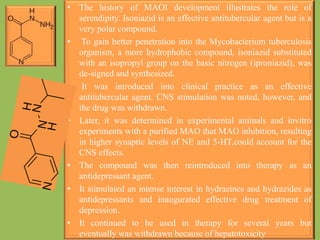
• The history of MAOI development illustrates the role of
serendipity. Isoniazid is an effective antitubercular agent but is a
very polar compound.
• To gain better penetration into the Mycobacterium tuberculosis
organism, a more hydrophobic compound, isoniazid substituted
with an isopropyl group on the basic nitrogen (iproniazid), was
de-signed and synthesized.
• It was introduced into clinical practice as an effective
antitubercular agent. CNS stimulation was noted, however, and
the drug was withdrawn.
• Later, it was determined in experimental animals and invitro
experiments with a purified MAO that MAO inhibition, resulting
in higher synaptic levels of NE and 5-HT,could account for the
CNS effects.
• The compound was then reintroduced into therapy as an
antidepressant agent.
• It stimulated an intense interest in hydrazines and hydrazides as
antidepressants and inaugurated effective drug treatment of
depression.
• It continued to be used in therapy for several years but
eventually was withdrawn because of hepatotoxicity
• The present clinically useful irreversible inactivators can be considered mechanism-
based inhibitors of MAO.
• They are converted by MAO to agents that inhibit the enzyme.
• They can form reactants that bond covalently with the enzyme or its cofactor.
• A consequence of irreversible inactivation is that the action of the agents may continue
for up to 2 weeks after administration is discontinued.
• The delay is caused by the necessity of synthesizing new, active MAO to replace the
covalently inactivated enzyme.
• Consequently, many drugs degraded by MAO or drugs that elevate levels of MAO
substrates cannot be administered during that time.
• For a long time, because the agents that opened the field and then dominated it were
irreversible inactivator, MAO inhibition was almost always regarded as irreversible.
• From the beginning, however, it was known that it was possible to have agents that act
exclusively by competitive enzyme inhibition.
• For example, it has long been known that the harmala alkaloids harmine and harmaline
act as CNS stimulants by competitive inhibition of MAO.
• Reversible(competitive) inhibitors selective for each of the two major MAO subtypes
(A and B) are reportedly forthcoming.
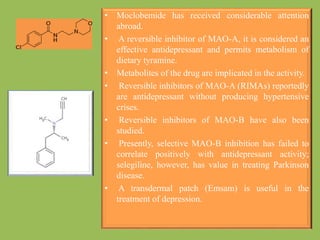
• Moclobemide has received considerable attention
abroad.
• A reversible inhibitor of MAO-A, it is considered an
effective antidepressant and permits metabolism of
dietary tyramine.
• Metabolites of the drug are implicated in the activity.
• Reversible inhibitors of MAO-A (RIMAs) reportedly
are antidepressant without producing hypertensive
crises.
• Reversible inhibitors of MAO-B have also been
studied.
• Presently, selective MAO-B inhibition has failed to
correlate positively with antidepressant activity;
selegiline, however, has value in treating Parkinson
disease.
• A transdermal patch (Emsam) is useful in the
treatment of depression.
• The clinically useful MAOI antidepressants are non
selective between inhibiting metabolism of NE and
5-HT.
• Agents selective for a MAO that degrades 5-HT
have been under study for some time.
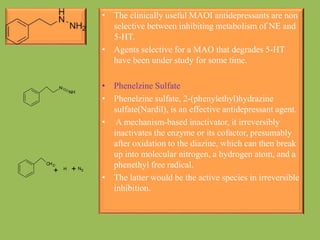
• Phenelzine Sulfate
• Phenelzine sulfate, 2-(phenylethyl)hydrazine
sulfate(Nardil), is an effective antidepressant agent.
• A mechanism-based inactivator, it irreversibly
inactivates the enzyme or its cofactor, presumably
after oxidation to the diazine, which can then break
up into molecular nitrogen, a hydrogen atom, and a
phenethyl free radical.
• The latter would be the active species in irreversible
inhibition.
N
NH
CH2.
+ +H N2
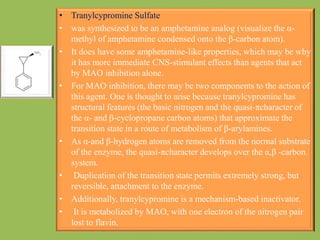
• Tranylcypromine Sulfate
• was synthesized to be an amphetamine analog (visualize the α-
methyl of amphetamine condensed onto the β-carbon atom).
• It does have some amphetamine-like properties, which may be why
it has more immediate CNS-stimulant effects than agents that act
by MAO inhibition alone.
• For MAO inhibition, there may be two components to the action of
this agent. One is thought to arise because tranylcypromine has
structural features (the basic nitrogen and the quasi-πcharacter of
the α- and β-cyclopropane carbon atoms) that approximate the
transition state in a route of metabolism of β-arylamines.
• As α-and β-hydrogen atoms are removed from the normal substrate
of the enzyme, the quasi-πcharacter develops over the α,β -carbon
system.
• Duplication of the transition state permits extremely strong, but
reversible, attachment to the enzyme.
• Additionally, tranylcypromine is a mechanism-based inactivator.
• It is metabolized by MAO, with one electron of the nitrogen pair
lost to flavin.
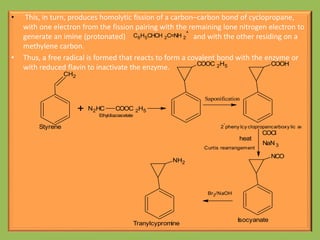
• This, in turn, produces homolytic fission of a carbon–carbon bond of cyclopropane,
with one electron from the fission pairing with the remaining lone nitrogen electron to
generate an imine (protonated) and with the other residing on a
methylene carbon.
• Thus, a free radical is formed that reacts to form a covalent bond with the enzyme or
with reduced flavin to inactivate the enzyme.
CH2
Styrene
+ N2HC COOC 2H5
Ethyldiazoacetate
COOC 2H5 COOH
Saponification
NCO
COCl
NaN3
heat
Curtis rearrangement
Isocyanate
Br2/NaOH
NH2
Tranylcypromine
2
-
pheny lcy clopropancarboxy lic acid
C6H5CHCH 2C=NH 2
+
Mechanism action of MAO
• MAO is an enzyme found in all tissues & almost all cells, bound to the outer
mitochondrial membrane.
• It catalyses the deamination of primary & secndary amines.
• The mechanism of deamination is as follows
Four structural types;
1. Hydrazines;
2. cyclopropylamines;
3. Propargylamines;
4.Carbolines
Chemically two major classes;
1. Hydrazidse eg Phenelgine &
2. Non hydrazides eg Tranylcypromine
Mechanistically two types of MAO
MAO-A; deaminates serotonin & NE but not phenykethylamine
MAO-B; deaminates phenylethyamine better than serotonin & NE
R CH NH2
H
Flavin
R CH
+
NH2
-
R CH NH
H2O
R CH O + NH3
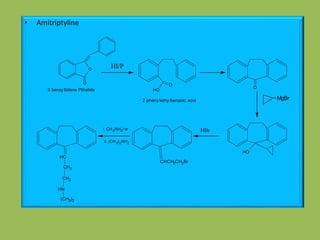
• Amitriptyline
O
O
3 benzy llidene Pthalide
HI/P
OH
O
O
MgBr
OH
HBr
CHCH2CH2Br
CH
CH2
CH2
NH
(CH3)2
i. CH3NH2/ or
ii. (CH3)2NH2
2
-
pheny lethy lbenzoic acid
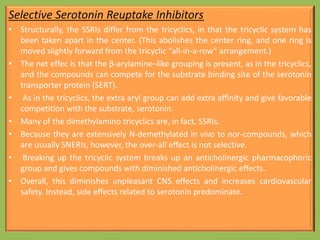
Selective Serotonin Reuptake Inhibitors
• Structurally, the SSRIs differ from the tricyclics, in that the tricyclic system has
been taken apart in the center. (This abolishes the center ring, and one ring is
moved slightly forward from the tricyclic “all-in-a-row” arrangement.)
• The net effec is that the β-arylamine–like grouping is present, as in the tricyclics,
and the compounds can compete for the substrate binding site of the serotonin
transporter protein (SERT).
• As in the tricyclics, the extra aryl group can add extra affinity and give favorable
competition with the substrate, serotonin.
• Many of the dimethylamino tricyclics are, in fact, SSRIs.
• Because they are extensively N-demethylated in vivo to nor-compounds, which
are usually SNERIs, however, the over-all effect is not selective.
• Breaking up the tricyclic system breaks up an anticholinergic pharmacophoric
group and gives compounds with diminished anticholinergic effects.
• Overall, this diminishes unpleasant CNS effects and increases cardiovascular
safety. Instead, side effects related to serotonin predominate.
Fluoxetine
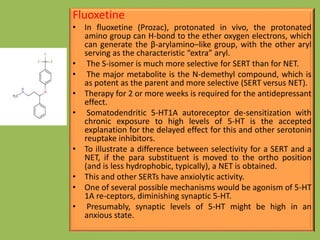
• In fluoxetine (Prozac), protonated in vivo, the protonated
amino group can H-bond to the ether oxygen electrons, which
can generate the β-arylamino–like group, with the other aryl
serving as the characteristic “extra” aryl.
• The S-isomer is much more selective for SERT than for NET.
• The major metabolite is the N-demethyl compound, which is
as potent as the parent and more selective (SERT versus NET).
• Therapy for 2 or more weeks is required for the antidepressant
effect.
• Somatodendritic 5-HT1A autoreceptor de-sensitization with
chronic exposure to high levels of 5-HT is the accepted
explanation for the delayed effect for this and other serotonin
reuptake inhibitors.
• To illustrate a difference between selectivity for a SERT and a
NET, if the para substituent is moved to the ortho position
(and is less hydrophobic, typically), a NET is obtained.
• This and other SERTs have anxiolytic activity.
• One of several possible mechanisms would be agonism of 5-HT
1A re-ceptors, diminishing synaptic 5-HT.
• Presumably, synaptic levels of 5-HT might be high in an
anxious state.
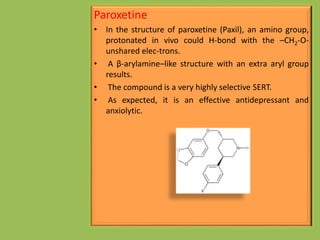
Paroxetine
• In the structure of paroxetine (Paxil), an amino group,
protonated in vivo could H-bond with the –CH2-O-
unshared elec-trons.
• A β-arylamine–like structure with an extra aryl group
results.
• The compound is a very highly selective SERT.
• As expected, it is an effective antidepressant and
anxiolytic.
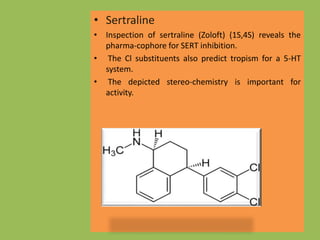
• Sertraline
• Inspection of sertraline (Zoloft) (1S,4S) reveals the
pharma-cophore for SERT inhibition.
• The Cl substituents also predict tropism for a 5-HT
system.
• The depicted stereo-chemistry is important for
activity.
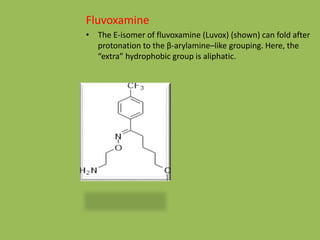
Fluvoxamine
• The E-isomer of fluvoxamine (Luvox) (shown) can fold after
protonation to the β-arylamine–like grouping. Here, the
“extra” hydrophobic group is aliphatic.
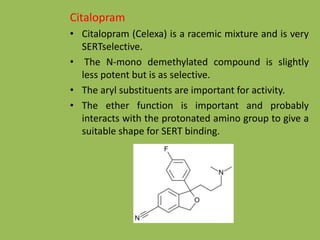
Citalopram
• Citalopram (Celexa) is a racemic mixture and is very
SERTselective.
• The N-mono demethylated compound is slightly
less potent but is as selective.
• The aryl substituents are important for activity.
• The ether function is important and probably
interacts with the protonated amino group to give a
suitable shape for SERT binding.
Selective Norepinephrine Reuptake Inhibitors
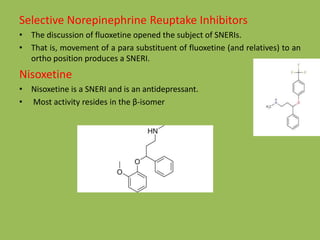
• The discussion of fluoxetine opened the subject of SNERIs.
• That is, movement of a para substituent of fluoxetine (and relatives) to an
ortho position produces a SNERI.
Nisoxetine
• Nisoxetine is a SNERI and is an antidepressant.
• Most activity resides in the β-isomer
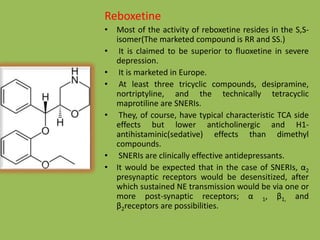
Reboxetine
• Most of the activity of reboxetine resides in the S,S-
isomer(The marketed compound is RR and SS.)
• It is claimed to be superior to fluoxetine in severe
depression.
• It is marketed in Europe.
• At least three tricyclic compounds, desipramine,
nortriptyline, and the technically tetracyclic
maprotiline are SNERIs.
• They, of course, have typical characteristic TCA side
effects but lower anticholinergic and H1-
antihistaminic(sedative) effects than dimethyl
compounds.
• SNERIs are clinically effective antidepressants.
• It would be expected that in the case of SNERIs, α2
presynaptic receptors would be desensitized, after
which sustained NE transmission would be via one or
more post-synaptic receptors; α 1, β1, and
β2receptors are possibilities.
Newer (Nontricyclic) Nonselective 5-HT And NE Reuptake Inhibitors
• Presently, one such compound is clinically used in theUnited States.
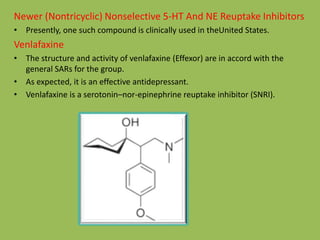
Venlafaxine
• The structure and activity of venlafaxine (Effexor) are in accord with the
general SARs for the group.
• As expected, it is an effective antidepressant.
• Venlafaxine is a serotonin–nor-epinephrine reuptake inhibitor (SNRI).
Selective Serotoninergic ReuptakeInhibitors and 5-HT2A Antagonists
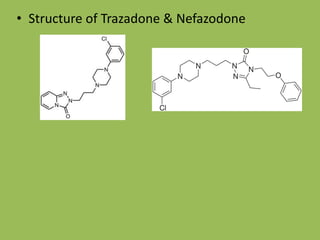
• The SSRIs and 5-HT2Aantagonists are represented by trazodone (Desyrel) and
nefazodone (Serzone).
• The structures of these two compounds derive from those of the
fluorobutyrophenone antipsychotics.
• They have β-arylamine–like structures that permit binding to the SERT and inhibit
5-HT reuptake.
• In these compounds, the additional hydrophobic substituent can be viewed as
being attached to the nitrogen of the β-arylamine–like group.
• Additionally, they are 5-HT2Aantagonists.
• 5-HT2Aantagonists appear to have antidepressant and anxiolytic activities.
• They may act, at least in part, by enhancing 5-HT1Aactivities.
• Also, some of the effects may be mediated through 5-HT2Cagonism. perhaps
generally so for 5-HT–acting antidepressants).
• Structure of Trazadone & Nefazodone
• Some of the side effects of SSRIs are considered to be mediated through 5-
HT2Areceptors, so a 5-HT2Ablocker would reduce them.
• The two compounds yield the same compound on N-dealkylation.
• It is a serotonin reuptake inhibitor.
• The most common use of trazodone is not as an antidepressant.
• A 100-mg dose can be used as a sedative–hypnotic.
• Despite this use, it has been shown that nefazodone produces better sleep
hygiene than does trazodone, which is a rapid eye movement (REM)-
suppressing compound.
5-HT1AAgonists and Partial Agonists
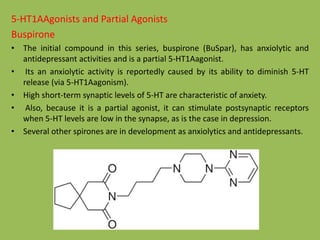
Buspirone
• The initial compound in this series, buspirone (BuSpar), has anxiolytic and
antidepressant activities and is a partial 5-HT1Aagonist.
• Its an anxiolytic activity is reportedly caused by its ability to diminish 5-HT
release (via 5-HT1Aagonism).
• High short-term synaptic levels of 5-HT are characteristic of anxiety.
• Also, because it is a partial agonist, it can stimulate postsynaptic receptors
when 5-HT levels are low in the synapse, as is the case in depression.
• Several other spirones are in development as anxiolytics and antidepressants.
Synthesis of Buspirone
N
N
Cl
2
-
Chloro pyrimidine
NHNH
N
N
NNH
Cl(CH2)3CN
4-
Chloro butyronitrile
(alkylation)
N
N
N
N
NC
LiAlH4[H]
N
N
N
N
NH2
O
O
O
Spirocyclic glutaric anhydrideO
O
N
N
N
N
N
Buspirone
α 2 Antagonists
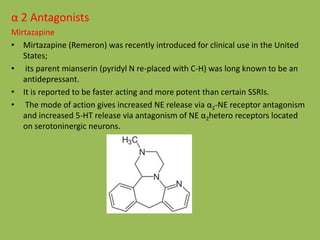
Mirtazapine
• Mirtazapine (Remeron) was recently introduced for clinical use in the United
States;
• its parent mianserin (pyridyl N re-placed with C-H) was long known to be an
antidepressant.
• It is reported to be faster acting and more potent than certain SSRIs.
• The mode of action gives increased NE release via α2-NE receptor antagonism
and increased 5-HT release via antagonism of NE α2hetero receptors located
on serotoninergic neurons.
O
CH3
Acetophenone
1) HCHO
2) (CH3)2NH
Mannich reaction
O N
CH3
CH3
[H]
B2H6
Reduction
OH N
CH3
CH3
SOCl 2
Cl N
CH3
CH3
OH
CF3
NaOH
F3C
O
N
CH3
CH3
CNBr
-CH3
Van Braun reaction
F3C
O
N
H
CH3
Fluxetine
Synthesis of Fluxetine
Antidepressants

Antidepressants

  • 1.
    TCA (Tricyclic AntidepressantDrugs) ------------------------------------ Examples: 1. Amitryptyline 2. Imipramine 3. Dothiepin 4. Trazodone 5. Clomipramine ------------------------------------ MAOI (Mono mine Oxidase Inhibitors) ------------------------------------ Non selective & Irreversible Examples: 1. Phenelzine 2. Tranylcypromine ------------------------------------
  • 2.
    • RIMA (ReversibleInhibitors of Monoamine Oxidase Type) ------------------------------------ Also called as Type A MAO Inhibitors Also called as selective MAO Inhibitors Example: 1. Moclobemide ------------------------------------ SSRI (Selective Serotonin Reuptake Inhibitors) ------------------------------------ Examples: 1. Fluvoxamine 2. Fluoxetine 3. SErtraline 4. Paroxetine 5. Citalopram 6. Escitalopram ------------------------------------
  • 3.
    • SNRI (Serotoninand Noradrenaline Reuptake Inhibitors) ------------------------------------ Example: 1. Venlafaxine ------------------------------------ NaSSa (Noradrenergic and Specific Serotonergic Antidepressants) ------------------------------------ Example: 1. Mrtazapine ------------------------------------ NARI (Noradrenaline Reuptake Inhibitors) ------------------------------------ Example: 1. Reboxetine
  • 4.
    • The signsand symptoms of depression include • loss of interest in activities that were once interesting or enjoyable, including sex; • loss of appetite (anorexia) with weight loss or overeating with weight gain; • loss of emotional expression (flat affect); • a persistently sad, anxious or empty mood; • feelings of hopelessness, pessimism, guilt, worthlessness, or helplessness; • social withdrawal; • unusual fatigue, low energy level, a feeling of being slowed down; • sleep disturbance with insomnia, early-morning awakening, or oversleeping; • trouble concentrating, remembering, or making decisions; • unusual restlessness or irritability; • persistent physical problems such as headaches, digestive disorders, or chronic pain that do not respond to treatment; • thoughts of death or suicide or suicide attempts. • Alcohol or drug abuse may be signs of depression.
  • 5.
    • The principaltypes of depression are major depression, • dysthymia, and • bipolar disease (also called manic-depressive disease). • Major depression causes a combination of symptoms that interfere with the ability to work, study, sleep, eat, and enjoy once pleasurable activities. • Such a disabling episode of depression may occur only once but more commonly occurs several times in a lifetime. • Dysthymia is a less severe type of depression with long-term chronic symptoms that do not disable, but keep one from functioning well or from feeling good. • Many people with dysthymia also experience major depressive episodes at some time in their lives. • Bipolar disorder (manic-depressive illness) is characterized by cycling mood changes: severe highs (mania) and lows (depression). • Sometimes the mood switches are dramatic and rapid, but more often they are gradual. • When in the depressed phase of the cycle, one can have any or all of the symptoms of a depressive disorder. • When in the manic cycle, one may be overactive, over talkative, and have excess energy. • Mania often affects thinking, judgment, and social behavior in ways that cause serious problems and embarrassment. • For example, the individual in a manic phase may feel elated, full of grand schemes that might range from unwise business decisions to romantic sprees. • Mania, left untreated, may worsen to a psychotic state. • Bipolar disorder is not nearly as common as other forms of depressive disorders.
  • 6.
    • There arefour main biological factors that can increase a persons risk for depression and these include • (1) genetic factors, • (2) biochemical factors, • (3) alterations in hormonal regulation and, • (4) sleep abnormalities. • Genetic Factors • Studies done with twins have shown that genetic factors play a role in the development of depressive disorders. There have been a number of studies done that show that the average rate of shared mood disorders among identical twins is 45% to 60%. This means if one twin suffers from depression, or any other mood disorder, there is a 45% to 60% chance that the other twin will also be affected. Contrast this with fraternal twins where the percentage falls of drastically to only 12%. • Moods disorders are inheritable for some people. This also means that those who are genetically susceptible to mood disorders can have an earlier age of onset, a greater rate of suffering other disorders in addition to depression and an increased risk of recurrent illnesses. However, any genetic factors that are present must interact with environmental factors for depression to develop.
  • 7.
    • Biochemical Factors •The brain contains billions of neurons and is a highly complex organ. There is a lot of evidence that points to the idea that depression is a biological or chemical disorder where central nervous system neurotransmitter abnormalities are a probable cause of clinical depression. • These neurotransmitter abnormalities may be the result of 1.inherited or 2.environmental factors, or 3.even of other medical conditions, such as cerebral infarction, hypothyroidism, AIDS, or substance abuse. • Specific neurotransmitters in the brain are believed to be related to mood altered states. It was initially believed that the two main neurotransmitters involved were serotonin and norepinephrine. • With new research though it is now thought that depression results from the dysregulation of a number of neurotransmitter systems in addition to serotonin and norepinephrine. • The dopamine, acetylcholine, and GABA systems are also believed to be involved in the pathophysiology of major depression.
  • 8.
    Alterations in HormonalRegulation • Although there is still inconclusive evidence that hormones can play a role in depression. The most studied neuroendocrine characteristic that relates to depression has been hyperactivity of the hypothalamic-pituitary-adrenal cortical axis. Evidence of increased cortisol secretion is apparent in 20% to 40% of depressed outpatients and 40% to 60% of depressed inpatients. • Significantly, patients with psychotic major depression are among those with the highest rates of nonsuppression of cortisol on the dexamethasone suppression test. Sleep Abnormalities • Sleep electroencephalogram abnormalities may be evident in 40% to 60% of outpatients and up to 90% of inpatients during a major depressive episode. • People prone to depression tend to have a pre-mature loss of sleep, slow delta wave sleep and altered rapid eye movement (REM) latency. • The phase of REM sleep associated with dreaming occurs earlier in two thirds of people with bipolar and major depressive illnesses. • This sign is referred to as reduced REM latency and is consistent with the expected manifestation of an inherited trait. Reduced REM latency and deficits in slow-wave sleep typical persist following recovery from a depressed episode. • Data also suggests that depressed patients without this sign are not likely to respond to treatment with tricyclic antidepressants, which suppress early REM sleep.
  • 9.
    Monoamine Oxidase Inhibitors •Antidepressant therapy usually implies therapy directed against major depressive disorders of the unipolar type and is centered on three groups of chemical agents: 1. the MAOIs, 2. the monoamine reuptake inhibitors, and 3. autoreceptor desensitizers and antagonists. • Electroshock therapy is another option. The highest cure or remission rate is achieved with electroshock therapy. In some patients, especially those who are suicidal, this may be the preferred therapy. • MAOIs and monoamine reuptake inhibitors have about the same response rate (60%–70%). • A key prescribing tenet is that if a member of the patient’s family has been successfully treated with an anti-depressant drug, then the patient will likely respond to that same drug.
  • 10.
    • A severeproblem associated with the MAOIs that has been a major factor in relerating them to second-line drug status is that the original compounds inhibit liver MAOs irreversibly in addition to brain MAOs, thereby allowing dietary pressor amines that normally would be inactivated to exert their effects systemically. • Several severe hypertensive responses, some fatal, have followed ingestion of foods high in pressor amines. • It was hoped that the development of agents such as selegiline that presumably spare liver MAO might solve this problem. The approach of using MAO selectivity did solve the hypertensive problem, but the compound was not an antidepressant (it is useful in Parkinson disease). • Another approach using a reversible MAOI has yielded antidepressants that lacked the hypertensive “cheese” effect. • Another prominent side effect of MAOIs isorthostatic hypotension, said to arise from a block of NE re-leased in the periphery. • Actually, one MAOI, pargyline, was used clinically for its hypotensive action. • Finally, some of the first compounds produced serious hepatotoxicity. • Compounds available today reportedly are safer in this regard but suffer the stigma of association with the older compounds.
  • 11.
    • The historyof MAOI development illustrates the role of serendipity. Isoniazid is an effective antitubercular agent but is a very polar compound. • To gain better penetration into the Mycobacterium tuberculosis organism, a more hydrophobic compound, isoniazid substituted with an isopropyl group on the basic nitrogen (iproniazid), was de-signed and synthesized. • It was introduced into clinical practice as an effective antitubercular agent. CNS stimulation was noted, however, and the drug was withdrawn. • Later, it was determined in experimental animals and invitro experiments with a purified MAO that MAO inhibition, resulting in higher synaptic levels of NE and 5-HT,could account for the CNS effects. • The compound was then reintroduced into therapy as an antidepressant agent. • It stimulated an intense interest in hydrazines and hydrazides as antidepressants and inaugurated effective drug treatment of depression. • It continued to be used in therapy for several years but eventually was withdrawn because of hepatotoxicity
  • 12.
    • The presentclinically useful irreversible inactivators can be considered mechanism- based inhibitors of MAO. • They are converted by MAO to agents that inhibit the enzyme. • They can form reactants that bond covalently with the enzyme or its cofactor. • A consequence of irreversible inactivation is that the action of the agents may continue for up to 2 weeks after administration is discontinued. • The delay is caused by the necessity of synthesizing new, active MAO to replace the covalently inactivated enzyme. • Consequently, many drugs degraded by MAO or drugs that elevate levels of MAO substrates cannot be administered during that time. • For a long time, because the agents that opened the field and then dominated it were irreversible inactivator, MAO inhibition was almost always regarded as irreversible. • From the beginning, however, it was known that it was possible to have agents that act exclusively by competitive enzyme inhibition. • For example, it has long been known that the harmala alkaloids harmine and harmaline act as CNS stimulants by competitive inhibition of MAO. • Reversible(competitive) inhibitors selective for each of the two major MAO subtypes (A and B) are reportedly forthcoming.
  • 13.
    • Moclobemide hasreceived considerable attention abroad. • A reversible inhibitor of MAO-A, it is considered an effective antidepressant and permits metabolism of dietary tyramine. • Metabolites of the drug are implicated in the activity. • Reversible inhibitors of MAO-A (RIMAs) reportedly are antidepressant without producing hypertensive crises. • Reversible inhibitors of MAO-B have also been studied. • Presently, selective MAO-B inhibition has failed to correlate positively with antidepressant activity; selegiline, however, has value in treating Parkinson disease. • A transdermal patch (Emsam) is useful in the treatment of depression.
  • 14.
    • The clinicallyuseful MAOI antidepressants are non selective between inhibiting metabolism of NE and 5-HT. • Agents selective for a MAO that degrades 5-HT have been under study for some time. • Phenelzine Sulfate • Phenelzine sulfate, 2-(phenylethyl)hydrazine sulfate(Nardil), is an effective antidepressant agent. • A mechanism-based inactivator, it irreversibly inactivates the enzyme or its cofactor, presumably after oxidation to the diazine, which can then break up into molecular nitrogen, a hydrogen atom, and a phenethyl free radical. • The latter would be the active species in irreversible inhibition. N NH CH2. + +H N2
  • 15.
    • Tranylcypromine Sulfate •was synthesized to be an amphetamine analog (visualize the α- methyl of amphetamine condensed onto the β-carbon atom). • It does have some amphetamine-like properties, which may be why it has more immediate CNS-stimulant effects than agents that act by MAO inhibition alone. • For MAO inhibition, there may be two components to the action of this agent. One is thought to arise because tranylcypromine has structural features (the basic nitrogen and the quasi-πcharacter of the α- and β-cyclopropane carbon atoms) that approximate the transition state in a route of metabolism of β-arylamines. • As α-and β-hydrogen atoms are removed from the normal substrate of the enzyme, the quasi-πcharacter develops over the α,β -carbon system. • Duplication of the transition state permits extremely strong, but reversible, attachment to the enzyme. • Additionally, tranylcypromine is a mechanism-based inactivator. • It is metabolized by MAO, with one electron of the nitrogen pair lost to flavin.
  • 16.
    • This, inturn, produces homolytic fission of a carbon–carbon bond of cyclopropane, with one electron from the fission pairing with the remaining lone nitrogen electron to generate an imine (protonated) and with the other residing on a methylene carbon. • Thus, a free radical is formed that reacts to form a covalent bond with the enzyme or with reduced flavin to inactivate the enzyme. CH2 Styrene + N2HC COOC 2H5 Ethyldiazoacetate COOC 2H5 COOH Saponification NCO COCl NaN3 heat Curtis rearrangement Isocyanate Br2/NaOH NH2 Tranylcypromine 2 - pheny lcy clopropancarboxy lic acid C6H5CHCH 2C=NH 2 +
  • 17.
    Mechanism action ofMAO • MAO is an enzyme found in all tissues & almost all cells, bound to the outer mitochondrial membrane. • It catalyses the deamination of primary & secndary amines. • The mechanism of deamination is as follows Four structural types; 1. Hydrazines; 2. cyclopropylamines; 3. Propargylamines; 4.Carbolines Chemically two major classes; 1. Hydrazidse eg Phenelgine & 2. Non hydrazides eg Tranylcypromine Mechanistically two types of MAO MAO-A; deaminates serotonin & NE but not phenykethylamine MAO-B; deaminates phenylethyamine better than serotonin & NE R CH NH2 H Flavin R CH + NH2 - R CH NH H2O R CH O + NH3
  • 18.
    • Amitriptyline O O 3 benzyllidene Pthalide HI/P OH O O MgBr OH HBr CHCH2CH2Br CH CH2 CH2 NH (CH3)2 i. CH3NH2/ or ii. (CH3)2NH2 2 - pheny lethy lbenzoic acid
  • 19.
    Selective Serotonin ReuptakeInhibitors • Structurally, the SSRIs differ from the tricyclics, in that the tricyclic system has been taken apart in the center. (This abolishes the center ring, and one ring is moved slightly forward from the tricyclic “all-in-a-row” arrangement.) • The net effec is that the β-arylamine–like grouping is present, as in the tricyclics, and the compounds can compete for the substrate binding site of the serotonin transporter protein (SERT). • As in the tricyclics, the extra aryl group can add extra affinity and give favorable competition with the substrate, serotonin. • Many of the dimethylamino tricyclics are, in fact, SSRIs. • Because they are extensively N-demethylated in vivo to nor-compounds, which are usually SNERIs, however, the over-all effect is not selective. • Breaking up the tricyclic system breaks up an anticholinergic pharmacophoric group and gives compounds with diminished anticholinergic effects. • Overall, this diminishes unpleasant CNS effects and increases cardiovascular safety. Instead, side effects related to serotonin predominate.
  • 20.
    Fluoxetine • In fluoxetine(Prozac), protonated in vivo, the protonated amino group can H-bond to the ether oxygen electrons, which can generate the β-arylamino–like group, with the other aryl serving as the characteristic “extra” aryl. • The S-isomer is much more selective for SERT than for NET. • The major metabolite is the N-demethyl compound, which is as potent as the parent and more selective (SERT versus NET). • Therapy for 2 or more weeks is required for the antidepressant effect. • Somatodendritic 5-HT1A autoreceptor de-sensitization with chronic exposure to high levels of 5-HT is the accepted explanation for the delayed effect for this and other serotonin reuptake inhibitors. • To illustrate a difference between selectivity for a SERT and a NET, if the para substituent is moved to the ortho position (and is less hydrophobic, typically), a NET is obtained. • This and other SERTs have anxiolytic activity. • One of several possible mechanisms would be agonism of 5-HT 1A re-ceptors, diminishing synaptic 5-HT. • Presumably, synaptic levels of 5-HT might be high in an anxious state.
  • 21.
    Paroxetine • In thestructure of paroxetine (Paxil), an amino group, protonated in vivo could H-bond with the –CH2-O- unshared elec-trons. • A β-arylamine–like structure with an extra aryl group results. • The compound is a very highly selective SERT. • As expected, it is an effective antidepressant and anxiolytic.
  • 22.
    • Sertraline • Inspectionof sertraline (Zoloft) (1S,4S) reveals the pharma-cophore for SERT inhibition. • The Cl substituents also predict tropism for a 5-HT system. • The depicted stereo-chemistry is important for activity.
  • 23.
    Fluvoxamine • The E-isomerof fluvoxamine (Luvox) (shown) can fold after protonation to the β-arylamine–like grouping. Here, the “extra” hydrophobic group is aliphatic.
  • 24.
    Citalopram • Citalopram (Celexa)is a racemic mixture and is very SERTselective. • The N-mono demethylated compound is slightly less potent but is as selective. • The aryl substituents are important for activity. • The ether function is important and probably interacts with the protonated amino group to give a suitable shape for SERT binding.
  • 25.
    Selective Norepinephrine ReuptakeInhibitors • The discussion of fluoxetine opened the subject of SNERIs. • That is, movement of a para substituent of fluoxetine (and relatives) to an ortho position produces a SNERI. Nisoxetine • Nisoxetine is a SNERI and is an antidepressant. • Most activity resides in the β-isomer
  • 26.
    Reboxetine • Most ofthe activity of reboxetine resides in the S,S- isomer(The marketed compound is RR and SS.) • It is claimed to be superior to fluoxetine in severe depression. • It is marketed in Europe. • At least three tricyclic compounds, desipramine, nortriptyline, and the technically tetracyclic maprotiline are SNERIs. • They, of course, have typical characteristic TCA side effects but lower anticholinergic and H1- antihistaminic(sedative) effects than dimethyl compounds. • SNERIs are clinically effective antidepressants. • It would be expected that in the case of SNERIs, α2 presynaptic receptors would be desensitized, after which sustained NE transmission would be via one or more post-synaptic receptors; α 1, β1, and β2receptors are possibilities.
  • 27.
    Newer (Nontricyclic) Nonselective5-HT And NE Reuptake Inhibitors • Presently, one such compound is clinically used in theUnited States. Venlafaxine • The structure and activity of venlafaxine (Effexor) are in accord with the general SARs for the group. • As expected, it is an effective antidepressant. • Venlafaxine is a serotonin–nor-epinephrine reuptake inhibitor (SNRI).
  • 28.
    Selective Serotoninergic ReuptakeInhibitorsand 5-HT2A Antagonists • The SSRIs and 5-HT2Aantagonists are represented by trazodone (Desyrel) and nefazodone (Serzone). • The structures of these two compounds derive from those of the fluorobutyrophenone antipsychotics. • They have β-arylamine–like structures that permit binding to the SERT and inhibit 5-HT reuptake. • In these compounds, the additional hydrophobic substituent can be viewed as being attached to the nitrogen of the β-arylamine–like group. • Additionally, they are 5-HT2Aantagonists. • 5-HT2Aantagonists appear to have antidepressant and anxiolytic activities. • They may act, at least in part, by enhancing 5-HT1Aactivities. • Also, some of the effects may be mediated through 5-HT2Cagonism. perhaps generally so for 5-HT–acting antidepressants).
  • 29.
    • Structure ofTrazadone & Nefazodone
  • 30.
    • Some ofthe side effects of SSRIs are considered to be mediated through 5- HT2Areceptors, so a 5-HT2Ablocker would reduce them. • The two compounds yield the same compound on N-dealkylation. • It is a serotonin reuptake inhibitor. • The most common use of trazodone is not as an antidepressant. • A 100-mg dose can be used as a sedative–hypnotic. • Despite this use, it has been shown that nefazodone produces better sleep hygiene than does trazodone, which is a rapid eye movement (REM)- suppressing compound.
  • 31.
    5-HT1AAgonists and PartialAgonists Buspirone • The initial compound in this series, buspirone (BuSpar), has anxiolytic and antidepressant activities and is a partial 5-HT1Aagonist. • Its an anxiolytic activity is reportedly caused by its ability to diminish 5-HT release (via 5-HT1Aagonism). • High short-term synaptic levels of 5-HT are characteristic of anxiety. • Also, because it is a partial agonist, it can stimulate postsynaptic receptors when 5-HT levels are low in the synapse, as is the case in depression. • Several other spirones are in development as anxiolytics and antidepressants.
  • 32.
    Synthesis of Buspirone N N Cl 2 - Chloropyrimidine NHNH N N NNH Cl(CH2)3CN 4- Chloro butyronitrile (alkylation) N N N N NC LiAlH4[H] N N N N NH2 O O O Spirocyclic glutaric anhydrideO O N N N N N Buspirone
  • 33.
    α 2 Antagonists Mirtazapine •Mirtazapine (Remeron) was recently introduced for clinical use in the United States; • its parent mianserin (pyridyl N re-placed with C-H) was long known to be an antidepressant. • It is reported to be faster acting and more potent than certain SSRIs. • The mode of action gives increased NE release via α2-NE receptor antagonism and increased 5-HT release via antagonism of NE α2hetero receptors located on serotoninergic neurons.
  • 34.
    O CH3 Acetophenone 1) HCHO 2) (CH3)2NH Mannichreaction O N CH3 CH3 [H] B2H6 Reduction OH N CH3 CH3 SOCl 2 Cl N CH3 CH3 OH CF3 NaOH F3C O N CH3 CH3 CNBr -CH3 Van Braun reaction F3C O N H CH3 Fluxetine Synthesis of Fluxetine