Adolescence - The period of physical
and psychological development from the
onset of puberty to maturity


                A Simplified & Integrated Presentation


                                      “A COMMON EMOTION”

                              “THE COMMON COLD OF MENTAL HEALTH”

                  “Adolescence is the highest risk period for depression onset”

             “RESEARCH HAS DISCOVERED THAT DEPRESSION ONSET IS
            OCCURRING EARLIER IN INDIVIDUALS BORN IN MORE RECENT
                   DECADES” - National Institute of Mental Health


“Depression is not a sign of personal weakness”
Depression can be a direct reaction to life circumstance or event (i.e. loss,
   change, tragic/stressful event) sometimes known as “situational “
   depression . Clinical depression is a more prolonged state of sadness
   resulting from a potentially complex combination of environmental,
   biological and psychological/social factors
        EXAMPLES OF CIRCUMSTANCES THAT CAN TRIGGER DEPRESSIVE EMOTIONS

         Loss, change, tragic/stressful events
        Family dysfunction; divorce, inadequate childcare           Family dysfunction; divorce, inadequate
        Bullying, social/family repercussions of homosexuality
        Involvement in the justice/legal system
        Peer or Academic Pressure
        Economics (being poor)


Biological factors complicate the feelings/emotions experienced during adolescence
in addition could be a main factor in some cases of depression
        Chemical imbalances in the brain; neurotransmitter/synapse
         complications; low serotonin levels; nutritional deficiency disorders;
        Body changes; transitional nature of adolescence      Other risk factors
         (puberty/hormonal changes/sexual maturation)             Substance abuse
        Low blood sugar levels                                    Physical trauma
        Genetics (heredity)                                       Disease, disorders
        Ecological impact on the body/psyche                      Post teen pregnancy (postpartum depression)
                                                                   Weather (Seasonal affective disorder)
FEELINGS/EMOTIONS                            PHYSICAL SIGNS
        -Sadness, empty mood                       -Worsening chronic pain or
        -Hopelessness, worthlessness,               physical slowing down
         excessive guilt                            -Headaches
        -Reduced enjoyment/interest in             -Muscle aches
         most or all aspects of life                -Chest and back pain
        -Feelings of inadequacy,                   -Loss of energy
         discouragement                             -Sleep and appetite changes
        -Self depreciation/loss of self            -Insomnia or oversleeping
         esteem
                                                    -Restlessness
        -Inability to cope, disappointment
        -Socially withdrawn/alienation
        -Anxiousness, poor concentration
        -Uncontrollable crying
        -Anger, irritability
        -Grim/suicidal thoughts and
         behaviour

With the heightened complexity of todays world, many combinations of the above are possible
and have been associated with depression . Having an understanding of the root cause will often
allow for the proper treatment(s), personal growth and well being. This is the most fundamental
aspect of dealing with mental health.
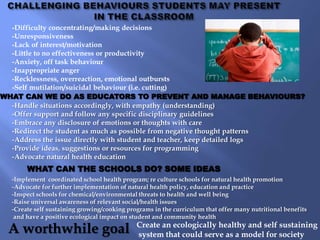
-Difficulty concentrating/making decisions
  -Unresponsiveness
  -Lack of interest/motivation
  -Little to no effectiveness or productivity
  -Anxiety, off task behaviour
  -Inappropriate anger
  -Recklessness, overreaction, emotional outbursts
  -Self mutilation/suicidal behaviour (i.e. cutting)
WHAT CAN WE DO AS EDUCATORS TO PREVENT AND MANAGE BEHAVIOURS?
  -Handle situations accordingly, with empathy (understanding)
  -Offer support and follow any specific disciplinary guidelines
  -Embrace any disclosure of emotions or thoughts with care
  -Redirect the student as much as possible from negative thought patterns
  -Address the issue directly with student and teacher, keep detailed logs
  -Provide ideas, suggestions or resources for programming
  -Advocate natural health education
       WHAT CAN THE SCHOOLS DO? SOME IDEAS
  -Implement coordinated school health program; re culture schools for natural health promotion
  -Advocate for further implementation of natural health policy, education and practice
  -Inspect schools for chemical/environmental threats to health and well being
  -Raise universal awareness of relevant social/health issues
  -Create self sustaining growing/cooking programs in the curriculum that offer many nutritional benefits
   and have a positive ecological impact on student and community health

 A worthwhile goal                           Create an ecologically healthy and self sustaining
                                             system that could serve as a model for society
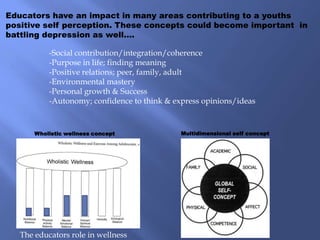
Educators have an impact in many areas contributing to a youths
positive self perception. These concepts could become important in
battling depression as well….

           -Social contribution/integration/coherence
           -Purpose in life; finding meaning
           -Positive relations; peer, family, adult
           -Environmental mastery
           -Personal growth & Success
           -Autonomy; confidence to think & express opinions/ideas


       Wholistic wellness concept             Multidimensional self concept


   The educators role in wellness
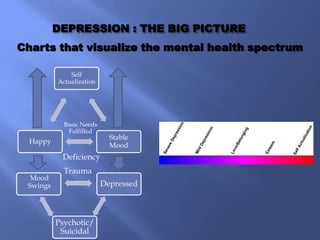
DEPRESSION : THE BIG PICTURE
Charts that visualize the mental health spectrum

              Self
          Actualization


            Basic Needs
             Fulfilled
                            Stable
  Happy
                            Mood
           Deficiency
            Trauma
  Mood
 Swings                   Depressed


          Psychotic/
           Suicidal
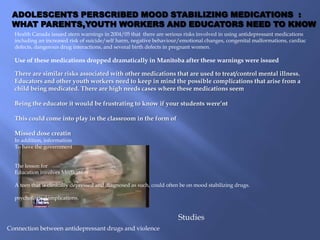
ADOLESCENTS PERSCRIBED MOOD STABILIZING MEDICATIONS :
 WHAT PARENTS,YOUTH WORKERS AND EDUCATORS NEED TO KNOW
  Health Canada issued stern warnings in 2004/05 that there are serious risks involved in using antidepressant medications
  including an increased risk of suicide/self harm, negative behaviour/emotional changes, congenital malformations, cardiac
  defects, dangerous drug interactions, and several birth defects in pregnant women.

  Use of these medications dropped dramatically in Manitoba after these warnings were issued

  There are similar risks associated with other medications that are used to treat/control mental illness.
  Educators and other youth workers need to keep in mind the possible complications that arise from a
  child being medicated. There are high needs cases where these medications seem

  Being the educator it would be frustrating to know if your students were’nt

  This could come into play in the classroom in the form of

  Missed dose creatin
  In addition, information
  To have the government


  The lesson for
  Education involves Medication

  A teen that is clinically depressed and diagnosed as such, could often be on mood stabilizing drugs.

  psychological implications.


                                                                       Studies
Connection between antidepressant drugs and violence
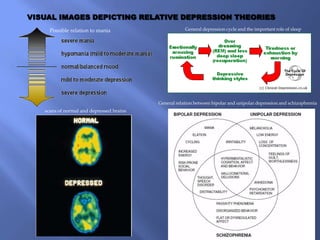
VISUAL IMAGES DEPICTING RELATIVE DEPRESSION THEORIES
     Possible relation to mania                       General depression cycle and the important role of sleep


                                          General relation between bipolar and unipolar depression and schizophrenia
   scans of normal and depressed brains
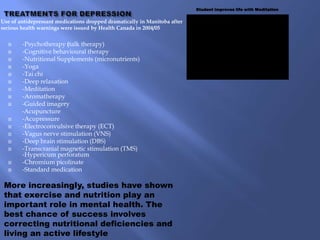
Student improves life with Meditation


Use of antidepressant medications dropped dramatically in Manitoba after
serious health warnings were issued by Health Canada in 2004/05


       -Psychotherapy (talk therapy)
       -Cognitive behavioural therapy
       -Nutritional Supplements (micronutrients)
       -Yoga
       -Tai chi
       -Deep relaxation
       -Meditation
       -Aromatherapy
       -Guided imagery
        -Acupuncture
       -Acupressure
       -Electroconvulsive therapy (ECT)
       -Vagus nerve stimulation (VNS)
       -Deep brain stimulation (DBS)
       -Transcranial magnetic stimulation (TMS)
        -Hypericum perforatum
       -Chromium picolinate
       -Standard medication

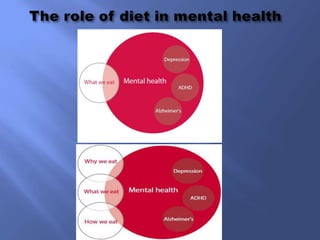
 More increasingly, studies have shown
 that exercise and nutrition play an
 important role in mental health. The
 best chance of success involves
 correcting nutritional deficiencies and
 living an active lifestyle
Mental Health Foundation (Feeding Minds Report) www.mentalhealth.org.uk


                  Positive psychology in schools

Adolescent Depression

  • 1.
    Adolescence - Theperiod of physical and psychological development from the onset of puberty to maturity A Simplified & Integrated Presentation “A COMMON EMOTION” “THE COMMON COLD OF MENTAL HEALTH” “Adolescence is the highest risk period for depression onset” “RESEARCH HAS DISCOVERED THAT DEPRESSION ONSET IS OCCURRING EARLIER IN INDIVIDUALS BORN IN MORE RECENT DECADES” - National Institute of Mental Health “Depression is not a sign of personal weakness”
  • 2.
    Depression can bea direct reaction to life circumstance or event (i.e. loss, change, tragic/stressful event) sometimes known as “situational “ depression . Clinical depression is a more prolonged state of sadness resulting from a potentially complex combination of environmental, biological and psychological/social factors EXAMPLES OF CIRCUMSTANCES THAT CAN TRIGGER DEPRESSIVE EMOTIONS Loss, change, tragic/stressful events  Family dysfunction; divorce, inadequate childcare  Family dysfunction; divorce, inadequate  Bullying, social/family repercussions of homosexuality  Involvement in the justice/legal system  Peer or Academic Pressure  Economics (being poor) Biological factors complicate the feelings/emotions experienced during adolescence in addition could be a main factor in some cases of depression  Chemical imbalances in the brain; neurotransmitter/synapse complications; low serotonin levels; nutritional deficiency disorders;  Body changes; transitional nature of adolescence Other risk factors  (puberty/hormonal changes/sexual maturation)  Substance abuse  Low blood sugar levels  Physical trauma  Genetics (heredity)  Disease, disorders  Ecological impact on the body/psyche  Post teen pregnancy (postpartum depression)  Weather (Seasonal affective disorder)
  • 3.
    FEELINGS/EMOTIONS PHYSICAL SIGNS  -Sadness, empty mood  -Worsening chronic pain or  -Hopelessness, worthlessness, physical slowing down excessive guilt  -Headaches  -Reduced enjoyment/interest in  -Muscle aches most or all aspects of life  -Chest and back pain  -Feelings of inadequacy,  -Loss of energy discouragement  -Sleep and appetite changes  -Self depreciation/loss of self  -Insomnia or oversleeping esteem  -Restlessness  -Inability to cope, disappointment  -Socially withdrawn/alienation  -Anxiousness, poor concentration  -Uncontrollable crying  -Anger, irritability  -Grim/suicidal thoughts and behaviour With the heightened complexity of todays world, many combinations of the above are possible and have been associated with depression . Having an understanding of the root cause will often allow for the proper treatment(s), personal growth and well being. This is the most fundamental aspect of dealing with mental health.
  • 4.
    -Difficulty concentrating/making decisions -Unresponsiveness -Lack of interest/motivation -Little to no effectiveness or productivity -Anxiety, off task behaviour -Inappropriate anger -Recklessness, overreaction, emotional outbursts -Self mutilation/suicidal behaviour (i.e. cutting) WHAT CAN WE DO AS EDUCATORS TO PREVENT AND MANAGE BEHAVIOURS? -Handle situations accordingly, with empathy (understanding) -Offer support and follow any specific disciplinary guidelines -Embrace any disclosure of emotions or thoughts with care -Redirect the student as much as possible from negative thought patterns -Address the issue directly with student and teacher, keep detailed logs -Provide ideas, suggestions or resources for programming -Advocate natural health education WHAT CAN THE SCHOOLS DO? SOME IDEAS -Implement coordinated school health program; re culture schools for natural health promotion -Advocate for further implementation of natural health policy, education and practice -Inspect schools for chemical/environmental threats to health and well being -Raise universal awareness of relevant social/health issues -Create self sustaining growing/cooking programs in the curriculum that offer many nutritional benefits and have a positive ecological impact on student and community health A worthwhile goal Create an ecologically healthy and self sustaining system that could serve as a model for society
  • 5.
    Educators have animpact in many areas contributing to a youths positive self perception. These concepts could become important in battling depression as well…. -Social contribution/integration/coherence -Purpose in life; finding meaning -Positive relations; peer, family, adult -Environmental mastery -Personal growth & Success -Autonomy; confidence to think & express opinions/ideas Wholistic wellness concept Multidimensional self concept The educators role in wellness
  • 6.
    DEPRESSION : THEBIG PICTURE Charts that visualize the mental health spectrum Self Actualization Basic Needs Fulfilled Stable Happy Mood Deficiency Trauma Mood Swings Depressed Psychotic/ Suicidal
  • 7.
    ADOLESCENTS PERSCRIBED MOODSTABILIZING MEDICATIONS : WHAT PARENTS,YOUTH WORKERS AND EDUCATORS NEED TO KNOW Health Canada issued stern warnings in 2004/05 that there are serious risks involved in using antidepressant medications including an increased risk of suicide/self harm, negative behaviour/emotional changes, congenital malformations, cardiac defects, dangerous drug interactions, and several birth defects in pregnant women. Use of these medications dropped dramatically in Manitoba after these warnings were issued There are similar risks associated with other medications that are used to treat/control mental illness. Educators and other youth workers need to keep in mind the possible complications that arise from a child being medicated. There are high needs cases where these medications seem Being the educator it would be frustrating to know if your students were’nt This could come into play in the classroom in the form of Missed dose creatin In addition, information To have the government The lesson for Education involves Medication A teen that is clinically depressed and diagnosed as such, could often be on mood stabilizing drugs. psychological implications. Studies Connection between antidepressant drugs and violence
  • 8.
    VISUAL IMAGES DEPICTINGRELATIVE DEPRESSION THEORIES Possible relation to mania General depression cycle and the important role of sleep General relation between bipolar and unipolar depression and schizophrenia scans of normal and depressed brains
  • 9.
    Student improves lifewith Meditation Use of antidepressant medications dropped dramatically in Manitoba after serious health warnings were issued by Health Canada in 2004/05  -Psychotherapy (talk therapy)  -Cognitive behavioural therapy  -Nutritional Supplements (micronutrients)  -Yoga  -Tai chi  -Deep relaxation  -Meditation  -Aromatherapy  -Guided imagery -Acupuncture  -Acupressure  -Electroconvulsive therapy (ECT)  -Vagus nerve stimulation (VNS)  -Deep brain stimulation (DBS)  -Transcranial magnetic stimulation (TMS) -Hypericum perforatum  -Chromium picolinate  -Standard medication More increasingly, studies have shown that exercise and nutrition play an important role in mental health. The best chance of success involves correcting nutritional deficiencies and living an active lifestyle
  • 11.
    Mental Health Foundation(Feeding Minds Report) www.mentalhealth.org.uk Positive psychology in schools

Editor's Notes

  • #3 Depression can be wrongly attributed to normal teenage behaviour – Pay close attention for symptoms
  • #5 -Off Task Behaviour-Lack of Interest-Lack of Motivation-Self Mutilation (i.e. cutting)
  • #8 Antidepressant drugs can be unpredictable