Anti-Depressant
Presented by:-
Nitish
M.Pharm (1st Semester)
Department of Pharmacology
INDO-SOVIET FRIENDSHIP COLLEGE OF PHARMACY
MOGA, PUNJAB
Contents
• Introduction
• Pathophysiology
• Epidemiology
• Treatment of depression
• Psychotherapy
• Antidepressants
• MAO inhibitors
• Tricyclic antidepressants
• Selective serotonin reuptake inhibitors
• Atypical antidepressants
• Herbal drugs used in depression
• Drugs under clinical trail
Introduction
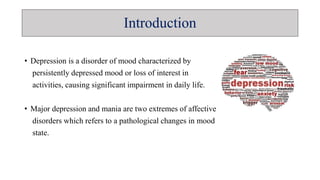
• Depression is a disorder of mood characterized by
persistently depressed mood or loss of interest in
activities, causing significant impairment in daily life.
• Major depression and mania are two extremes of affective
disorders which refers to a pathological changes in mood
state.
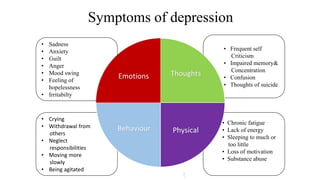
• Crying
• Withdrawal from
others
• Neglect
responsibilities
• Moving more
slowly
• Being agitated
• Sadness
• Anxiety
• Guilt
• Anger
• Mood swing
• Feeling of
hopelessness
• Irritabilty
• Chronic fatigue
• Lack of energy
• Sleeping to much or
too little
• Loss of motivation
• Substance abuse
• Frequent self
Criticism
• Impaired memory&
Concentration
• Confusion
• Thoughts of suicide
Symptoms of depression
Thoughts
Behaviour Physical
t
Emotions
Types of depression
Three of the most common depression are:
 Major depression
 Dysthymic disorder/Chronic depression
 Atypical disorder
Manic/bipolar depression
Postpartum depression
Seasonal affective disorder (SAD)
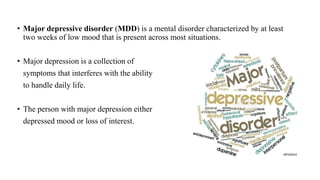
• Major depressive disorder (MDD) is a mental disorder characterized by at least
two weeks of low mood that is present across most situations.
• Major depression is a collection of
symptoms that interferes with the ability
to handle daily life.
• The person with major depression either
depressed mood or loss of interest.
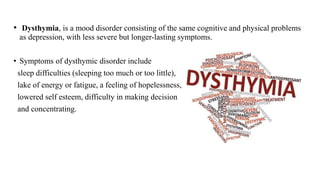
• Dysthymia, is a mood disorder consisting of the same cognitive and physical problems
as depression, with less severe but longer-lasting symptoms.
• Symptoms of dysthymic disorder include
sleep difficulties (sleeping too much or too little),
lake of energy or fatigue, a feeling of hopelessness,
lowered self esteem, difficulty in making decision
and concentrating.
In atypical depression:
• Bipolar disorder sometimes referred to as manic depression, is a complex mood
disorder that alternates between period of clinical depression and times of extreme
mania.
• There are two subtypes
bipolar l disorder
bipolar ll disorder
• Postpartum depression (PPD) occurs among new mothers a few month after they
give birth.
• PPD is thought to be caused by hormone changes, but is more likely to occur in
difficult situations (low partner support, a colicky baby, or history of depression.
• Seasonal affective disorder or (SAD) is another form of depression, which is
connected to seasonal changes and usually occur at every fall or winter.
• The cause of SAD is not completely understood, but it seems to be related to change
in the amount of sunlight available.
Pathophysiology of depression
1. The monoamine theory: This theory suggest that the depression is caused by
a functional deficit of monoamine neurotransmitters at certain site in the brain.
• Serotonin
• Nor- epinephrine
2. Melatonin: Melatonin, produced rhythmically by pineal gland, is a hormone
involved in the regulation of several physiological and Behavioural processes,
including the sleep inducing effect and the activation of male and female sexual
activity.
3. Stress hormone: Cortisol is the hormone that can cause depression, if level rise too
high or fall to far below average.
• High level of cortisol can create agitation, increased belly fat, insomnia and sugar
cravings.
• Low levels can associated with inability to handle stress, extreme fatigue, low
libido and mood instability.
4. According to latest research, depression is associated with decreased
level of brain derived neurotropic factor(BDNF) which is critical for
regulation of neural plasticity and neurogenesis.
Epidemiology
• Globally, more than 300 million people of all ages suffer from
depression.
• More women are affected by depression than men.
• Close to 800 000 people die due to suicide every year. Suicide is the
second leading cause of death in 15-29-year-olds.
• Over 5 crore people suffer from depression in India.
Treatment for depression
There are two components to the management of depression:
• Psychotherapy, also known as talking therapies,
such as cognitive behavioral therapy(CBT).
• Drug treatment, specifically antidepressants.
Psychotherapy
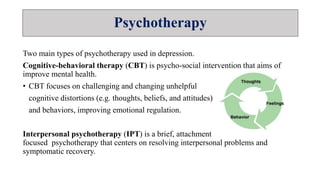
Two main types of psychotherapy used in depression.
Cognitive-behavioral therapy (CBT) is psycho-social intervention that aims of
improve mental health.
• CBT focuses on challenging and changing unhelpful
cognitive distortions (e.g. thoughts, beliefs, and attitudes)
and behaviors, improving emotional regulation.
Interpersonal psychotherapy (IPT) is a brief, attachment
focused psychotherapy that centers on resolving interpersonal problems and
symptomatic recovery.
Antidepressants
• Antidepressants are used for the treatment of depression.
• These are drugs which can elevate
mood in depressive illness.
• Practically all antidepressant affect
monoaminergic transmission in the brain
in one way or the other and many of them
have other associated properties.
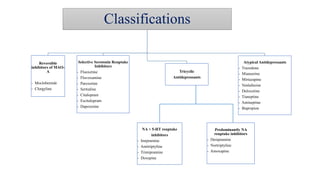
NA + 5-HT reuptake
inhibitors
- Imipramine
- Amitriptyline
- Trimipramine
- Doxepine
Classifications
Reversible
inhibitors of MAO-
A
- Moclobemide
- Clorgyline
Selective Serotonin Reuptake
Inhibitors
- Fluoxetine
- Fluvoxamine
- Paroxetine
- Sertraline
- Citalopram
- Escitalopram
- Dapoxetine
Tricyclic
Antidepressants
Atypical Antidepressants
- Trazodone
- Mianserine
- Mirtazapine
- Venlafaxine
- Duloxetine
- Tianeptine
- Amineptine
- Bupropion
Predominantly NA
reuptake inhibitors
- Desipramine
- Nortriptyline
- Amoxapine
MAO inhibitors
• Two types of monoamino oxidase(MAO) enzyme are involve in the metabolism of
monoamine.
MAO-A preferentially deaminates NA & 5-HT and is
present in the intestine, peripheral nerve ending.
MAO-B preferentially deaminates phenylethylamine
and is present in brain & platelets.
Note
• Dopamine is degraded equally by both isoenzymes.
• Liver contain both isoenzymes.
There are two types of MAO inhibitors:-
A. Nonselective MAO inhibitors
• Inhibits both isoform of MAO irreversibly.
• Their anti-depressant effect takes 3-4 weeks to develop.
• These drugs exhibit a large number of drug and food interactions. The important ones
are:
• Cheese reaction
• Increases the risk of seizures if given along with pethidine
• Serotonin syndrome
• Drugs under this category are tranylcypromine, isocarboxazid, phenelzine.
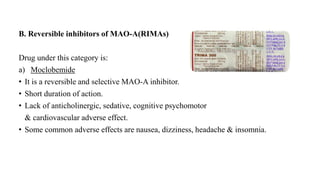
B. Reversible inhibitors of MAO-A(RIMAs)
Drug under this category is:
a) Moclobemide
• It is a reversible and selective MAO-A inhibitor.
• Short duration of action.
• Lack of anticholinergic, sedative, cognitive psychomotor
& cardiovascular adverse effect.
• Some common adverse effects are nausea, dizziness, headache & insomnia.
Tricyclic antidepressants(TCAs)
• TCAs were discovered in the early 1950s and were marketed later
in the decade.
• These drugs act by inhibiting the reuptake of both 5-HT & NA.
Pharmacological actions
1. CNS
In normal individuals it induce a peculiar clumsy feeling, tiredness,
sleepiness, difficulty in concentration.
In depressed patients after 2-3 weeks the mood is gradually elevated,
patient become more communicative and start to taking interest in self
and surroundings.
2. ANS
Most TCAs are potent anticholinergics- cause dry mouth blurring
of vision, constipation and urinary hesitancy as side effect.
3. CVS
Tachycardia due to anticholinergic and NA potentiating actions.
Postural hypotension due to inhibitions of cardiovascular reflexes and α1
blockade.
ECG changes and cardiac arrhythmias because of T wave suppression.
Pharmacokinetics
• The oral absorption of TCAs is good.
• They are highly bound to plasma protein and tissue
protein-have large volume of distribution (~20L/kg).
• Metabolized in liver.
• Metabolites are excreted in urine over 1-2 weeks.
• The plasma t1/2 range between 16-24 hours.
Adverse effects
• Anticholinergic effects
• Sedation, mental confusion and weakness
• Weight gain
• Sweating and fine tremors are common
• Postural hypotension
• Cardiac arrhythmias
• Rashes and jaundice
Selective Serotonin Reuptake Inhibitors(SSRIs)
• These drugs inhibit the reuptake of 5-HT only.
• SSRIs are now the first choice drugs for depression because they offers several
advantages over TCAs:
 No anticholinergic side effects
 No α blocking property
 No sedation or weight loss
 No propensity to cause arrhythmias
Drugs under this category are:
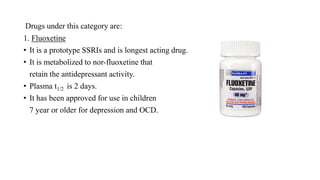
1. Fluoxetine
• It is a prototype SSRIs and is longest acting drug.
• It is metabolized to nor-fluoxetine that
retain the antidepressant activity.
• Plasma t1/2 is 2 days.
• It has been approved for use in children
7 year or older for depression and OCD.
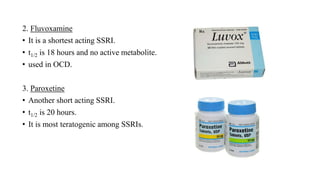
2. Fluvoxamine
• It is a shortest acting SSRI.
• t1/2 is 18 hours and no active metabolite.
• used in OCD.
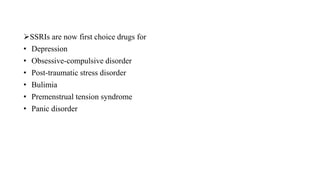
3. Paroxetine
• Another short acting SSRI.
• t1/2 is 20 hours.
• It is most teratogenic among SSRIs.
SSRIs are now first choice drugs for
• Depression
• Obsessive-compulsive disorder
• Post-traumatic stress disorder
• Bulimia
• Premenstrual tension syndrome
• Panic disorder
Atypical antidepressants
These drugs may or may not increase monoaminergic levels and posses different
anti-depressant mechanism.
Drugs under this category are:
1. Trazadone
• First atypical antidepressant.
• It is a prominent α blocker and weak 5-HT2 antagonist.
• It produce sedation, priapism and postural hypotension as a side effect.
• Its t1/2 is short (~6 hour).
2. Mianserin
• It is unique in not inhibiting either NA or 5-HT uptake; but block presynaptic α2
receptors.
• But seizure augmenting and bone marrow depressant action restrict its use.
3. Amineptine & Tianeptine
• These drugs act by enhancing the serotonin reuptake.
• Side effects are dry mouth, epigastric pain, flatulence, drowsiness & bodyache.
4. Venlafaxine & Duloxetine
• Selective NET(noradrenaline transporter) & SERT(serotonin transporter)
inhibitors.
• These drugs does not produce the side effects of TCAs.
5. Mirtazapine
• It inhibits presynaptic α2 receptor and thus increases NA & 5-HT release due to
inhibition of auto and hetero receptor respectively.
• It commonly cause sedation, weight gain, lipid abnormalities and dizziness.
6. Bupropion
• It inhibits the uptake of NA and DA.
• It is used for smoke cessation.
Herbal drugs used in depression
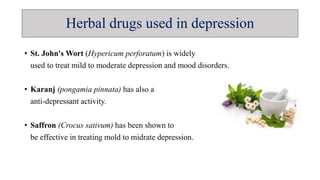
• St. John's Wort (Hypericum perforatum) is widely
used to treat mild to moderate depression and mood disorders.
• Karanj (pongamia pinnata) has also a
anti-depressant activity.
• Saffron (Crocus sativum) has been shown to
be effective in treating mold to midrate depression.
Drugs under clinical trail
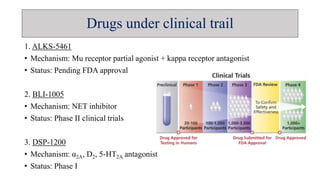
1. ALKS-5461
• Mechanism: Mu receptor partial agonist + kappa receptor antagonist
• Status: Pending FDA approval
2. BLI-1005
• Mechanism: NET inhibitor
• Status: Phase II clinical trials
3. DSP-1200
• Mechanism: α2A, D2, 5-HT2A antagonist
• Status: Phase I
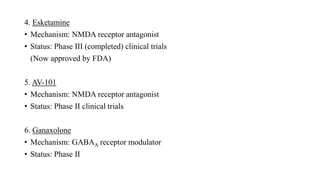
4. Esketamine
• Mechanism: NMDA receptor antagonist
• Status: Phase III (completed) clinical trials
(Now approved by FDA)
5. AV-101
• Mechanism: NMDA receptor antagonist
• Status: Phase II clinical trials
6. Ganaxolone
• Mechanism: GABAA receptor modulator
• Status: Phase II
References
• Tripathi KD. Essentials of Medical pharmacology. 7th edition. New
Delhi : Jaypee Brothers Medical Publisher (p) ltd ; 2013. pp.397-410
• Garg G.R. and Gupta S.,2017 . Review of pharmacology. 11th edition
Jaypee Brothers Medical Publishers (p) Limited. Pp.231-234
Antidepressants

Antidepressants

  • 1.
    Anti-Depressant Presented by:- Nitish M.Pharm (1stSemester) Department of Pharmacology INDO-SOVIET FRIENDSHIP COLLEGE OF PHARMACY MOGA, PUNJAB
  • 2.
    Contents • Introduction • Pathophysiology •Epidemiology • Treatment of depression • Psychotherapy • Antidepressants • MAO inhibitors • Tricyclic antidepressants • Selective serotonin reuptake inhibitors • Atypical antidepressants • Herbal drugs used in depression • Drugs under clinical trail
  • 3.
    Introduction • Depression isa disorder of mood characterized by persistently depressed mood or loss of interest in activities, causing significant impairment in daily life. • Major depression and mania are two extremes of affective disorders which refers to a pathological changes in mood state.
  • 4.
    • Crying • Withdrawalfrom others • Neglect responsibilities • Moving more slowly • Being agitated • Sadness • Anxiety • Guilt • Anger • Mood swing • Feeling of hopelessness • Irritabilty • Chronic fatigue • Lack of energy • Sleeping to much or too little • Loss of motivation • Substance abuse • Frequent self Criticism • Impaired memory& Concentration • Confusion • Thoughts of suicide Symptoms of depression Thoughts Behaviour Physical t Emotions
  • 5.
    Types of depression Threeof the most common depression are:  Major depression  Dysthymic disorder/Chronic depression  Atypical disorder Manic/bipolar depression Postpartum depression Seasonal affective disorder (SAD)
  • 6.
    • Major depressivedisorder (MDD) is a mental disorder characterized by at least two weeks of low mood that is present across most situations. • Major depression is a collection of symptoms that interferes with the ability to handle daily life. • The person with major depression either depressed mood or loss of interest.
  • 7.
    • Dysthymia, isa mood disorder consisting of the same cognitive and physical problems as depression, with less severe but longer-lasting symptoms. • Symptoms of dysthymic disorder include sleep difficulties (sleeping too much or too little), lake of energy or fatigue, a feeling of hopelessness, lowered self esteem, difficulty in making decision and concentrating.
  • 8.
    In atypical depression: •Bipolar disorder sometimes referred to as manic depression, is a complex mood disorder that alternates between period of clinical depression and times of extreme mania. • There are two subtypes bipolar l disorder bipolar ll disorder
  • 9.
    • Postpartum depression(PPD) occurs among new mothers a few month after they give birth. • PPD is thought to be caused by hormone changes, but is more likely to occur in difficult situations (low partner support, a colicky baby, or history of depression. • Seasonal affective disorder or (SAD) is another form of depression, which is connected to seasonal changes and usually occur at every fall or winter. • The cause of SAD is not completely understood, but it seems to be related to change in the amount of sunlight available.
  • 10.
    Pathophysiology of depression 1.The monoamine theory: This theory suggest that the depression is caused by a functional deficit of monoamine neurotransmitters at certain site in the brain. • Serotonin • Nor- epinephrine 2. Melatonin: Melatonin, produced rhythmically by pineal gland, is a hormone involved in the regulation of several physiological and Behavioural processes, including the sleep inducing effect and the activation of male and female sexual activity.
  • 11.
    3. Stress hormone:Cortisol is the hormone that can cause depression, if level rise too high or fall to far below average. • High level of cortisol can create agitation, increased belly fat, insomnia and sugar cravings. • Low levels can associated with inability to handle stress, extreme fatigue, low libido and mood instability. 4. According to latest research, depression is associated with decreased level of brain derived neurotropic factor(BDNF) which is critical for regulation of neural plasticity and neurogenesis.
  • 12.
    Epidemiology • Globally, morethan 300 million people of all ages suffer from depression. • More women are affected by depression than men. • Close to 800 000 people die due to suicide every year. Suicide is the second leading cause of death in 15-29-year-olds. • Over 5 crore people suffer from depression in India.
  • 13.
    Treatment for depression Thereare two components to the management of depression: • Psychotherapy, also known as talking therapies, such as cognitive behavioral therapy(CBT). • Drug treatment, specifically antidepressants.
  • 14.
    Psychotherapy Two main typesof psychotherapy used in depression. Cognitive-behavioral therapy (CBT) is psycho-social intervention that aims of improve mental health. • CBT focuses on challenging and changing unhelpful cognitive distortions (e.g. thoughts, beliefs, and attitudes) and behaviors, improving emotional regulation. Interpersonal psychotherapy (IPT) is a brief, attachment focused psychotherapy that centers on resolving interpersonal problems and symptomatic recovery.
  • 15.
    Antidepressants • Antidepressants areused for the treatment of depression. • These are drugs which can elevate mood in depressive illness. • Practically all antidepressant affect monoaminergic transmission in the brain in one way or the other and many of them have other associated properties.
  • 16.
    NA + 5-HTreuptake inhibitors - Imipramine - Amitriptyline - Trimipramine - Doxepine Classifications Reversible inhibitors of MAO- A - Moclobemide - Clorgyline Selective Serotonin Reuptake Inhibitors - Fluoxetine - Fluvoxamine - Paroxetine - Sertraline - Citalopram - Escitalopram - Dapoxetine Tricyclic Antidepressants Atypical Antidepressants - Trazodone - Mianserine - Mirtazapine - Venlafaxine - Duloxetine - Tianeptine - Amineptine - Bupropion Predominantly NA reuptake inhibitors - Desipramine - Nortriptyline - Amoxapine
  • 17.
    MAO inhibitors • Twotypes of monoamino oxidase(MAO) enzyme are involve in the metabolism of monoamine. MAO-A preferentially deaminates NA & 5-HT and is present in the intestine, peripheral nerve ending. MAO-B preferentially deaminates phenylethylamine and is present in brain & platelets. Note • Dopamine is degraded equally by both isoenzymes. • Liver contain both isoenzymes.
  • 18.
    There are twotypes of MAO inhibitors:- A. Nonselective MAO inhibitors • Inhibits both isoform of MAO irreversibly. • Their anti-depressant effect takes 3-4 weeks to develop. • These drugs exhibit a large number of drug and food interactions. The important ones are: • Cheese reaction • Increases the risk of seizures if given along with pethidine • Serotonin syndrome • Drugs under this category are tranylcypromine, isocarboxazid, phenelzine.
  • 19.
    B. Reversible inhibitorsof MAO-A(RIMAs) Drug under this category is: a) Moclobemide • It is a reversible and selective MAO-A inhibitor. • Short duration of action. • Lack of anticholinergic, sedative, cognitive psychomotor & cardiovascular adverse effect. • Some common adverse effects are nausea, dizziness, headache & insomnia.
  • 20.
    Tricyclic antidepressants(TCAs) • TCAswere discovered in the early 1950s and were marketed later in the decade. • These drugs act by inhibiting the reuptake of both 5-HT & NA. Pharmacological actions 1. CNS In normal individuals it induce a peculiar clumsy feeling, tiredness, sleepiness, difficulty in concentration. In depressed patients after 2-3 weeks the mood is gradually elevated, patient become more communicative and start to taking interest in self and surroundings.
  • 21.
    2. ANS Most TCAsare potent anticholinergics- cause dry mouth blurring of vision, constipation and urinary hesitancy as side effect. 3. CVS Tachycardia due to anticholinergic and NA potentiating actions. Postural hypotension due to inhibitions of cardiovascular reflexes and α1 blockade. ECG changes and cardiac arrhythmias because of T wave suppression.
  • 22.
    Pharmacokinetics • The oralabsorption of TCAs is good. • They are highly bound to plasma protein and tissue protein-have large volume of distribution (~20L/kg). • Metabolized in liver. • Metabolites are excreted in urine over 1-2 weeks. • The plasma t1/2 range between 16-24 hours.
  • 23.
    Adverse effects • Anticholinergiceffects • Sedation, mental confusion and weakness • Weight gain • Sweating and fine tremors are common • Postural hypotension • Cardiac arrhythmias • Rashes and jaundice
  • 24.
    Selective Serotonin ReuptakeInhibitors(SSRIs) • These drugs inhibit the reuptake of 5-HT only. • SSRIs are now the first choice drugs for depression because they offers several advantages over TCAs:  No anticholinergic side effects  No α blocking property  No sedation or weight loss  No propensity to cause arrhythmias
  • 25.
    Drugs under thiscategory are: 1. Fluoxetine • It is a prototype SSRIs and is longest acting drug. • It is metabolized to nor-fluoxetine that retain the antidepressant activity. • Plasma t1/2 is 2 days. • It has been approved for use in children 7 year or older for depression and OCD.
  • 26.
    2. Fluvoxamine • Itis a shortest acting SSRI. • t1/2 is 18 hours and no active metabolite. • used in OCD. 3. Paroxetine • Another short acting SSRI. • t1/2 is 20 hours. • It is most teratogenic among SSRIs.
  • 27.
    SSRIs are nowfirst choice drugs for • Depression • Obsessive-compulsive disorder • Post-traumatic stress disorder • Bulimia • Premenstrual tension syndrome • Panic disorder
  • 28.
    Atypical antidepressants These drugsmay or may not increase monoaminergic levels and posses different anti-depressant mechanism. Drugs under this category are: 1. Trazadone • First atypical antidepressant. • It is a prominent α blocker and weak 5-HT2 antagonist. • It produce sedation, priapism and postural hypotension as a side effect. • Its t1/2 is short (~6 hour).
  • 29.
    2. Mianserin • Itis unique in not inhibiting either NA or 5-HT uptake; but block presynaptic α2 receptors. • But seizure augmenting and bone marrow depressant action restrict its use. 3. Amineptine & Tianeptine • These drugs act by enhancing the serotonin reuptake. • Side effects are dry mouth, epigastric pain, flatulence, drowsiness & bodyache. 4. Venlafaxine & Duloxetine • Selective NET(noradrenaline transporter) & SERT(serotonin transporter) inhibitors. • These drugs does not produce the side effects of TCAs.
  • 30.
    5. Mirtazapine • Itinhibits presynaptic α2 receptor and thus increases NA & 5-HT release due to inhibition of auto and hetero receptor respectively. • It commonly cause sedation, weight gain, lipid abnormalities and dizziness. 6. Bupropion • It inhibits the uptake of NA and DA. • It is used for smoke cessation.
  • 31.
    Herbal drugs usedin depression • St. John's Wort (Hypericum perforatum) is widely used to treat mild to moderate depression and mood disorders. • Karanj (pongamia pinnata) has also a anti-depressant activity. • Saffron (Crocus sativum) has been shown to be effective in treating mold to midrate depression.
  • 32.
    Drugs under clinicaltrail 1. ALKS-5461 • Mechanism: Mu receptor partial agonist + kappa receptor antagonist • Status: Pending FDA approval 2. BLI-1005 • Mechanism: NET inhibitor • Status: Phase II clinical trials 3. DSP-1200 • Mechanism: α2A, D2, 5-HT2A antagonist • Status: Phase I
  • 33.
    4. Esketamine • Mechanism:NMDA receptor antagonist • Status: Phase III (completed) clinical trials (Now approved by FDA) 5. AV-101 • Mechanism: NMDA receptor antagonist • Status: Phase II clinical trials 6. Ganaxolone • Mechanism: GABAA receptor modulator • Status: Phase II
  • 34.
    References • Tripathi KD.Essentials of Medical pharmacology. 7th edition. New Delhi : Jaypee Brothers Medical Publisher (p) ltd ; 2013. pp.397-410 • Garg G.R. and Gupta S.,2017 . Review of pharmacology. 11th edition Jaypee Brothers Medical Publishers (p) Limited. Pp.231-234