WHO, “Health is a state of complete physical,
mental and social well being, and not merely
the absence of any disease or infirmity in an
individual”
 WHO, “The capacity of an individual to form
harmonious relationship with others and to
participate in and contribute constructively
to changes in the social environment”.
 Meninger defines, “The adjustment of human
beings to the world and to each other with
the maximum of effectiveness and
happiness”.
 Mental illness can occur when the brain is
not working well.
 One or more of its 6 main functions will be
disrupted.
 Thinking
 Perception
 Emotion
 Behavior
 Physical
 Signaling
 Find out the difference between mental
illness and mental retardation.
 Neurosis also known as Psychoneurosis
 It refers to minor mental disorders
 They are characterized by inner struggles
and certain mental and physical disturbances
 Clinically, Psychoneurosis implies a bodily
disturbance without ant structural or organic
defect.
 The patient is unable to understand but
nevertheless, he realizes that something is
wrong with him/her.
 Ex: Phobia, Stress related disorders
 Psychosis refer to insanity or madness.
 Psychosis are major personality disorders
marked by gross emotional and mental
disruptions.
 These diseases make the individual incapable
of adequate self management and
adjustment to society.
 Ex: Personality disorders, mood disorders,
and so on.
 Prepare a chart on the differences between
Neurosis and Psychosis and bring it to next
class.
 Psychiatric disorders are classified mostly on
the basis of symptoms. Sometimes on the
basis of etiology.
 To make generally acceptable diagnosis
 To facilitate communication between
psychiatrists, other doctors and other
professionals
 Leading to better treatment planning
 To make framework for research in
psychiatry.
 CLASSIFICATION – placing a clinical condition
into a category based on shared
characteristics.
 MULTIAXIAL SYSTEM – A classification system
that has multiple dimensions.
 DIAGNOSIS – the conclusion reached
concerning the nature of a patient’s problem,
based on clinical observations.
 ETIOLOGY – the cause(s) or Origin(s) of a
condition.
 SYNDROME – a group of signs and symptoms
that together indicate or describe a disorder.
 DISEASE –A definite pathological process
having a characteristic set of signs and
symptoms.
 DISORDER – a derangement or abnormality of
function; a morbid physical or mental state.
 ILLNESS –refers to the feelings that might
come with having a disease.
 SYMPTOMS – refers to an observable behavior
or state.
 1796 – Edinburgh physician William Cullen attempts to
classify mental disorders using an approach based on
biologists’ systems for classifying plants and animals.
 1879 – English psychiatrist William Maudsley suggests
classifying mental disorders in terms of identifiable
symptoms.
 1883- German psychiatrist Emil Kreapelin published the
first edition of an influential textbook that describes and
classifies several mental disorders.
 6th edition of the International Classification of Diseases,
injuries and causes of death is published and includes for
the first time a section devoted to mental disorders.
 1980 – the 3rd edition of the APA’s Diagnostic and Statiscal
Manual is published.
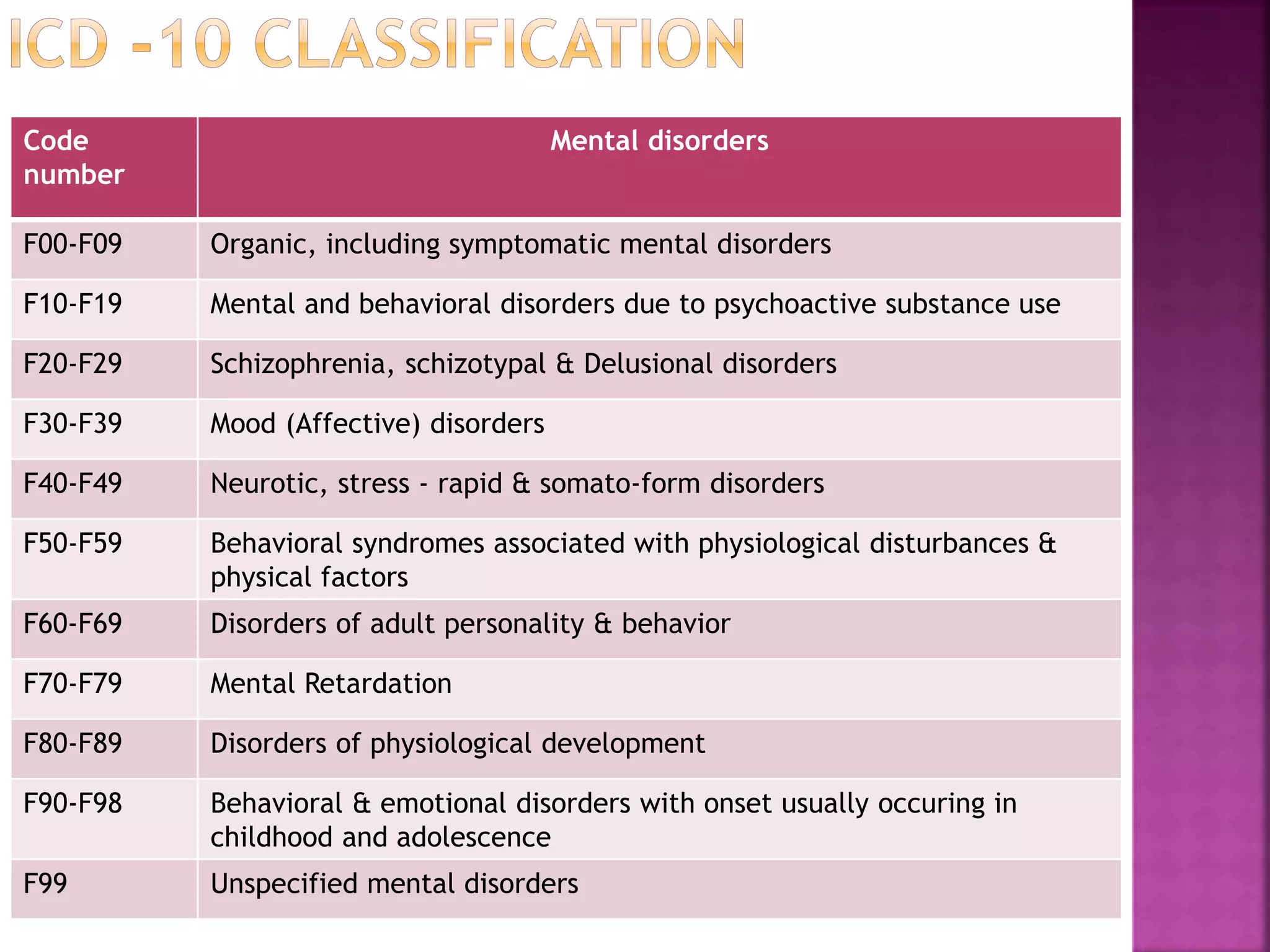
 International Statiscal Classification of
Disease and Related health problems – 1992
 Developed by the World Health Organization
 Mostly used in Europe, Africa and Asia
 The chapter ‘F’ classifies psychiatric disorder
as a mental and behavioral disorders and
codes them on an alphanumeric system from
F00 to F99.
Code
number
Mental disorders
F00-F09 Organic, including symptomatic mental disorders
F10-F19 Mental and behavioral disorders due to psychoactive substance use
F20-F29 Schizophrenia, schizotypal & Delusional disorders
F30-F39 Mood (Affective) disorders
F40-F49 Neurotic, stress - rapid & somato-form disorders
F50-F59 Behavioral syndromes associated with physiological disturbances &
physical factors
F60-F69 Disorders of adult personality & behavior
F70-F79 Mental Retardation
F80-F89 Disorders of physiological development
F90-F98 Behavioral & emotional disorders with onset usually occuring in
childhood and adolescence
F99 Unspecified mental disorders
 Emil Kraepelin (1856-1926) – two symptom
patterns that seemed to hang together and
recur.
 Ex: Dementia praecox (Schizophrenia) and
manic depressive insanity (Bipolar)
 The APA’s multiaxial classification system
(DSM) is currently so widely accepted .
 Published in 2000 by American Psychiatric
Association, US
 5 axes
 Provide information about the biological,
psychological and social aspects of a person’s
condition.
 It is used worldwide and mostly used for
research purposes.
 Axis I – Clinical Psychiatric Diagnosis
 Axis II – Personality disorders and MR
 Axis III – General medical conditions relevant to
a case
 Axis IV – Psycho-social and environmental
problems
 Axis V – Global assessment of functioning (GAF)
rating scale from 1 to 100.
 100 – no symptoms – superior functioning
 60 – moderate symptoms or moderate difficulty in
social, occupational or social functioning.
 10 – persistent danger of severely hurting self or
others
 Find out the differences between ICD and
DSM

Mental health disorders

  • 3.
    WHO, “Health isa state of complete physical, mental and social well being, and not merely the absence of any disease or infirmity in an individual”
  • 5.
     WHO, “Thecapacity of an individual to form harmonious relationship with others and to participate in and contribute constructively to changes in the social environment”.  Meninger defines, “The adjustment of human beings to the world and to each other with the maximum of effectiveness and happiness”.
  • 6.
     Mental illnesscan occur when the brain is not working well.  One or more of its 6 main functions will be disrupted.  Thinking  Perception  Emotion  Behavior  Physical  Signaling
  • 7.
     Find outthe difference between mental illness and mental retardation.
  • 9.
     Neurosis alsoknown as Psychoneurosis  It refers to minor mental disorders  They are characterized by inner struggles and certain mental and physical disturbances  Clinically, Psychoneurosis implies a bodily disturbance without ant structural or organic defect.  The patient is unable to understand but nevertheless, he realizes that something is wrong with him/her.  Ex: Phobia, Stress related disorders
  • 10.
     Psychosis referto insanity or madness.  Psychosis are major personality disorders marked by gross emotional and mental disruptions.  These diseases make the individual incapable of adequate self management and adjustment to society.  Ex: Personality disorders, mood disorders, and so on.
  • 11.
     Prepare achart on the differences between Neurosis and Psychosis and bring it to next class.
  • 12.
     Psychiatric disordersare classified mostly on the basis of symptoms. Sometimes on the basis of etiology.
  • 13.
     To makegenerally acceptable diagnosis  To facilitate communication between psychiatrists, other doctors and other professionals  Leading to better treatment planning  To make framework for research in psychiatry.
  • 14.
     CLASSIFICATION –placing a clinical condition into a category based on shared characteristics.  MULTIAXIAL SYSTEM – A classification system that has multiple dimensions.  DIAGNOSIS – the conclusion reached concerning the nature of a patient’s problem, based on clinical observations.  ETIOLOGY – the cause(s) or Origin(s) of a condition.
  • 15.
     SYNDROME –a group of signs and symptoms that together indicate or describe a disorder.  DISEASE –A definite pathological process having a characteristic set of signs and symptoms.  DISORDER – a derangement or abnormality of function; a morbid physical or mental state.  ILLNESS –refers to the feelings that might come with having a disease.  SYMPTOMS – refers to an observable behavior or state.
  • 16.
     1796 –Edinburgh physician William Cullen attempts to classify mental disorders using an approach based on biologists’ systems for classifying plants and animals.  1879 – English psychiatrist William Maudsley suggests classifying mental disorders in terms of identifiable symptoms.  1883- German psychiatrist Emil Kreapelin published the first edition of an influential textbook that describes and classifies several mental disorders.  6th edition of the International Classification of Diseases, injuries and causes of death is published and includes for the first time a section devoted to mental disorders.  1980 – the 3rd edition of the APA’s Diagnostic and Statiscal Manual is published.
  • 17.
     International StatiscalClassification of Disease and Related health problems – 1992  Developed by the World Health Organization  Mostly used in Europe, Africa and Asia  The chapter ‘F’ classifies psychiatric disorder as a mental and behavioral disorders and codes them on an alphanumeric system from F00 to F99.
  • 18.
    Code number Mental disorders F00-F09 Organic,including symptomatic mental disorders F10-F19 Mental and behavioral disorders due to psychoactive substance use F20-F29 Schizophrenia, schizotypal & Delusional disorders F30-F39 Mood (Affective) disorders F40-F49 Neurotic, stress - rapid & somato-form disorders F50-F59 Behavioral syndromes associated with physiological disturbances & physical factors F60-F69 Disorders of adult personality & behavior F70-F79 Mental Retardation F80-F89 Disorders of physiological development F90-F98 Behavioral & emotional disorders with onset usually occuring in childhood and adolescence F99 Unspecified mental disorders
  • 19.
     Emil Kraepelin(1856-1926) – two symptom patterns that seemed to hang together and recur.  Ex: Dementia praecox (Schizophrenia) and manic depressive insanity (Bipolar)  The APA’s multiaxial classification system (DSM) is currently so widely accepted .
  • 20.
     Published in2000 by American Psychiatric Association, US  5 axes  Provide information about the biological, psychological and social aspects of a person’s condition.  It is used worldwide and mostly used for research purposes.
  • 21.
     Axis I– Clinical Psychiatric Diagnosis  Axis II – Personality disorders and MR  Axis III – General medical conditions relevant to a case  Axis IV – Psycho-social and environmental problems  Axis V – Global assessment of functioning (GAF) rating scale from 1 to 100.  100 – no symptoms – superior functioning  60 – moderate symptoms or moderate difficulty in social, occupational or social functioning.  10 – persistent danger of severely hurting self or others
  • 22.
     Find outthe differences between ICD and DSM