


DENGUE FEVER Dr. Anita Lamichhane Deptt. Of pediatrics  Shaikh Zayed Hospital
Etiological Agent
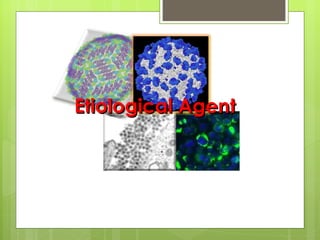
Dengue virus  Single stranded RNA virus,Arbovirus belonging to flaviviridae family 4  antigenically distinct serotypes-DEN 1, 2,3, 4. DEN-1, DEN-2 were prevalent until 1980s DEN-3 is predominant in recent outbreak DEN-4 primarily detected in secondary dengue infections Serotype provides specific life time immunity and short term cross immunity
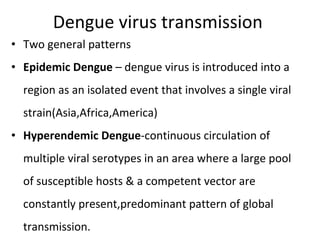
Dengue virus transmission  Two general patterns Epidemic Dengue  – dengue virus is introduced into a region as an isolated event that involves a single viral strain(Asia,Africa,America) Hyperendemic Dengue -continuous circulation of multiple viral serotypes in an area where a large pool of susceptible hosts & a competent vector are constantly present,predominant pattern of global transmission.
 
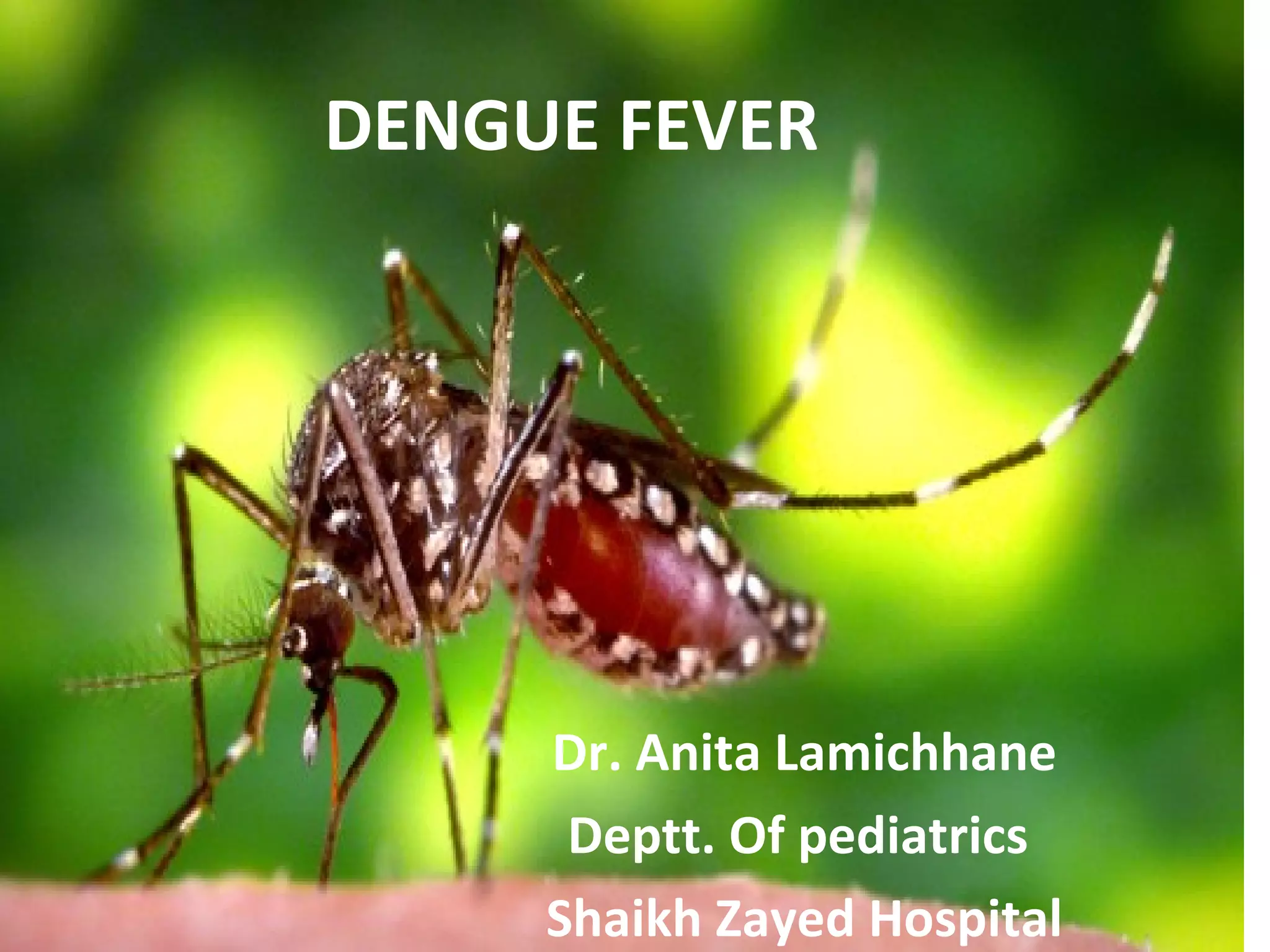
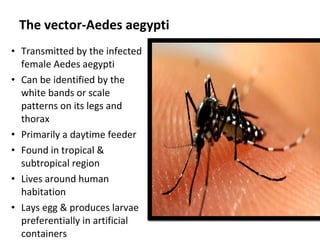
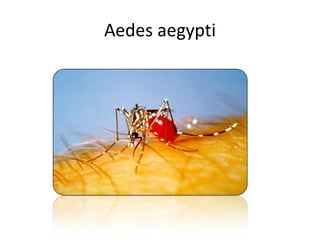
The vector-Aedes aegypti Transmitted by the infected female Aedes aegypti Can be identified by the white bands or scale patterns on its legs and thorax Primarily a daytime feeder Found in tropical & subtropical region Lives around human habitation Lays egg & produces larvae preferentially in artificial containers
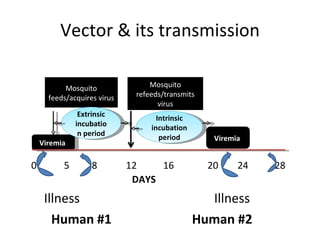
Vector & its transmission 0   5   8   12  16  20  24  28 DAYS   Illness  Illness Human #1   Human #2  Mosquito feeds/acquires virus Mosquito refeeds/transmits virus Viremia   Intrinsic incubation period Extrinsic incubation period Viremia
Replication & transmission of Dengue virus Virus inoculated into a human being with mosquito saliva The virus localizes and replicates in various target organs-local lymph nodes & liver   released   spreads through the blood   infect the WBCs &  reticuloendothelial system(dendritic cells,hepatocytes,endothelial cells) The mosquito ingests blood containing the viruses (on biting an infective person)
Virus replicates in the midgut,ovaries,nerve tissue, fat body of the mosquito It then escapes into the body cavity and later on infects the salivary glands In the salivary glands, the virus replicates  When the mosquito bites another human ,the life cycle continues Humans are the primary reservoir of infection
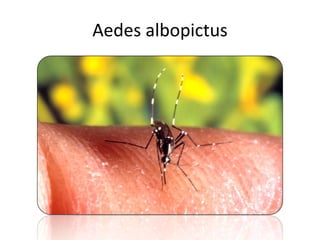
Vector  Aedes aegypti/Aedes albopictus The female mosquito feeds on blood ( they need the protein found in blood to produce eggs) Male mosquitoes feed only on plant nectar.  The mosquito is attracted by the body odours, carbon dioxide and heat emitted from the animal or humans .
Aedes aegypti  Mosquito life cycle  Eggs are laid on the walls of water-filled containers in the house and patio.  The eggs can survive for months and hatch when submerged in water.  Female mosquitoes lay dozens of eggs up to 5 times during their life time.  The mosquito life cycle, takes 8 days and occurs in water. Adult mosquitoes live for one month.
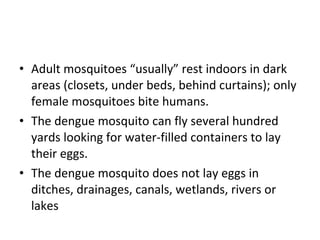
Adult mosquitoes “usually” rest indoors in dark areas (closets, under beds, behind curtains); only female mosquitoes bite humans.  The dengue mosquito can fly several hundred yards looking for water-filled containers to lay their eggs.  The dengue mosquito does not lay eggs in ditches, drainages, canals, wetlands, rivers or lakes
Aedes aegypti
Aedes albopictus
PATHOPHYSIOLOGY
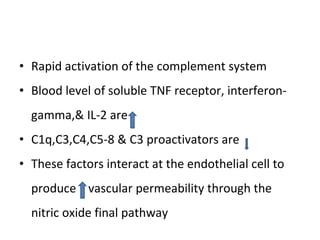
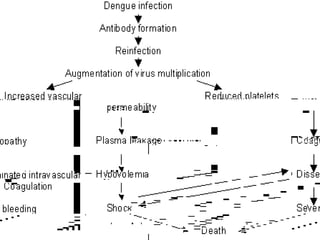
Rapid activation of the complement system Blood level of soluble TNF receptor, interferon-gamma,& IL-2 are  C1q,C3,C4,C5-8 & C3 proactivators are  These factors interact at the endothelial cell to produce  vascular permeability through the nitric oxide final pathway
The blood clotting & fibrinolytic system are  & levels of factor XII are  Capillary damage allows fluid, electrolytes & small proteins ,red cells to leak into extravascular spaces This internal redistribution of fluid together with deficits caused by fasting, thirst,vomiting results in hemoconcentration,hypovolaemia, increase cardiac work, tissue hypoxia, metabolic acidosis & hyponatremia
CLINICAL MANIFESTATIONS
Four dengue clinical syndrome Undifferentiated fever Classic dengue fever Dengue hemorrhagic fever(DHF) Dengue Shock Syndrome (DSS)- a severe form of DHF
Undifferentiated fever Most common presentation Silent transmission Incubation period of 3-14 days(average 4-7 days) Sudden onset of fever, biphasic Severe headache(retro-orbital)
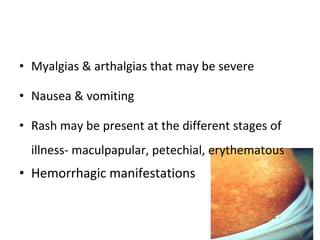
Myalgias & arthalgias that may be severe Nausea & vomiting Rash may be present at the different stages of illness- maculpapular, petechial, erythematous Hemorrhagic manifestations
DENGUE HEMORRHAGIC   FEVER
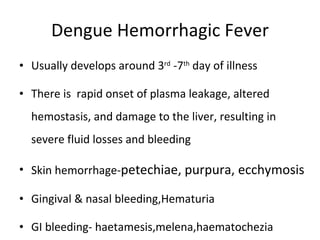
Dengue Hemorrhagic Fever Usually develops around 3 rd  -7 th  day of illness There is  rapid onset of plasma leakage, altered hemostasis, and damage to the liver, resulting in severe fluid losses and bleeding Skin hemorrhage- petechiae, purpura, ecchymosis Gingival & nasal bleeding,Hematuria GI bleeding- haetamesis,melena,haematochezia
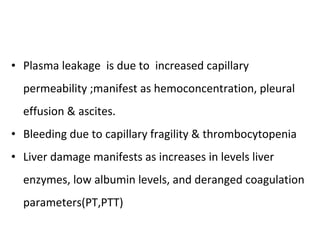
Plasma leakage  is due to  increased capillary permeability ;manifest as hemoconcentration, pleural effusion & ascites.  Bleeding due to capillary fragility & thrombocytopenia  Liver damage manifests as increases in levels liver enzymes, low albumin levels, and deranged coagulation parameters(PT,PTT)
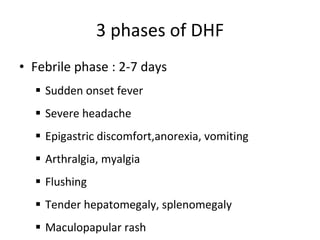
3 phases of DHF Febrile phase : 2-7 days Sudden onset fever Severe headache Epigastric discomfort,anorexia, vomiting Arthralgia, myalgia Flushing Tender hepatomegaly, splenomegaly Maculopapular rash
Leakage phase 1 ST  24-48 HOURS Pleural effusion Ascities Pericardial effusion Haemorrhagic menifestation Haematemesis,malena ,epistaxis & menorrhagia
Convalescent phase Short & uneventful Short & uneventful Return of appetite Bradycardia Recovery rash Severe itching on palms & soles of appetite Bradycardia Recovery z
Criteria to label Dengue Hemorrhagic Fever
WHO case definition of DHF Fever-sudden onset 2-7 days Hemorrhagic manifestations with positive tourniquet test Low platelet count(1,00,000/mm 3  or less) Objective evidence of plasma leak syndrome Hematocrit ≥ 20% above baseline Low albumin Pleural/pericardial effusions
Four grades of DHF Grade I - Fever & non-specific constitutional  symptoms Positive tourniquet test is only  hemorrhagic manifestations Grade  II-  Grade I manifestations +  spontaneous bleeding Grade III -signs of circulatory failure Grade IV-  profound shock (undetectable pulse & BP)
Danger signs in Dengue Hemorrhagic Fever Abdominal pain-intense & sustained Persistent vomiting Abrupt change from fever to hypothermia, with sweating  Change in mental status of the patient
Unusual presentation of Severe Dengue Fever Encephalopathy Liver failure or fulminant hepatitis Demonstrated by Increase aminotransferas, increase bilirubin, incresae PT,APTT Cardiomyopathy-conduction defects, myocarditis Severe GI hemorrhage
Risk Factors  Age: all groups are affected Pre-existing anti –dengue antibody,either caused by previous infection or to maternal antibodies passed to infants Higher risk in secondary infections Higher risk inlocations with two or more seroypes circulating  simultaneously at high levels
TOURNIQUET TEST
Inflate BP cuff to a point midway between SBP & DBP for 5 minute After deflating the cuff, wait for the skin to return to its normal colour ,then count the number of petechiae visible in one inch-square area on the ventral surface of the forearm Positive test: 20 0r more petechiae per one inch 2
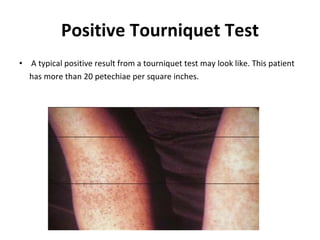
Positive Tourniquet Test A typical positive result from a tourniquet test may look like. This patient has more than 20 petechiae per square inches.
Dengue Shock Syndrome
Four criteria  Evidence of circulatory failure, manifested indirectly by all of the following Rapid & weak pulse Narrow pulse pressure (≤ 20 mm Hg or hypotension for age) Cold, clammy skin  & altered mental status Frank shock
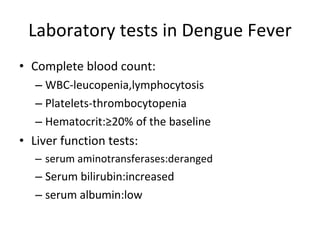
Laboratory tests in Dengue Fever Complete blood count: WBC-leucopenia,lymphocytosis Platelets-thrombocytopenia Hematocrit:≥20% of the baseline Liver function tests: serum aminotransferases:deranged Serum bilirubin:increased serum albumin:low
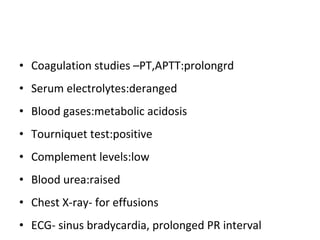
Coagulation studies –PT,APTT:prolongrd Serum electrolytes:deranged Blood gases:metabolic acidosis Tourniquet test:positive Complement levels:low Blood urea:raised Chest X-ray- for effusions ECG- sinus bradycardia, prolonged PR interval
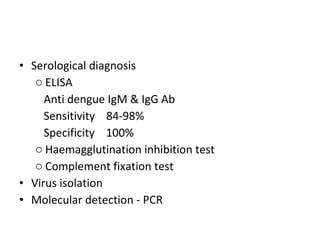
Serological diagnosis ELISA Anti dengue IgM & IgG Ab Sensitivity  84-98% Specificity  100% Haemagglutination inhibition test Complement fixation test Virus isolation Molecular detection - PCR
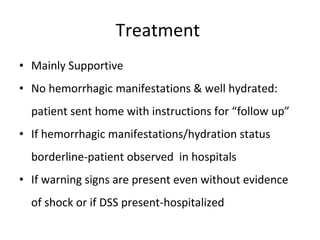
Treatment  Mainly Supportive No hemorrhagic manifestations & well hydrated: patient sent home with instructions for “follow up” If hemorrhagic manifestations/hydration status  borderline-patient observed  in hospitals If warning signs are present even without evidence of shock or if DSS present-hospitalized
Intravenous fluids with Electrolyte balance Antipyretics-acetaminophen(aspirin and NSAIDS should be avoided as they interfere with platelet function) H2 blockers,antiemetics(Domperidone) Platelet and FFP transfusion when needed Monitoring of BP, urine output, platelet count and hematocrit Soft,balanced nutritious diet
Mosquito barrier Needed until fever subsides(to prevent Aedes aegypti mosquito from biting patients & acquiring virus) Patients should be kept ideally in screened room or under mosquito net
Treatment of DHF & DSS A medical emergency Admit in ICU Keep the patient in supine position Immediate evaluation of vital signs & degrees of hemoconcentration, dehydration & electrolyte imbalance Rapid I/v replacement with wide bore cannula –N/S ideal fluid of choice
Monitor CBC, LFTs, S/E, PT/APTT When pulse pressure is ≤ 10 mmHg or when elevation of Hct persists after replacement of fluids; plasma or colloids are indicated FFP & platelets for bleeding No role of corticosteroids Look for evidence of complications Avoid hypervolaemia
Complications  Fluid & electrolyte losses Myocarditis  Hepatic dysfunction Febrile convulsions Residual brain damage Encephalopathy  Disseminated Intravascular coagulation Dengue shock syndrome
Indications for hospital discharge Absence of fever for 24 hours(without anti-fever therapy) & return of appetite Visible improvement in clnical picture Stable haematocrit 3 das after recovery from shock platelets ≥ 50,000/mm 3 No respiratory distress from pleural effusion/ascites
Return IMMEDIATELY to clinic or emergency department if any of the following warning signs appear :    Severe abdominal pain or persistent vomiting    Red spots or patches on the skin    Bleeding from nose or gums , Vomiting blood    Black, tarry stools    Drowsiness or irritability    Pale, cold, or clammy skin    Difficulty breathing
Dengue Vaccine No licensed vaccine at present Effective vaccine must be tetravalent Field testing of an attenuated tetravalent vaccine currently underway
PREVENTION
Vector control  Chemical control-  Larvicides  may be used to kill the immature aquatic stages Ultra-low volume fumigation is effective against adult mosquitoes Mosquitoes may have resistance to commercial aerosols spray
Biological control - largely experimental -Placing fish in containers to eat the larvae Environmental control Elimination of larval habitats Most likely method to be effective in the long term
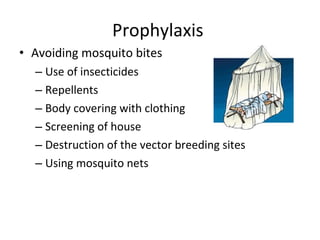
Prophylaxis  Avoiding mosquito bites Use of insecticides Repellents Body covering with clothing Screening of house Destruction of the vector breeding sites Using mosquito nets
If storage is mandatory, a tight fitting lid or a thin layer of oil may prevent egg laying or hatching A larvicide (Abate) available as a 1% sand –granule formations may be added safely to drinking water
Why to control??/Purpose of control Reduce female vector density to a level below which epidemic vector transmission will not occur The minimum vector density to prevent epidemic transmission is unknown
Program to minimize the impact of epidemic Teaching the medical community how to diagnose and mange DHF Educating the general public to encourage & enable them to carry out vector control in their home and neighborhood
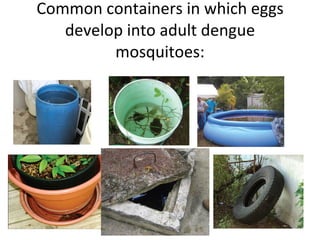
Common containers in which eggs develop into adult dengue mosquitoes:
Recent advances Gene-modified mosquitos could stop dengue fever :  genetically modified mosquitoes wee released  last year at sites in Malaysia and the Cayman Islands.
Key Message Dengue infection is preventable disease No direct person to person transmission Prevent Man – Mosquito contact to prevent the disease

Dengue fever

  • 1.
    DENGUE FEVER Dr.Anita Lamichhane Deptt. Of pediatrics Shaikh Zayed Hospital
  • 2.
  • 3.
    Dengue virus Single stranded RNA virus,Arbovirus belonging to flaviviridae family 4 antigenically distinct serotypes-DEN 1, 2,3, 4. DEN-1, DEN-2 were prevalent until 1980s DEN-3 is predominant in recent outbreak DEN-4 primarily detected in secondary dengue infections Serotype provides specific life time immunity and short term cross immunity
  • 4.
    Dengue virus transmission Two general patterns Epidemic Dengue – dengue virus is introduced into a region as an isolated event that involves a single viral strain(Asia,Africa,America) Hyperendemic Dengue -continuous circulation of multiple viral serotypes in an area where a large pool of susceptible hosts & a competent vector are constantly present,predominant pattern of global transmission.
  • 5.
  • 6.
    The vector-Aedes aegyptiTransmitted by the infected female Aedes aegypti Can be identified by the white bands or scale patterns on its legs and thorax Primarily a daytime feeder Found in tropical & subtropical region Lives around human habitation Lays egg & produces larvae preferentially in artificial containers
  • 7.
    Vector & itstransmission 0 5 8 12 16 20 24 28 DAYS Illness Illness Human #1 Human #2 Mosquito feeds/acquires virus Mosquito refeeds/transmits virus Viremia Intrinsic incubation period Extrinsic incubation period Viremia
  • 8.
    Replication & transmissionof Dengue virus Virus inoculated into a human being with mosquito saliva The virus localizes and replicates in various target organs-local lymph nodes & liver  released  spreads through the blood  infect the WBCs & reticuloendothelial system(dendritic cells,hepatocytes,endothelial cells) The mosquito ingests blood containing the viruses (on biting an infective person)
  • 9.
    Virus replicates inthe midgut,ovaries,nerve tissue, fat body of the mosquito It then escapes into the body cavity and later on infects the salivary glands In the salivary glands, the virus replicates When the mosquito bites another human ,the life cycle continues Humans are the primary reservoir of infection
  • 10.
    Vector Aedesaegypti/Aedes albopictus The female mosquito feeds on blood ( they need the protein found in blood to produce eggs) Male mosquitoes feed only on plant nectar. The mosquito is attracted by the body odours, carbon dioxide and heat emitted from the animal or humans .
  • 11.
    Aedes aegypti Mosquito life cycle Eggs are laid on the walls of water-filled containers in the house and patio. The eggs can survive for months and hatch when submerged in water. Female mosquitoes lay dozens of eggs up to 5 times during their life time. The mosquito life cycle, takes 8 days and occurs in water. Adult mosquitoes live for one month.
  • 12.
    Adult mosquitoes “usually”rest indoors in dark areas (closets, under beds, behind curtains); only female mosquitoes bite humans. The dengue mosquito can fly several hundred yards looking for water-filled containers to lay their eggs. The dengue mosquito does not lay eggs in ditches, drainages, canals, wetlands, rivers or lakes
  • 13.
  • 14.
  • 15.
  • 16.
    Rapid activation ofthe complement system Blood level of soluble TNF receptor, interferon-gamma,& IL-2 are C1q,C3,C4,C5-8 & C3 proactivators are These factors interact at the endothelial cell to produce vascular permeability through the nitric oxide final pathway
  • 17.
    The blood clotting& fibrinolytic system are & levels of factor XII are Capillary damage allows fluid, electrolytes & small proteins ,red cells to leak into extravascular spaces This internal redistribution of fluid together with deficits caused by fasting, thirst,vomiting results in hemoconcentration,hypovolaemia, increase cardiac work, tissue hypoxia, metabolic acidosis & hyponatremia
  • 18.
  • 19.
    Four dengue clinicalsyndrome Undifferentiated fever Classic dengue fever Dengue hemorrhagic fever(DHF) Dengue Shock Syndrome (DSS)- a severe form of DHF
  • 20.
    Undifferentiated fever Mostcommon presentation Silent transmission Incubation period of 3-14 days(average 4-7 days) Sudden onset of fever, biphasic Severe headache(retro-orbital)
  • 21.
    Myalgias & arthalgiasthat may be severe Nausea & vomiting Rash may be present at the different stages of illness- maculpapular, petechial, erythematous Hemorrhagic manifestations
  • 22.
  • 23.
    Dengue Hemorrhagic FeverUsually develops around 3 rd -7 th day of illness There is rapid onset of plasma leakage, altered hemostasis, and damage to the liver, resulting in severe fluid losses and bleeding Skin hemorrhage- petechiae, purpura, ecchymosis Gingival & nasal bleeding,Hematuria GI bleeding- haetamesis,melena,haematochezia
  • 24.
    Plasma leakage is due to increased capillary permeability ;manifest as hemoconcentration, pleural effusion & ascites. Bleeding due to capillary fragility & thrombocytopenia Liver damage manifests as increases in levels liver enzymes, low albumin levels, and deranged coagulation parameters(PT,PTT)
  • 25.
    3 phases ofDHF Febrile phase : 2-7 days Sudden onset fever Severe headache Epigastric discomfort,anorexia, vomiting Arthralgia, myalgia Flushing Tender hepatomegaly, splenomegaly Maculopapular rash
  • 26.
    Leakage phase 1ST 24-48 HOURS Pleural effusion Ascities Pericardial effusion Haemorrhagic menifestation Haematemesis,malena ,epistaxis & menorrhagia
  • 27.
    Convalescent phase Short& uneventful Short & uneventful Return of appetite Bradycardia Recovery rash Severe itching on palms & soles of appetite Bradycardia Recovery z
  • 28.
    Criteria to labelDengue Hemorrhagic Fever
  • 29.
    WHO case definitionof DHF Fever-sudden onset 2-7 days Hemorrhagic manifestations with positive tourniquet test Low platelet count(1,00,000/mm 3 or less) Objective evidence of plasma leak syndrome Hematocrit ≥ 20% above baseline Low albumin Pleural/pericardial effusions
  • 30.
    Four grades ofDHF Grade I - Fever & non-specific constitutional symptoms Positive tourniquet test is only hemorrhagic manifestations Grade II- Grade I manifestations + spontaneous bleeding Grade III -signs of circulatory failure Grade IV- profound shock (undetectable pulse & BP)
  • 31.
    Danger signs inDengue Hemorrhagic Fever Abdominal pain-intense & sustained Persistent vomiting Abrupt change from fever to hypothermia, with sweating Change in mental status of the patient
  • 32.
    Unusual presentation ofSevere Dengue Fever Encephalopathy Liver failure or fulminant hepatitis Demonstrated by Increase aminotransferas, increase bilirubin, incresae PT,APTT Cardiomyopathy-conduction defects, myocarditis Severe GI hemorrhage
  • 33.
    Risk Factors Age: all groups are affected Pre-existing anti –dengue antibody,either caused by previous infection or to maternal antibodies passed to infants Higher risk in secondary infections Higher risk inlocations with two or more seroypes circulating simultaneously at high levels
  • 34.
  • 35.
    Inflate BP cuffto a point midway between SBP & DBP for 5 minute After deflating the cuff, wait for the skin to return to its normal colour ,then count the number of petechiae visible in one inch-square area on the ventral surface of the forearm Positive test: 20 0r more petechiae per one inch 2
  • 36.
    Positive Tourniquet TestA typical positive result from a tourniquet test may look like. This patient has more than 20 petechiae per square inches.
  • 37.
  • 38.
    Four criteria Evidence of circulatory failure, manifested indirectly by all of the following Rapid & weak pulse Narrow pulse pressure (≤ 20 mm Hg or hypotension for age) Cold, clammy skin & altered mental status Frank shock
  • 39.
    Laboratory tests inDengue Fever Complete blood count: WBC-leucopenia,lymphocytosis Platelets-thrombocytopenia Hematocrit:≥20% of the baseline Liver function tests: serum aminotransferases:deranged Serum bilirubin:increased serum albumin:low
  • 40.
    Coagulation studies –PT,APTT:prolongrdSerum electrolytes:deranged Blood gases:metabolic acidosis Tourniquet test:positive Complement levels:low Blood urea:raised Chest X-ray- for effusions ECG- sinus bradycardia, prolonged PR interval
  • 41.
    Serological diagnosis ELISAAnti dengue IgM & IgG Ab Sensitivity 84-98% Specificity 100% Haemagglutination inhibition test Complement fixation test Virus isolation Molecular detection - PCR
  • 42.
    Treatment MainlySupportive No hemorrhagic manifestations & well hydrated: patient sent home with instructions for “follow up” If hemorrhagic manifestations/hydration status borderline-patient observed in hospitals If warning signs are present even without evidence of shock or if DSS present-hospitalized
  • 43.
    Intravenous fluids withElectrolyte balance Antipyretics-acetaminophen(aspirin and NSAIDS should be avoided as they interfere with platelet function) H2 blockers,antiemetics(Domperidone) Platelet and FFP transfusion when needed Monitoring of BP, urine output, platelet count and hematocrit Soft,balanced nutritious diet
  • 44.
    Mosquito barrier Neededuntil fever subsides(to prevent Aedes aegypti mosquito from biting patients & acquiring virus) Patients should be kept ideally in screened room or under mosquito net
  • 45.
    Treatment of DHF& DSS A medical emergency Admit in ICU Keep the patient in supine position Immediate evaluation of vital signs & degrees of hemoconcentration, dehydration & electrolyte imbalance Rapid I/v replacement with wide bore cannula –N/S ideal fluid of choice
  • 46.
    Monitor CBC, LFTs,S/E, PT/APTT When pulse pressure is ≤ 10 mmHg or when elevation of Hct persists after replacement of fluids; plasma or colloids are indicated FFP & platelets for bleeding No role of corticosteroids Look for evidence of complications Avoid hypervolaemia
  • 47.
    Complications Fluid& electrolyte losses Myocarditis Hepatic dysfunction Febrile convulsions Residual brain damage Encephalopathy Disseminated Intravascular coagulation Dengue shock syndrome
  • 48.
    Indications for hospitaldischarge Absence of fever for 24 hours(without anti-fever therapy) & return of appetite Visible improvement in clnical picture Stable haematocrit 3 das after recovery from shock platelets ≥ 50,000/mm 3 No respiratory distress from pleural effusion/ascites
  • 49.
    Return IMMEDIATELY toclinic or emergency department if any of the following warning signs appear :  Severe abdominal pain or persistent vomiting  Red spots or patches on the skin  Bleeding from nose or gums , Vomiting blood  Black, tarry stools  Drowsiness or irritability  Pale, cold, or clammy skin  Difficulty breathing
  • 50.
    Dengue Vaccine Nolicensed vaccine at present Effective vaccine must be tetravalent Field testing of an attenuated tetravalent vaccine currently underway
  • 51.
  • 52.
    Vector control Chemical control- Larvicides may be used to kill the immature aquatic stages Ultra-low volume fumigation is effective against adult mosquitoes Mosquitoes may have resistance to commercial aerosols spray
  • 53.
    Biological control -largely experimental -Placing fish in containers to eat the larvae Environmental control Elimination of larval habitats Most likely method to be effective in the long term
  • 54.
    Prophylaxis Avoidingmosquito bites Use of insecticides Repellents Body covering with clothing Screening of house Destruction of the vector breeding sites Using mosquito nets
  • 55.
    If storage ismandatory, a tight fitting lid or a thin layer of oil may prevent egg laying or hatching A larvicide (Abate) available as a 1% sand –granule formations may be added safely to drinking water
  • 56.
    Why to control??/Purposeof control Reduce female vector density to a level below which epidemic vector transmission will not occur The minimum vector density to prevent epidemic transmission is unknown
  • 57.
    Program to minimizethe impact of epidemic Teaching the medical community how to diagnose and mange DHF Educating the general public to encourage & enable them to carry out vector control in their home and neighborhood
  • 58.
    Common containers inwhich eggs develop into adult dengue mosquitoes:
  • 59.
    Recent advances Gene-modifiedmosquitos could stop dengue fever : genetically modified mosquitoes wee released last year at sites in Malaysia and the Cayman Islands.
  • 60.
    Key Message Dengueinfection is preventable disease No direct person to person transmission Prevent Man – Mosquito contact to prevent the disease