CITRIC ACID CYCLECITRIC ACID CYCLE
-Anaplerosis-Anaplerosis
Reading:
Harper’s Biochemistry Chapter 18
Lehninger Principles of Biochemistry
3rd Ed. pp. 584-592
OBJECTIVESOBJECTIVES
To understand the citric acid cycle as both a source
and “sink” for carbon compounds involved in other
metabolic pathways.
To understand anaplerosis as a mechanism for
regulating the flow of intermediates in the citric acid
cycle.
To understand how the citric acid cycle is essential
for supplying acetyl-CoA to the cytoplasm for use in
fatty acid biosynthesis.
In aerobic organisms, the citric acid cycle is an
amphibolic pathway, one that serves in both catabolic and
anabolic processes.
Besides its role in the oxidative catabolism of
carbohydrates, fatty acids, and amino acids, the cycle
provides precursors for many biosynthetic pathways,
through reactions that served the same purpose in
anaerobic ancestors.
Ketoglutarate and oxaloacetate can serves as precursors
for glutamate and aspartate, respectively, by simple
transamination, which themselves can act as precursors
for other amino acids and nucleotides.
Oxaloacetate can be converted to glucose in
gluconeogenesis.
Succinyl-CoA is a central intermediate of heme groups.
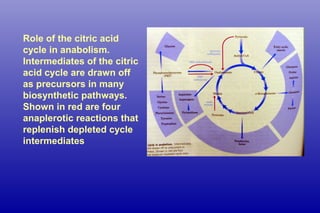
Role of the citric acid
cycle in anabolism.
Intermediates of the citric
acid cycle are drawn off
as precursors in many
biosynthetic pathways.
Shown in red are four
anaplerotic reactions that
replenish depleted cycle
intermediates
Anaplerotic reactions replenishAnaplerotic reactions replenish
intermediates in citric acid cycleintermediates in citric acid cycle
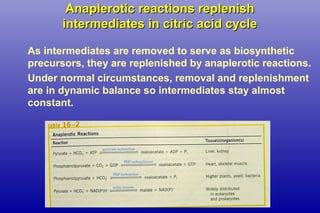
As intermediates are removed to serve as biosynthetic
precursors, they are replenished by anaplerotic reactions.
Under normal circumstances, removal and replenishment
are in dynamic balance so intermediates stay almost
constant.
Most significant is the formation ofMost significant is the formation of
oxaloacetate by pyruvate carboxylaseoxaloacetate by pyruvate carboxylase
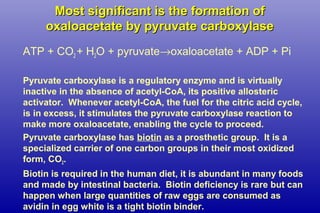
ATP + CO2 + H2O + pyruvate→oxaloacetate + ADP + Pi
Pyruvate carboxylase is a regulatory enzyme and is virtually
inactive in the absence of acetyl-CoA, its positive allosteric
activator. Whenever acetyl-CoA, the fuel for the citric acid cycle,
is in excess, it stimulates the pyruvate carboxylase reaction to
make more oxaloacetate, enabling the cycle to proceed.
Pyruvate carboxylase has biotin as a prosthetic group. It is a
specialized carrier of one carbon groups in their most oxidized
form, CO2.
Biotin is required in the human diet, it is abundant in many foods
and made by intestinal bacteria. Biotin deficiency is rare but can
happen when large quantities of raw eggs are consumed as
avidin in egg white is a tight biotin binder.
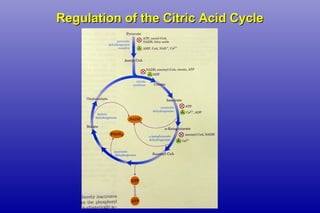
Regulation of the Citric Acid CycleRegulation of the Citric Acid Cycle
Regulation of acetyl-CoA production by theRegulation of acetyl-CoA production by the
pyruvate dehydrogenase complexpyruvate dehydrogenase complex
The pyruvate dehydrogenase complex of vertebrates is
strongly inhibited by ATP, by acetyl-CoA, and by NADH,
the products of the reaction catalyzed by the complex.
When long chain fatty acids are available, and can
provide acetyl-CoA via B-oxidation, pyruvate oxidation is
inhibited.
When too little acetate flows through the cycle, AMP,
CoA, and NAD+
all accumulate and allosterically activate
the pyruvate dehydrogenase complex.
Pyruvate dehydrogenase is inhibited by reversible serine
phosphorylation - the kinase responsible is allosterically
activated by ATP.
Regulation of the citric acid cycle at itsRegulation of the citric acid cycle at its
three exergonic stepsthree exergonic steps
The flow of metabolites through the citric acid cycle is under stringent
regulation.
Three major factors govern the rate of flux: substrate availability, inhibition
by accumulating products, and allosteric feedback inhibition of the enzymes
that catalyze early steps in the cycle.
Each of the three strongly exergonic steps - those catalyzed by citrate
synthesis, isocitrate dehydrogenase, and α-ketoglutarate dehydrogenase
can become the rate-limiting step under specific conditions:
-citrate synthase can limit the rate of citrate formation if substrates (acetyl-
CoA and oxaloacetate) are at low level
-high NADH/NAD+
ratio inhibits both dehydrogenase reactions
-product accumulation inhibits all three steps
-In muscle Ca2+
, the signal for contraction and increased energy demand,
activates isocitrate, α-ketoglutarate, and pyruvate dehydrogenases
The citric acid cycle takes part in fatty acidThe citric acid cycle takes part in fatty acid
biosynthesisbiosynthesis
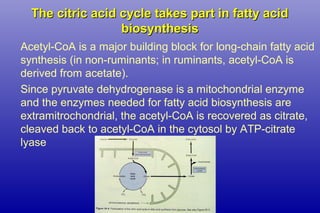
Acetyl-CoA is a major building block for long-chain fatty acid
synthesis (in non-ruminants; in ruminants, acetyl-CoA is
derived from acetate).
Since pyruvate dehydrogenase is a mitochondrial enzyme
and the enzymes needed for fatty acid biosynthesis are
extramitrochondrial, the acetyl-CoA is recovered as citrate,
cleaved back to acetyl-CoA in the cytosol by ATP-citrate
lyase
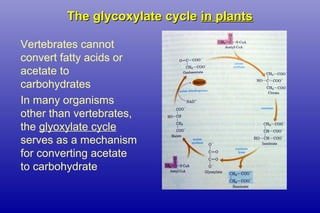
The glycoxylate cycleThe glycoxylate cycle in plantsin plants
Vertebrates cannot
convert fatty acids or
acetate to
carbohydrates
In many organisms
other than vertebrates,
the glyoxylate cycle
serves as a mechanism
for converting acetate
to carbohydrate
SummarySummary
The citric acid cycle is the final pathway for the oxidation of
carbohydrate, lipid, and protein. It catalyzes the
combination of their common metabolite, acetyl-CoA, with
oxaloacetate to form citrate. Through a series of
dehydrogenations and decarboxylations, citrate is
degraded, producing reducing equivalents in the form of
NADH and FADH2, releasing CO2, and regenerating
oxaloacetate.
The overall rate of the citric acid cycle is controlled by the
rate of conversion of pyruvate to acetyl-CoA and by the flux
through citrate synthase, isocitrate dehydrogenase, and α-
ketoglutarate dehydrogenase. These fluxes are largely
determined by the concentrations of substrates and
products; the end products ATP and NADH are inhibitory.
SummarySummary
Citric acid cycle intermediates are also used as precursors
in the biosynthesis of amino acids and other biomolecules.
These intermediates are replenished by anaplerotic
reactions catalyzed by pyruvate decarboxylase, PEP
carboxykinase, PEP carboxylase, and malic enzyme
The glyoxylate cycle in plants and some microorganisms
bypasses the two decarboxylation steps of the citric acid
cycle and makes possible the net formation of succinate
and oxaloacetate from acetyl-CoA, glucose formation from
fatty acids or acetate.

Citric Acid Cycle-Anaplerosis

  • 1.
    CITRIC ACID CYCLECITRICACID CYCLE -Anaplerosis-Anaplerosis Reading: Harper’s Biochemistry Chapter 18 Lehninger Principles of Biochemistry 3rd Ed. pp. 584-592
  • 2.
    OBJECTIVESOBJECTIVES To understand thecitric acid cycle as both a source and “sink” for carbon compounds involved in other metabolic pathways. To understand anaplerosis as a mechanism for regulating the flow of intermediates in the citric acid cycle. To understand how the citric acid cycle is essential for supplying acetyl-CoA to the cytoplasm for use in fatty acid biosynthesis.
  • 3.
    In aerobic organisms,the citric acid cycle is an amphibolic pathway, one that serves in both catabolic and anabolic processes. Besides its role in the oxidative catabolism of carbohydrates, fatty acids, and amino acids, the cycle provides precursors for many biosynthetic pathways, through reactions that served the same purpose in anaerobic ancestors. Ketoglutarate and oxaloacetate can serves as precursors for glutamate and aspartate, respectively, by simple transamination, which themselves can act as precursors for other amino acids and nucleotides. Oxaloacetate can be converted to glucose in gluconeogenesis. Succinyl-CoA is a central intermediate of heme groups.
  • 4.
    Role of thecitric acid cycle in anabolism. Intermediates of the citric acid cycle are drawn off as precursors in many biosynthetic pathways. Shown in red are four anaplerotic reactions that replenish depleted cycle intermediates
  • 5.
    Anaplerotic reactions replenishAnapleroticreactions replenish intermediates in citric acid cycleintermediates in citric acid cycle As intermediates are removed to serve as biosynthetic precursors, they are replenished by anaplerotic reactions. Under normal circumstances, removal and replenishment are in dynamic balance so intermediates stay almost constant.
  • 6.
    Most significant isthe formation ofMost significant is the formation of oxaloacetate by pyruvate carboxylaseoxaloacetate by pyruvate carboxylase ATP + CO2 + H2O + pyruvate→oxaloacetate + ADP + Pi Pyruvate carboxylase is a regulatory enzyme and is virtually inactive in the absence of acetyl-CoA, its positive allosteric activator. Whenever acetyl-CoA, the fuel for the citric acid cycle, is in excess, it stimulates the pyruvate carboxylase reaction to make more oxaloacetate, enabling the cycle to proceed. Pyruvate carboxylase has biotin as a prosthetic group. It is a specialized carrier of one carbon groups in their most oxidized form, CO2. Biotin is required in the human diet, it is abundant in many foods and made by intestinal bacteria. Biotin deficiency is rare but can happen when large quantities of raw eggs are consumed as avidin in egg white is a tight biotin binder.
  • 8.
    Regulation of theCitric Acid CycleRegulation of the Citric Acid Cycle
  • 9.
    Regulation of acetyl-CoAproduction by theRegulation of acetyl-CoA production by the pyruvate dehydrogenase complexpyruvate dehydrogenase complex The pyruvate dehydrogenase complex of vertebrates is strongly inhibited by ATP, by acetyl-CoA, and by NADH, the products of the reaction catalyzed by the complex. When long chain fatty acids are available, and can provide acetyl-CoA via B-oxidation, pyruvate oxidation is inhibited. When too little acetate flows through the cycle, AMP, CoA, and NAD+ all accumulate and allosterically activate the pyruvate dehydrogenase complex. Pyruvate dehydrogenase is inhibited by reversible serine phosphorylation - the kinase responsible is allosterically activated by ATP.
  • 10.
    Regulation of thecitric acid cycle at itsRegulation of the citric acid cycle at its three exergonic stepsthree exergonic steps The flow of metabolites through the citric acid cycle is under stringent regulation. Three major factors govern the rate of flux: substrate availability, inhibition by accumulating products, and allosteric feedback inhibition of the enzymes that catalyze early steps in the cycle. Each of the three strongly exergonic steps - those catalyzed by citrate synthesis, isocitrate dehydrogenase, and α-ketoglutarate dehydrogenase can become the rate-limiting step under specific conditions: -citrate synthase can limit the rate of citrate formation if substrates (acetyl- CoA and oxaloacetate) are at low level -high NADH/NAD+ ratio inhibits both dehydrogenase reactions -product accumulation inhibits all three steps -In muscle Ca2+ , the signal for contraction and increased energy demand, activates isocitrate, α-ketoglutarate, and pyruvate dehydrogenases
  • 11.
    The citric acidcycle takes part in fatty acidThe citric acid cycle takes part in fatty acid biosynthesisbiosynthesis Acetyl-CoA is a major building block for long-chain fatty acid synthesis (in non-ruminants; in ruminants, acetyl-CoA is derived from acetate). Since pyruvate dehydrogenase is a mitochondrial enzyme and the enzymes needed for fatty acid biosynthesis are extramitrochondrial, the acetyl-CoA is recovered as citrate, cleaved back to acetyl-CoA in the cytosol by ATP-citrate lyase
  • 12.
    The glycoxylate cycleTheglycoxylate cycle in plantsin plants Vertebrates cannot convert fatty acids or acetate to carbohydrates In many organisms other than vertebrates, the glyoxylate cycle serves as a mechanism for converting acetate to carbohydrate
  • 13.
    SummarySummary The citric acidcycle is the final pathway for the oxidation of carbohydrate, lipid, and protein. It catalyzes the combination of their common metabolite, acetyl-CoA, with oxaloacetate to form citrate. Through a series of dehydrogenations and decarboxylations, citrate is degraded, producing reducing equivalents in the form of NADH and FADH2, releasing CO2, and regenerating oxaloacetate. The overall rate of the citric acid cycle is controlled by the rate of conversion of pyruvate to acetyl-CoA and by the flux through citrate synthase, isocitrate dehydrogenase, and α- ketoglutarate dehydrogenase. These fluxes are largely determined by the concentrations of substrates and products; the end products ATP and NADH are inhibitory.
  • 14.
    SummarySummary Citric acid cycleintermediates are also used as precursors in the biosynthesis of amino acids and other biomolecules. These intermediates are replenished by anaplerotic reactions catalyzed by pyruvate decarboxylase, PEP carboxykinase, PEP carboxylase, and malic enzyme The glyoxylate cycle in plants and some microorganisms bypasses the two decarboxylation steps of the citric acid cycle and makes possible the net formation of succinate and oxaloacetate from acetyl-CoA, glucose formation from fatty acids or acetate.