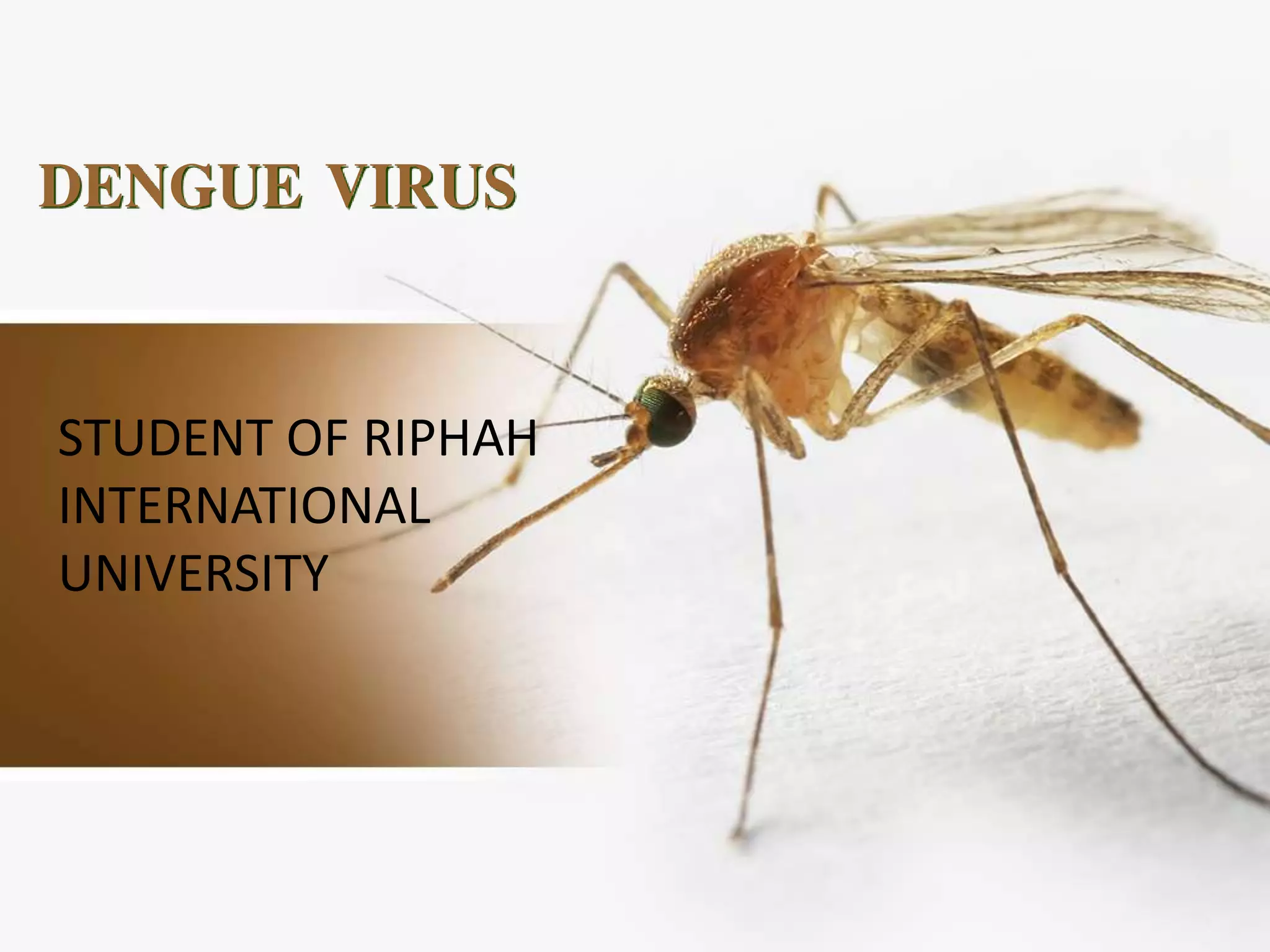
DENGUE VIRUS
STUDENT OF RIPHAH
INTERNATIONAL
UNIVERSITY
CONTENTS
• What is dengue virus
• History of dengue virus
• Taxonomic classification
• Types of dengue virus
• Structure of dengue virus
• Modes of transmission
• Pathogenesis
• Epidemiology
• Clinical features
• Diagnosis
• Treatment and medicine
• Precautions
• Role of pharmacist
• References
WHAT IS DENGUE VIRUS
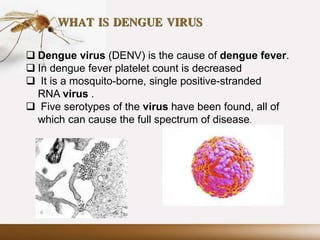
 Dengue virus (DENV) is the cause of dengue fever.
 In dengue fever platelet count is decreased
 It is a mosquito-borne, single positive-stranded
RNA virus .
 Five serotypes of the virus have been found, all of
which can cause the full spectrum of disease.
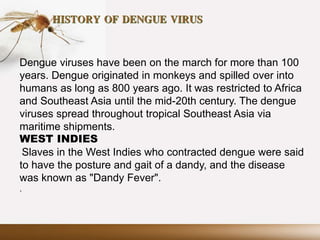
HISTORY OF DENGUE VIRUS
Dengue viruses have been on the march for more than 100
years. Dengue originated in monkeys and spilled over into
humans as long as 800 years ago. It was restricted to Africa
and Southeast Asia until the mid-20th century. The dengue
viruses spread throughout tropical Southeast Asia via
maritime shipments.
WEST INDIES
Slaves in the West Indies who contracted dengue were said
to have the posture and gait of a dandy, and the disease
was known as "Dandy Fever".
.
CONT…
FIRST RECORD CASE
 The first record of a case of probable dengue fever is in a Chinese medical
encyclopedia from the Jin Dynasty (265–420 AD) which referred to a “water
poison” associated with flying insects.
 The first recognized Dengue epidemics occurred almost simultaneously in
Asia, Africa, and North America in the 1780s, shortly after the identification
and naming of the disease in 1779.
 The first confirmed case report dates from 1789 and, by the term "break bone
fever" because of the symptoms of myalgia and arthralgia
 A relatively large dengue outbreak occurred in September 2001 in Hawaii,
where 1,644 persons had locally acquired dengue-like symptoms, of whom
122 were laboratory-confirmed. DENV-1 was isolated from 15 patients. The
outbreak illustrates how the virus can be moved from a distant area of
ongoing transmission to a new locality where mosquito vector populations are
abundant enough to initiate an outbreak.
 A recent island wide epidemic occurred in 2007, with more than 10,000 cases
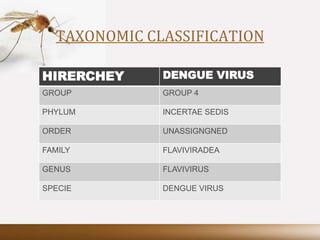
TAXONOMIC CLASSIFICATION
HIRERCHEY DENGUE VIRUS
GROUP GROUP 4
PHYLUM INCERTAE SEDIS
ORDER UNASSIGNGNED
FAMILY FLAVIVIRADEA
GENUS FLAVIVIRUS
SPECIE DENGUE VIRUS
TYPES OF DENGUE INFECTION
There are two types of dengue infection
1. Asymptomatic
2. Symptomatic
Dengue fever [with hemorrhage and without
hemorrhage]
DENV-1, DENV-2, DENV-3, and DENV-4
 Dengue hemorrhagic fever [ no shock and
dengue shock syndrome]
STRUCTURE OF DENGUE VIRUS
DNA COMONENTS
Internal structure [10 genes ]
 3 structural
 7 non structural
MOLECULAR STRUCTURE
External structure
 icosahedral
DIAMETER
 50nm in diameter
MODE OF TRANSMISSION
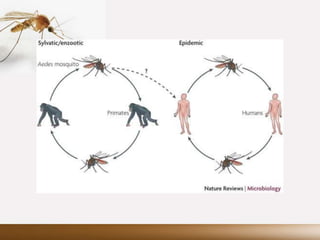
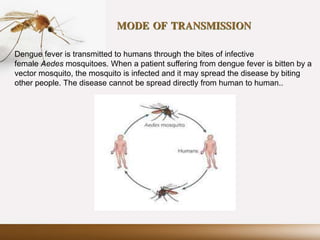
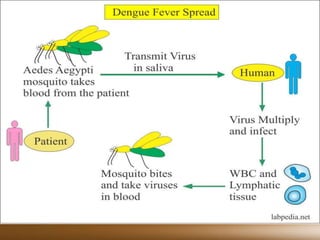
Dengue fever is transmitted to humans through the bites of infective
female Aedes mosquitoes. When a patient suffering from dengue fever is bitten by a
vector mosquito, the mosquito is infected and it may spread the disease by biting
other people. The disease cannot be spread directly from human to human..
CONT…
DENV can also be transmitted from an infected woman to her fetus
in utero or infant during parturition. More research is needed to
determine perinatal transmission rates and factors associated with
perinatal transmission.
Sources of DENV are
• Saliva of infected Aedes spp. mosquito
•Blood or organs from an acutely infected person
Modes of transmission also include
• Mosquito bite
•Perinatal transmission
•Blood transfusion
•Organ transplantation
•Needle stick injury or laboratory accident
INCUBATION PERIOD OF MOSQUITOE
The incubation period ranges from 3 – 14 days, commonly 4 – 7 days.
PATHOGENESIS
The manner of development of a disease is called
pathogenesis
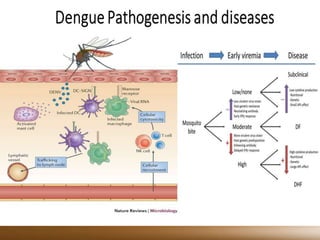
PATHOGENESIS OF DENGUE FEVER
It is strongly believed by many scientists studying dengue
pathogenesis that a high viral load and activation of high
numbers of nonprotective T cells result in a “storm” of
inflammatory cytokines and other mediators, leading to the
increased plasma leakage characteristic of DHF/DSS.
EIDEMIOLOGY
• Epidemiology is the study and analysis of the
distribution, patterns and determinants of health
and disease conditions in defined populations
• Dengue is widespread throughout the tropics, with
risk factors influenced by local spatial variations of
rainfall, temperature, relative humidity, degree of
urbanization and quality of vector control services
in urban areas.
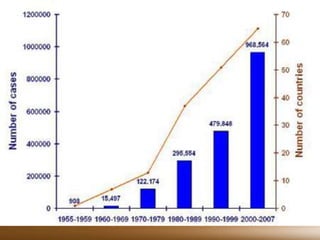
• Before 1970, only nine countries had experienced
severe dengue epidemics. Today, the disease is
endemic in more than 100 countries.
CLINICAL FEATURES
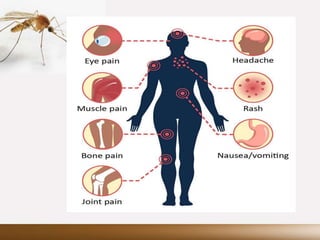
 Dengue fever is clinically characterized by high fever, severe
headache, pain behind the eyes, muscle and joint pain, nausea,
vomiting, swollen lymph nodes and rash.
 The symptoms of first infection are usually mild. Once recovered,
lifelong immunity to that serotype of dengue virus will develop
 Severe dengue include high fever, which lasts for 2 – 7 days and
can be as high as 40 – 41°C, facial flush .
 Later, there may be severe abdominal pain, persistent vomiting, rapid
breathing, fatigue, restlessness and manifestations of bleeding
tendency such as skin bruises, nose or gum bleeding, and possibly
internal bleeding.
 In severe cases, it may progress to circulatory failure, shock and
death.
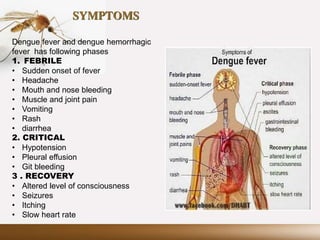
SYMPTOMS
Dengue fever and dengue hemorrhagic
fever has following phases
1. FEBRILE
• Sudden onset of fever
• Headache
• Mouth and nose bleeding
• Muscle and joint pain
• Vomiting
• Rash
• diarrhea
2. CRITICAL
• Hypotension
• Pleural effusion
• Git bleeding
3 . RECOVERY
• Altered level of consciousness
• Seizures
• Itching
• Slow heart rate
DIAGNOSIS OF DENGUE FEVER
• ALSO KNOWN AS
Dengue Fever Antibodies, Dengue Fever Virus
• FORMAL NAME
Dengue Antibodies (IgG, IgM), Dengue Virus by PCR
• DIAGNOSIS TEST
The diagnosis of dengue fever consist of the following tests
 CBC [Complete blood count]
 PCR test [Polymerase chain reaction]
 Antibody titer type for dengue virus
 LFT [ liver function test]
TREATMENT AND MEDICINE OF FEVER
• There is no specific medicine to treat dengue infection.
If you think you may have dengue fever, you should
use pain relievers with acetaminophen and avoid
medicines with aspirin, which could worsen bleeding.
You should also rest, drink plenty of fluids, and see
your doctor
• Patients with dengue hemorrhagic fever
or dengue shock syndrome may require intravenous
volume replacement.
Caripill [carica papaya leaf extract] is used
as a treatment of dengue fever according to
latest research.
PRECAUTIONS OF DENGUE FEVER
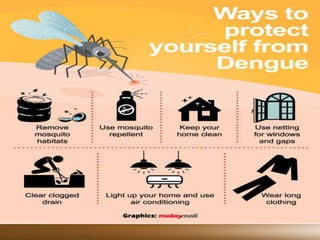
You can protect yourself against dengue fever by taking the
following precautions: Protect yourself against mosquito
bites.
 Apply mosquito repellent, ideally one containing DEET.
 Protect yourself against mosquito bites
 Prevent mosquito breeding inside and outside your home
 Avoid visiting areas prone to mosquitoes
 Wear long sleeves and long pants to cover arms and
sleeves.
 Use mosquito net while sleeping
ROLE OF PHARMACIST
The role of pharmacist for the control of dengue fever is as
follows
 The pharmacist must increase the awareness on
dengue fever specially in rural areas.
 Evaluate the impact of awareness among people.
 Improve the patients compliance
 Drug selection
 Formulary management
 Medication management
 Drug dispensing
 Research and make new medicines relating to dengue
REFRENCES
• https://www.google.com/search?sxsrf=ALeKk01Sd
bQNln5xDIMJlMEaCV4lrpygtQ%3A158705077271
5&ei=FHmYXtGsK4TBgQbAh6a
• https://www.slideshare.net/ZehraaCheaib/dengue-
virus-42568757
• https://www.google.com/search?q=structure+of+de
ngue+virus&sxsrf=ALeKk02iZWO9M2fd8rjfLSD5pt
8JADWHLA:158705150
• https://www.ghttps//www.google.com/search?q=str
ucture+of+dengue+virus&sxsrf=A
DENGUE VIRUS

DENGUE VIRUS

  • 1.
    DENGUE VIRUS STUDENT OFRIPHAH INTERNATIONAL UNIVERSITY
  • 2.
    CONTENTS • What isdengue virus • History of dengue virus • Taxonomic classification • Types of dengue virus • Structure of dengue virus • Modes of transmission • Pathogenesis • Epidemiology • Clinical features • Diagnosis • Treatment and medicine • Precautions • Role of pharmacist • References
  • 3.
    WHAT IS DENGUEVIRUS  Dengue virus (DENV) is the cause of dengue fever.  In dengue fever platelet count is decreased  It is a mosquito-borne, single positive-stranded RNA virus .  Five serotypes of the virus have been found, all of which can cause the full spectrum of disease.
  • 4.
    HISTORY OF DENGUEVIRUS Dengue viruses have been on the march for more than 100 years. Dengue originated in monkeys and spilled over into humans as long as 800 years ago. It was restricted to Africa and Southeast Asia until the mid-20th century. The dengue viruses spread throughout tropical Southeast Asia via maritime shipments. WEST INDIES Slaves in the West Indies who contracted dengue were said to have the posture and gait of a dandy, and the disease was known as "Dandy Fever". .
  • 5.
    CONT… FIRST RECORD CASE The first record of a case of probable dengue fever is in a Chinese medical encyclopedia from the Jin Dynasty (265–420 AD) which referred to a “water poison” associated with flying insects.  The first recognized Dengue epidemics occurred almost simultaneously in Asia, Africa, and North America in the 1780s, shortly after the identification and naming of the disease in 1779.  The first confirmed case report dates from 1789 and, by the term "break bone fever" because of the symptoms of myalgia and arthralgia  A relatively large dengue outbreak occurred in September 2001 in Hawaii, where 1,644 persons had locally acquired dengue-like symptoms, of whom 122 were laboratory-confirmed. DENV-1 was isolated from 15 patients. The outbreak illustrates how the virus can be moved from a distant area of ongoing transmission to a new locality where mosquito vector populations are abundant enough to initiate an outbreak.  A recent island wide epidemic occurred in 2007, with more than 10,000 cases
  • 7.
    TAXONOMIC CLASSIFICATION HIRERCHEY DENGUEVIRUS GROUP GROUP 4 PHYLUM INCERTAE SEDIS ORDER UNASSIGNGNED FAMILY FLAVIVIRADEA GENUS FLAVIVIRUS SPECIE DENGUE VIRUS
  • 8.
    TYPES OF DENGUEINFECTION There are two types of dengue infection 1. Asymptomatic 2. Symptomatic Dengue fever [with hemorrhage and without hemorrhage] DENV-1, DENV-2, DENV-3, and DENV-4  Dengue hemorrhagic fever [ no shock and dengue shock syndrome]
  • 9.
    STRUCTURE OF DENGUEVIRUS DNA COMONENTS Internal structure [10 genes ]  3 structural  7 non structural MOLECULAR STRUCTURE External structure  icosahedral DIAMETER  50nm in diameter
  • 10.
    MODE OF TRANSMISSION Denguefever is transmitted to humans through the bites of infective female Aedes mosquitoes. When a patient suffering from dengue fever is bitten by a vector mosquito, the mosquito is infected and it may spread the disease by biting other people. The disease cannot be spread directly from human to human..
  • 11.
    CONT… DENV can alsobe transmitted from an infected woman to her fetus in utero or infant during parturition. More research is needed to determine perinatal transmission rates and factors associated with perinatal transmission. Sources of DENV are • Saliva of infected Aedes spp. mosquito •Blood or organs from an acutely infected person Modes of transmission also include • Mosquito bite •Perinatal transmission •Blood transfusion •Organ transplantation •Needle stick injury or laboratory accident INCUBATION PERIOD OF MOSQUITOE The incubation period ranges from 3 – 14 days, commonly 4 – 7 days.
  • 13.
    PATHOGENESIS The manner ofdevelopment of a disease is called pathogenesis PATHOGENESIS OF DENGUE FEVER It is strongly believed by many scientists studying dengue pathogenesis that a high viral load and activation of high numbers of nonprotective T cells result in a “storm” of inflammatory cytokines and other mediators, leading to the increased plasma leakage characteristic of DHF/DSS.
  • 15.
    EIDEMIOLOGY • Epidemiology isthe study and analysis of the distribution, patterns and determinants of health and disease conditions in defined populations • Dengue is widespread throughout the tropics, with risk factors influenced by local spatial variations of rainfall, temperature, relative humidity, degree of urbanization and quality of vector control services in urban areas. • Before 1970, only nine countries had experienced severe dengue epidemics. Today, the disease is endemic in more than 100 countries.
  • 17.
    CLINICAL FEATURES  Denguefever is clinically characterized by high fever, severe headache, pain behind the eyes, muscle and joint pain, nausea, vomiting, swollen lymph nodes and rash.  The symptoms of first infection are usually mild. Once recovered, lifelong immunity to that serotype of dengue virus will develop  Severe dengue include high fever, which lasts for 2 – 7 days and can be as high as 40 – 41°C, facial flush .  Later, there may be severe abdominal pain, persistent vomiting, rapid breathing, fatigue, restlessness and manifestations of bleeding tendency such as skin bruises, nose or gum bleeding, and possibly internal bleeding.  In severe cases, it may progress to circulatory failure, shock and death.
  • 19.
    SYMPTOMS Dengue fever anddengue hemorrhagic fever has following phases 1. FEBRILE • Sudden onset of fever • Headache • Mouth and nose bleeding • Muscle and joint pain • Vomiting • Rash • diarrhea 2. CRITICAL • Hypotension • Pleural effusion • Git bleeding 3 . RECOVERY • Altered level of consciousness • Seizures • Itching • Slow heart rate
  • 20.
    DIAGNOSIS OF DENGUEFEVER • ALSO KNOWN AS Dengue Fever Antibodies, Dengue Fever Virus • FORMAL NAME Dengue Antibodies (IgG, IgM), Dengue Virus by PCR • DIAGNOSIS TEST The diagnosis of dengue fever consist of the following tests  CBC [Complete blood count]  PCR test [Polymerase chain reaction]  Antibody titer type for dengue virus  LFT [ liver function test]
  • 21.
    TREATMENT AND MEDICINEOF FEVER • There is no specific medicine to treat dengue infection. If you think you may have dengue fever, you should use pain relievers with acetaminophen and avoid medicines with aspirin, which could worsen bleeding. You should also rest, drink plenty of fluids, and see your doctor • Patients with dengue hemorrhagic fever or dengue shock syndrome may require intravenous volume replacement.
  • 22.
    Caripill [carica papayaleaf extract] is used as a treatment of dengue fever according to latest research.
  • 23.
    PRECAUTIONS OF DENGUEFEVER You can protect yourself against dengue fever by taking the following precautions: Protect yourself against mosquito bites.  Apply mosquito repellent, ideally one containing DEET.  Protect yourself against mosquito bites  Prevent mosquito breeding inside and outside your home  Avoid visiting areas prone to mosquitoes  Wear long sleeves and long pants to cover arms and sleeves.  Use mosquito net while sleeping
  • 25.
    ROLE OF PHARMACIST Therole of pharmacist for the control of dengue fever is as follows  The pharmacist must increase the awareness on dengue fever specially in rural areas.  Evaluate the impact of awareness among people.  Improve the patients compliance  Drug selection  Formulary management  Medication management  Drug dispensing  Research and make new medicines relating to dengue
  • 26.
    REFRENCES • https://www.google.com/search?sxsrf=ALeKk01Sd bQNln5xDIMJlMEaCV4lrpygtQ%3A158705077271 5&ei=FHmYXtGsK4TBgQbAh6a • https://www.slideshare.net/ZehraaCheaib/dengue- virus-42568757 •https://www.google.com/search?q=structure+of+de ngue+virus&sxsrf=ALeKk02iZWO9M2fd8rjfLSD5pt 8JADWHLA:158705150 • https://www.ghttps//www.google.com/search?q=str ucture+of+dengue+virus&sxsrf=A

Editor's Notes

  • #8 SINGLE STRANDED POSITIVE RNA
  • #16 .
  • #22  It raises the platelet count in patients and aids in the recovery from the disease.”Nov 20, 2018