What is dengue fever?


 Dengue Fever is an illness caused by
infection with a virus transmitted by the
            Aedes mosquito.
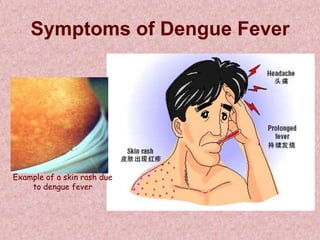
Symptoms of Dengue Fever


Example of a skin rash due
    to dengue fever
Do you know…
Dengue Fever (DF) and Dengue
Haemorrhagic Fever (DHF) are the most
common mosquito-borne viral disease in the
world.

It can be fatal.
Characteristics of the
         Aedes Mosquito
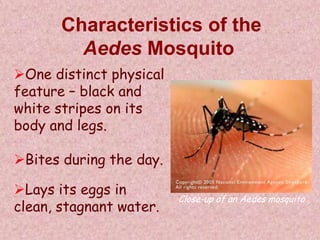
One distinct physical
feature – black and
white stripes on its
body and legs.

Bites during the day.

Lays its eggs in
                         Close-up of an Aedes mosquito
clean, stagnant water.
Do you know…
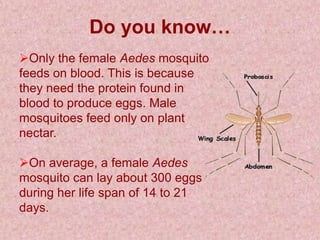
Only the female Aedes mosquito
feeds on blood. This is because
they need the protein found in
blood to produce eggs. Male
mosquitoes feed only on plant
nectar.

On average, a female Aedes
mosquito can lay about 300 eggs
during her life span of 14 to 21
days.
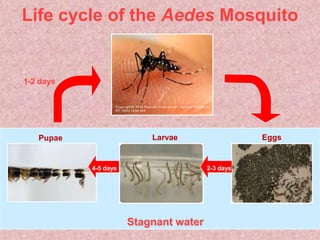
Life cycle of the Aedes Mosquito


1-2 days


   Pupae                  Larvae                  Eggs


           4-5 days                    2-3 days


                      Stagnant water
How Do Aedes Mosquitoes Transmit
          Diseases...
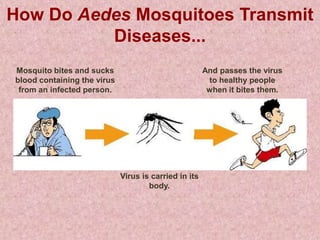
Mosquito bites and sucks                               And passes the virus
blood containing the virus                              to healthy people
 from an infected person.                               when it bites them.


                             Virus is carried in its
                                     body.
This is what you
can do to help…
Prevent Aedes from Breeding!


    Remove ALL sources of
       stagnant water.

 Deny the Aedes mosquito of any chance
               to breed.
10-Minute Mozzie Wipe-Out
          Exercise
      Turn over all pails and water
          storage containers.
Clear blockages and put Bti insecticide in
         roof gutters monthly.
Remove water from flowerpot plates on
          alternate days.
Do not litter. Rubbish such as cups and
bottles can collect rain water and breed
               mosquitoes.
Change water in vases on alternate days.
Before you leave for holidays…
• Cover all toilet bowls in your home.

• Seal off the overflow pipe of the flushing cistern.

• Cover all gully/floor traps.

• Add sand granular insecticide to places that
mosquitoes could potentially breed, such as flower
vases and places where stagnant water could not be
removed.
Dengue fever
• Dengue is an arthropod-borne disease caused by any
  one of four closely related viruses, (Arbovirus).
• Characterized by fever, severe headache, backache joint
  pains nausea and vomiting, eye pain and rash
• Occasionally produces shock and hemorrhage, leading
  to death.
• Also called breakbone fever, dandy fever or dengue
  fever.
Dengue Viruses

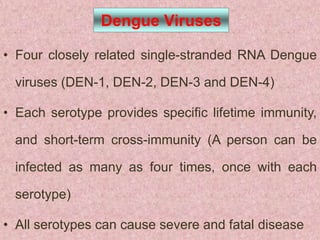
• Four closely related single-stranded RNA Dengue

 viruses (DEN-1, DEN-2, DEN-3 and DEN-4)

• Each serotype provides specific lifetime immunity,

 and short-term cross-immunity (A person can be

 infected as many as four times, once with each

 serotype)

• All serotypes can cause severe and fatal disease
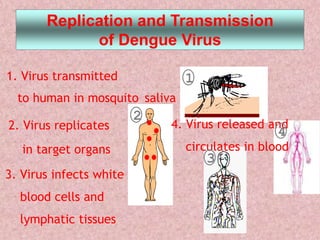
Replication and Transmission
             of Dengue Virus

1. Virus transmitted            1
  to human in mosquito saliva
                         2
2. Virus replicates          4. Virus released and
                                                4
   in target organs             circulates in blood
                                    3
3. Virus infects white
  blood cells and
  lymphatic tissues
Aedes aegypti Mosquito
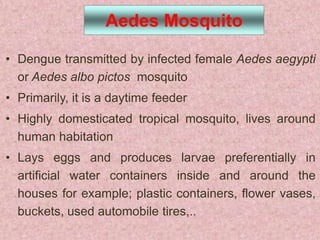
Aedes Mosquito

• Dengue transmitted by infected female Aedes aegypti
  or Aedes albo pictos mosquito
• Primarily, it is a daytime feeder
• Highly domesticated tropical mosquito, lives around
  human habitation
• Lays eggs and produces larvae preferentially in
  artificial water containers inside and around the
  houses for example; plastic containers, flower vases,
  buckets, used automobile tires,..
Dengue Clinical Syndromes

• Undifferentiated fever (87% of
  Patients are asymptomatic or mild
  fever)
• Classic dengue fever (DF)
• Dengue hemorrhagic fever (DHF)
• Dengue shock syndrome (DSS)
Clinical Characteristics
          of Dengue Classic Fever
• Incubation period 3-14 days (commonly 4-7
  days)
• Fever
• Headache
• Muscle and joint pain
• Nausea/vomiting
• Rash
• Hemorrhagic manifestations
Dengue Hemorrhagic Fever (DHF)
            4 Necessary Criteria:
 •   Fever, or recent history of acute fever
 •   Hemorrhagic manifestations
 •   Low platelet count (100,000/mm3 or less)
 •   Objective evidence of “leaky capillaries:”
     – elevated hematocrit (20% or more over
       baseline)
     – low albumin
     – pleural or other effusions
Dengue Shock Syndrome (DSS)

• 4 criteria for DHF
• Evidence of circulatory failure.
Treatment of Dengue Fever
• Antipyretics (Acetaminophen) preparations to
  manage the pain and fever.
• Rest and drink plenty of fluids
• Monitor blood pressure, hematocrit, platelet
  count,...
• Keep patient in screened sickroom or under a
  mosquito net
• Mosquito barriers are only needed until fever
  subsides, to prevent Aedes aegypti mosquitoes
  from biting patients and acquiring virus.
Prevention

• Personal protection against mosquito biting by:

  – Screening doors and windows

  – Protective clothing

  – Application of mosquito repellents on exposed
    skin

• However, the best preventive measure is vector
  control.
Vector Control Methods:

• Biological control
  – Largely experimental
  – Option: place fish in containers to eat larvae

• Environmental control
  – Elimination of larval habitats; Cover water holding
    containers, Discard artificial containers,…
  – It is the most likely method to be effective in the long
    term.
Vector Control Methods:

• Chemical Control
• Larvicides may be used to kill immature aquatic stages

• Ultra-low volume fumigation is ineffective against adult
  mosquitoes as Aedes aegypti is fully domesticated

• Mosquitoes may have resistance to commercial aerosol
  sprays.
Dengue Vaccine?

• No licensed vaccine at present
• Effective vaccine must be tetravalent
• Field testing of an attenuated tetravalent
 vaccine currently underway
• Effective, safe and affordable vaccine will not
 be available in the immediate future.
Community Participation
• Active community involvement and participation to
  reduce larval breeding sources is the key for
  prevention and control.
• Educate the public in the basics of dengue, such as:
  – Where the mosquito lays her eggs
  – The link between larvae and adult mosquitoes
  – General information about dengue transmission,
    symptoms and treatment
Public Education
• Dengue fever is NOT contagious through person-to-
  person contact
• Early hospitalization is important.
• Reduce Aedes vector populations
• Reduce exposure to Aedes.
   – Use insect repellent.
   – Sleep under a mosquito net in affected areas.
   – Wear protective clothing.
• Vaccine is NOT available.
Denggi...

Denggi...

  • 2.
    What is denguefever? Dengue Fever is an illness caused by infection with a virus transmitted by the Aedes mosquito.
  • 3.
    Symptoms of DengueFever Example of a skin rash due to dengue fever
  • 4.
    Do you know… DengueFever (DF) and Dengue Haemorrhagic Fever (DHF) are the most common mosquito-borne viral disease in the world. It can be fatal.
  • 5.
    Characteristics of the Aedes Mosquito One distinct physical feature – black and white stripes on its body and legs. Bites during the day. Lays its eggs in Close-up of an Aedes mosquito clean, stagnant water.
  • 6.
    Do you know… Onlythe female Aedes mosquito feeds on blood. This is because they need the protein found in blood to produce eggs. Male mosquitoes feed only on plant nectar. On average, a female Aedes mosquito can lay about 300 eggs during her life span of 14 to 21 days.
  • 7.
    Life cycle ofthe Aedes Mosquito 1-2 days Pupae Larvae Eggs 4-5 days 2-3 days Stagnant water
  • 8.
    How Do AedesMosquitoes Transmit Diseases... Mosquito bites and sucks And passes the virus blood containing the virus to healthy people from an infected person. when it bites them. Virus is carried in its body.
  • 9.
    This is whatyou can do to help…
  • 10.
    Prevent Aedes fromBreeding! Remove ALL sources of stagnant water. Deny the Aedes mosquito of any chance to breed.
  • 11.
    10-Minute Mozzie Wipe-Out Exercise Turn over all pails and water storage containers. Clear blockages and put Bti insecticide in roof gutters monthly. Remove water from flowerpot plates on alternate days. Do not litter. Rubbish such as cups and bottles can collect rain water and breed mosquitoes. Change water in vases on alternate days.
  • 12.
    Before you leavefor holidays…
  • 13.
    Before you leavefor holidays… • Cover all toilet bowls in your home. • Seal off the overflow pipe of the flushing cistern. • Cover all gully/floor traps. • Add sand granular insecticide to places that mosquitoes could potentially breed, such as flower vases and places where stagnant water could not be removed.
  • 14.
    Dengue fever • Dengueis an arthropod-borne disease caused by any one of four closely related viruses, (Arbovirus). • Characterized by fever, severe headache, backache joint pains nausea and vomiting, eye pain and rash • Occasionally produces shock and hemorrhage, leading to death. • Also called breakbone fever, dandy fever or dengue fever.
  • 16.
    Dengue Viruses • Fourclosely related single-stranded RNA Dengue viruses (DEN-1, DEN-2, DEN-3 and DEN-4) • Each serotype provides specific lifetime immunity, and short-term cross-immunity (A person can be infected as many as four times, once with each serotype) • All serotypes can cause severe and fatal disease
  • 17.
    Replication and Transmission of Dengue Virus 1. Virus transmitted 1 to human in mosquito saliva 2 2. Virus replicates 4. Virus released and 4 in target organs circulates in blood 3 3. Virus infects white blood cells and lymphatic tissues
  • 18.
  • 19.
    Aedes Mosquito • Denguetransmitted by infected female Aedes aegypti or Aedes albo pictos mosquito • Primarily, it is a daytime feeder • Highly domesticated tropical mosquito, lives around human habitation • Lays eggs and produces larvae preferentially in artificial water containers inside and around the houses for example; plastic containers, flower vases, buckets, used automobile tires,..
  • 20.
    Dengue Clinical Syndromes •Undifferentiated fever (87% of Patients are asymptomatic or mild fever) • Classic dengue fever (DF) • Dengue hemorrhagic fever (DHF) • Dengue shock syndrome (DSS)
  • 21.
    Clinical Characteristics of Dengue Classic Fever • Incubation period 3-14 days (commonly 4-7 days) • Fever • Headache • Muscle and joint pain • Nausea/vomiting • Rash • Hemorrhagic manifestations
  • 22.
    Dengue Hemorrhagic Fever(DHF) 4 Necessary Criteria: • Fever, or recent history of acute fever • Hemorrhagic manifestations • Low platelet count (100,000/mm3 or less) • Objective evidence of “leaky capillaries:” – elevated hematocrit (20% or more over baseline) – low albumin – pleural or other effusions
  • 23.
    Dengue Shock Syndrome(DSS) • 4 criteria for DHF • Evidence of circulatory failure.
  • 24.
    Treatment of DengueFever • Antipyretics (Acetaminophen) preparations to manage the pain and fever. • Rest and drink plenty of fluids • Monitor blood pressure, hematocrit, platelet count,... • Keep patient in screened sickroom or under a mosquito net • Mosquito barriers are only needed until fever subsides, to prevent Aedes aegypti mosquitoes from biting patients and acquiring virus.
  • 25.
    Prevention • Personal protectionagainst mosquito biting by: – Screening doors and windows – Protective clothing – Application of mosquito repellents on exposed skin • However, the best preventive measure is vector control.
  • 26.
    Vector Control Methods: •Biological control – Largely experimental – Option: place fish in containers to eat larvae • Environmental control – Elimination of larval habitats; Cover water holding containers, Discard artificial containers,… – It is the most likely method to be effective in the long term.
  • 27.
    Vector Control Methods: •Chemical Control • Larvicides may be used to kill immature aquatic stages • Ultra-low volume fumigation is ineffective against adult mosquitoes as Aedes aegypti is fully domesticated • Mosquitoes may have resistance to commercial aerosol sprays.
  • 28.
    Dengue Vaccine? • Nolicensed vaccine at present • Effective vaccine must be tetravalent • Field testing of an attenuated tetravalent vaccine currently underway • Effective, safe and affordable vaccine will not be available in the immediate future.
  • 29.
    Community Participation • Activecommunity involvement and participation to reduce larval breeding sources is the key for prevention and control. • Educate the public in the basics of dengue, such as: – Where the mosquito lays her eggs – The link between larvae and adult mosquitoes – General information about dengue transmission, symptoms and treatment
  • 30.
    Public Education • Denguefever is NOT contagious through person-to- person contact • Early hospitalization is important. • Reduce Aedes vector populations • Reduce exposure to Aedes. – Use insect repellent. – Sleep under a mosquito net in affected areas. – Wear protective clothing. • Vaccine is NOT available.