



Ms. Angelia T. Galinato, BSN, RN
     Staff Nurse, Lipunan Hospital
OVERVIEW
Dengue Fever
• A virus infection caused by the dengue
  virus
• There are 4 kinds of dengue viruses
• Mosquito transmits this viral disease
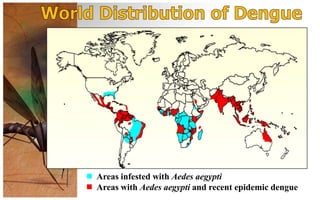
Areas infested with Aedes aegypti
Areas with Aedes aegypti and recent epidemic dengue
Global Status
• New infections annually: 50 million
• Deaths: 24,000 annually
• People at risk: 2.5-3 billion
• Hospitalized cases: 500,000/year
   – 90% of those affected are children
• Disease burden: 465,000 Disability
  Adjusted Life Years (DALY)
Dengue in the Philippines
• Endemic
   – 5% mortality rate
   – estimated 25,000 deaths/year
• Occurrence: sporadic throughout the
  year and high cases usually occur during
  the rainy seasons
   – June-November
TRANSMISSION
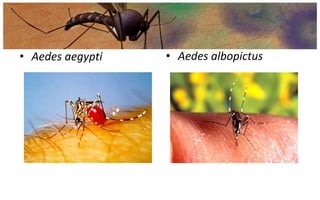
• Aedes aegypti   • Aedes albopictus
Aedes aegypti
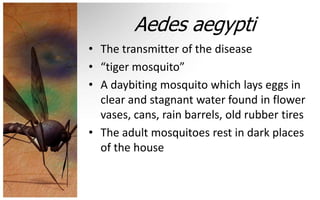
• The transmitter of the disease
• “tiger mosquito”
• A daybiting mosquito which lays eggs in
  clear and stagnant water found in flower
  vases, cans, rain barrels, old rubber tires
• The adult mosquitoes rest in dark places
  of the house
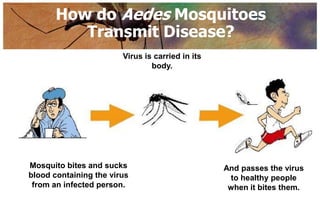
How do Aedes Mosquitoes
          Transmit Disease?
                        Virus is carried in its
                                body.


Mosquito bites and sucks                          And passes the virus
blood containing the virus                         to healthy people
 from an infected person.                          when it bites them.
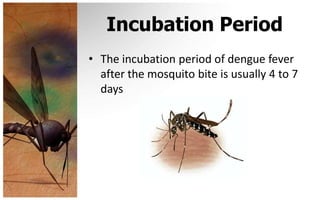
Incubation Period
• The incubation period of dengue fever
  after the mosquito bite is usually 4 to 7
  days
RISK FACTORS
• Virus strain
• Pre-existing anti-dengue antibody
   – previous infection
   – maternal antibodies in infants
• Host genetics
• Age
• Higher risk in secondary infections
• Higher risk in locations with two or more
  serotypes circulating simultaneously at high
  levels (hyperendemic transmission)
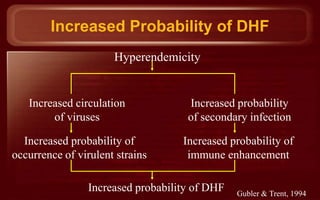
Increased Probability of DHF
                      Hyperendemicity


   Increased circulation            Increased probability
        of viruses                  of secondary infection

  Increased probability of         Increased probability of
occurrence of virulent strains      immune enhancement

                Increased probability of DHF   Gubler & Trent, 1994
CLINICAL
MANIFESTATIONS
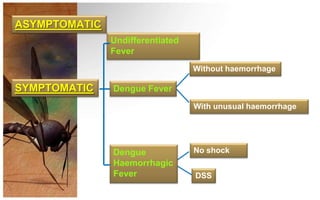
ASYMPTOMATIC
               Undifferentiated
               Fever
                                  Without haemorrhage

SYMPTOMATIC    Dengue Fever
                                  With unusual haemorrhage


               Dengue             No shock
               Haemorrhagic
               Fever              DSS
Undifferentiated Fever
• May be the most common manifestation
  of dengue
• Prospective study found that 87% of
  students infected were either
  asymptomatic or only mildly
  symptomatic
• Other prospective studies including all
  age- groups also demonstrate silent
  transmission
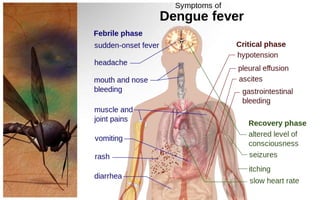
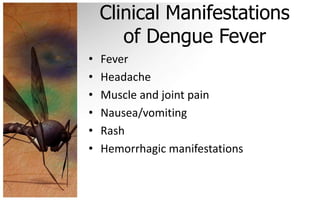
Clinical Manifestations
       of Dengue Fever
•   Fever
•   Headache
•   Muscle and joint pain
•   Nausea/vomiting
•   Rash
•   Hemorrhagic manifestations
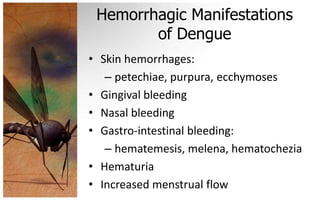
Hemorrhagic Manifestations
        of Dengue
• Skin hemorrhages:
   – petechiae, purpura, ecchymoses
• Gingival bleeding
• Nasal bleeding
• Gastro-intestinal bleeding:
   – hematemesis, melena, hematochezia
• Hematuria
• Increased menstrual flow
4 GRADES OF DHF
• Grade 1
   – Fever and nonspecific constitutional
     symptoms
   – Positive tourniquet test is only
     hemorrhagic manifestation

• Grade 2
   – Grade 1 manifestations + spontaneous
     bleeding
• Grade 3
   – Signs of circulatory failure (rapid/weak
     pulse, narrow         pulse     pressure,
     hypotension, cold/clammy skin)

• Grade 4
   – Profound shock (undetectable pulse
     and BP)
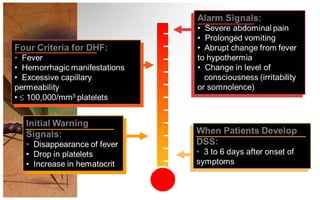
DANGER SIGNS IN DHF
• Abdominal pain - intense and sustained
• Persistent vomiting
• Abrupt change from fever to
  hypothermia, with sweating and
  prostration
• Restlessness or somnolence
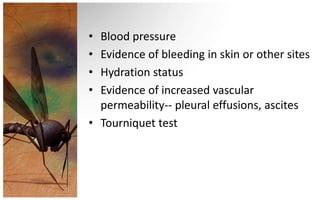
CLINICAL
EVALUATION
• Blood pressure
• Evidence of bleeding in skin or other sites
• Hydration status
• Evidence of increased vascular
  permeability-- pleural effusions, ascites
• Tourniquet test
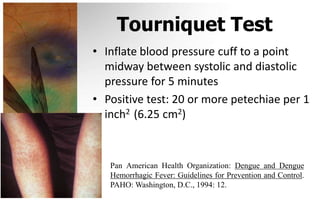
Tourniquet Test
• Inflate blood pressure cuff to a point
  midway between systolic and diastolic
  pressure for 5 minutes
• Positive test: 20 or more petechiae per 1
  inch2 (6.25 cm2)


   Pan American Health Organization: Dengue and Dengue
   Hemorrhagic Fever: Guidelines for Prevention and Control.
   PAHO: Washington, D.C., 1994: 12.
Clinical Laboratory Tests
• CBC
   – WBC, platelets, hematocrit
• Albumin
• Liver function tests
• Urine
   – check for microscopic hematuria
• Dengue-specific tests
   – Virus isolation
   – Serology
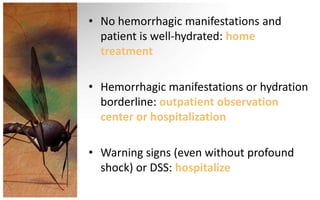
OUTPATIENT TRIAGE
• No hemorrhagic manifestations and
  patient is well-hydrated: home
  treatment

• Hemorrhagic manifestations or hydration
  borderline: outpatient observation
  center or hospitalization

• Warning signs (even without profound
  shock) or DSS: hospitalize
Patient Follow-up
• Patients treated at home
   – Instruction regarding danger signs
   – Consider repeat clinical evaluation

• Patients with bleeding manifestations
   – Serial hematocrits and platelets at
     least daily until temperature normal
     for 1 to 2 days
Patient Follow-up
• All patients
   – If blood sample taken in first 5 days
     after onset, need convalescent sample
     between days 6 - 30
   – All hospitalized patients need samples
     on admission and at discharge or
     death
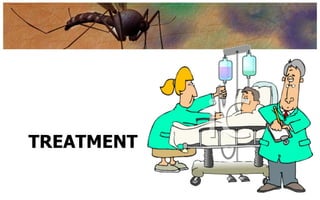
TREATMENT
Dengue Fever and
         DHF I & II
• Fluids
• Rest
• Antipyretics (avoid aspirin and non-
  steroidal anti-inflammatory drugs)
• Monitor blood pressure, hematocrit,
  platelet count, level of consciousness
DHF III & IV
• All above treatment +
• In case of severe bleeding, give fresh
  whole blood
• Give platelet rich plasma transfusion
• After BT, continue fluid therapy
Indications for Hospital Discharge
                       • Absence of fever for 24 hours (without anti-
                         fever therapy) and return of appetite
                       • Visible improvement in clinical picture
                       • Stable hematocrit
                       • 3 days after recovery from shock
                       • Platelets 50,000/mm3
                       • No respiratory distress from pleural
                         effusions/ascites
Pan American Health Organization: Dengue and Dengue Hemorrhagic Fever: Guidelines for Prevention and Control.
PAHO: Washington, D.C., 1994: 69.
TRIVIA
Do you know that…
• Dengue fever and dengue hemorrhagic
  fever are the most common mosquito-
  borne viral disease in the world.

• Only the female mosquito feeds on
  blood. This is because they need the
  protein found in blood to produce eggs.
  Male mosquitoes feed only on plant
  nectar.
Do you know that…
• The mosquito is attracted by the body
  odors, carbon dioxide and heat emitted
  from the animal or humans.

• The female Aedes mosquito searches for
  suitable places to lay their eggs.

• Aedes are day-biters, most active during
  dawn and dusk.
COMMON MISCONCEPTIONS
 DHF kills only by hemorrhage
    Patient dies as a result of shock


 Poor management turns dengue into DHF
    Poorly managed dengue can be more severe,
     but DHF is a distinct condition, which even
     well-treated patients may develop

 Positive tourniquet test = DHF
    Tourniquet test is a nonspecific indicator of
     capillary fragility
 DHF is a pediatric disease
    All age groups are involved


 DHF is a problem of low income families
    All socioeconomic groups are affected


 Tourists will certainly get DHF with a
  second infection
      Tourists are at low risk to acquire DHF
PREVENTION
• Cover water drums and water pails at all
  times to prevent mosquitoes from
  breeding.

• Replace water in flower vases once a
  week.

• Clean all water containers once a week.
  Scrub the sides well to remove eggs of
  mosquitoes sticking to the sides.
• Clean gutters of leaves and debris so that
  rain water will not collect as breeding
  places of mosquitoes.

• Old tires used as roof support should be
  punctured or cut to avoid accumulation
  of water.

• Collect and dispose all unusable tin cans,
  jars, bottles and other items that can
  collect and hold water.
-Angie

Understanding dengue

  • 1.
    Ms. Angelia T.Galinato, BSN, RN Staff Nurse, Lipunan Hospital
  • 2.
  • 3.
    Dengue Fever • Avirus infection caused by the dengue virus • There are 4 kinds of dengue viruses • Mosquito transmits this viral disease
  • 4.
    Areas infested withAedes aegypti Areas with Aedes aegypti and recent epidemic dengue
  • 5.
    Global Status • Newinfections annually: 50 million • Deaths: 24,000 annually • People at risk: 2.5-3 billion • Hospitalized cases: 500,000/year – 90% of those affected are children • Disease burden: 465,000 Disability Adjusted Life Years (DALY)
  • 6.
    Dengue in thePhilippines • Endemic – 5% mortality rate – estimated 25,000 deaths/year • Occurrence: sporadic throughout the year and high cases usually occur during the rainy seasons – June-November
  • 7.
  • 8.
    • Aedes aegypti • Aedes albopictus
  • 9.
    Aedes aegypti • Thetransmitter of the disease • “tiger mosquito” • A daybiting mosquito which lays eggs in clear and stagnant water found in flower vases, cans, rain barrels, old rubber tires • The adult mosquitoes rest in dark places of the house
  • 10.
    How do AedesMosquitoes Transmit Disease? Virus is carried in its body. Mosquito bites and sucks And passes the virus blood containing the virus to healthy people from an infected person. when it bites them.
  • 11.
    Incubation Period • Theincubation period of dengue fever after the mosquito bite is usually 4 to 7 days
  • 12.
  • 13.
    • Virus strain •Pre-existing anti-dengue antibody – previous infection – maternal antibodies in infants • Host genetics • Age • Higher risk in secondary infections • Higher risk in locations with two or more serotypes circulating simultaneously at high levels (hyperendemic transmission)
  • 14.
    Increased Probability ofDHF Hyperendemicity Increased circulation Increased probability of viruses of secondary infection Increased probability of Increased probability of occurrence of virulent strains immune enhancement Increased probability of DHF Gubler & Trent, 1994
  • 15.
  • 16.
    ASYMPTOMATIC Undifferentiated Fever Without haemorrhage SYMPTOMATIC Dengue Fever With unusual haemorrhage Dengue No shock Haemorrhagic Fever DSS
  • 17.
    Undifferentiated Fever • Maybe the most common manifestation of dengue • Prospective study found that 87% of students infected were either asymptomatic or only mildly symptomatic • Other prospective studies including all age- groups also demonstrate silent transmission
  • 19.
    Clinical Manifestations of Dengue Fever • Fever • Headache • Muscle and joint pain • Nausea/vomiting • Rash • Hemorrhagic manifestations
  • 20.
    Hemorrhagic Manifestations of Dengue • Skin hemorrhages: – petechiae, purpura, ecchymoses • Gingival bleeding • Nasal bleeding • Gastro-intestinal bleeding: – hematemesis, melena, hematochezia • Hematuria • Increased menstrual flow
  • 21.
  • 22.
    • Grade 1 – Fever and nonspecific constitutional symptoms – Positive tourniquet test is only hemorrhagic manifestation • Grade 2 – Grade 1 manifestations + spontaneous bleeding
  • 23.
    • Grade 3 – Signs of circulatory failure (rapid/weak pulse, narrow pulse pressure, hypotension, cold/clammy skin) • Grade 4 – Profound shock (undetectable pulse and BP)
  • 24.
  • 25.
    • Abdominal pain- intense and sustained • Persistent vomiting • Abrupt change from fever to hypothermia, with sweating and prostration • Restlessness or somnolence
  • 27.
  • 28.
    • Blood pressure •Evidence of bleeding in skin or other sites • Hydration status • Evidence of increased vascular permeability-- pleural effusions, ascites • Tourniquet test
  • 29.
    Tourniquet Test • Inflateblood pressure cuff to a point midway between systolic and diastolic pressure for 5 minutes • Positive test: 20 or more petechiae per 1 inch2 (6.25 cm2) Pan American Health Organization: Dengue and Dengue Hemorrhagic Fever: Guidelines for Prevention and Control. PAHO: Washington, D.C., 1994: 12.
  • 30.
    Clinical Laboratory Tests •CBC – WBC, platelets, hematocrit • Albumin • Liver function tests • Urine – check for microscopic hematuria • Dengue-specific tests – Virus isolation – Serology
  • 31.
  • 32.
    • No hemorrhagicmanifestations and patient is well-hydrated: home treatment • Hemorrhagic manifestations or hydration borderline: outpatient observation center or hospitalization • Warning signs (even without profound shock) or DSS: hospitalize
  • 33.
    Patient Follow-up • Patientstreated at home – Instruction regarding danger signs – Consider repeat clinical evaluation • Patients with bleeding manifestations – Serial hematocrits and platelets at least daily until temperature normal for 1 to 2 days
  • 34.
    Patient Follow-up • Allpatients – If blood sample taken in first 5 days after onset, need convalescent sample between days 6 - 30 – All hospitalized patients need samples on admission and at discharge or death
  • 35.
  • 36.
    Dengue Fever and DHF I & II • Fluids • Rest • Antipyretics (avoid aspirin and non- steroidal anti-inflammatory drugs) • Monitor blood pressure, hematocrit, platelet count, level of consciousness
  • 37.
    DHF III &IV • All above treatment + • In case of severe bleeding, give fresh whole blood • Give platelet rich plasma transfusion • After BT, continue fluid therapy
  • 38.
    Indications for HospitalDischarge • Absence of fever for 24 hours (without anti- fever therapy) and return of appetite • Visible improvement in clinical picture • Stable hematocrit • 3 days after recovery from shock • Platelets 50,000/mm3 • No respiratory distress from pleural effusions/ascites Pan American Health Organization: Dengue and Dengue Hemorrhagic Fever: Guidelines for Prevention and Control. PAHO: Washington, D.C., 1994: 69.
  • 39.
  • 40.
    Do you knowthat… • Dengue fever and dengue hemorrhagic fever are the most common mosquito- borne viral disease in the world. • Only the female mosquito feeds on blood. This is because they need the protein found in blood to produce eggs. Male mosquitoes feed only on plant nectar.
  • 41.
    Do you knowthat… • The mosquito is attracted by the body odors, carbon dioxide and heat emitted from the animal or humans. • The female Aedes mosquito searches for suitable places to lay their eggs. • Aedes are day-biters, most active during dawn and dusk.
  • 42.
  • 43.
     DHF killsonly by hemorrhage  Patient dies as a result of shock  Poor management turns dengue into DHF  Poorly managed dengue can be more severe, but DHF is a distinct condition, which even well-treated patients may develop  Positive tourniquet test = DHF  Tourniquet test is a nonspecific indicator of capillary fragility
  • 44.
     DHF isa pediatric disease  All age groups are involved  DHF is a problem of low income families  All socioeconomic groups are affected  Tourists will certainly get DHF with a second infection  Tourists are at low risk to acquire DHF
  • 45.
  • 46.
    • Cover waterdrums and water pails at all times to prevent mosquitoes from breeding. • Replace water in flower vases once a week. • Clean all water containers once a week. Scrub the sides well to remove eggs of mosquitoes sticking to the sides.
  • 47.
    • Clean guttersof leaves and debris so that rain water will not collect as breeding places of mosquitoes. • Old tires used as roof support should be punctured or cut to avoid accumulation of water. • Collect and dispose all unusable tin cans, jars, bottles and other items that can collect and hold water.
  • 50.