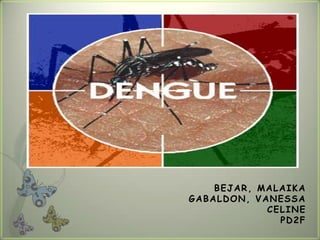
BEJAR , MALAIKA
G A B A L DON, V A N ES S A
                  CEL I N E
                     PD2F
WHAT IS DENGUE?
   Dengue fever is a disease caused by a
    family of viruses ( genus Flavivirus, family
    Flaviviridae) that are transmitted by
    mosquitoes ( Aedes aegypti).
   It is an acute illness of sudden onset that
    usually follows a benign course with
    symptoms such as
    headache, fever, exhaustion, severe
    muscle and joint pain, swollen glands
    (lymphadenopathy), and rash.
CAUSES OF DENGUE
   There are four Dengue viruses (DENV) that cause
    Dengue fever, all of which are spread by a species of
    mosquito known as the Aedes aegypti mosquito, and
    more rarely by the Aedes albopictus mosquito. Aedes
    aegypti originated in Africa, but nowadays is found in
    all the tropical areas around the world and prospers in
    and close to areas of human population.
   The virus is transmitted from an infected mosquito to
    human. The process begins when a person who is
    infected with the Dengue virus is bitten by a
    mosquito, the virus is then passed on when someone
    else is then bitten by the infected mosquito.
Signs and Symptoms
Mild Dengue Fever - symptoms can appear up to
seven days after the mosquito carrying the virus
bites, and usually disappear after a week. This form of the
disease hardly ever results in serious or fatal
complications. The symptoms of mild dengue fever are:
              Aching muscles and joints
              Body rashes that can disappear and then reappear
              High fever
              Intense headache
              Pain behind the eyes
              Vomiting and feeling nauseous
Dengue hemorrhagic fever
(DHF) - symptoms during onset may be mild, but
gradually worsen after a number of days. DHF can
result in death if not treated in time. Mild dengue
fever symptoms may occur in DHF, as well as the
ones listed below:
•Bleeding    from your mouth/gums
•Nosebleeds

•Clammy     skin
•Considerably      damaged lymph and blood vessels
•Internal   bleeding, which can result in black vomit and feces (stools)
•Lower  number of platelets in blood - these are the cells that help
clot your blood
•Sensitive   stomach
Dengue shock syndrome
  This is the worst form of dengue which can
also result in death, again mild dengue fever
  symptoms may appear, but others likely to
                                  appear are:
         •Intense  stomach pain
         •Disorientation
         •Sudden hypotension (fast drop in
         blood pressure)
         •Heavy bleeding
         •Regular vomiting
         •Blood vessels leaking fluid
         •Death
MODE OF TRANSMISSION
Bites from infected females of
certain Aedes mosquito species. Ae. aegypti is the
major vector of dengue; Aedes albopictus can also
transmit DENV, but much less efficiently than Ae.
aegypti .
Ae. aegypti is a very domesticated, urban mosquito
found in the tropics and subtropics, and in Australia
is currently confined to Queensland; it usually breeds
in man-made containers and prefers
indoor, sheltered, dark resting sites. Humans are the
preferred source of blood meals for female Ae.
aegypti ; they are day-biting mosquitoes.
Ae. albopictus is a peri-domestic mosquito
found not only in the tropics and subtropics
but also some temperate regions. It is an
aggressive coloniser, but in Australia is
currently confined to the Torres Strait. It
breeds not only in artificial containers but
also in some naturally occurring sites such
as tree holes and coconut shells. Adults
prefer heavily-shaded outdoor resting sites;
the female takes blood from a wide range of
mammals. It is an aggressive day -biting
mosquito.
PERIOD OF
    COMMUNICABILITY, RESISTANCE
            AND SUSCEPTIBILITY

A human case is infective to mosquitoes from
shortly before, until the end of the period of
symptomatic viraemia; usually 4 - 5 days, but
can be longer.
For public health purposes, the duration of
viraemia is assumed to be from one day before
until 12 days after the onset of symptoms .
There is no direct person to person
transmission, but transfusion
related cases can occur.
Susceptibility to primary infection
appears universal. Recovery from
infection with one DENV serotype
provides lifelong immunity against
that serotype, but only short-term
protection against other serotypes.
Antibody dependent enhancement (ADE) is
an immunological phenomenon believed to
be responsible for the pathogenesis of
plasma leakage, a potentially severe
manifestation of dengue. In brief, following
infection with a particular DENV
serotype, the cross-protection against other
serotypes wanes after several months; at
some point the previously protected person
has, through ADE, an increased risk of
developing severe dengue following a
secondary infection (from another DENV
serotype).
It is hypothesized that ADE occurs in
the secondary infection when pre-
existing, but no longer
protective, antibodies enhance the
binding of the (secondary) virus to
macrophages and monocytes, leading to
increased virus replication in these
cells. This, in turn, leads to complement
activation and the release of various
cytokines that target vascular
endothelial cells, resulting in the leak
of plasma and protein.
Treatment for Dengue

       There is no tested and approved
        vaccine for the dengue flavivirus.
       There is no specific medicine or
        antibiotic to treat it.
       For typical dengue, the treatment is
        purely concerned with relief of the
        symptoms (symptomatic). Close
        monitoring of vital signs in the
        critical period
 Rest
     and fluid intake for adequate
 hydration is important.
 Supplementation  with intravenous
 fluids may be necessary to prevent
 dehydration and significant
 concentration of the blood if the
 patient is unable to maintain oral
 intake.
 Acetaminophen (Tylenol) and
 codeine may be given for severe
 headache and for the joint and
 muscle pain (myalgia)
 Platelettransfusion may be indicated if
 the platelet level drops significantly
 (below 20,000) or if there is significant
 bleeding The presence of melena may
 indicate internal gastrointestinal
 bleeding requiring platelet and/or red
 blood cell transfusion.
 Aspirinand non-steroidal inflammatory
 drugs should be avoided as these drugs
 may worsen the bleeding tendency
METHODS OF CONTROL
•preventing  mosquitoes from accessing egg-
laying habitats by environmental
management and modification;
•disposing of solid waste properly and
removing artificial man-made habitats;
•covering, emptying and cleaning of
domestic water storage containers on a
weekly basis;
•applying appropriate insecticides to water
storage outdoor containers;
•   using of personal household protection such
    as window screens, long-sleeved
    clothes, insecticide treated materials, coils
    and vaporizers;
•   improving community participation and
    mobilization for sustained vector control;
•   applying insecticides as space spraying
    during outbreaks as one of the emergency
    vector control measures;
•   active monitoring and surveillance of vectors
    should be carried out to determine
    effectiveness of control interventions.
PROGENY FOR PREVENTION

   Clothing - your chances of being bitten are significantly
    reduced if you expose as little skin as possible. When in an
    area with mosquitoes, be sure to wear long trousers/pants, long
    sleeved shirts, and socks. For further protection, tuck your
    pant legs into your shoes or socks. Wear a hat.
   Mosquito repellants - be sure to use one with at least 10%
    concentration of DEET, you will need a higher concentration
    the longer you need the protection, avoid using DEET on young
    children.
   Use mosquito traps and nets - studies have shown that the risk
    of being bitten by mosquitoes is considerably reduced if you
    use a mosquito net when you go to sleep
   Smell - Avoid wearing heavily scented soaps and perfumes.
 Windows- use structural barriers, such as
 window screens or netting.
 Camping  - if you are camping, treat
 clothes, shoes and camping gear with
 permethrin. There are clothes which have
 been treated with permethrin.
 Certaintimes of day - try to avoid being
 outside at dawn, dusk and early evening.
 Stagnant water - the Aedes mosquito
 prefers to breed in clean, stagnant water.
 It is important to frequently check and
 remove stagnant water in your
 home/premises.
The End

Bejar, malaika

  • 1.
    BEJAR , MALAIKA GA B A L DON, V A N ES S A CEL I N E PD2F
  • 2.
    WHAT IS DENGUE?  Dengue fever is a disease caused by a family of viruses ( genus Flavivirus, family Flaviviridae) that are transmitted by mosquitoes ( Aedes aegypti).  It is an acute illness of sudden onset that usually follows a benign course with symptoms such as headache, fever, exhaustion, severe muscle and joint pain, swollen glands (lymphadenopathy), and rash.
  • 3.
    CAUSES OF DENGUE  There are four Dengue viruses (DENV) that cause Dengue fever, all of which are spread by a species of mosquito known as the Aedes aegypti mosquito, and more rarely by the Aedes albopictus mosquito. Aedes aegypti originated in Africa, but nowadays is found in all the tropical areas around the world and prospers in and close to areas of human population.  The virus is transmitted from an infected mosquito to human. The process begins when a person who is infected with the Dengue virus is bitten by a mosquito, the virus is then passed on when someone else is then bitten by the infected mosquito.
  • 4.
    Signs and Symptoms MildDengue Fever - symptoms can appear up to seven days after the mosquito carrying the virus bites, and usually disappear after a week. This form of the disease hardly ever results in serious or fatal complications. The symptoms of mild dengue fever are:  Aching muscles and joints  Body rashes that can disappear and then reappear  High fever  Intense headache  Pain behind the eyes  Vomiting and feeling nauseous
  • 6.
    Dengue hemorrhagic fever (DHF)- symptoms during onset may be mild, but gradually worsen after a number of days. DHF can result in death if not treated in time. Mild dengue fever symptoms may occur in DHF, as well as the ones listed below: •Bleeding from your mouth/gums •Nosebleeds •Clammy skin •Considerably damaged lymph and blood vessels •Internal bleeding, which can result in black vomit and feces (stools) •Lower number of platelets in blood - these are the cells that help clot your blood •Sensitive stomach
  • 7.
    Dengue shock syndrome This is the worst form of dengue which can also result in death, again mild dengue fever symptoms may appear, but others likely to appear are: •Intense stomach pain •Disorientation •Sudden hypotension (fast drop in blood pressure) •Heavy bleeding •Regular vomiting •Blood vessels leaking fluid •Death
  • 8.
    MODE OF TRANSMISSION Bitesfrom infected females of certain Aedes mosquito species. Ae. aegypti is the major vector of dengue; Aedes albopictus can also transmit DENV, but much less efficiently than Ae. aegypti . Ae. aegypti is a very domesticated, urban mosquito found in the tropics and subtropics, and in Australia is currently confined to Queensland; it usually breeds in man-made containers and prefers indoor, sheltered, dark resting sites. Humans are the preferred source of blood meals for female Ae. aegypti ; they are day-biting mosquitoes.
  • 9.
    Ae. albopictus isa peri-domestic mosquito found not only in the tropics and subtropics but also some temperate regions. It is an aggressive coloniser, but in Australia is currently confined to the Torres Strait. It breeds not only in artificial containers but also in some naturally occurring sites such as tree holes and coconut shells. Adults prefer heavily-shaded outdoor resting sites; the female takes blood from a wide range of mammals. It is an aggressive day -biting mosquito.
  • 10.
    PERIOD OF COMMUNICABILITY, RESISTANCE AND SUSCEPTIBILITY A human case is infective to mosquitoes from shortly before, until the end of the period of symptomatic viraemia; usually 4 - 5 days, but can be longer. For public health purposes, the duration of viraemia is assumed to be from one day before until 12 days after the onset of symptoms .
  • 11.
    There is nodirect person to person transmission, but transfusion related cases can occur. Susceptibility to primary infection appears universal. Recovery from infection with one DENV serotype provides lifelong immunity against that serotype, but only short-term protection against other serotypes.
  • 12.
    Antibody dependent enhancement(ADE) is an immunological phenomenon believed to be responsible for the pathogenesis of plasma leakage, a potentially severe manifestation of dengue. In brief, following infection with a particular DENV serotype, the cross-protection against other serotypes wanes after several months; at some point the previously protected person has, through ADE, an increased risk of developing severe dengue following a secondary infection (from another DENV serotype).
  • 13.
    It is hypothesizedthat ADE occurs in the secondary infection when pre- existing, but no longer protective, antibodies enhance the binding of the (secondary) virus to macrophages and monocytes, leading to increased virus replication in these cells. This, in turn, leads to complement activation and the release of various cytokines that target vascular endothelial cells, resulting in the leak of plasma and protein.
  • 14.
    Treatment for Dengue  There is no tested and approved vaccine for the dengue flavivirus.  There is no specific medicine or antibiotic to treat it.  For typical dengue, the treatment is purely concerned with relief of the symptoms (symptomatic). Close monitoring of vital signs in the critical period
  • 15.
     Rest and fluid intake for adequate hydration is important.  Supplementation with intravenous fluids may be necessary to prevent dehydration and significant concentration of the blood if the patient is unable to maintain oral intake.  Acetaminophen (Tylenol) and codeine may be given for severe headache and for the joint and muscle pain (myalgia)
  • 16.
     Platelettransfusion maybe indicated if the platelet level drops significantly (below 20,000) or if there is significant bleeding The presence of melena may indicate internal gastrointestinal bleeding requiring platelet and/or red blood cell transfusion.  Aspirinand non-steroidal inflammatory drugs should be avoided as these drugs may worsen the bleeding tendency
  • 17.
    METHODS OF CONTROL •preventing mosquitoes from accessing egg- laying habitats by environmental management and modification; •disposing of solid waste properly and removing artificial man-made habitats; •covering, emptying and cleaning of domestic water storage containers on a weekly basis; •applying appropriate insecticides to water storage outdoor containers;
  • 18.
    using of personal household protection such as window screens, long-sleeved clothes, insecticide treated materials, coils and vaporizers; • improving community participation and mobilization for sustained vector control; • applying insecticides as space spraying during outbreaks as one of the emergency vector control measures; • active monitoring and surveillance of vectors should be carried out to determine effectiveness of control interventions.
  • 19.
    PROGENY FOR PREVENTION  Clothing - your chances of being bitten are significantly reduced if you expose as little skin as possible. When in an area with mosquitoes, be sure to wear long trousers/pants, long sleeved shirts, and socks. For further protection, tuck your pant legs into your shoes or socks. Wear a hat.  Mosquito repellants - be sure to use one with at least 10% concentration of DEET, you will need a higher concentration the longer you need the protection, avoid using DEET on young children.  Use mosquito traps and nets - studies have shown that the risk of being bitten by mosquitoes is considerably reduced if you use a mosquito net when you go to sleep  Smell - Avoid wearing heavily scented soaps and perfumes.
  • 20.
     Windows- usestructural barriers, such as window screens or netting.  Camping - if you are camping, treat clothes, shoes and camping gear with permethrin. There are clothes which have been treated with permethrin.  Certaintimes of day - try to avoid being outside at dawn, dusk and early evening.  Stagnant water - the Aedes mosquito prefers to breed in clean, stagnant water. It is important to frequently check and remove stagnant water in your home/premises.
  • 21.