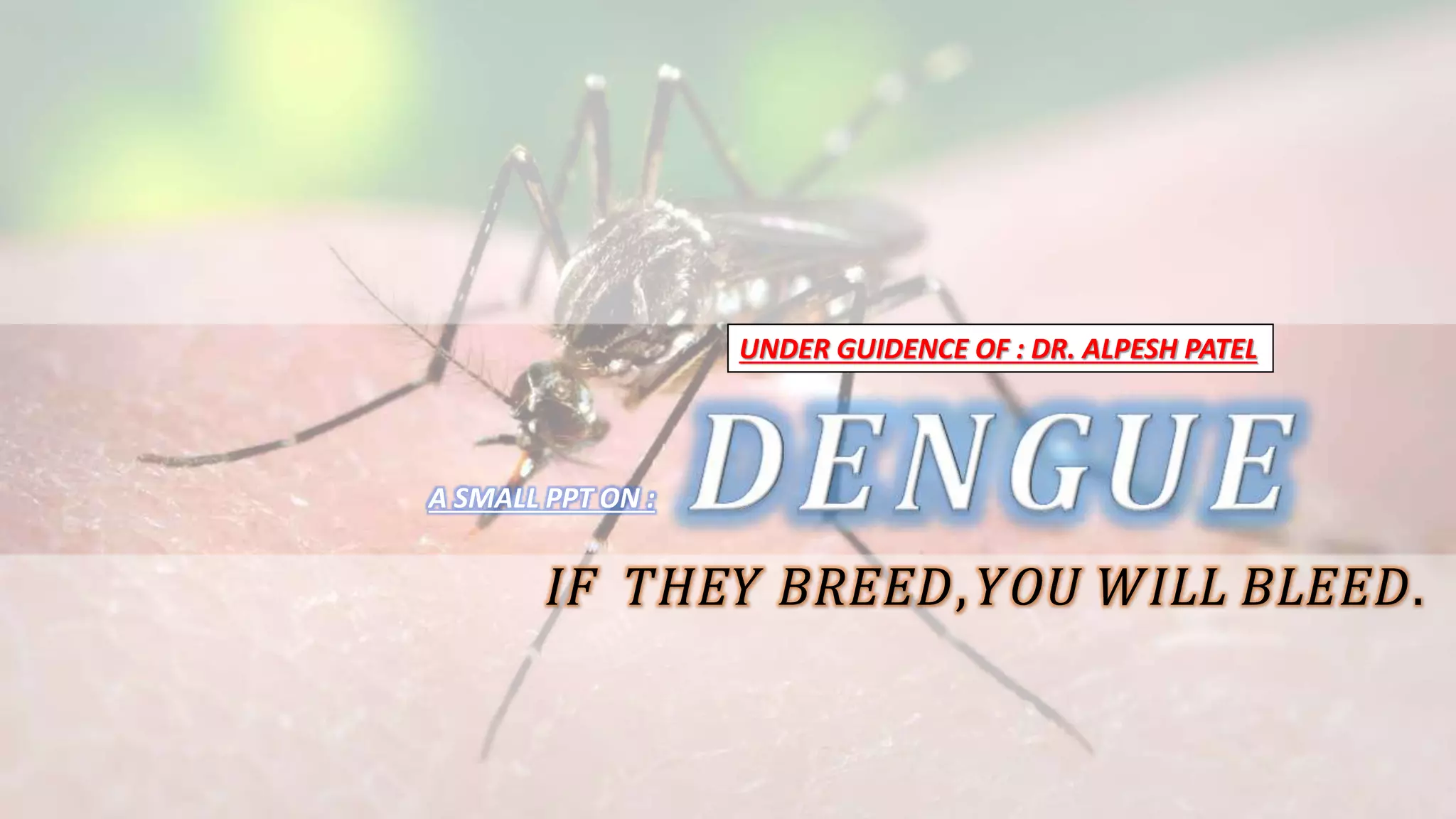
𝐼𝐹 𝑇𝐻𝐸𝑌 𝐵𝑅𝐸𝐸𝐷, 𝑌𝑂𝑈 𝑊𝐼𝐿𝐿 𝐵𝐿𝐸𝐸𝐷.
UNDER GUIDENCE OF : DR. ALPESH PATEL
A SMALL PPT ON :
Dengue - Reason behind this name….
According to one theory……….
Dengue is a Spanish word (?)
• “Dengue" means fastidious or careful, which would
describe the gait of a person suffering the bone pain
of dengue fever.
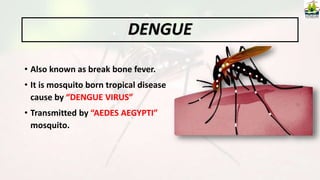
DENGUE
• Also known as break bone fever.
• It is mosquito born tropical disease
cause by “DENGUE VIRUS”
• Transmitted by “AEDES AEGYPTI”
mosquito.
EPIDEMIOLOGY AND HISTORY
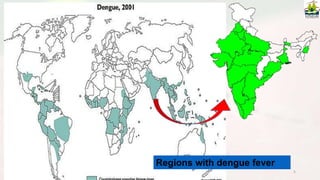
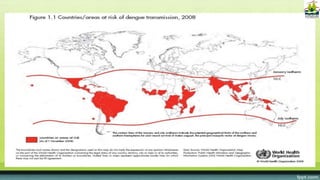
• IN WORLD : About 50 million cases annually worldwide
 Incidence of dengue fever highest in tropical and
subtropical regions
 Recent increase in disease activity worldwide
• IN INDIA : First outbreak of dengue was recorded in 1812
 A double peak hemorrhagic fever epidemic occurred
in India for the first time in Calcutta between July 1963
& March 1964
5
Regions with dengue fever
0
10000
20000
30000
40000
50000
60000
70000
80000
2009
2010
2011
2012
2013
2014
2015 cont.
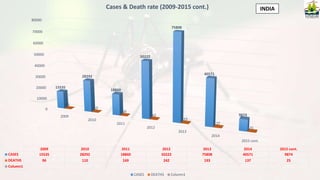
15535
28292
18860
50222
75808
40571
9874
96
110
169
242
193
137
25
2009 2010 2011 2012 2013 2014 2015 cont.
CASES 15535 28292 18860 50222 75808 40571 9874
DEATHS 96 110 169 242 193 137 25
Column1
Cases & Death rate (2009-2015 cont.)
CASES DEATHS Column1
INDIA
0
1000
2000
3000
4000
5000
6000
7000
2009 2010 2011 2012 2013 2014 2015 cont.
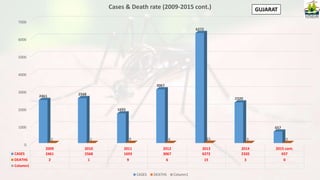
CASES 2461 2568 1693 3067 6272 2320 657
DEATHS 2 1 9 6 15 3 0
Column1
2461 2568
1693
3067
6272
2320
657
2 1 9 6 15 3 0
Cases & Death rate (2009-2015 cont.)
CASES DEATHS Column1
GUJARAT
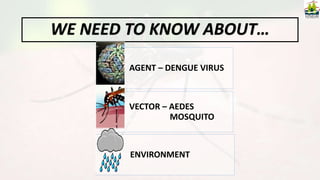
WE NEED TO KNOW ABOUT…
AGENT – DENGUE VIRUS
VECTOR – AEDES
MOSQUITO
ENVIRONMENT
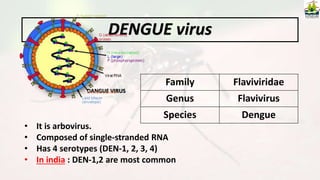
DENGUE virus
Family Flaviviridae
Genus Flavivirus
Species Dengue
DANGUE VIRUS
• It is arbovirus.
• Composed of single-stranded RNA
• Has 4 serotypes (DEN-1, 2, 3, 4)
• In india : DEN-1,2 are most common
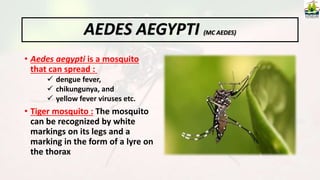
• Aedes aegypti is a mosquito
that can spread :
 dengue fever,
 chikungunya, and
 yellow fever viruses etc.
• Tiger mosquito : The mosquito
can be recognized by white
markings on its legs and a
marking in the form of a lyre on
the thorax
AEDES AEGYPTI (MC AEDES)
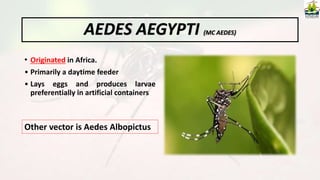
• Originated in Africa.
• Primarily a daytime feeder
• Lays eggs and produces larvae
preferentially in artificial containers
AEDES AEGYPTI (MC AEDES)
Other vector is Aedes Albopictus
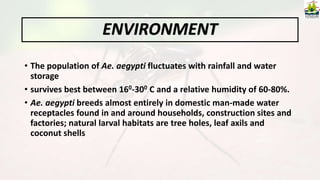
• The population of Ae. aegypti fluctuates with rainfall and water
storage
• survives best between 160-300 C and a relative humidity of 60-80%.
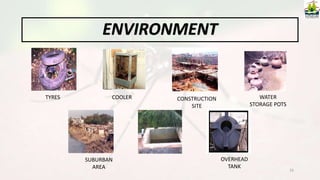
• Ae. aegypti breeds almost entirely in domestic man-made water
receptacles found in and around households, construction sites and
factories; natural larval habitats are tree holes, leaf axils and
coconut shells
ENVIRONMENT
16
ENVIRONMENT
TYRES COOLER CONSTRUCTION
SITE
WATER
STORAGE POTS
OVERHEAD
TANK
SUBURBAN
AREA
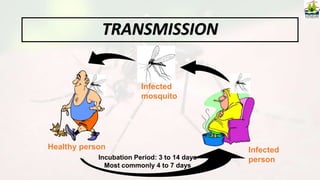
TRANSMISSION
Infected
person
Healthy person
Infected
mosquito
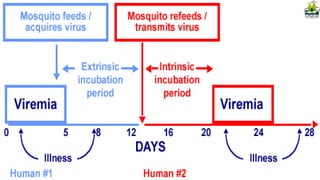
Incubation Period: 3 to 14 days
Most commonly 4 to 7 days
PATHOGENESISDENGUEINFECTION
PRODUCTION OF Ab
Ag-Ab INTERACTION
WITH COMPLEMENT
ACTIVATION
DePOSITION IN
VESSELS, VARIOUS
TISSUE AND PLATELETS
CLINICAL
MENIFESTATIONS
ACTIVATION OF T-CELL
PRODUCTION OF
CYTOKINES
VASCULAR
PERMIABILITY
INCREASE
CLINICAL
MENIFESTATION
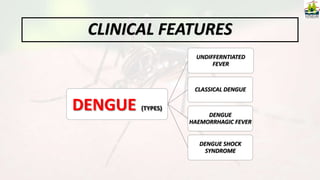
CLINICAL FEATURES
DENGUE (TYPES)
UNDIFFERNTIATED
FEVER
CLASSICAL DENGUE
DENGUE
HAEMORRHAGIC FEVER
DENGUE SHOCK
SYNDROME
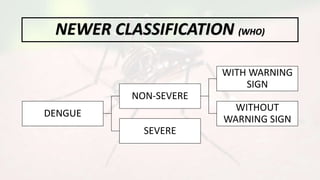
NEWER CLASSIFICATION (WHO)
DENGUE
NON-SEVERE
WITH WARNING
SIGN
WITHOUT
WARNING SIGN
SEVERE
• Non-severe dengue without warning
signs:
1) Live in/travel to endemic area
2) Fever and two of the following
criteria:
- Nausea and Vomiting
-Rash
-Aches and pains
- Tourniquet test positive
- Leucopenia
- No warning sign
• Non-severe dengue with warning
signs:
• Presence of warning signs
- Abdominal pain or tenderness
- Persistent Vomiting
- Clinical fluid accumulation
- Mucosal bleed
- Lethargy and restlessness
- Liver enlargement >2cm
- Laboratory: Increase in
haematocrit concurrent with
rapid decrease in platelet count.
NEWER CLASSIFICATION (WHO)
• Severe Dengue:
1) Severe plasma leakage leading to
- Shock(DSS)
- Fluid accumulation with respiratory distress
2) Severe bleeding
NEWER CLASSIFICATION (WHO)
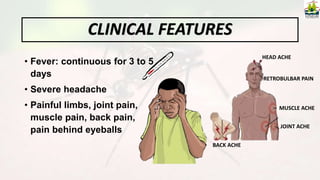
• Fever: continuous for 3 to 5
days
• Severe headache
• Painful limbs, joint pain,
muscle pain, back pain,
pain behind eyeballs
HEAD ACHE
MUSCLE ACHE
JOINT ACHE
BACK ACHE
CLINICAL FEATURES
RETROBULBAR PAIN
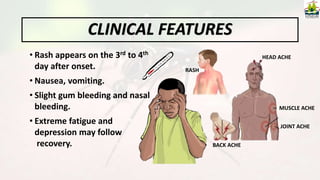
• Rash appears on the 3rd to 4th
day after onset.
• Nausea, vomiting.
• Slight gum bleeding and nasal
bleeding.
• Extreme fatigue and
depression may follow
recovery.
HEAD ACHE
MUSCLE ACHE
JOINT ACHE
BACK ACHE
CLINICAL FEATURES
RASH
CLINICAL FEATURES
MANAGEMENT OF
DENGUE
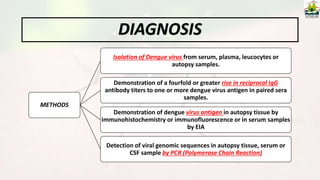
DIAGNOSIS
METHODS
Isolation of Dengue virus from serum, plasma, leucocytes or
autopsy samples.
Demonstration of a fourfold or greater rise in reciprocal IgG
antibody titers to one or more dengue virus antigen in paired sera
samples.
Demonstration of dengue virus antigen in autopsy tissue by
immunohistochemistry or immunofluorescence or in serum samples
by EIA
Detection of viral genomic sequences in autopsy tissue, serum or
CSF sample by PCR (Polymerase Chain Reaction)
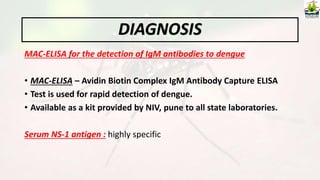
MAC-ELISA for the detection of IgM antibodies to dengue
• MAC-ELISA – Avidin Biotin Complex IgM Antibody Capture ELISA
• Test is used for rapid detection of dengue.
• Available as a kit provided by NIV, pune to all state laboratories.
Serum NS-1 antigen : highly specific
DIAGNOSIS
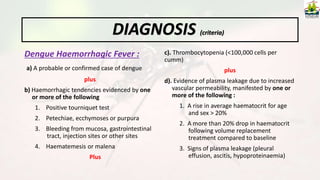
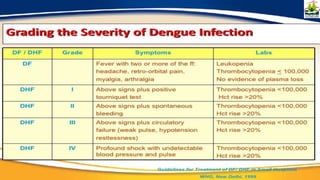
Dengue Haemorrhagic Fever :
a) A probable or confirmed case of dengue
plus
b) Haemorrhagic tendencies evidenced by one
or more of the following
1. Positive tourniquet test
2. Petechiae, ecchymoses or purpura
3. Bleeding from mucosa, gastrointestinal
tract, injection sites or other sites
4. Haematemesis or malena
Plus
c). Thrombocytopenia (<100,000 cells per
cumm)
plus
d). Evidence of plasma leakage due to increased
vascular permeability, manifested by one or
more of the following :
1. A rise in average haematocrit for age
and sex > 20%
2. A more than 20% drop in haematocrit
following volume replacement
treatment compared to baseline
3. Signs of plasma leakage (pleural
effusion, ascitis, hypoproteinaemia)
DIAGNOSIS (criteria)
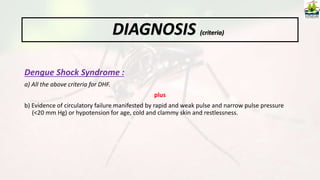
Dengue Shock Syndrome :
a) All the above criteria for DHF.
plus
b) Evidence of circulatory failure manifested by rapid and weak pulse and narrow pulse pressure
(<20 mm Hg) or hypotension for age, cold and clammy skin and restlessness.
DIAGNOSIS (criteria)
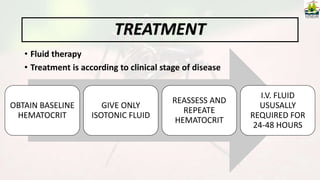
TREATMENT
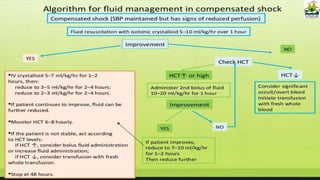
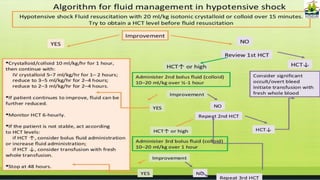
• Fluid therapy
• Treatment is according to clinical stage of disease
OBTAIN BASELINE
HEMATOCRIT
GIVE ONLY
ISOTONIC FLUID
REASSESS AND
REPEATE
HEMATOCRIT
I.V. FLUID
USUSALLY
REQUIRED FOR
24-48 HOURS
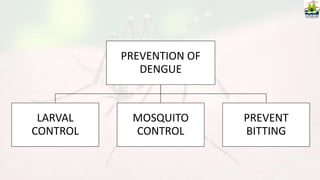
PREVENTION
PREVENTION OF
DENGUE
LARVAL
CONTROL
MOSQUITO
CONTROL
PREVENT
BITTING
39
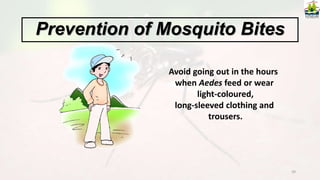
Avoid going out in the hours
when Aedes feed or wear
light-coloured,
long-sleeved clothing and
trousers.
Prevention of Mosquito Bites
40
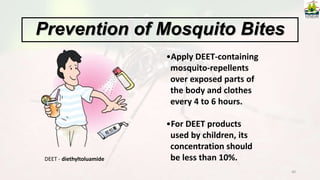
•Apply DEET-containing
mosquito-repellents
over exposed parts of
the body and clothes
every 4 to 6 hours.
•For DEET products
used by children, its
concentration should
be less than 10%.
Prevention of Mosquito Bites
DEET - diethyltoluamide
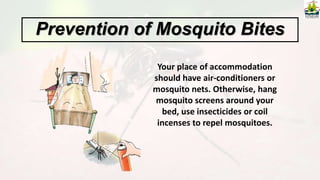
Your place of accommodation
should have air-conditioners or
mosquito nets. Otherwise, hang
mosquito screens around your
bed, use insecticides or coil
incenses to repel mosquitoes.
Prevention of Mosquito Bites
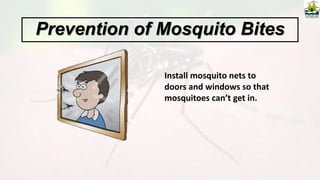
Install mosquito nets to
doors and windows so that
mosquitoes can’t get in.
Prevention of Mosquito Bites
43
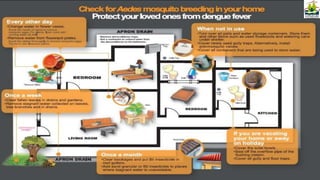
The most effective way to
eliminate mosquitoes is to
keep the environment
clean and to remove
stagnant water so that
mosquitoes can’t breed.
Elimination of Mosquitoes
44
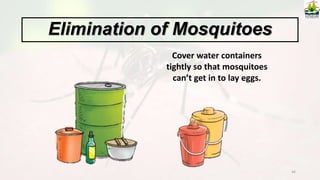
Cover water containers
tightly so that mosquitoes
can’t get in to lay eggs.
Elimination of Mosquitoes
45
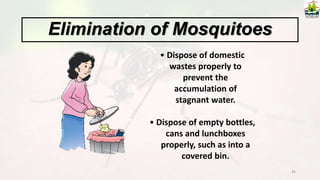
• Dispose of domestic
wastes properly to
prevent the
accumulation of
stagnant water.
• Dispose of empty bottles,
cans and lunchboxes
properly, such as into a
covered bin.
Elimination of Mosquitoes
46
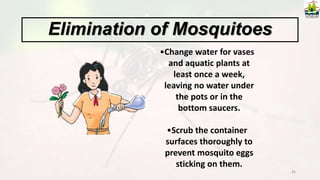
•Change water for vases
and aquatic plants at
least once a week,
leaving no water under
the pots or in the
bottom saucers.
•Scrub the container
surfaces thoroughly to
prevent mosquito eggs
sticking on them.
Elimination of Mosquitoes
47
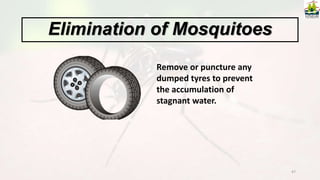
Remove or puncture any
dumped tyres to prevent
the accumulation of
stagnant water.
Elimination of Mosquitoes
48
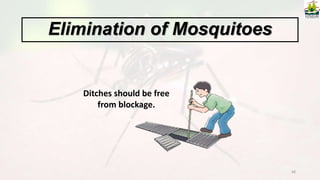
Ditches should be free
from blockage.
Elimination of Mosquitoes
49
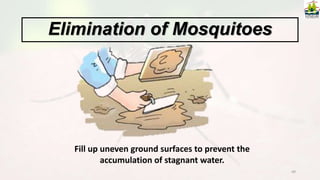
Fill up uneven ground surfaces to prevent the
accumulation of stagnant water.
Elimination of Mosquitoes
50
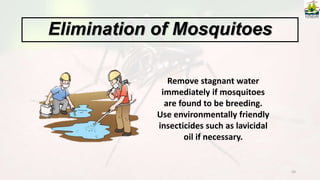
Remove stagnant water
immediately if mosquitoes
are found to be breeding.
Use environmentally friendly
insecticides such as lavicidal
oil if necessary.
Elimination of Mosquitoes
51
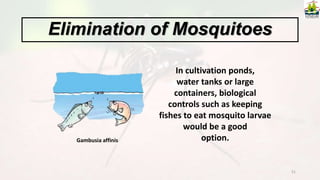
In cultivation ponds,
water tanks or large
containers, biological
controls such as keeping
fishes to eat mosquito larvae
would be a good
option.
Elimination of Mosquitoes
Gambusia affinis
• Insecticide-treated materials
• Insecticide-treated window curtains and sheet covers can also reduce dengue
vector densities and transmission.
• In studies in Mexico and Venezuela, ITMs (particularly curtains) were well
accepted by the communities as their efficacy was reinforced by the reduction of
other biting insects as well as cockroaches, houseflies and other pests. Window
curtains, screens, and doorway or wardrobe curtains, etc. all appear to have
promising results in different settings.
Prevention research
• Lethal ovitraps
• Ovitraps or oviposition traps collect the eggs laid by the mosquitoes which
develop into larva, pupa and adult mosquitoes. Ovitraps are often used for
surveillance of Aedes vectors can be modified to render it lethal to immature or
adult populations of Ae. aegypti.
• Lethal ovitraps (which incorporate an insecticide on the oviposition substrate),
autocidal ovitraps (which allow oviposition but prevent adult emergence), and
sticky ovitraps (which trap the mosquito when it lands) have been used on a
limited basis. Studies have shown that population densities can be reduced with
sufficiently large numbers of frequently-serviced traps.
• Life expectancy of the vector may also potentially be shortened, thus reducing the
number of vectors that become infective.
Prevention research
• Genetically-modified mosquitoes
• Population suppression: reduce mosquito population such that it would not be
able to sustain pathogen transmission. This includes sterility, reduced adult
longevity, or decrease larva/pupa survival.
• Population replacement: Reduce inherent ability to transmit the pathogen.
Mating will alter the genetic pool of the wild population.
Prevention research
• No vaccine is currently approved for the prevention of dengue
infection.
• Because immunity to a single dengue strain is the major risk factor
for dengue hemorrhagic fever and dengue shock syndrome, a
vaccine must provide high levels of immunity to all 4 dengue strains
to be clinically useful.
• Immunogenic, safe tetravalent vaccines have been developed and
are undergoing clinical trials.
Vaccine
• Developed a Long Term Action Plan for Prevention and Control of Dengue in the
country and sent to the State(s) on January 2007 for implementation.
• National guidelines for clinical management of Dengue Fever, Dengue Haemmorragic
Fever, Dengue Shock Syndrome has been sent to the State(s) April 2007 for circulation
in all hospitals.
• Established 110 Sentinel Surveillance Hospitals with laboratory support for
augmentation of diagnostic facility for Dengue in endemic State(s) in 2007 which has
been increased to 170 in 2009. All these are linked with 13 Apex Referral Laboratories
with advanced diagnostic facilities for back up support.
• To maintain the uniformity and standard of diagnostics in these laboratories IgM MAC
ELISA test kits are provided through National Institute of Virology (NIV), Pune. Cost is
borne by GOI.
• Diagnosis of Dengue and Chikungunya is provided to the community at free of cost.
Government of India has taken various steps for prevention and
control of Dengue and Chikungunya in the country.
• Since 2007, every year in the 1st quarter Directorate of NVBDCP prepare the
tentative allocation of test kits based on the previous epidemiological situation
of Dengue and Chikungunya in the states and communicate to both NIV, Pune
and States.
• Kits are supplied by NIV, Pune on receipt of requirement from the respective
states.
• Buffer stocks are also maintained to meet any exigency.
• State wise allocation of Dengue and Chikungunya during 2010 was
communicated to the states on 15th February 2010.
• Ensuring the diagnostic facility and availability of kits is the responsibility of the
respective State Programme Officers, NVBDCP.
Government of India has taken various steps for prevention and
control of Dengue and Chikungunya in the country.
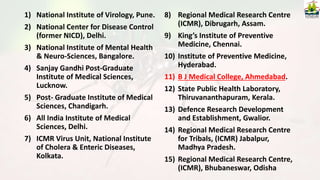
1) National Institute of Virology, Pune.
2) National Center for Disease Control
(former NICD), Delhi.
3) National Institute of Mental Health
& Neuro-Sciences, Bangalore.
4) Sanjay Gandhi Post-Graduate
Institute of Medical Sciences,
Lucknow.
5) Post- Graduate Institute of Medical
Sciences, Chandigarh.
6) All India Institute of Medical
Sciences, Delhi.
7) ICMR Virus Unit, National Institute
of Cholera & Enteric Diseases,
Kolkata.
8) Regional Medical Research Centre
(ICMR), Dibrugarh, Assam.
9) King’s Institute of Preventive
Medicine, Chennai.
10) Institute of Preventive Medicine,
Hyderabad.
11) B J Medical College, Ahmedabad.
12) State Public Health Laboratory,
Thiruvananthapuram, Kerala.
13) Defence Research Development
and Establishment, Gwalior.
14) Regional Medical Research Centre
for Tribals, (ICMR) Jabalpur,
Madhya Pradesh.
15) Regional Medical Research Centre,
(ICMR), Bhubaneswar, Odisha
A POWERPOINT PRESENTATION BY :
Dr. MAYUR PATEL
Dr. DHRUV PATEL
Dr. KRUNAL PATEL
Dr. DHARMIN PATEL
Dr. DARSHAK PATEL
Dr. MAITRIK PATEL
Dr. DISHA PATEL
Dr. ISHANI PATEL

Dangue - If they breed, you will bleed.

  • 1.
    𝐼𝐹 𝑇𝐻𝐸𝑌 𝐵𝑅𝐸𝐸𝐷,𝑌𝑂𝑈 𝑊𝐼𝐿𝐿 𝐵𝐿𝐸𝐸𝐷. UNDER GUIDENCE OF : DR. ALPESH PATEL A SMALL PPT ON :
  • 2.
    Dengue - Reasonbehind this name…. According to one theory………. Dengue is a Spanish word (?) • “Dengue" means fastidious or careful, which would describe the gait of a person suffering the bone pain of dengue fever.
  • 3.
    DENGUE • Also knownas break bone fever. • It is mosquito born tropical disease cause by “DENGUE VIRUS” • Transmitted by “AEDES AEGYPTI” mosquito.
  • 4.
    EPIDEMIOLOGY AND HISTORY •IN WORLD : About 50 million cases annually worldwide  Incidence of dengue fever highest in tropical and subtropical regions  Recent increase in disease activity worldwide • IN INDIA : First outbreak of dengue was recorded in 1812  A double peak hemorrhagic fever epidemic occurred in India for the first time in Calcutta between July 1963 & March 1964
  • 5.
  • 9.
    0 10000 20000 30000 40000 50000 60000 70000 80000 2009 2010 2011 2012 2013 2014 2015 cont. 15535 28292 18860 50222 75808 40571 9874 96 110 169 242 193 137 25 2009 20102011 2012 2013 2014 2015 cont. CASES 15535 28292 18860 50222 75808 40571 9874 DEATHS 96 110 169 242 193 137 25 Column1 Cases & Death rate (2009-2015 cont.) CASES DEATHS Column1 INDIA
  • 10.
    0 1000 2000 3000 4000 5000 6000 7000 2009 2010 20112012 2013 2014 2015 cont. CASES 2461 2568 1693 3067 6272 2320 657 DEATHS 2 1 9 6 15 3 0 Column1 2461 2568 1693 3067 6272 2320 657 2 1 9 6 15 3 0 Cases & Death rate (2009-2015 cont.) CASES DEATHS Column1 GUJARAT
  • 11.
    WE NEED TOKNOW ABOUT… AGENT – DENGUE VIRUS VECTOR – AEDES MOSQUITO ENVIRONMENT
  • 12.
    DENGUE virus Family Flaviviridae GenusFlavivirus Species Dengue DANGUE VIRUS • It is arbovirus. • Composed of single-stranded RNA • Has 4 serotypes (DEN-1, 2, 3, 4) • In india : DEN-1,2 are most common
  • 13.
    • Aedes aegyptiis a mosquito that can spread :  dengue fever,  chikungunya, and  yellow fever viruses etc. • Tiger mosquito : The mosquito can be recognized by white markings on its legs and a marking in the form of a lyre on the thorax AEDES AEGYPTI (MC AEDES)
  • 14.
    • Originated inAfrica. • Primarily a daytime feeder • Lays eggs and produces larvae preferentially in artificial containers AEDES AEGYPTI (MC AEDES) Other vector is Aedes Albopictus
  • 15.
    • The populationof Ae. aegypti fluctuates with rainfall and water storage • survives best between 160-300 C and a relative humidity of 60-80%. • Ae. aegypti breeds almost entirely in domestic man-made water receptacles found in and around households, construction sites and factories; natural larval habitats are tree holes, leaf axils and coconut shells ENVIRONMENT
  • 16.
  • 17.
  • 19.
    PATHOGENESISDENGUEINFECTION PRODUCTION OF Ab Ag-AbINTERACTION WITH COMPLEMENT ACTIVATION DePOSITION IN VESSELS, VARIOUS TISSUE AND PLATELETS CLINICAL MENIFESTATIONS ACTIVATION OF T-CELL PRODUCTION OF CYTOKINES VASCULAR PERMIABILITY INCREASE CLINICAL MENIFESTATION
  • 20.
    CLINICAL FEATURES DENGUE (TYPES) UNDIFFERNTIATED FEVER CLASSICALDENGUE DENGUE HAEMORRHAGIC FEVER DENGUE SHOCK SYNDROME
  • 21.
    NEWER CLASSIFICATION (WHO) DENGUE NON-SEVERE WITHWARNING SIGN WITHOUT WARNING SIGN SEVERE
  • 22.
    • Non-severe denguewithout warning signs: 1) Live in/travel to endemic area 2) Fever and two of the following criteria: - Nausea and Vomiting -Rash -Aches and pains - Tourniquet test positive - Leucopenia - No warning sign • Non-severe dengue with warning signs: • Presence of warning signs - Abdominal pain or tenderness - Persistent Vomiting - Clinical fluid accumulation - Mucosal bleed - Lethargy and restlessness - Liver enlargement >2cm - Laboratory: Increase in haematocrit concurrent with rapid decrease in platelet count. NEWER CLASSIFICATION (WHO)
  • 23.
    • Severe Dengue: 1)Severe plasma leakage leading to - Shock(DSS) - Fluid accumulation with respiratory distress 2) Severe bleeding NEWER CLASSIFICATION (WHO)
  • 24.
    • Fever: continuousfor 3 to 5 days • Severe headache • Painful limbs, joint pain, muscle pain, back pain, pain behind eyeballs HEAD ACHE MUSCLE ACHE JOINT ACHE BACK ACHE CLINICAL FEATURES RETROBULBAR PAIN
  • 25.
    • Rash appearson the 3rd to 4th day after onset. • Nausea, vomiting. • Slight gum bleeding and nasal bleeding. • Extreme fatigue and depression may follow recovery. HEAD ACHE MUSCLE ACHE JOINT ACHE BACK ACHE CLINICAL FEATURES RASH
  • 26.
  • 27.
  • 28.
    DIAGNOSIS METHODS Isolation of Denguevirus from serum, plasma, leucocytes or autopsy samples. Demonstration of a fourfold or greater rise in reciprocal IgG antibody titers to one or more dengue virus antigen in paired sera samples. Demonstration of dengue virus antigen in autopsy tissue by immunohistochemistry or immunofluorescence or in serum samples by EIA Detection of viral genomic sequences in autopsy tissue, serum or CSF sample by PCR (Polymerase Chain Reaction)
  • 29.
    MAC-ELISA for thedetection of IgM antibodies to dengue • MAC-ELISA – Avidin Biotin Complex IgM Antibody Capture ELISA • Test is used for rapid detection of dengue. • Available as a kit provided by NIV, pune to all state laboratories. Serum NS-1 antigen : highly specific DIAGNOSIS
  • 30.
    Dengue Haemorrhagic Fever: a) A probable or confirmed case of dengue plus b) Haemorrhagic tendencies evidenced by one or more of the following 1. Positive tourniquet test 2. Petechiae, ecchymoses or purpura 3. Bleeding from mucosa, gastrointestinal tract, injection sites or other sites 4. Haematemesis or malena Plus c). Thrombocytopenia (<100,000 cells per cumm) plus d). Evidence of plasma leakage due to increased vascular permeability, manifested by one or more of the following : 1. A rise in average haematocrit for age and sex > 20% 2. A more than 20% drop in haematocrit following volume replacement treatment compared to baseline 3. Signs of plasma leakage (pleural effusion, ascitis, hypoproteinaemia) DIAGNOSIS (criteria)
  • 31.
    Dengue Shock Syndrome: a) All the above criteria for DHF. plus b) Evidence of circulatory failure manifested by rapid and weak pulse and narrow pulse pressure (<20 mm Hg) or hypotension for age, cold and clammy skin and restlessness. DIAGNOSIS (criteria)
  • 34.
    TREATMENT • Fluid therapy •Treatment is according to clinical stage of disease OBTAIN BASELINE HEMATOCRIT GIVE ONLY ISOTONIC FLUID REASSESS AND REPEATE HEMATOCRIT I.V. FLUID USUSALLY REQUIRED FOR 24-48 HOURS
  • 37.
  • 38.
  • 39.
    39 Avoid going outin the hours when Aedes feed or wear light-coloured, long-sleeved clothing and trousers. Prevention of Mosquito Bites
  • 40.
    40 •Apply DEET-containing mosquito-repellents over exposedparts of the body and clothes every 4 to 6 hours. •For DEET products used by children, its concentration should be less than 10%. Prevention of Mosquito Bites DEET - diethyltoluamide
  • 41.
    Your place ofaccommodation should have air-conditioners or mosquito nets. Otherwise, hang mosquito screens around your bed, use insecticides or coil incenses to repel mosquitoes. Prevention of Mosquito Bites
  • 42.
    Install mosquito netsto doors and windows so that mosquitoes can’t get in. Prevention of Mosquito Bites
  • 43.
    43 The most effectiveway to eliminate mosquitoes is to keep the environment clean and to remove stagnant water so that mosquitoes can’t breed. Elimination of Mosquitoes
  • 44.
    44 Cover water containers tightlyso that mosquitoes can’t get in to lay eggs. Elimination of Mosquitoes
  • 45.
    45 • Dispose ofdomestic wastes properly to prevent the accumulation of stagnant water. • Dispose of empty bottles, cans and lunchboxes properly, such as into a covered bin. Elimination of Mosquitoes
  • 46.
    46 •Change water forvases and aquatic plants at least once a week, leaving no water under the pots or in the bottom saucers. •Scrub the container surfaces thoroughly to prevent mosquito eggs sticking on them. Elimination of Mosquitoes
  • 47.
    47 Remove or punctureany dumped tyres to prevent the accumulation of stagnant water. Elimination of Mosquitoes
  • 48.
    48 Ditches should befree from blockage. Elimination of Mosquitoes
  • 49.
    49 Fill up unevenground surfaces to prevent the accumulation of stagnant water. Elimination of Mosquitoes
  • 50.
    50 Remove stagnant water immediatelyif mosquitoes are found to be breeding. Use environmentally friendly insecticides such as lavicidal oil if necessary. Elimination of Mosquitoes
  • 51.
    51 In cultivation ponds, watertanks or large containers, biological controls such as keeping fishes to eat mosquito larvae would be a good option. Elimination of Mosquitoes Gambusia affinis
  • 53.
    • Insecticide-treated materials •Insecticide-treated window curtains and sheet covers can also reduce dengue vector densities and transmission. • In studies in Mexico and Venezuela, ITMs (particularly curtains) were well accepted by the communities as their efficacy was reinforced by the reduction of other biting insects as well as cockroaches, houseflies and other pests. Window curtains, screens, and doorway or wardrobe curtains, etc. all appear to have promising results in different settings. Prevention research
  • 54.
    • Lethal ovitraps •Ovitraps or oviposition traps collect the eggs laid by the mosquitoes which develop into larva, pupa and adult mosquitoes. Ovitraps are often used for surveillance of Aedes vectors can be modified to render it lethal to immature or adult populations of Ae. aegypti. • Lethal ovitraps (which incorporate an insecticide on the oviposition substrate), autocidal ovitraps (which allow oviposition but prevent adult emergence), and sticky ovitraps (which trap the mosquito when it lands) have been used on a limited basis. Studies have shown that population densities can be reduced with sufficiently large numbers of frequently-serviced traps. • Life expectancy of the vector may also potentially be shortened, thus reducing the number of vectors that become infective. Prevention research
  • 55.
    • Genetically-modified mosquitoes •Population suppression: reduce mosquito population such that it would not be able to sustain pathogen transmission. This includes sterility, reduced adult longevity, or decrease larva/pupa survival. • Population replacement: Reduce inherent ability to transmit the pathogen. Mating will alter the genetic pool of the wild population. Prevention research
  • 56.
    • No vaccineis currently approved for the prevention of dengue infection. • Because immunity to a single dengue strain is the major risk factor for dengue hemorrhagic fever and dengue shock syndrome, a vaccine must provide high levels of immunity to all 4 dengue strains to be clinically useful. • Immunogenic, safe tetravalent vaccines have been developed and are undergoing clinical trials. Vaccine
  • 57.
    • Developed aLong Term Action Plan for Prevention and Control of Dengue in the country and sent to the State(s) on January 2007 for implementation. • National guidelines for clinical management of Dengue Fever, Dengue Haemmorragic Fever, Dengue Shock Syndrome has been sent to the State(s) April 2007 for circulation in all hospitals. • Established 110 Sentinel Surveillance Hospitals with laboratory support for augmentation of diagnostic facility for Dengue in endemic State(s) in 2007 which has been increased to 170 in 2009. All these are linked with 13 Apex Referral Laboratories with advanced diagnostic facilities for back up support. • To maintain the uniformity and standard of diagnostics in these laboratories IgM MAC ELISA test kits are provided through National Institute of Virology (NIV), Pune. Cost is borne by GOI. • Diagnosis of Dengue and Chikungunya is provided to the community at free of cost. Government of India has taken various steps for prevention and control of Dengue and Chikungunya in the country.
  • 58.
    • Since 2007,every year in the 1st quarter Directorate of NVBDCP prepare the tentative allocation of test kits based on the previous epidemiological situation of Dengue and Chikungunya in the states and communicate to both NIV, Pune and States. • Kits are supplied by NIV, Pune on receipt of requirement from the respective states. • Buffer stocks are also maintained to meet any exigency. • State wise allocation of Dengue and Chikungunya during 2010 was communicated to the states on 15th February 2010. • Ensuring the diagnostic facility and availability of kits is the responsibility of the respective State Programme Officers, NVBDCP. Government of India has taken various steps for prevention and control of Dengue and Chikungunya in the country.
  • 59.
    1) National Instituteof Virology, Pune. 2) National Center for Disease Control (former NICD), Delhi. 3) National Institute of Mental Health & Neuro-Sciences, Bangalore. 4) Sanjay Gandhi Post-Graduate Institute of Medical Sciences, Lucknow. 5) Post- Graduate Institute of Medical Sciences, Chandigarh. 6) All India Institute of Medical Sciences, Delhi. 7) ICMR Virus Unit, National Institute of Cholera & Enteric Diseases, Kolkata. 8) Regional Medical Research Centre (ICMR), Dibrugarh, Assam. 9) King’s Institute of Preventive Medicine, Chennai. 10) Institute of Preventive Medicine, Hyderabad. 11) B J Medical College, Ahmedabad. 12) State Public Health Laboratory, Thiruvananthapuram, Kerala. 13) Defence Research Development and Establishment, Gwalior. 14) Regional Medical Research Centre for Tribals, (ICMR) Jabalpur, Madhya Pradesh. 15) Regional Medical Research Centre, (ICMR), Bhubaneswar, Odisha
  • 61.
    A POWERPOINT PRESENTATIONBY : Dr. MAYUR PATEL Dr. DHRUV PATEL Dr. KRUNAL PATEL Dr. DHARMIN PATEL Dr. DARSHAK PATEL Dr. MAITRIK PATEL Dr. DISHA PATEL Dr. ISHANI PATEL