MRS. M.PRADEEPA MPT (NEURO)
VICE PRINCIPAL
PPG COLLEGE OF PHYSIOTHERAPY
COIMBATORE,TAMILNADU
INTRODUCTION
 The term dementia derives from the Latin root demens,
which means being out of one’s mind.
 Dementia is one of the major causes of disability and
dependency among older people worldwide
 Dementia is not a single disease; it’s an overall term that
covers a wide range of specific medical conditions,
including Alzheimer’s disease.
 Disorders grouped under the general term “dementia” are
caused by abnormal brain changes.
 These changes trigger a decline in cognitive abilities,
severe enough to impair daily life and independent
function.
 They also affect behavior, feelings and relationships.
DEFINITION
 Progressive deterioration of intellect, behaviour and
personality as a consequence of diffuse disease of
the cerebral hemispheres, maximally affecting the
cerebral cortex and hippocampus.
Epidemiology
 Dementia affects about 47 million people worldwide .
 According to World Alzhemier’s report 2015, the
number of people affected by dementia is expected
to increase to 131 million in 2050, where majority
would be in developing countries.
 Dementia may occur at any age but is more common
in the elderly, increasing with age - approximate
prevalence 1% in 60s, 5% in 70s, 15% in 80s.
 Rates are slightly higher in women than men at ages
65 and greater.
Classification - Based on etiology:
 1. DEGENERATIVE
 A. Pure dementia
Alzheimer’s disese (~60%)
Frontotemporal/Pick’s disease (~5%)
 B. Dementia plus syndromes
Dementia with Lewy bodies (~10%)
Parkinson’s disease with dementia
 2. CORTICOBASAL DEGENERATION
Progressive supranuclear palsy
Huntington’s disease
 3.CEREBROVASCULAR DISEASES (20%)
Multiple infarct dementia
Subcortical ischaemic vascular dementia
Chronic subdural haematomas
Cerebral amyloid angiopathy
 4. STRUCTURAL DISORDERS
Normal pressure hydrocephalus
Based on etiology
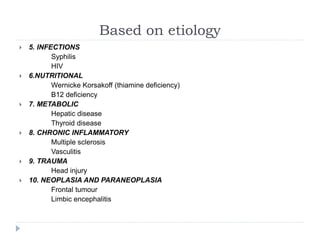
 5. INFECTIONS
Syphilis
HIV
 6.NUTRITIONAL
Wernicke Korsakoff (thiamine deficiency)
B12 deficiency
 7. METABOLIC
Hepatic disease
Thyroid disease
 8. CHRONIC INFLAMMATORY
Multiple sclerosis
Vasculitis
 9. TRAUMA
Head injury
 10. NEOPLASIA AND PARANEOPLASIA
Frontal tumour
Limbic encephalitis
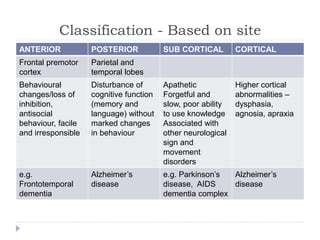
Classification - Based on site
ANTERIOR POSTERIOR SUB CORTICAL CORTICAL
Frontal premotor
cortex
Parietal and
temporal lobes
Behavioural
changes/loss of
inhibition,
antisocial
behaviour, facile
and irresponsible
Disturbance of
cognitive function
(memory and
language) without
marked changes
in behaviour
Apathetic
Forgetful and
slow, poor ability
to use knowledge
Associated with
other neurological
sign and
movement
disorders
Higher cortical
abnormalities –
dysphasia,
agnosia, apraxia
e.g.
Frontotemporal
dementia
Alzheimer’s
disease
e.g. Parkinson’s
disease, AIDS
dementia complex
Alzheimer’s
disease
Risk factors
 Smoking
 Alcohol consumption
 Sedentary life style, obseity
 High blood pressure
 Hyperlipidemia
 Hypercholesterolemia
 Depression
 Heart diseases
 Prior stroke
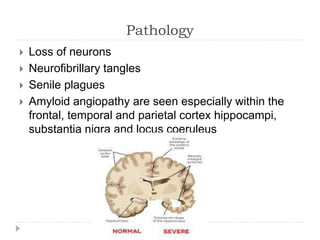
Pathology
 Loss of neurons
 Neurofibrillary tangles
 Senile plagues
 Amyloid angiopathy are seen especially within the
frontal, temporal and parietal cortex hippocampi,
substantia nigra and locus coeruleus
Signs and symptoms
 Neuropsychiatric symptoms - termed as
Behavioural and psychological symptoms of
dementia (BPSD). These can include problems with:
 Balance
 Tremor
 Speech and language
 Eating/swallowing
 Memory
 Wandering or restlessness
 Visual perception
Signs and symptoms
 Behavioral and psychological symptoms of dementia
almost always occur in all types of dementia and may
manifest as:
 Agitation
 Depression
 Anxiety
 Abnormal motor behavior
 Elated mood
 Irritability
 Apathy
 Delusions (often believing people are stealing from them)
or hallucinations
 Changes in sleep or appetite
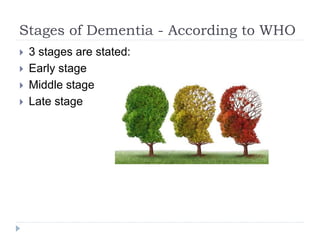
Stages of Dementia - According to WHO
 3 stages are stated:
 Early stage
 Middle stage
 Late stage
Early stage:
 The onset is gradual. Common symptoms include:
a. Memory difficulty include some word-finding
problems (anomia) and problems with planning and
organizational skills
b. Losing track of the time
c. Becoming lost in familiar places.
d. Repeating things, personality changes, social
withdrawal and difficulties at work
e. MMSE scores are between 20 and 25.
Middle stage:
 The signs and symptoms become clearer and more
restricting, these include:
a. Severely impaired in solving problems and their
social judgment
b. Becoming forgetful of recent events and people's
names
c. Becoming lost at home
d. Having increasing difficulty with communication
e. Needing help with personal care
f. Experiencing behaviour changes, including
wandering and repeated questioning
g. MMSE between scores of 6–17
Late stage:
 Near total dependence and inactivity. Memory
disturbances are serious and the physical signs and
symptoms become more obvious. Symptoms
include:
a. Becoming unaware of the time and place
b. Having difficulty recognizing relatives and friends
c. Having an increasing need for assisted self-care
d. Often eat pureed diets, thickened liquids, and
require assistance in eating
e. Having difficulty walking
f. Experiencing behaviour changes that may escalate
and include aggression
Diagnosis
 Cognitive and neuropsychological tests
 Mini mental scale
 Rating Anxiety in Dementia
 The Dementia Quality of Life Instrument
 The disability assessment for dementia
 CT or MRI. These scans can check for evidence of
stroke or bleeding or tumor or hydrocephalus.
 PET scans. These can show patterns of brain
activity and whether the amyloid protein, a hallmark
of Alzheimer's disease, has been deposited in the
brain.
 Laboratory tests
 Simple blood tests can detect physical problems that
can affect brain function, such as vitamin B-12
deficiency or an underactive thyroid gland.
 The spinal fluid is examined for infection,
inflammation or markers of some degenerative
diseases.
Differential diagnosis
 Dementia can have different causes, and the
following conditions need to be treated and/or
excluded first:
 Vitamin B12 deficiency
 Hormone deficiencies (e.g. thyroid problems)
 Depression
 Medication side-effects
 Alcohol abuse
 Overmedication
 Infections
 Brain tumours
Medical Management
 Most types of dementia can't be cured, but there are
ways to manage your symptoms.
 Cholinesterase inhibitors: including donepezil
(Aricept), rivastigmine (Exelon) and galantamine
(Razadyne) — work by boosting levels of a chemical
messenger involved in memory and judgment.
 Memantine: Memantine (Namenda) works by
regulating the activity of glutamate, another chemical
messenger involved in brain functions, such as
learning and memory. In some cases, memantine is
prescribed with a cholinesterase inhibitor.
Rehabilitation
 Physiotherapy: plays an essential part in promoting
and maintaining mobility for people with dementia,
and particularly has a vital role in end of life care, by
managing positioning, seating and painful
contractures.
 Occupational therapy: teaches coping behaviors.
The purpose is to prevent accidents, such as falls;
manage behavior; and prepare you for the dementia
progression.
 Modifying the environment. Reducing clutter and
noise can make it easier for someone with dementia
to focus and function. Monitoring systems can alert
you if the person with dementia wanders.
 Simplifying tasks. Break tasks into easier steps
and focus on success, not failure. Structure and
routine also help reduce confusion in people with
dementia

Dementia

  • 1.
    MRS. M.PRADEEPA MPT(NEURO) VICE PRINCIPAL PPG COLLEGE OF PHYSIOTHERAPY COIMBATORE,TAMILNADU
  • 2.
    INTRODUCTION  The termdementia derives from the Latin root demens, which means being out of one’s mind.  Dementia is one of the major causes of disability and dependency among older people worldwide  Dementia is not a single disease; it’s an overall term that covers a wide range of specific medical conditions, including Alzheimer’s disease.  Disorders grouped under the general term “dementia” are caused by abnormal brain changes.  These changes trigger a decline in cognitive abilities, severe enough to impair daily life and independent function.  They also affect behavior, feelings and relationships.
  • 3.
    DEFINITION  Progressive deteriorationof intellect, behaviour and personality as a consequence of diffuse disease of the cerebral hemispheres, maximally affecting the cerebral cortex and hippocampus.
  • 4.
    Epidemiology  Dementia affectsabout 47 million people worldwide .  According to World Alzhemier’s report 2015, the number of people affected by dementia is expected to increase to 131 million in 2050, where majority would be in developing countries.  Dementia may occur at any age but is more common in the elderly, increasing with age - approximate prevalence 1% in 60s, 5% in 70s, 15% in 80s.  Rates are slightly higher in women than men at ages 65 and greater.
  • 5.
    Classification - Basedon etiology:  1. DEGENERATIVE  A. Pure dementia Alzheimer’s disese (~60%) Frontotemporal/Pick’s disease (~5%)  B. Dementia plus syndromes Dementia with Lewy bodies (~10%) Parkinson’s disease with dementia  2. CORTICOBASAL DEGENERATION Progressive supranuclear palsy Huntington’s disease  3.CEREBROVASCULAR DISEASES (20%) Multiple infarct dementia Subcortical ischaemic vascular dementia Chronic subdural haematomas Cerebral amyloid angiopathy  4. STRUCTURAL DISORDERS Normal pressure hydrocephalus
  • 6.
    Based on etiology 5. INFECTIONS Syphilis HIV  6.NUTRITIONAL Wernicke Korsakoff (thiamine deficiency) B12 deficiency  7. METABOLIC Hepatic disease Thyroid disease  8. CHRONIC INFLAMMATORY Multiple sclerosis Vasculitis  9. TRAUMA Head injury  10. NEOPLASIA AND PARANEOPLASIA Frontal tumour Limbic encephalitis
  • 7.
    Classification - Basedon site ANTERIOR POSTERIOR SUB CORTICAL CORTICAL Frontal premotor cortex Parietal and temporal lobes Behavioural changes/loss of inhibition, antisocial behaviour, facile and irresponsible Disturbance of cognitive function (memory and language) without marked changes in behaviour Apathetic Forgetful and slow, poor ability to use knowledge Associated with other neurological sign and movement disorders Higher cortical abnormalities – dysphasia, agnosia, apraxia e.g. Frontotemporal dementia Alzheimer’s disease e.g. Parkinson’s disease, AIDS dementia complex Alzheimer’s disease
  • 8.
    Risk factors  Smoking Alcohol consumption  Sedentary life style, obseity  High blood pressure  Hyperlipidemia  Hypercholesterolemia  Depression  Heart diseases  Prior stroke
  • 9.
    Pathology  Loss ofneurons  Neurofibrillary tangles  Senile plagues  Amyloid angiopathy are seen especially within the frontal, temporal and parietal cortex hippocampi, substantia nigra and locus coeruleus
  • 10.
    Signs and symptoms Neuropsychiatric symptoms - termed as Behavioural and psychological symptoms of dementia (BPSD). These can include problems with:  Balance  Tremor  Speech and language  Eating/swallowing  Memory  Wandering or restlessness  Visual perception
  • 11.
    Signs and symptoms Behavioral and psychological symptoms of dementia almost always occur in all types of dementia and may manifest as:  Agitation  Depression  Anxiety  Abnormal motor behavior  Elated mood  Irritability  Apathy  Delusions (often believing people are stealing from them) or hallucinations  Changes in sleep or appetite
  • 12.
    Stages of Dementia- According to WHO  3 stages are stated:  Early stage  Middle stage  Late stage
  • 13.
    Early stage:  Theonset is gradual. Common symptoms include: a. Memory difficulty include some word-finding problems (anomia) and problems with planning and organizational skills b. Losing track of the time c. Becoming lost in familiar places. d. Repeating things, personality changes, social withdrawal and difficulties at work e. MMSE scores are between 20 and 25.
  • 14.
    Middle stage:  Thesigns and symptoms become clearer and more restricting, these include: a. Severely impaired in solving problems and their social judgment b. Becoming forgetful of recent events and people's names c. Becoming lost at home d. Having increasing difficulty with communication e. Needing help with personal care f. Experiencing behaviour changes, including wandering and repeated questioning g. MMSE between scores of 6–17
  • 15.
    Late stage:  Neartotal dependence and inactivity. Memory disturbances are serious and the physical signs and symptoms become more obvious. Symptoms include: a. Becoming unaware of the time and place b. Having difficulty recognizing relatives and friends c. Having an increasing need for assisted self-care d. Often eat pureed diets, thickened liquids, and require assistance in eating e. Having difficulty walking f. Experiencing behaviour changes that may escalate and include aggression
  • 16.
    Diagnosis  Cognitive andneuropsychological tests  Mini mental scale  Rating Anxiety in Dementia  The Dementia Quality of Life Instrument  The disability assessment for dementia  CT or MRI. These scans can check for evidence of stroke or bleeding or tumor or hydrocephalus.
  • 17.
     PET scans.These can show patterns of brain activity and whether the amyloid protein, a hallmark of Alzheimer's disease, has been deposited in the brain.  Laboratory tests  Simple blood tests can detect physical problems that can affect brain function, such as vitamin B-12 deficiency or an underactive thyroid gland.  The spinal fluid is examined for infection, inflammation or markers of some degenerative diseases.
  • 18.
    Differential diagnosis  Dementiacan have different causes, and the following conditions need to be treated and/or excluded first:  Vitamin B12 deficiency  Hormone deficiencies (e.g. thyroid problems)  Depression  Medication side-effects  Alcohol abuse  Overmedication  Infections  Brain tumours
  • 19.
    Medical Management  Mosttypes of dementia can't be cured, but there are ways to manage your symptoms.  Cholinesterase inhibitors: including donepezil (Aricept), rivastigmine (Exelon) and galantamine (Razadyne) — work by boosting levels of a chemical messenger involved in memory and judgment.  Memantine: Memantine (Namenda) works by regulating the activity of glutamate, another chemical messenger involved in brain functions, such as learning and memory. In some cases, memantine is prescribed with a cholinesterase inhibitor.
  • 20.
    Rehabilitation  Physiotherapy: playsan essential part in promoting and maintaining mobility for people with dementia, and particularly has a vital role in end of life care, by managing positioning, seating and painful contractures.  Occupational therapy: teaches coping behaviors. The purpose is to prevent accidents, such as falls; manage behavior; and prepare you for the dementia progression.
  • 21.
     Modifying theenvironment. Reducing clutter and noise can make it easier for someone with dementia to focus and function. Monitoring systems can alert you if the person with dementia wanders.  Simplifying tasks. Break tasks into easier steps and focus on success, not failure. Structure and routine also help reduce confusion in people with dementia