G
O
O
D
morning
Ambika Gaur
Organic brain disorder
Dementia
Ambika Gaur Bhatt
Senior Nursing Tutor
HIN Pounta Sahib
๏ฑIntroduction:
โ€ข Chronic organic brain syndrome
โ€ข Organic mental disorders are behavioural or
psychological disorder associated with
transient or permanent brain dysfunction
โ€ข Alzheimer's type dementia is an irreversible
disease marked by global, progressive
impairment of cognitive functioning, memory
& personality
๏ฑ Classification of organicbrain
disorders:
โ€ข (F00-f09) organic, including
symptomatic, mentaldisorders
โ€ข (F00) Dementia in Alzheimerโ€™sdisease
โ€ข (F01) Vascular dementia
โ€ข (F02) Dementia in other
diseases classified elsewhere
โ€ข (F03) unspecified dementia
โ€ข (F04) organic amnestic syndrome,
not induced by alcohol and other
psychoactive substances
โ€ข (F05)delirium not induced by alcoholand
other psychoactivesubstances
โ€ข (F06) Other mental disorders due to brain
damage and dysfunction and to physical
disease
โ€ข (F07)personality and behavioural disorders
due to brain disease, damage anddysfunction
โ€ข (F09)unspecified organic or symptomatic
mental disorder.
๏ฑHistory of dementia:
โ€ข Dementia wasfirst described in abook about
mental illness in 1893. In 1894, Dr.Alois
Alzheimer, a German neuropathologist who
hasaparticular interest in โ€œnervousdisordersโ€
described changesin the brain causedby
vascular disease(now known asvascular
dementia).
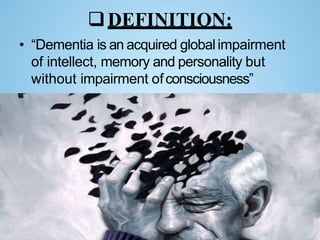
๏ฑDEFINITION:
โ€ข โ€œDementia is an acquired globalimpairment
of intellect, memory and personality but
without impairment ofconsciousnessโ€
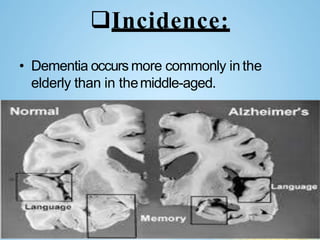
๏ฑIncidence:
โ€ข Dementia occurs more commonly in the
elderly than in themiddle-aged.
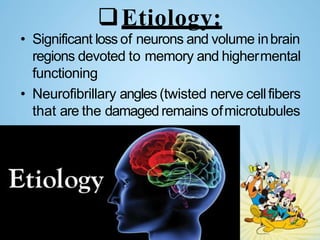
๏ฑEtiology:
โ€ข Significant loss of neurons and volume inbrain
regions devoted to memory and highermental
functioning
โ€ข Neurofibrillary angles (twisted nerve cellfibers
that are the damagedremains ofmicrotubules
โ€ข Environmental factors: infection, metals
and toxins.
โ€ข Excessiveamount of metal ions, suchas
zinc and copper, in brain
โ€ข Deficiencies of vitamin B6,B12And
Folate Possible RiskFactor DueT
o
Increased LevelsOf Hemocysteine
(amino acid that may interfere with
nerve cell repair)
โ€ข Early depression: common genetic
factors seenin those with early
depression andAlzheimer's disease
Untreatable and irreversible
cause of dementia
โ€ข Degenerating disorders of CNS
โ€ข Alzheimerโ€™s disease(this is the mostcommon
of all dementingillnesses)
โ€ข Pickโ€™sdisease
โ€ข Huntingtonโ€™s chorea
โ€ข Parkinsonโ€™s disease
Treatable and reversible
causes of dementia
โ€ข Vascular-multi-infarct dementia
โ€ข Intracranial spaceoccupying lesions
โ€ข Metabolic disorders-hepatic failure, renalfailure
โ€ข Endocrine disorders- myxedema, Addisonโ€™s
disease
โ€ข Infections- AIDS,meningitis, encephalitis
โ€ข Intoxication- Alcohol, heavy metals(lead,
arsenic),
โ€ข Anoxia- Anemia, post-anesthesia,chronic
respiratory failure
โ€ข Vitamin deficiency, especially deficiency ofthiamine
and nicotine
Physiologic:
โ€ข Normal pressurehydrocephalus
Metabolic:
โ€ข Endocrinopathies (e.g. hypothyroidism)
Tumor:
โ€ข Primary or metastatic (e.g. meningiomaor
metastatic breast or lungcancer)
Traumatic:
โ€ข Subduralhematoma
๏ฑTypes of dementia:
the classificationsinclude.
๏ฑCortical dementia: dementia where the brain
damage primarily affects the brainโ€™s cortex,or
outer layer. Cortical dementias tend to cause
problems with memory, language, thinking,
and social behaviour.
๏ฑSubcortical dementia: dementia that affects
parts of the brain below the cortex. Sub-
cortical dementia tends to causechangesin
emotions and emotions and movement in
addition to problems withmemory.
๏ฑProgressive dementia: dementia that gets
worse over time, gradually interfering with
more and more cognitiveabilities.
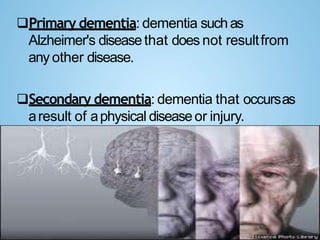
๏ฑPrimary dementia: dementia suchas
Alzheimer's diseasethat does not resultfrom
any other disease.
๏ฑSecondary dementia: dementia that occursas
aresult of aphysical diseaseor injury.
๏ฑStages ofdementia:
Stage I: Early stage (2 to4years):
โ€ข Forgetfulness
โ€ข Declining interest in environment
โ€ข Hesitancy in initiating actions
โ€ข Poor performance at work
Stage II: Middle stage (2 to12years):
โ€ข Progressive memory loss
โ€ข Hesitates in response to questions
โ€ข Hasdifficulty in following simpleinstructions
โ€ข Irritable, anxious
โ€ข Wandering
โ€ข Neglects personal hygiene
โ€ข Social isolation
Stage III: Final stage (up to a year):
โ€ข Marked loss of weight becauseof
inadequate intake of food
โ€ข Unable to communicate
โ€ข Doesnot recognizefamily
โ€ข Incontinence of urine andfeces
โ€ข Losesthe ability to stand andwalk
โ€ข Death is causedby aspiration
pneumonia
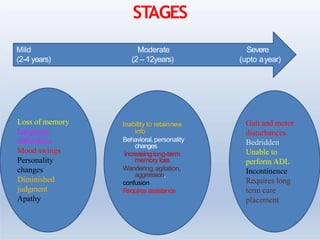
STAGES
Mild Moderate Severe
(2-4 years) (2 โ€“ 12years) (upto ayear)
Loss of memory
Language
difficulties
Mood swings
Personality
changes
Diminished
judgment
Apathy
Inability to retainnew
info
Behavioral, personality
changes
Increasing long-term
memory loss
Wandering,agitation,
aggression,
confusion
Requires assistance
Gait and motor
disturbances
Bedridden
Unable to
perform ADL
Incontinence
Requires long
term care
placement
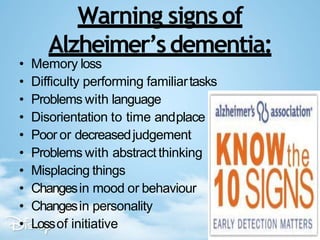
Warning signs of
Alzheimerโ€™sdementia:
โ€ข Memory loss
โ€ข Difficulty performing familiartasks
โ€ข Problems with language
โ€ข Disorientation to time andplace
โ€ข Poor or decreasedjudgement
โ€ข Problems with abstractthinking
โ€ข Misplacing things
โ€ข Changesin mood or behaviour
โ€ข Changesin personality
โ€ข Lossof initiative
Clinical features(For
Alzheimerโ€™stype)
โ€ข Personality changes: lack of interestin
day-to-day activities, easymental
fatigability, self-centred, withdrawn,
decreased self-care.
โ€ข Memory impairment: recent memoryis
prominently affected.
โ€ข Cognitive impairment: disorientation
poor judgement, difficulty in
abstraction, decreased attention span.
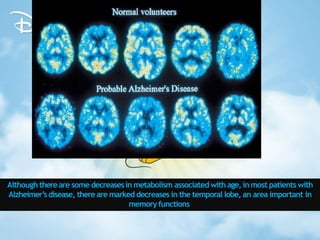
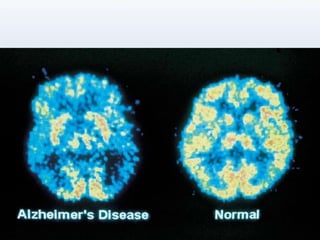
Although thereare some decreasesin metabolism associated with age, in most patients with
Alzheimerโ€™sdisease, there are marked decreases in the temporal lobe, an area important in
memoryfunctions.
โ€ข Affective impairment: labile mood,
irritableness, depression
โ€ข Behavioural impairment: stereotyped
behaviour, alteration in sexualdrivesand
activities, psychoticbehaviour.
โ€ข Neurological impairment: stereotyped
behaviour, alteration in sexualdrivesand
activities,
๏ฑDiagnosis:
โ€ข Following test are used fordiagnosis:
โ€ข Cognitive assessmentevaluation- mini
mental status examination (MMSE)โ€“
showscognitive impairment
โ€ข Functional dementia scale(to indicate
the degree of dementia)
โ€ข Magnetic resonance imaging (MRI):of
the brain showsstructural and
neurologic changes.
โ€ข Spinal fluid analysis showsincreased
beta amyloid deposits
๏ฑTreatmentmodalities:
โ€ขTacrinehydrochloride (cognex)
โ€ขDonepezil hydrochloride(Aricept)
NMDAANTAGONISTS.
โ€ขMemantine
ANTIPSYCHOTICAGENTS
โ€ขRisperidone, quetiapine, and
โ€ขolanzapine
ANTIDEPRESSANTAGENTSANDMOOD
STABILIZERS
โ€ข Low dosesof the selective serotoninreuptake
inhibitors and other newer antidepressive
agents should be considered.
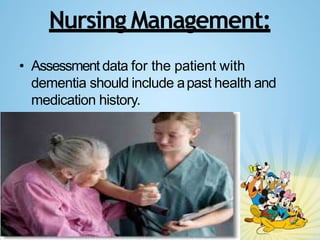
Nursing Management:
โ€ข Assessment data for the patient with
dementia should include apast health and
medication history.
Data to be included for nursingassessment
โ€ข Disorientation
โ€ข Mood changes
โ€ข Fear
โ€ข Suspiciousness
โ€ข Self-care deficit
โ€ข Social behaviour
โ€ข Levelof mobility, wanderingbehaviour
โ€ข Judgement ability
โ€ข Sleep disturbances
โ€ข Speechor language impairment
โ€ข Hallucinations, illusions or delusions
โ€ข Bowel and bladder incontinence
โ€ข Apathy
โ€ข Any decline in nutritional status
โ€ข Recognition of familymembers
โ€ข Identify primary care giver, supportsystem
and the knowledge baseof the family
members.

๏ฑNursing intervention:
โ€ข Daily routine
โ€ข Nutrition & bodyweight
โ€ข Personal hygiene
โ€ข Toilet habits and incontinence
โ€ข Accidents
โ€ข Fluid management
โ€ข Moods and emotions
โ€ข Wandering
โ€ข Disturbed sleep
โ€ข Interpersonal relationship
Summary:
๏ƒผ Introduction
๏ƒผ Classification
๏ƒผ History
๏ƒผ Definition
๏ƒผ Etiology
๏ƒผ Types
๏ƒผ Stages
๏ƒผ Warning signs
๏ƒผ Clinical features
๏ƒผ Diagnosis
๏ƒผ Treatment modalities
๏ƒผ Nursing management
Conclusion:
โ€ข Dementia is aserious cognitive disorder all
together dementia is afar common in the
geriatric population, it may be occur inany
stageof childhood
โ€ข Soasanurse we need to get aware aboutthe
preventive measures of dementia and
educative the individuals about its signsand
symptoms with its treatment
Bibliography:
โ€ข RSreevani, aguide to mental health and
psychiatric nursing,
jaypee publishers,
3rd edition, pg.no:244-246
โ€ข Townsend cMary, text book on โ€œPsychiatric
Mental Health Nursing.โ€
Jaypeepublications.

5th edition, page 387-405
Dementia

Dementia

  • 1.
  • 2.
    Organic brain disorder Dementia AmbikaGaur Bhatt Senior Nursing Tutor HIN Pounta Sahib
  • 4.
    ๏ฑIntroduction: โ€ข Chronic organicbrain syndrome โ€ข Organic mental disorders are behavioural or psychological disorder associated with transient or permanent brain dysfunction โ€ข Alzheimer's type dementia is an irreversible disease marked by global, progressive impairment of cognitive functioning, memory & personality
  • 5.
    ๏ฑ Classification oforganicbrain disorders: โ€ข (F00-f09) organic, including symptomatic, mentaldisorders โ€ข (F00) Dementia in Alzheimerโ€™sdisease โ€ข (F01) Vascular dementia โ€ข (F02) Dementia in other diseases classified elsewhere โ€ข (F03) unspecified dementia โ€ข (F04) organic amnestic syndrome, not induced by alcohol and other psychoactive substances
  • 6.
    โ€ข (F05)delirium notinduced by alcoholand other psychoactivesubstances โ€ข (F06) Other mental disorders due to brain damage and dysfunction and to physical disease โ€ข (F07)personality and behavioural disorders due to brain disease, damage anddysfunction โ€ข (F09)unspecified organic or symptomatic mental disorder.
  • 7.
    ๏ฑHistory of dementia: โ€ขDementia wasfirst described in abook about mental illness in 1893. In 1894, Dr.Alois Alzheimer, a German neuropathologist who hasaparticular interest in โ€œnervousdisordersโ€ described changesin the brain causedby vascular disease(now known asvascular dementia).
  • 8.
    ๏ฑDEFINITION: โ€ข โ€œDementia isan acquired globalimpairment of intellect, memory and personality but without impairment ofconsciousnessโ€
  • 9.
    ๏ฑIncidence: โ€ข Dementia occursmore commonly in the elderly than in themiddle-aged.
  • 10.
    ๏ฑEtiology: โ€ข Significant lossof neurons and volume inbrain regions devoted to memory and highermental functioning โ€ข Neurofibrillary angles (twisted nerve cellfibers that are the damagedremains ofmicrotubules
  • 11.
    โ€ข Environmental factors:infection, metals and toxins. โ€ข Excessiveamount of metal ions, suchas zinc and copper, in brain โ€ข Deficiencies of vitamin B6,B12And Folate Possible RiskFactor DueT o Increased LevelsOf Hemocysteine (amino acid that may interfere with nerve cell repair) โ€ข Early depression: common genetic factors seenin those with early depression andAlzheimer's disease
  • 12.
    Untreatable and irreversible causeof dementia โ€ข Degenerating disorders of CNS โ€ข Alzheimerโ€™s disease(this is the mostcommon of all dementingillnesses) โ€ข Pickโ€™sdisease โ€ข Huntingtonโ€™s chorea โ€ข Parkinsonโ€™s disease
  • 13.
    Treatable and reversible causesof dementia โ€ข Vascular-multi-infarct dementia โ€ข Intracranial spaceoccupying lesions โ€ข Metabolic disorders-hepatic failure, renalfailure โ€ข Endocrine disorders- myxedema, Addisonโ€™s disease โ€ข Infections- AIDS,meningitis, encephalitis โ€ข Intoxication- Alcohol, heavy metals(lead, arsenic), โ€ข Anoxia- Anemia, post-anesthesia,chronic respiratory failure
  • 14.
    โ€ข Vitamin deficiency,especially deficiency ofthiamine and nicotine Physiologic: โ€ข Normal pressurehydrocephalus Metabolic: โ€ข Endocrinopathies (e.g. hypothyroidism) Tumor: โ€ข Primary or metastatic (e.g. meningiomaor metastatic breast or lungcancer) Traumatic: โ€ข Subduralhematoma
  • 15.
    ๏ฑTypes of dementia: theclassificationsinclude. ๏ฑCortical dementia: dementia where the brain damage primarily affects the brainโ€™s cortex,or outer layer. Cortical dementias tend to cause problems with memory, language, thinking, and social behaviour.
  • 16.
    ๏ฑSubcortical dementia: dementiathat affects parts of the brain below the cortex. Sub- cortical dementia tends to causechangesin emotions and emotions and movement in addition to problems withmemory. ๏ฑProgressive dementia: dementia that gets worse over time, gradually interfering with more and more cognitiveabilities.
  • 17.
    ๏ฑPrimary dementia: dementiasuchas Alzheimer's diseasethat does not resultfrom any other disease. ๏ฑSecondary dementia: dementia that occursas aresult of aphysical diseaseor injury.
  • 19.
    ๏ฑStages ofdementia: Stage I:Early stage (2 to4years): โ€ข Forgetfulness โ€ข Declining interest in environment โ€ข Hesitancy in initiating actions โ€ข Poor performance at work
  • 20.
    Stage II: Middlestage (2 to12years): โ€ข Progressive memory loss โ€ข Hesitates in response to questions โ€ข Hasdifficulty in following simpleinstructions โ€ข Irritable, anxious โ€ข Wandering โ€ข Neglects personal hygiene โ€ข Social isolation
  • 21.
    Stage III: Finalstage (up to a year): โ€ข Marked loss of weight becauseof inadequate intake of food โ€ข Unable to communicate โ€ข Doesnot recognizefamily โ€ข Incontinence of urine andfeces โ€ข Losesthe ability to stand andwalk โ€ข Death is causedby aspiration pneumonia
  • 22.
    STAGES Mild Moderate Severe (2-4years) (2 โ€“ 12years) (upto ayear) Loss of memory Language difficulties Mood swings Personality changes Diminished judgment Apathy Inability to retainnew info Behavioral, personality changes Increasing long-term memory loss Wandering,agitation, aggression, confusion Requires assistance Gait and motor disturbances Bedridden Unable to perform ADL Incontinence Requires long term care placement
  • 23.
    Warning signs of Alzheimerโ€™sdementia: โ€ขMemory loss โ€ข Difficulty performing familiartasks โ€ข Problems with language โ€ข Disorientation to time andplace โ€ข Poor or decreasedjudgement โ€ข Problems with abstractthinking โ€ข Misplacing things โ€ข Changesin mood or behaviour โ€ข Changesin personality โ€ข Lossof initiative
  • 24.
    Clinical features(For Alzheimerโ€™stype) โ€ข Personalitychanges: lack of interestin day-to-day activities, easymental fatigability, self-centred, withdrawn, decreased self-care. โ€ข Memory impairment: recent memoryis prominently affected. โ€ข Cognitive impairment: disorientation poor judgement, difficulty in abstraction, decreased attention span.
  • 25.
    Although thereare somedecreasesin metabolism associated with age, in most patients with Alzheimerโ€™sdisease, there are marked decreases in the temporal lobe, an area important in memoryfunctions.
  • 26.
    โ€ข Affective impairment:labile mood, irritableness, depression โ€ข Behavioural impairment: stereotyped behaviour, alteration in sexualdrivesand activities, psychoticbehaviour. โ€ข Neurological impairment: stereotyped behaviour, alteration in sexualdrivesand activities,
  • 27.
    ๏ฑDiagnosis: โ€ข Following testare used fordiagnosis: โ€ข Cognitive assessmentevaluation- mini mental status examination (MMSE)โ€“ showscognitive impairment โ€ข Functional dementia scale(to indicate the degree of dementia) โ€ข Magnetic resonance imaging (MRI):of the brain showsstructural and neurologic changes. โ€ข Spinal fluid analysis showsincreased beta amyloid deposits
  • 29.
  • 30.
    ANTIDEPRESSANTAGENTSANDMOOD STABILIZERS โ€ข Low dosesofthe selective serotoninreuptake inhibitors and other newer antidepressive agents should be considered.
  • 31.
    Nursing Management: โ€ข Assessmentdata for the patient with dementia should include apast health and medication history.
  • 32.
    Data to beincluded for nursingassessment โ€ข Disorientation โ€ข Mood changes โ€ข Fear โ€ข Suspiciousness โ€ข Self-care deficit โ€ข Social behaviour โ€ข Levelof mobility, wanderingbehaviour โ€ข Judgement ability โ€ข Sleep disturbances โ€ข Speechor language impairment โ€ข Hallucinations, illusions or delusions
  • 33.
    โ€ข Bowel andbladder incontinence โ€ข Apathy โ€ข Any decline in nutritional status โ€ข Recognition of familymembers โ€ข Identify primary care giver, supportsystem and the knowledge baseof the family members.
  • 34.
    ๏ฑNursing intervention: โ€ข Dailyroutine โ€ข Nutrition & bodyweight โ€ข Personal hygiene โ€ข Toilet habits and incontinence โ€ข Accidents โ€ข Fluid management โ€ข Moods and emotions โ€ข Wandering โ€ข Disturbed sleep โ€ข Interpersonal relationship
  • 35.
    Summary: ๏ƒผ Introduction ๏ƒผ Classification ๏ƒผHistory ๏ƒผ Definition ๏ƒผ Etiology ๏ƒผ Types ๏ƒผ Stages ๏ƒผ Warning signs ๏ƒผ Clinical features ๏ƒผ Diagnosis ๏ƒผ Treatment modalities ๏ƒผ Nursing management
  • 36.
    Conclusion: โ€ข Dementia isaserious cognitive disorder all together dementia is afar common in the geriatric population, it may be occur inany stageof childhood โ€ข Soasanurse we need to get aware aboutthe preventive measures of dementia and educative the individuals about its signsand symptoms with its treatment
  • 37.
    Bibliography: โ€ข RSreevani, aguideto mental health and psychiatric nursing, jaypee publishers, 3rd edition, pg.no:244-246 โ€ข Townsend cMary, text book on โ€œPsychiatric Mental Health Nursing.โ€ Jaypeepublications. 5th edition, page 387-405