DEMENTIA
HAZIM AIMAN BIN SAIFUL AHMAD
WHAT IS DEMENTIA ?
• The term Dementia is used to describe the collection of symptoms including a
decline in memory, reasoning and communication skills, and a gradual loss of
skills needed to carry out daily activities.
• These symptoms are caused by structural and chemical changes in the brain as a
result of physical diseases such as Alzheimer’s disease.
SYMPTOMS OF DEMENTIA
• Loss of memory – problems with day to day memory with difficulty recalling
events that happened recently
• Concentrating, planning and organising – difficulties making decisions , solving
problems or carrying out a sequence of tasks
• Language – difficulties in understanding what people are saying and or finding
the right word for something
TYPES OF DEMENTIA
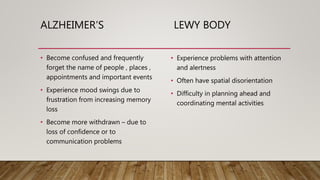
• ALZHEIMER’S -
• LEWY BODY
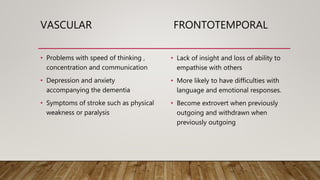
• VASCULAR
• FRONTOTEMPORAL
ALZHEIMER’S LEWY BODY
• Become confused and frequently
forget the name of people , places ,
appointments and important events
• Experience mood swings due to
frustration from increasing memory
loss
• Become more withdrawn – due to
loss of confidence or to
communication problems
• Experience problems with attention
and alertness
• Often have spatial disorientation
• Difficulty in planning ahead and
coordinating mental activities
VASCULAR FRONTOTEMPORAL
• Problems with speed of thinking ,
concentration and communication
• Depression and anxiety
accompanying the dementia
• Symptoms of stroke such as physical
weakness or paralysis
• Lack of insight and loss of ability to
empathise with others
• More likely to have difficulties with
language and emotional responses.
• Become extrovert when previously
outgoing and withdrawn when
previously outgoing
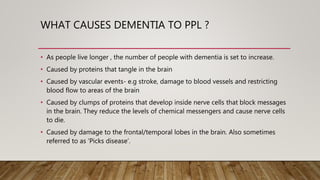
WHAT CAUSES DEMENTIA TO PPL ?
• As people live longer , the number of people with dementia is set to increase.
• Caused by proteins that tangle in the brain
• Caused by vascular events- e.g stroke, damage to blood vessels and restricting
blood flow to areas of the brain
• Caused by clumps of proteins that develop inside nerve cells that block messages
in the brain. They reduce the levels of chemical messengers and cause nerve cells
to die.
• Caused by damage to the frontal/temporal lobes in the brain. Also sometimes
referred to as ‘Picks disease’.
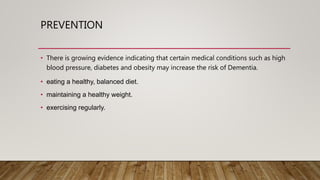
PREVENTION
• There is growing evidence indicating that certain medical conditions such as high
blood pressure, diabetes and obesity may increase the risk of Dementia.
• eating a healthy, balanced diet.
• maintaining a healthy weight.
• exercising regularly.
DIAGNOSIS
• Blood tests to rule out any physical health reasons for an impaired memory
• History taking – talk to the person and someone who knows them well
• A scan of the brain
• A diagnosis may take weeks / months
TREATMENT
MEDICATION THERAPIES
• Memantine. Memantine (Namenda)
works by regulating the activity of
glutamate, another chemical
messenger involved in brain
functions, such as learning and
memory. In some cases, memantine
is prescribed with a cholinesterase
inhibitor. A common side effect of
memantine is dizziness.
• Occupational therapy. An
occupational therapist can show you
how to make your home safer and
teach coping behaviors. The purpose
is to prevent accidents, such as falls;
manage behavior and prepare you
for the dementia progression.
THANK YOU

Dementia

  • 1.
  • 2.
    WHAT IS DEMENTIA? • The term Dementia is used to describe the collection of symptoms including a decline in memory, reasoning and communication skills, and a gradual loss of skills needed to carry out daily activities. • These symptoms are caused by structural and chemical changes in the brain as a result of physical diseases such as Alzheimer’s disease.
  • 3.
    SYMPTOMS OF DEMENTIA •Loss of memory – problems with day to day memory with difficulty recalling events that happened recently • Concentrating, planning and organising – difficulties making decisions , solving problems or carrying out a sequence of tasks • Language – difficulties in understanding what people are saying and or finding the right word for something
  • 4.
    TYPES OF DEMENTIA •ALZHEIMER’S - • LEWY BODY • VASCULAR • FRONTOTEMPORAL
  • 5.
    ALZHEIMER’S LEWY BODY •Become confused and frequently forget the name of people , places , appointments and important events • Experience mood swings due to frustration from increasing memory loss • Become more withdrawn – due to loss of confidence or to communication problems • Experience problems with attention and alertness • Often have spatial disorientation • Difficulty in planning ahead and coordinating mental activities
  • 6.
    VASCULAR FRONTOTEMPORAL • Problemswith speed of thinking , concentration and communication • Depression and anxiety accompanying the dementia • Symptoms of stroke such as physical weakness or paralysis • Lack of insight and loss of ability to empathise with others • More likely to have difficulties with language and emotional responses. • Become extrovert when previously outgoing and withdrawn when previously outgoing
  • 7.
    WHAT CAUSES DEMENTIATO PPL ? • As people live longer , the number of people with dementia is set to increase. • Caused by proteins that tangle in the brain • Caused by vascular events- e.g stroke, damage to blood vessels and restricting blood flow to areas of the brain • Caused by clumps of proteins that develop inside nerve cells that block messages in the brain. They reduce the levels of chemical messengers and cause nerve cells to die. • Caused by damage to the frontal/temporal lobes in the brain. Also sometimes referred to as ‘Picks disease’.
  • 8.
    PREVENTION • There isgrowing evidence indicating that certain medical conditions such as high blood pressure, diabetes and obesity may increase the risk of Dementia. • eating a healthy, balanced diet. • maintaining a healthy weight. • exercising regularly.
  • 9.
    DIAGNOSIS • Blood teststo rule out any physical health reasons for an impaired memory • History taking – talk to the person and someone who knows them well • A scan of the brain • A diagnosis may take weeks / months
  • 10.
  • 11.
    MEDICATION THERAPIES • Memantine.Memantine (Namenda) works by regulating the activity of glutamate, another chemical messenger involved in brain functions, such as learning and memory. In some cases, memantine is prescribed with a cholinesterase inhibitor. A common side effect of memantine is dizziness. • Occupational therapy. An occupational therapist can show you how to make your home safer and teach coping behaviors. The purpose is to prevent accidents, such as falls; manage behavior and prepare you for the dementia progression.
  • 12.