Welcome To Demand Flow Technology Workshop Principles of Lean Manufacturing
Objectives Develop the knowledge of what the philosophies and techniques are and why they are important Total picture of the the demand flow technology business strategy Understand and establish how to perform the techniques and skills learned Exercises and feedback Technical information and examples
Cycle Time One of the most noteworthy accomplishments in keeping the price of Ford products low is the gradual shortening of the production cycle. The longer an article is in the process of manufacture and the more it is moved about, the greater is its ultimate cost.
WHAT IS DFT ANYWAY?
Lean Is Market Driven Every morning in Africa, a gazelle wakes up. It knows it must run faster than the fastest lion or it will be killed. Every morning a lion wakes up. It knows it must outrun the slowest gazelle or it will starve to death. It doesn’t matter whether you are a lion or a gazelle – when the sun comes up, you had better be running.
Defining DFT DFT has been defined in many different ways: A systematic approach to identifying and eliminating waste (non-value-added-activities) through continuous improvement by flowing the product at the pull of the customer in pursuit of perfection.
Defining DFT A manufacturing technology that focuses an aggressive flow process that seeks to eliminate or minimize non-value added work in the production process while emphasizing quality throughout the process.
Primary Objective to build a  HIGH QUALITY  product in the SHORTEST PRODUCTION  time and at the  LOWEST POSSIBLE COST
What are the advantages of DFT People – the number of people needed to produce the daily rate is calculated daily Processes and quality checks are documented (A.I., OMS & SOE’s)‏ Quality built into the product Kanban Less material in WIP and RIP
What are the advantages of DFT Component kanban – two-bin system NVA work is minimized or eliminated Processes are in a constant continuous improvement state Speed-to-market Next day Customer Responsiveness
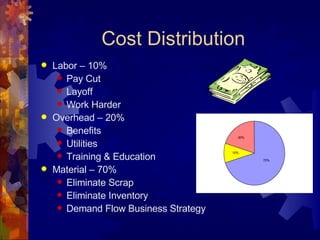
Cost Distribution Labor – 10% Pay Cut Layoff Work Harder Overhead – 20% Benefits Utilities Training & Education Material – 70% Eliminate Scrap Eliminate Inventory Demand Flow Business Strategy
Station 1 One-Down Operation Out-of-Box FG’s Customer Cost to the Company Defect Found At …..
Traditional Mfg. Vs. Demand Flow Mfg. Scheduling techniques Fabrication & subassembly production Departmental build Schedule, queue and batch work time Material movement External Inspection Mathematical technology Mixed-model flow process Flow line design Build the product in total work content time or less Minimum material movement TQC & verify
Product Synchronization A relationship of the processes in a flow to produce a product.
Product Synch
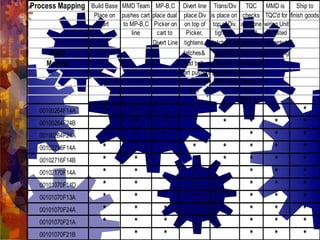
Process Mapping Matrix of products across the top and processes along the side
 
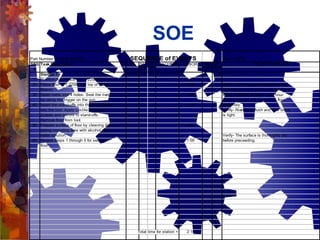
Sequence of Events Defines quality criteria against each work element, value-added steps and time estimates.
SOE
Operational Method Sheet (OMS)‏ A “colored” graphic representation of quality criteria and work content defined by the S.O.E. to be performed at an operation Work Content TQC – check someone else work Verify – check your own work
Demand at Capacity - Dc The highest targeted volume output of products that is planned to be achieved by a demand flow manufacturing process
Dc Dc =  Pv   Wd 100 units per month 20 days = 5 units/day Dc = Designed Daily Rate He = Effective Work Hours S = Shifts per day 400 units per month 20 days = 20 units/day
Total Product Cycle Time (TPCT)‏ The calculated work content through the longest path of the processes required to build a product Money Picker (6633D) = 30 min/prs 0.5 Stacker (7835H) = 42 min/prs 0.7 Transport (7836B) = 23min/prs 0.383 Printer (1670A) = 40 min/prs 0.66
TAKT The calculated target of work content time to be performed independently by a person or machine in a demand flow line
TAKT Conversion 100’s or Minutes 7.66/5 = 1.532 hr/unit (IDM)‏   92 min/unit 7.66/20 = 0.383 hr/unit (R/L transport)‏   23 min/unit 7.66/111 = 0.069 (Picker)‏ 4.14 min/unit
Stations Actual Time TAKT Time Money Picker 30 minutes assembly time 4.14 TAKT = 7.24 = 7 stations
Resources Resources can be: Operations – labor Machines Pieces – batch equipment People - flexible
Flexible Employees Employees in a DFT line have a minimum flexibility of three operations: Primary One up-stream One down-stream
People (Dr)‏ Resources are calculated daily to determine the requirement to produce the daily rate Dc x L H x S Money picker 50 x .50 (8) X (1)‏ =3.125 3 people
Line Balancing Tools Tools used when actual time at an operation exceed TAKT Relocate work Reduce or eliminate non-value added work content Add resources or duplicate resources Move inventory and time (Kanban)‏
Certification Meet TAKT Train others Meet quality criteria Flex
In-Process Kanban (IPK)‏ A visual signal that identifies when work needs to be performed in a line
Kanban Card A card used as a communications signal to pull material based on demand
Pull Sequence Every part that is kanban pulled must have a definable path that identifies the supply and consumption points (e.g Line, Rip, Wip, FG’s)‏
Mixed Model Line A  primary goal of demand flow manufacturing is to design flow lines to produce families of similar products. The mixed model line has the ability to build a range of volumes of any product, any day, based on the direction of actual customer demand.
Backflush The method used to relieve RIP (Raw in Process) inventory of a product’s bill of material quantity when a product is complete
Communication Lights Management Light – A light that can be seen from a wide area to identify if action needs to be taken on the line e.g Andon
Measuring Linearity Example: during a nine-day period the production rate is (4) per day: 4+4+4+4+4+4+4+4+4=36 Actual production was: 3+4+5+3+4+5+3+4+5=36 Traditionally we would say this is o.k. Actually the sum of the total deviation is 6 or 84% Suggested Goal = 90%
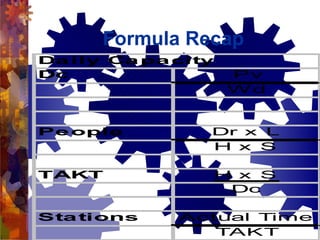
Formula Recap
QUESTIONS???

Demand Flow Technology: learnsigma.com

  • 1.
    Welcome To DemandFlow Technology Workshop Principles of Lean Manufacturing
  • 2.
    Objectives Develop theknowledge of what the philosophies and techniques are and why they are important Total picture of the the demand flow technology business strategy Understand and establish how to perform the techniques and skills learned Exercises and feedback Technical information and examples
  • 3.
    Cycle Time Oneof the most noteworthy accomplishments in keeping the price of Ford products low is the gradual shortening of the production cycle. The longer an article is in the process of manufacture and the more it is moved about, the greater is its ultimate cost.
  • 4.
    WHAT IS DFTANYWAY?
  • 5.
    Lean Is MarketDriven Every morning in Africa, a gazelle wakes up. It knows it must run faster than the fastest lion or it will be killed. Every morning a lion wakes up. It knows it must outrun the slowest gazelle or it will starve to death. It doesn’t matter whether you are a lion or a gazelle – when the sun comes up, you had better be running.
  • 6.
    Defining DFT DFThas been defined in many different ways: A systematic approach to identifying and eliminating waste (non-value-added-activities) through continuous improvement by flowing the product at the pull of the customer in pursuit of perfection.
  • 7.
    Defining DFT Amanufacturing technology that focuses an aggressive flow process that seeks to eliminate or minimize non-value added work in the production process while emphasizing quality throughout the process.
  • 8.
    Primary Objective tobuild a HIGH QUALITY product in the SHORTEST PRODUCTION time and at the LOWEST POSSIBLE COST
  • 9.
    What are theadvantages of DFT People – the number of people needed to produce the daily rate is calculated daily Processes and quality checks are documented (A.I., OMS & SOE’s)‏ Quality built into the product Kanban Less material in WIP and RIP
  • 10.
    What are theadvantages of DFT Component kanban – two-bin system NVA work is minimized or eliminated Processes are in a constant continuous improvement state Speed-to-market Next day Customer Responsiveness
  • 11.
    Cost Distribution Labor– 10% Pay Cut Layoff Work Harder Overhead – 20% Benefits Utilities Training & Education Material – 70% Eliminate Scrap Eliminate Inventory Demand Flow Business Strategy
  • 12.
    Station 1 One-DownOperation Out-of-Box FG’s Customer Cost to the Company Defect Found At …..
  • 13.
    Traditional Mfg. Vs.Demand Flow Mfg. Scheduling techniques Fabrication & subassembly production Departmental build Schedule, queue and batch work time Material movement External Inspection Mathematical technology Mixed-model flow process Flow line design Build the product in total work content time or less Minimum material movement TQC & verify
  • 14.
    Product Synchronization Arelationship of the processes in a flow to produce a product.
  • 15.
  • 16.
    Process Mapping Matrixof products across the top and processes along the side
  • 17.
  • 18.
    Sequence of EventsDefines quality criteria against each work element, value-added steps and time estimates.
  • 19.
  • 20.
    Operational Method Sheet(OMS)‏ A “colored” graphic representation of quality criteria and work content defined by the S.O.E. to be performed at an operation Work Content TQC – check someone else work Verify – check your own work
  • 21.
    Demand at Capacity- Dc The highest targeted volume output of products that is planned to be achieved by a demand flow manufacturing process
  • 22.
    Dc Dc = Pv Wd 100 units per month 20 days = 5 units/day Dc = Designed Daily Rate He = Effective Work Hours S = Shifts per day 400 units per month 20 days = 20 units/day
  • 23.
    Total Product CycleTime (TPCT)‏ The calculated work content through the longest path of the processes required to build a product Money Picker (6633D) = 30 min/prs 0.5 Stacker (7835H) = 42 min/prs 0.7 Transport (7836B) = 23min/prs 0.383 Printer (1670A) = 40 min/prs 0.66
  • 24.
    TAKT The calculatedtarget of work content time to be performed independently by a person or machine in a demand flow line
  • 25.
    TAKT Conversion 100’sor Minutes 7.66/5 = 1.532 hr/unit (IDM)‏ 92 min/unit 7.66/20 = 0.383 hr/unit (R/L transport)‏ 23 min/unit 7.66/111 = 0.069 (Picker)‏ 4.14 min/unit
  • 26.
    Stations Actual TimeTAKT Time Money Picker 30 minutes assembly time 4.14 TAKT = 7.24 = 7 stations
  • 27.
    Resources Resources canbe: Operations – labor Machines Pieces – batch equipment People - flexible
  • 28.
    Flexible Employees Employeesin a DFT line have a minimum flexibility of three operations: Primary One up-stream One down-stream
  • 29.
    People (Dr)‏ Resourcesare calculated daily to determine the requirement to produce the daily rate Dc x L H x S Money picker 50 x .50 (8) X (1)‏ =3.125 3 people
  • 30.
    Line Balancing ToolsTools used when actual time at an operation exceed TAKT Relocate work Reduce or eliminate non-value added work content Add resources or duplicate resources Move inventory and time (Kanban)‏
  • 31.
    Certification Meet TAKTTrain others Meet quality criteria Flex
  • 32.
    In-Process Kanban (IPK)‏A visual signal that identifies when work needs to be performed in a line
  • 33.
    Kanban Card Acard used as a communications signal to pull material based on demand
  • 34.
    Pull Sequence Everypart that is kanban pulled must have a definable path that identifies the supply and consumption points (e.g Line, Rip, Wip, FG’s)‏
  • 35.
    Mixed Model LineA primary goal of demand flow manufacturing is to design flow lines to produce families of similar products. The mixed model line has the ability to build a range of volumes of any product, any day, based on the direction of actual customer demand.
  • 36.
    Backflush The methodused to relieve RIP (Raw in Process) inventory of a product’s bill of material quantity when a product is complete
  • 37.
    Communication Lights ManagementLight – A light that can be seen from a wide area to identify if action needs to be taken on the line e.g Andon
  • 38.
    Measuring Linearity Example:during a nine-day period the production rate is (4) per day: 4+4+4+4+4+4+4+4+4=36 Actual production was: 3+4+5+3+4+5+3+4+5=36 Traditionally we would say this is o.k. Actually the sum of the total deviation is 6 or 84% Suggested Goal = 90%
  • 39.
  • 40.