LEAN innovation 
Basic principles of Lean 
@Joeri Vercammen
Introduction 
Innovations in aeronautics! – J. Vaughan (Flickr)
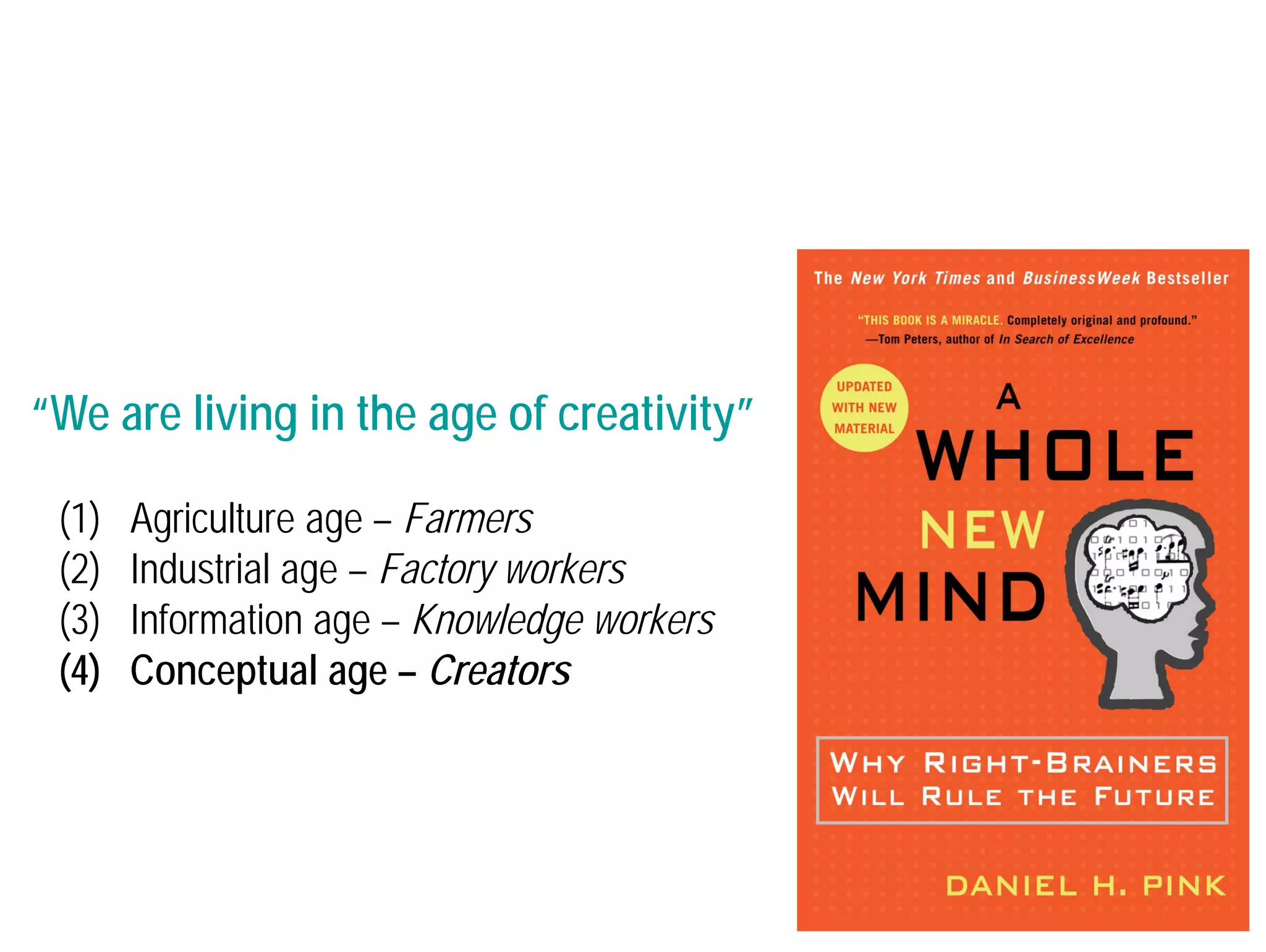
“We are living in the age of creativity” 
(1) Agriculture age – Farmers 
(2) Industrial age – Factory workers 
(3) Information age – Knowledge workers 
(4) Conceptual age – Creators
 
 
 
 
 
 
 
 
 
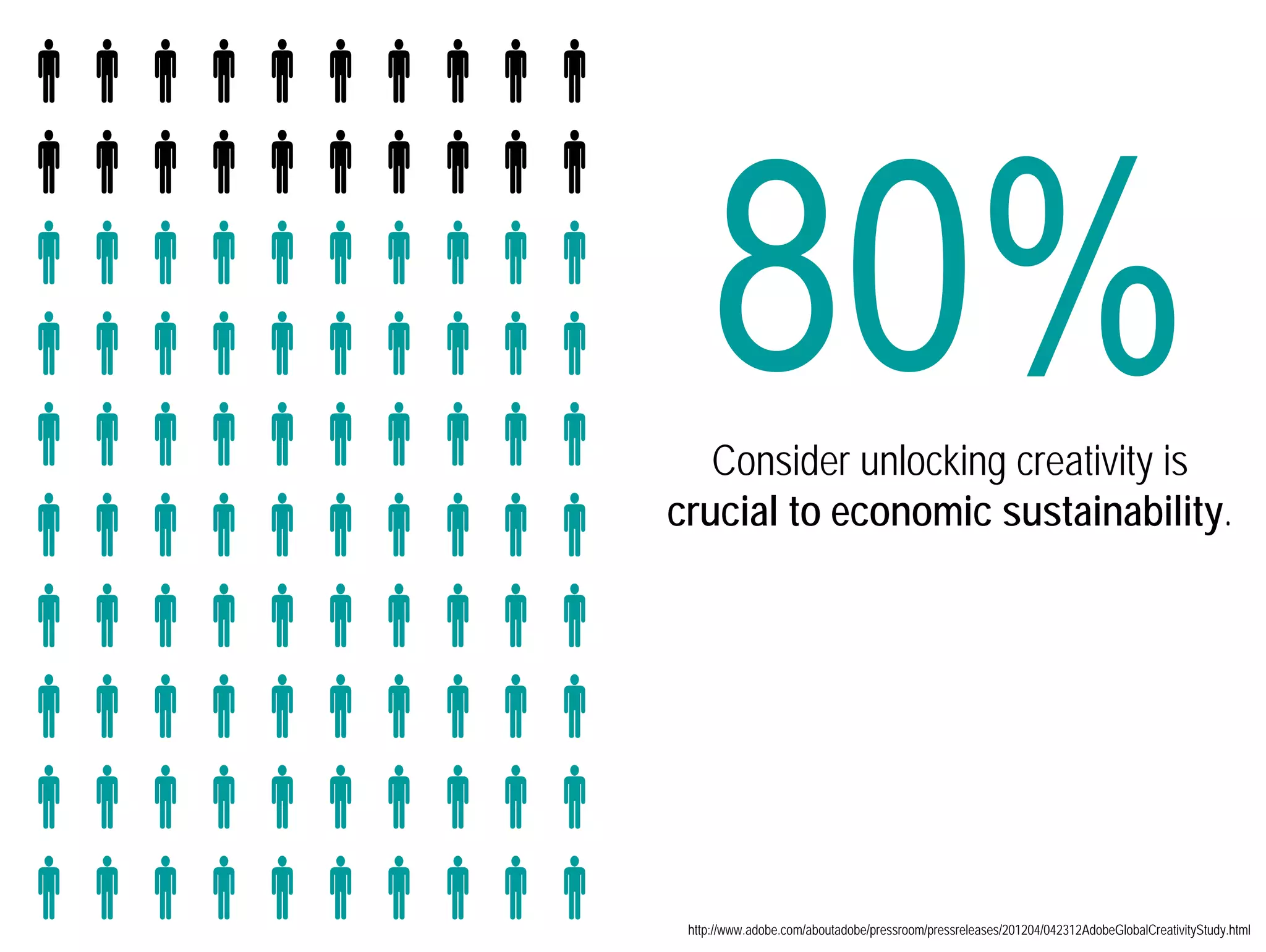
Consider unlocking creativity is 
crucial to economic sustainability. 
 
http://www.adobe.com/aboutadobe/pressroom/pressreleases/201204/042312AdobeGlobalCreativityStudy.html
 
 
 
 
 
 
 
 
 
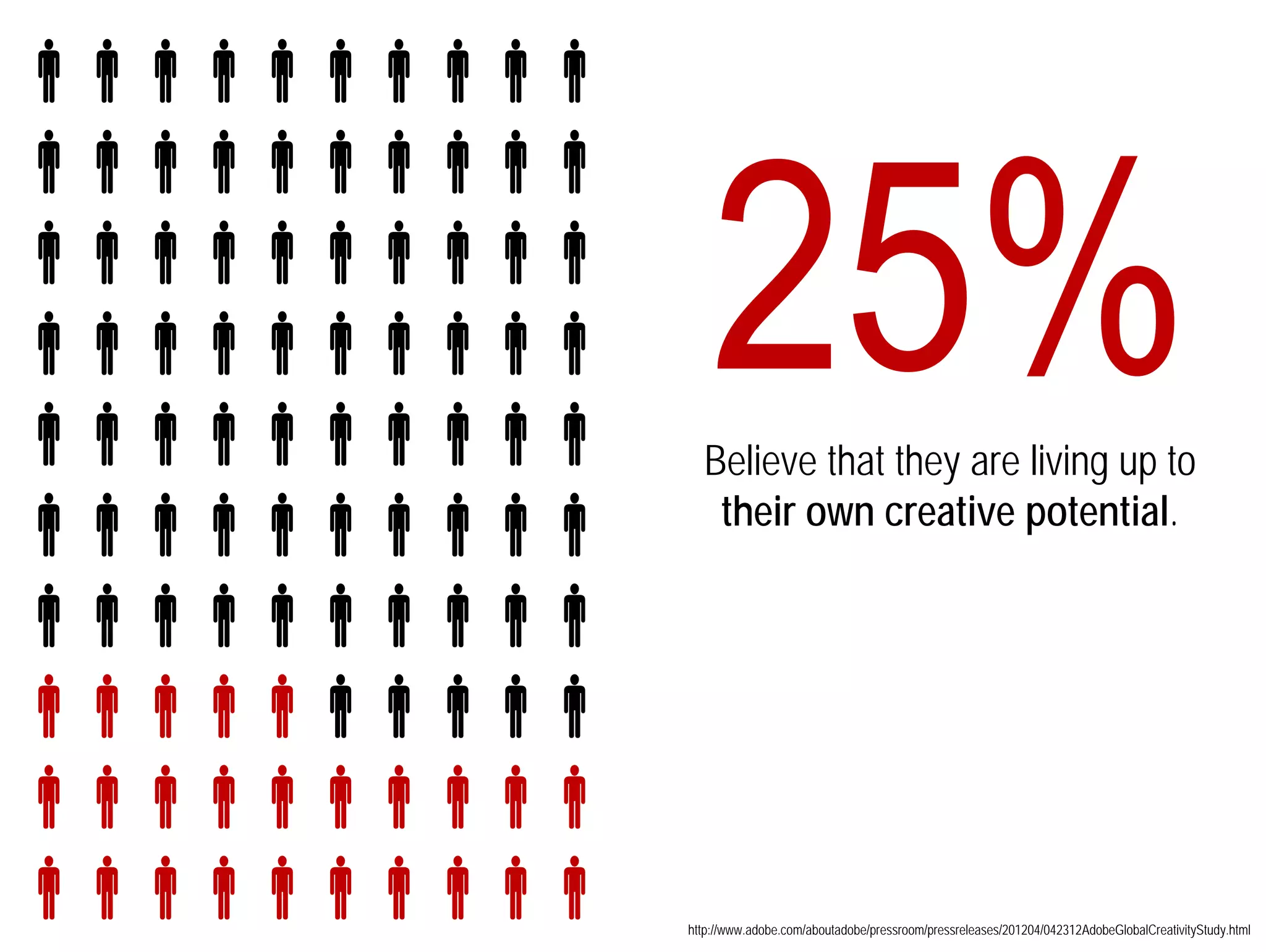
Believe that they are living up to 
their own creative potential. 
 
http://www.adobe.com/aboutadobe/pressroom/pressreleases/201204/042312AdobeGlobalCreativityStudy.html
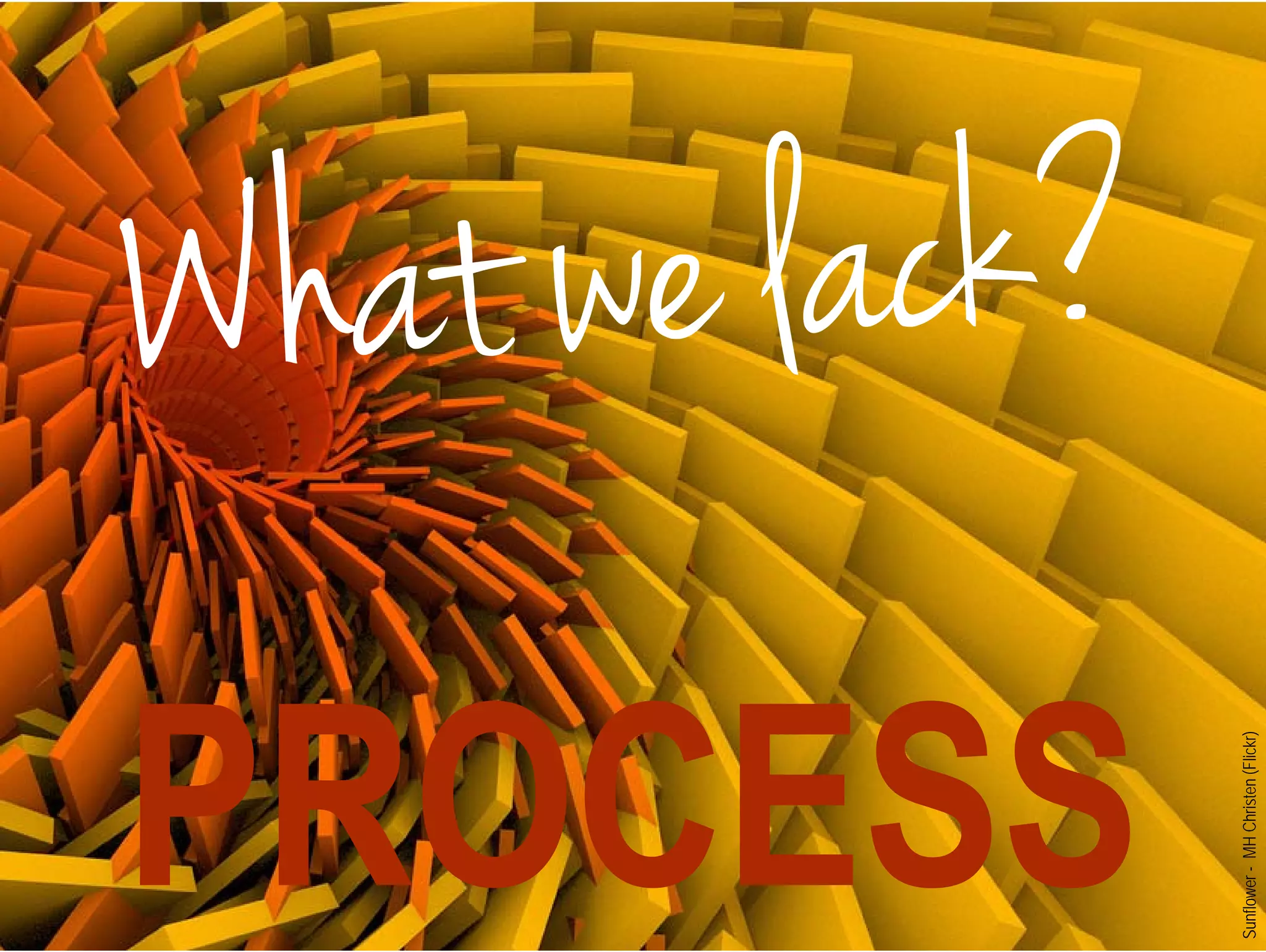
Sunflower - MH Christen (Flickr)
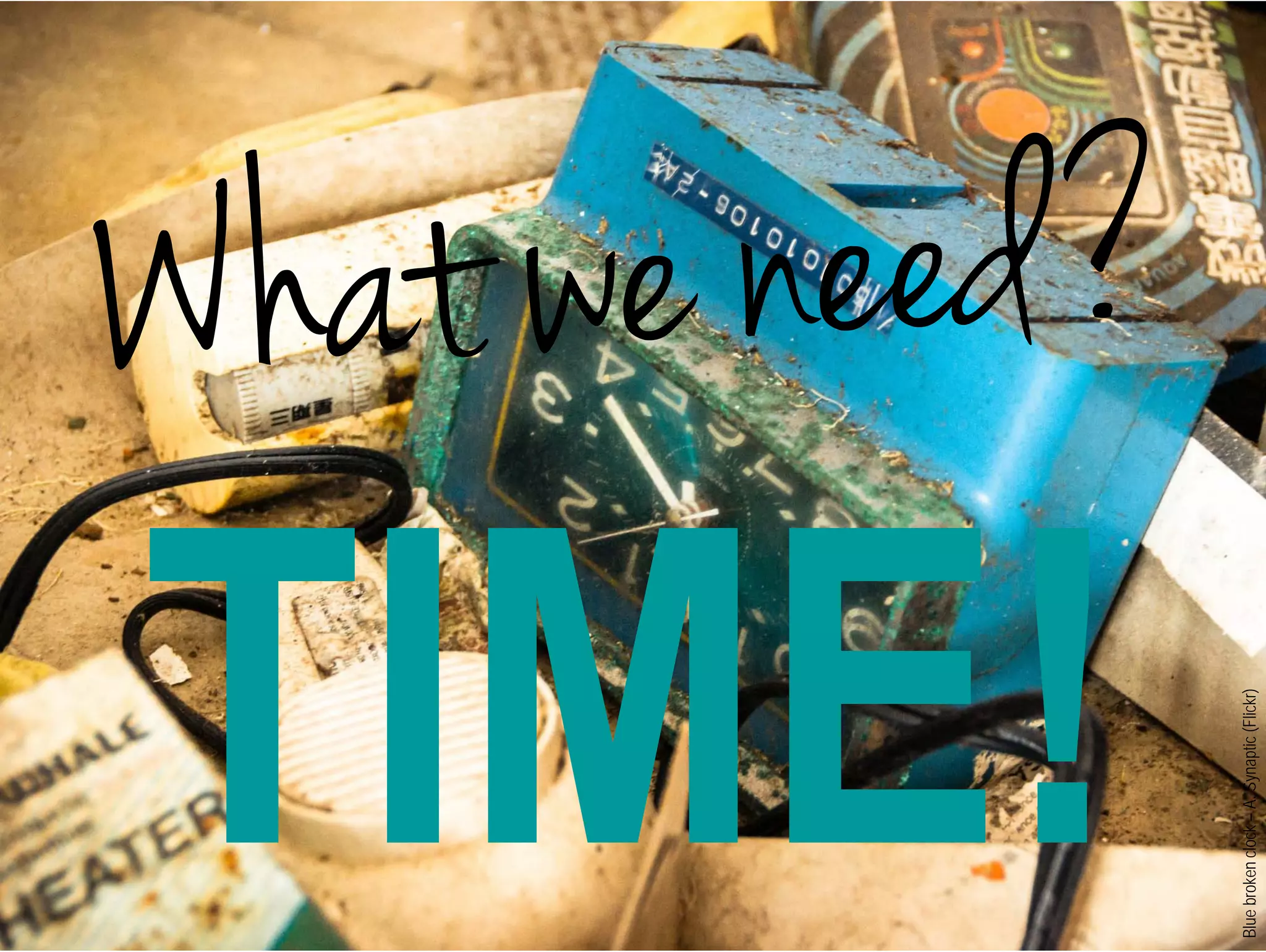
Blue broken clock – A. Synaptic (Flickr)
Lean provides: 
 the tools to release wasted time 
 the insights of a structured process
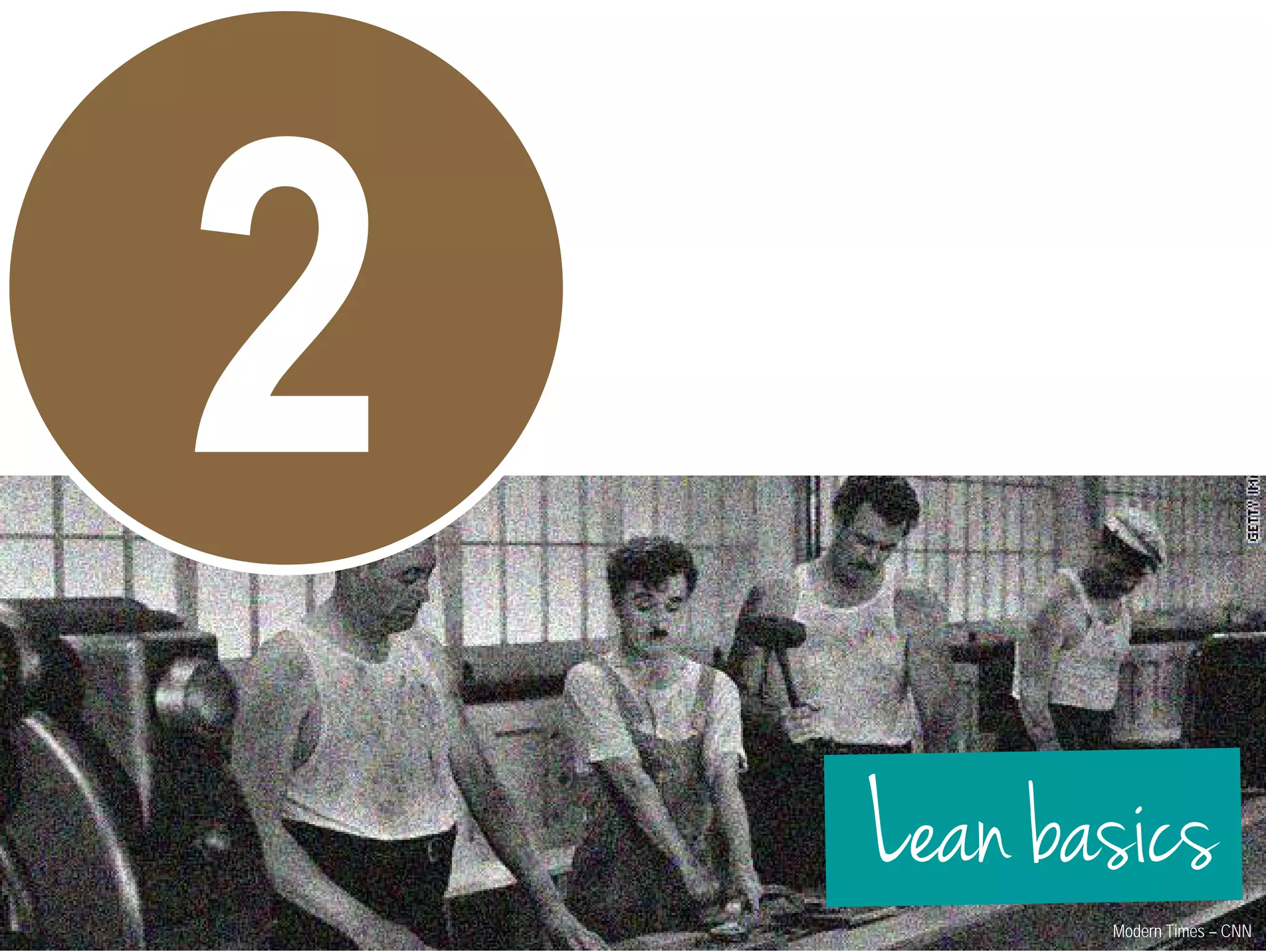
Lean basics 
Modern Times – CNN
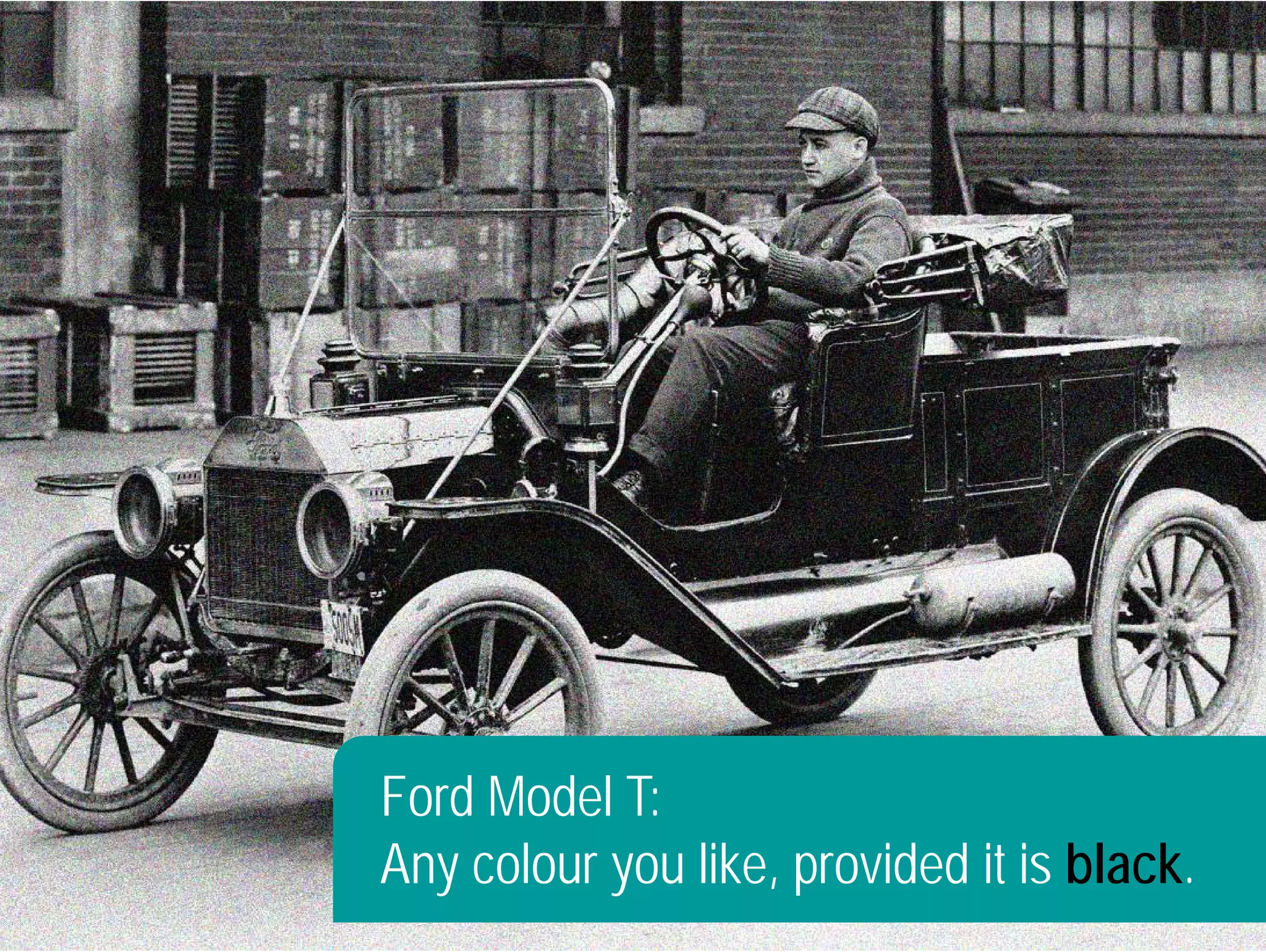
Ford Model T: 
Any colour you like, provided it is black.
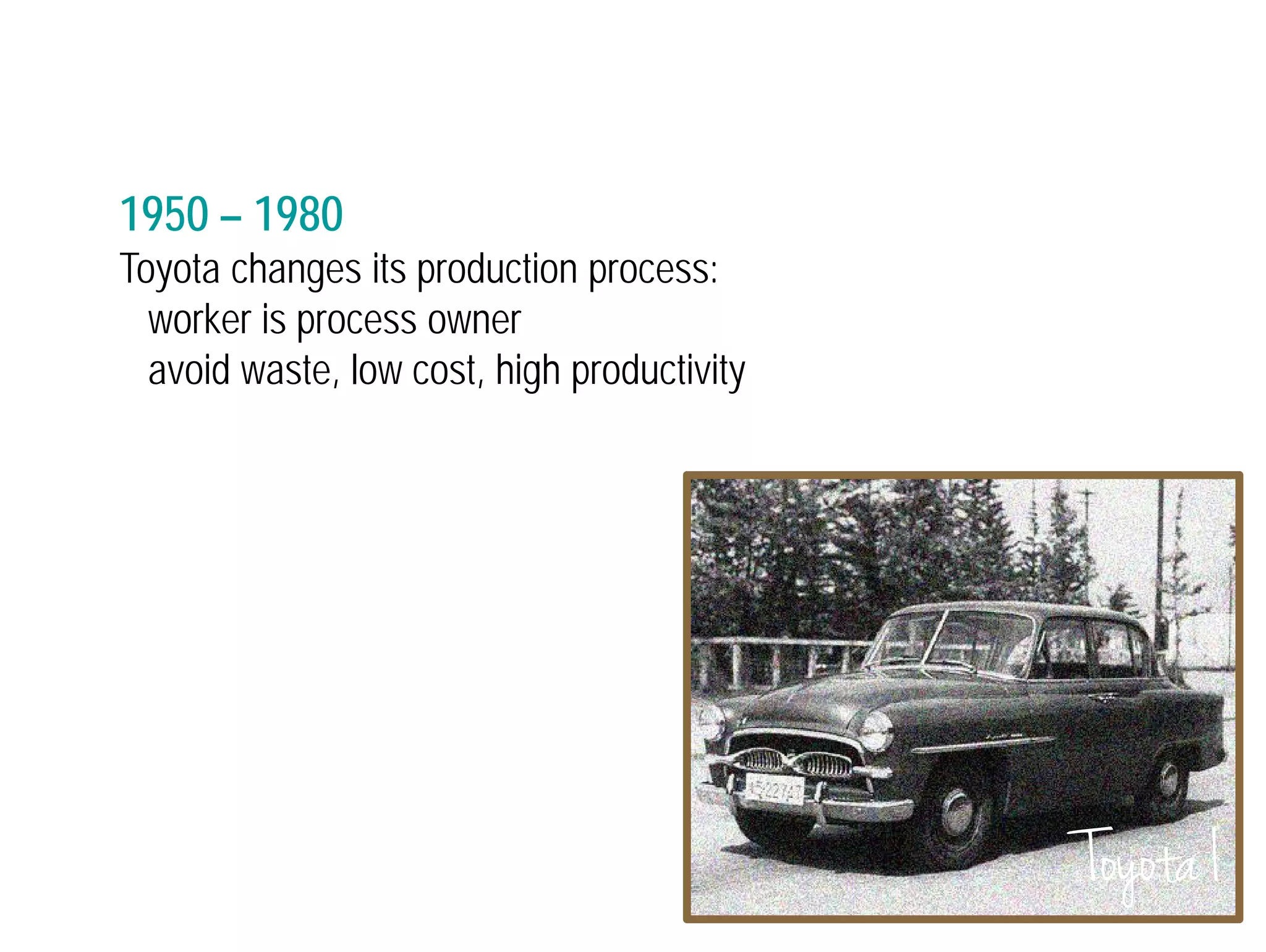
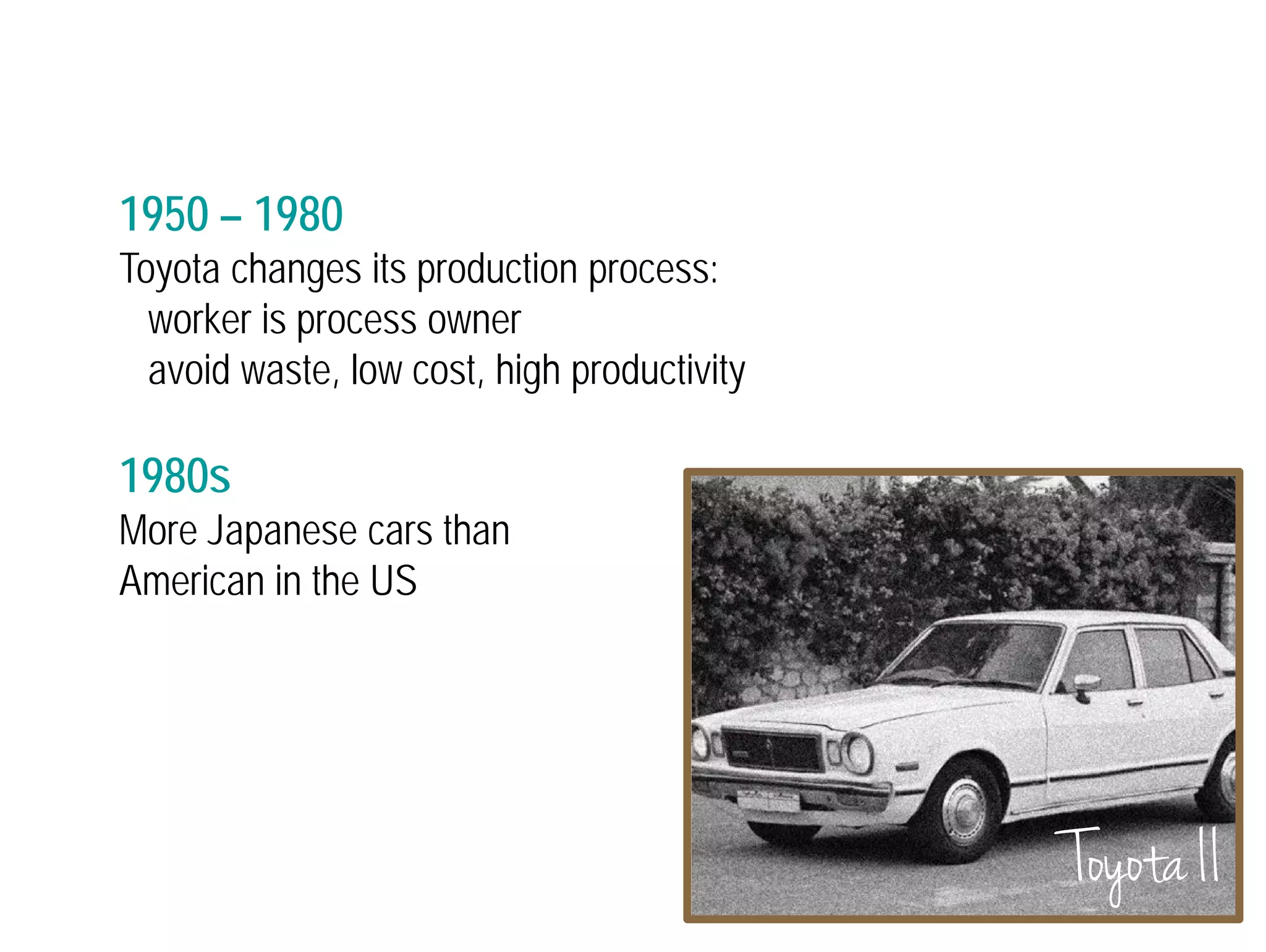
1950 – 1980 
Toyota changes its production process: 
worker is process owner 
avoid waste, low cost, high productivity 
Toyota I
1950 – 1980 
Toyota changes its production process: 
worker is process owner 
avoid waste, low cost, high productivity 
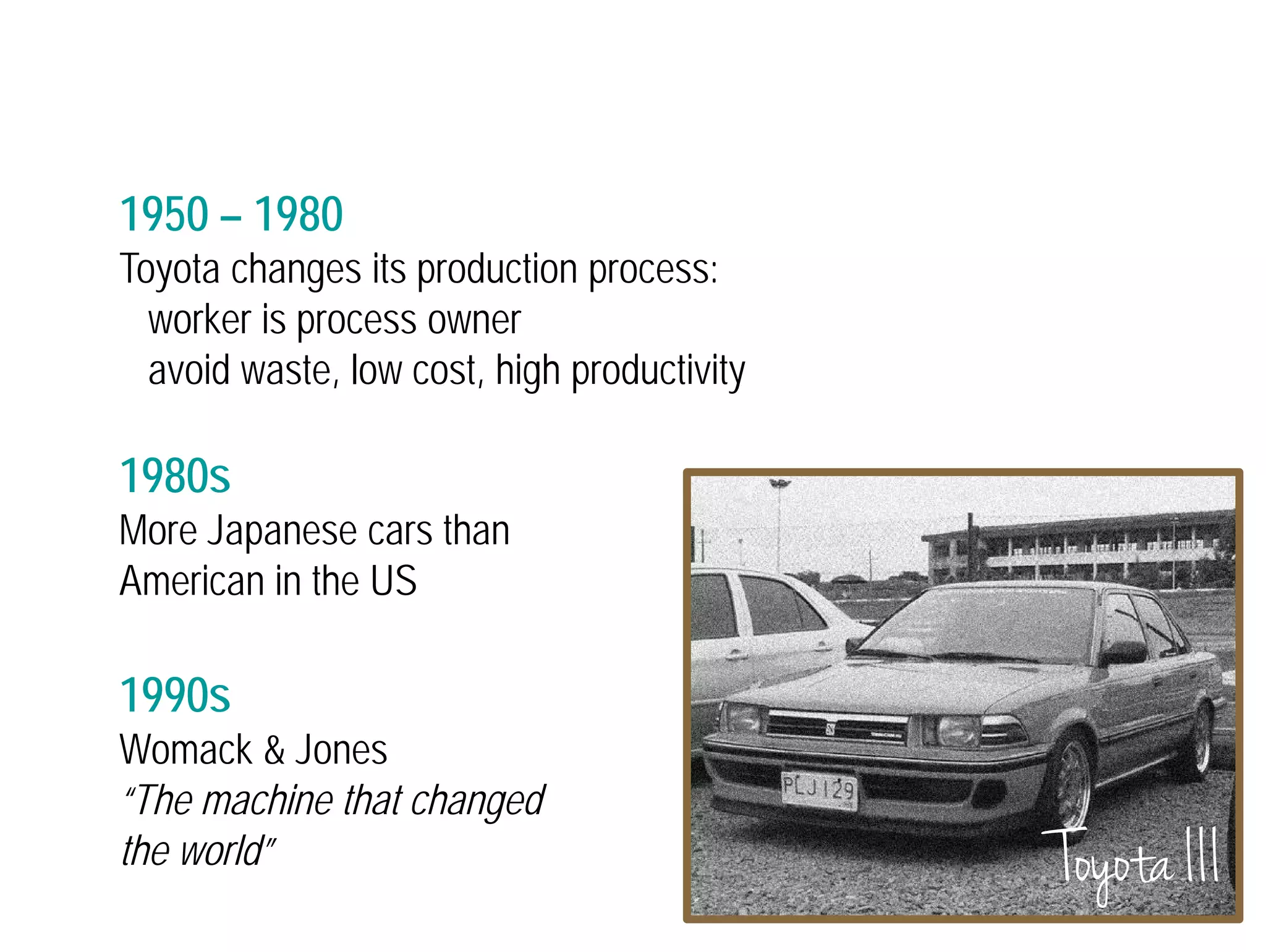
1980s 
More Japanese cars than 
American in the US 
Toyota II
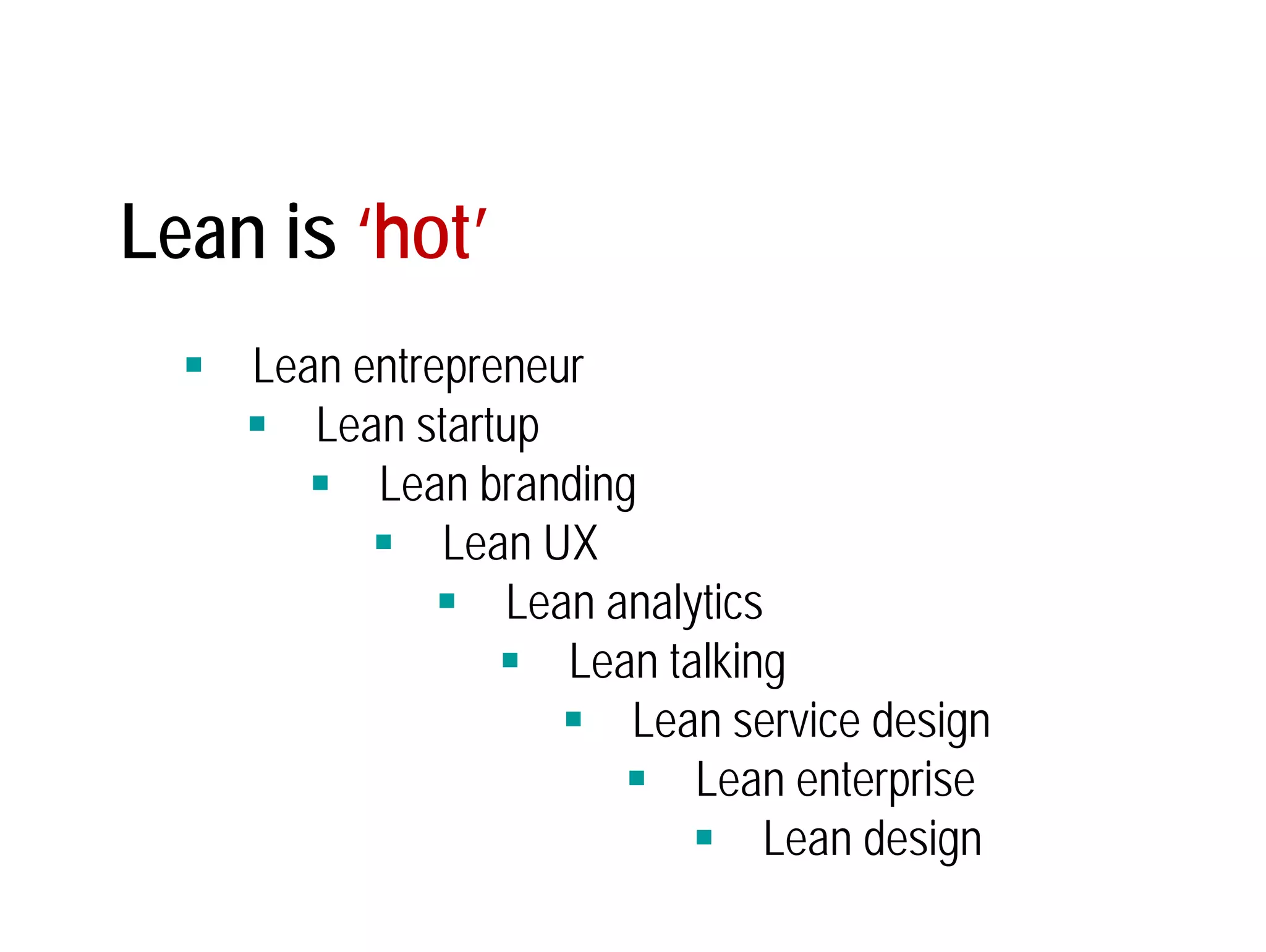
1950 – 1980 
Toyota changes its production process: 
worker is process owner 
avoid waste, low cost, high productivity 
1980s 
More Japanese cars than 
American in the US 
1990s 
Womack & Jones 
“The machine that changed 
the world” Toyota III
Lean is ‘hot’ 
 Lean entrepreneur 
 Lean startup 
 Lean branding 
 Lean UX 
 Lean analytics 
 Lean talking 
 Lean service design 
 Lean enterprise 
 Lean design
“Lean is a philosophy with as goal 
to increase productivity by systematic elimination of waste” 
It starts with the visualization of a process. 
In the broadest of sense, i.e. 
manufacturing, service, administration, etc
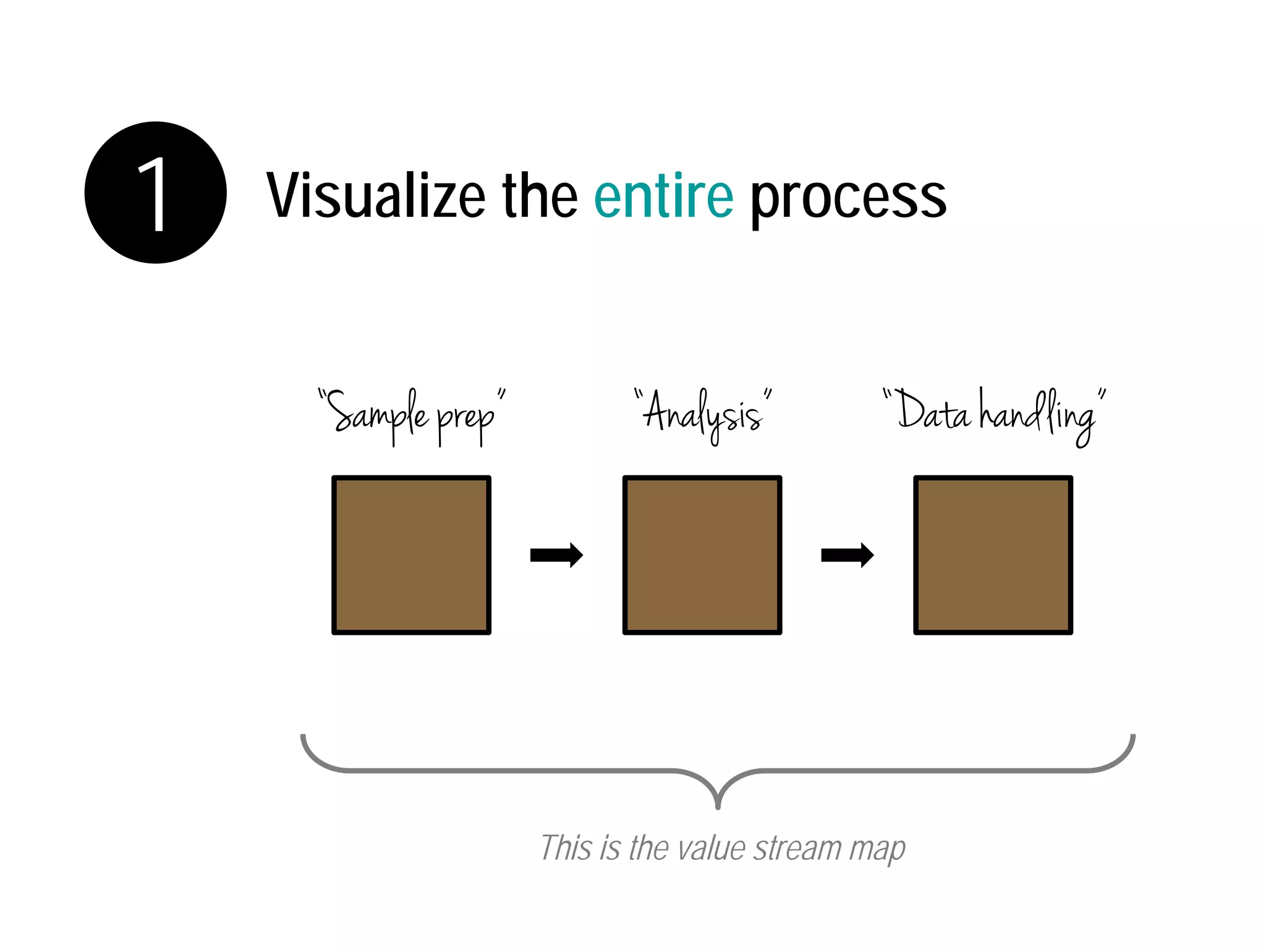
1 Visualize the entire process 
“Sample prep” “Analysis” “Data handling” 
This is the value stream map
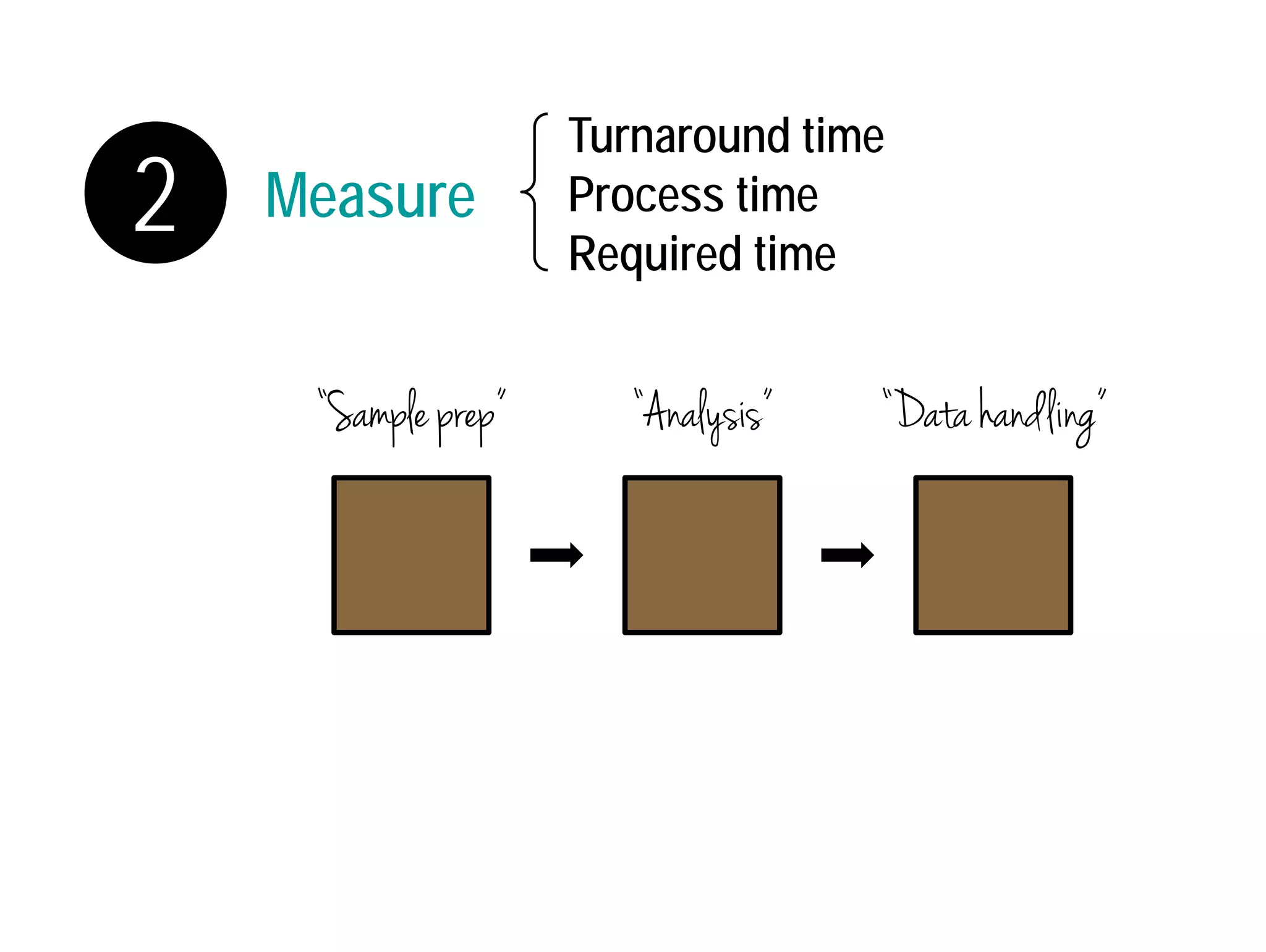
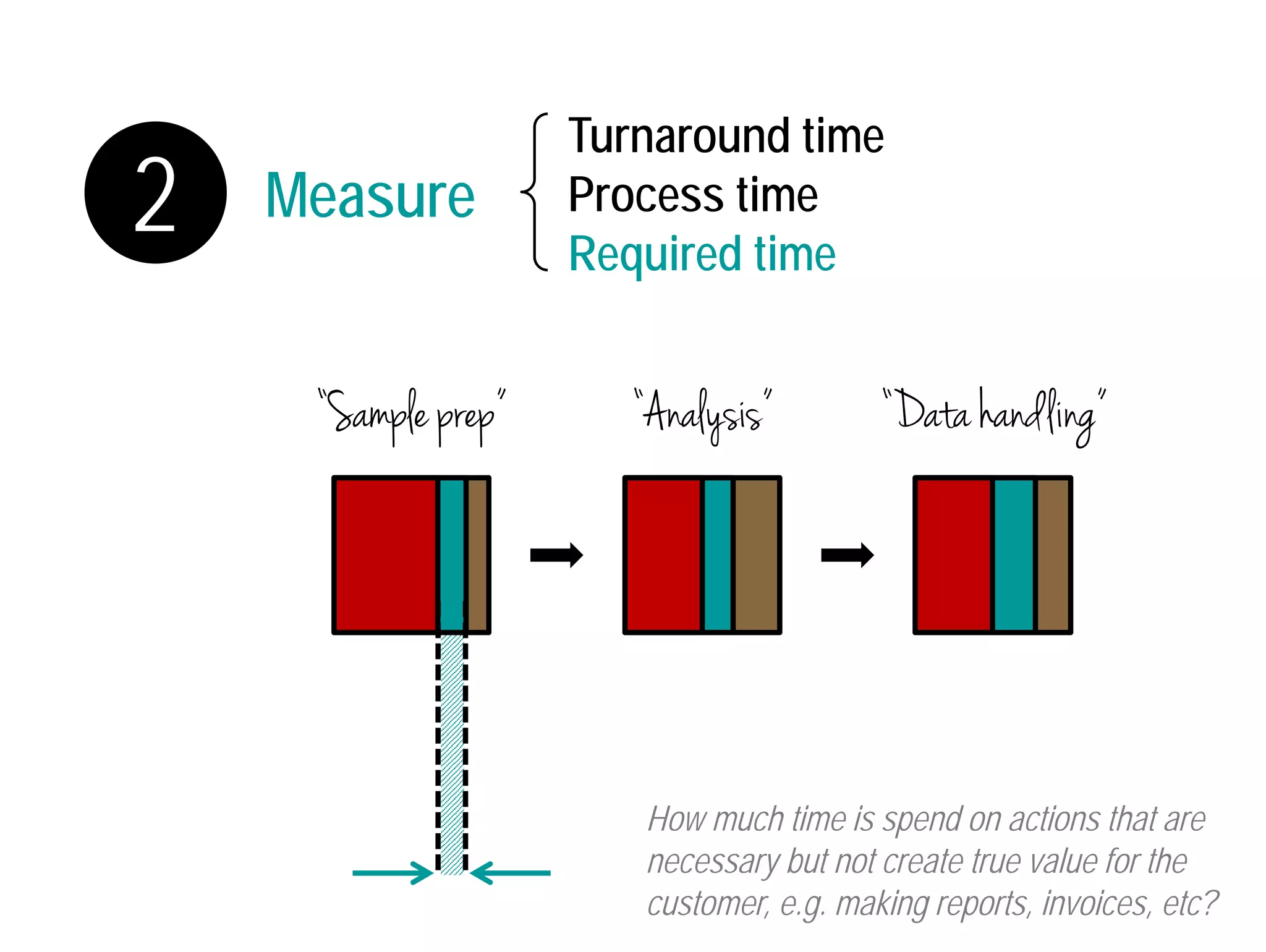
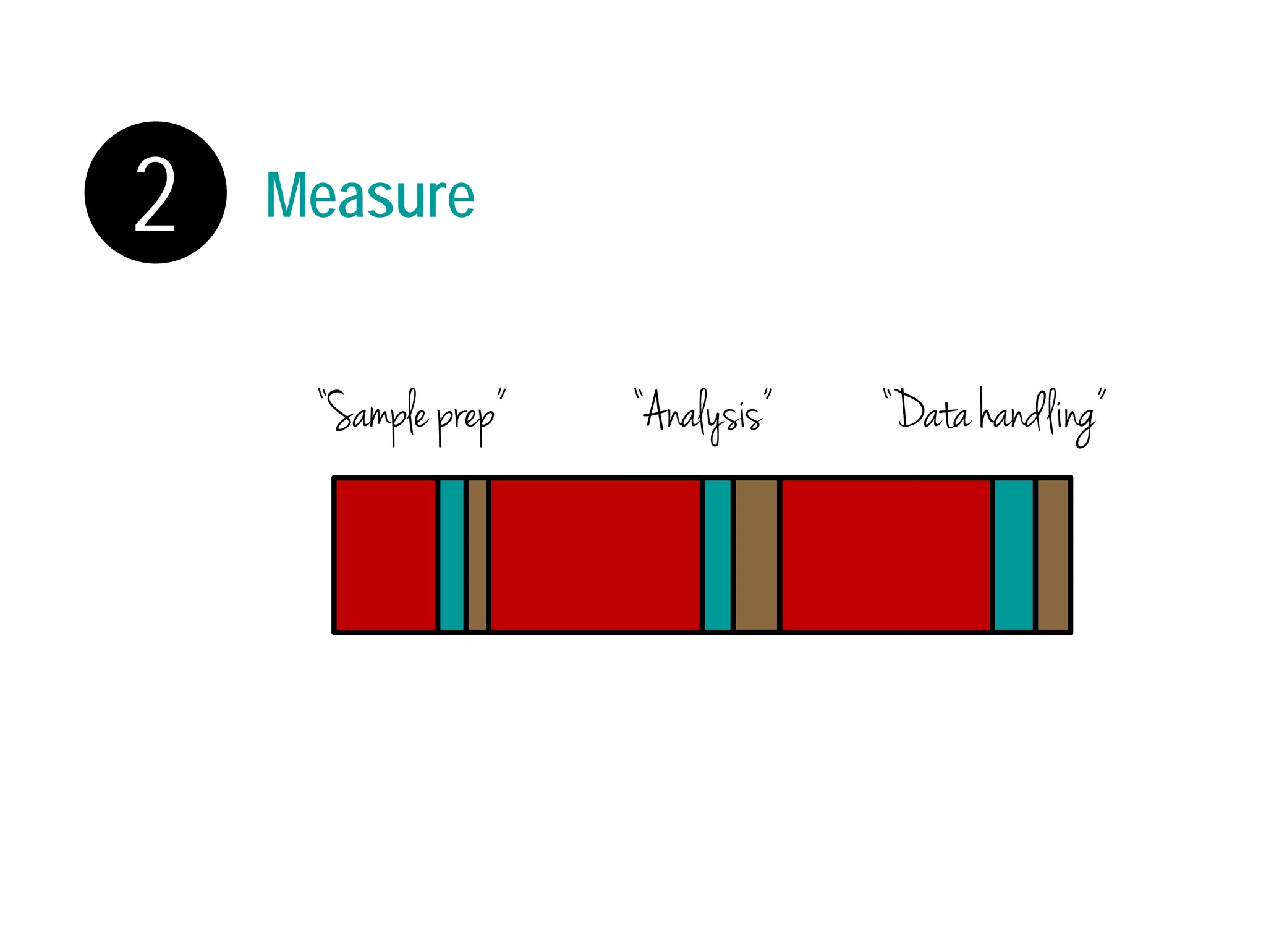
2 Measure 
Turnaround time 
Process time 
Required time 
“Sample prep” “Analysis” “Data handling”
2 Measure 
Turnaround time 
Process time 
Required time 
“Sample prep” “Analysis” “Data handling” 
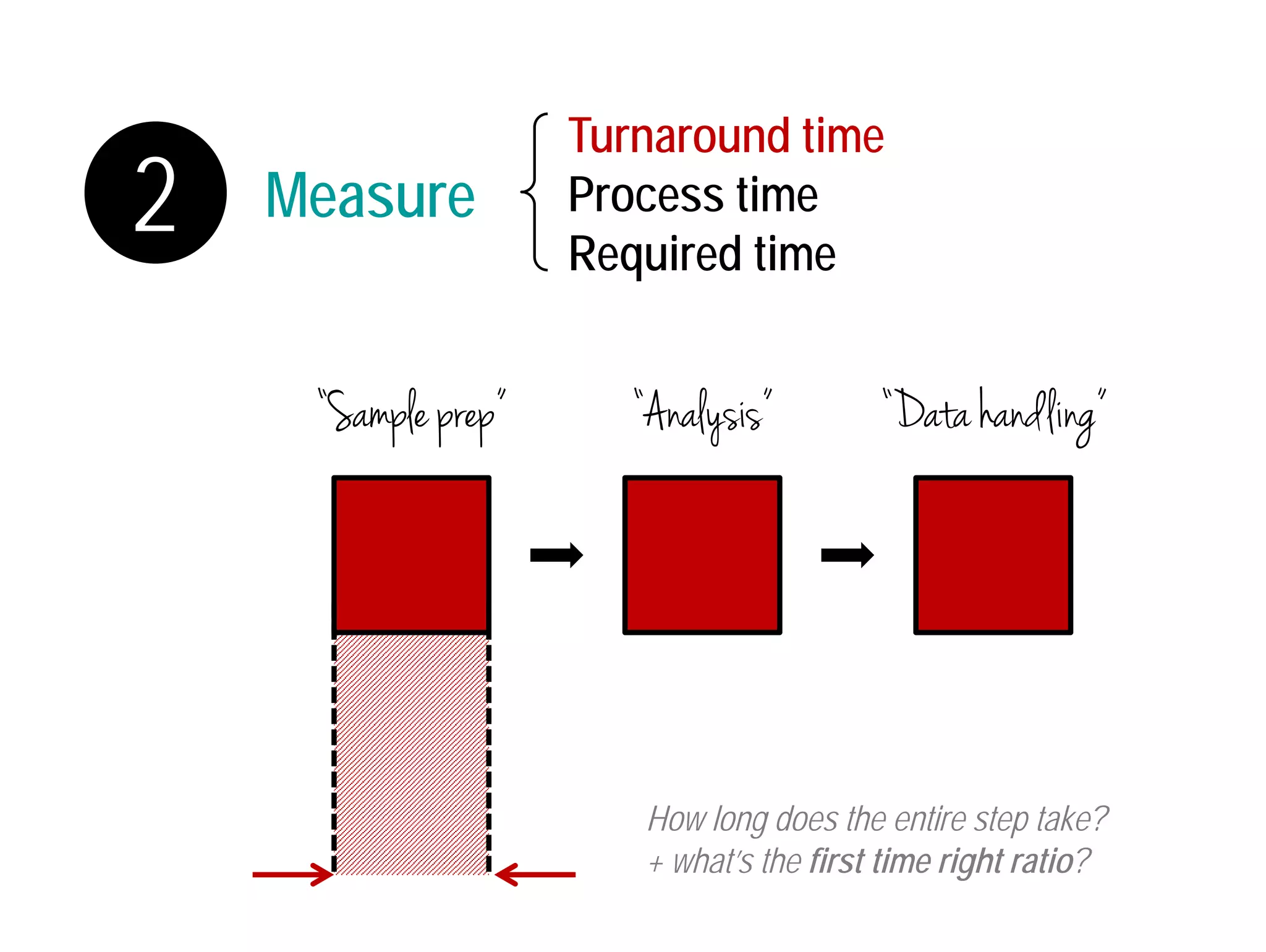
How long does the entire step take? 
+ what’s the first time right ratio?
Turnaround time 
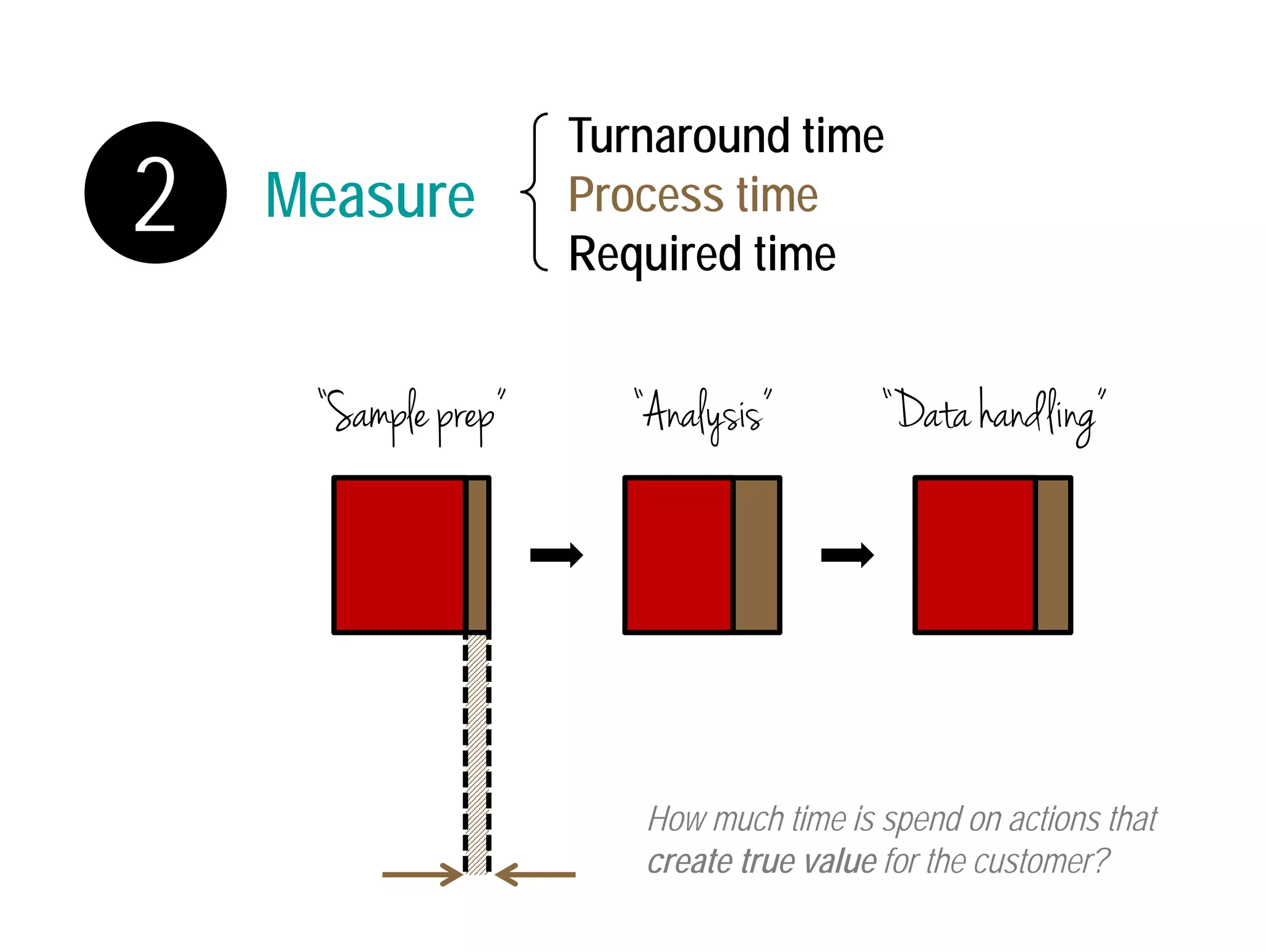
Process time 
Required time 
How much time is spend on actions that 
create true value for the customer? 
2 Measure 
“Sample prep” “Analysis” “Data handling”
2 Measure 
Turnaround time 
Process time 
Required time 
“Sample prep” “Analysis” “Data handling” 
How much time is spend on actions that are 
necessary but not create true value for the 
customer, e.g. making reports, invoices, etc?
2 Measure 
“Sample prep” “Analysis” “Data handling”
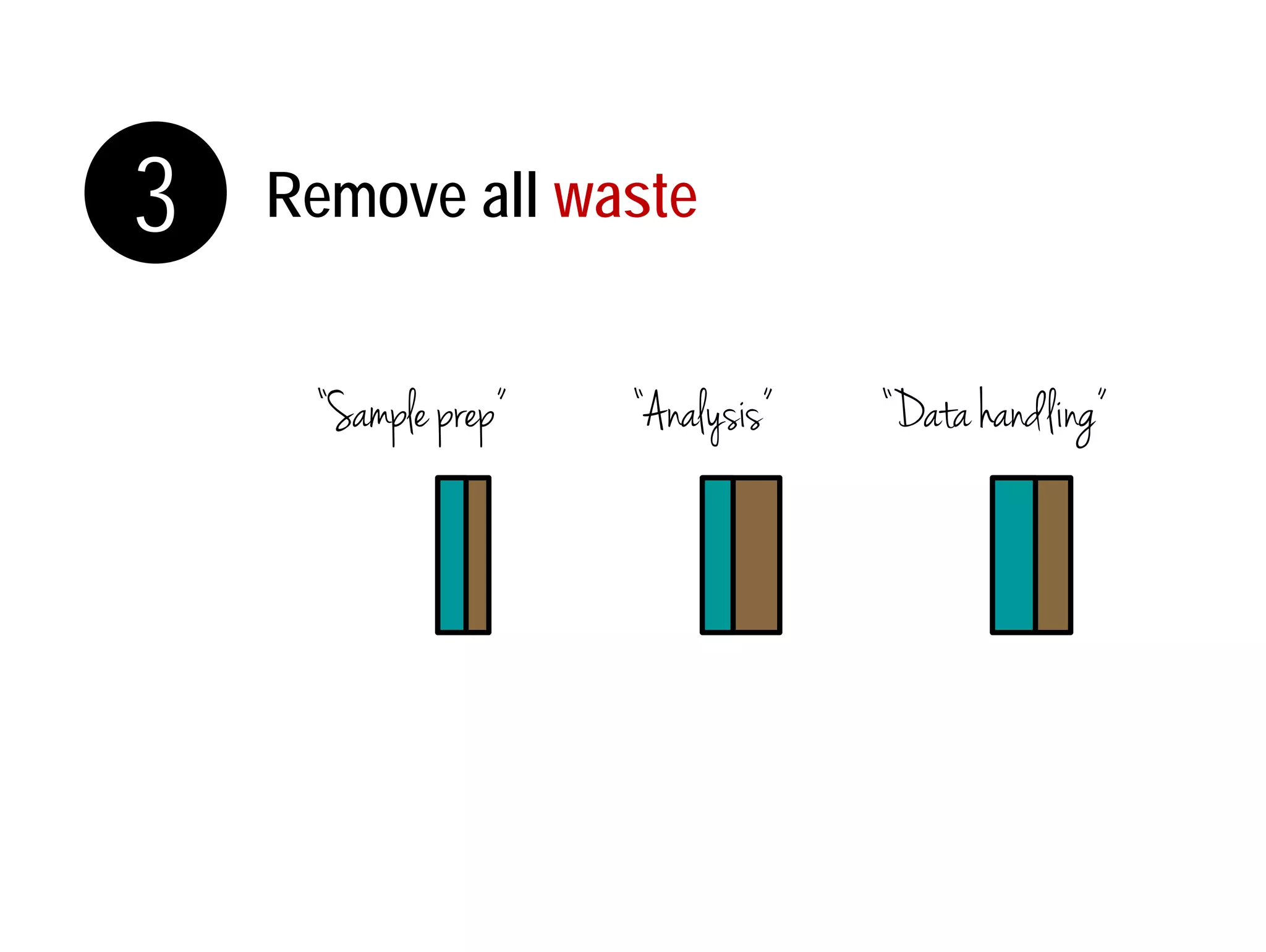
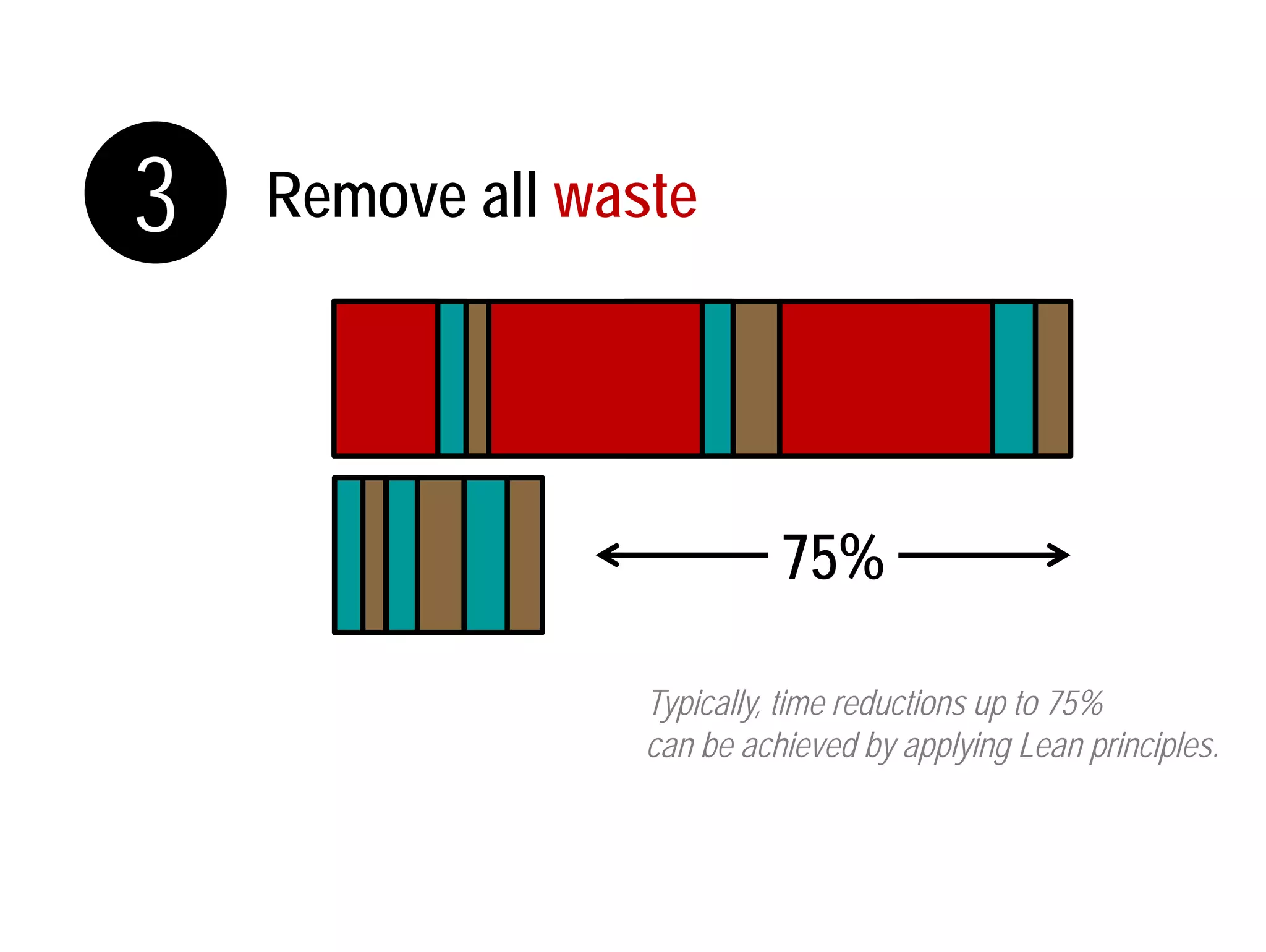
3 Remove all waste 
“Sample prep” “Analysis” “Data handling”
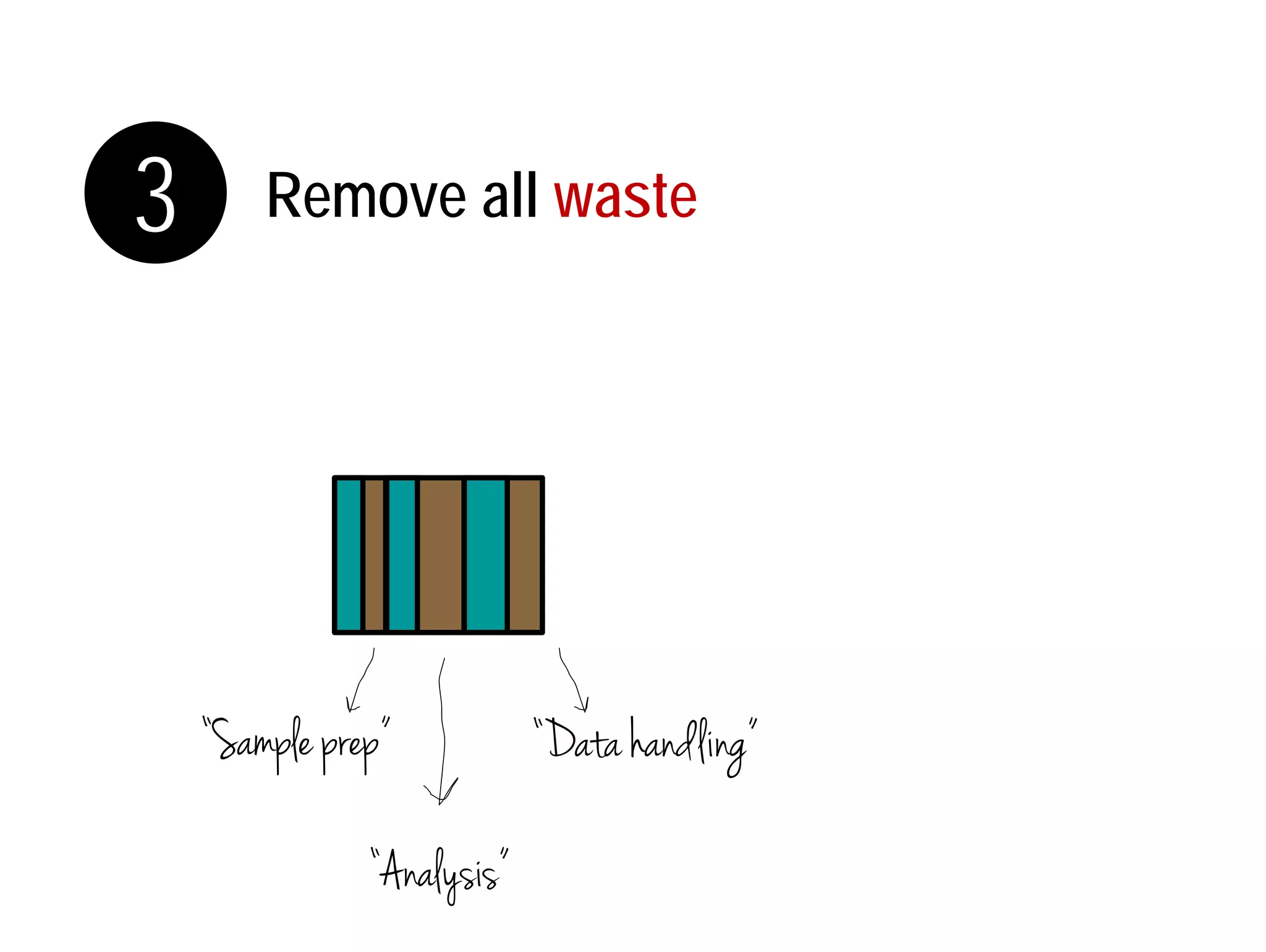
3 Remove all waste 
“Sample prep” 
“Analysis” 
“Data handling”
3 Remove all waste 
75% 
Typically, time reductions up to 75% 
can be achieved by applying Lean principles.
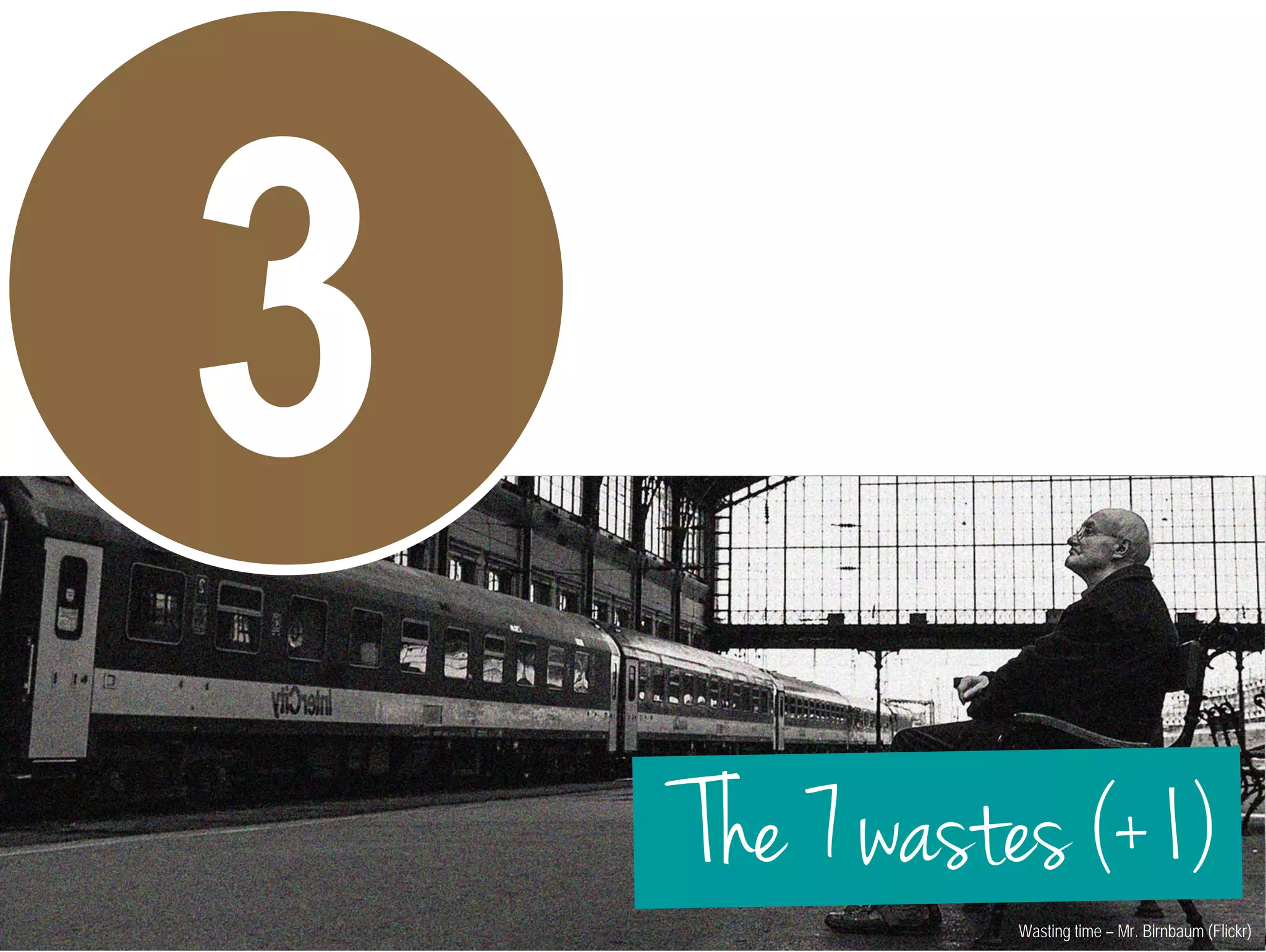
The 7 wastes (+1) 
Wasting time – Mr. Birnbaum (Flickr)
Remember Tim Woods?
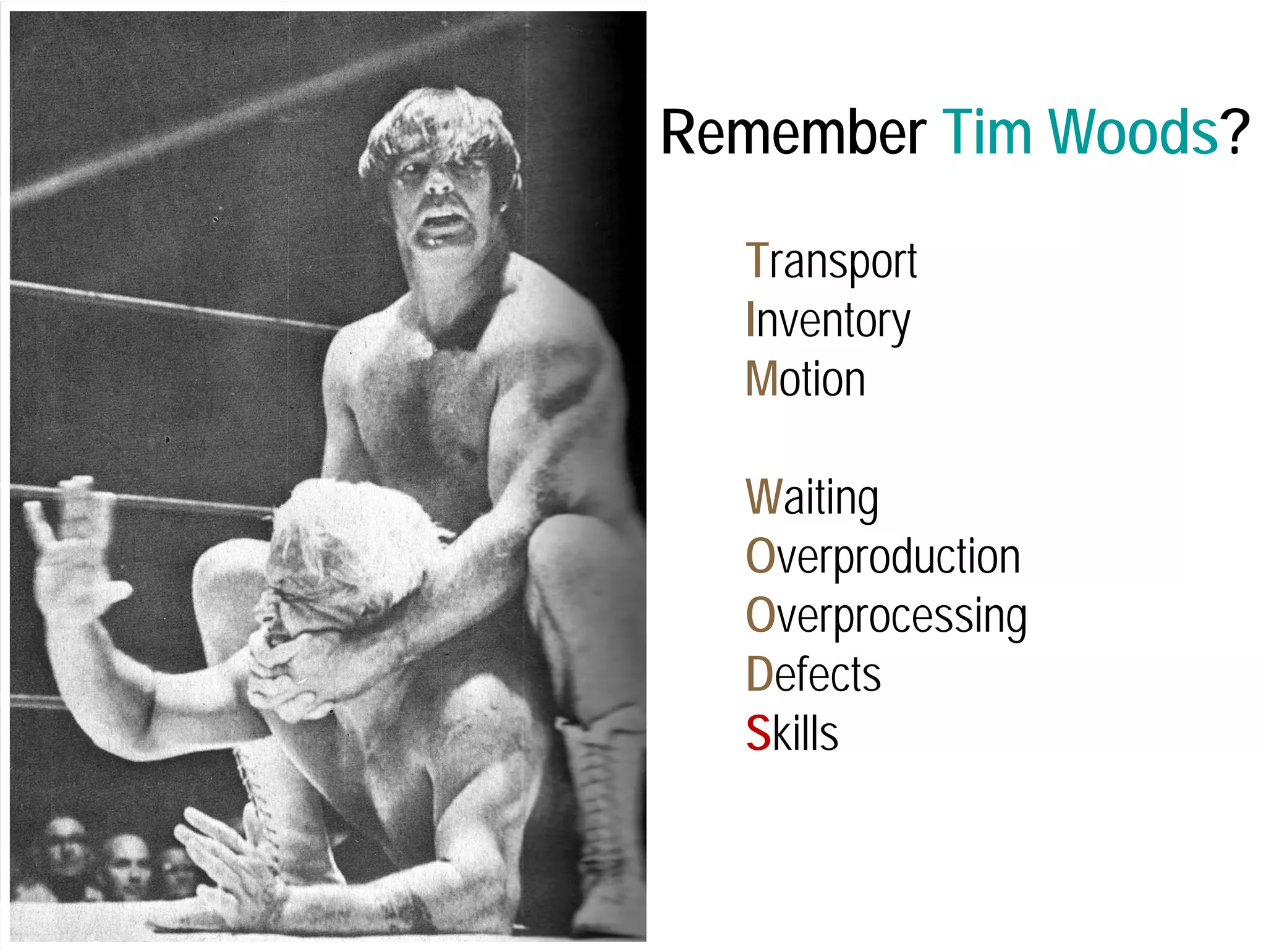
Remember Tim Woods? 
Transport 
Inventory 
Motion 
Waiting 
Overproduction 
Overprocessing 
Defects 
Skills
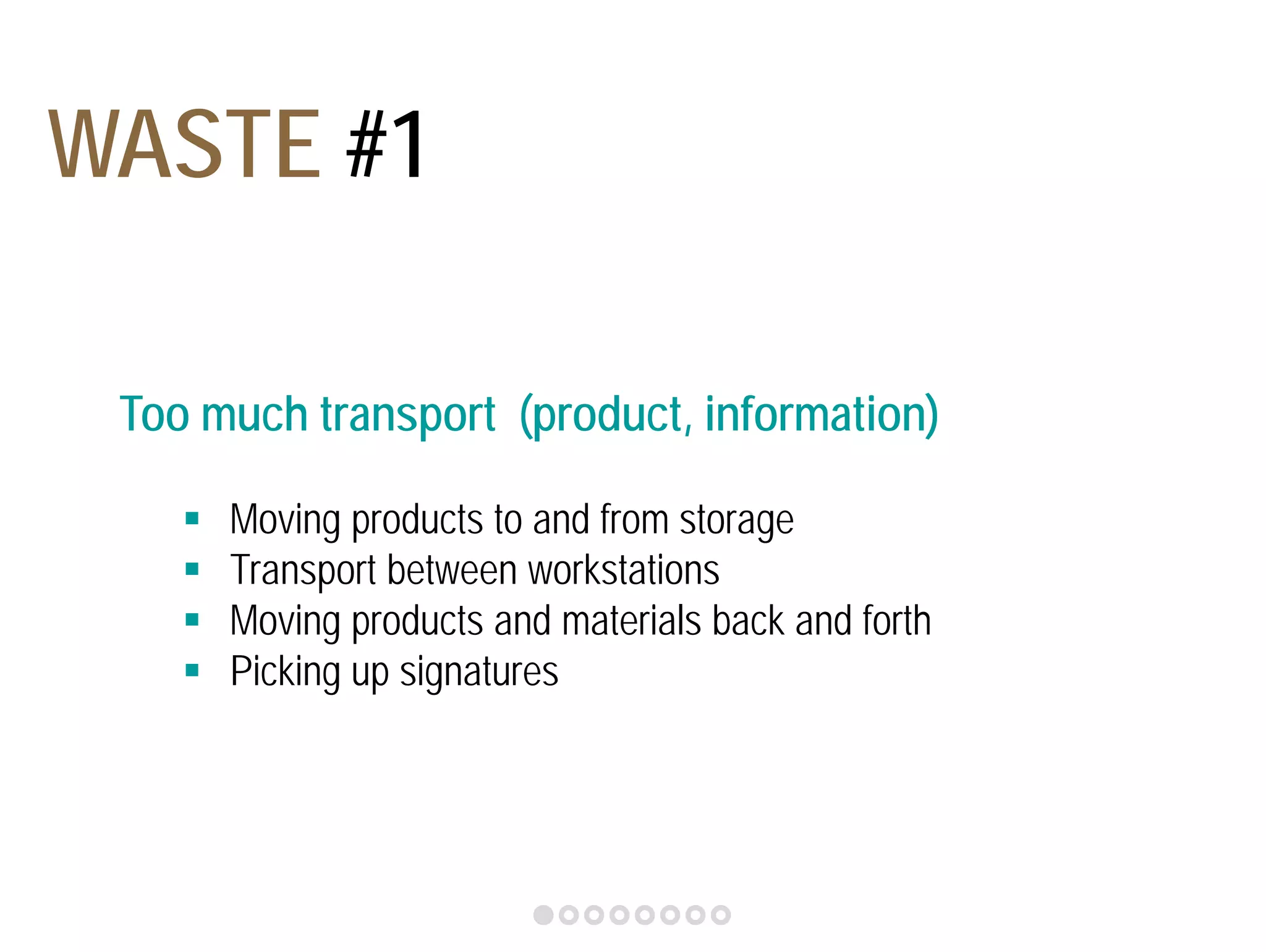
WASTE #1 
Too much transport (product, information) 
 Moving products to and from storage 
 Transport between workstations 
 Moving products and materials back and forth 
 Picking up signatures
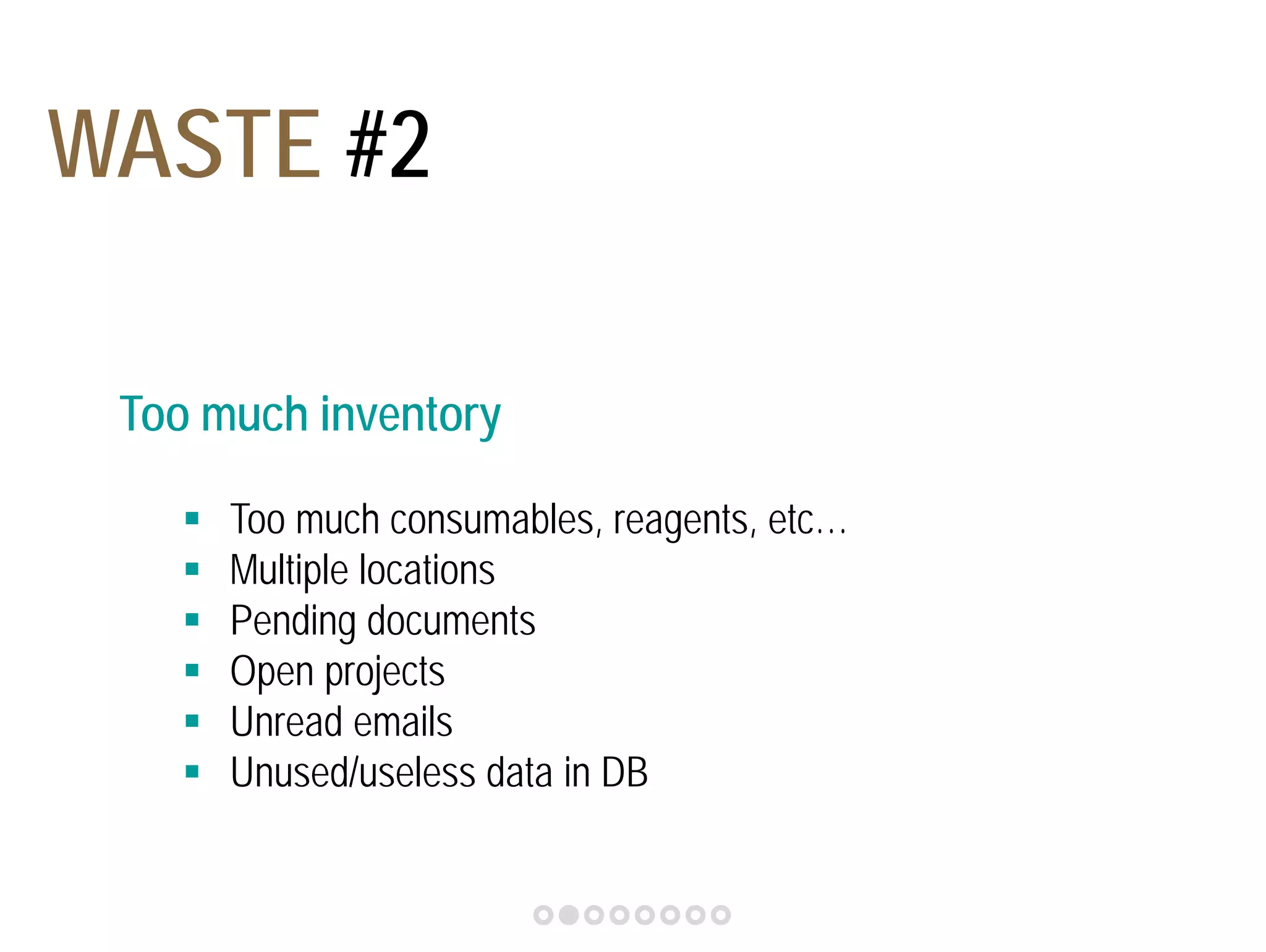
WASTE #2 
Too much inventory 
 Too much consumables, reagents, etc… 
 Multiple locations 
 Pending documents 
 Open projects 
 Unread emails 
 Unused/useless data in DB
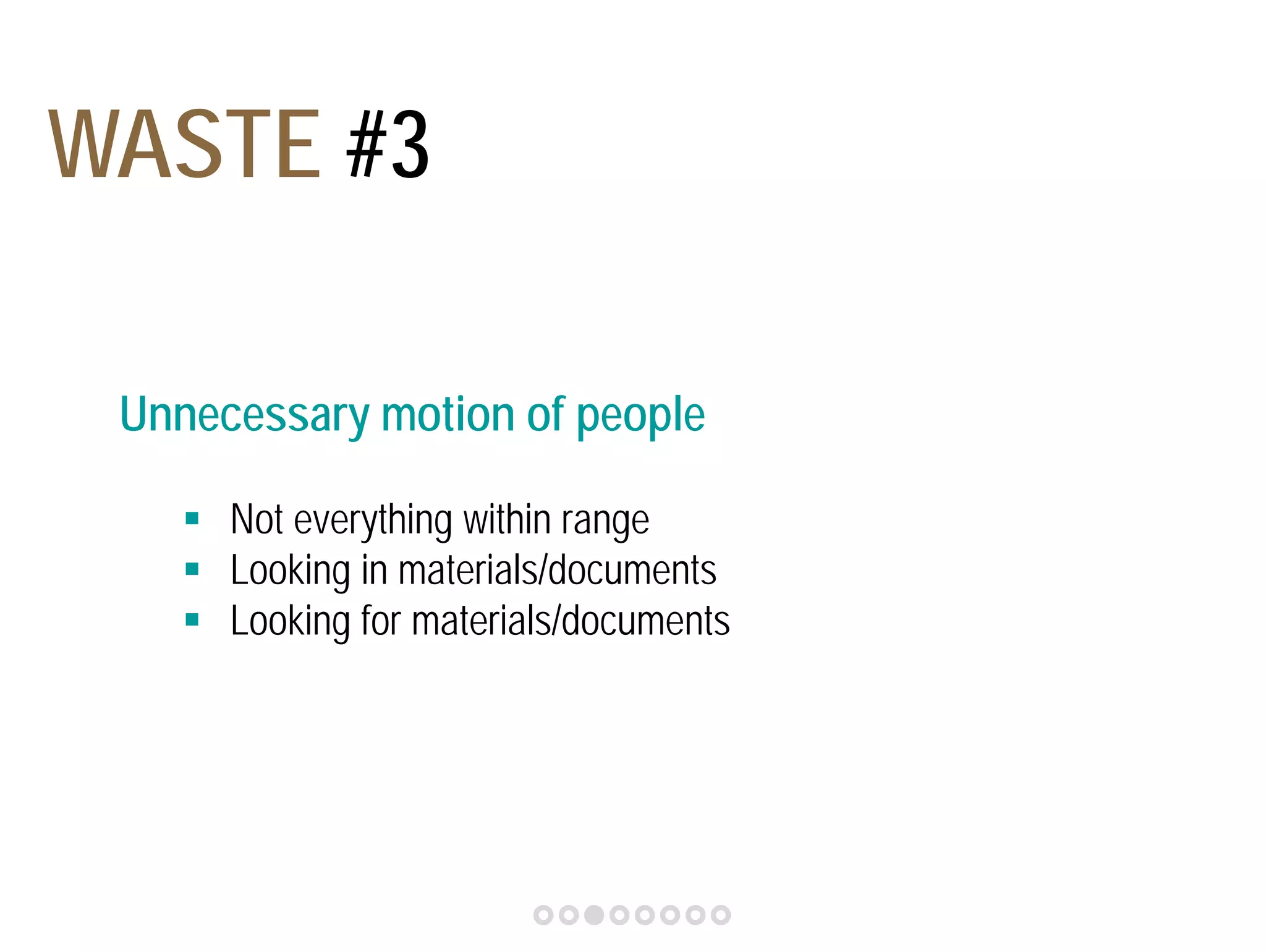
Unnecessary motion of people 
 Not everything within range 
 Looking in materials/documents 
 Looking for materials/documents 
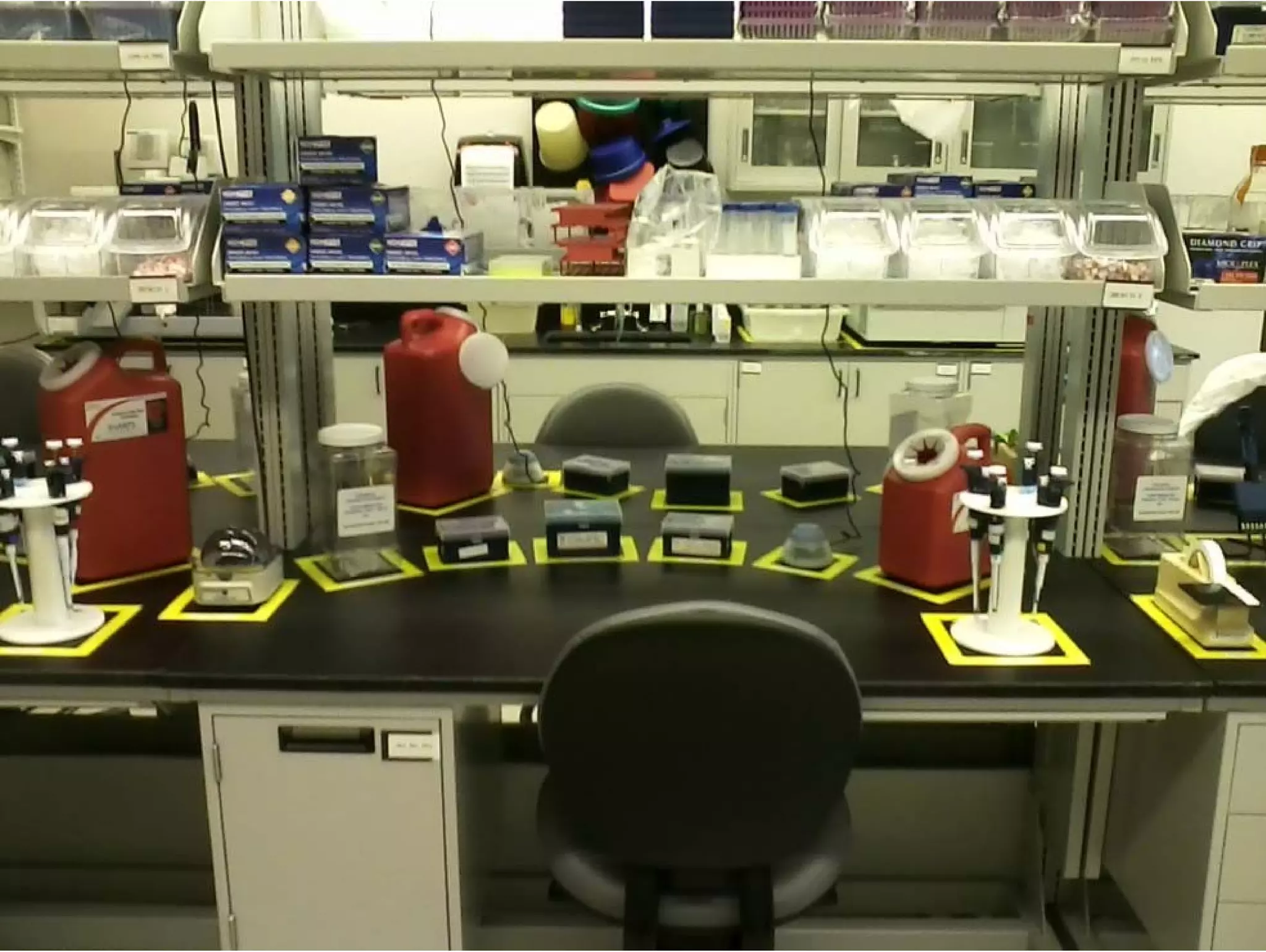
5S 
WASTE #3
WASTE #4 
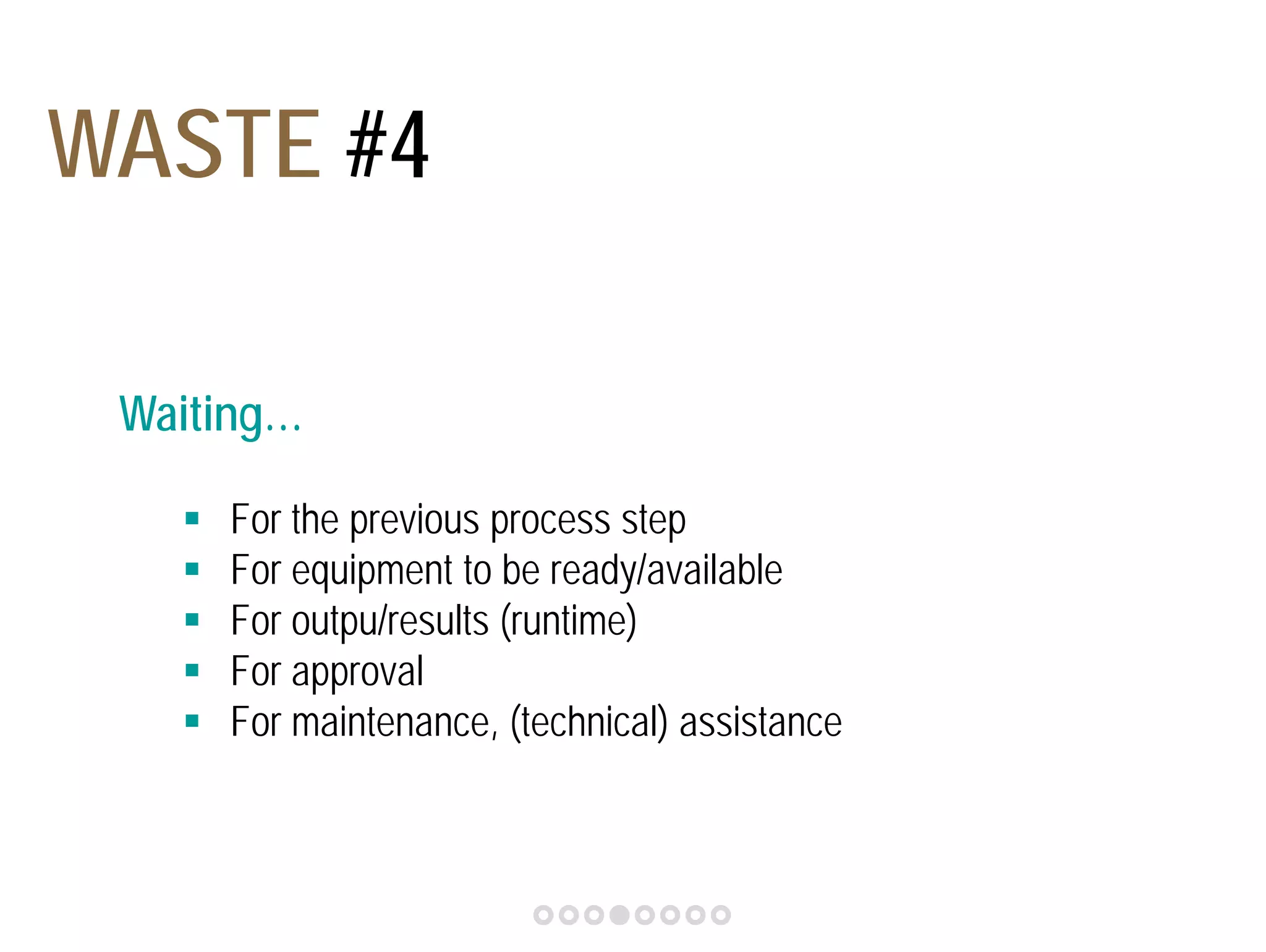
Waiting… 
 For the previous process step 
 For equipment to be ready/available 
 For outpu/results (runtime) 
 For approval 
 For maintenance, (technical) assistance
WASTE #5 
Overproduction 
 Too much reagents, standards, etc… 
 Too much samples 
 Too much data 
 Making reports that are never read 
 Making an extra copy (endless cc-ing)
WASTE #6 
Overprocessing 
 Unnecessary re-analysis/calibrations 
 Doublechecks 
 Validation 
 Over-complicated procedures 
 Double documents
WASTE #7 
Defects 
 Instrument failures 
 Retesting 
 Variation 
 Wrong data input 
 Missing information 
 No procedure
WASTE #8 
Skills 
 Underutilizing skills of people 
 Lack of decent training 
 Not using people’s creativity
Some Lean tools 
Old tools – J.M. Rosell (Flickr)
Main sources of waste are: 
 Waiting 
 Overproduction & overprocessing leading to inventory 
 Motion
FLOW & PULL 
A simple way to address these wastes 
(similar to the assembly line in a car manufacturing plant)
FLOW & PULL 
A simple way to address these issues 
= make sure that a product never stops from the 
moment the production process is launched. 
(similar to the assembly line in a car manufacturing plant)
FLOW & PULL 
A simple way to address these issues 
= the subsequent process step signals when 
ready to accept new product. 
(similar to the assembly line in a car manufacturing plant)
[The tools] 
PDCA 
5 Whys 
One-piece flow 
Kanban 
Takt time 
Line balancing 
5S
Kaizen 
Continuous improvement. 
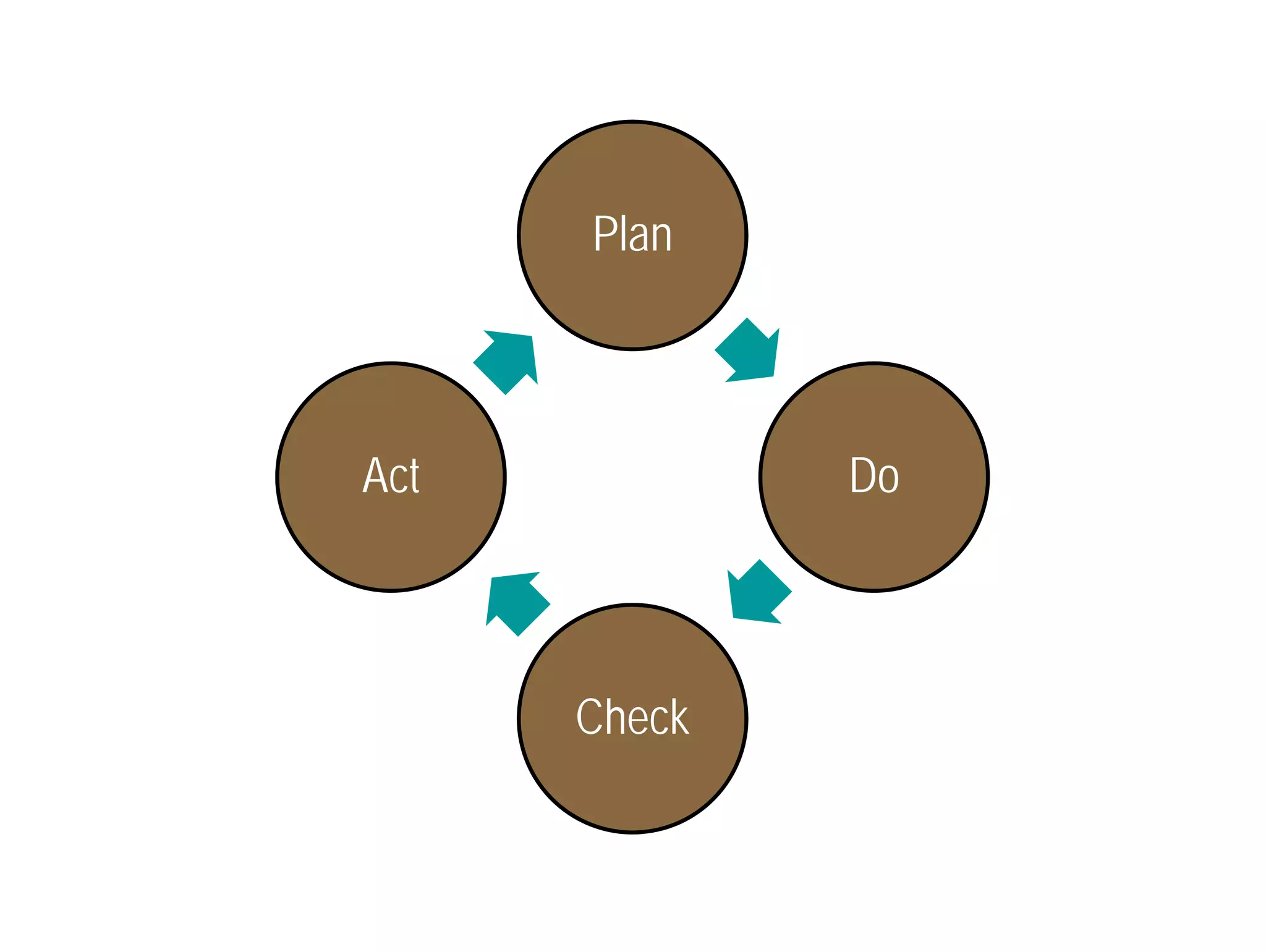
Kaizen is derived from two Japanese characters; kai, meaning ‘change’ 
and zen meaning ‘good’. It aims at continuously eliminating waste from 
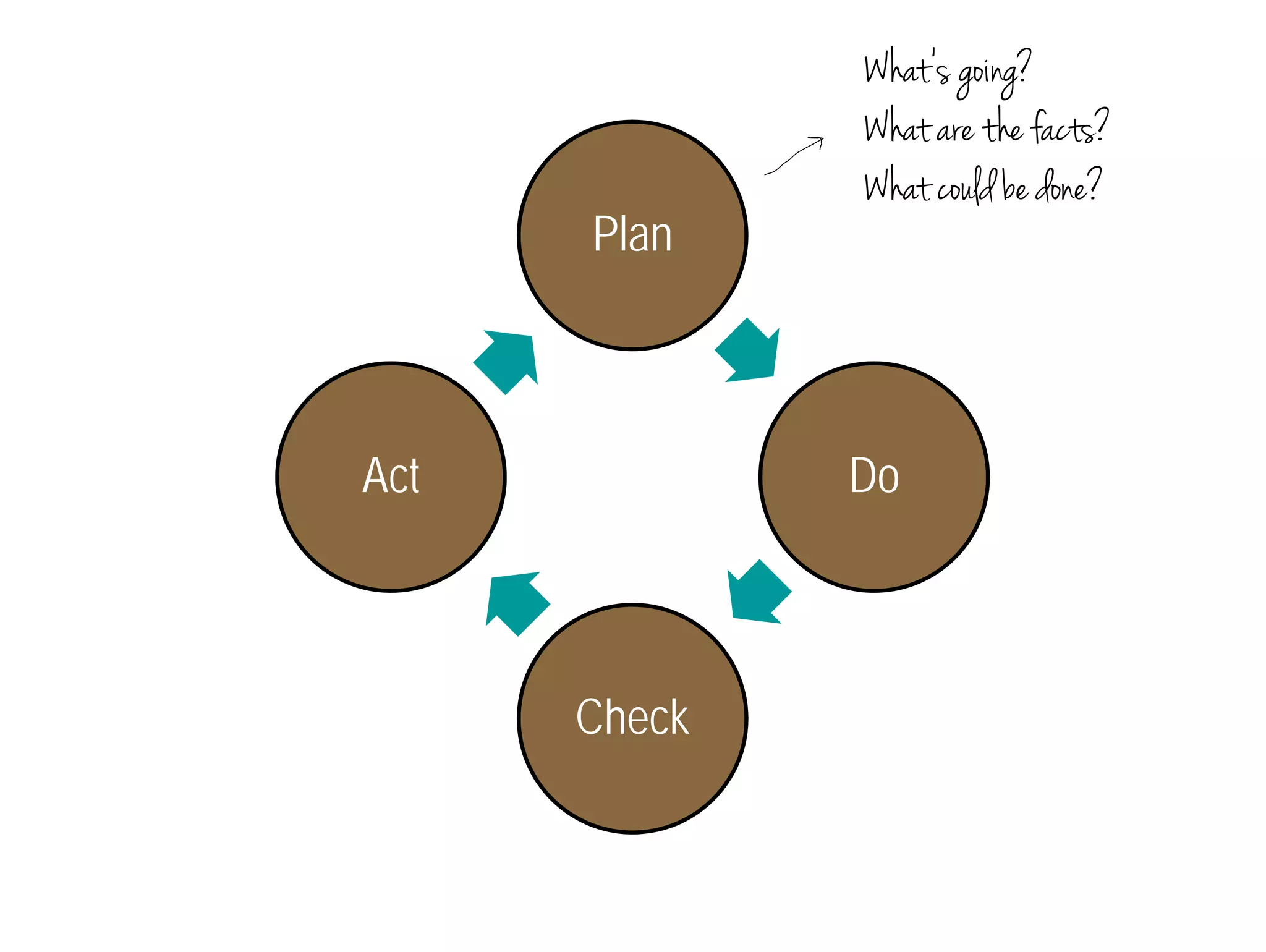
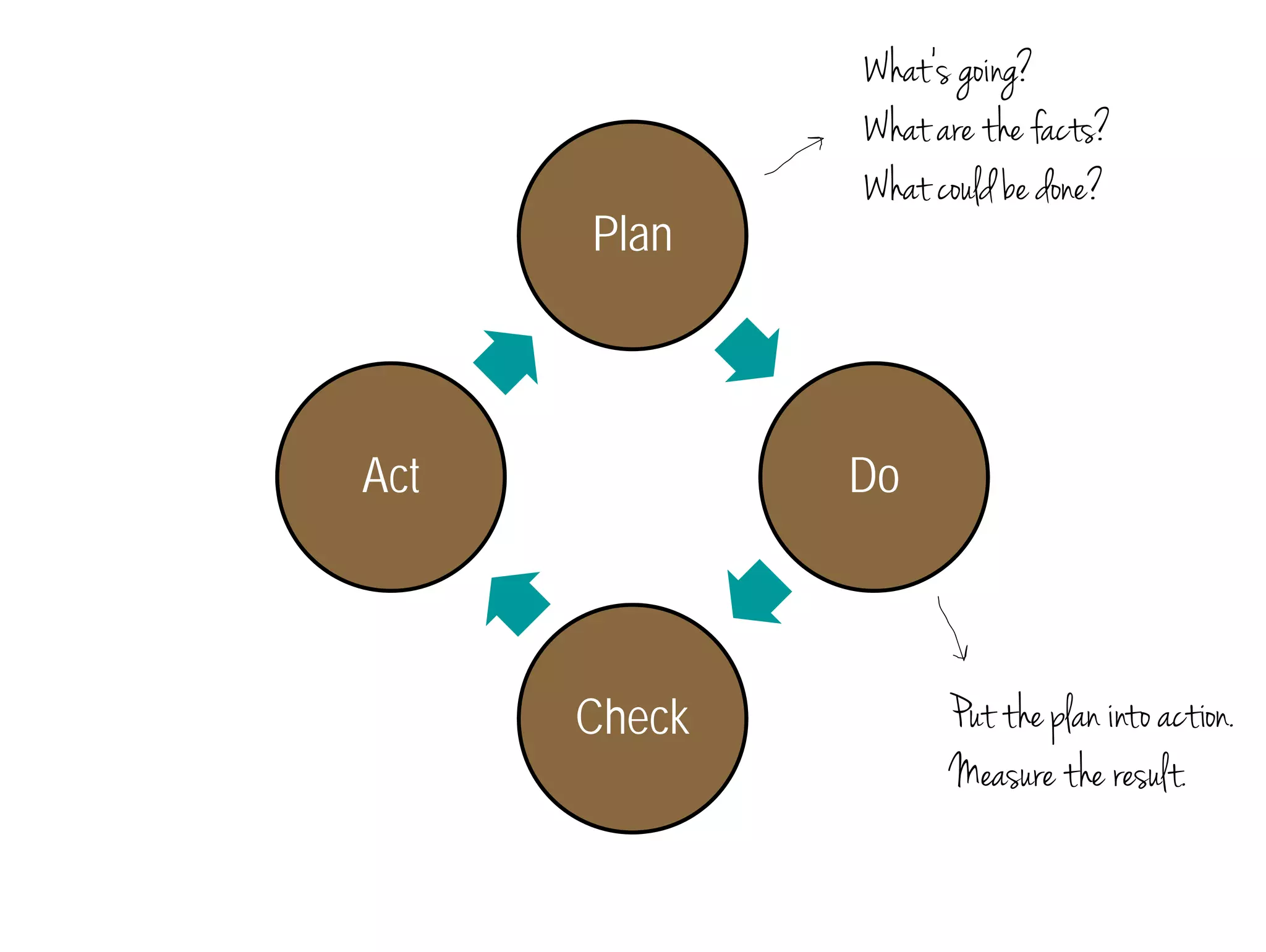
the value stream. Therefore, it applies the so-called PDCA cycle.
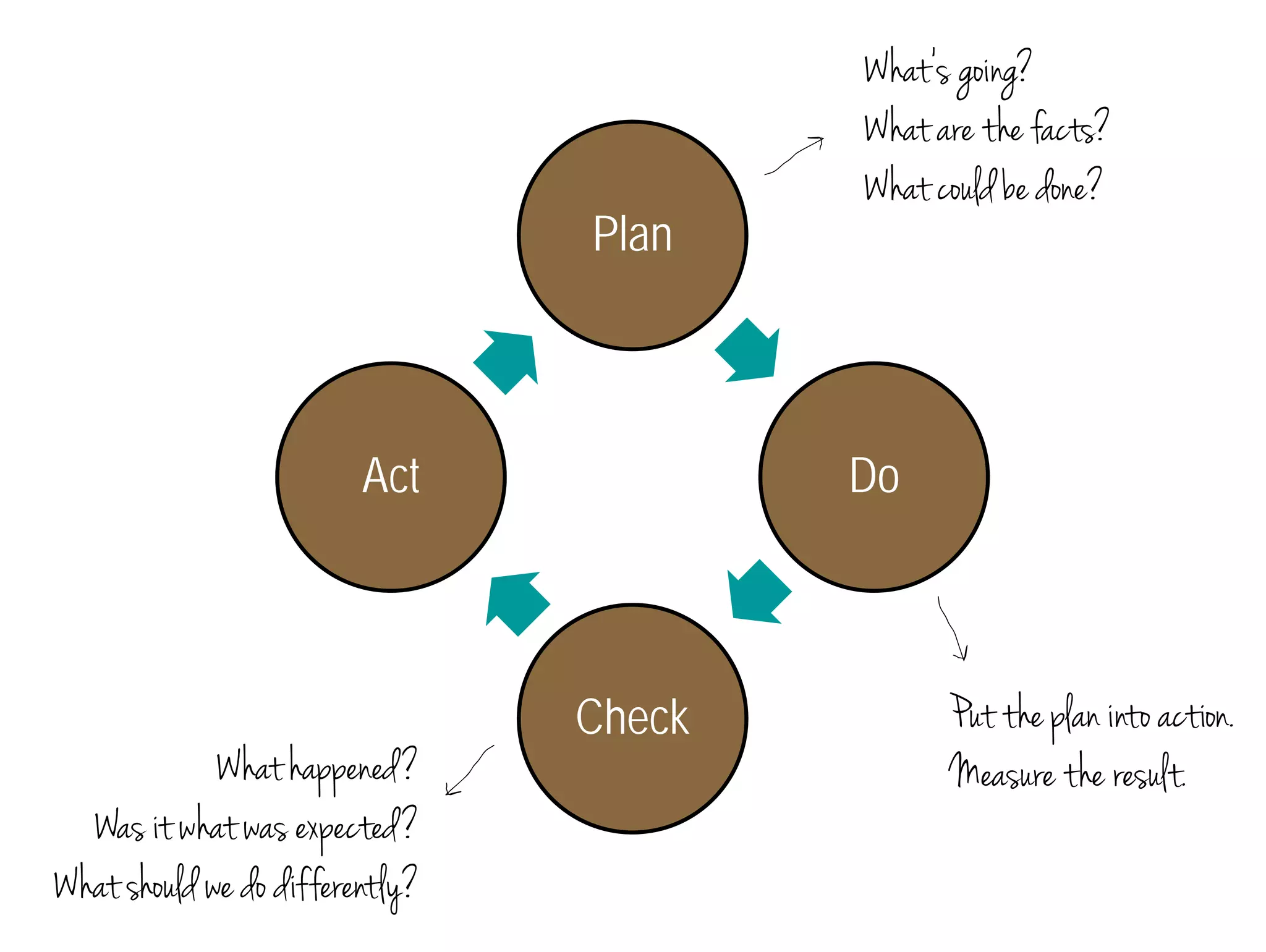
Plan 
Do 
Check 
Act
Plan 
Do 
Check 
Act 
What’s going? 
What are the facts? 
What could be done?
Plan 
Do 
Check 
Act 
What’s going? 
What are the facts? 
What could be done? 
Put the plan into action. 
Measure the result.
Plan 
Do 
Check 
Act 
What’s going? 
What are the facts? 
What could be done? 
Put the plan into action. 
What happened? Measure the result. 
Was it what was expected? 
What should we do differently?
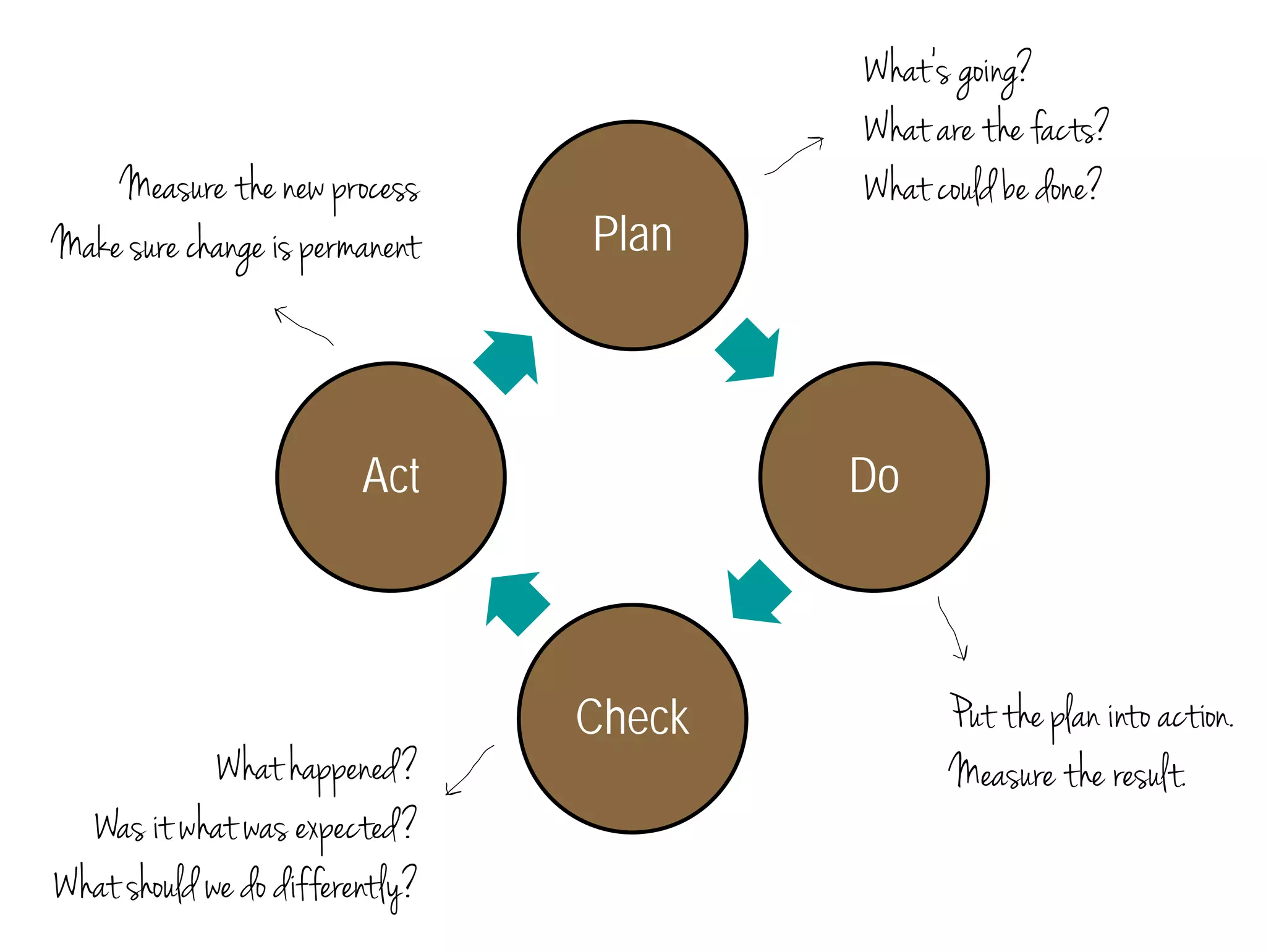
Plan 
Do 
Check 
Measure the new process 
Make sure change is permanent 
Act 
What’s going? 
What are the facts? 
What could be done? 
Put the plan into action. 
What happened? Measure the result. 
Was it what was expected? 
What should we do differently?
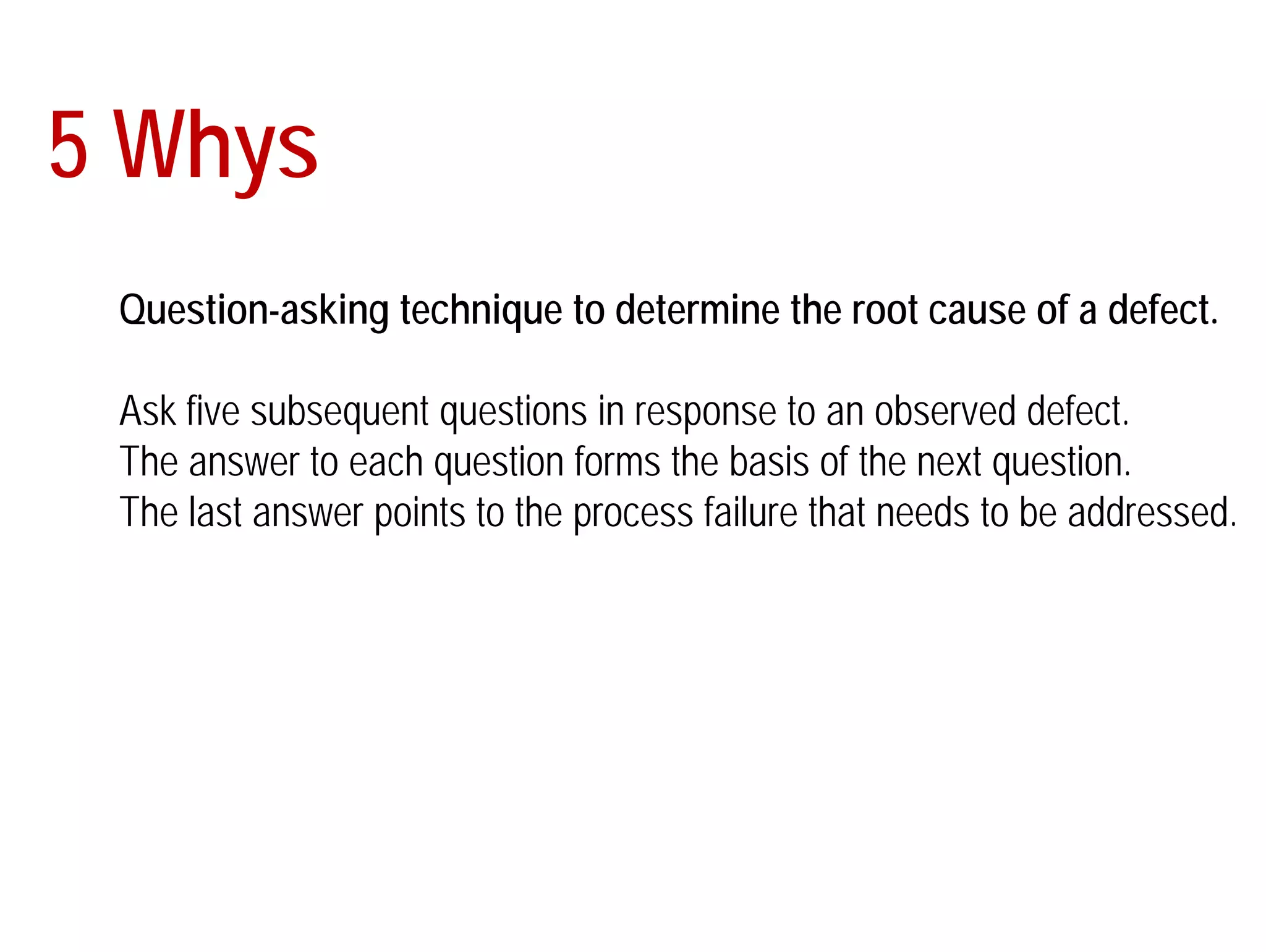
5 Whys 
Question-asking technique to determine the root cause of a defect. 
Ask five subsequent questions in response to an observed defect. 
The answer to each question forms the basis of the next question. 
The last answer points to the process failure that needs to be addressed.
One-piece flow 
Approach to prepare each product individually rather than in batch. 
By working this way, turnaround times are reduced significantly and the 
impact of errors on the process is less significant because only ‘one 
piece’ is involved rather than a batch of pieces.
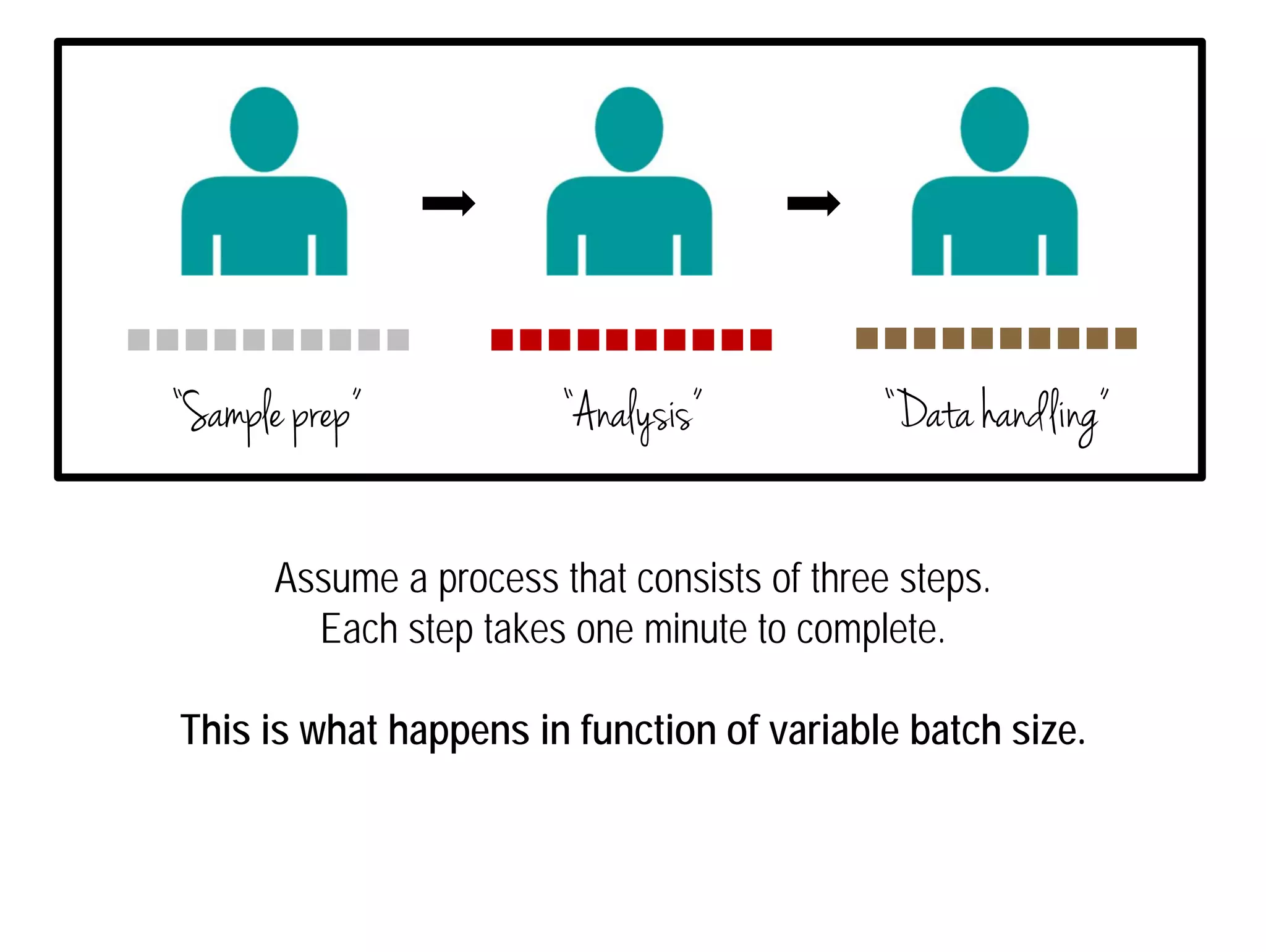
“Sample prep” “Analysis” “Data handling” 
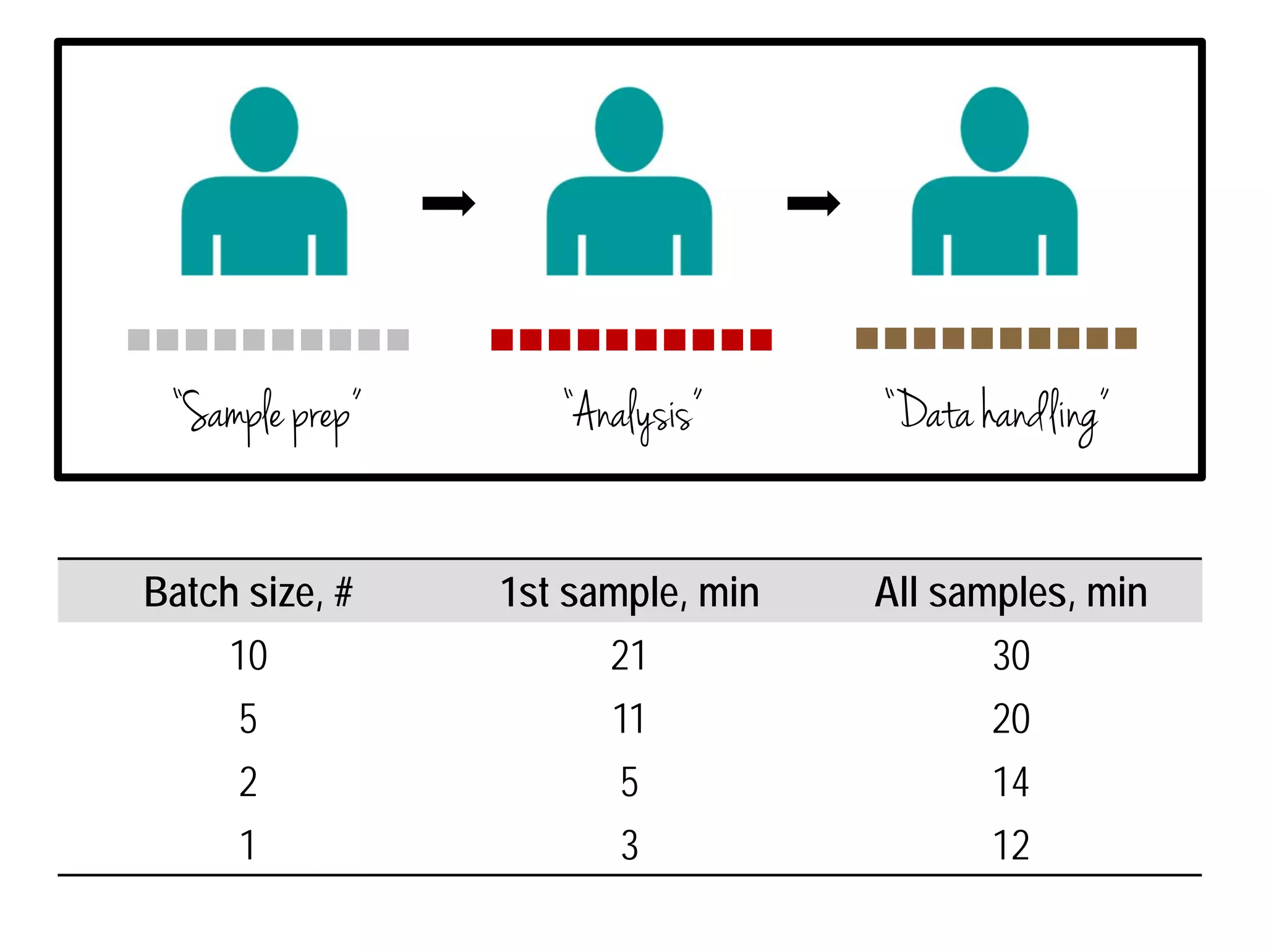
Assume a process that consists of three steps. 
Each step takes one minute to complete. 
This is what happens in function of variable batch size.
“Sample prep” “Analysis” “Data handling” 
Batch size, # 1st sample, min All samples, min 
10 21 30 
5 11 20 
2 5 14 
1 3 12
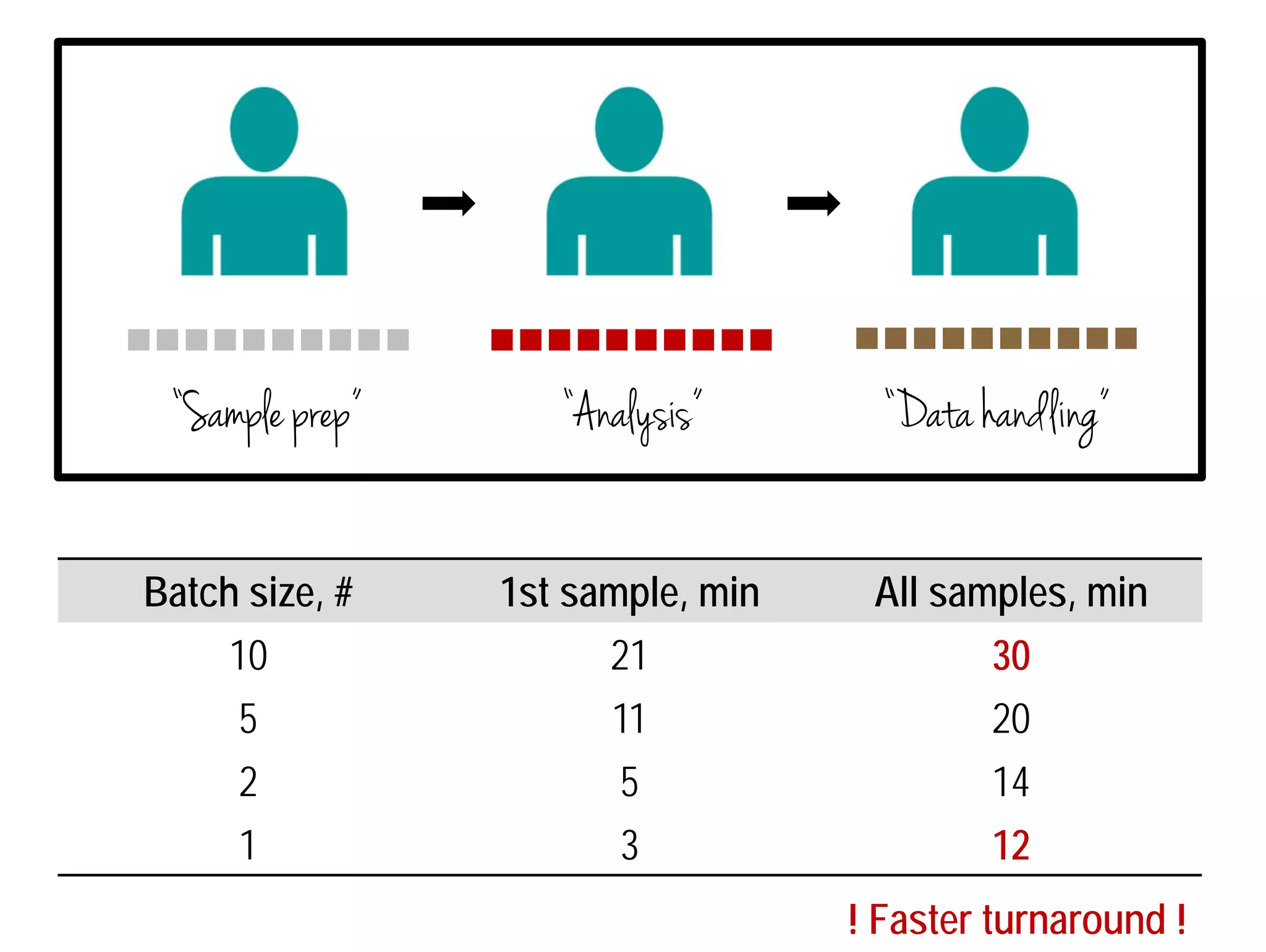
“Sample prep” “Analysis” “Data handling” 
Batch size, # 1st sample, min All samples, min 
10 21 30 
5 11 20 
2 5 14 
1 3 12 
! Faster turnaround !
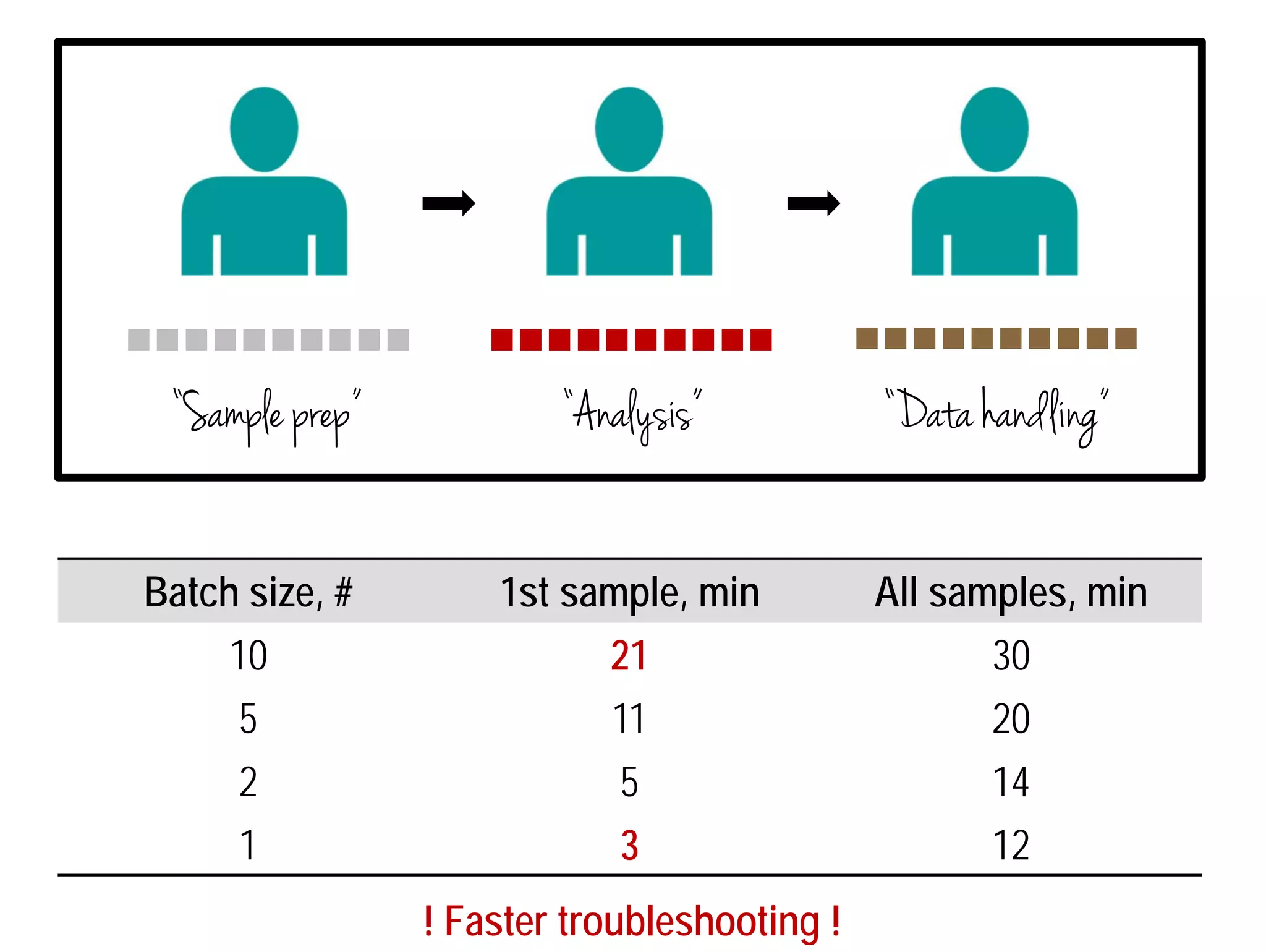
“Sample prep” “Analysis” “Data handling” 
Batch size, # 1st sample, min All samples, min 
10 21 30 
5 11 20 
2 5 14 
1 3 12 
! Faster troubleshooting !
Kanban 
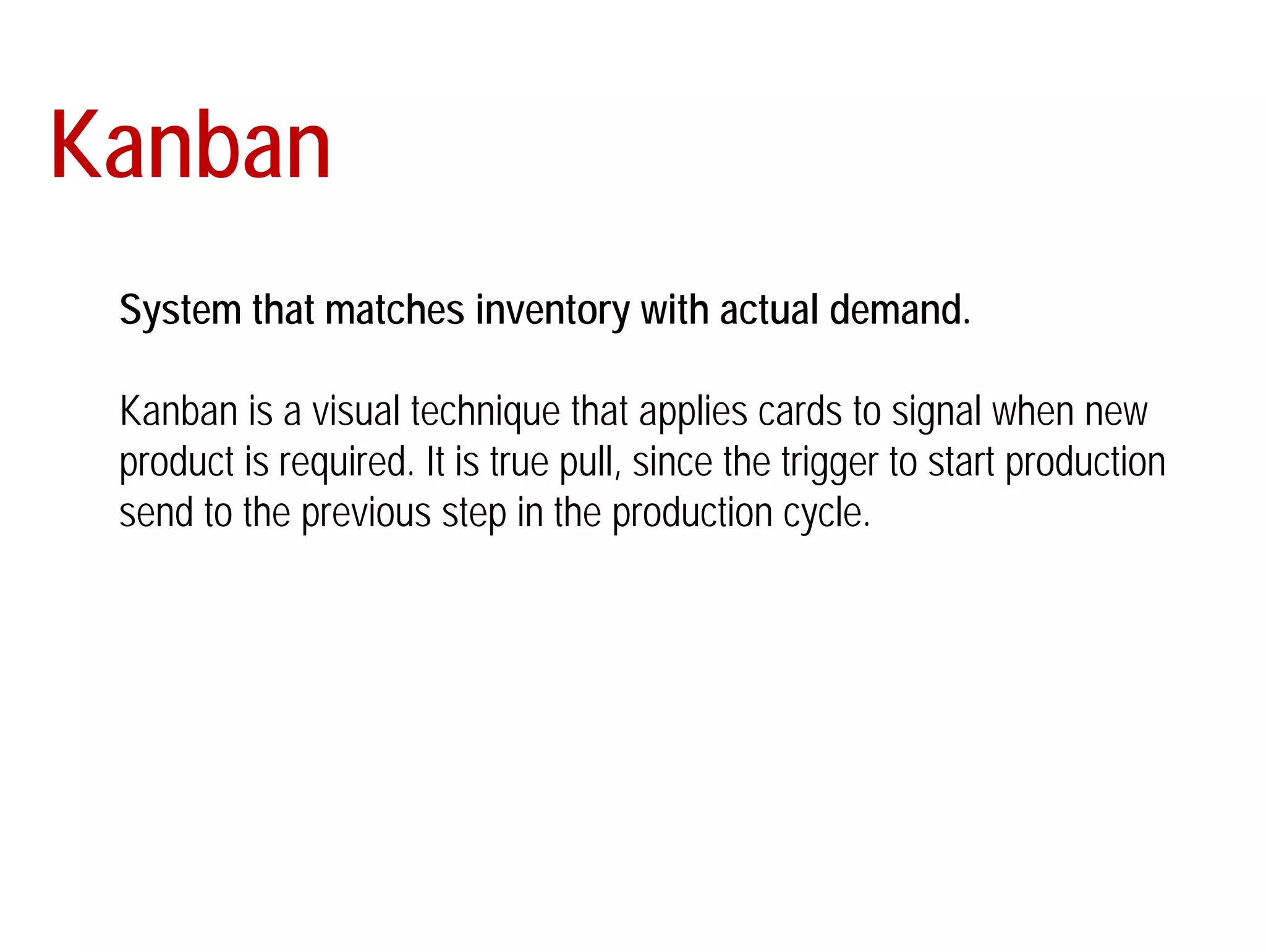
System that matches inventory with actual demand. 
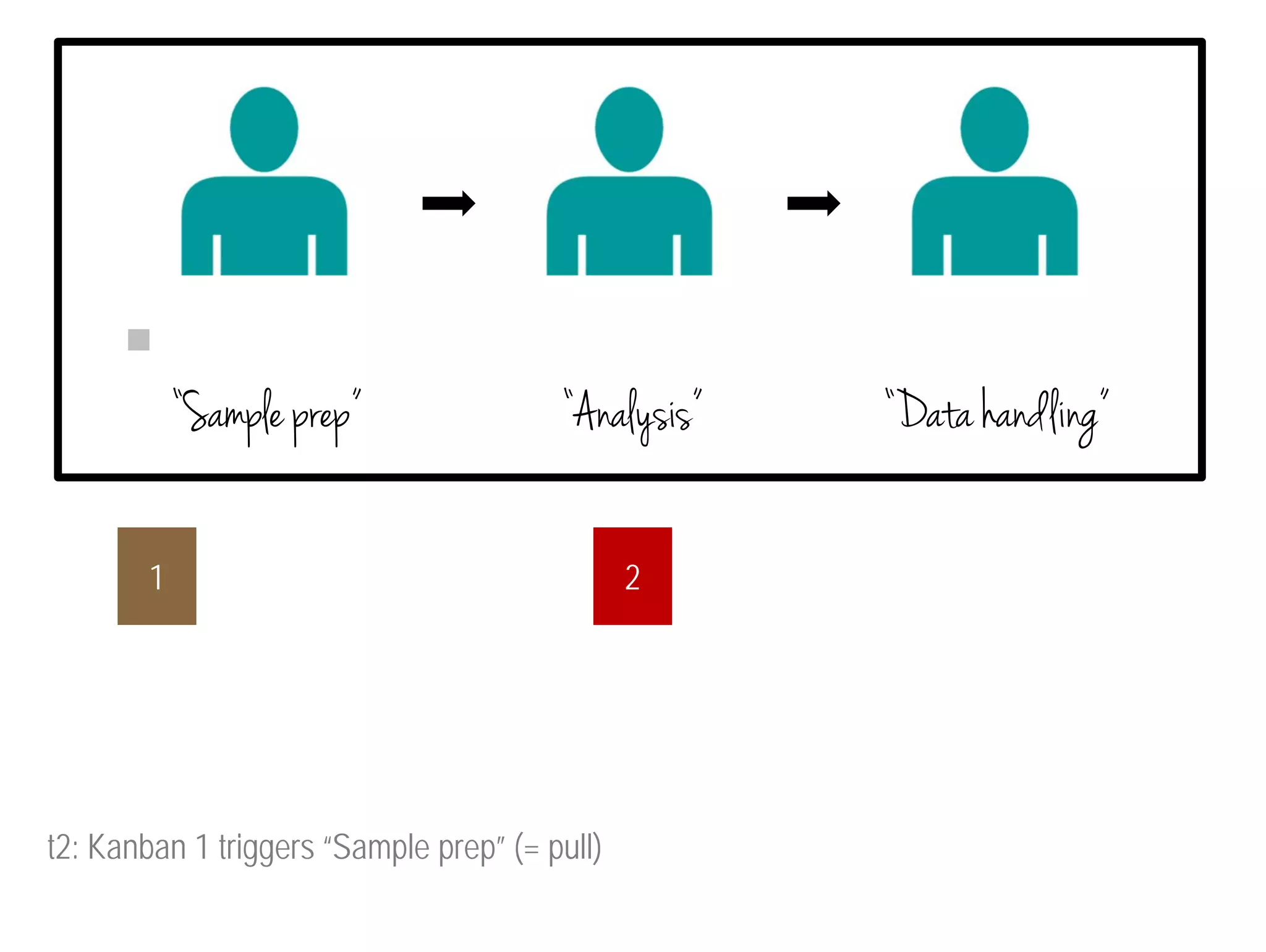
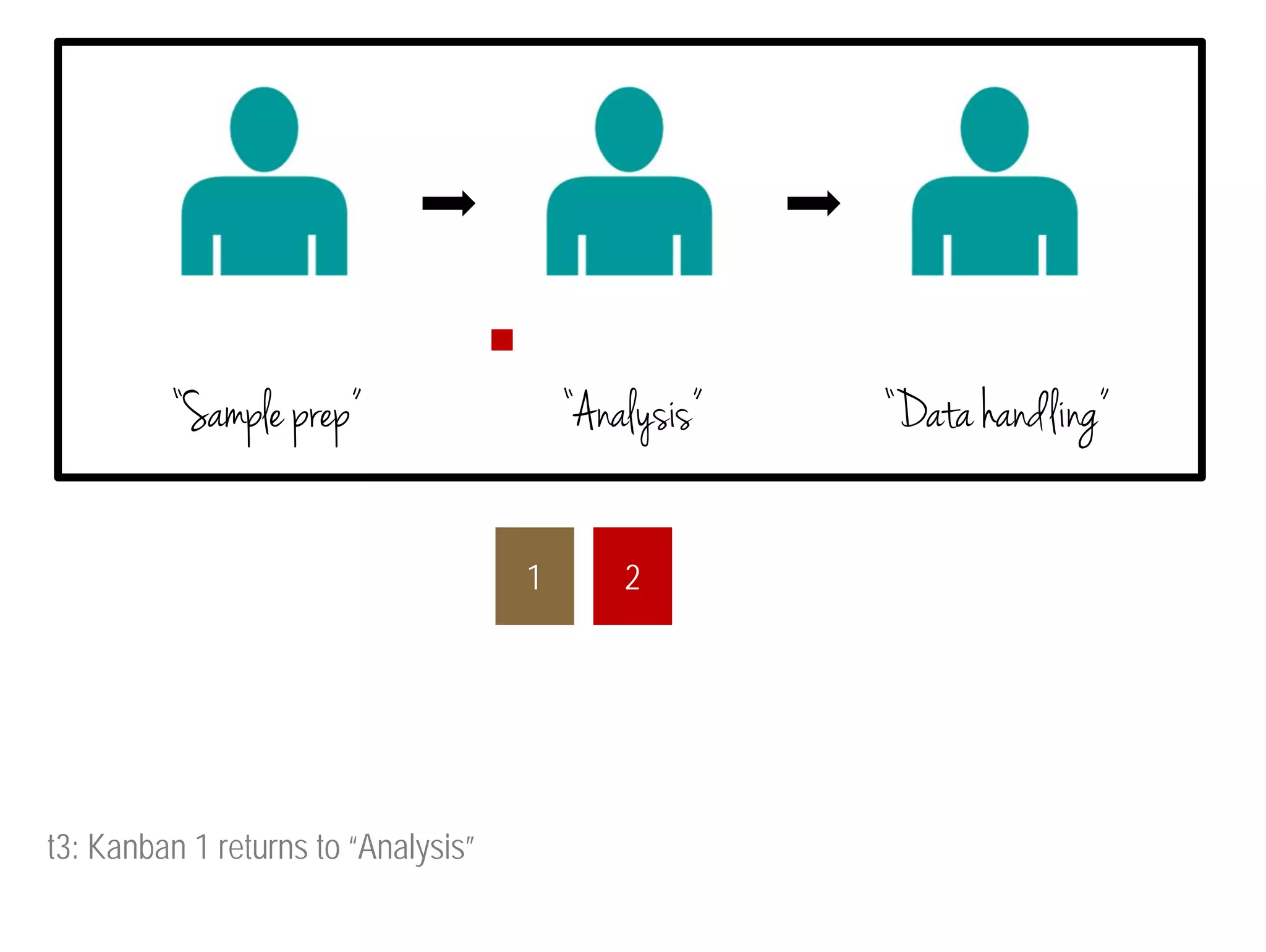
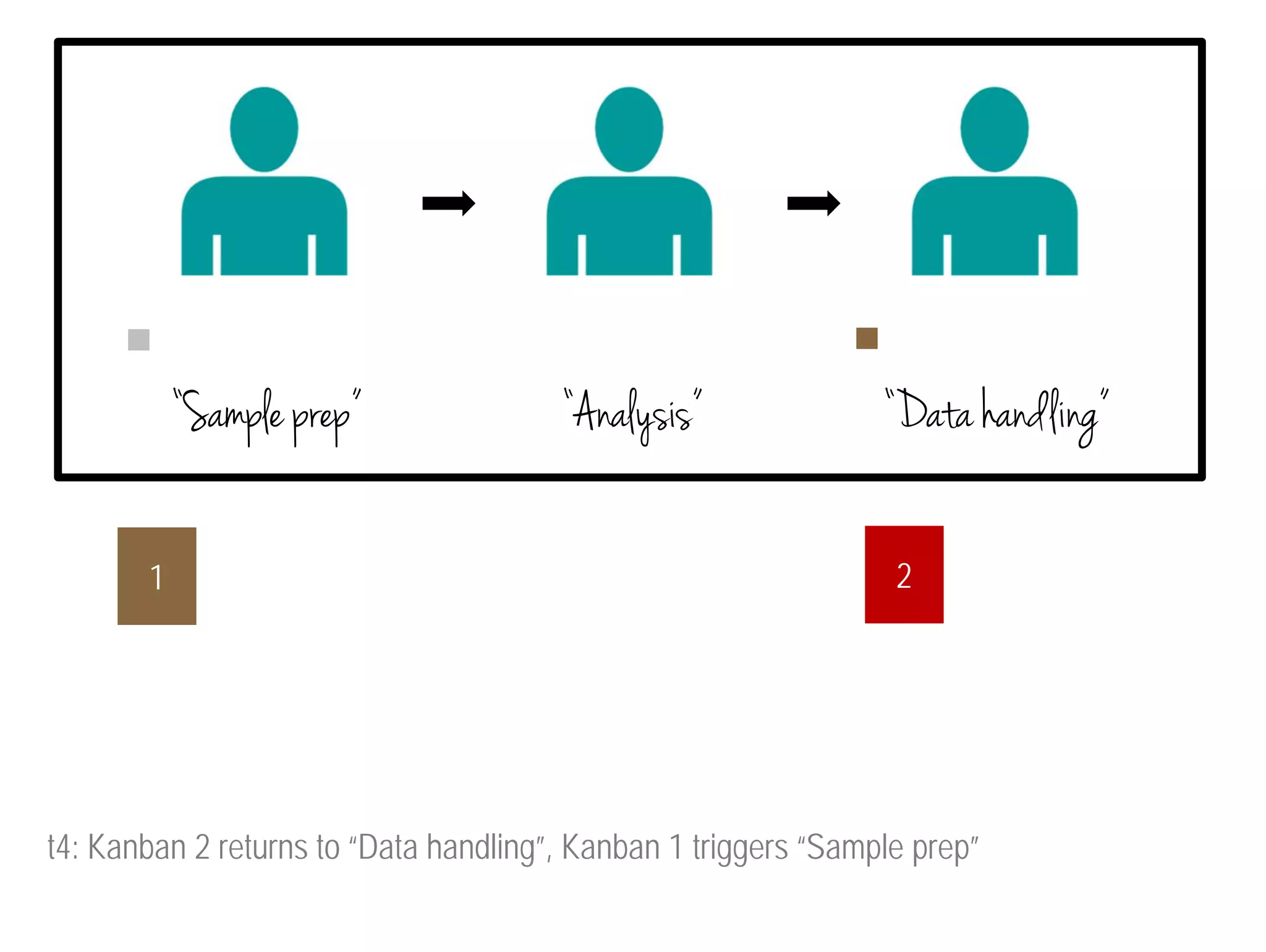
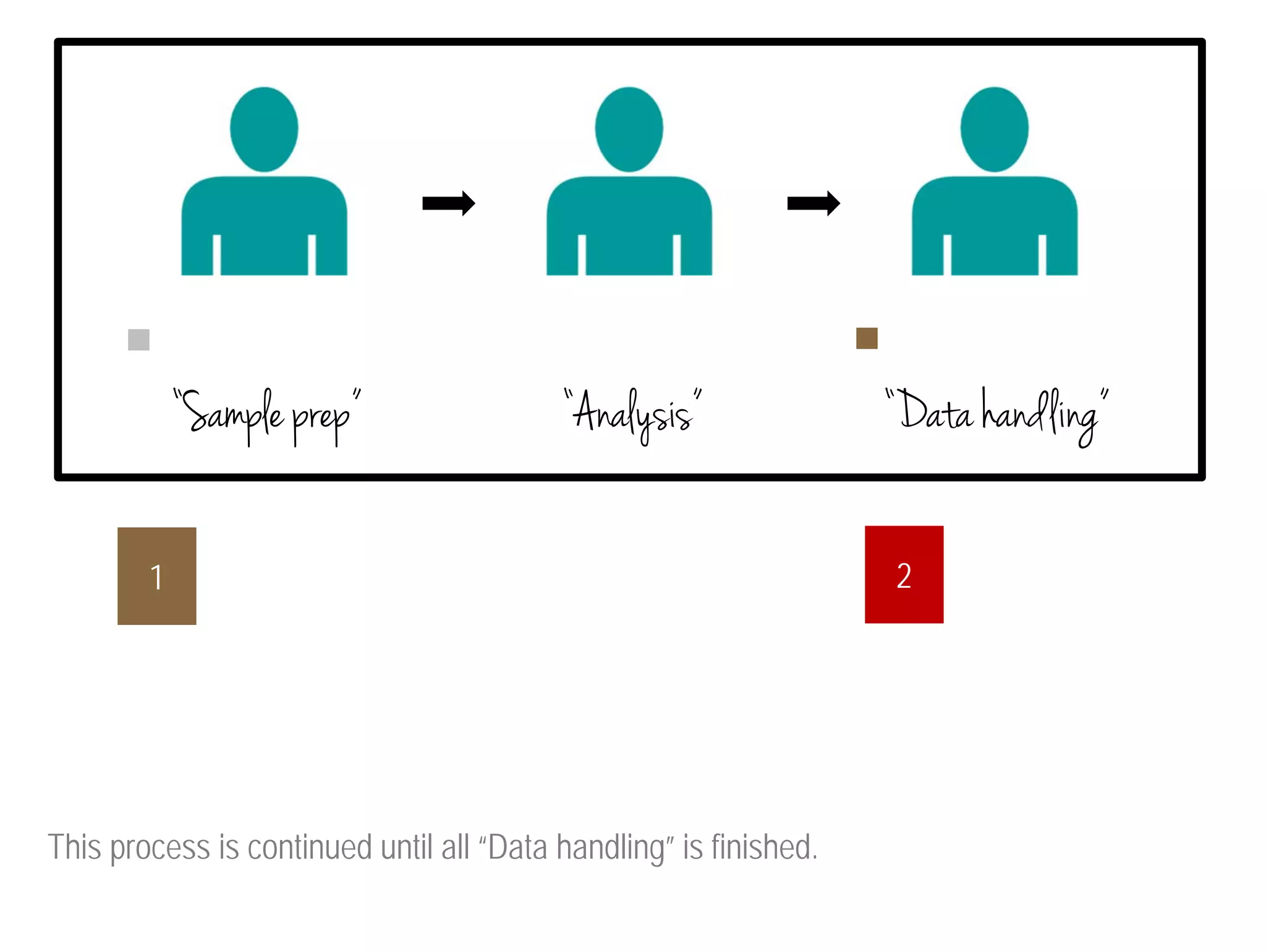
Kanban is a visual technique that applies cards to signal when new 
product is required. It is true pull, since the trigger to start production 
send to the previous step in the production cycle.
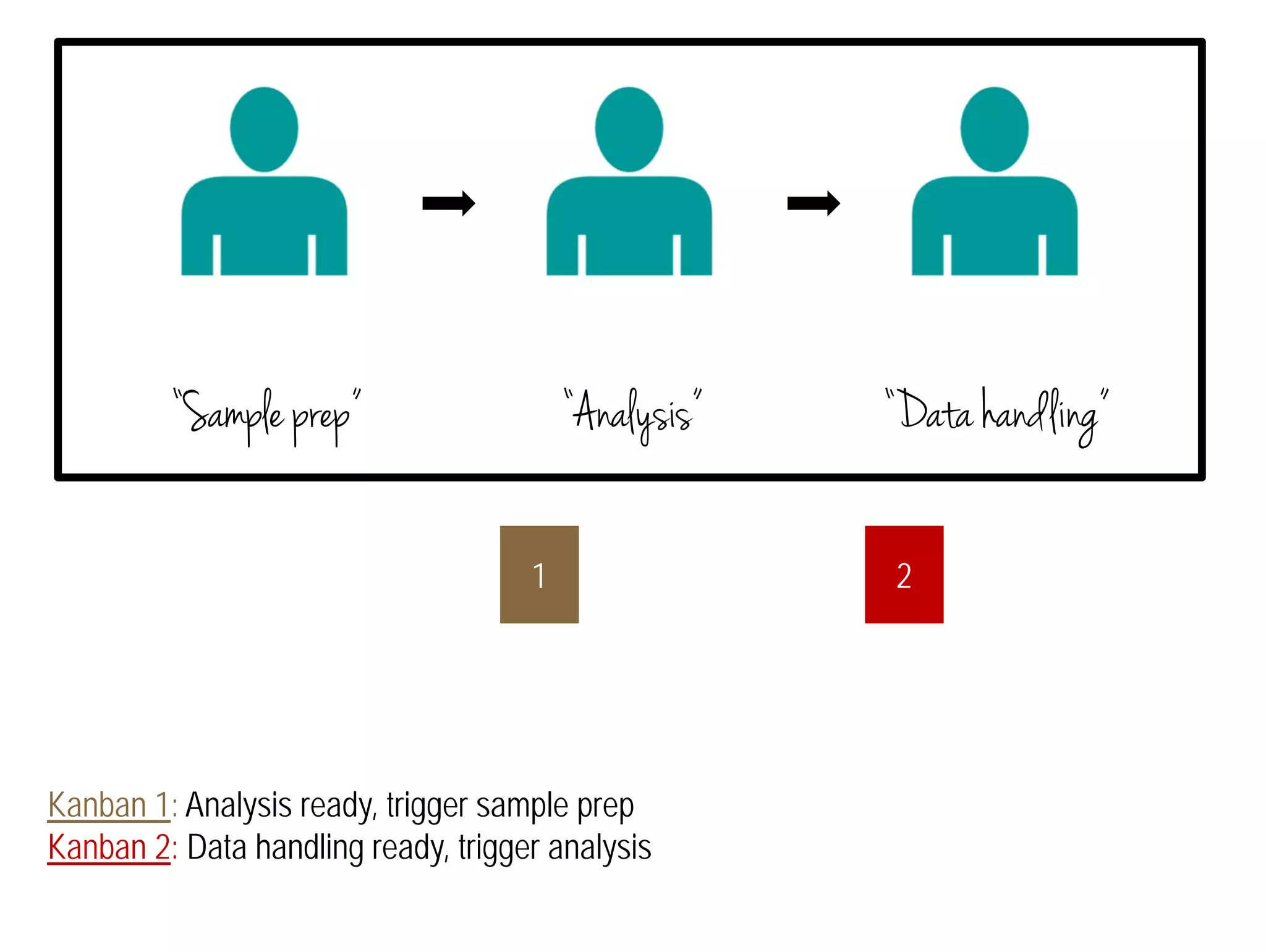
“Sample prep” “Analysis” “Data handling” 
1 2 
Kanban 1: Analysis ready, trigger sample prep 
Kanban 2: Data handling ready, trigger analysis
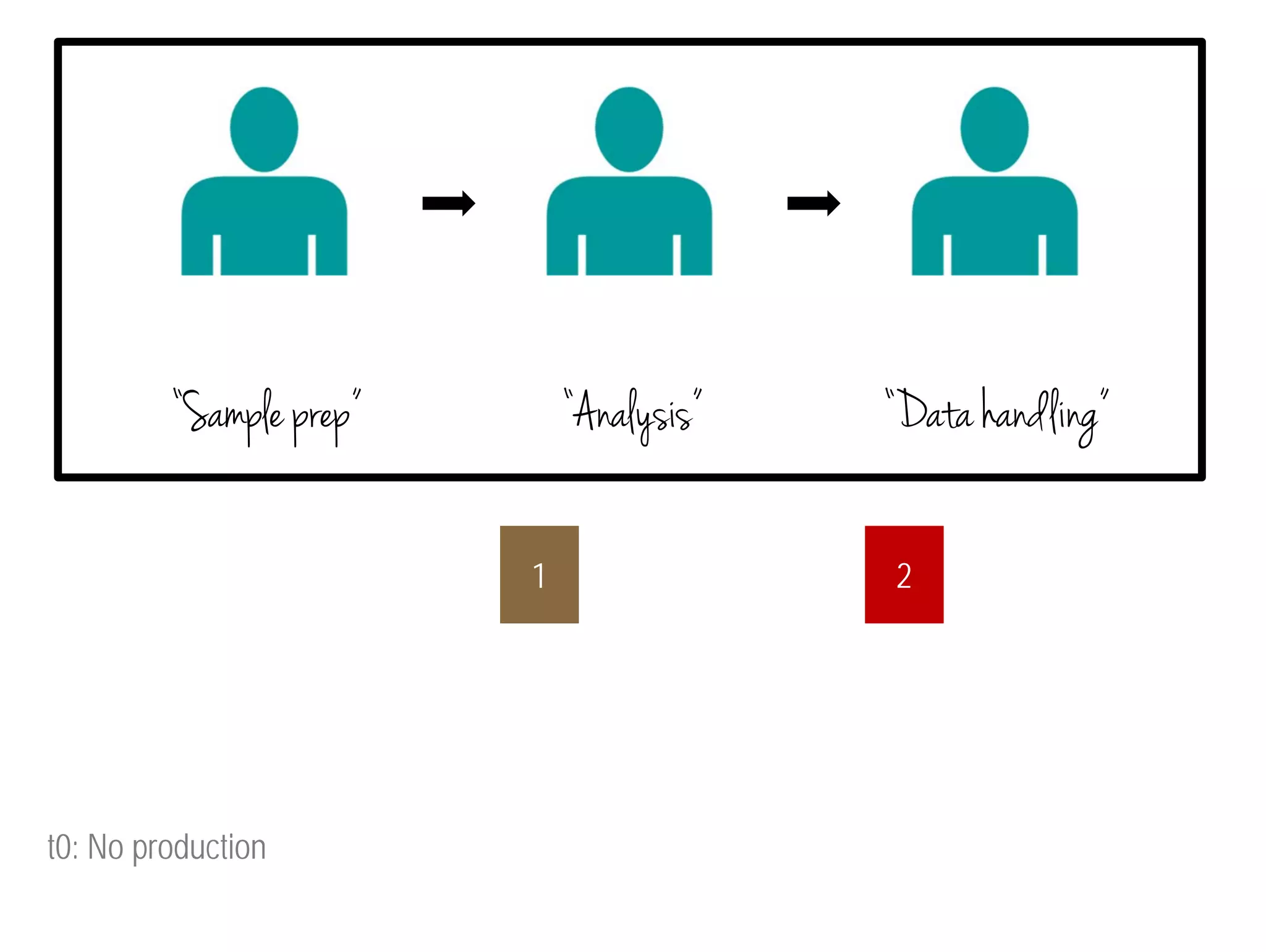
“Sample prep” “Analysis” “Data handling” 
t0: No production 
1 2
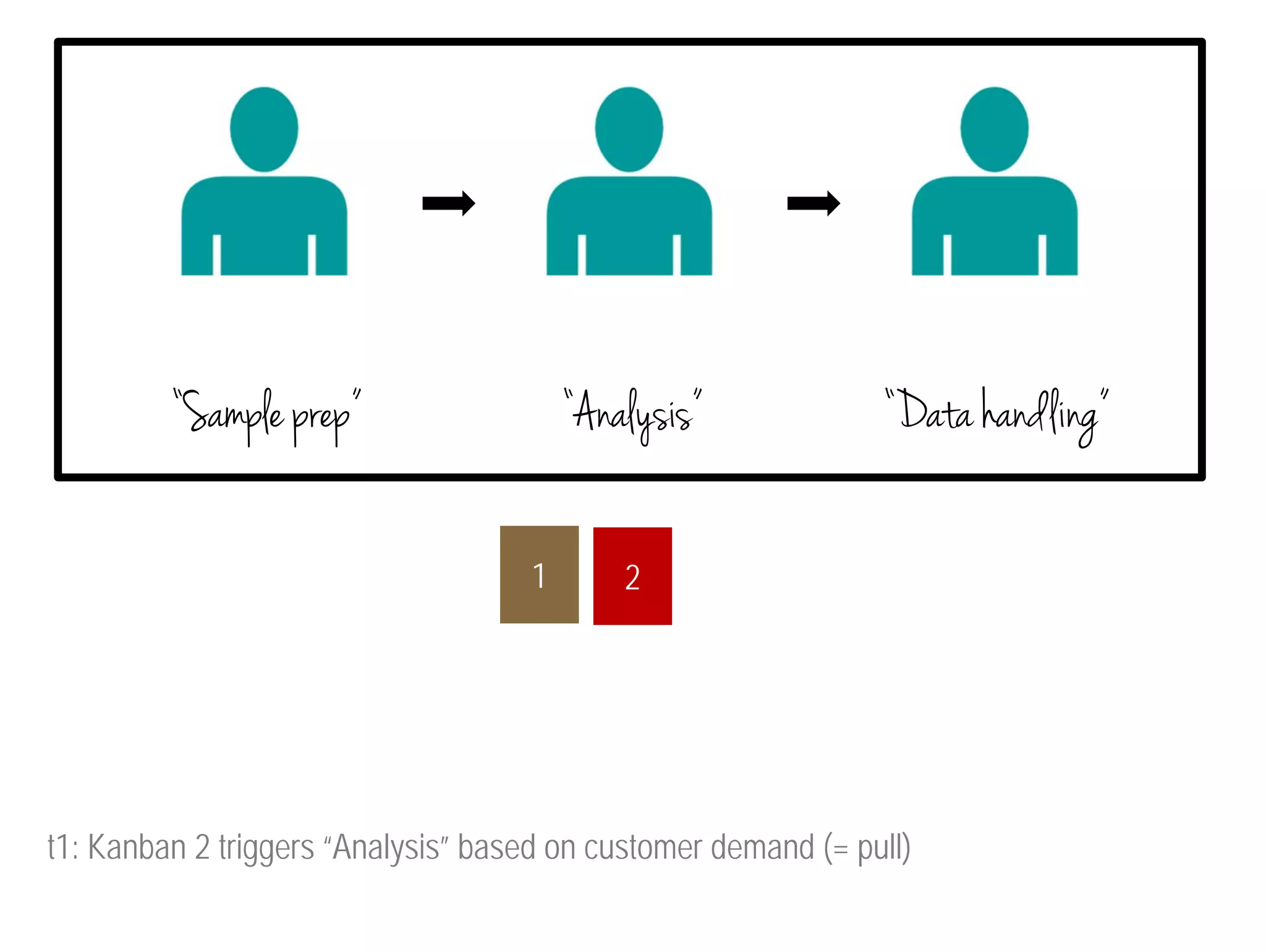
“Sample prep” “Analysis” “Data handling” 
2 
1 
t1: Kanban 2 triggers “Analysis” based on customer demand (= pull)
“Sample prep” “Analysis” “Data handling” 
1 
t2: Kanban 1 triggers “Sample prep” (= pull) 
2
“Sample prep” “Analysis” “Data handling” 
1 2 
t3: Kanban 1 returns to “Analysis”
“Sample prep” “Analysis” “Data handling” 
1 2 
t4: Kanban 2 returns to “Data handling”, Kanban 1 triggers “Sample prep”
“Sample prep” “Analysis” “Data handling” 
1 2 
This process is continued until all “Data handling” is finished.
Takt time 
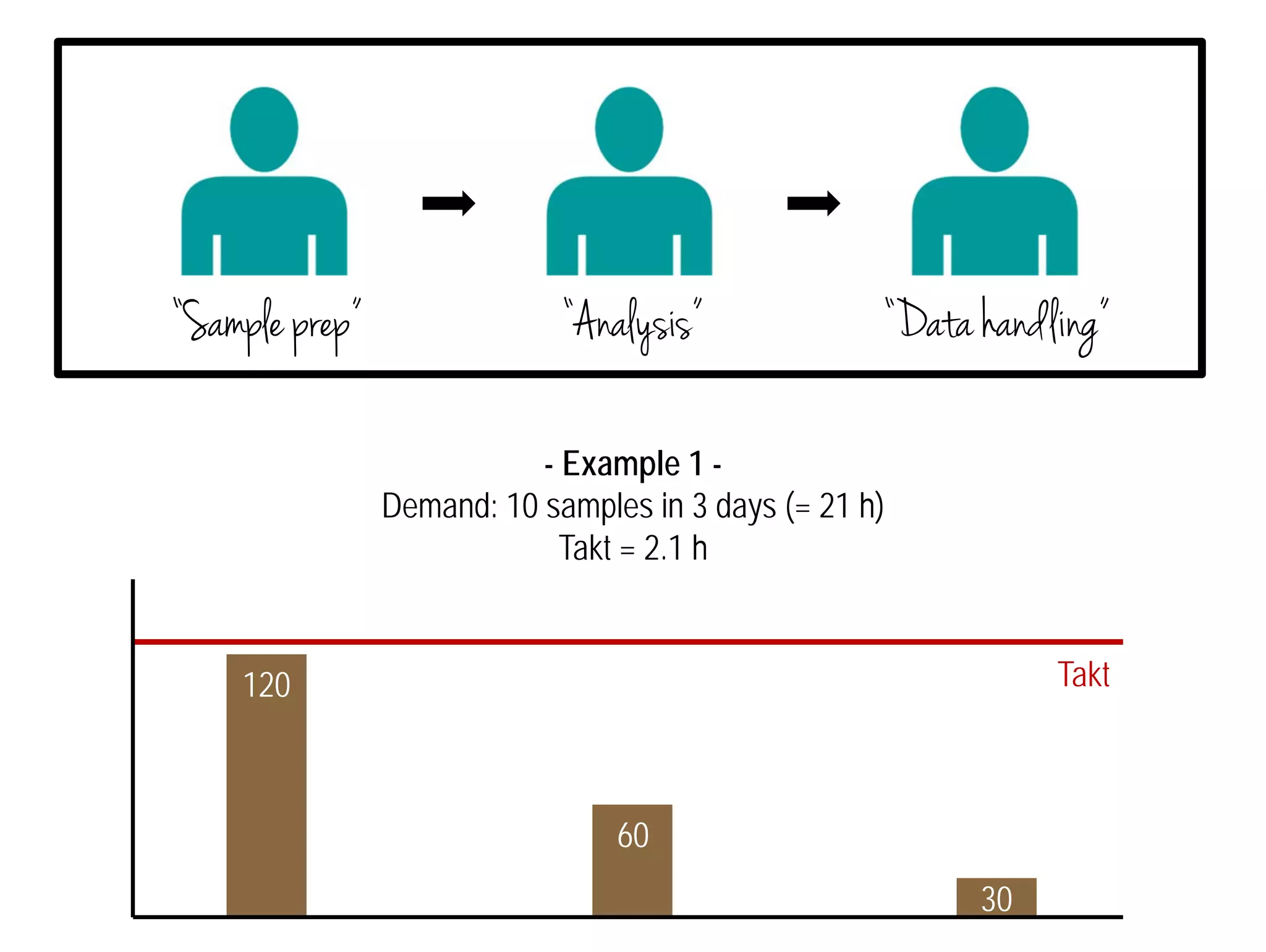
Production time needed to meet customer demand (= pull). 
If a customer needs 10 units per week for example, then the average time 
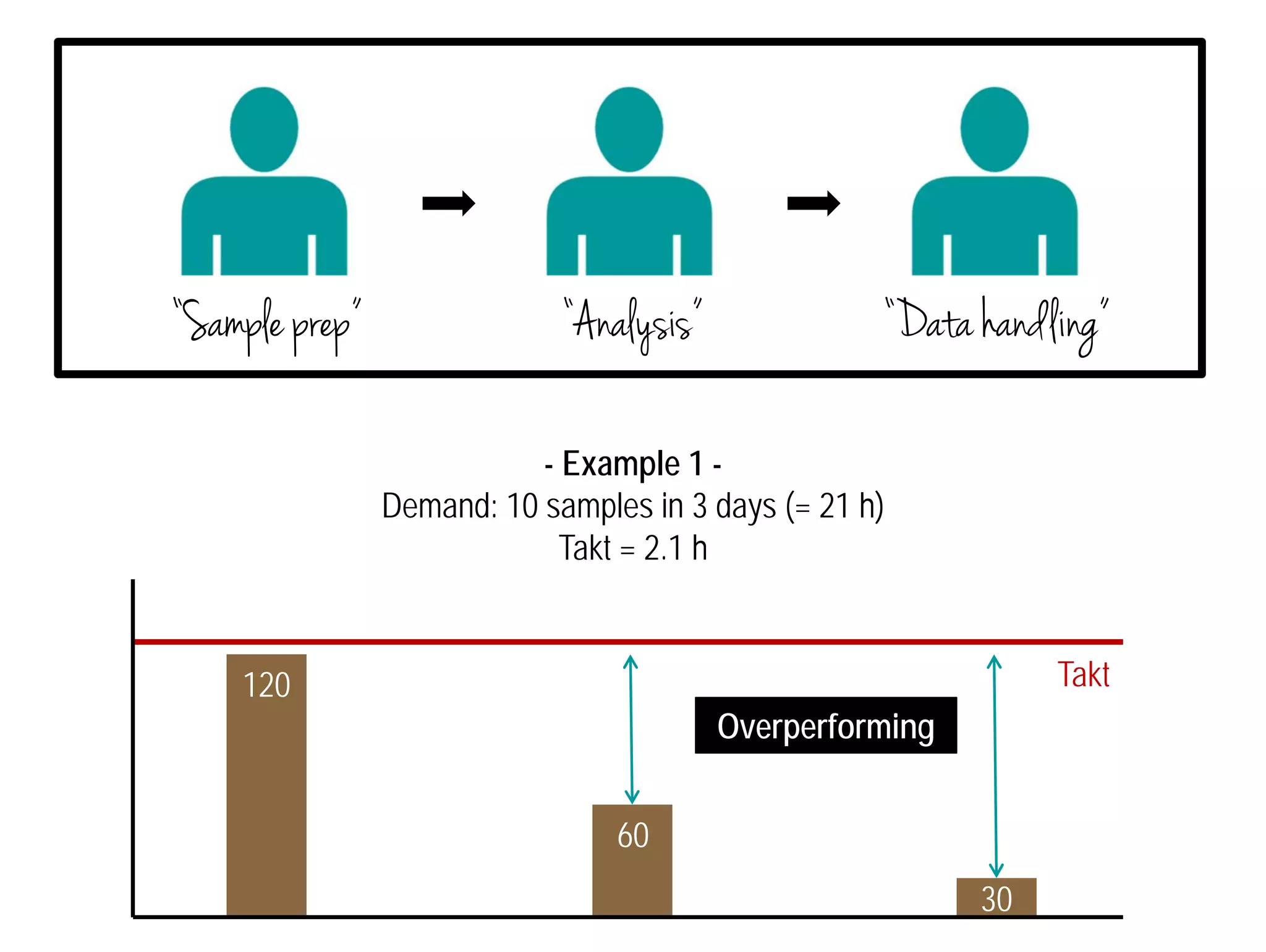
to build a single unit must be 4 hours (= takt time). Production must be 
(slightly) faster than takt time, so that it can meet customer demand 
without over or under performing. 
Available time 
Required units 
Takt =
“Sample prep” “Analysis” “Data handling” 
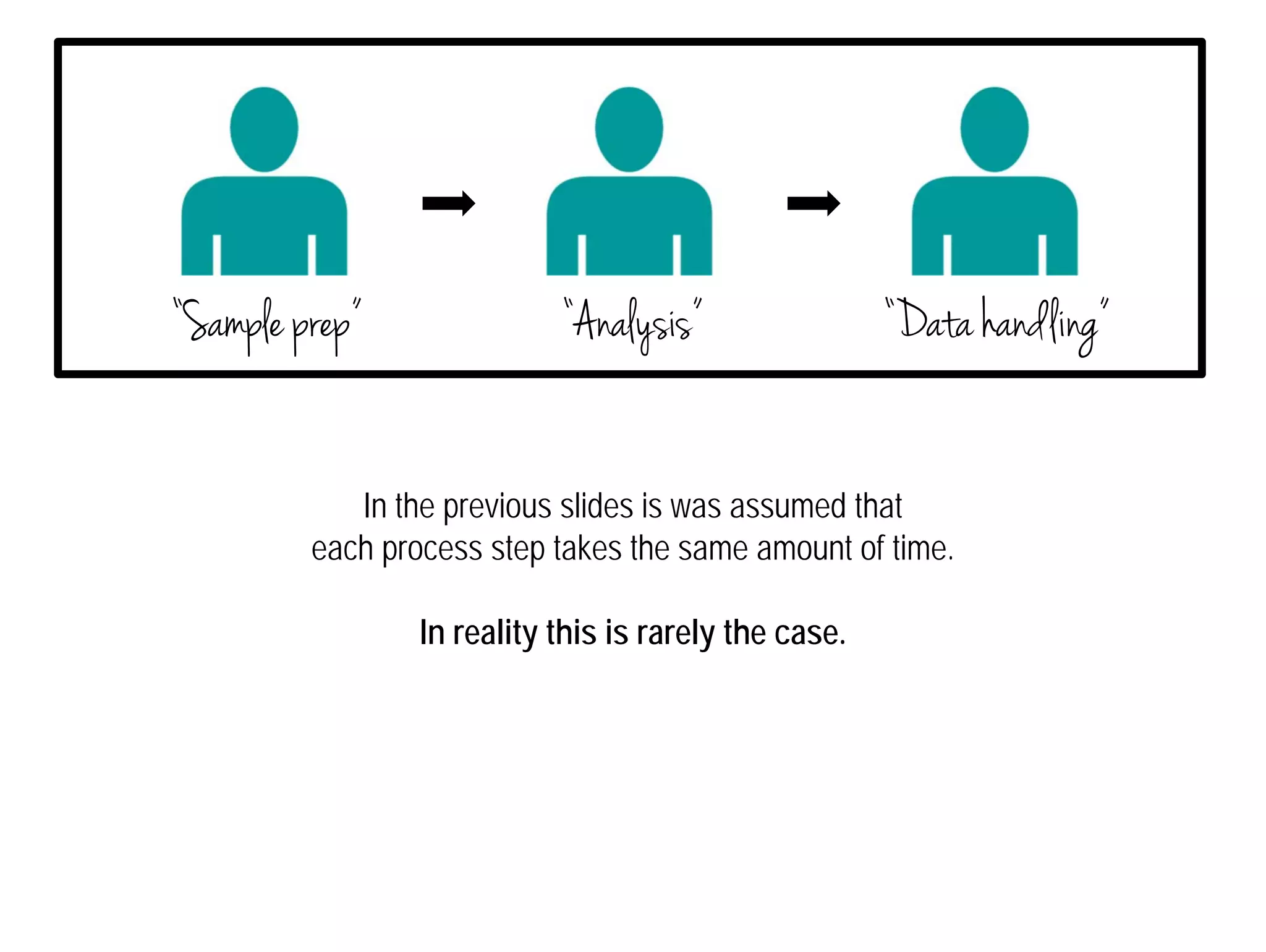
In the previous slides is was assumed that 
each process step takes the same amount of time. 
In reality this is rarely the case.
“Sample prep” “Analysis” “Data handling” 
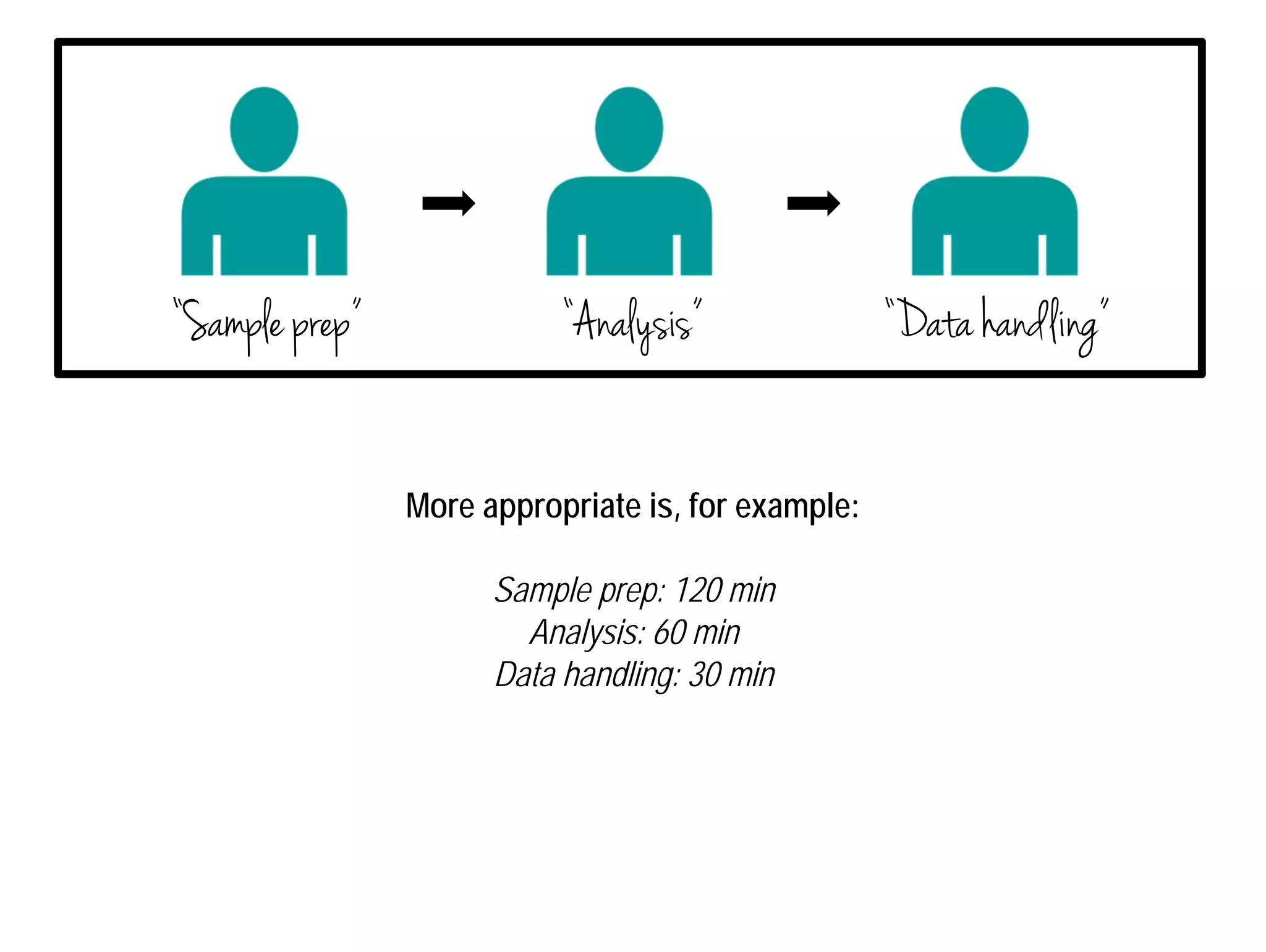
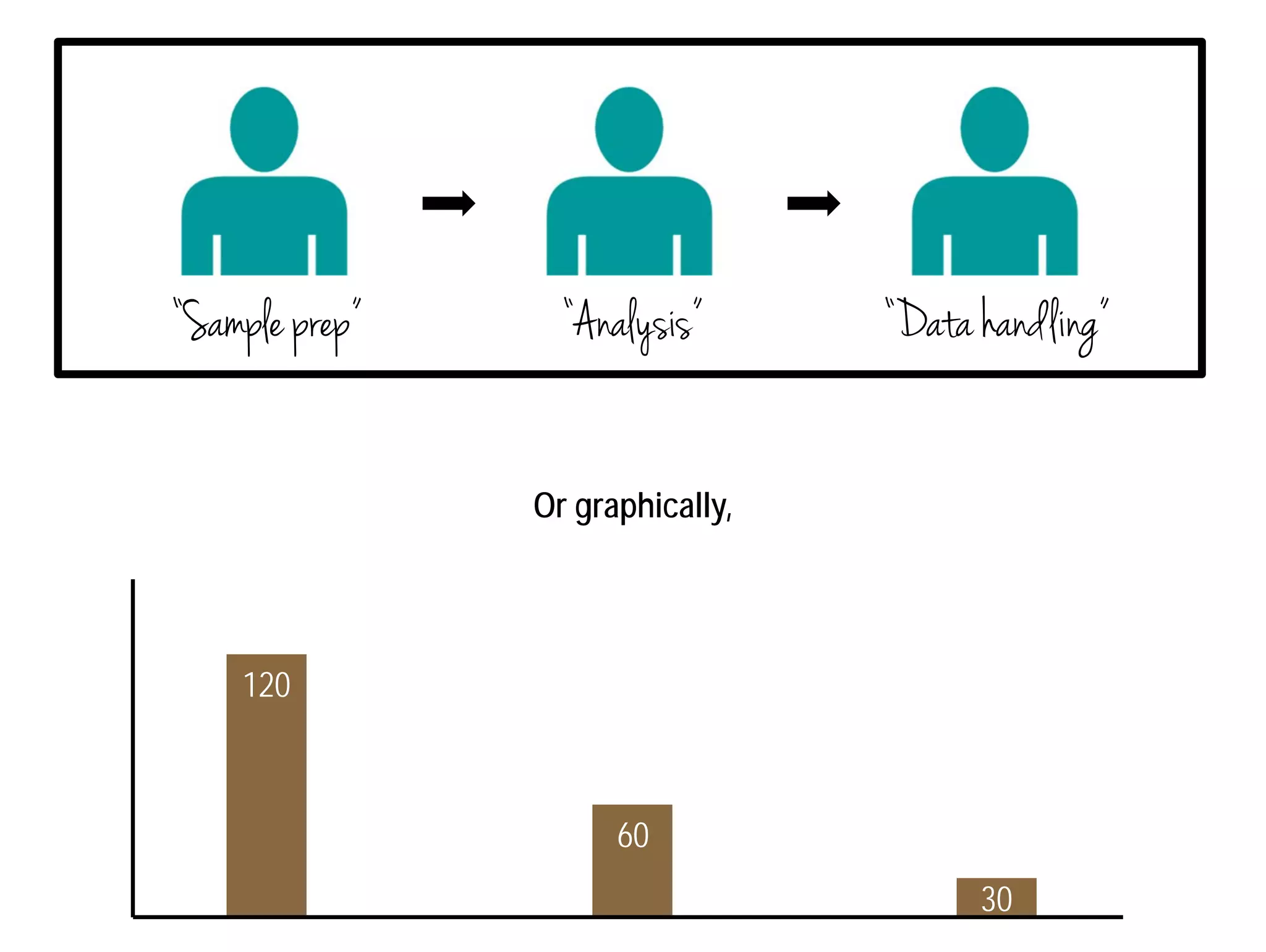
More appropriate is, for example: 
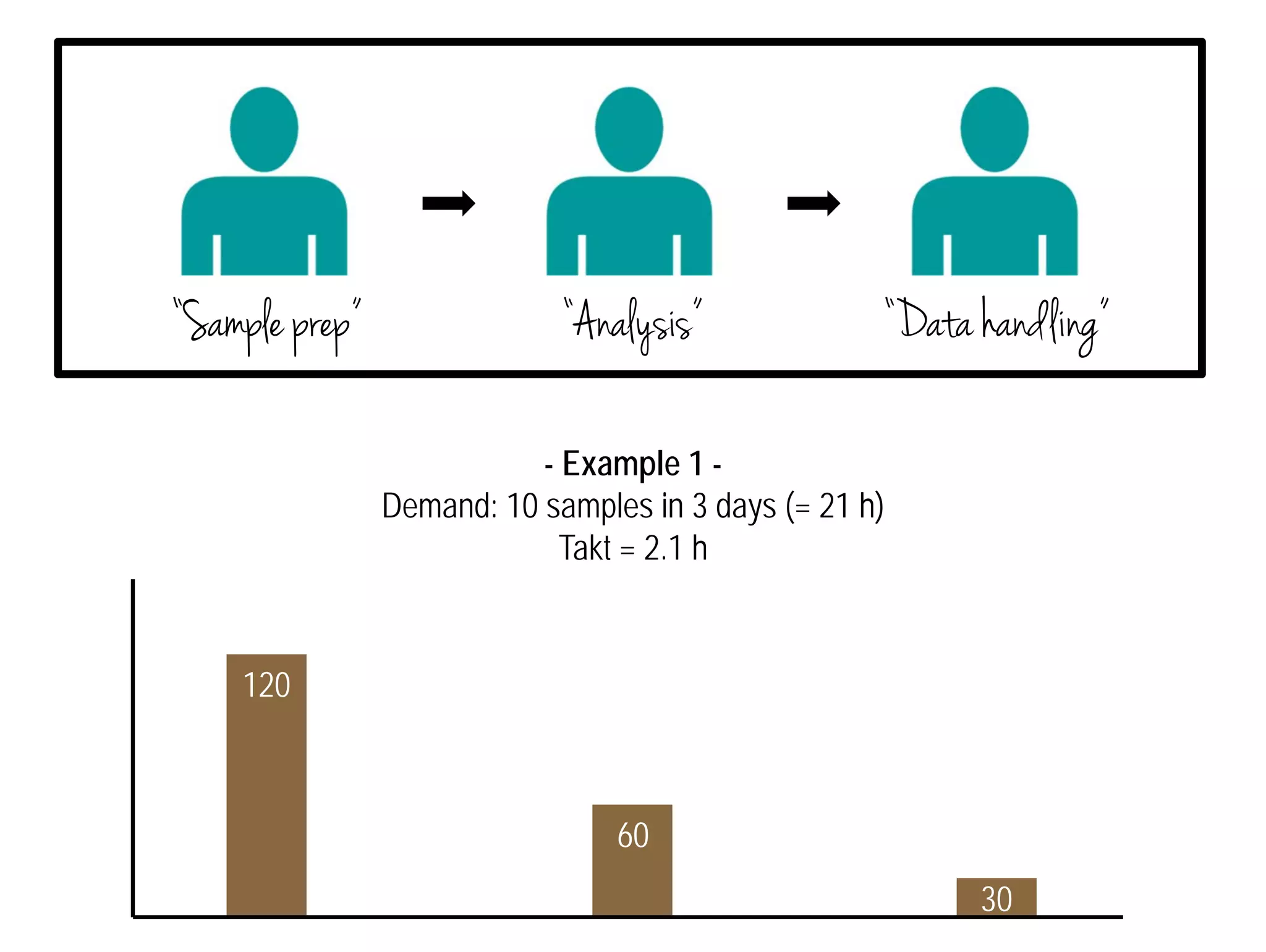
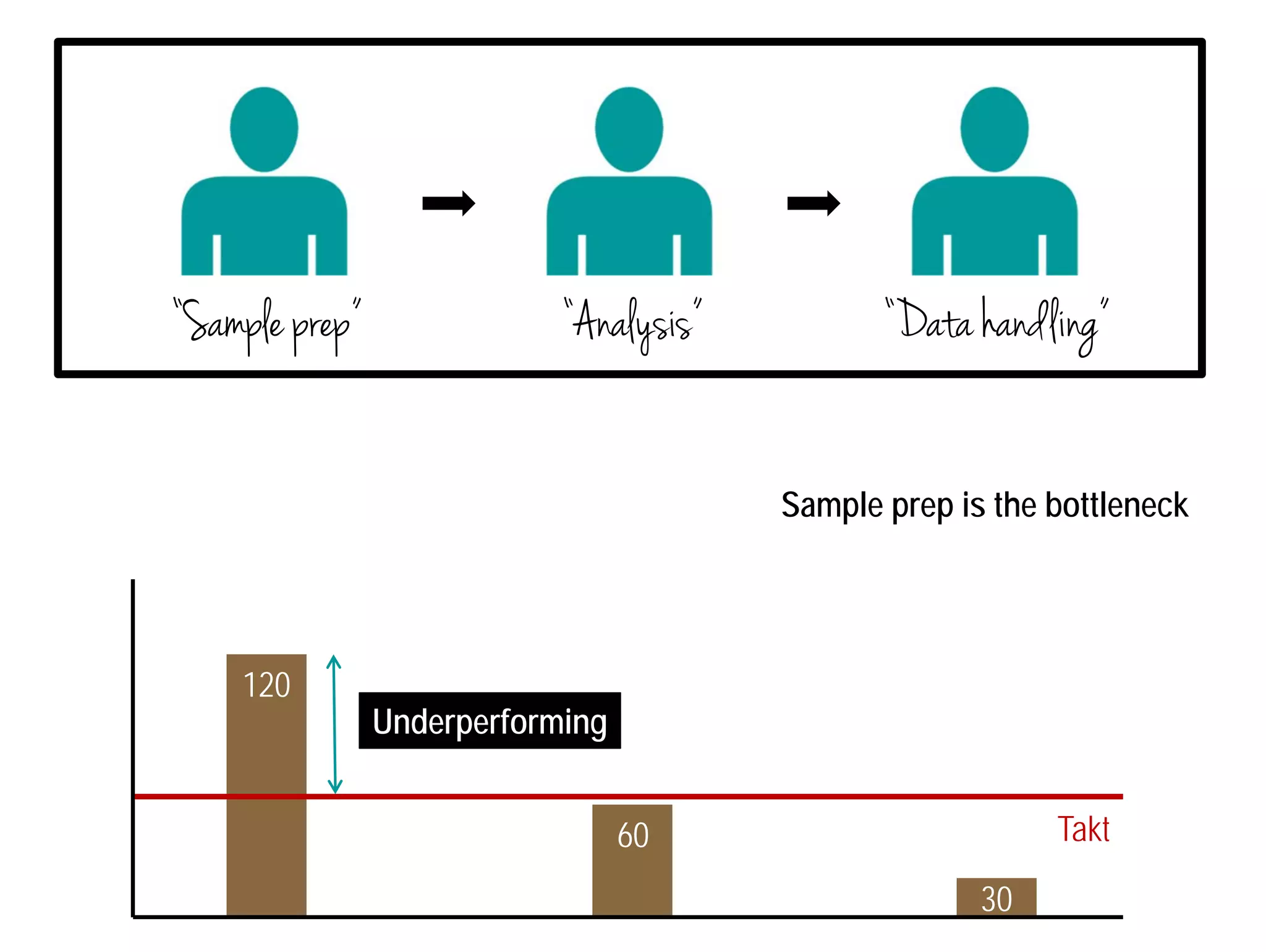
Sample prep: 120 min 
Analysis: 60 min 
Data handling: 30 min
“Sample prep” “Analysis” “Data handling” 
120 
60 
30 
Or graphically,
“Sample prep” “Analysis” “Data handling” 
- Example 1 - 
Demand: 10 samples in 3 days (= 21 h) 
Takt = 2.1 h 
120 
60 
30
“Sample prep” “Analysis” “Data handling” 
Takt 
120 
60 
30 
- Example 1 - 
Demand: 10 samples in 3 days (= 21 h) 
Takt = 2.1 h
“Sample prep” “Analysis” “Data handling” 
Takt 
Overperforming 
120 
60 
30 
- Example 1 - 
Demand: 10 samples in 3 days (= 21 h) 
Takt = 2.1 h
“Sample prep” “Analysis” “Data handling” 
Takt 
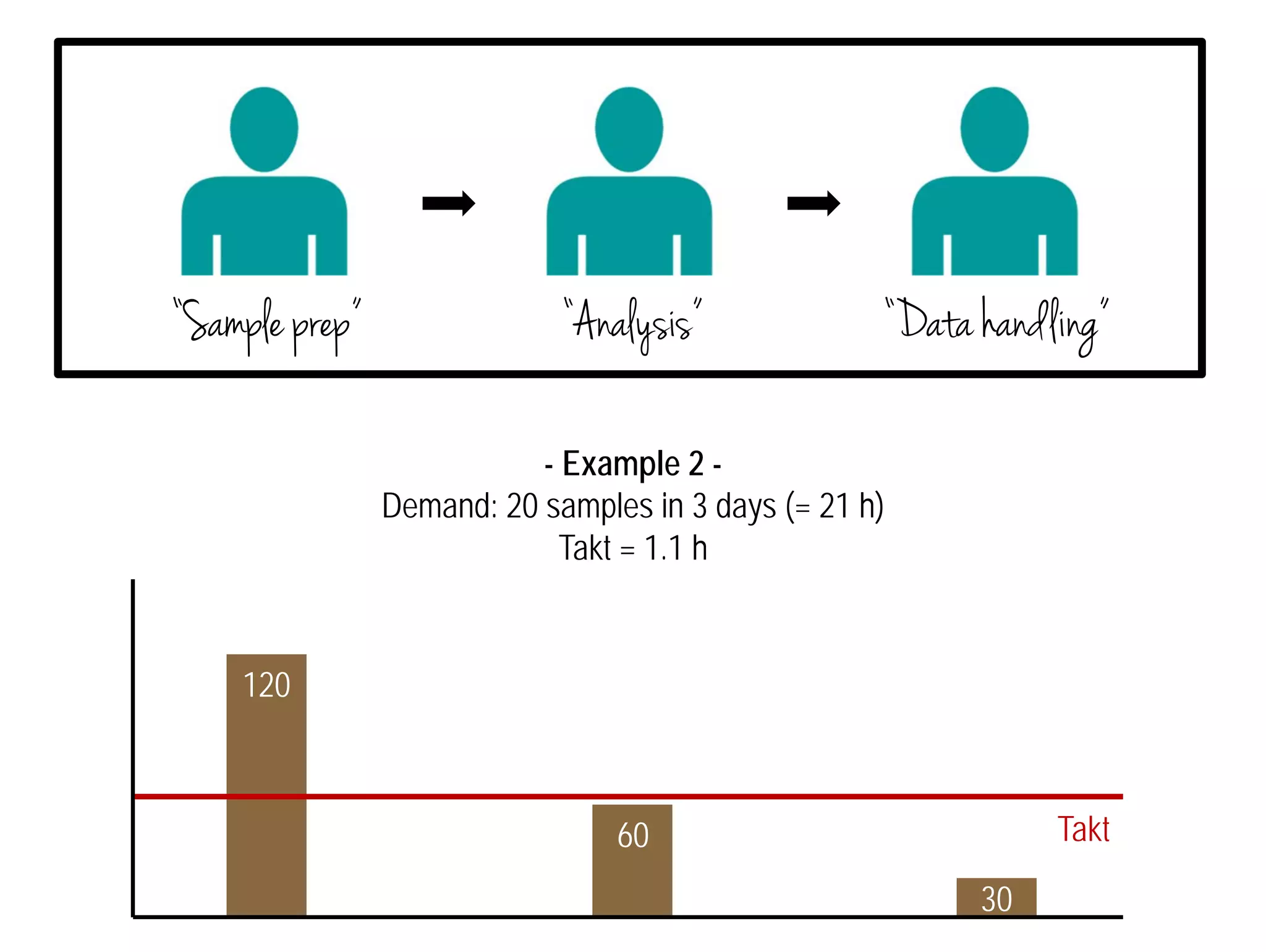
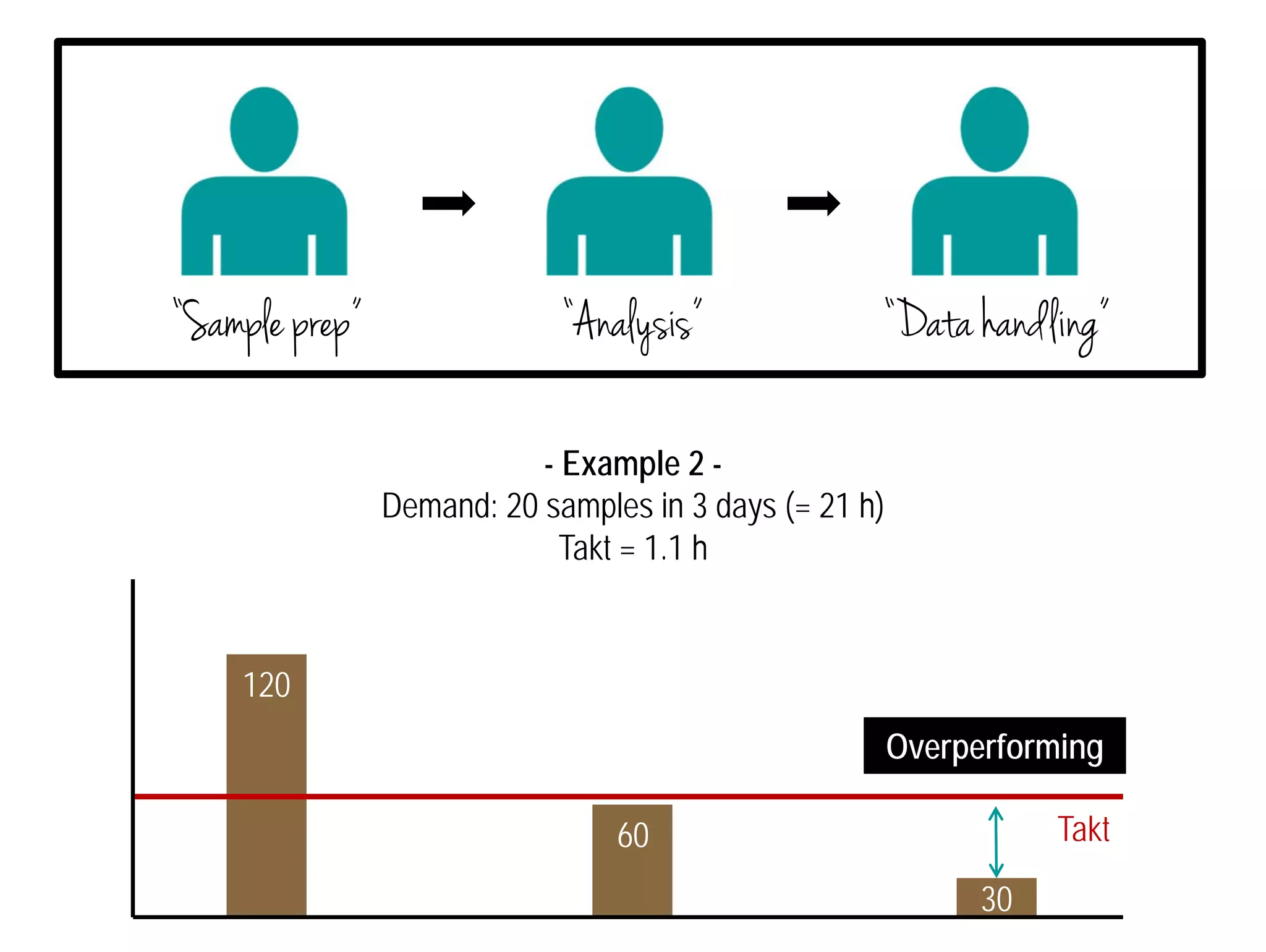
- Example 2 - 
Demand: 20 samples in 3 days (= 21 h) 
Takt = 1.1 h 
120 
60 
30
“Sample prep” “Analysis” “Data handling” 
Overperforming 
Takt 
- Example 2 - 
Demand: 20 samples in 3 days (= 21 h) 
Takt = 1.1 h 
120 
60 
30
“Sample prep” “Analysis” “Data handling” 
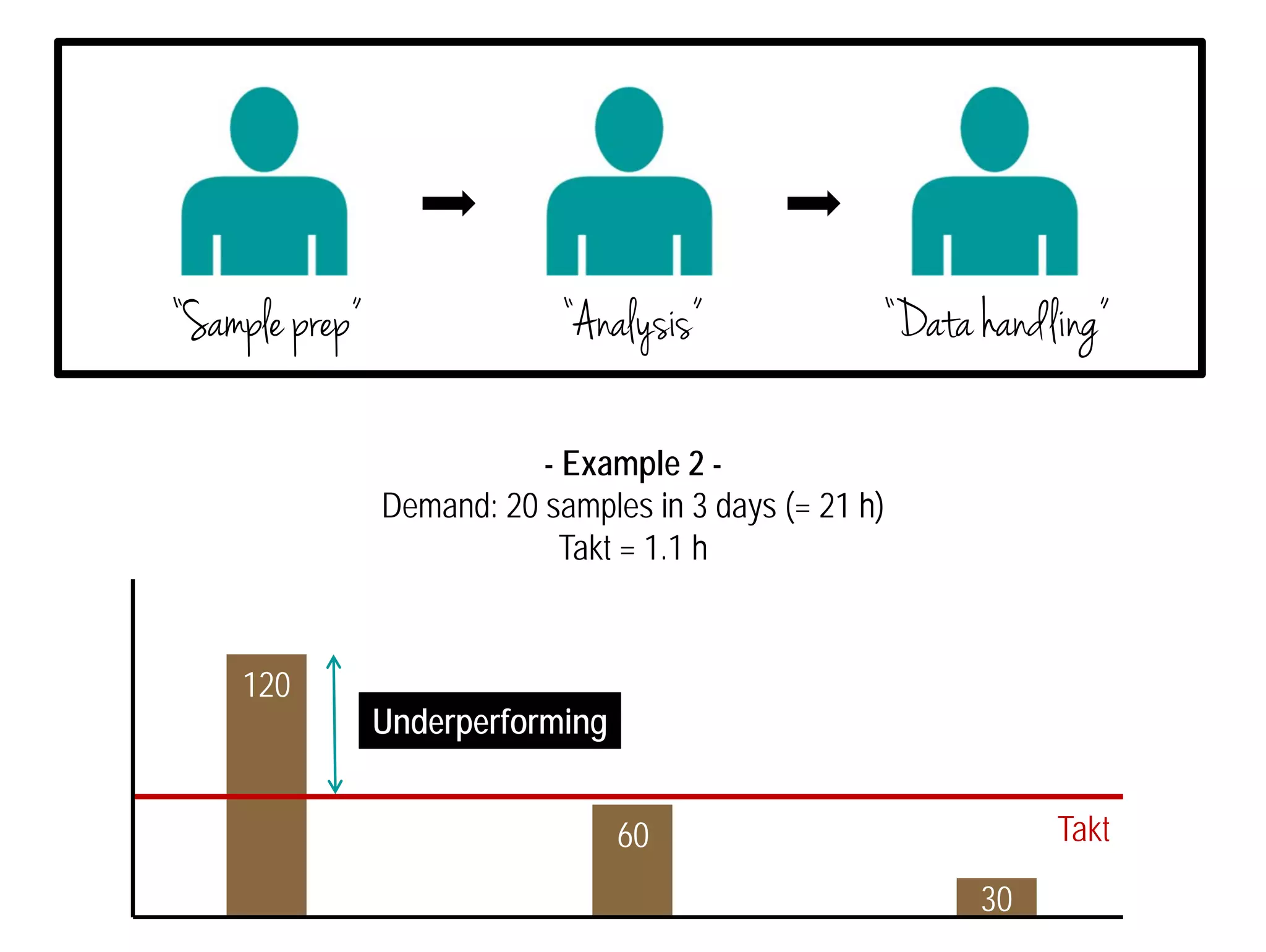
Takt 
- Example 2 - 
Demand: 20 samples in 3 days (= 21 h) 
Takt = 1.1 h 
120 
60 
30 
Underperforming
Line balancing 
Leveling the workload in a value stream. 
Lean balancing applies takt time calculations to remove bottlenecks 
and excess capacity from a process.
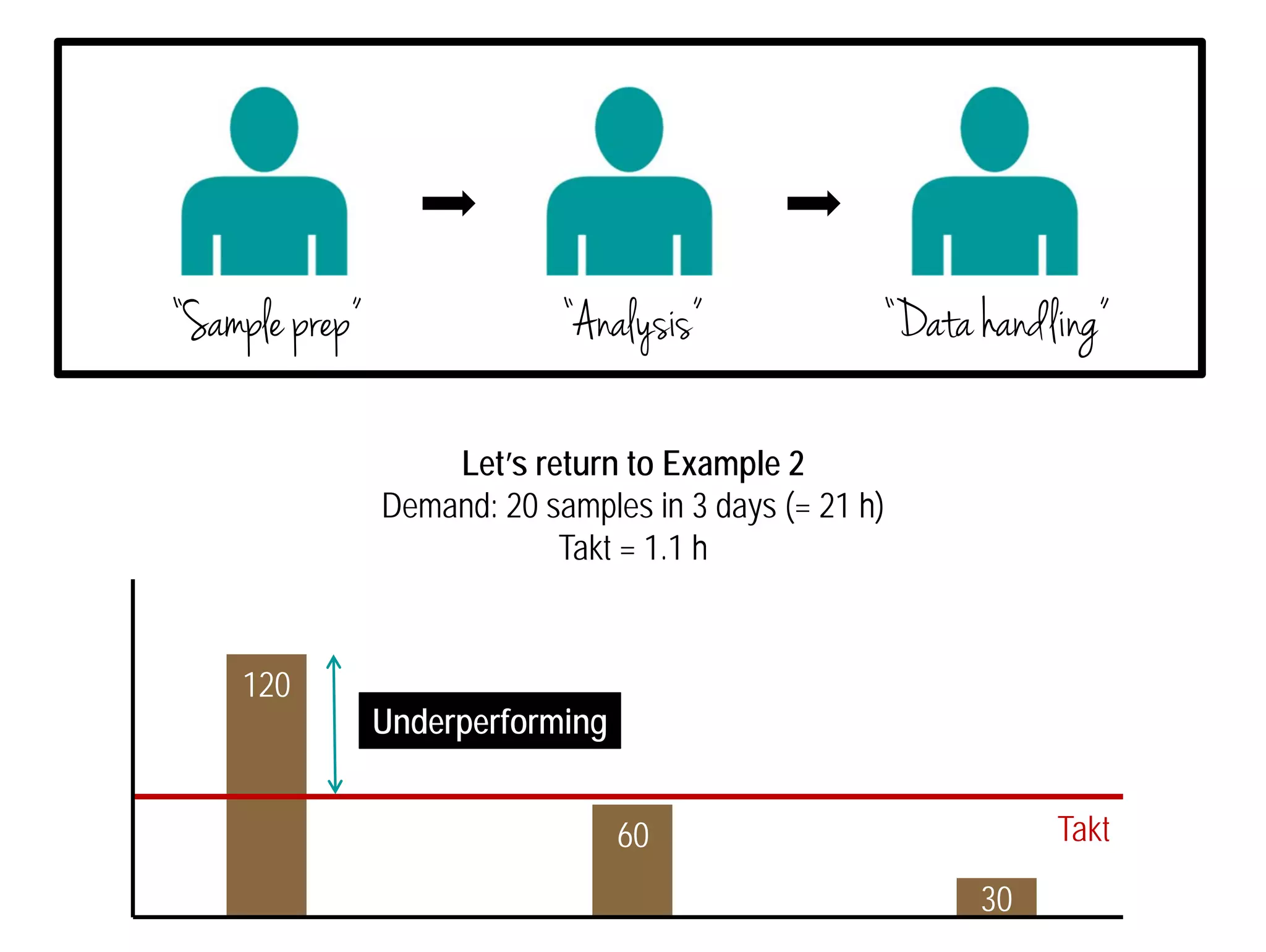
“Sample prep” “Analysis” “Data handling” 
Takt 
Let’s return to Example 2 
Demand: 20 samples in 3 days (= 21 h) 
Takt = 1.1 h 
120 
60 
30 
Underperforming
“Sample prep” “Analysis” “Data handling” 
Sample prep is the bottleneck 
Takt 
120 
60 
30 
Underperforming
“Sample prep” “Analysis” “Data handling” 
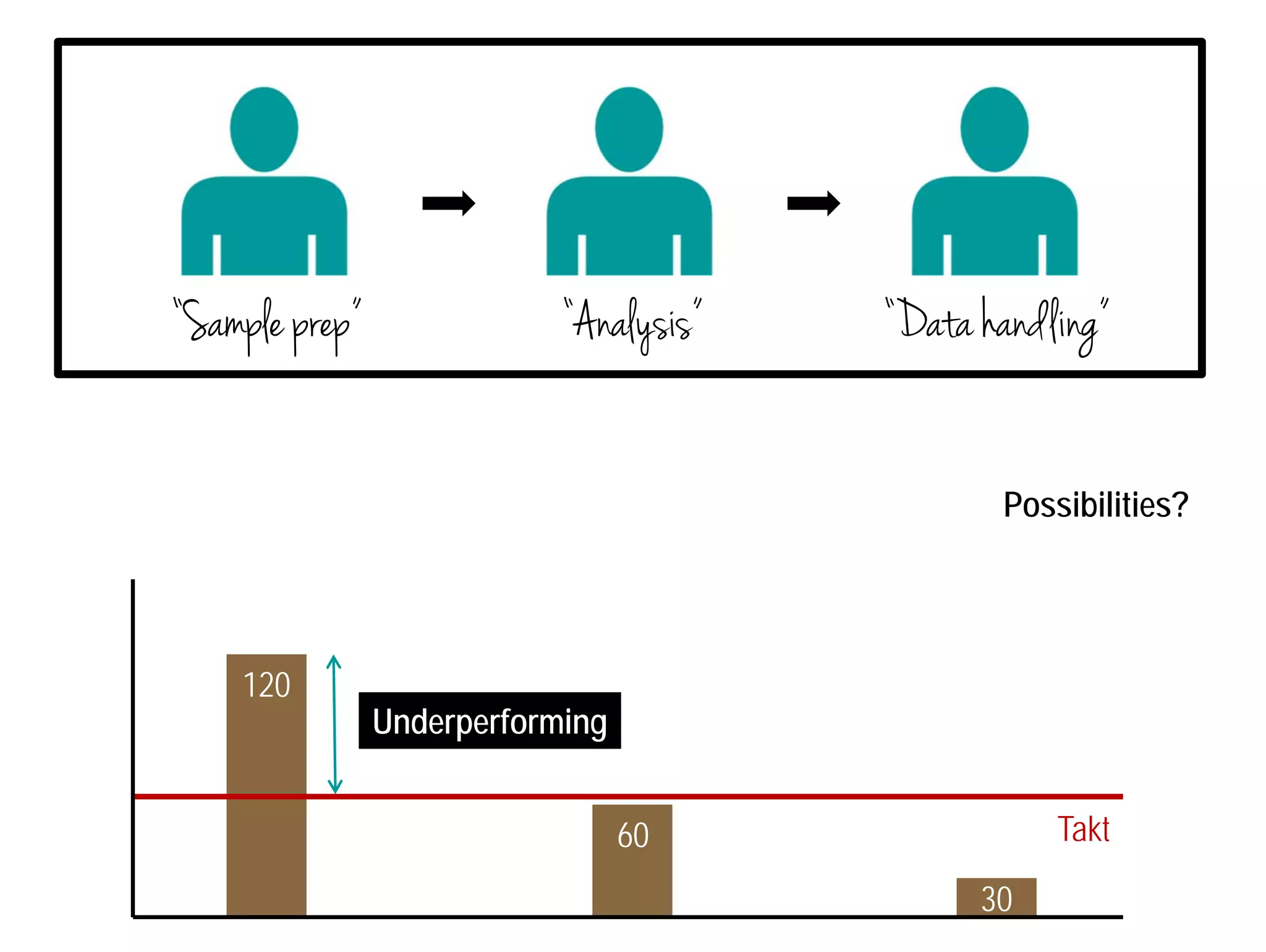
Possibilities? 
Takt 
120 
60 
30 
Underperforming
“Sample prep” “Analysis” “Data handling” 
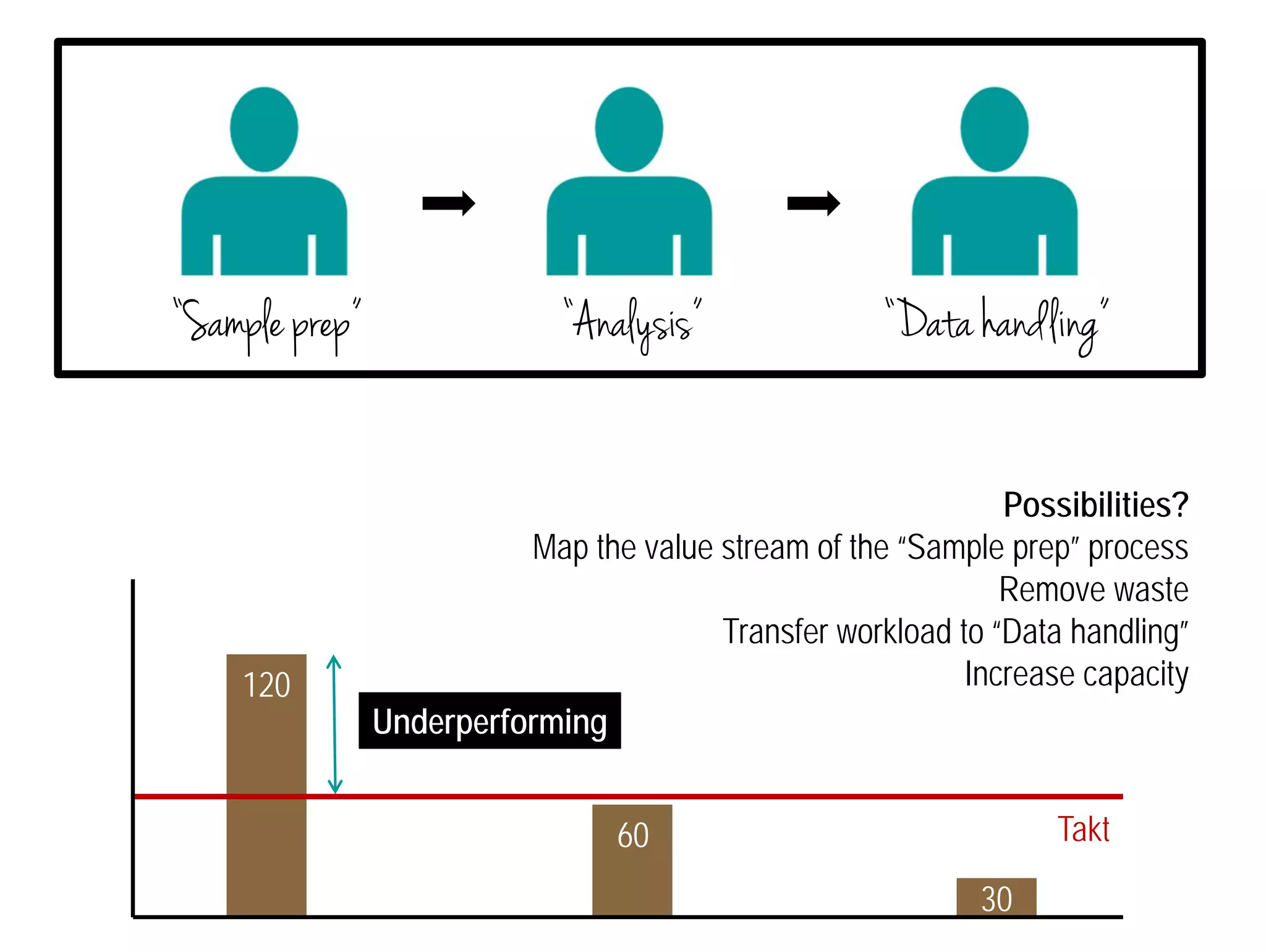
Possibilities? 
Map the value stream of the “Sample prep” process 
Remove waste 
Transfer workload to “Data handling” 
Increase capacity 
Takt 
120 
60 
30 
Underperforming
5S 
A method to organize a clean & efficient workplace. 
It involves a sustained hierarchical organization of all the tools and 
products that are needed to get a job done.
Summary 
Thinking differently – M. Cardus (Flickr)
Lean provides a strategy to release time that is 
otherwise inevitably lost in inefficient procedures. 
It provides crucial insights into how things are done. 
It is the ideal starting point 
to provoke more effective innovation.
Contact 
j.vercammen@is-x.com

Lean innovation - Basic principles of Lean

  • 1.
    LEAN innovation Basicprinciples of Lean @Joeri Vercammen
  • 2.
    Introduction Innovations inaeronautics! – J. Vaughan (Flickr)
  • 3.
    “We are livingin the age of creativity” (1) Agriculture age – Farmers (2) Industrial age – Factory workers (3) Information age – Knowledge workers (4) Conceptual age – Creators
  • 4.
             Consider unlocking creativity is crucial to economic sustainability.  http://www.adobe.com/aboutadobe/pressroom/pressreleases/201204/042312AdobeGlobalCreativityStudy.html
  • 5.
             Believe that they are living up to their own creative potential.  http://www.adobe.com/aboutadobe/pressroom/pressreleases/201204/042312AdobeGlobalCreativityStudy.html
  • 6.
    Sunflower - MHChristen (Flickr)
  • 7.
    Blue broken clock– A. Synaptic (Flickr)
  • 8.
    Lean provides: the tools to release wasted time  the insights of a structured process
  • 9.
    Lean basics ModernTimes – CNN
  • 10.
    Ford Model T: Any colour you like, provided it is black.
  • 11.
    1950 – 1980 Toyota changes its production process: worker is process owner avoid waste, low cost, high productivity Toyota I
  • 12.
    1950 – 1980 Toyota changes its production process: worker is process owner avoid waste, low cost, high productivity 1980s More Japanese cars than American in the US Toyota II
  • 13.
    1950 – 1980 Toyota changes its production process: worker is process owner avoid waste, low cost, high productivity 1980s More Japanese cars than American in the US 1990s Womack & Jones “The machine that changed the world” Toyota III
  • 14.
    Lean is ‘hot’  Lean entrepreneur  Lean startup  Lean branding  Lean UX  Lean analytics  Lean talking  Lean service design  Lean enterprise  Lean design
  • 15.
    “Lean is aphilosophy with as goal to increase productivity by systematic elimination of waste” It starts with the visualization of a process. In the broadest of sense, i.e. manufacturing, service, administration, etc
  • 16.
    1 Visualize theentire process “Sample prep” “Analysis” “Data handling” This is the value stream map
  • 17.
    2 Measure Turnaroundtime Process time Required time “Sample prep” “Analysis” “Data handling”
  • 18.
    2 Measure Turnaroundtime Process time Required time “Sample prep” “Analysis” “Data handling” How long does the entire step take? + what’s the first time right ratio?
  • 19.
    Turnaround time Processtime Required time How much time is spend on actions that create true value for the customer? 2 Measure “Sample prep” “Analysis” “Data handling”
  • 20.
    2 Measure Turnaroundtime Process time Required time “Sample prep” “Analysis” “Data handling” How much time is spend on actions that are necessary but not create true value for the customer, e.g. making reports, invoices, etc?
  • 21.
    2 Measure “Sampleprep” “Analysis” “Data handling”
  • 22.
    3 Remove allwaste “Sample prep” “Analysis” “Data handling”
  • 23.
    3 Remove allwaste “Sample prep” “Analysis” “Data handling”
  • 24.
    3 Remove allwaste 75% Typically, time reductions up to 75% can be achieved by applying Lean principles.
  • 25.
    The 7 wastes(+1) Wasting time – Mr. Birnbaum (Flickr)
  • 26.
  • 27.
    Remember Tim Woods? Transport Inventory Motion Waiting Overproduction Overprocessing Defects Skills
  • 28.
    WASTE #1 Toomuch transport (product, information)  Moving products to and from storage  Transport between workstations  Moving products and materials back and forth  Picking up signatures
  • 29.
    WASTE #2 Toomuch inventory  Too much consumables, reagents, etc…  Multiple locations  Pending documents  Open projects  Unread emails  Unused/useless data in DB
  • 30.
    Unnecessary motion ofpeople  Not everything within range  Looking in materials/documents  Looking for materials/documents 5S WASTE #3
  • 31.
    WASTE #4 Waiting…  For the previous process step  For equipment to be ready/available  For outpu/results (runtime)  For approval  For maintenance, (technical) assistance
  • 32.
    WASTE #5 Overproduction  Too much reagents, standards, etc…  Too much samples  Too much data  Making reports that are never read  Making an extra copy (endless cc-ing)
  • 33.
    WASTE #6 Overprocessing  Unnecessary re-analysis/calibrations  Doublechecks  Validation  Over-complicated procedures  Double documents
  • 34.
    WASTE #7 Defects  Instrument failures  Retesting  Variation  Wrong data input  Missing information  No procedure
  • 35.
    WASTE #8 Skills  Underutilizing skills of people  Lack of decent training  Not using people’s creativity
  • 36.
    Some Lean tools Old tools – J.M. Rosell (Flickr)
  • 37.
    Main sources ofwaste are:  Waiting  Overproduction & overprocessing leading to inventory  Motion
  • 38.
    FLOW & PULL A simple way to address these wastes (similar to the assembly line in a car manufacturing plant)
  • 39.
    FLOW & PULL A simple way to address these issues = make sure that a product never stops from the moment the production process is launched. (similar to the assembly line in a car manufacturing plant)
  • 40.
    FLOW & PULL A simple way to address these issues = the subsequent process step signals when ready to accept new product. (similar to the assembly line in a car manufacturing plant)
  • 41.
    [The tools] PDCA 5 Whys One-piece flow Kanban Takt time Line balancing 5S
  • 42.
    Kaizen Continuous improvement. Kaizen is derived from two Japanese characters; kai, meaning ‘change’ and zen meaning ‘good’. It aims at continuously eliminating waste from the value stream. Therefore, it applies the so-called PDCA cycle.
  • 43.
  • 44.
    Plan Do Check Act What’s going? What are the facts? What could be done?
  • 45.
    Plan Do Check Act What’s going? What are the facts? What could be done? Put the plan into action. Measure the result.
  • 46.
    Plan Do Check Act What’s going? What are the facts? What could be done? Put the plan into action. What happened? Measure the result. Was it what was expected? What should we do differently?
  • 47.
    Plan Do Check Measure the new process Make sure change is permanent Act What’s going? What are the facts? What could be done? Put the plan into action. What happened? Measure the result. Was it what was expected? What should we do differently?
  • 48.
    5 Whys Question-askingtechnique to determine the root cause of a defect. Ask five subsequent questions in response to an observed defect. The answer to each question forms the basis of the next question. The last answer points to the process failure that needs to be addressed.
  • 49.
    One-piece flow Approachto prepare each product individually rather than in batch. By working this way, turnaround times are reduced significantly and the impact of errors on the process is less significant because only ‘one piece’ is involved rather than a batch of pieces.
  • 50.
    “Sample prep” “Analysis”“Data handling” Assume a process that consists of three steps. Each step takes one minute to complete. This is what happens in function of variable batch size.
  • 51.
    “Sample prep” “Analysis”“Data handling” Batch size, # 1st sample, min All samples, min 10 21 30 5 11 20 2 5 14 1 3 12
  • 52.
    “Sample prep” “Analysis”“Data handling” Batch size, # 1st sample, min All samples, min 10 21 30 5 11 20 2 5 14 1 3 12 ! Faster turnaround !
  • 53.
    “Sample prep” “Analysis”“Data handling” Batch size, # 1st sample, min All samples, min 10 21 30 5 11 20 2 5 14 1 3 12 ! Faster troubleshooting !
  • 54.
    Kanban System thatmatches inventory with actual demand. Kanban is a visual technique that applies cards to signal when new product is required. It is true pull, since the trigger to start production send to the previous step in the production cycle.
  • 55.
    “Sample prep” “Analysis”“Data handling” 1 2 Kanban 1: Analysis ready, trigger sample prep Kanban 2: Data handling ready, trigger analysis
  • 56.
    “Sample prep” “Analysis”“Data handling” t0: No production 1 2
  • 57.
    “Sample prep” “Analysis”“Data handling” 2 1 t1: Kanban 2 triggers “Analysis” based on customer demand (= pull)
  • 58.
    “Sample prep” “Analysis”“Data handling” 1 t2: Kanban 1 triggers “Sample prep” (= pull) 2
  • 59.
    “Sample prep” “Analysis”“Data handling” 1 2 t3: Kanban 1 returns to “Analysis”
  • 60.
    “Sample prep” “Analysis”“Data handling” 1 2 t4: Kanban 2 returns to “Data handling”, Kanban 1 triggers “Sample prep”
  • 61.
    “Sample prep” “Analysis”“Data handling” 1 2 This process is continued until all “Data handling” is finished.
  • 62.
    Takt time Productiontime needed to meet customer demand (= pull). If a customer needs 10 units per week for example, then the average time to build a single unit must be 4 hours (= takt time). Production must be (slightly) faster than takt time, so that it can meet customer demand without over or under performing. Available time Required units Takt =
  • 63.
    “Sample prep” “Analysis”“Data handling” In the previous slides is was assumed that each process step takes the same amount of time. In reality this is rarely the case.
  • 64.
    “Sample prep” “Analysis”“Data handling” More appropriate is, for example: Sample prep: 120 min Analysis: 60 min Data handling: 30 min
  • 65.
    “Sample prep” “Analysis”“Data handling” 120 60 30 Or graphically,
  • 66.
    “Sample prep” “Analysis”“Data handling” - Example 1 - Demand: 10 samples in 3 days (= 21 h) Takt = 2.1 h 120 60 30
  • 67.
    “Sample prep” “Analysis”“Data handling” Takt 120 60 30 - Example 1 - Demand: 10 samples in 3 days (= 21 h) Takt = 2.1 h
  • 68.
    “Sample prep” “Analysis”“Data handling” Takt Overperforming 120 60 30 - Example 1 - Demand: 10 samples in 3 days (= 21 h) Takt = 2.1 h
  • 69.
    “Sample prep” “Analysis”“Data handling” Takt - Example 2 - Demand: 20 samples in 3 days (= 21 h) Takt = 1.1 h 120 60 30
  • 70.
    “Sample prep” “Analysis”“Data handling” Overperforming Takt - Example 2 - Demand: 20 samples in 3 days (= 21 h) Takt = 1.1 h 120 60 30
  • 71.
    “Sample prep” “Analysis”“Data handling” Takt - Example 2 - Demand: 20 samples in 3 days (= 21 h) Takt = 1.1 h 120 60 30 Underperforming
  • 72.
    Line balancing Levelingthe workload in a value stream. Lean balancing applies takt time calculations to remove bottlenecks and excess capacity from a process.
  • 73.
    “Sample prep” “Analysis”“Data handling” Takt Let’s return to Example 2 Demand: 20 samples in 3 days (= 21 h) Takt = 1.1 h 120 60 30 Underperforming
  • 74.
    “Sample prep” “Analysis”“Data handling” Sample prep is the bottleneck Takt 120 60 30 Underperforming
  • 75.
    “Sample prep” “Analysis”“Data handling” Possibilities? Takt 120 60 30 Underperforming
  • 76.
    “Sample prep” “Analysis”“Data handling” Possibilities? Map the value stream of the “Sample prep” process Remove waste Transfer workload to “Data handling” Increase capacity Takt 120 60 30 Underperforming
  • 77.
    5S A methodto organize a clean & efficient workplace. It involves a sustained hierarchical organization of all the tools and products that are needed to get a job done.
  • 79.
    Summary Thinking differently– M. Cardus (Flickr)
  • 80.
    Lean provides astrategy to release time that is otherwise inevitably lost in inefficient procedures. It provides crucial insights into how things are done. It is the ideal starting point to provoke more effective innovation.
  • 81.

Editor's Notes

  • #35 Value-added: Transforming information Customer wants it First time right Non-value added but required: Regulation, customer, compliance Non-value added: Use resources but not necessary for customers
  • #74 The deliberate quest to have your view of the world challenged.
  • #77 Remove a vital part Multiply a vital part Steel-and-add Separate vital parts Introduce (in)dependency