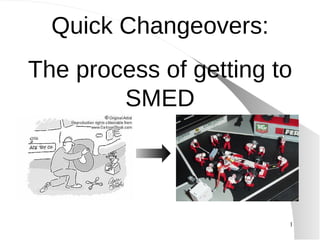
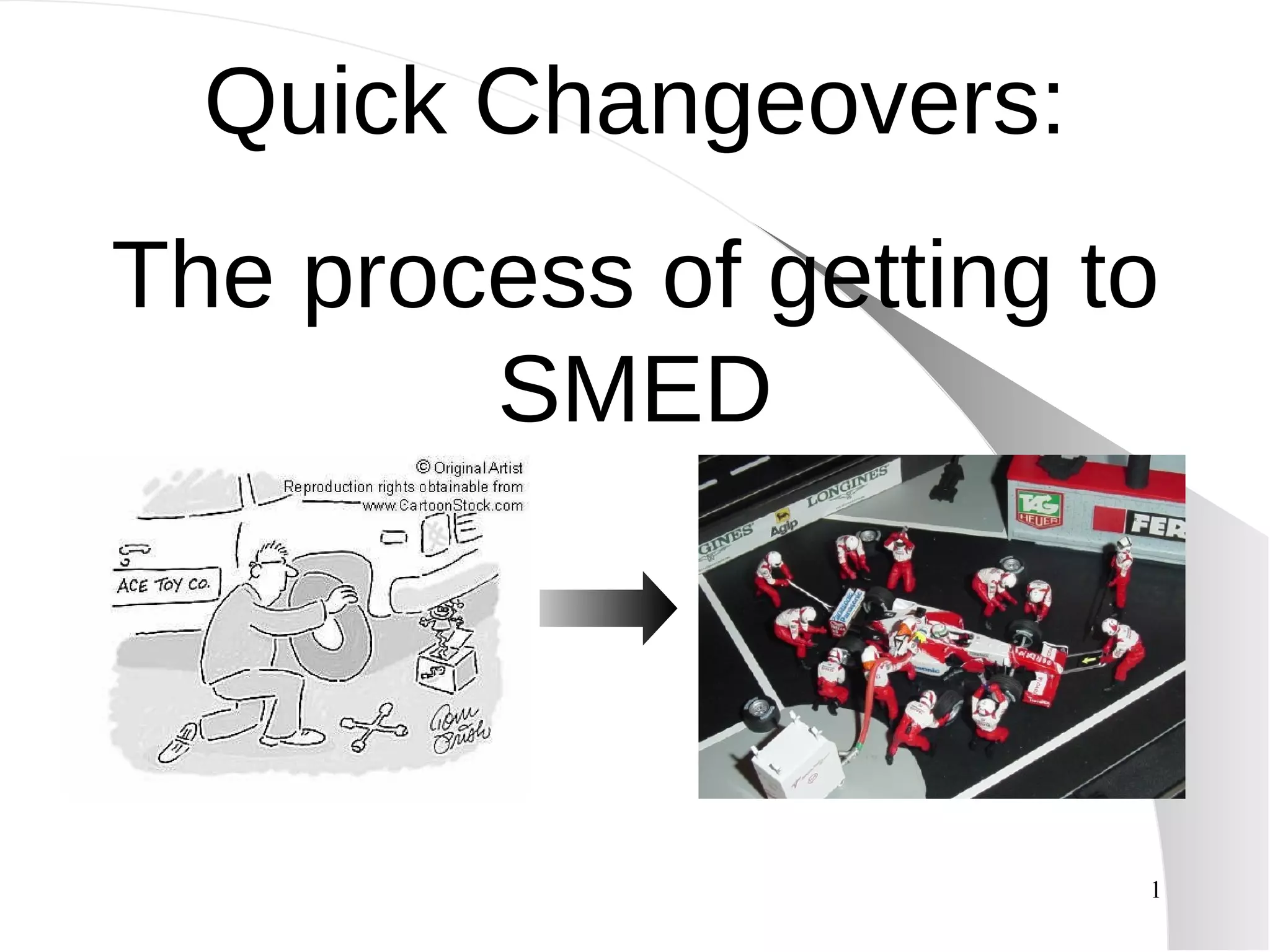
Quick Changeovers: The process of getting to SMED
Quick Changeover  Definition Importance Goals Process
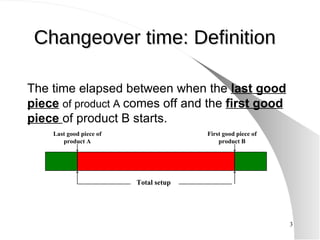
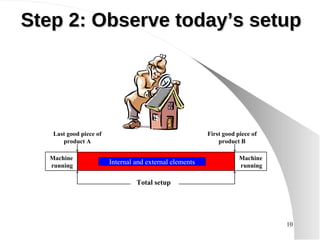
Changeover time: Definition The time elapsed between when the  last good piece   of product A  comes off and the  first good piece  of product B starts. Last good piece of product A First good piece of product B Total setup
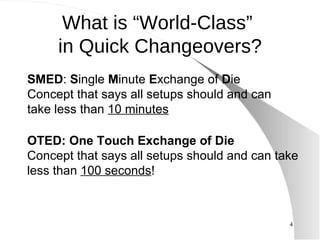
SMED :  S ingle  M inute  E xchange of  D ie Concept that says all setups should and can take less than  10 minutes OTED: One Touch Exchange of Die Concept that says all setups should and can take less than  100 seconds ! What is “World-Class”  in Quick Changeovers?
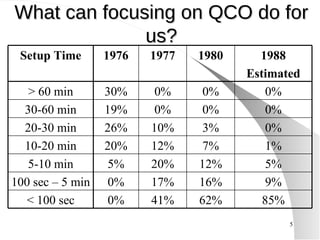
What can focusing on QCO do for us? 85% 62% 41% 0% < 100 sec 9% 16% 17% 0% 100 sec – 5 min 5% 12% 20% 5% 5-10 min 1% 7% 12% 20% 10-20 min 0% 3% 10% 26% 20-30 min 0% 0% 0% 19% 30-60 min 0% 0% 0% 30% > 60 min 1988 Estimated 1980 1977 1976 Setup Time
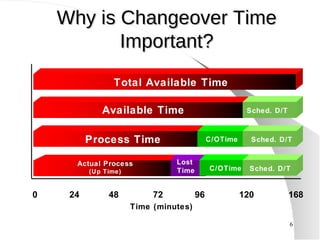
Why is Changeover Time Important? Time (minutes) Available Time Process Time Actual Process (Up Time) 0   24   48   72  96  120 168 Sched. D/T Total Available Time Sched. D/T Sched. D/T C/OTime C/OTime Lost  Time
Goals of quick changeover Reduce inventory Reduce batch sizes Reduce changeover time Reduce impact on equipment utilization Improve quality after changeover Improve repeatability Improve throughput Improve flexibility Flow!
 
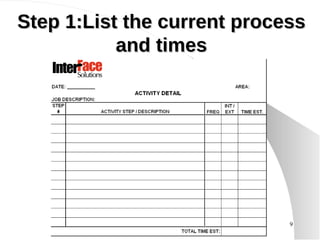
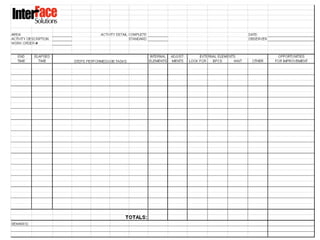
Step 1:List the current process and times
Machine running Machine running Last good piece of product A First good piece of product B Total setup Internal and external elements Step 2: Observe today’s setup
Observations An on-the-floor process for documenting an activity as it is performed Helps us understand why we do things the way that we do - do not hesitate to ask why Identify internal and external elements, waste/lost time, variances from the standard process Are not conducted for the purpose of eliminating jobs or reducing people!
Observations We should  always :  Notify the party to be observed ahead of time Explain why we are conducting an observation We’re observing the activity not the person What we are trying to accomplish  Explain the possible benefits for them and the company Review the observation with the individual Coaching Clarification
 
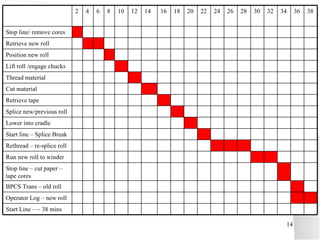
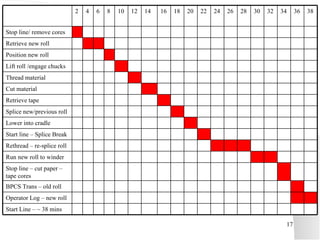
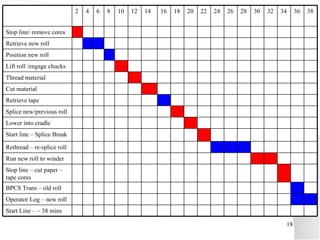
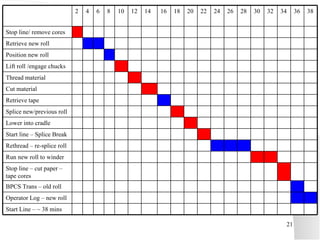
BPCS Trans – old roll 34 30 26 28 Cut material  Thread material Lift roll /engage chucks Position new roll Retrieve new roll Start Line – ~ 38 mins Operator Log – new roll Stop line – cut paper – tape cores Run new roll to winder Rethread – re-splice roll Start line – Splice Break Lower into cradle Splice new/previous roll Retrieve tape Stop line/ remove cores 38 36 32 24 22 20 18 16 14 12 10 8 6 4 2
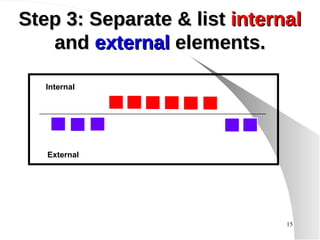
Step 3: Separate & list  internal  and  external  elements. Internal External
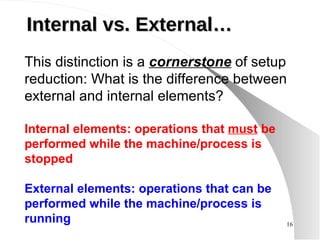
Internal vs. External… This distinction is a   cornerstone  of setup reduction: What is the difference between external and internal elements? Internal elements: operations that  must  be performed while the machine/process is stopped External elements: operations that can be performed while the machine/process is running
BPCS Trans – old roll 34 30 26 28 Cut material  Thread material Lift roll /engage chucks Position new roll Retrieve new roll Start Line – ~ 38 mins Operator Log – new roll Stop line – cut paper – tape cores Run new roll to winder Rethread – re-splice roll Start line – Splice Break Lower into cradle Splice new/previous roll Retrieve tape Stop line/ remove cores 38 36 32 24 22 20 18 16 14 12 10 8 6 4 2
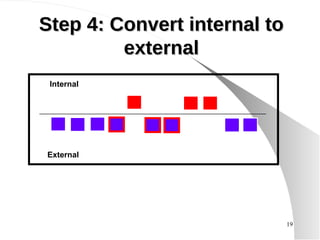
Step 4: Convert internal to external Internal External
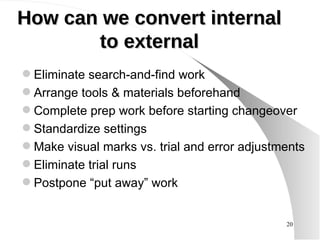
How can we convert internal to external Eliminate search-and-find work Arrange tools & materials beforehand Complete prep work before starting changeover Standardize settings Make visual marks vs. trial and error adjustments Eliminate trial runs Postpone “put away” work
BPCS Trans – old roll 34 30 26 28 Cut material  Thread material Lift roll /engage chucks Position new roll Retrieve new roll Start Line – ~ 38 mins Operator Log – new roll Stop line – cut paper – tape cores Run new roll to winder Rethread – re-splice roll Start line – Splice Break Lower into cradle Splice new/previous roll Retrieve tape Stop line/ remove cores 38 36 32 24 22 20 18 16 14 12 10 8 6 4 2
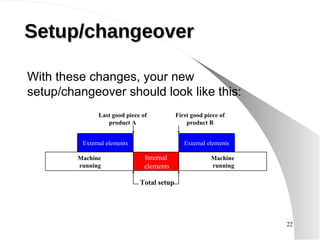
Internal elements Machine running Machine running Last good piece of product A First good piece of product B Total setup External elements External elements Setup/changeover With these changes, your new setup/changeover should look like this:
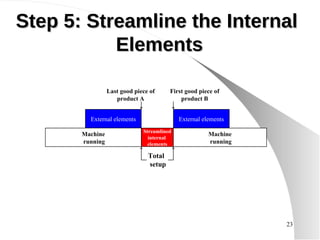
Streamlined internal  elements Machine running Machine running Last good piece of product A First good piece of product B Total  setup External elements External elements Step 5: Streamline the Internal  Elements
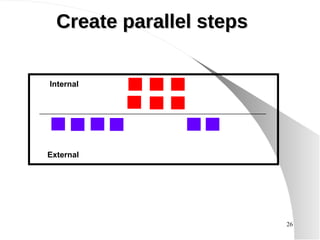
Create parallel steps Parallel steps - completed at the same time Example: On large equipment, one person in front and one person at rear of machine. Each person has designated duties to reduce walking.
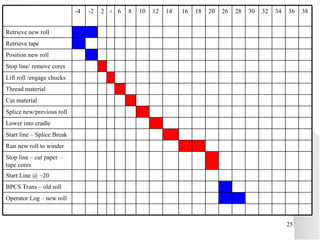
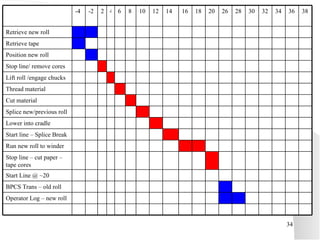
26 -4 -2 Position new roll Stop line/ remove cores Lift roll /engage chucks Thread material Cut material  Splice new/previous roll Lower into cradle Start line – Splice Break Run new roll to winder Stop line – cut paper – tape cores Start Line @ ~20 BPCS Trans – old roll 34 30 28 Operator Log – new roll Retrieve tape Retrieve new roll  38 36 32 20 18 16 14 12 10 8 6 4 2
Create parallel steps Internal External
Reduce complexity and eliminate waste Use functional fixtures and jigs one motion fasteners levered or one-turn fasteners interlocking wedge or slot Eliminate adjustments use angle and flat use preset pins, guides, notches etc. Eliminate need to leave the machine Use POUS and water spider
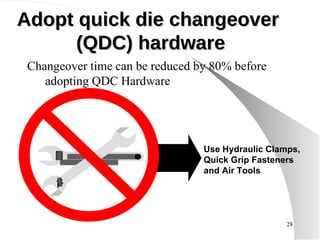
Adopt quick die changeover  (QDC) hardware Changeover time can be reduced by 80% before adopting QDC Hardware  Use Hydraulic Clamps, Quick Grip Fasteners and Air Tools
Quick die changeover hardware Reduce the number of nuts and bolts Adopt QDC hardware after the standardization is complete and the process is routine and reliable
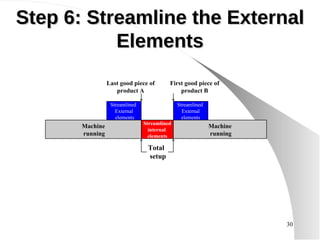
Streamlined internal  elements Machine running Machine running Last good piece of product A First good piece of product B Total  setup Streamlined  External elements Streamlined  External elements Step 6: Streamline the External Elements
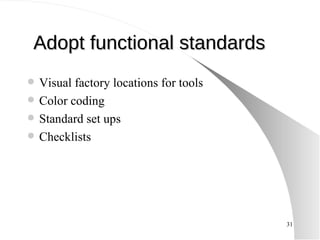
Adopt functional standards Visual factory locations for tools Color coding Standard set ups Checklists
Step 7:   Create new process Document  who  will do  what  and  when Practice quick changeover (QCO) before doing it
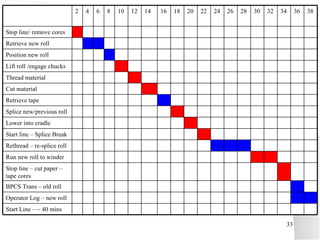
BPCS Trans – old roll 34 30 26 28 Cut material  Thread material Lift roll /engage chucks Position new roll Retrieve new roll Start Line – ~ 40 mins Operator Log – new roll Stop line – cut paper – tape cores Run new roll to winder Rethread – re-splice roll Start line – Splice Break Lower into cradle Splice new/previous roll Retrieve tape Stop line/ remove cores 38 36 32 24 22 20 18 16 14 12 10 8 6 4 2
26 -4 -2 Position new roll Stop line/ remove cores Lift roll /engage chucks Thread material Cut material  Splice new/previous roll Lower into cradle Start line – Splice Break Run new roll to winder Stop line – cut paper – tape cores Start Line @ ~20 BPCS Trans – old roll 34 30 28 Operator Log – new roll Retrieve tape Retrieve new roll  38 36 32 20 18 16 14 12 10 8 6 4 2
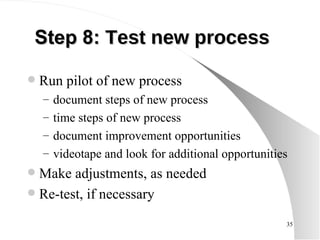
Step 8:   Test new process Run pilot of new process document steps of new process time steps of new process document improvement opportunities videotape and look for additional opportunities Make adjustments, as needed Re-test, if necessary
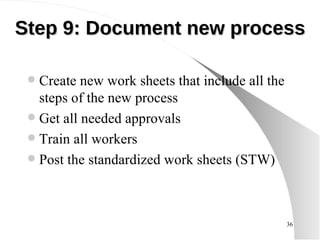
Step 9:  Document new process Create new work sheets that include all the steps of the new process Get all needed approvals Train all workers Post the standardized work sheets (STW)
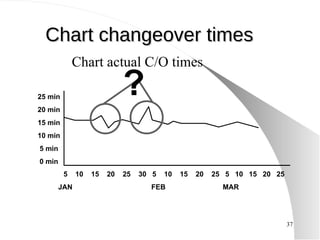
Chart changeover times Chart actual C/O times 5  10  15  20  25  30  5  10  15  20  25  5  10  15  20  25 JAN  FEB  MAR 25 min 20 min 15 min 10 min 5 min 0 min ?
Step 10: Kaizen the C/O! SMED/Quick Changeover
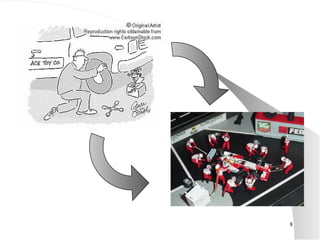
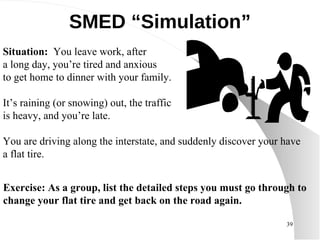
SMED “Simulation” Situation:   You leave work, after a long day, you’re tired and anxious  to get home to dinner with your family. It’s raining (or snowing) out, the traffic is heavy, and you’re late. You are driving along the interstate, and suddenly discover your have a flat tire. Exercise: As a group, list the detailed steps you must go through to change your flat tire and get back on the road again.
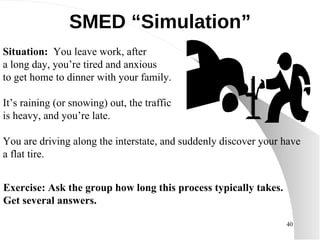
SMED “Simulation” Situation:   You leave work, after a long day, you’re tired and anxious  to get home to dinner with your family. It’s raining (or snowing) out, the traffic is heavy, and you’re late. You are driving along the interstate, and suddenly discover your have a flat tire. Exercise: Ask the group how long this process typically takes.  Get several answers.
SMED “Simulation” Situation:   Now we’ll take a look At how “professionals” change tires, And how long it takes them.
Questions?

SMED-Observation Training

  • 1.
    Quick Changeovers: Theprocess of getting to SMED
  • 2.
    Quick Changeover Definition Importance Goals Process
  • 3.
    Changeover time: DefinitionThe time elapsed between when the last good piece of product A comes off and the first good piece of product B starts. Last good piece of product A First good piece of product B Total setup
  • 4.
    SMED : S ingle M inute E xchange of D ie Concept that says all setups should and can take less than 10 minutes OTED: One Touch Exchange of Die Concept that says all setups should and can take less than 100 seconds ! What is “World-Class” in Quick Changeovers?
  • 5.
    What can focusingon QCO do for us? 85% 62% 41% 0% < 100 sec 9% 16% 17% 0% 100 sec – 5 min 5% 12% 20% 5% 5-10 min 1% 7% 12% 20% 10-20 min 0% 3% 10% 26% 20-30 min 0% 0% 0% 19% 30-60 min 0% 0% 0% 30% > 60 min 1988 Estimated 1980 1977 1976 Setup Time
  • 6.
    Why is ChangeoverTime Important? Time (minutes) Available Time Process Time Actual Process (Up Time) 0 24 48 72 96 120 168 Sched. D/T Total Available Time Sched. D/T Sched. D/T C/OTime C/OTime Lost Time
  • 7.
    Goals of quickchangeover Reduce inventory Reduce batch sizes Reduce changeover time Reduce impact on equipment utilization Improve quality after changeover Improve repeatability Improve throughput Improve flexibility Flow!
  • 8.
  • 9.
    Step 1:List thecurrent process and times
  • 10.
    Machine running Machinerunning Last good piece of product A First good piece of product B Total setup Internal and external elements Step 2: Observe today’s setup
  • 11.
    Observations An on-the-floorprocess for documenting an activity as it is performed Helps us understand why we do things the way that we do - do not hesitate to ask why Identify internal and external elements, waste/lost time, variances from the standard process Are not conducted for the purpose of eliminating jobs or reducing people!
  • 12.
    Observations We should always : Notify the party to be observed ahead of time Explain why we are conducting an observation We’re observing the activity not the person What we are trying to accomplish Explain the possible benefits for them and the company Review the observation with the individual Coaching Clarification
  • 13.
  • 14.
    BPCS Trans –old roll 34 30 26 28 Cut material Thread material Lift roll /engage chucks Position new roll Retrieve new roll Start Line – ~ 38 mins Operator Log – new roll Stop line – cut paper – tape cores Run new roll to winder Rethread – re-splice roll Start line – Splice Break Lower into cradle Splice new/previous roll Retrieve tape Stop line/ remove cores 38 36 32 24 22 20 18 16 14 12 10 8 6 4 2
  • 15.
    Step 3: Separate& list internal and external elements. Internal External
  • 16.
    Internal vs. External…This distinction is a cornerstone of setup reduction: What is the difference between external and internal elements? Internal elements: operations that must be performed while the machine/process is stopped External elements: operations that can be performed while the machine/process is running
  • 17.
    BPCS Trans –old roll 34 30 26 28 Cut material Thread material Lift roll /engage chucks Position new roll Retrieve new roll Start Line – ~ 38 mins Operator Log – new roll Stop line – cut paper – tape cores Run new roll to winder Rethread – re-splice roll Start line – Splice Break Lower into cradle Splice new/previous roll Retrieve tape Stop line/ remove cores 38 36 32 24 22 20 18 16 14 12 10 8 6 4 2
  • 18.
    BPCS Trans –old roll 34 30 26 28 Cut material Thread material Lift roll /engage chucks Position new roll Retrieve new roll Start Line – ~ 38 mins Operator Log – new roll Stop line – cut paper – tape cores Run new roll to winder Rethread – re-splice roll Start line – Splice Break Lower into cradle Splice new/previous roll Retrieve tape Stop line/ remove cores 38 36 32 24 22 20 18 16 14 12 10 8 6 4 2
  • 19.
    Step 4: Convertinternal to external Internal External
  • 20.
    How can weconvert internal to external Eliminate search-and-find work Arrange tools & materials beforehand Complete prep work before starting changeover Standardize settings Make visual marks vs. trial and error adjustments Eliminate trial runs Postpone “put away” work
  • 21.
    BPCS Trans –old roll 34 30 26 28 Cut material Thread material Lift roll /engage chucks Position new roll Retrieve new roll Start Line – ~ 38 mins Operator Log – new roll Stop line – cut paper – tape cores Run new roll to winder Rethread – re-splice roll Start line – Splice Break Lower into cradle Splice new/previous roll Retrieve tape Stop line/ remove cores 38 36 32 24 22 20 18 16 14 12 10 8 6 4 2
  • 22.
    Internal elements Machinerunning Machine running Last good piece of product A First good piece of product B Total setup External elements External elements Setup/changeover With these changes, your new setup/changeover should look like this:
  • 23.
    Streamlined internal elements Machine running Machine running Last good piece of product A First good piece of product B Total setup External elements External elements Step 5: Streamline the Internal Elements
  • 24.
    Create parallel stepsParallel steps - completed at the same time Example: On large equipment, one person in front and one person at rear of machine. Each person has designated duties to reduce walking.
  • 25.
    26 -4 -2Position new roll Stop line/ remove cores Lift roll /engage chucks Thread material Cut material Splice new/previous roll Lower into cradle Start line – Splice Break Run new roll to winder Stop line – cut paper – tape cores Start Line @ ~20 BPCS Trans – old roll 34 30 28 Operator Log – new roll Retrieve tape Retrieve new roll 38 36 32 20 18 16 14 12 10 8 6 4 2
  • 26.
    Create parallel stepsInternal External
  • 27.
    Reduce complexity andeliminate waste Use functional fixtures and jigs one motion fasteners levered or one-turn fasteners interlocking wedge or slot Eliminate adjustments use angle and flat use preset pins, guides, notches etc. Eliminate need to leave the machine Use POUS and water spider
  • 28.
    Adopt quick diechangeover (QDC) hardware Changeover time can be reduced by 80% before adopting QDC Hardware Use Hydraulic Clamps, Quick Grip Fasteners and Air Tools
  • 29.
    Quick die changeoverhardware Reduce the number of nuts and bolts Adopt QDC hardware after the standardization is complete and the process is routine and reliable
  • 30.
    Streamlined internal elements Machine running Machine running Last good piece of product A First good piece of product B Total setup Streamlined External elements Streamlined External elements Step 6: Streamline the External Elements
  • 31.
    Adopt functional standardsVisual factory locations for tools Color coding Standard set ups Checklists
  • 32.
    Step 7: Create new process Document who will do what and when Practice quick changeover (QCO) before doing it
  • 33.
    BPCS Trans –old roll 34 30 26 28 Cut material Thread material Lift roll /engage chucks Position new roll Retrieve new roll Start Line – ~ 40 mins Operator Log – new roll Stop line – cut paper – tape cores Run new roll to winder Rethread – re-splice roll Start line – Splice Break Lower into cradle Splice new/previous roll Retrieve tape Stop line/ remove cores 38 36 32 24 22 20 18 16 14 12 10 8 6 4 2
  • 34.
    26 -4 -2Position new roll Stop line/ remove cores Lift roll /engage chucks Thread material Cut material Splice new/previous roll Lower into cradle Start line – Splice Break Run new roll to winder Stop line – cut paper – tape cores Start Line @ ~20 BPCS Trans – old roll 34 30 28 Operator Log – new roll Retrieve tape Retrieve new roll 38 36 32 20 18 16 14 12 10 8 6 4 2
  • 35.
    Step 8: Test new process Run pilot of new process document steps of new process time steps of new process document improvement opportunities videotape and look for additional opportunities Make adjustments, as needed Re-test, if necessary
  • 36.
    Step 9: Document new process Create new work sheets that include all the steps of the new process Get all needed approvals Train all workers Post the standardized work sheets (STW)
  • 37.
    Chart changeover timesChart actual C/O times 5 10 15 20 25 30 5 10 15 20 25 5 10 15 20 25 JAN FEB MAR 25 min 20 min 15 min 10 min 5 min 0 min ?
  • 38.
    Step 10: Kaizenthe C/O! SMED/Quick Changeover
  • 39.
    SMED “Simulation” Situation: You leave work, after a long day, you’re tired and anxious to get home to dinner with your family. It’s raining (or snowing) out, the traffic is heavy, and you’re late. You are driving along the interstate, and suddenly discover your have a flat tire. Exercise: As a group, list the detailed steps you must go through to change your flat tire and get back on the road again.
  • 40.
    SMED “Simulation” Situation: You leave work, after a long day, you’re tired and anxious to get home to dinner with your family. It’s raining (or snowing) out, the traffic is heavy, and you’re late. You are driving along the interstate, and suddenly discover your have a flat tire. Exercise: Ask the group how long this process typically takes. Get several answers.
  • 41.
    SMED “Simulation” Situation: Now we’ll take a look At how “professionals” change tires, And how long it takes them.
  • 42.

Editor's Notes

  • #2 PURPOSE: To teach the SMED/Quick Changeover process SAY: SMED = Single Minute Exchange of Die DO: Ask why SMED/QCO is important? ADDITIONAL NOTES: C/O is waste because the product is not flowing while the process is being changed over.