Lean Six Sigma Manufacturing  Overview  Machine Shop   2009
What does Alan Desrocher bring to the table Strategic programs Tactical approaches Cultural elements to both
Objectives Review brief history of manufacturing systems Distinguish between mass and lean manufacturing Introduce key Concepts of  Lean Manufacturing  Review the kinds of changes needed to be considered a lean manufacturer.
Objectives Understand where we are as a “Lean Culture” using a Lean Improvement Roadmap Assessment Distinguish between what has been learned second hand or thoroughly taught, we don’t want to reinvent the wheel Reinforce key Concepts of  Lean Manufacturing  if known Review the kinds of changes needed to be considered a lean manufacturer. Dig in
Objectives Using the designed Roadmap we’ll be displaying throughout the organization where we are and where we want to go Using the Roadmap we’ll be assuring that all employees are communicated to….. at the level that they feel confident that we are heading  “ together towards excellence” ! Using the Roadmap we’ll be monitoring our progress and celebrating our successes and understanding and correcting our failures
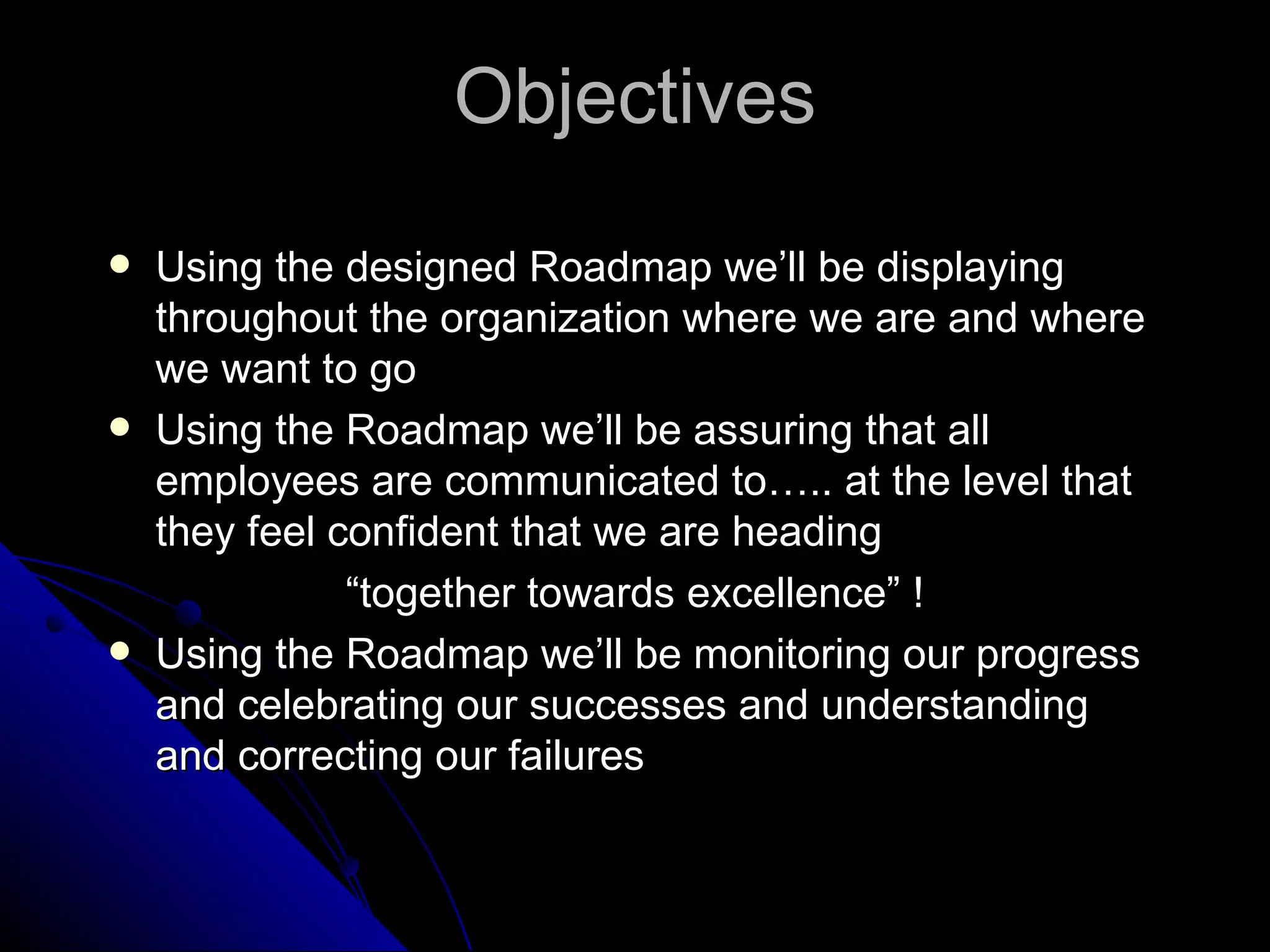
Craft Manufacturing  Late 1800’s Car built on blocks in the barn as workers walked around the car. Built by craftsmen with pride Components hand-crafted, hand-fitted Excellent quality Very expensive Few produced
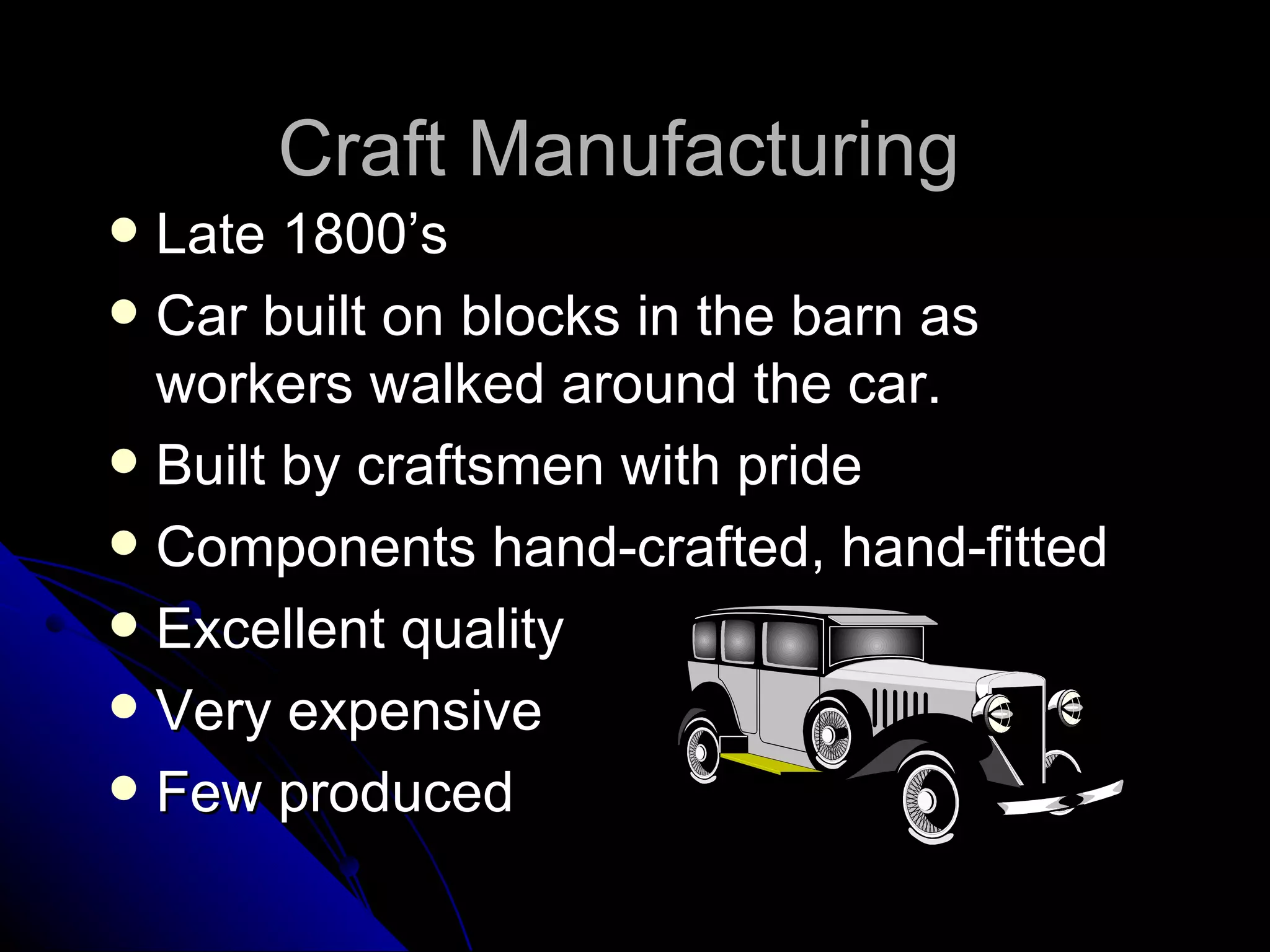
Mass Manufacturing  Assembly line - Henry Ford 1920s Low skilled labor, simplistic jobs,  no pride in work Interchangeable parts Lower quality Affordably priced for the average family Billions produced - identical
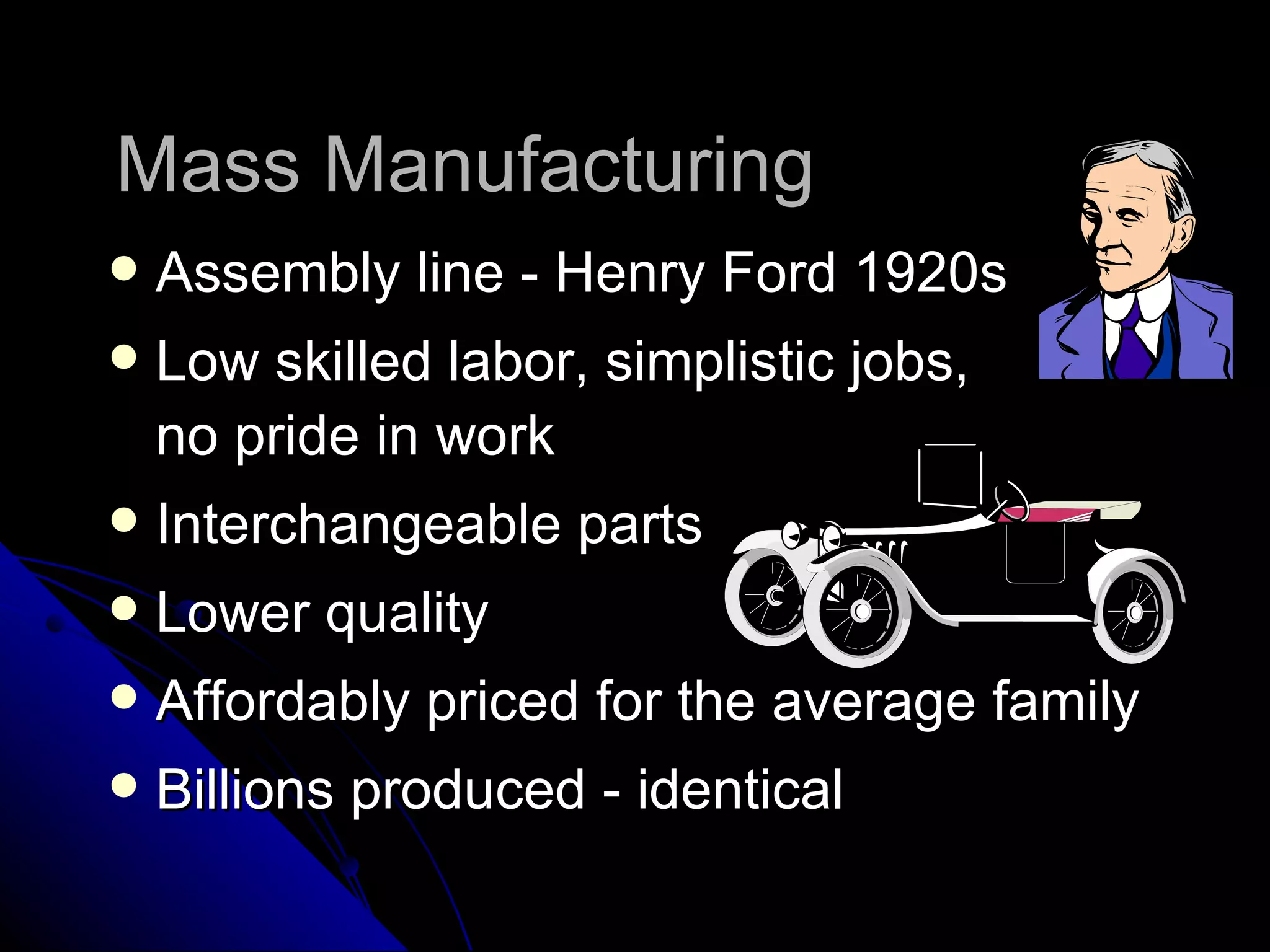
Lean Manufacturing  Cells or flexible assembly lines Broader jobs, highly skilled  workers, proud of product Interchangeable parts,  even more variety Excellent quality mandatory Costs being decreased through process improvements. Global markets and competition.
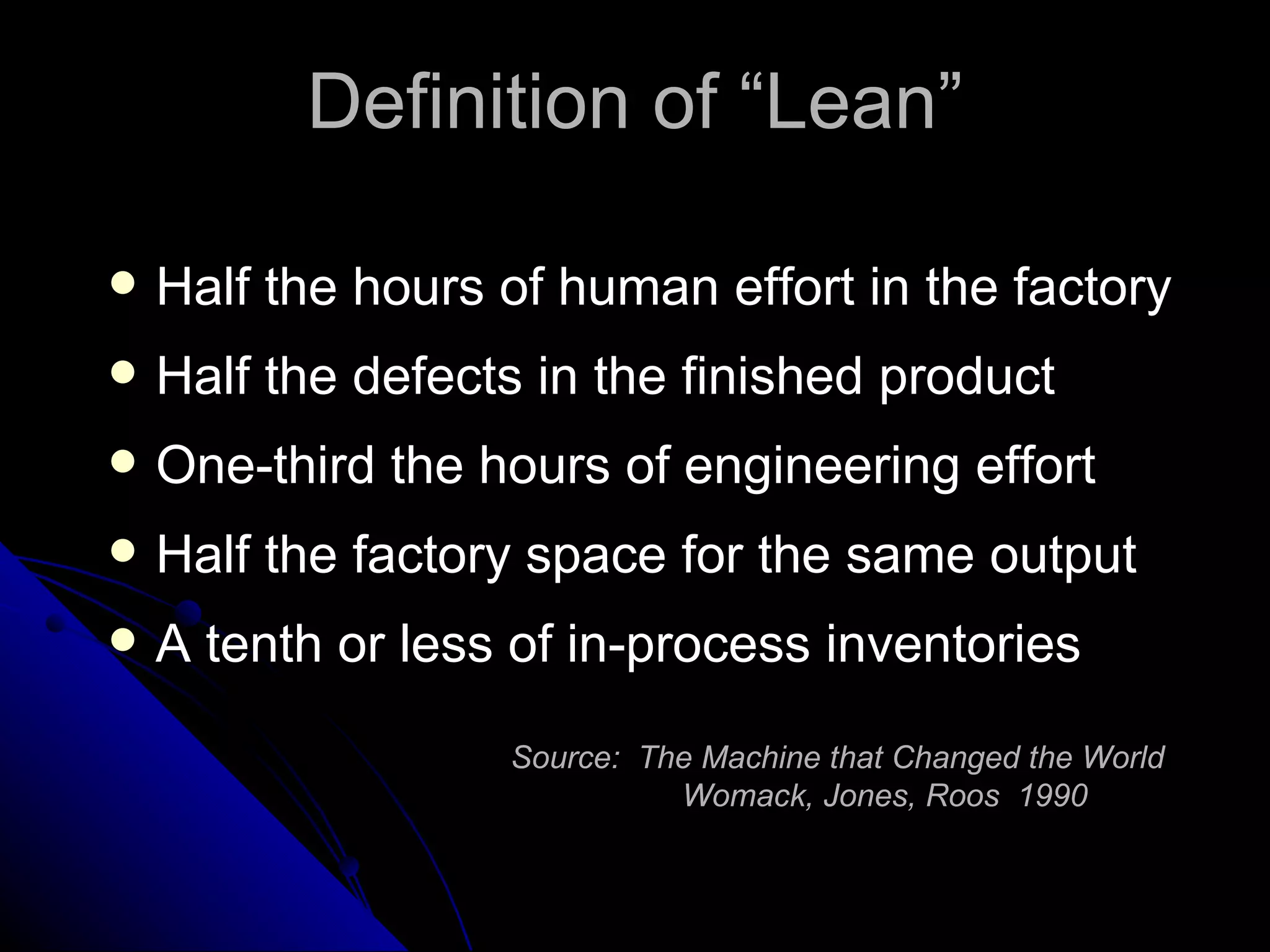
Definition of “Lean” Half the hours of human effort in the factory Half the defects in the finished product One-third the hours of engineering effort Half the factory space for the same output A tenth or less of in-process inventories Source:  The Machine that Changed the World   Womack, Jones, Roos  1990
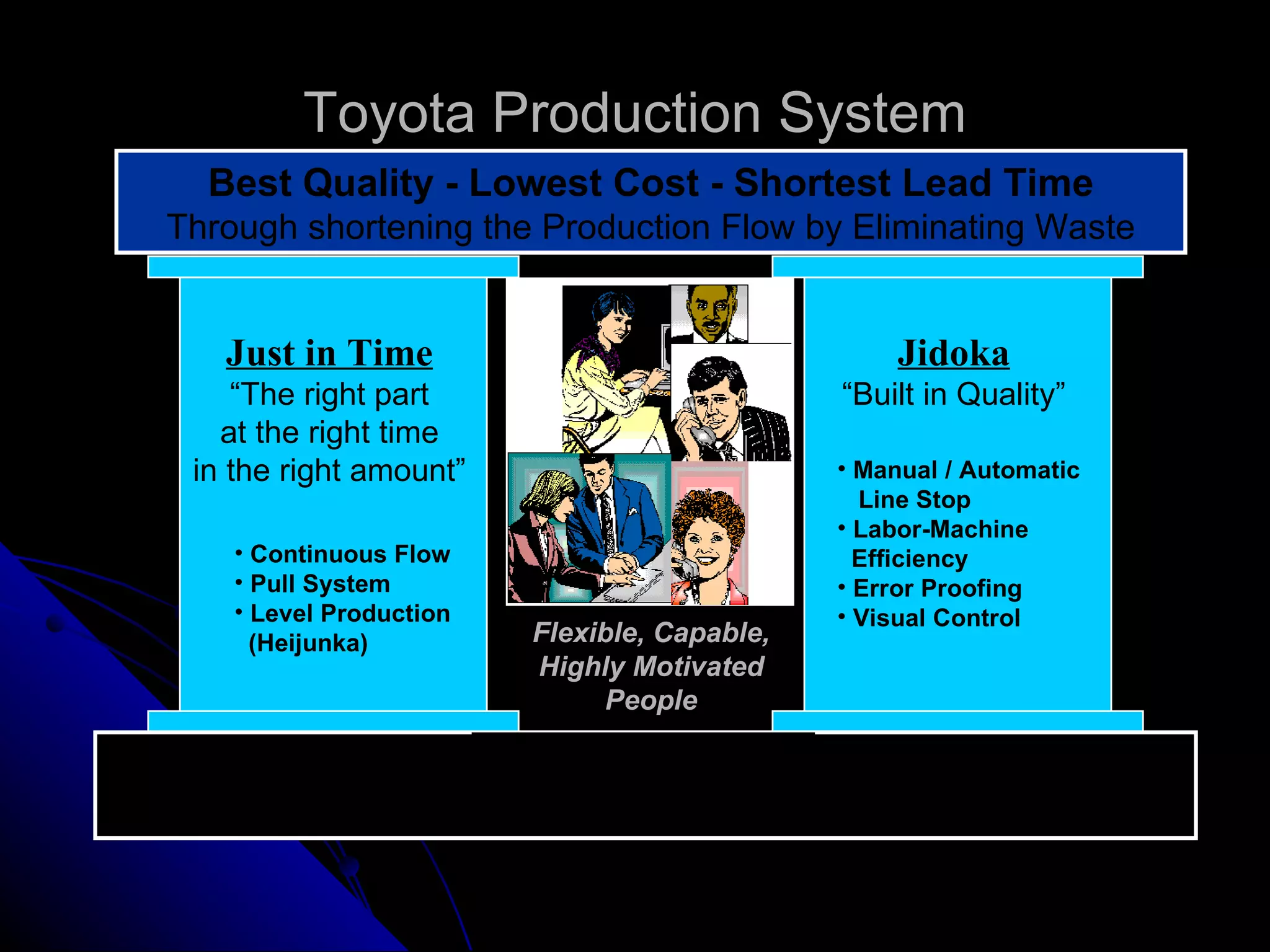
Toyota Production System Best Quality - Lowest Cost - Shortest Lead Time Through shortening the Production Flow by Eliminating Waste Just in Time “The right part at the right time in the right amount” Continuous Flow Pull System Level Production   (Heijunka) Jidoka “Built in Quality” Manual / Automatic   Line Stop Labor-Machine   Efficiency Error Proofing Visual Control Flexible, Capable, Highly Motivated People Standardized Work Total Productive Maintenance Robust Products & Processes Supplier Involvement Operational Stability
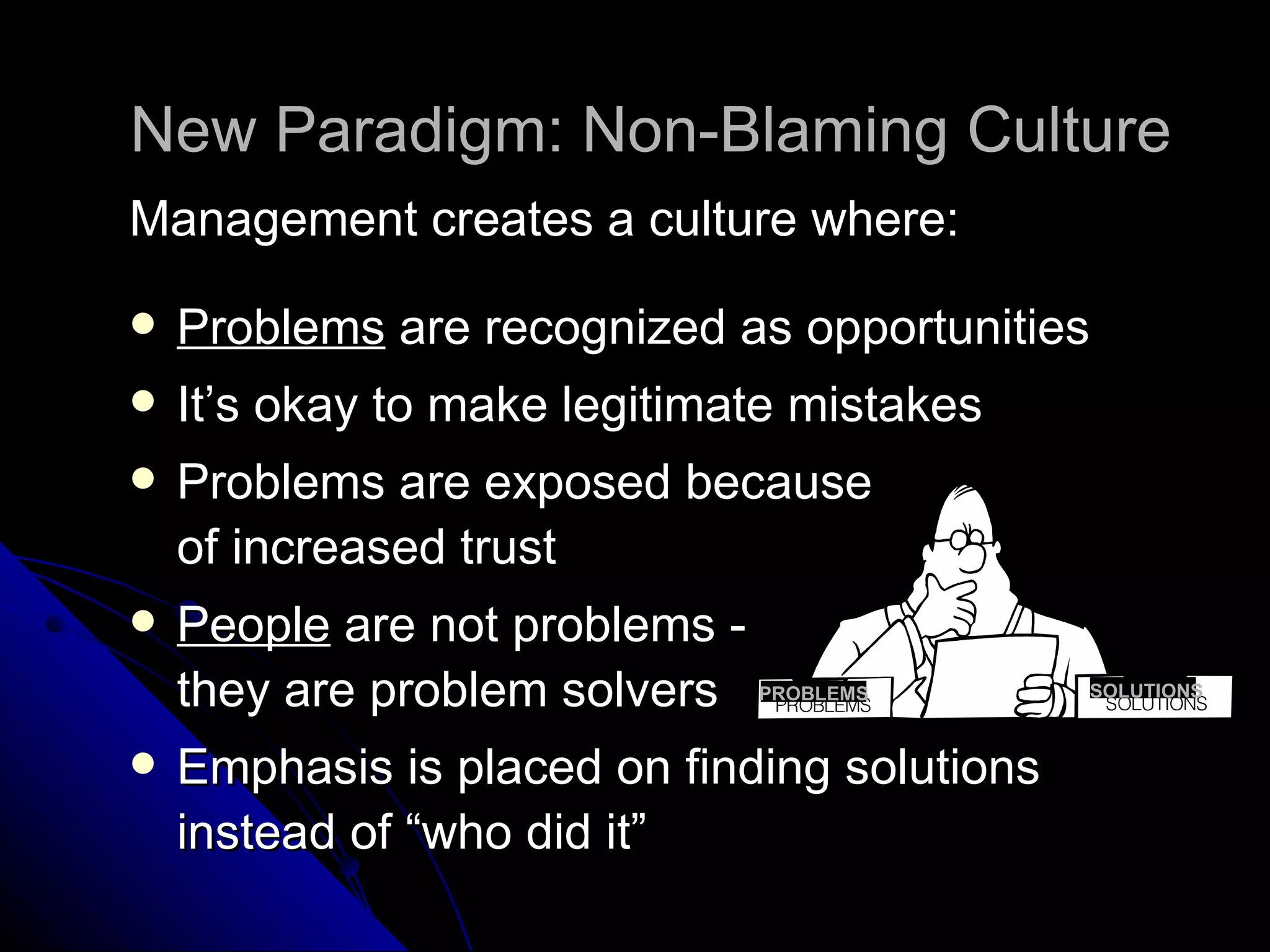
New Paradigm: Non-Blaming Culture Management creates a culture where: Problems  are recognized as opportunities It’s okay to make legitimate mistakes Problems are exposed because  of increased trust People  are not problems -  they are problem solvers Emphasis is placed on finding solutions instead of “who did it” SOLUTIONS PROBLEMS
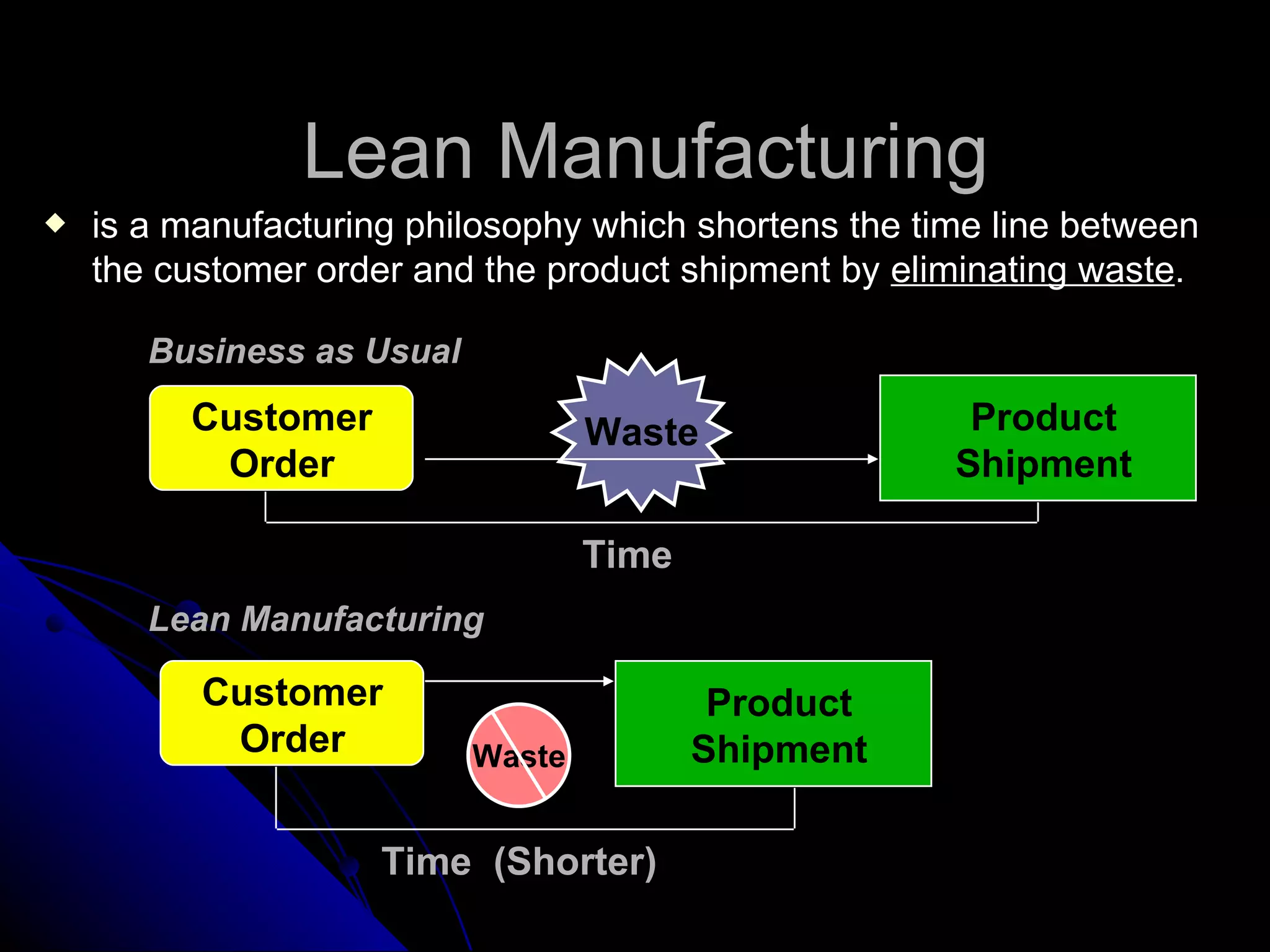
Lean Manufacturing is a manufacturing philosophy which shortens the time line between the customer order and the product shipment by  eliminating waste .  Customer Order Waste Time Customer Order Time  (Shorter) Business as Usual Waste Lean Manufacturing Product Shipment Product Shipment
Waste “ Anything that adds Cost  to the product  without adding Value”
Customer Role Play  re: Value Add Notes only on this page.
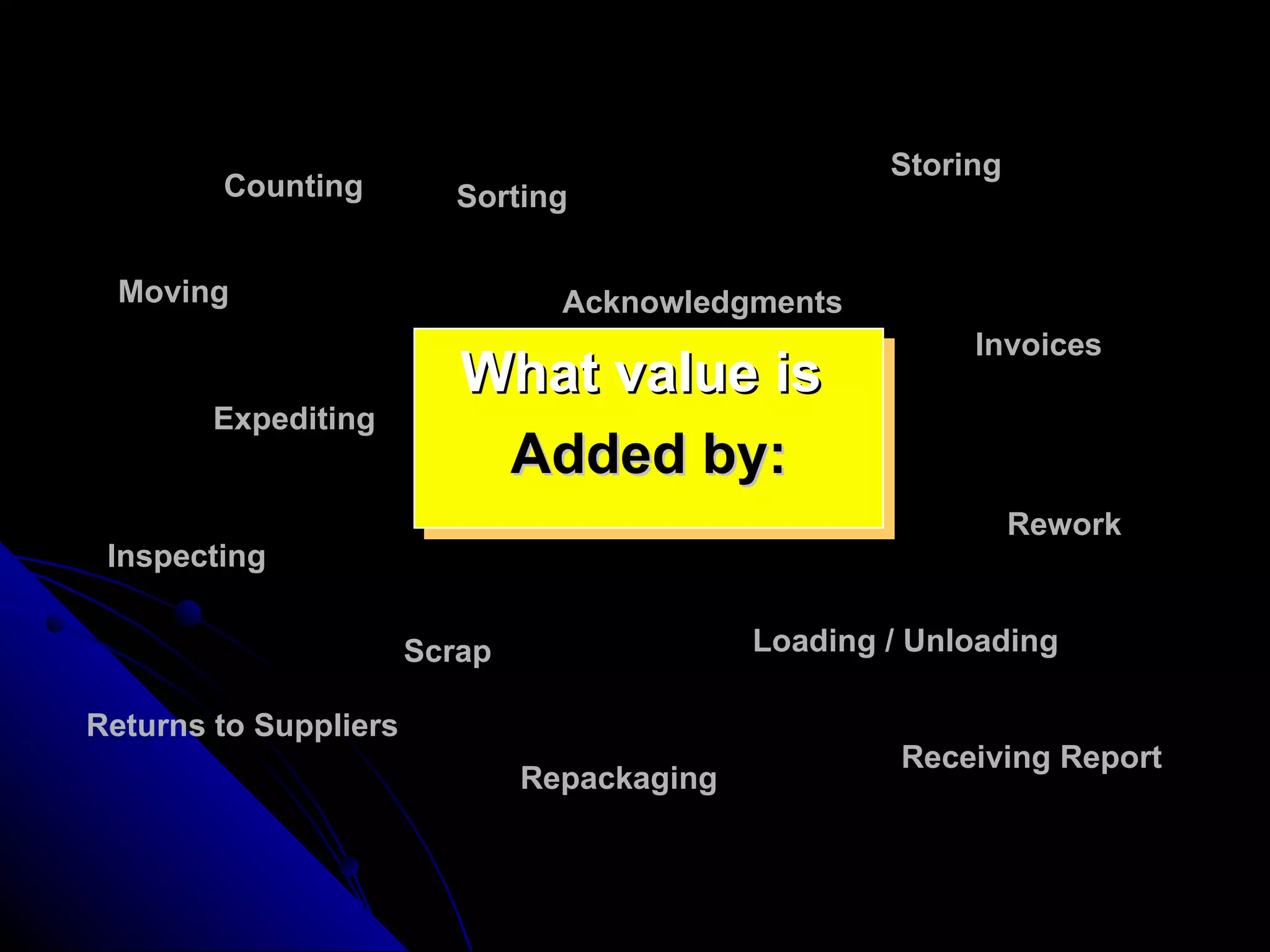
What value is  Added by: Sorting Counting Acknowledgments Moving Expediting Inspecting Returns to Suppliers Repackaging Scrap Storing Invoices Rework Loading / Unloading Receiving Report
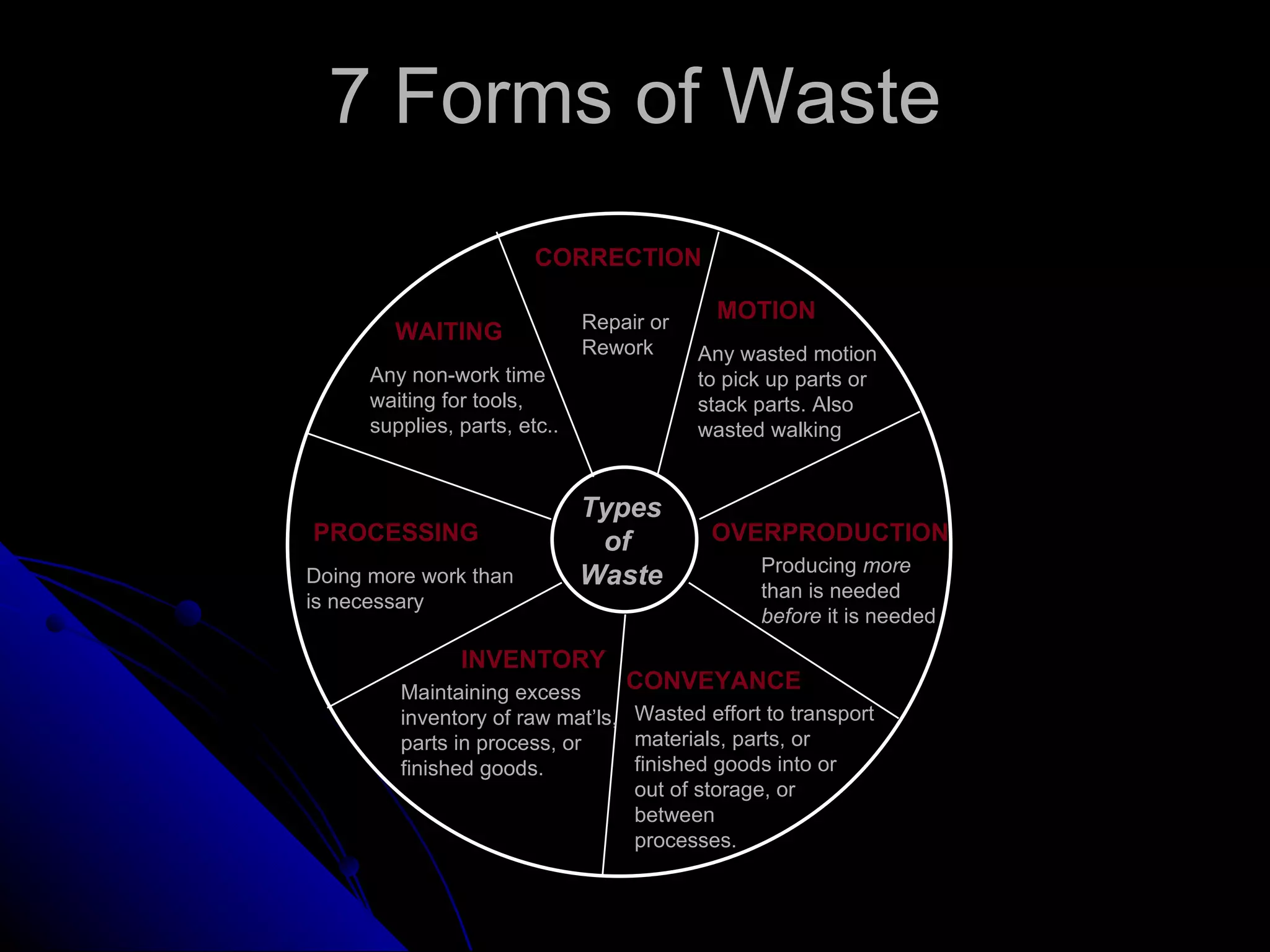
7 Forms of Waste Types of  Waste CORRECTION WAITING PROCESSING MOTION INVENTORY CONVEYANCE OVERPRODUCTION Repair or Rework Any wasted motion to pick up parts or  stack parts. Also  wasted walking Wasted effort to transport materials, parts, or  finished goods into or  out of storage, or  between  processes. Producing  more than is needed  before  it is needed Maintaining excess inventory of raw mat’ls, parts in process, or finished goods. Doing more work than is necessary Any non-work time waiting for tools,  supplies, parts, etc..
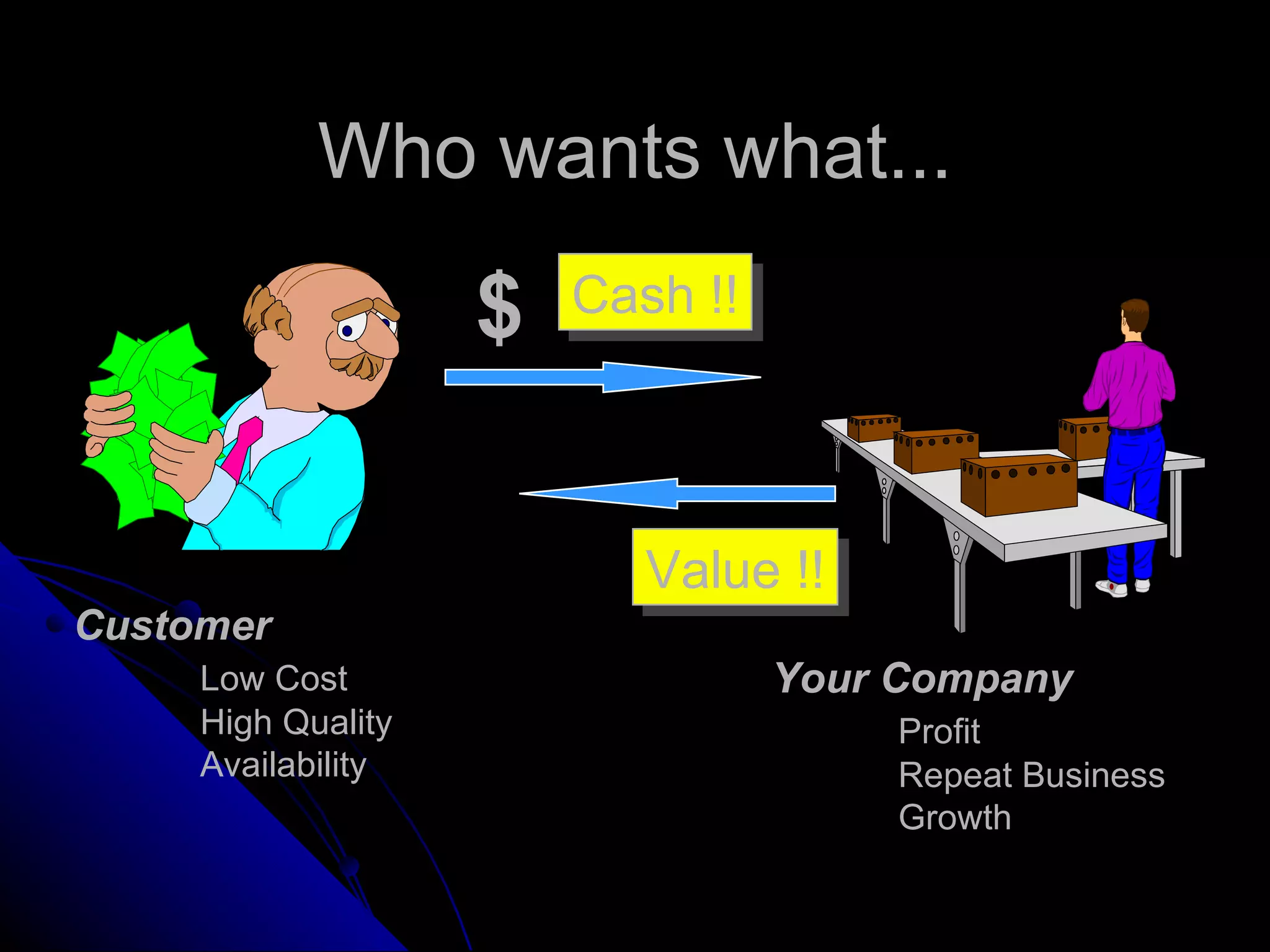
Who wants what... Customer Low Cost High Quality Availability Your Company Profit Repeat Business Growth Cash !! $ Value !!
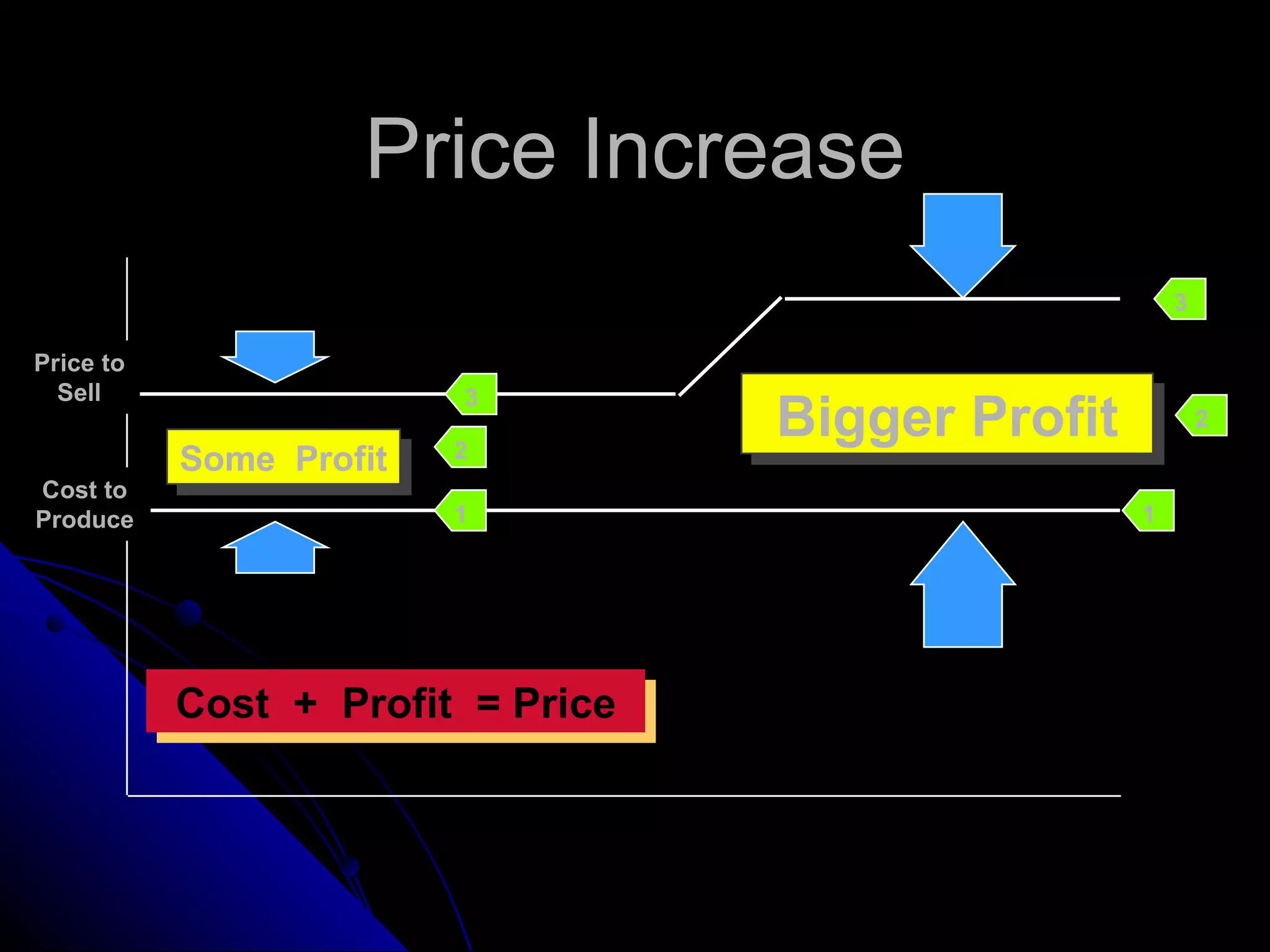
Price Increase Some  Profit Bigger Profit Price to Sell Cost to Produce Cost  +  Profit  = Price 1 2 3 1 2 3
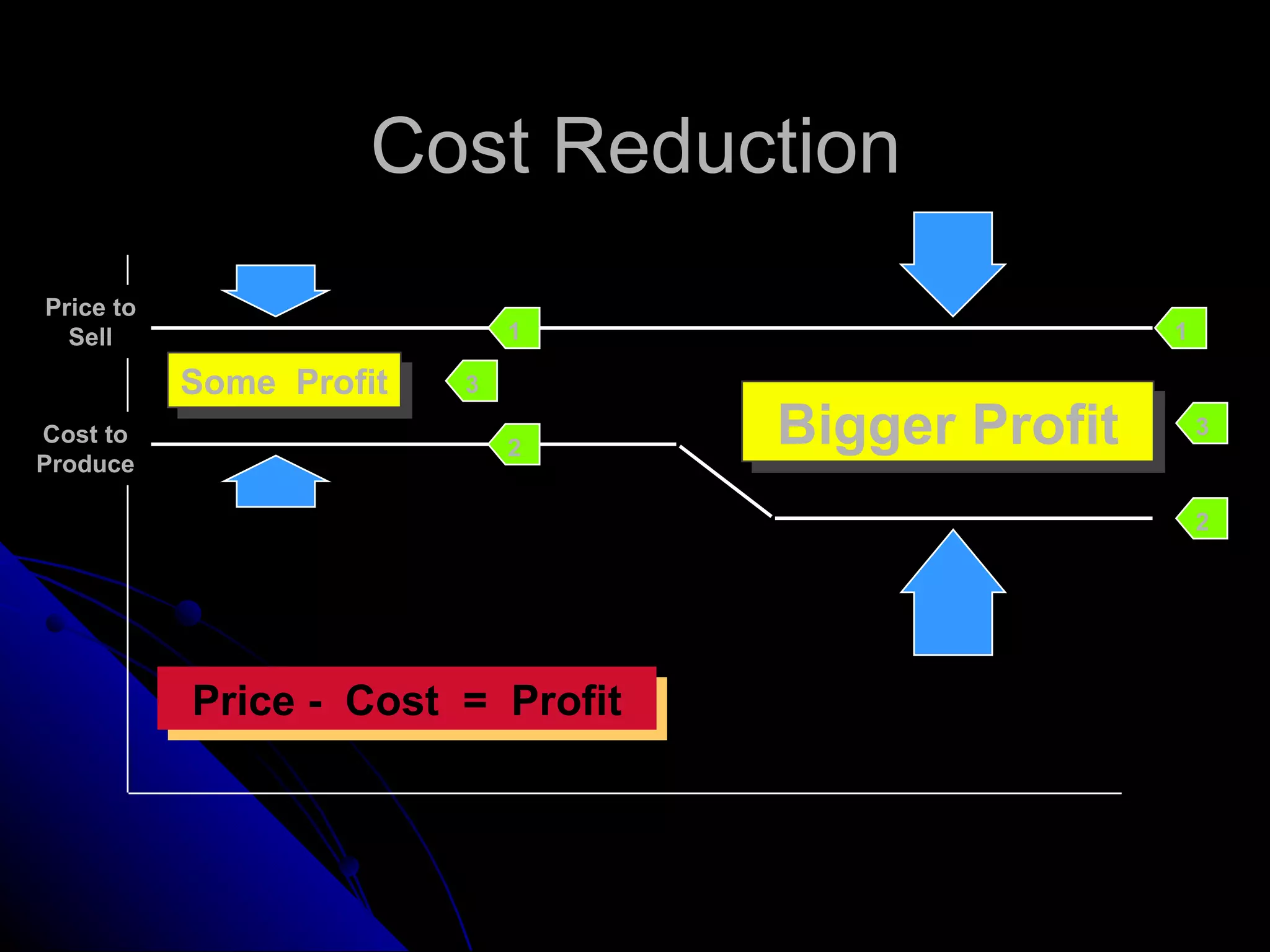
Cost Reduction Some  Profit Bigger Profit Price to Sell Cost to Produce Price -  Cost  =  Profit 1 2 3 1 2 3
Just in Time Manufacturing  Produce according to customer demands: What is needed When it is needed In the quantity it is needed Utilize  - Continuous flow processing - Pull system
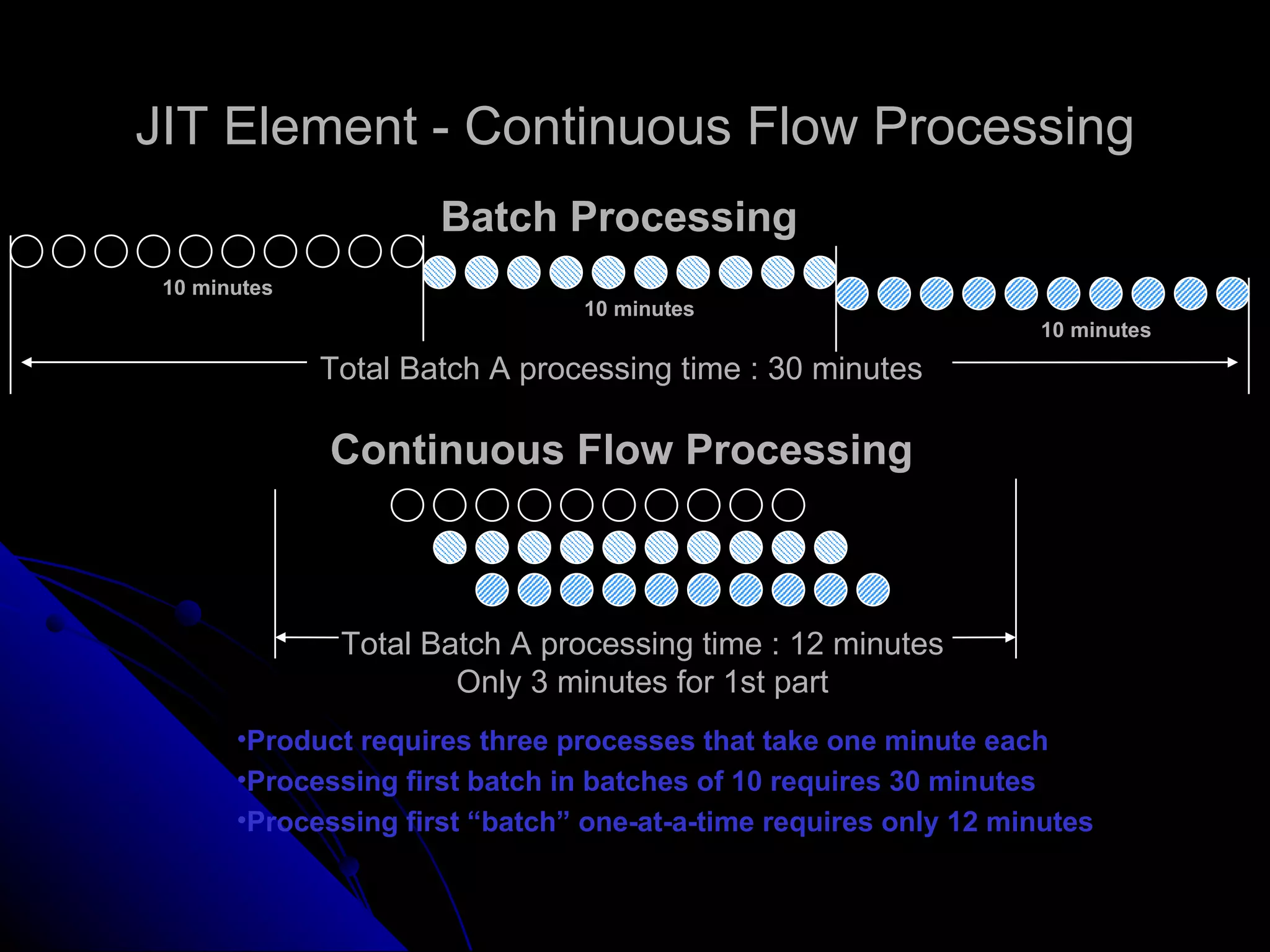
JIT Element - Continuous Flow Processing Batch Processing 10 minutes 10 minutes 10 minutes Total Batch A processing time : 30 minutes Continuous Flow Processing Total Batch A processing time : 12 minutes Only 3 minutes for 1st part Product requires three processes that take one minute each Processing first batch in batches of 10 requires 30 minutes Processing first “batch” one-at-a-time requires only 12 minutes
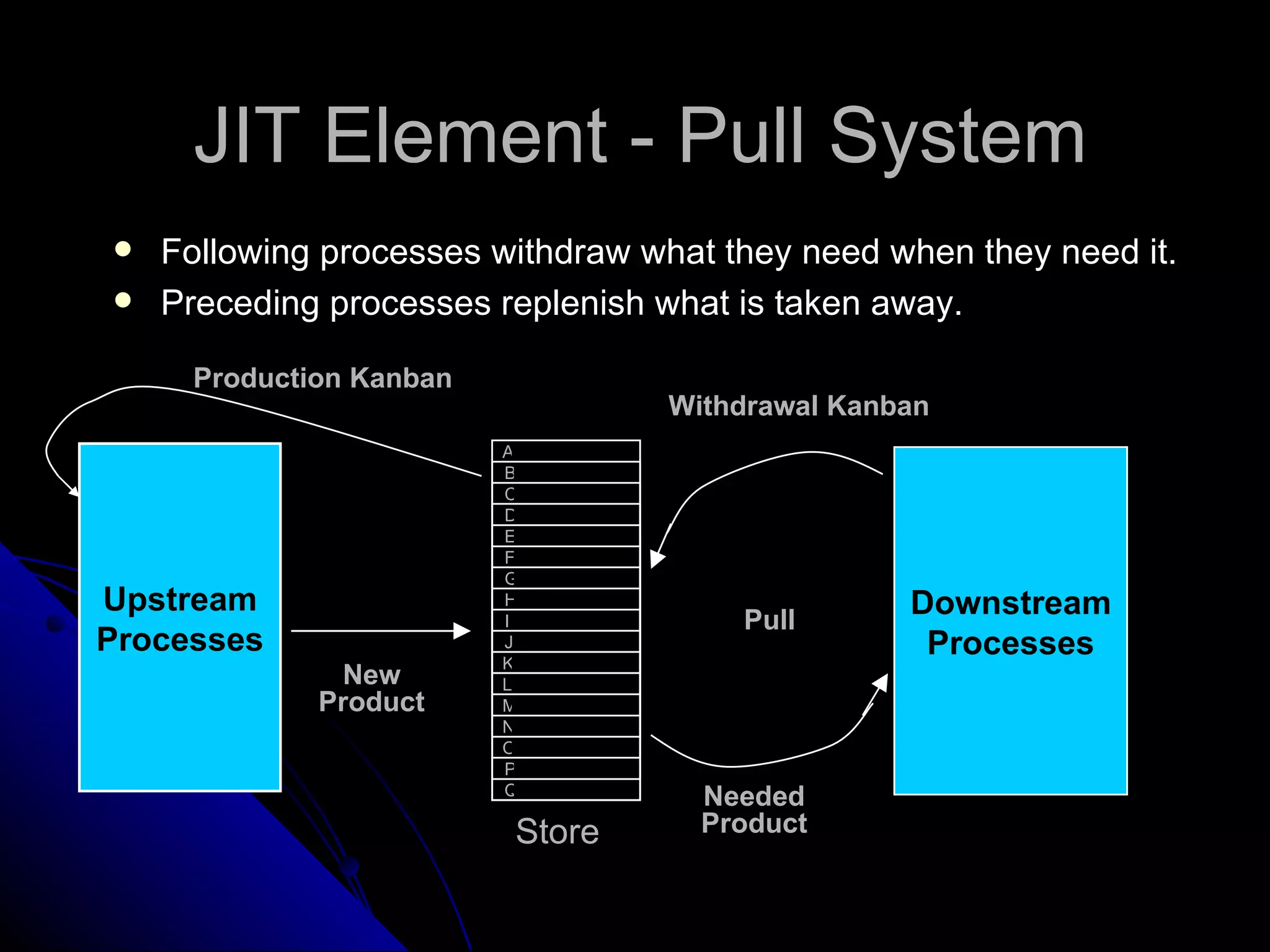
JIT Element - Pull System Following processes withdraw what they need when they need it. Preceding processes replenish what is taken away. Upstream Processes Downstream Processes New Product Needed Product Pull Withdrawal Kanban Production Kanban Store A B C D E F G H I J K L M N O P Q
Production Scheduling Assumptions Production Schedules will always change Production will never go according to schedule.
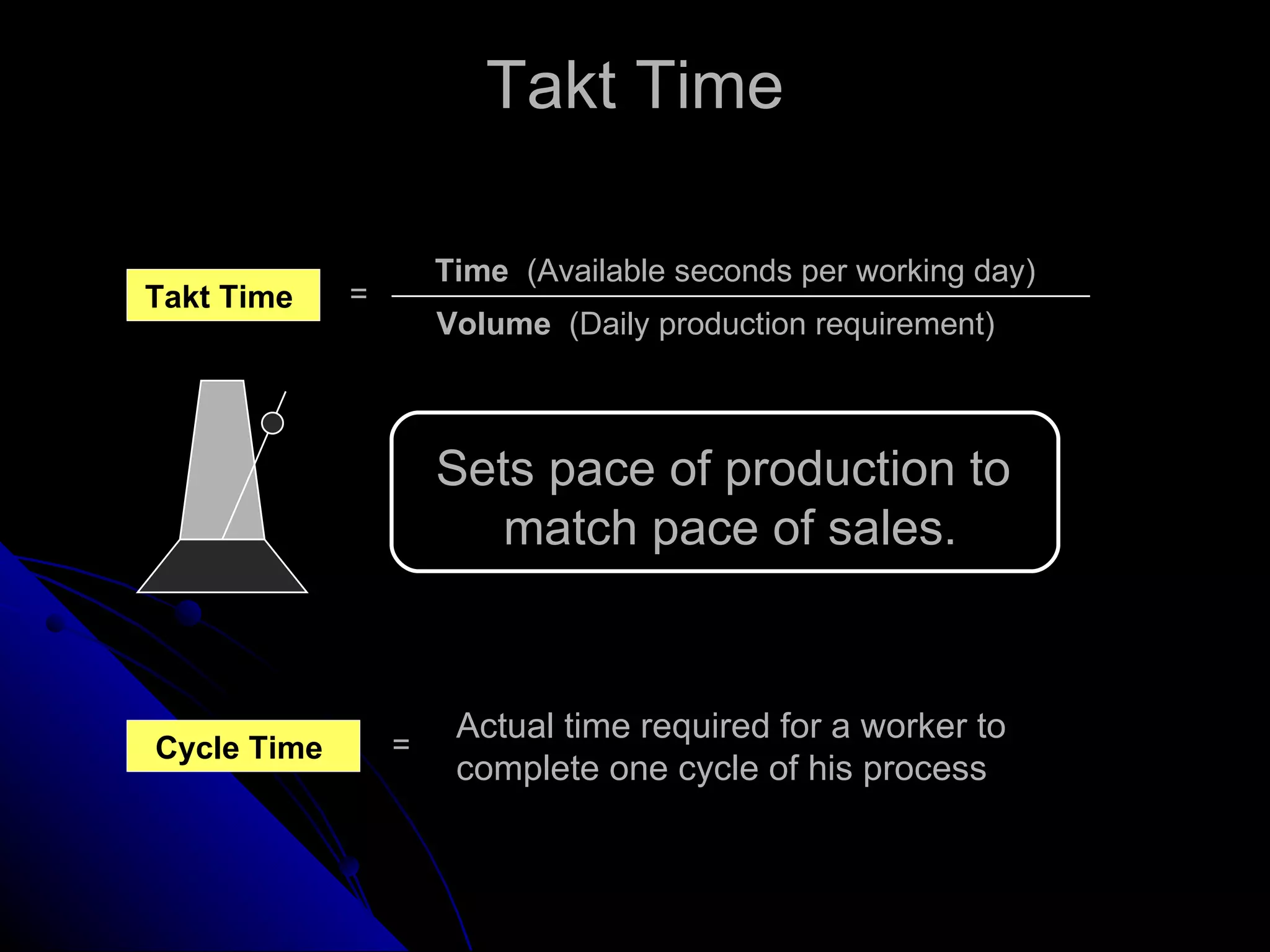
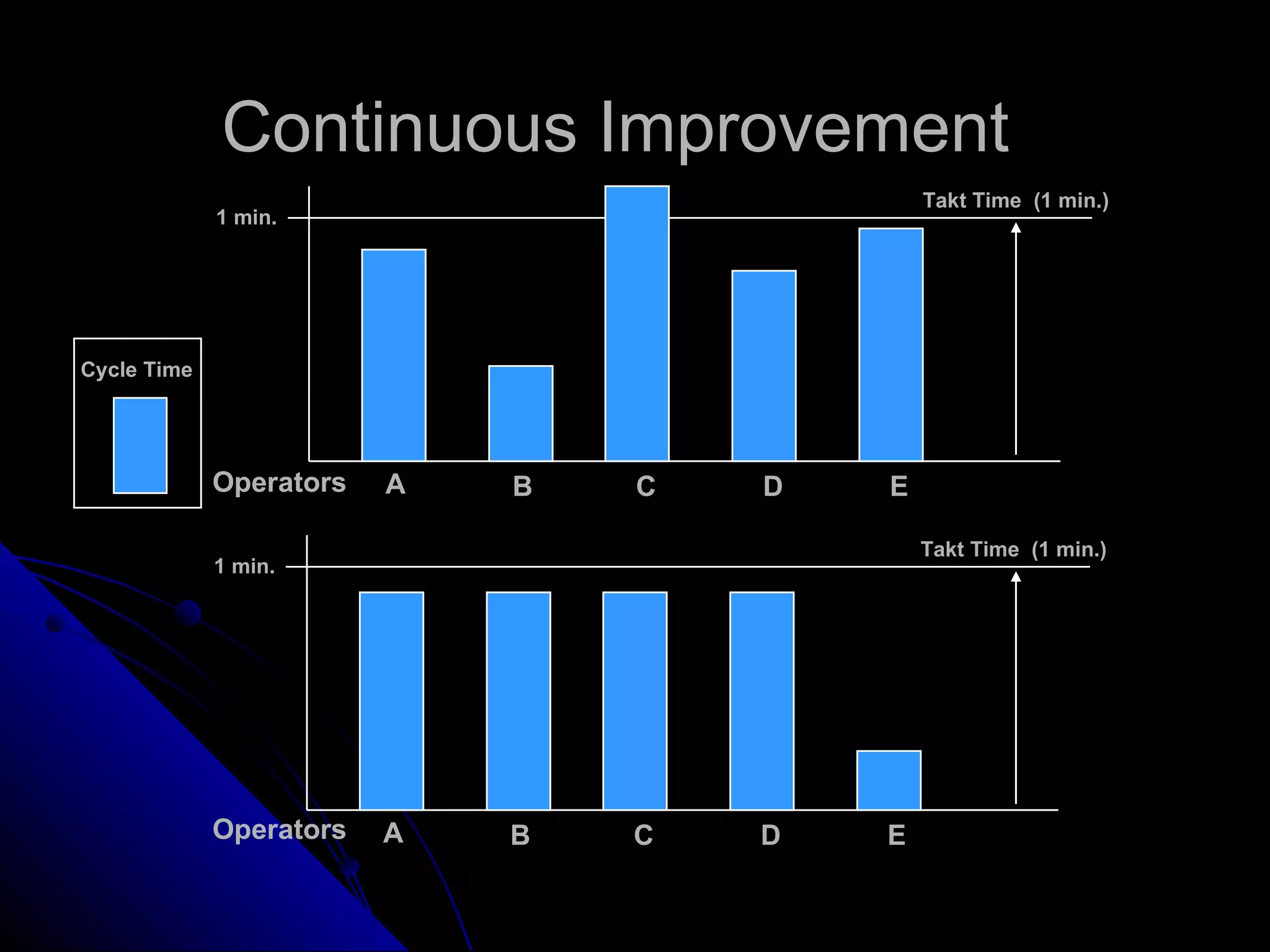
Takt Time Takt Time   Volume   (Daily production requirement)  Time   (Available seconds per working day)  = Cycle Time   = Actual time required for a worker to  complete one cycle of his process Sets pace of production to  match pace of sales.
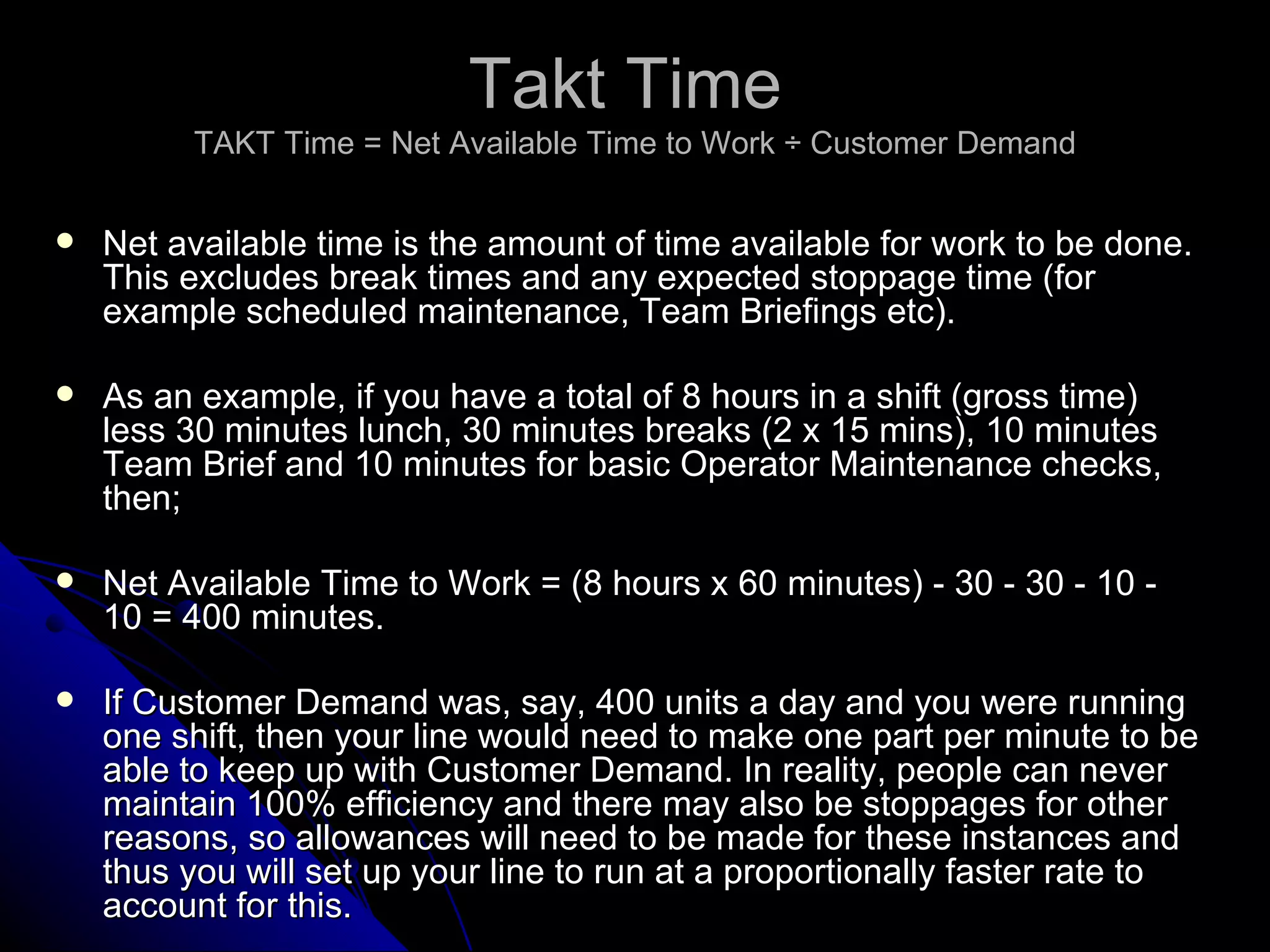
Takt Time  TAKT Time = Net Available Time to Work Ă· Customer Demand Net available time is the amount of time available for work to be done. This excludes break times and any expected stoppage time (for example scheduled maintenance, Team Briefings etc). As an example, if you have a total of 8 hours in a shift (gross time) less 30 minutes lunch, 30 minutes breaks (2 x 15 mins), 10 minutes Team Brief and 10 minutes for basic Operator Maintenance checks, then; Net Available Time to Work = (8 hours x 60 minutes) - 30 - 30 - 10 - 10 = 400 minutes. If Customer Demand was, say, 400 units a day and you were running one shift, then your line would need to make one part per minute to be able to keep up with Customer Demand. In reality, people can never maintain 100% efficiency and there may also be stoppages for other reasons, so allowances will need to be made for these instances and thus you will set up your line to run at a proportionally faster rate to account for this.
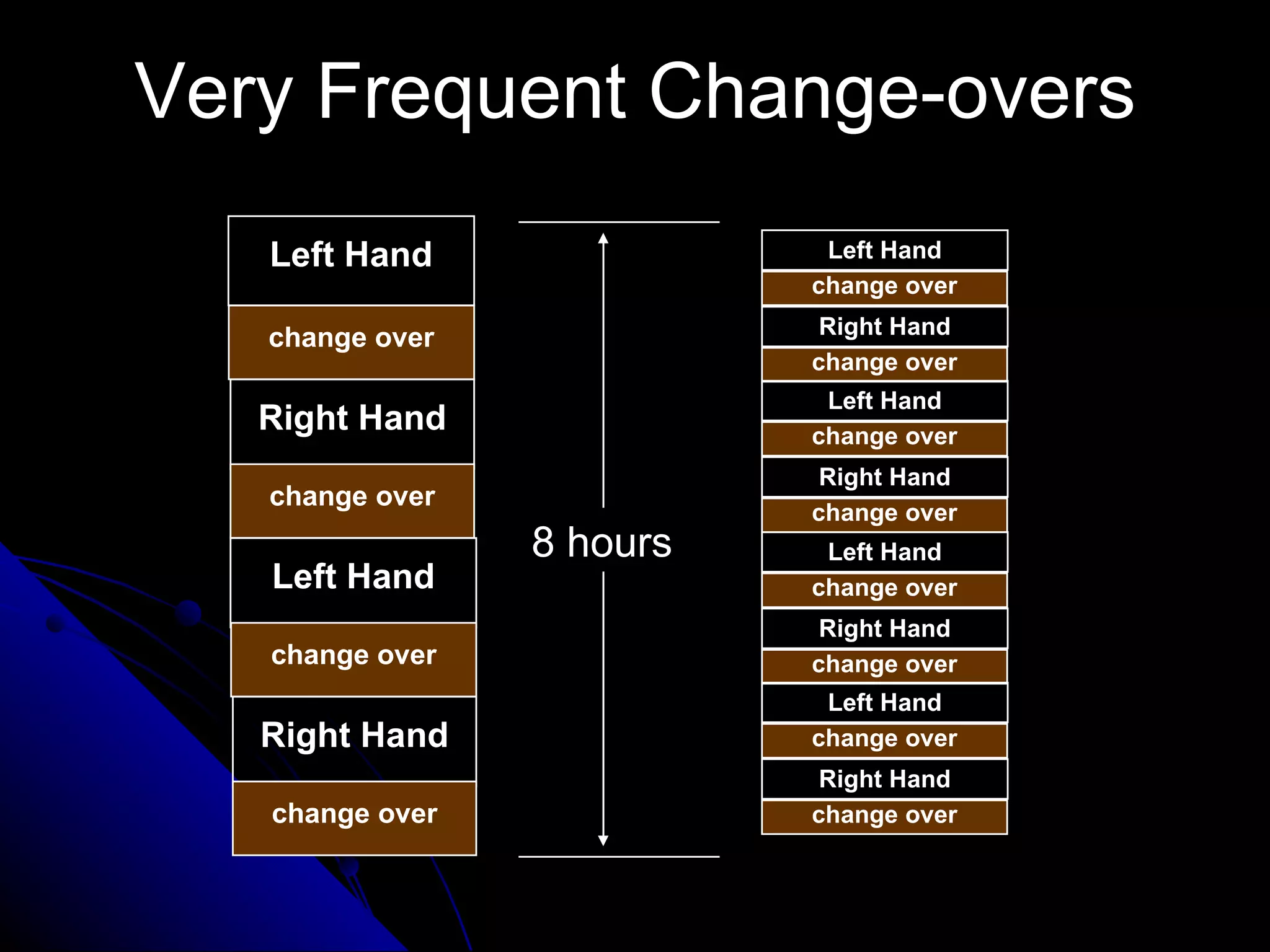
Very Frequent Change-overs 8 hours change over Right Hand  change over Left Hand  change over Right Hand  change over Left Hand  Left Hand   change over Right Hand   change over Left Hand   change over Right Hand   change over Left Hand   change over Right Hand   change over Left Hand   change over Right Hand   change over
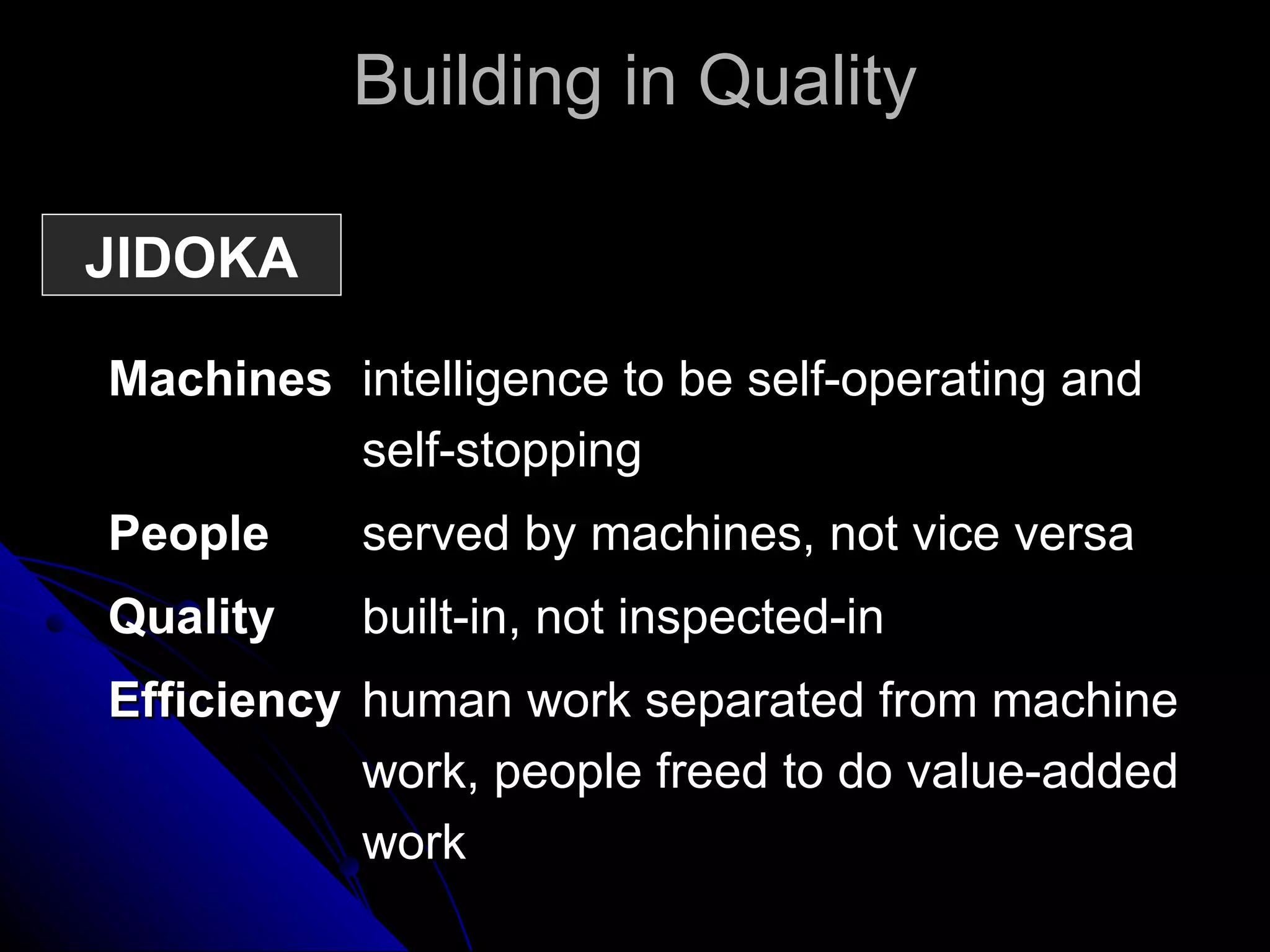
Building in Quality Machines intelligence to be self-operating and    self-stopping People served by machines, not vice versa Quality built-in, not inspected-in Efficiency human work separated from machine work, people freed to do value-added work JIDOKA
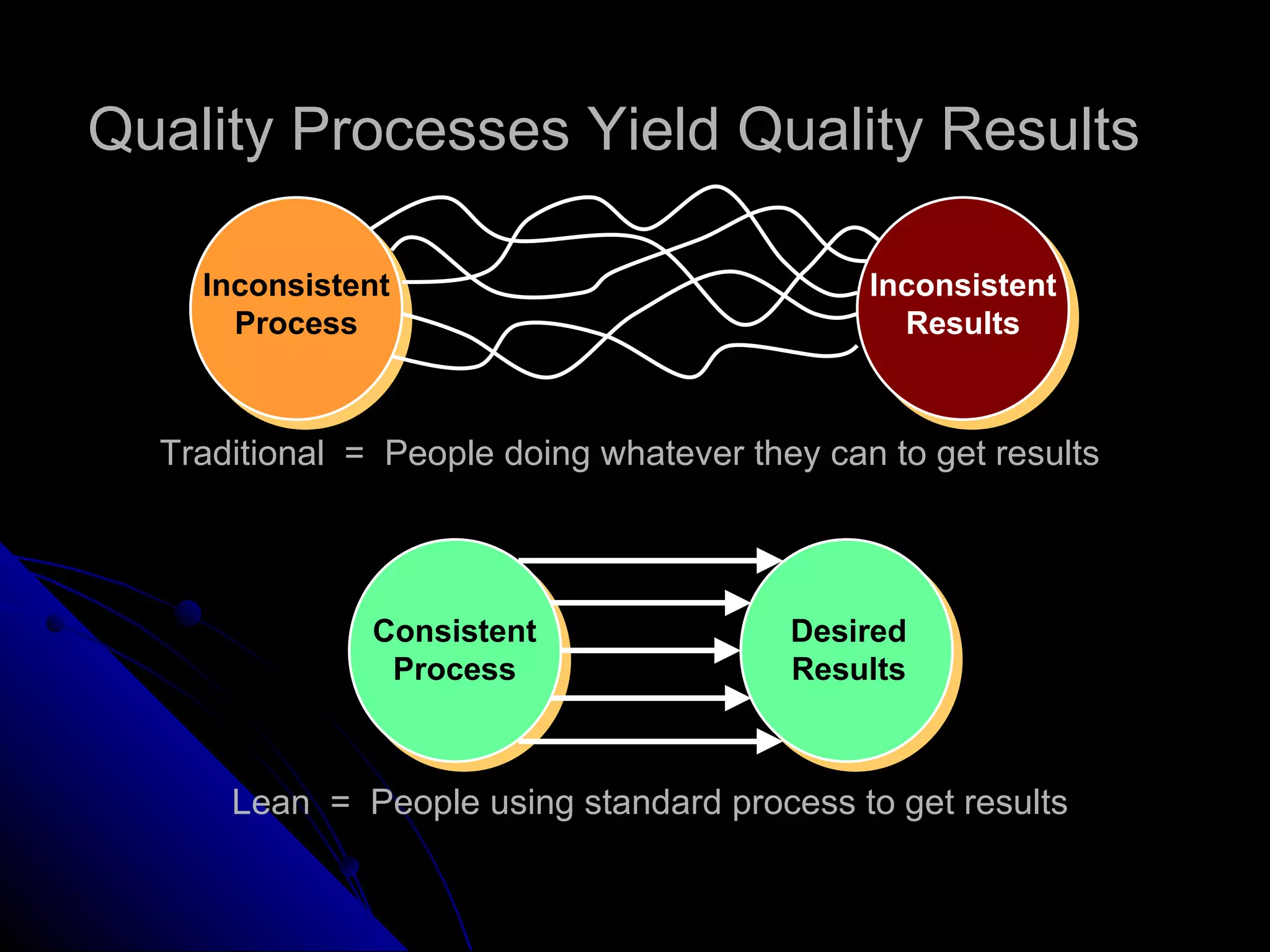
Quality Processes Yield Quality Results Consistent Process Desired Results Inconsistent Process Inconsistent Results Traditional  =  People doing whatever they can to get results Lean  =  People using standard process to get results
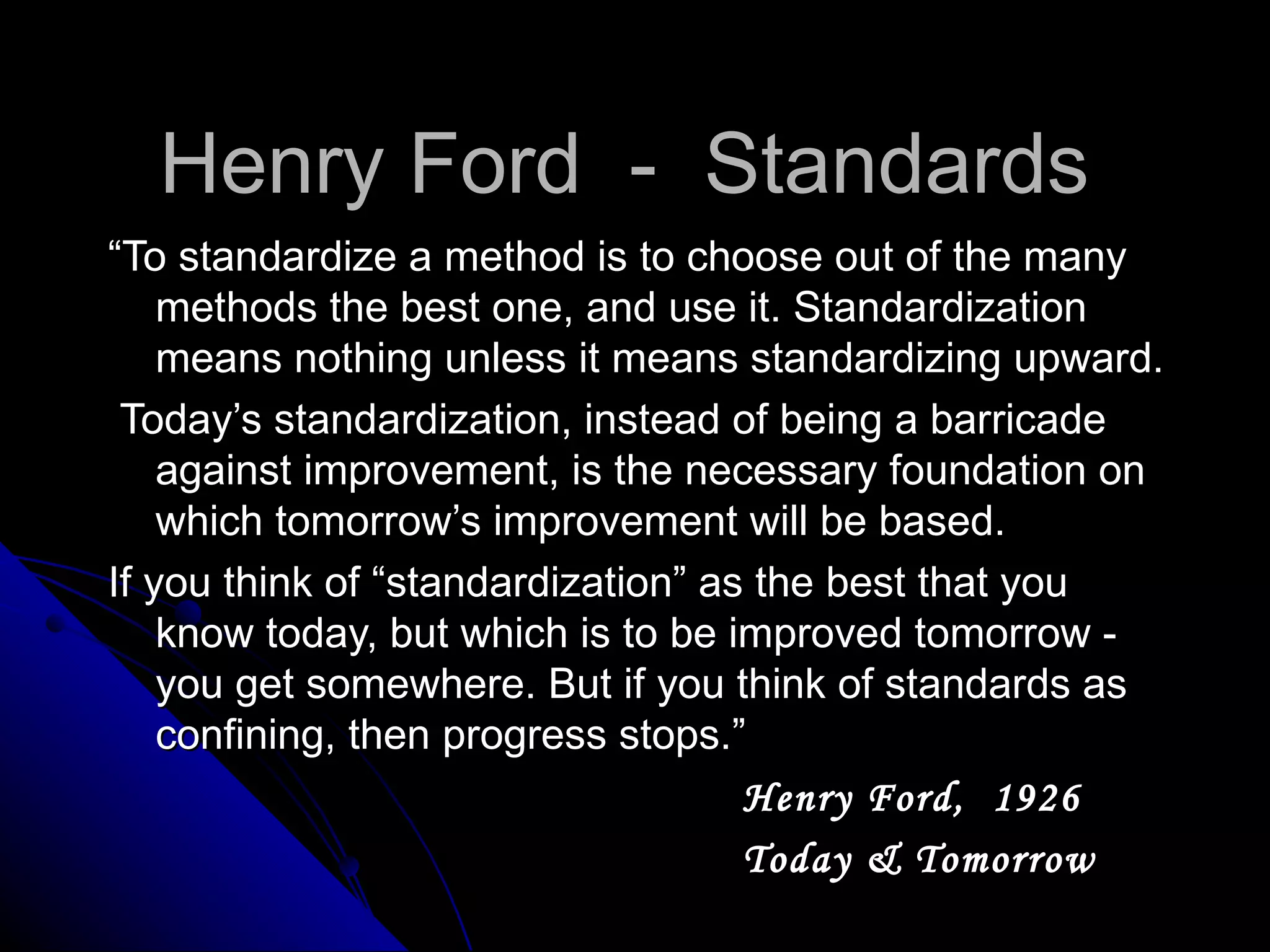
Henry Ford  -  Standards “ To standardize a method is to choose out of the many methods the best one, and use it. Standardization means nothing unless it means standardizing upward. Today’s standardization, instead of being a barricade against improvement, is the necessary foundation on which tomorrow’s improvement will be based.  If you think of “standardization” as the best that you know today, but which is to be improved tomorrow - you get somewhere. But if you think of standards as confining, then progress stops.” Henry Ford,  1926 Today & Tomorrow
Captures best practices Posted at the work station Visual aid Reference document work sequence job layout time elements safety Developed with operators Basis for Continuous Improvement  Standardized Work
Continuous Improvement  A D E C B 1 min. Takt Time  (1 min.) Operators A D E C B 1 min. Takt Time  (1 min.) Operators Cycle Time
Visual Factory Error Proofing Quick Change-over Total Productive Maintenance Other Tools
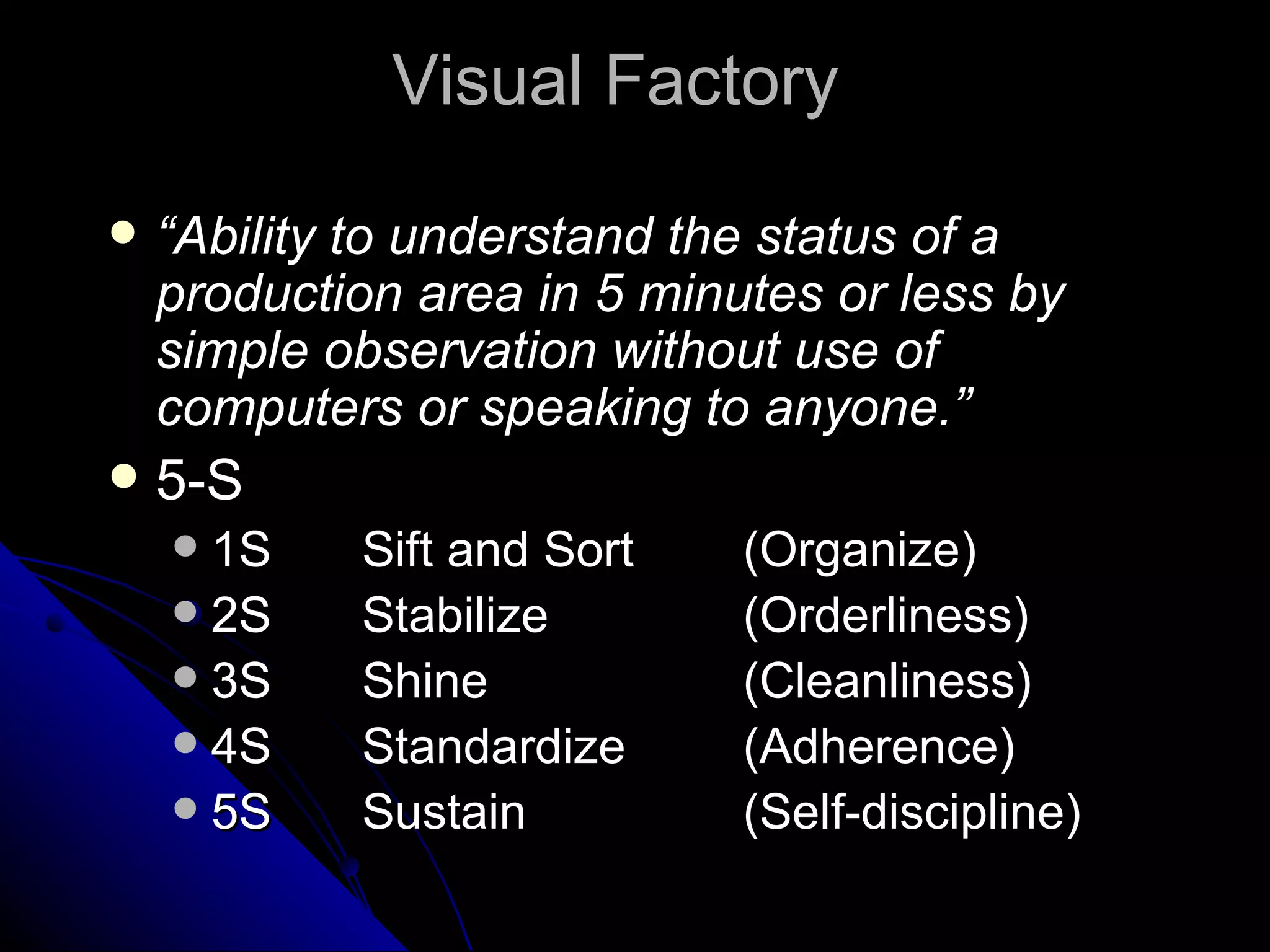
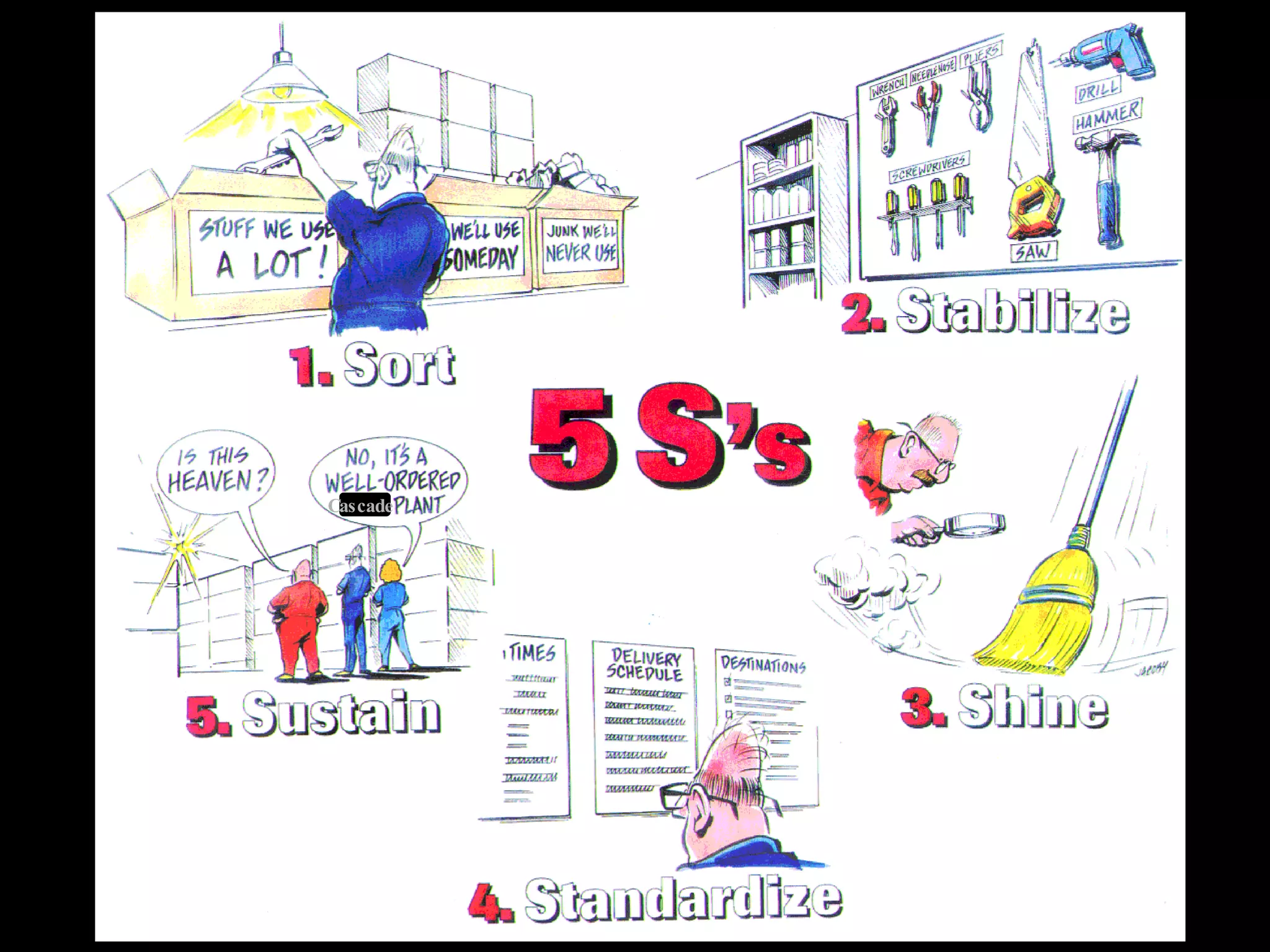
“ Ability to understand the status of a production area in 5 minutes or less by simple observation without use of computers or speaking to anyone.” 5-S 1S Sift and Sort  (Organize) 2S Stabilize   (Orderliness) 3S Shine (Cleanliness) 4S Standardize (Adherence) 5S Sustain (Self-discipline) Visual Factory
Cascade
Error Proofing  Preventing accidental errors in the manufacturing process Error detection Error prevention A way to achieve zero defects.
Quick Change Over  QCO is used to: Reduce time needed to change over from one set-up to another. Improve first time capability. Improve repeatability of change over operations
TPM is a structured approach to maintaining equipment and insuring stable manufacturing processes. Everybody gets involved. Total Productive Maintenance
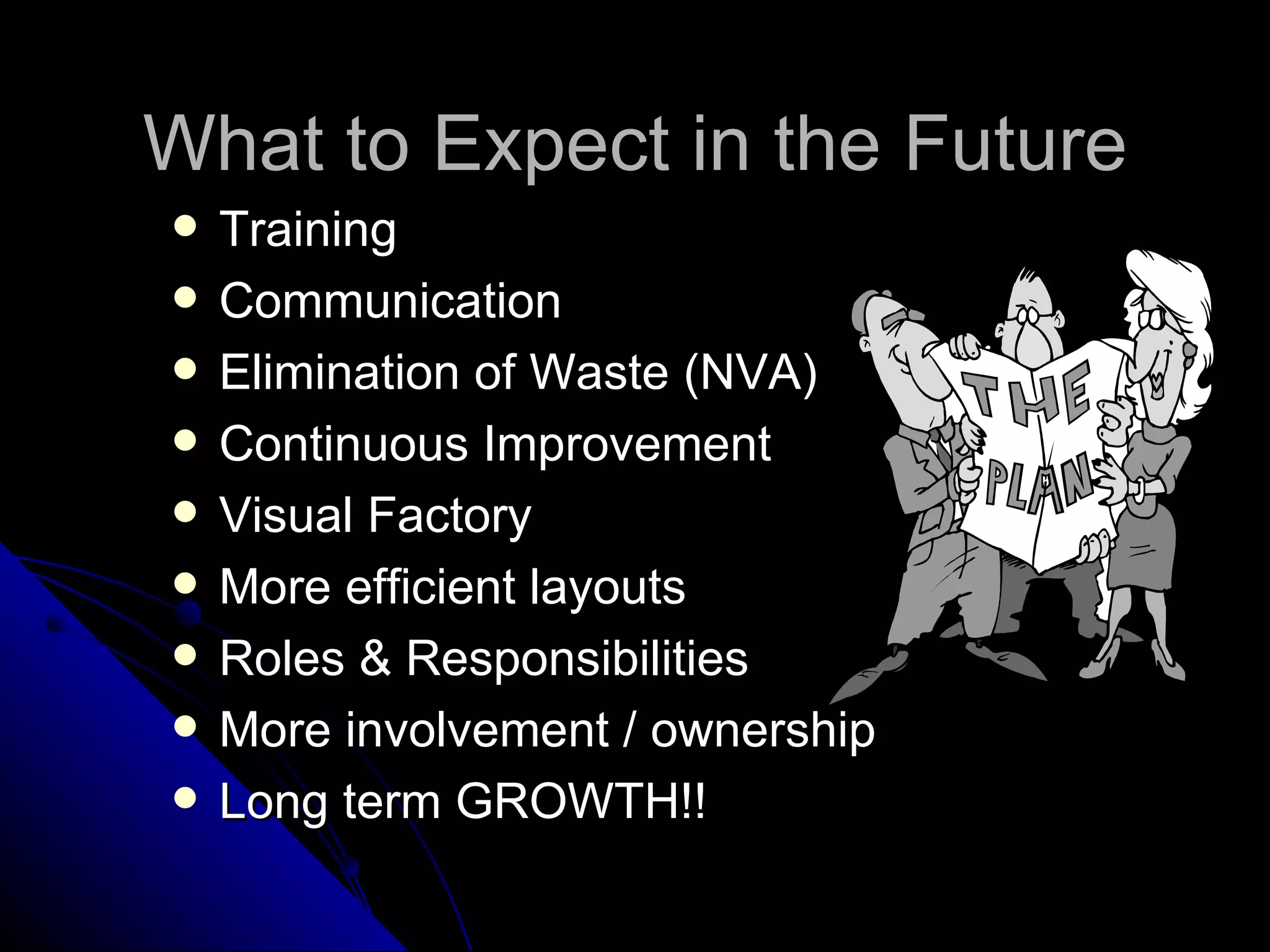
Impact on You!! First Time Quality Standardized Work Error Proofing Root Cause Analysis Problem Solving Change Request Forms Predictable Processes Machine Reliability Total Productive Maintenance Improved up-time Reduced scrap & repairs People Skilled, multi-function workers Training Employee development Small Group Activity Quality Safety Productivity Cost Structured feedback meetings Empowerment Involvement Accountability Responsibility Authority Safety & Ergonomics Just in Time Kanban production Min / Max levels Smaller Lots Quick Change Over Less inventory Less reliance on schedules
What to Expect in the Future Training Communication Elimination of Waste (NVA) Continuous Improvement Visual Factory More efficient layouts Roles & Responsibilities More involvement / ownership Long term GROWTH!!
Evidence of Progress toward Lean Smaller lot sizes Increased capacity / throughput Higher inventory turns More available floor space Improved workplace organization Improved quality : reduced scrap / re-work Reduced inventories : raw, WIP, FG Reduced lead times Greater gross margin Improved participation & morale

Generic Lean Overview For Future Employer Of Alan S Desrocher

  • 1.
    Lean Six SigmaManufacturing Overview Machine Shop 2009
  • 2.
    What does AlanDesrocher bring to the table Strategic programs Tactical approaches Cultural elements to both
  • 3.
    Objectives Review briefhistory of manufacturing systems Distinguish between mass and lean manufacturing Introduce key Concepts of Lean Manufacturing Review the kinds of changes needed to be considered a lean manufacturer.
  • 4.
    Objectives Understand wherewe are as a “Lean Culture” using a Lean Improvement Roadmap Assessment Distinguish between what has been learned second hand or thoroughly taught, we don’t want to reinvent the wheel Reinforce key Concepts of Lean Manufacturing if known Review the kinds of changes needed to be considered a lean manufacturer. Dig in
  • 5.
    Objectives Using thedesigned Roadmap we’ll be displaying throughout the organization where we are and where we want to go Using the Roadmap we’ll be assuring that all employees are communicated to….. at the level that they feel confident that we are heading “ together towards excellence” ! Using the Roadmap we’ll be monitoring our progress and celebrating our successes and understanding and correcting our failures
  • 6.
    Craft Manufacturing Late 1800’s Car built on blocks in the barn as workers walked around the car. Built by craftsmen with pride Components hand-crafted, hand-fitted Excellent quality Very expensive Few produced
  • 7.
    Mass Manufacturing Assembly line - Henry Ford 1920s Low skilled labor, simplistic jobs, no pride in work Interchangeable parts Lower quality Affordably priced for the average family Billions produced - identical
  • 8.
    Lean Manufacturing Cells or flexible assembly lines Broader jobs, highly skilled workers, proud of product Interchangeable parts, even more variety Excellent quality mandatory Costs being decreased through process improvements. Global markets and competition.
  • 9.
    Definition of “Lean”Half the hours of human effort in the factory Half the defects in the finished product One-third the hours of engineering effort Half the factory space for the same output A tenth or less of in-process inventories Source: The Machine that Changed the World Womack, Jones, Roos 1990
  • 10.
    Toyota Production SystemBest Quality - Lowest Cost - Shortest Lead Time Through shortening the Production Flow by Eliminating Waste Just in Time “The right part at the right time in the right amount” Continuous Flow Pull System Level Production (Heijunka) Jidoka “Built in Quality” Manual / Automatic Line Stop Labor-Machine Efficiency Error Proofing Visual Control Flexible, Capable, Highly Motivated People Standardized Work Total Productive Maintenance Robust Products & Processes Supplier Involvement Operational Stability
  • 11.
    New Paradigm: Non-BlamingCulture Management creates a culture where: Problems are recognized as opportunities It’s okay to make legitimate mistakes Problems are exposed because of increased trust People are not problems - they are problem solvers Emphasis is placed on finding solutions instead of “who did it” SOLUTIONS PROBLEMS
  • 12.
    Lean Manufacturing isa manufacturing philosophy which shortens the time line between the customer order and the product shipment by eliminating waste . Customer Order Waste Time Customer Order Time (Shorter) Business as Usual Waste Lean Manufacturing Product Shipment Product Shipment
  • 13.
    Waste “ Anythingthat adds Cost to the product without adding Value”
  • 14.
    Customer Role Play re: Value Add Notes only on this page.
  • 15.
    What value is Added by: Sorting Counting Acknowledgments Moving Expediting Inspecting Returns to Suppliers Repackaging Scrap Storing Invoices Rework Loading / Unloading Receiving Report
  • 16.
    7 Forms ofWaste Types of Waste CORRECTION WAITING PROCESSING MOTION INVENTORY CONVEYANCE OVERPRODUCTION Repair or Rework Any wasted motion to pick up parts or stack parts. Also wasted walking Wasted effort to transport materials, parts, or finished goods into or out of storage, or between processes. Producing more than is needed before it is needed Maintaining excess inventory of raw mat’ls, parts in process, or finished goods. Doing more work than is necessary Any non-work time waiting for tools, supplies, parts, etc..
  • 17.
    Who wants what...Customer Low Cost High Quality Availability Your Company Profit Repeat Business Growth Cash !! $ Value !!
  • 18.
    Price Increase Some Profit Bigger Profit Price to Sell Cost to Produce Cost + Profit = Price 1 2 3 1 2 3
  • 19.
    Cost Reduction Some Profit Bigger Profit Price to Sell Cost to Produce Price - Cost = Profit 1 2 3 1 2 3
  • 20.
    Just in TimeManufacturing Produce according to customer demands: What is needed When it is needed In the quantity it is needed Utilize - Continuous flow processing - Pull system
  • 21.
    JIT Element -Continuous Flow Processing Batch Processing 10 minutes 10 minutes 10 minutes Total Batch A processing time : 30 minutes Continuous Flow Processing Total Batch A processing time : 12 minutes Only 3 minutes for 1st part Product requires three processes that take one minute each Processing first batch in batches of 10 requires 30 minutes Processing first “batch” one-at-a-time requires only 12 minutes
  • 22.
    JIT Element -Pull System Following processes withdraw what they need when they need it. Preceding processes replenish what is taken away. Upstream Processes Downstream Processes New Product Needed Product Pull Withdrawal Kanban Production Kanban Store A B C D E F G H I J K L M N O P Q
  • 23.
    Production Scheduling AssumptionsProduction Schedules will always change Production will never go according to schedule.
  • 24.
    Takt Time TaktTime Volume (Daily production requirement) Time (Available seconds per working day) = Cycle Time = Actual time required for a worker to complete one cycle of his process Sets pace of production to match pace of sales.
  • 25.
    Takt Time TAKT Time = Net Available Time to Work Ă· Customer Demand Net available time is the amount of time available for work to be done. This excludes break times and any expected stoppage time (for example scheduled maintenance, Team Briefings etc). As an example, if you have a total of 8 hours in a shift (gross time) less 30 minutes lunch, 30 minutes breaks (2 x 15 mins), 10 minutes Team Brief and 10 minutes for basic Operator Maintenance checks, then; Net Available Time to Work = (8 hours x 60 minutes) - 30 - 30 - 10 - 10 = 400 minutes. If Customer Demand was, say, 400 units a day and you were running one shift, then your line would need to make one part per minute to be able to keep up with Customer Demand. In reality, people can never maintain 100% efficiency and there may also be stoppages for other reasons, so allowances will need to be made for these instances and thus you will set up your line to run at a proportionally faster rate to account for this.
  • 26.
    Very Frequent Change-overs8 hours change over Right Hand change over Left Hand change over Right Hand change over Left Hand Left Hand change over Right Hand change over Left Hand change over Right Hand change over Left Hand change over Right Hand change over Left Hand change over Right Hand change over
  • 27.
    Building in QualityMachines intelligence to be self-operating and self-stopping People served by machines, not vice versa Quality built-in, not inspected-in Efficiency human work separated from machine work, people freed to do value-added work JIDOKA
  • 28.
    Quality Processes YieldQuality Results Consistent Process Desired Results Inconsistent Process Inconsistent Results Traditional = People doing whatever they can to get results Lean = People using standard process to get results
  • 29.
    Henry Ford - Standards “ To standardize a method is to choose out of the many methods the best one, and use it. Standardization means nothing unless it means standardizing upward. Today’s standardization, instead of being a barricade against improvement, is the necessary foundation on which tomorrow’s improvement will be based. If you think of “standardization” as the best that you know today, but which is to be improved tomorrow - you get somewhere. But if you think of standards as confining, then progress stops.” Henry Ford, 1926 Today & Tomorrow
  • 30.
    Captures best practicesPosted at the work station Visual aid Reference document work sequence job layout time elements safety Developed with operators Basis for Continuous Improvement Standardized Work
  • 31.
    Continuous Improvement A D E C B 1 min. Takt Time (1 min.) Operators A D E C B 1 min. Takt Time (1 min.) Operators Cycle Time
  • 32.
    Visual Factory ErrorProofing Quick Change-over Total Productive Maintenance Other Tools
  • 33.
    “ Ability tounderstand the status of a production area in 5 minutes or less by simple observation without use of computers or speaking to anyone.” 5-S 1S Sift and Sort (Organize) 2S Stabilize (Orderliness) 3S Shine (Cleanliness) 4S Standardize (Adherence) 5S Sustain (Self-discipline) Visual Factory
  • 34.
  • 35.
    Error Proofing Preventing accidental errors in the manufacturing process Error detection Error prevention A way to achieve zero defects.
  • 36.
    Quick Change Over QCO is used to: Reduce time needed to change over from one set-up to another. Improve first time capability. Improve repeatability of change over operations
  • 37.
    TPM is astructured approach to maintaining equipment and insuring stable manufacturing processes. Everybody gets involved. Total Productive Maintenance
  • 38.
    Impact on You!!First Time Quality Standardized Work Error Proofing Root Cause Analysis Problem Solving Change Request Forms Predictable Processes Machine Reliability Total Productive Maintenance Improved up-time Reduced scrap & repairs People Skilled, multi-function workers Training Employee development Small Group Activity Quality Safety Productivity Cost Structured feedback meetings Empowerment Involvement Accountability Responsibility Authority Safety & Ergonomics Just in Time Kanban production Min / Max levels Smaller Lots Quick Change Over Less inventory Less reliance on schedules
  • 39.
    What to Expectin the Future Training Communication Elimination of Waste (NVA) Continuous Improvement Visual Factory More efficient layouts Roles & Responsibilities More involvement / ownership Long term GROWTH!!
  • 40.
    Evidence of Progresstoward Lean Smaller lot sizes Increased capacity / throughput Higher inventory turns More available floor space Improved workplace organization Improved quality : reduced scrap / re-work Reduced inventories : raw, WIP, FG Reduced lead times Greater gross margin Improved participation & morale

Editor's Notes

  • #8 Time & Motion studies - Fredrick Taylor Interchangeable parts - Eli Whitney
  • #10 Term “lean” coined by John Krafcik, one of the research members on Jim Womack’s MIT team for the 5 year study.
  • #13 The sooner product ships, the sooner Cedar Works gets paid The faster material moves through the system Less money tied up in inventory in the system
  • #14 Who decides what is valuable? ---->>> Customer
  • #15 Let’s look at it from a customer’s viewpoint. Does the customer care about all these problems?? Discuss a few in depth. ROLE PLAY: pick someone for each part Customer - Subcontractor Resaw - Small parts Shipping - Assembly at West Union Walk through the role play problem example at each work station. “ Does the customer care?? ” NO!! What does the customer care about?? Low Cost High Quality Availability / On-time delivery What does Cascade care about? Profit Market share Repeat business Why are these things important to Cascade ?? Jobs - Income (Salary & Profit sharing) Employment - Future growth - Job security High inventories High scrap Wasted matl’s Absenteeism Machine downtime Late deliveries Low profit margin Long set-up time
  • #16 Discussion None of these activities adds Value. Some are important or necessary, but None add value.
  • #17 Discuss each Ask for examples of each type from different work areas at Cedar Works. Transition to Mercury Marine video . After video, tee up introduction of Cedar Works Production System and Lean Manufacturing. “ So what do you think it will take for Cedar Works to steadily eliminate waste, or NVA from their operations?? Discussion
  • #18 What we have here is a pretty fundamental relationship. Each party wants something; the customer and Cascade. The essential ingredients that make the whole thing go are: Value to the Customer Profit to Cascade These are the two fundamentals that MUST be there for a company to grow and thrive. If only one side of this flow takes place, the company will soon be out of business; if the customer does not receive adequate value if the company doesn’t make sufficient profit As for value to the customer, what determines if the customer is getting good value? Answer: Desired product and features at low cost. As for Cascade, what determines how much profit you make? Answer: Sales Price - Cost to produce Transition to next slide
  • #19 Show left hand side first , 1. Determine Cost to produce an item 2. Add profit you want 3. This gives you Price to the customer If you want to increase your profit under this system, how do you do it? --->>> Raise the price to the customer. reveal right hand side This is what most companies operated in the 60’s and 70’s, just pass the cost along to the customer. But as the markets get more and more competitive, do you think this strategy will still work?? NO!! So if Cascade wants to increase their profits now a days, how could they do it?? Discussion Transition to next slide......
  • #20 Show left hand side first , 1. Determine Price customer is willing to pay 2. Subtract the Cost to produce an item 3. This leaves your profit Under this system if you want to increase your profit, how do you do it? ---->>> Lower Cost. How do you suppose you lower Cost?? Elimination of Non-Value Added Activity. Elimination of Waste !! What exactly is waste? Discussion
  • #31 Show sample Standardized Work from Cedar Works Bring training manual