Game-based learning, branching stories,
and advantages for using with adult learning
Vikki Trace and Eileen Kirk
Derbyshire Adult Community Education Service (DACES)
eTrees
An online service to improve communication skills in the
workplace using branching stories games
Purpose
1. To develop a game-based learning application using branching scenarios
for practicing, evaluating, and enhancing communication skills.
2. To develop a validated game-based learning methodology and resources
that will permit trainers and businesses to develop and use their own
branching scenarios and content.
The eTrees consortium
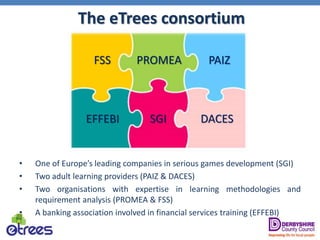
• One of Europe’s leading companies in serious games development (SGI)
• Two adult learning providers (PAIZ & DACES)
• Two organisations with expertise in learning methodologies and
requirement analysis (PROMEA & FSS)
• A banking association involved in financial services training (EFFEBI)
SGI
FSS PAIZ
DACES
PROMEA
EFFEBI
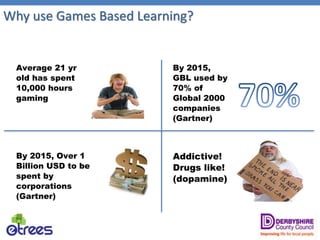
Why use Games Based Learning?
Average 21 yr
old has spent
10,000 hours
gaming
By 2015, Over 1
Billion USD to be
spent by
corporations
(Gartner)
By 2015,
GBL used by
70% of
Global 2000
companies
(Gartner)
Addictive!
Drugs like!
(dopamine)
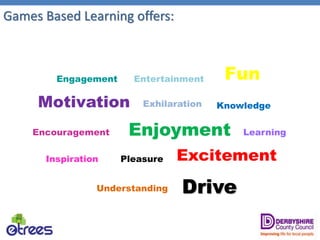
Encouragement Learning
Exhilaration
Excitement
Motivation
Inspiration
Knowledge
Pleasure
Understanding
Engagement
Drive
Entertainment
Enjoyment
Fun
Games Based Learning offers:
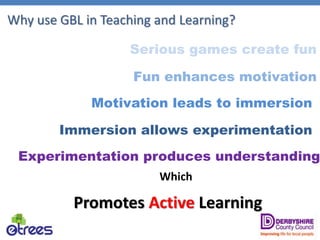
Serious games create fun
Fun enhances motivation
Motivation leads to immersion
Immersion allows experimentation
Experimentation produces understanding
Which
Promotes Active Learning
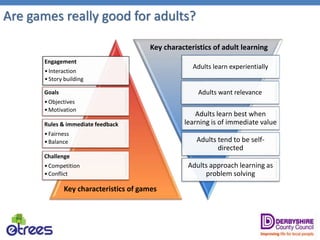
Are games really good for adults?
Adults learn experientially
Adults want relevance
Adults learn best when
learning is of immediate value
Adults tend to be self-
directed
Adults approach learning as
problem solving
Engagement
•Interaction
•Story building
Goals
•Objectives
•Motivation
Rules & immediate feedback
•Fairness
•Balance
Challenge
•Competition
•Conflict
Key characteristics of adult learning
Key characteristics of games
What about branching scenarios?
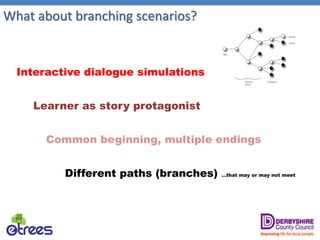
Interactive dialogue simulations
Learner as story protagonist
Common beginning, multiple endings
Different paths (branches) …that may or may not meet
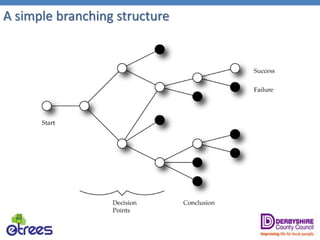
A simple branching structure
start
ending
ending
ending
ending ending
ending
ending
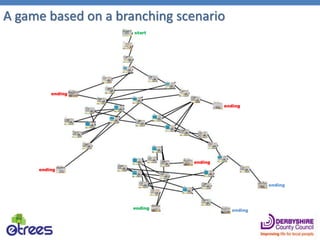
A game based on a branching scenario
What is the added value of using GBL?
Offers Realism
Higher control & responsibility
Strengthened sense of attachment
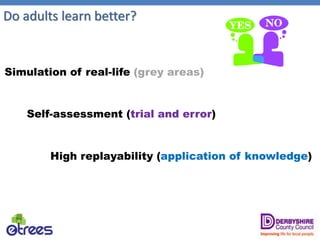
Do adults learn better?
Simulation of real-life (grey areas)
Self-assessment (trial and error)
High replayability (application of knowledge)
Example of a Branching Story
To try the Greek story Click here
For DACES Click here
www.daces.org.uk/course/view.php?id=625
Building a Branching Story – using e-trees tool
eTrees Tool
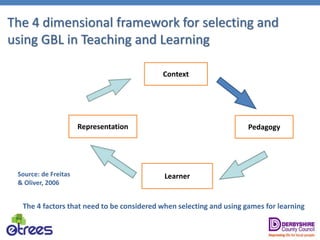
The 4 dimensional framework for selecting and
using GBL in Teaching and Learning
Context
Pedagogy
Learner
Representation
The 4 factors that need to be considered when selecting and using games for learning
Source: de Freitas
& Oliver, 2006
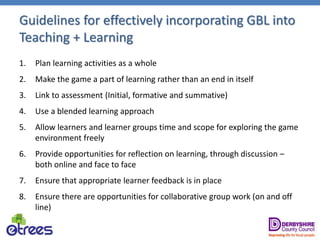
Guidelines for effectively incorporating GBL into
Teaching + Learning
1. Plan learning activities as a whole
2. Make the game a part of learning rather than an end in itself
3. Link to assessment (Initial, formative and summative)
4. Use a blended learning approach
5. Allow learners and learner groups time and scope for exploring the game
environment freely
6. Provide opportunities for reflection on learning, through discussion –
both online and face to face
7. Ensure that appropriate learner feedback is in place
8. Ensure there are opportunities for collaborative group work (on and off
line)
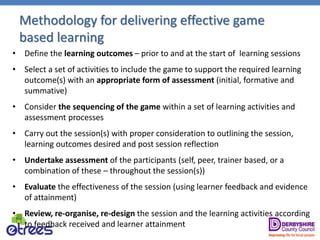
Methodology for delivering effective game
based learning
• Define the learning outcomes – prior to and at the start of learning sessions
• Select a set of activities to include the game to support the required learning
outcome(s) with an appropriate form of assessment (initial, formative and
summative)
• Consider the sequencing of the game within a set of learning activities and
assessment processes
• Carry out the session(s) with proper consideration to outlining the session,
learning outcomes desired and post session reflection
• Undertake assessment of the participants (self, peer, trainer based, or a
combination of these – throughout the session(s))
• Evaluate the effectiveness of the session (using learner feedback and evidence
of attainment)
• Review, re-organise, re-design the session and the learning activities according
to feedback received and learner attainment
Next Steps
• DACES – e-trees scenario to be developed and tested
– July 2014
• e-trees tool completed – Sept 2014
• National Launch of e-trees tool – Oct 2014
• e-trees game and software tool available for use –
Nov 2014
Thank you!
Vikki Trace and Eileen Kirk
Derbyshire Adult Community Education Service (DACES)
eileen.kirk@derbyshire.gov.uk
vikki.trace@derbyshire.gov.uk

Delivering effective games based learning

  • 1.
    Game-based learning, branchingstories, and advantages for using with adult learning Vikki Trace and Eileen Kirk Derbyshire Adult Community Education Service (DACES)
  • 2.
    eTrees An online serviceto improve communication skills in the workplace using branching stories games Purpose 1. To develop a game-based learning application using branching scenarios for practicing, evaluating, and enhancing communication skills. 2. To develop a validated game-based learning methodology and resources that will permit trainers and businesses to develop and use their own branching scenarios and content.
  • 3.
    The eTrees consortium •One of Europe’s leading companies in serious games development (SGI) • Two adult learning providers (PAIZ & DACES) • Two organisations with expertise in learning methodologies and requirement analysis (PROMEA & FSS) • A banking association involved in financial services training (EFFEBI) SGI FSS PAIZ DACES PROMEA EFFEBI
  • 4.
    Why use GamesBased Learning? Average 21 yr old has spent 10,000 hours gaming By 2015, Over 1 Billion USD to be spent by corporations (Gartner) By 2015, GBL used by 70% of Global 2000 companies (Gartner) Addictive! Drugs like! (dopamine)
  • 5.
  • 6.
    Serious games createfun Fun enhances motivation Motivation leads to immersion Immersion allows experimentation Experimentation produces understanding Which Promotes Active Learning
  • 7.
    Are games reallygood for adults? Adults learn experientially Adults want relevance Adults learn best when learning is of immediate value Adults tend to be self- directed Adults approach learning as problem solving Engagement •Interaction •Story building Goals •Objectives •Motivation Rules & immediate feedback •Fairness •Balance Challenge •Competition •Conflict Key characteristics of adult learning Key characteristics of games
  • 8.
    What about branchingscenarios? Interactive dialogue simulations Learner as story protagonist Common beginning, multiple endings Different paths (branches) …that may or may not meet
  • 9.
  • 10.
  • 11.
    What is theadded value of using GBL? Offers Realism Higher control & responsibility Strengthened sense of attachment
  • 12.
    Do adults learnbetter? Simulation of real-life (grey areas) Self-assessment (trial and error) High replayability (application of knowledge)
  • 13.
    Example of aBranching Story To try the Greek story Click here For DACES Click here www.daces.org.uk/course/view.php?id=625
  • 14.
    Building a BranchingStory – using e-trees tool eTrees Tool
  • 15.
    The 4 dimensionalframework for selecting and using GBL in Teaching and Learning Context Pedagogy Learner Representation The 4 factors that need to be considered when selecting and using games for learning Source: de Freitas & Oliver, 2006
  • 16.
    Guidelines for effectivelyincorporating GBL into Teaching + Learning 1. Plan learning activities as a whole 2. Make the game a part of learning rather than an end in itself 3. Link to assessment (Initial, formative and summative) 4. Use a blended learning approach 5. Allow learners and learner groups time and scope for exploring the game environment freely 6. Provide opportunities for reflection on learning, through discussion – both online and face to face 7. Ensure that appropriate learner feedback is in place 8. Ensure there are opportunities for collaborative group work (on and off line)
  • 17.
    Methodology for deliveringeffective game based learning • Define the learning outcomes – prior to and at the start of learning sessions • Select a set of activities to include the game to support the required learning outcome(s) with an appropriate form of assessment (initial, formative and summative) • Consider the sequencing of the game within a set of learning activities and assessment processes • Carry out the session(s) with proper consideration to outlining the session, learning outcomes desired and post session reflection • Undertake assessment of the participants (self, peer, trainer based, or a combination of these – throughout the session(s)) • Evaluate the effectiveness of the session (using learner feedback and evidence of attainment) • Review, re-organise, re-design the session and the learning activities according to feedback received and learner attainment
  • 18.
    Next Steps • DACES– e-trees scenario to be developed and tested – July 2014 • e-trees tool completed – Sept 2014 • National Launch of e-trees tool – Oct 2014 • e-trees game and software tool available for use – Nov 2014
  • 19.
    Thank you! Vikki Traceand Eileen Kirk Derbyshire Adult Community Education Service (DACES) eileen.kirk@derbyshire.gov.uk vikki.trace@derbyshire.gov.uk

Editor's Notes

  • #3 Point delegates to the e-trees flyer – for further information
  • #14 Show DACES branching story – or one of the e-trees branching stories
  • #16 Context Environment (Place of learning) Access to online learning Technical support available Pedagogy Assosiative (instructivist and often task centred) Cognitive (Constructivist) Situative (Learning in communities of practice) De-briefing through post-exercise discussion, reflection with peers/tutor Learner Demographics (age, culture, gender) Learning Preferences/Past experience Use of ICT/use of gaming software/social networking Group interactions/Skills Representation – of the game itself Internal reality and narrative of the game Level of immersion and fidelity Familiarity of interface with the learner group This framework offers a starting point for tutors considering using games in their practice.
  • #18 In Summary Trainers will need to use a flexible blended delivery methodology that adopts an experimental, exploratory and social approach to active learning and reflection. This approach should enable the learning that takes place during the game/learning session to be more easily transferred to the workplace setting