Play to Learn, Learn to Play!
How and Why Game-Based Learning
Works
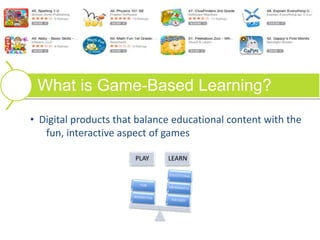
What is Game-Based Learning?
• Digital products that balance educational content with the
fun, interactive aspect of games
PLAY LEARN
What is Game-Based Learning?
• Digital products that balance educational content with the
fun, interactive aspect of games
• Feature defined learning outcomes
• Meaningful learning experiences
• Measureable outcomes
Key Features of Game-Based
Learning?
• Defined learning outcomes, meaningful learning experiences
• Provide context and real-world value of skills and content
• Encourage deeper learning, integration of knowledge bases and skill sets
• Seamless accountability, feedback, intrinsic and extrinsic motivators built-in
• Combine graphics, audio and movement into an interactive and immersive
experience
Characteristics of Good Games
Aligned to educational
standards
Cross Curricular
Skills Based
Purpose Aligned
Opportunities to
explore
Stimulating
Age
Appropriate
FUN!
Does Game-Based Learning Work?
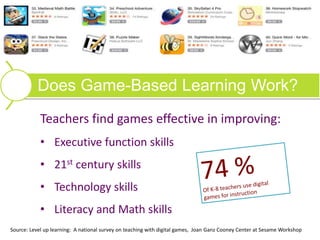
Teachers find games effective in improving:
• Executive function skills
• 21st century skills
• Technology skills
• Literacy and Math skills
Source: Level up learning: A national survey on teaching with digital games, Joan Ganz Cooney Center at Sesame Workshop
Does game-based learning work?
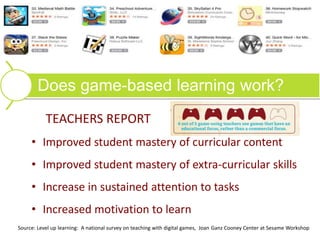
TEACHERS REPORT
• Improved student mastery of curricular content
• Improved student mastery of extra-curricular skills
• Increase in sustained attention to tasks
• Increased motivation to learn
Source: Level up learning: A national survey on teaching with digital games, Joan Ganz Cooney Center at Sesame Workshop
Does game-based learning work?
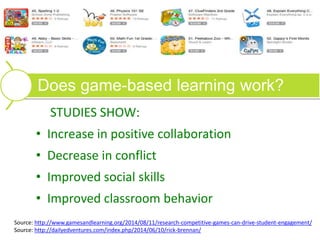
STUDIES SHOW:
• Increase in positive collaboration
• Decrease in conflict
• Improved social skills
• Improved classroom behavior
Source: http://www.gamesandlearning.org/2014/08/11/research-competitive-games-can-drive-student-engagement/
Source: http://dailyedventures.com/index.php/2014/06/10/rick-brennan/
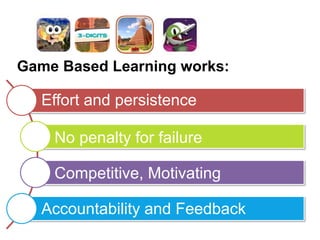
Game Based Learning works:
Effort and persistence
No penalty for failure
Competitive, Motivating
Accountability and Feedback
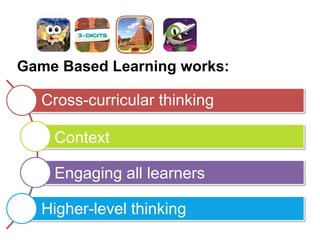
Game Based Learning works:
Cross-curricular thinking
Context
Engaging all learners
Higher-level thinking
Game Based Learning works:
Engage all learners
Progress tracking
Safe experimentation
Personalized learning
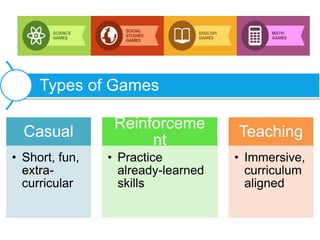
Casual
• Short, fun,
extra-
curricular
Reinforceme
nt
• Practice
already-learned
skills
Teaching
• Immersive,
curriculum
aligned
What kinds of games are out there?
• Interactive, immersive
• Success requires complex system learning, higher thinking
skills
• Competitive: studies show that the built-in competitive aspect
of digital gaming has measurable benefits for student
performance
• Instant feedback, opportunity to modify answers, which leads
to student ownership of learning
Keys to Success
• Progressive learning requires player to master topic before
moving forward
• Emphasis on persistence and effort
• Gameplay encourages deeper learning
• Content encourages integration of knowledge bases and skill
sets
Keys to Success
Casual
• Short, fun,
extra-
curricular
Reinforceme
nt
• Practice
already-learned
skills
Teaching
• Immersive,
curriculum
aligned
Types of Games
• As a break or reward
• In centers
• For skills practice
• During independent study time
• As homework
• After school
Use Casual and Reinforcement
Games
– Have students identify similarities and differences between the Maya Number System
and our Hindu-Arabic Number System
– Have students create their own Maya Number System math problems for their
classmates to solve
– Have students create a 3 Digits type game using a different number system (e.g.
Roman Numerals)
– Have students research other number systems to identify similarities and differences
between them
– Use loot archive as basis for further student work on Maya history
Game Integration Ideas
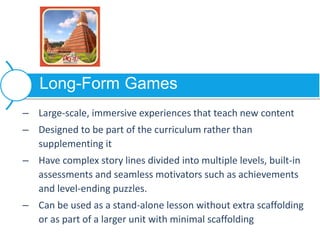
– Large-scale, immersive experiences that teach new content
– Designed to be part of the curriculum rather than
supplementing it
– Have complex story lines divided into multiple levels, built-in
assessments and seamless motivators such as achievements
and level-ending puzzles.
– Can be used as a stand-alone lesson without extra scaffolding
or as part of a larger unit with minimal scaffolding
Long-Form Games
• Unit study
• Extended project time
• Teacher-led lessons
• Group work
• Knowledge gain
• Tailored learning
Use Long Form Games
• Expand on value of in-game assessments and achievements
through additional external motivations (e.g. challenge to complete
puzzle in fastest time; extra credit for completing X achievement)
• Expand learning by using game as research tool: assign specific
puzzles or part of game and have students explain to others what
they learned
• Have students write report on in-game topics (e.g. Maya
government, Maya Calendar)
• Make connection to current events (e.g. Maya environmental
interaction and drought in CA)
Game Integration Ideas
Characteristics of Quality Games
Aligned to educational
standards
Cross Curricular
Skills Based
Purpose Aligned
Opportunities to
explore
Stimulating
Age
Appropriate
FUN!
Where can I find games?
For more information, visit
www.dig-itgames.com
E-mail us at: info@dig-itgames.com
@DigItGames
• www.Facebook.com/DigItGames

FETC 2016 Game Based Learning Workshop

  • 1.
    Play to Learn,Learn to Play! How and Why Game-Based Learning Works
  • 3.
    What is Game-BasedLearning? • Digital products that balance educational content with the fun, interactive aspect of games PLAY LEARN
  • 4.
    What is Game-BasedLearning? • Digital products that balance educational content with the fun, interactive aspect of games • Feature defined learning outcomes • Meaningful learning experiences • Measureable outcomes
  • 5.
    Key Features ofGame-Based Learning? • Defined learning outcomes, meaningful learning experiences • Provide context and real-world value of skills and content • Encourage deeper learning, integration of knowledge bases and skill sets • Seamless accountability, feedback, intrinsic and extrinsic motivators built-in • Combine graphics, audio and movement into an interactive and immersive experience
  • 6.
    Characteristics of GoodGames Aligned to educational standards Cross Curricular Skills Based Purpose Aligned Opportunities to explore Stimulating Age Appropriate FUN!
  • 7.
    Does Game-Based LearningWork? Teachers find games effective in improving: • Executive function skills • 21st century skills • Technology skills • Literacy and Math skills Source: Level up learning: A national survey on teaching with digital games, Joan Ganz Cooney Center at Sesame Workshop
  • 8.
    Does game-based learningwork? TEACHERS REPORT • Improved student mastery of curricular content • Improved student mastery of extra-curricular skills • Increase in sustained attention to tasks • Increased motivation to learn Source: Level up learning: A national survey on teaching with digital games, Joan Ganz Cooney Center at Sesame Workshop
  • 9.
    Does game-based learningwork? STUDIES SHOW: • Increase in positive collaboration • Decrease in conflict • Improved social skills • Improved classroom behavior Source: http://www.gamesandlearning.org/2014/08/11/research-competitive-games-can-drive-student-engagement/ Source: http://dailyedventures.com/index.php/2014/06/10/rick-brennan/
  • 10.
    Game Based Learningworks: Effort and persistence No penalty for failure Competitive, Motivating Accountability and Feedback
  • 11.
    Game Based Learningworks: Cross-curricular thinking Context Engaging all learners Higher-level thinking
  • 12.
    Game Based Learningworks: Engage all learners Progress tracking Safe experimentation Personalized learning
  • 13.
    Casual • Short, fun, extra- curricular Reinforceme nt •Practice already-learned skills Teaching • Immersive, curriculum aligned What kinds of games are out there?
  • 14.
    • Interactive, immersive •Success requires complex system learning, higher thinking skills • Competitive: studies show that the built-in competitive aspect of digital gaming has measurable benefits for student performance • Instant feedback, opportunity to modify answers, which leads to student ownership of learning Keys to Success
  • 15.
    • Progressive learningrequires player to master topic before moving forward • Emphasis on persistence and effort • Gameplay encourages deeper learning • Content encourages integration of knowledge bases and skill sets Keys to Success
  • 16.
    Casual • Short, fun, extra- curricular Reinforceme nt •Practice already-learned skills Teaching • Immersive, curriculum aligned Types of Games
  • 17.
    • As abreak or reward • In centers • For skills practice • During independent study time • As homework • After school Use Casual and Reinforcement Games
  • 18.
    – Have studentsidentify similarities and differences between the Maya Number System and our Hindu-Arabic Number System – Have students create their own Maya Number System math problems for their classmates to solve – Have students create a 3 Digits type game using a different number system (e.g. Roman Numerals) – Have students research other number systems to identify similarities and differences between them – Use loot archive as basis for further student work on Maya history Game Integration Ideas
  • 19.
    – Large-scale, immersiveexperiences that teach new content – Designed to be part of the curriculum rather than supplementing it – Have complex story lines divided into multiple levels, built-in assessments and seamless motivators such as achievements and level-ending puzzles. – Can be used as a stand-alone lesson without extra scaffolding or as part of a larger unit with minimal scaffolding Long-Form Games
  • 20.
    • Unit study •Extended project time • Teacher-led lessons • Group work • Knowledge gain • Tailored learning Use Long Form Games
  • 22.
    • Expand onvalue of in-game assessments and achievements through additional external motivations (e.g. challenge to complete puzzle in fastest time; extra credit for completing X achievement) • Expand learning by using game as research tool: assign specific puzzles or part of game and have students explain to others what they learned • Have students write report on in-game topics (e.g. Maya government, Maya Calendar) • Make connection to current events (e.g. Maya environmental interaction and drought in CA) Game Integration Ideas
  • 23.
    Characteristics of QualityGames Aligned to educational standards Cross Curricular Skills Based Purpose Aligned Opportunities to explore Stimulating Age Appropriate FUN!
  • 24.
    Where can Ifind games?
  • 25.
    For more information,visit www.dig-itgames.com E-mail us at: info@dig-itgames.com @DigItGames • www.Facebook.com/DigItGames

Editor's Notes

  • #3 DIG video
  • #4 What is GBL 1
  • #5 What is GBL 2
  • #6 Key features of GBL
  • #7 Characteristics of Good Games
  • #8 does GBL work 1
  • #9 does GBL work 2
  • #10 does GBL work 3
  • #11 Slide: GBL works 1
  • #12 Slide: GBL works 2
  • #13 Slide: GBL works 3
  • #14 Types of games
  • #15 Slide: 3 Digits keys to success 1
  • #16 Slide: 3 Digits keys to success 2
  • #17 Types of games
  • #18 Ways to use casual and reinforcement games
  • #19 3 Digits game integration ideas
  • #20 Long form games
  • #21 Ways to use long form games
  • #22 MM video
  • #23 MM game integration ideas
  • #24 Characteristics of Quality Games
  • #25 Where to find games
  • #26 end