As learning goes mobile Lee Rainie, Director, Pew Internet Project 10.20.11 Educause - Philadelphia  Email:  [email_address] Twitter: @Lrainie
Anti-executive summary Which textbook company stocks to buy or dump? (Who’ll do the ebooks thing best?) Are students’ attention spans shorter now? Are students’ brains being rewired? Are students more narcissistic and more indifferent to privacy? What’s the matter with kids today? (Or… Questions I cannot answer)
What I think I know about the rise of mobile learning Mobile connectivity is changing social and information spaces by enhancing/enabling … New access points to knowledge  Real-time information sharing Just-in-time searches  Perpetual, pervasive awareness of social networks Augmented reality Ubiquitous small screens are changing attention and media zones (including text-based media!) Mobile connectivity is changing public and private space/time continuum  New kinds of learners are emerging in dig. environ.
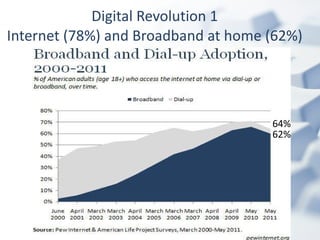
Digital Revolution 1 Internet (78%) and Broadband at home (62%) 64%  62%
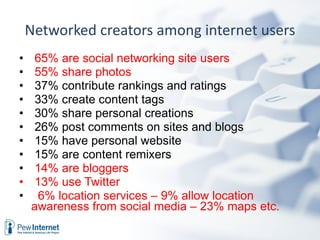
Networked creators among internet users 65% are social networking site users 55% share photos 37% contribute rankings and ratings 33% create content tags  30% share personal creations  26% post comments on sites and blogs 15% have personal website 15% are content remixers  14% are bloggers 13% use Twitter 6% location services – 9% allow location awareness from social media – 23% maps etc.
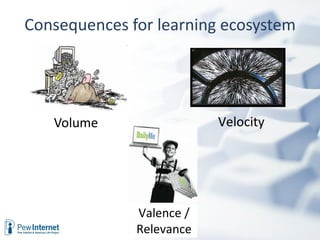
Consequences for learning ecosystem Volume Velocity Valence / Relevance
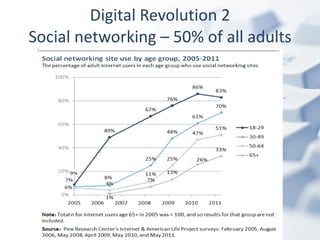
Digital Revolution 2 Social networking – 50% of all adults
Social networks and social media become more important in people’s learning strategies Consequences for learning ecosystem
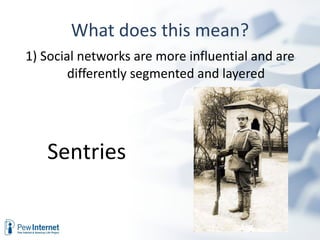
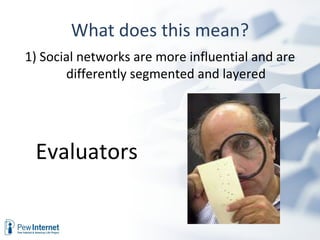
What does this mean? 1) Social networks are more influential and are differently segmented and layered Sentries
What does this mean? Evaluators 1) Social networks are more influential and are differently segmented and layered
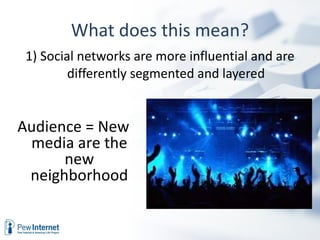
What does this mean? 1) Social networks are more influential and are differently segmented and layered Audience = New media are the new neighborhood
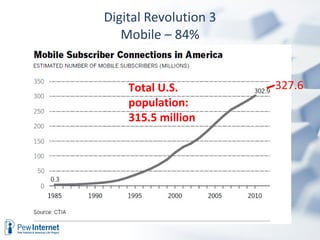
Digital Revolution 3 Mobile – 84% 327.6 Total U.S. population: 315.5 million
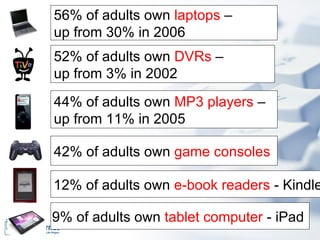
56% of adults own  laptops  –  up from 30% in 2006 44% of adults own  MP3 players  –  up from 11% in 2005 52% of adults own  DVRs  –  up from 3% in 2002 42% of adults own  game consoles 12% of adults own  e-book readers  - Kindle 9% of adults own  tablet computer  - iPad
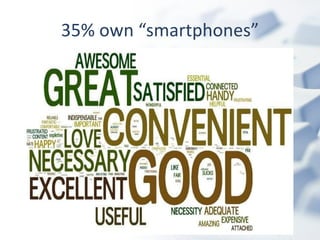
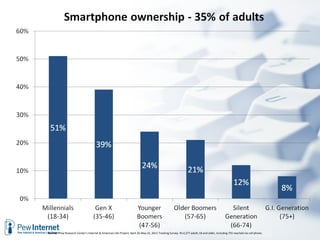
35% own “smartphones”
Source:  Pew Research Center's Internet & American Life Project, April 26-May 22, 2011 Tracking Survey. N=2,277 adults 18 and older, including 755 reached via cell phone.
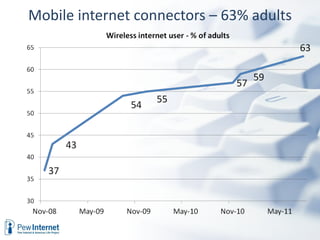
Mobile internet connectors – 63% adults
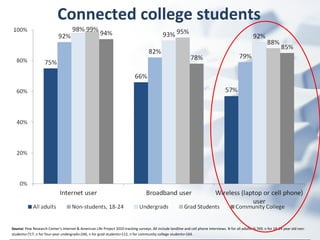
Connected college students Source:  Pew Research Center's Internet & American Life Project 2010 tracking surveys. All include landline and cell phone interviews. N for all adults=9,769; n for 18-24 year old non-students=717; n for four-year undergrads=246, n for grad students=112, n for community college students=164.
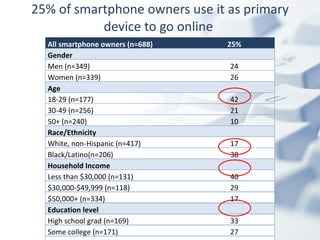
25% of smartphone owners use it as primary device to go online  All smartphone owners (n=688) 25% Gender Men (n=349) 24 Women (n=339) 26 Age 18-29 (n=177) 42 30-49 (n=256) 21 50+ (n=240) 10 Race/Ethnicity White, non-Hispanic (n=417) 17 Black/Latino(n=206) 38 Household Income Less than $30,000 (n=131) 40 $30,000-$49,999 (n=118) 29 $50,000+ (n=334) 17 Education level High school grad (n=169) 33 Some college (n=171) 27 College grad (n=308) 13
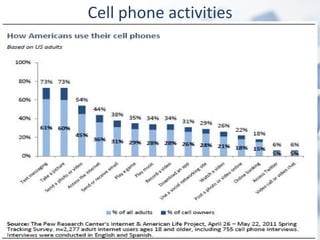
Cell phone activities
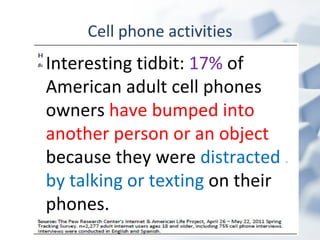
Interesting tidbit:  17%  of American adult cell phones owners  have bumped into another person or an object  because they were  distracted by talking or texting  on their phones. Cell phone activities
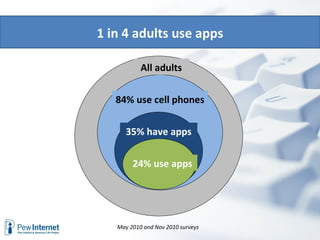
84% use cell phones 35% have apps 24% use apps All adults May 2010 and Nov 2010 surveys  1 in 4 adults use apps
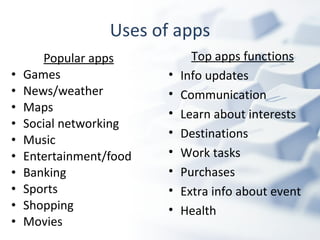
Uses of apps Popular apps Games News/weather Maps Social networking Music Entertainment/food Banking Sports Shopping Movies Top apps functions Info updates Communication Learn about interests Destinations Work tasks Purchases Extra info about event  Health
 
 
Back to the four things that I think I know
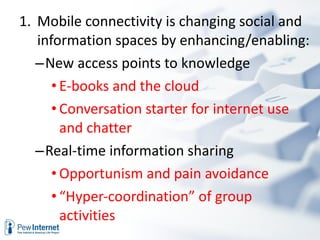
Mobile connectivity is changing social and information spaces by enhancing/enabling: New access points to knowledge  E-books and the cloud Conversation starter for internet use and chatter Real-time information sharing Opportunism and pain avoidance “ Hyper-coordination” of group activities
Mobile connectivity is changing social and information spaces by enhancing/enabling:  Just-in-time searches New “smarts” New cognition  Perpetual, pervasive awareness/access to social networks Deeper connection and consultation Incentive “to network” via social media Augmented reality Merger of real world and data New kinds of learning amplification
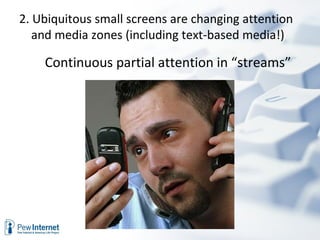
Continuous partial attention in “streams” 2. Ubiquitous small screens are changing attention and media zones (including text-based media!)
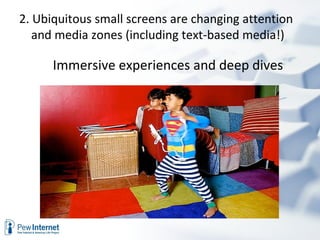
Immersive experiences and deep dives 2. Ubiquitous small screens are changing attention and media zones (including text-based media!)
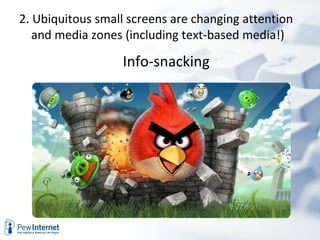
Info-snacking  2. Ubiquitous small screens are changing attention and media zones (including text-based media!)
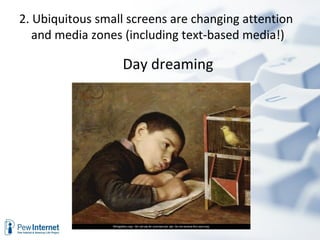
Day dreaming 2. Ubiquitous small screens are changing attention and media zones (including text-based media!)
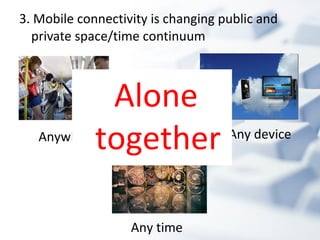
3. Mobile connectivity is changing public and private space/time continuum  Anywhere  Any device Any time  Alone together
4. New kinds of learners are emerging in the digital environment More self directed, less top-down  Better arrayed to capture new information inputs More reliant on feedback and response More inclined to collaboration  More open to cross discipline insights and creating their own “tagged” taxonomies More oriented towards people being their own individual nodes of production
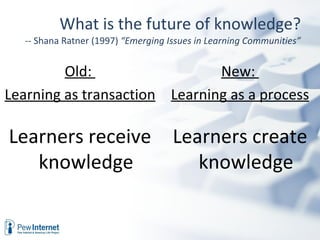
What is the future of knowledge? -- Shana Ratner (1997)  “Emerging Issues in Learning Communities” New:  Learning as a process Knowledge is objective and certain Old:  Learning as transaction Knowledge is subjective and provisional
What is the future of knowledge? -- Shana Ratner (1997)  “Emerging Issues in Learning Communities” New:  Learning as a process Learners receive knowledge Old:  Learning as transaction Learners create knowledge
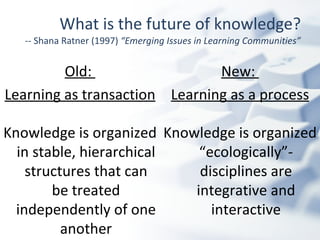
What is the future of knowledge? -- Shana Ratner (1997)  “Emerging Issues in Learning Communities” New:  Learning as a process Knowledge is organized in stable, hierarchical structures that can be treated independently of one another Old:  Learning as transaction Knowledge is organized “ecologically”-disciplines are integrative and interactive
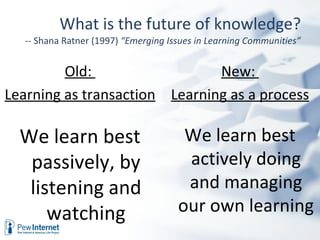
What is the future of knowledge? -- Shana Ratner (1997)  “Emerging Issues in Learning Communities” New:  Learning as a process We learn best passively, by listening and watching Old:  Learning as transaction We learn best actively doing and managing our own learning
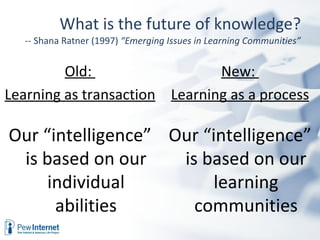
What is the future of knowledge? -- Shana Ratner (1997)  “Emerging Issues in Learning Communities” New:  Learning as a process Our “intelligence” is based on our individual abilities Old:  Learning as transaction Our “intelligence” is based on our learning communities
Be not afraid

As learning goes mobile - Educause

  • 1.
    As learning goesmobile Lee Rainie, Director, Pew Internet Project 10.20.11 Educause - Philadelphia Email: [email_address] Twitter: @Lrainie
  • 2.
    Anti-executive summary Whichtextbook company stocks to buy or dump? (Who’ll do the ebooks thing best?) Are students’ attention spans shorter now? Are students’ brains being rewired? Are students more narcissistic and more indifferent to privacy? What’s the matter with kids today? (Or… Questions I cannot answer)
  • 3.
    What I thinkI know about the rise of mobile learning Mobile connectivity is changing social and information spaces by enhancing/enabling … New access points to knowledge Real-time information sharing Just-in-time searches Perpetual, pervasive awareness of social networks Augmented reality Ubiquitous small screens are changing attention and media zones (including text-based media!) Mobile connectivity is changing public and private space/time continuum New kinds of learners are emerging in dig. environ.
  • 4.
    Digital Revolution 1Internet (78%) and Broadband at home (62%) 64% 62%
  • 5.
    Networked creators amonginternet users 65% are social networking site users 55% share photos 37% contribute rankings and ratings 33% create content tags 30% share personal creations 26% post comments on sites and blogs 15% have personal website 15% are content remixers 14% are bloggers 13% use Twitter 6% location services – 9% allow location awareness from social media – 23% maps etc.
  • 6.
    Consequences for learningecosystem Volume Velocity Valence / Relevance
  • 7.
    Digital Revolution 2Social networking – 50% of all adults
  • 8.
    Social networks andsocial media become more important in people’s learning strategies Consequences for learning ecosystem
  • 9.
    What does thismean? 1) Social networks are more influential and are differently segmented and layered Sentries
  • 10.
    What does thismean? Evaluators 1) Social networks are more influential and are differently segmented and layered
  • 11.
    What does thismean? 1) Social networks are more influential and are differently segmented and layered Audience = New media are the new neighborhood
  • 12.
    Digital Revolution 3Mobile – 84% 327.6 Total U.S. population: 315.5 million
  • 13.
    56% of adultsown laptops – up from 30% in 2006 44% of adults own MP3 players – up from 11% in 2005 52% of adults own DVRs – up from 3% in 2002 42% of adults own game consoles 12% of adults own e-book readers - Kindle 9% of adults own tablet computer - iPad
  • 14.
  • 15.
    Source: PewResearch Center's Internet & American Life Project, April 26-May 22, 2011 Tracking Survey. N=2,277 adults 18 and older, including 755 reached via cell phone.
  • 16.
  • 17.
    Connected college studentsSource: Pew Research Center's Internet & American Life Project 2010 tracking surveys. All include landline and cell phone interviews. N for all adults=9,769; n for 18-24 year old non-students=717; n for four-year undergrads=246, n for grad students=112, n for community college students=164.
  • 18.
    25% of smartphoneowners use it as primary device to go online All smartphone owners (n=688) 25% Gender Men (n=349) 24 Women (n=339) 26 Age 18-29 (n=177) 42 30-49 (n=256) 21 50+ (n=240) 10 Race/Ethnicity White, non-Hispanic (n=417) 17 Black/Latino(n=206) 38 Household Income Less than $30,000 (n=131) 40 $30,000-$49,999 (n=118) 29 $50,000+ (n=334) 17 Education level High school grad (n=169) 33 Some college (n=171) 27 College grad (n=308) 13
  • 19.
  • 20.
    Interesting tidbit: 17% of American adult cell phones owners have bumped into another person or an object because they were distracted by talking or texting on their phones. Cell phone activities
  • 21.
    84% use cellphones 35% have apps 24% use apps All adults May 2010 and Nov 2010 surveys 1 in 4 adults use apps
  • 22.
    Uses of appsPopular apps Games News/weather Maps Social networking Music Entertainment/food Banking Sports Shopping Movies Top apps functions Info updates Communication Learn about interests Destinations Work tasks Purchases Extra info about event Health
  • 23.
  • 24.
  • 25.
    Back to thefour things that I think I know
  • 26.
    Mobile connectivity ischanging social and information spaces by enhancing/enabling: New access points to knowledge E-books and the cloud Conversation starter for internet use and chatter Real-time information sharing Opportunism and pain avoidance “ Hyper-coordination” of group activities
  • 27.
    Mobile connectivity ischanging social and information spaces by enhancing/enabling: Just-in-time searches New “smarts” New cognition Perpetual, pervasive awareness/access to social networks Deeper connection and consultation Incentive “to network” via social media Augmented reality Merger of real world and data New kinds of learning amplification
  • 28.
    Continuous partial attentionin “streams” 2. Ubiquitous small screens are changing attention and media zones (including text-based media!)
  • 29.
    Immersive experiences anddeep dives 2. Ubiquitous small screens are changing attention and media zones (including text-based media!)
  • 30.
    Info-snacking 2.Ubiquitous small screens are changing attention and media zones (including text-based media!)
  • 31.
    Day dreaming 2.Ubiquitous small screens are changing attention and media zones (including text-based media!)
  • 32.
    3. Mobile connectivityis changing public and private space/time continuum Anywhere Any device Any time Alone together
  • 33.
    4. New kindsof learners are emerging in the digital environment More self directed, less top-down Better arrayed to capture new information inputs More reliant on feedback and response More inclined to collaboration More open to cross discipline insights and creating their own “tagged” taxonomies More oriented towards people being their own individual nodes of production
  • 34.
    What is thefuture of knowledge? -- Shana Ratner (1997) “Emerging Issues in Learning Communities” New: Learning as a process Knowledge is objective and certain Old: Learning as transaction Knowledge is subjective and provisional
  • 35.
    What is thefuture of knowledge? -- Shana Ratner (1997) “Emerging Issues in Learning Communities” New: Learning as a process Learners receive knowledge Old: Learning as transaction Learners create knowledge
  • 36.
    What is thefuture of knowledge? -- Shana Ratner (1997) “Emerging Issues in Learning Communities” New: Learning as a process Knowledge is organized in stable, hierarchical structures that can be treated independently of one another Old: Learning as transaction Knowledge is organized “ecologically”-disciplines are integrative and interactive
  • 37.
    What is thefuture of knowledge? -- Shana Ratner (1997) “Emerging Issues in Learning Communities” New: Learning as a process We learn best passively, by listening and watching Old: Learning as transaction We learn best actively doing and managing our own learning
  • 38.
    What is thefuture of knowledge? -- Shana Ratner (1997) “Emerging Issues in Learning Communities” New: Learning as a process Our “intelligence” is based on our individual abilities Old: Learning as transaction Our “intelligence” is based on our learning communities
  • 39.

Editor's Notes

  • #2 Title: As Learning Goes Mobile Subject: Lee Rainie, Director of the Pew Research Center’s Internet & American Life Project, will discuss the Project’s latest findings about how people (especially young adults) use mobile devices, including smartphones and tablet computers (iPads). He will explore how the mobile revolution has combined with the social networking revolution to produce new kinds of learning and knowledge-sharing environments and the challenges and opportunities this presents to colleges and teachers. Technology has enabled students to become different kinds of learners and Lee will explore what that means.