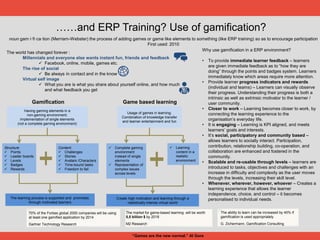
……and ERP Training? Use of gamification?
noun gam·i·fi·ca·tion (Merriam-Webster) the process of adding games or game like elements to something (like ERP training) so as to encourage participation
First used: 2010
Why use gamification in a ERP environment?
• To provide immediate learner feedback – learners
are given immediate feedback as to “how they are
doing” through the points and badges system. Learners
immediately know which areas require more attention.
• Provide learner progress indicators and rewards
(individual and teams) – Learners can visually observe
their progress. Understanding their progress is both a
intrinsic as well as extrinsic motivator to the learner /
user community.
• Closer to work – Learning becomes closer to work, by
connecting the learning experience to the
organisation’s everyday life.
• It is engaging – Learning is KPI aligned, and meets
learners’ goals and interests.
• It’s social, participatory and community based –
allows learners to socially interact. Participation,
contribution, relationship building, co-operation, and
collaboration are enhanced and fostered in the
community.
• Scalable and re-usable through levels – learners are
introduced to tasks, objectives and challenges with an
increase in difficulty and complexity as the user moves
through the levels, increasing their skill level.
• Whenever, wherever, however, whoever – Creates a
learning experience that allows the learner
independence, choice, and control – it becomes
personalised to individual needs.
70% of the Forbes global 2000 companies will be using
at least one gamified application by 2014
Gartner Technology Research
The ability to learn can be increased by 40% if
gamification is used appropriately
G. Zichermann, Gamification Consulting
The market for game-based learning will be worth
5,5 billion $ by 2018
M2 Research
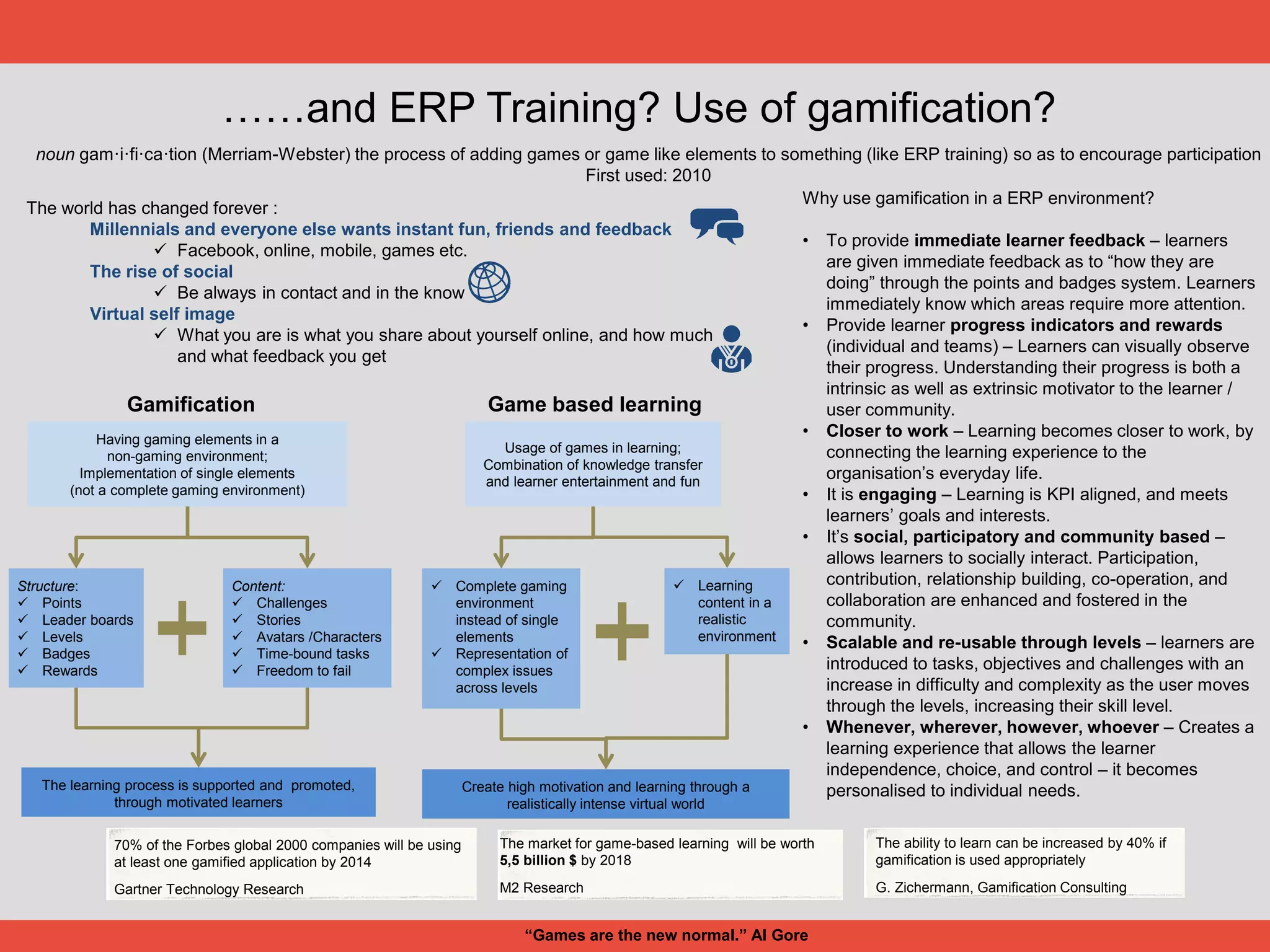
Having gaming elements in a
non-gaming environment;
Implementation of single elements
(not a complete gaming environment)
Structure:
 Points
 Leader boards
 Levels
 Badges
 Rewards
Content:
 Challenges
 Stories
 Avatars /Characters
 Time-bound tasks
 Freedom to fail
The learning process is supported and promoted,
through motivated learners
The world has changed forever :
Millennials and everyone else wants instant fun, friends and feedback
 Facebook, online, mobile, games etc.
The rise of social
 Be always in contact and in the know
Virtual self image
 What you are is what you share about yourself online, and how much
and what feedback you get
Usage of games in learning;
Combination of knowledge transfer
and learner entertainment and fun
 Complete gaming
environment
instead of single
elements
 Representation of
complex issues
across levels
 Learning
content in a
realistic
environment
Create high motivation and learning through a
realistically intense virtual world
Gamification Game based learning
“Games are the new normal.” Al Gore
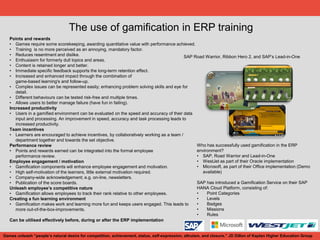
The use of gamification in ERP training
SAP Road Warrior, Ribbon Hero 2, and SAP’s Lead-in-One
Points and rewards
• Games require some scorekeeping, awarding quantitative value with performance achieved.
• Training is no more perceived as an annoying, mandatory factor.
• Reduces resentment and dislike.
• Enthusiasm for formerly dull topics and areas.
• Content is retained longer and better.
• Immediate specific feedback supports the long-term retention effect.
• Increased and enhanced impact through the combination of
game-based learning's and follow-up.
• Complex issues can be represented easily; enhancing problem solving skills and eye for
detail.
• Different behaviours can be tested risk-free and multiple times.
• Allows users to better manage failure (have fun in failing).
Increased productivity
• Users in a gamified environment can be evaluated on the speed and accuracy of their data
input and processing. An improvement in speed, accuracy and task processing leads to
increased productivity.
Team incentives
• Learners are encouraged to achieve incentives, by collaboratively working as a team /
department together and towards the set objective.
Performance review
• Points and rewards earned can be integrated into the formal employee
performance review.
Employee engagement / motivation
• Gamification components will enhance employee engagement and motivation.
• High self-motivation of the learners, little external motivation required.
• Company-wide acknowledgement; e.g. on-line, newsletters.
• Publication of the score boards.
Unleash employee’s competitive nature
• Gamification allows employees to track their rank relative to other employees.
Creating a fun learning environment
• Gamification makes work and learning more fun and keeps users engaged. This leads to
more out-of-the-box-improvements.
Can be utilised effectively before, during or after the ERP implementation
Who has successfully used gamification in the ERP
environment?
• SAP, Road Warrior and Lead-in-One
• WestJet as part of their Oracle implementation
• Microsoft, as part of their Office implementation (Demo
available)
SAP has introduced a Gamification Service on their SAP
HANA Cloud Platform, consisting of:
• Point Categories
• Levels
• Badges
• Missions
• Rules
Games unleash “people’s natural desire for competition, achievement, status, self-expression, altruism, and closure.” JD Dillon of Kaplan Higher Education Group

Gamification in ERP training

  • 1.
    ……and ERP Training?Use of gamification? noun gam·i·fi·ca·tion (Merriam-Webster) the process of adding games or game like elements to something (like ERP training) so as to encourage participation First used: 2010 Why use gamification in a ERP environment? • To provide immediate learner feedback – learners are given immediate feedback as to “how they are doing” through the points and badges system. Learners immediately know which areas require more attention. • Provide learner progress indicators and rewards (individual and teams) – Learners can visually observe their progress. Understanding their progress is both a intrinsic as well as extrinsic motivator to the learner / user community. • Closer to work – Learning becomes closer to work, by connecting the learning experience to the organisation’s everyday life. • It is engaging – Learning is KPI aligned, and meets learners’ goals and interests. • It’s social, participatory and community based – allows learners to socially interact. Participation, contribution, relationship building, co-operation, and collaboration are enhanced and fostered in the community. • Scalable and re-usable through levels – learners are introduced to tasks, objectives and challenges with an increase in difficulty and complexity as the user moves through the levels, increasing their skill level. • Whenever, wherever, however, whoever – Creates a learning experience that allows the learner independence, choice, and control – it becomes personalised to individual needs. 70% of the Forbes global 2000 companies will be using at least one gamified application by 2014 Gartner Technology Research The ability to learn can be increased by 40% if gamification is used appropriately G. Zichermann, Gamification Consulting The market for game-based learning will be worth 5,5 billion $ by 2018 M2 Research Having gaming elements in a non-gaming environment; Implementation of single elements (not a complete gaming environment) Structure:  Points  Leader boards  Levels  Badges  Rewards Content:  Challenges  Stories  Avatars /Characters  Time-bound tasks  Freedom to fail The learning process is supported and promoted, through motivated learners The world has changed forever : Millennials and everyone else wants instant fun, friends and feedback  Facebook, online, mobile, games etc. The rise of social  Be always in contact and in the know Virtual self image  What you are is what you share about yourself online, and how much and what feedback you get Usage of games in learning; Combination of knowledge transfer and learner entertainment and fun  Complete gaming environment instead of single elements  Representation of complex issues across levels  Learning content in a realistic environment Create high motivation and learning through a realistically intense virtual world Gamification Game based learning “Games are the new normal.” Al Gore
  • 2.
    The use ofgamification in ERP training SAP Road Warrior, Ribbon Hero 2, and SAP’s Lead-in-One Points and rewards • Games require some scorekeeping, awarding quantitative value with performance achieved. • Training is no more perceived as an annoying, mandatory factor. • Reduces resentment and dislike. • Enthusiasm for formerly dull topics and areas. • Content is retained longer and better. • Immediate specific feedback supports the long-term retention effect. • Increased and enhanced impact through the combination of game-based learning's and follow-up. • Complex issues can be represented easily; enhancing problem solving skills and eye for detail. • Different behaviours can be tested risk-free and multiple times. • Allows users to better manage failure (have fun in failing). Increased productivity • Users in a gamified environment can be evaluated on the speed and accuracy of their data input and processing. An improvement in speed, accuracy and task processing leads to increased productivity. Team incentives • Learners are encouraged to achieve incentives, by collaboratively working as a team / department together and towards the set objective. Performance review • Points and rewards earned can be integrated into the formal employee performance review. Employee engagement / motivation • Gamification components will enhance employee engagement and motivation. • High self-motivation of the learners, little external motivation required. • Company-wide acknowledgement; e.g. on-line, newsletters. • Publication of the score boards. Unleash employee’s competitive nature • Gamification allows employees to track their rank relative to other employees. Creating a fun learning environment • Gamification makes work and learning more fun and keeps users engaged. This leads to more out-of-the-box-improvements. Can be utilised effectively before, during or after the ERP implementation Who has successfully used gamification in the ERP environment? • SAP, Road Warrior and Lead-in-One • WestJet as part of their Oracle implementation • Microsoft, as part of their Office implementation (Demo available) SAP has introduced a Gamification Service on their SAP HANA Cloud Platform, consisting of: • Point Categories • Levels • Badges • Missions • Rules Games unleash “people’s natural desire for competition, achievement, status, self-expression, altruism, and closure.” JD Dillon of Kaplan Higher Education Group