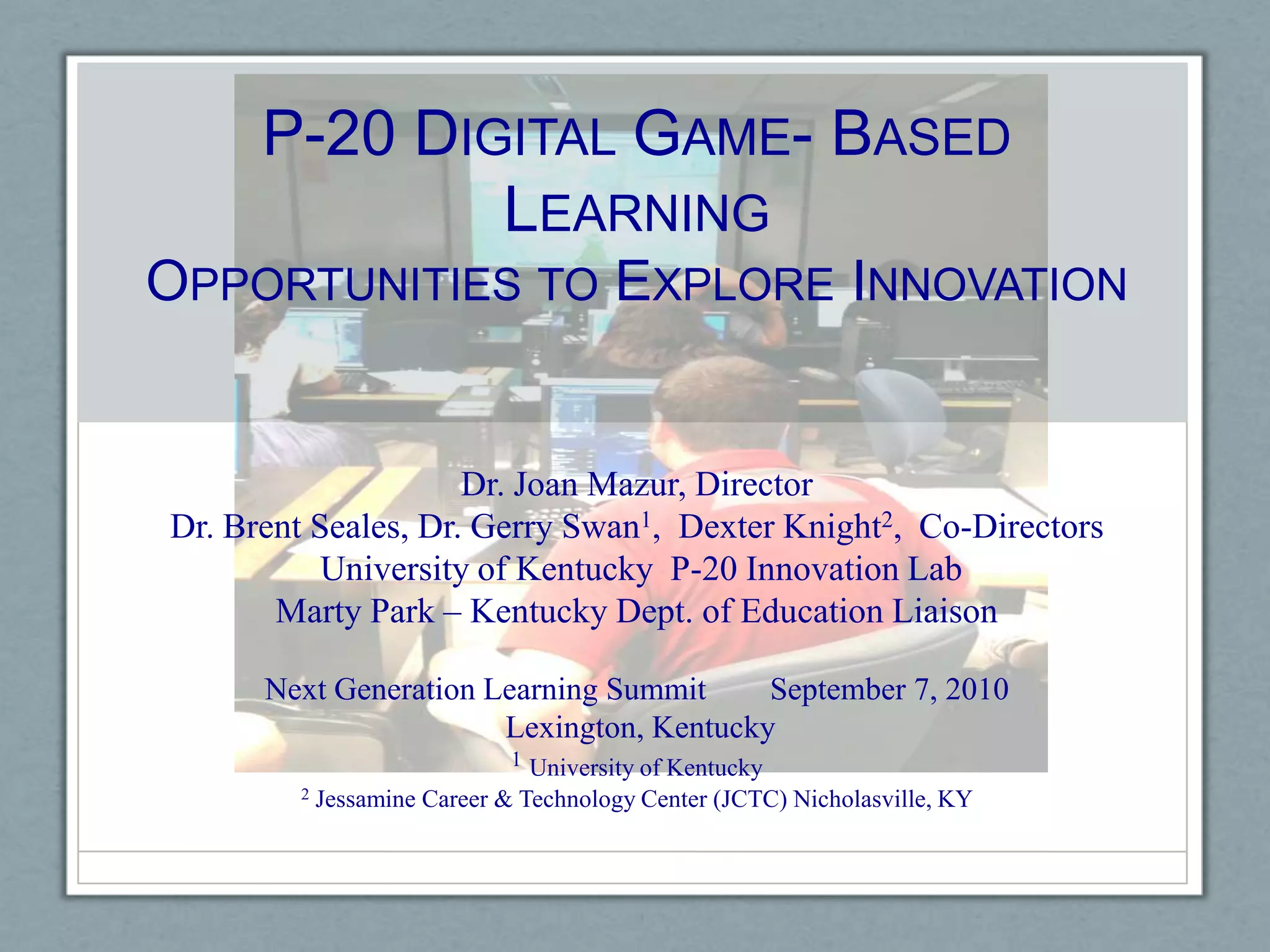
P-20 Digital Game- Based LearningOpportunities to Explore InnovationDr. Joan Mazur, DirectorDr. Brent Seales, Dr. Gerry Swan1,  Dexter Knight2,  Co-Directors  University of Kentucky  P-20 Innovation LabMarty Park – Kentucky Dept. of Education LiaisonNext Generation Learning Summit        September 7, 2010  Lexington, Kentucky1University of Kentucky2 Jessamine Career & Technology Center (JCTC) Nicholasville, KY
Why Learning with Games? Perhaps since the beginning of time, kids have been playing and learning.  Starting with some very basic social games, like Ring Around the Rosey most children naturally gravitate toward play and playfulness.  To Play, as to Learn, is Human!
Why Learning with Games? But games have changed over the years. Kids just a few years ago were still playing games like Candyland, Monopoloy, and Shutes and Ladders on actual game boards.  But today, kids are Digital Natives. They have grown up with technology and it is integral to their lives. Students, aged 8-18 devote an nearly 8 hours each day to usingentertainment media across a typical day (more than 53 hours a week).  
Why Learning with Games?  And because they spend so much of that time ‘media multitasking’ (using more than one medium at a time), they actually manage to pack a total of 10 hours and 45 minutes (10:45) worth of media content into those 7½ hours.While this information may be startling, even disturbing to some, many games involve teamwork, problem solving and creative thinking!
Why Learning with Games?  Kids learn with games NOT because they are fun and entertaining. Kids learn with games because they are interactive, engaging, build in feedback and assessment, contain proven instructional strategies and importantly build 21st Century Skills.  21st Century skills include teamwork, self-direction, problem solving, creativity, decision-making and critical thinking.
Why Learning with Games? It is very important that teachers, parents and students work together to learn to use and choose digital games that can help them learn content and succeed at the game of life!
Principle One of Game-based Learning: Play Theory, Cycles of Learning & EngagementPlay is naturally employed, effective learning paradigm (Biological imperative)Play requires interaction and participation Constant cycle of action/reaction Leads to engagement in gameSame principle as good learning
Principle Two of Game-based Learning: Problem-based LearningPS is highest level of learning (Gagne, 2005) Vehicle for all intellectual skills AND promotes transfer (Delisle, 1997) Two critical attributes of any problem (Jonassen, 2002. The unknown (goal requires generation of new knowledge) A value to learner in solving the problem
Principle Two of Game-based Learning: Problem-based Learning Requires short- and long-term goal setting Positive correlation with learning Improves self-efficacy, which is also correlated with learning (Bandura, 1997)Games are problem solving Have unknown & value; require short & long-term goals
Principle Three of Game-based Learning: Situated Cognition & LearningBrown, Collins, & Duguid, 1989Congruence of learning & performance contextsRelevance and “anchoring” of knowledge in authentic contextsImproves learning (Anderson, 1995; Bower, 1981 & 1987); Clark,
Principle Three of Game-based Learning: Situated Cognition & LearningAll learning in games is situatedGoal (unknown) drives everythingEverything learned is relevant and applied
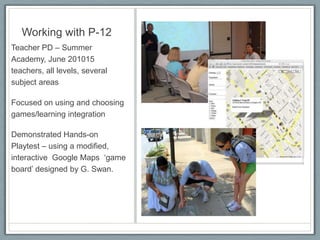
Working with P-12Teacher PD – Summer Academy, June 201015 teachers, all levels, several subject areasFocused on using and choosing games/learning integration Demonstrated Hands-on Playtest – using a modified, interactive  Google Maps  ‘game board’ designed by G. Swan.
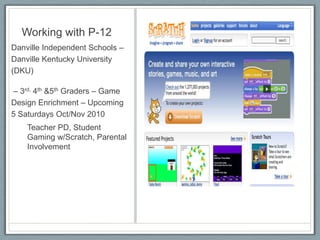
Working with P-12Danville Independent Schools – Danville Kentucky University (DKU) – 3rd, 4th &5th Graders – Game Design Enrichment – Upcoming 5 Saturdays Oct/Nov 2010Teacher PD, Student Gaming w/Scratch, Parental Involvement
Working with Post-SecondaryNew Graduate Course – EDC 543 Digital Game-based Learning (online) Spring 2010 – UK College of Education – MazurP-20 Innovation Lab Website Materials – under developmentMember, DGBL Interdisciplinary Group – University of KentuckyPartnership with Learning Games Network/BostonMIT Educational Arcade Spin-off group
How Can We Work With You?Tell us your thoughts/suggestions/concerns…THANKS!

Digital game based lab

  • 1.
    P-20 Digital Game-Based LearningOpportunities to Explore InnovationDr. Joan Mazur, DirectorDr. Brent Seales, Dr. Gerry Swan1, Dexter Knight2, Co-Directors University of Kentucky P-20 Innovation LabMarty Park – Kentucky Dept. of Education LiaisonNext Generation Learning Summit  September 7, 2010 Lexington, Kentucky1University of Kentucky2 Jessamine Career & Technology Center (JCTC) Nicholasville, KY
  • 2.
    Why Learning withGames? Perhaps since the beginning of time, kids have been playing and learning. Starting with some very basic social games, like Ring Around the Rosey most children naturally gravitate toward play and playfulness. To Play, as to Learn, is Human!
  • 3.
    Why Learning withGames? But games have changed over the years. Kids just a few years ago were still playing games like Candyland, Monopoloy, and Shutes and Ladders on actual game boards. But today, kids are Digital Natives. They have grown up with technology and it is integral to their lives. Students, aged 8-18 devote an nearly 8 hours each day to usingentertainment media across a typical day (more than 53 hours a week).  
  • 4.
    Why Learning withGames?  And because they spend so much of that time ‘media multitasking’ (using more than one medium at a time), they actually manage to pack a total of 10 hours and 45 minutes (10:45) worth of media content into those 7½ hours.While this information may be startling, even disturbing to some, many games involve teamwork, problem solving and creative thinking!
  • 5.
    Why Learning withGames?  Kids learn with games NOT because they are fun and entertaining. Kids learn with games because they are interactive, engaging, build in feedback and assessment, contain proven instructional strategies and importantly build 21st Century Skills. 21st Century skills include teamwork, self-direction, problem solving, creativity, decision-making and critical thinking.
  • 6.
    Why Learning withGames? It is very important that teachers, parents and students work together to learn to use and choose digital games that can help them learn content and succeed at the game of life!
  • 7.
    Principle One ofGame-based Learning: Play Theory, Cycles of Learning & EngagementPlay is naturally employed, effective learning paradigm (Biological imperative)Play requires interaction and participation Constant cycle of action/reaction Leads to engagement in gameSame principle as good learning
  • 8.
    Principle Two ofGame-based Learning: Problem-based LearningPS is highest level of learning (Gagne, 2005) Vehicle for all intellectual skills AND promotes transfer (Delisle, 1997) Two critical attributes of any problem (Jonassen, 2002. The unknown (goal requires generation of new knowledge) A value to learner in solving the problem
  • 9.
    Principle Two ofGame-based Learning: Problem-based Learning Requires short- and long-term goal setting Positive correlation with learning Improves self-efficacy, which is also correlated with learning (Bandura, 1997)Games are problem solving Have unknown & value; require short & long-term goals
  • 10.
    Principle Three ofGame-based Learning: Situated Cognition & LearningBrown, Collins, & Duguid, 1989Congruence of learning & performance contextsRelevance and “anchoring” of knowledge in authentic contextsImproves learning (Anderson, 1995; Bower, 1981 & 1987); Clark,
  • 11.
    Principle Three ofGame-based Learning: Situated Cognition & LearningAll learning in games is situatedGoal (unknown) drives everythingEverything learned is relevant and applied
  • 12.
    Working with P-12TeacherPD – Summer Academy, June 201015 teachers, all levels, several subject areasFocused on using and choosing games/learning integration Demonstrated Hands-on Playtest – using a modified, interactive Google Maps ‘game board’ designed by G. Swan.
  • 13.
    Working with P-12DanvilleIndependent Schools – Danville Kentucky University (DKU) – 3rd, 4th &5th Graders – Game Design Enrichment – Upcoming 5 Saturdays Oct/Nov 2010Teacher PD, Student Gaming w/Scratch, Parental Involvement
  • 14.
    Working with Post-SecondaryNewGraduate Course – EDC 543 Digital Game-based Learning (online) Spring 2010 – UK College of Education – MazurP-20 Innovation Lab Website Materials – under developmentMember, DGBL Interdisciplinary Group – University of KentuckyPartnership with Learning Games Network/BostonMIT Educational Arcade Spin-off group
  • 15.
    How Can WeWork With You?Tell us your thoughts/suggestions/concerns…THANKS!